© 2019 IEEE. Personal use of this material is permitted. Permission from IEEE must be obtained for all other uses,
in any current or future media, including reprinting/republishing this material for advertising or promotional
purposes, creating new collective works, for resale or redistribution to servers or lists, or reuse of any copyrighted
component of this work in other works.
IEEE Communications Surveys & Tutorials 1
QoE Management of Multimedia Streaming
Services in Future Networks: A Tutorial and Survey
Alcardo Alex Barakabitze, Nabajeet Barman, Arslan Ahmad, Saman Zadtootaghaj, Lingfen Sun,
Maria G. Martini, Luigi Atzori
Abstract—The highly demanding Over-The-Top (OTT) multi-media applications pose increased challenges to Internet Service Providers (ISPs) for assuring a reasonable Quality of Experience (QoE) to their customers due to lack of flexibility, agility and scal-ability in traditional networks. The future networks are shifting towards the cloudification of the network resources via Software Defined Networks (SDN) and Network Function Virtualization (NFV). This will equip ISPs with cutting-edge technologies to pro-vide service customization during service delivery and offer QoE which meets customers’ needs via intelligent QoE control and management approaches. Towards this end, we provide in this paper a tutorial and a comprehensive survey of QoE management solutions in current and future networks. We start with a high-level description of QoE management for multimedia services, which integrates QoE modelling, monitoring, and optimization. This followed by a discussion of HTTP Adaptive Streaming (HAS) solutions as the dominant technique for streaming videos over the best-effort Internet. We then summarize the key elements in SDN/NFV along with an overview of ongoing research projects, standardization activities and use cases related to SDN, NFV, and other emerging applications. We provide a survey of the state-of-the-art of QoE management techniques categorized into three different groups: a) QoE-aware/driven strategies using SDN and/or NFV; b) QoE-aware/driven approaches for adaptive streaming over emerging architectures such as multi-access edge computing, cloud/fog computing, and information-centric networking; and c) extended QoE management approaches in new domains such as immersive augmented and virtual real-ity, mulsemedia and video gaming applications. Based on the review, we present a list of identified future QoE management challenges regarding emerging multimedia applications, network management and orchestration, network slicing and collaborative service management in softwarized networks. Finally, we provide a discussion on future research directions with a focus on emerging research areas in QoE management, such as QoE-oriented business models, QoE-based big data strategies, and scalability issues in QoE optimization.
Index Terms—QoE, Network Management, OTT, ISP, 5G,
SDN, NFV, OTT and ISP collaboration.
I. INTRODUCTION
Multimedia services consumption has increased tremen-dously over the past years and is expected to continue to grow even more over the next years. According to the latest Cisco
Alcardo Alex Barakabitze and Lingfen Sun are with Plymouth University, U.K., Email: {alcardoalex.barakabitze, l.sun}@plymouth.ac.uk
Nabajeet Barman and Maria Martini are with Kingston University, U.K. Email: {n.barman, m.martini}@kingston.ac.uk
Arslan Ahmad is with IS-Wireless, 05-500, Piaseczno, Poland. Email: [email protected]
Saman Zadtootaghaj is with Technische Universität Berlin, Germany. Email: [email protected]
Luigi Atzori is with University of Cagliari, Italy. Email: [email protected] Manuscript received xxxx 19, 2018; revised xxx 2019
Visual Networking Index (VNI) Forecast [1], 82% of all IP traffic will be video by 2022. Mobile-connected devices (e.g., Device to Device (D2D) and Machine to Machine (M2M) communications) are estimated to be 14.6 billion by 2022 and therefore exceeding the world’s projected population of 8 billion by 2022. This exponential growth, due to the increasing popularity and use of video streaming services (e.g., YouTube and Netflix), has triggered and introduced new revenue po-tential for Internet Service Providers (ISPs), mobile operators and Over-The-Top providers (OTTP). Delivering high video quality to the end users is very important for the continued success of such services [2], [3]. Today, the end-users are accustomed to more resource demanding services with better quality from ISPs [4], [5]. However, achieving good Quality of Experience (QoE) is a challenging task because of many fac-tors such as different client devices/request patterns, changing media contents, varying transmission/network conditions, and significant spatial and temporal variation in the performance of Content Distribution Networks (CDNs). Great efforts from both academia and industry have been made to optimize the video content delivery chain and enhance end users’ QoE. The most common mechanisms used for improving end-users’ QoE are either based on network optimization (e.g. QoE-driven network resource allocation and QoE-driven routing) or client-driven adaptive video streaming [6]–[9].
Despite these efforts, QoE management remains a challeng-ing task due to many issues [8], [10] which can be categorized into four different aspects, as illustrated in Fig. 1. The first aspect is the variability of network resources, unstable nature of wireless channels and the characteristics of fixed/mobile networks in heterogeneous environments [11]. Congested areas such as trains, stadiums and shopping malls require continuous adaptation of network resource allocation to various clients. The second aspect is the emergence of new services (e.g., video gaming and virtual/augmented reality (VR/AR)), the diversity of context of use, the users’ expectations combined with the operational cost optimization by mobile and service providers. The third aspect is the consideration of a variety of networks (e.g., fixed and mobile), where different measure-ment and assessmeasure-ment methods are required to be employed for QoE management considering resource constraints. The final aspect is associated with the popularity and fast growth of the multimedia services over the Internet, and the heterogeneity of end-user devices with different capabilities (e.g., screen size, computational power/resources, and storage capabilities). This poses even more challenges when allocating resources among users with different QoE preferences. Fig. 1 summarizes
Heterogenous Environments
Multiple Terminals Multiple Applications
End Users with Different Preferences Network Domains 5G LTE/4G WiMax Internet WLAN Network Domains 5G LTE/4G WiMax Internet WLAN Multiple Networks Heterogenous Environments Multiple Terminals Multiple Applications
End Users with
Network Domains 5G LTE/4G WiMax Internet WLAN Multiple Networks
Fig. 1: QoE management challenges in future networks.
the QoE management challenges in IP-based networks. The increased user demand and expectations of services with excel-lent quality have triggered telecom operators to upgrade their systems and invest in new cutting-edge network softwarization paradigms such as Software Defined Networking (SDN) [12], Network Function Virtualization (NFV) [13], Multi-Access Edge Computing (MEC) [14] and Cloud/Fog Computing (C/FoC). This transformation and the upgrade of their systems is also driven by the mounting pressure of new emerging use cases, ranging from ultra-high definition video resolutions (4K/8K), network-controlled D2D communications, Machine Type Communication (MTC) and Massive Internet of Things (MIoT).
In such an agile and flexible environment, it is essential to consider new solutions, such as the separation of user and control planes, and possibly re-define the boundaries between the network domains (e.g., radio access network and the core network). Therefore, there is a need for new advanced autonomic network management platforms that can guarantee the end users’ QoE, especially in heterogeneous environments. Towards this end, new paradigms such as SDN and NFV have been identified as critical technologies for enabling future network control to be programmable, centrally manageable, adaptable and cost-effective. SDN and NFV are considered to be suitable for applications such as video streaming [15]– [22]. Indeed, SDN and NFV may enable network management to be automated and ensure that the end users’ QoS/QoE requirements as well as Experience Level Agreement (ELA)1 are fulfilled in the heterogeneous environments [23].
More importantly, SDN and NFV can provide end-to-end resource, infrastructure and services across multi-programmable domains that belong to different operators or 1Experience Level Agreement (ELA): Indicates a QoE-enabled counterpart to traditional QoS-based Service Level Agreement (SLA) that conveys the performance of the service in terms of QoE. The ELA establishes a common understanding of an end-user’s experience while using the service.
service providers.To this end, investigations are ongoing as to what extent future networks and different supporting technolo-gies can be software-configurable and software platforms to be hardware-agnostic. Aligned with the continuing SDN and NFV research activities by some standardization bodies, there is an urgent need to study and explore the adoption of SDN and NFV on how they could introduce significant changes on the operation, management, and delivery of QoE-aware services in the context of emerging and future networks.
A. Related Work and Motivation
The industry and the academia are embracing SDN and NFV at an unprecedented speed as future potential technolo-gies to provide service customization and better solutions concerning QoE control and management of multimedia ser-vices in current and future networks (e.g., 5G) [19], [24]. To this end, different works in the past have been proposed to identify potential approaches, use cases and architectures for QoE management of multimedia services in fixed and mobile networks. Barakovic´and Skorin-Kapov [8] presented a survey of QoE management in wireless networks by focusing on three broad management aspects, namely, QoE modeling,
QoE measurement, and QoE adaptation. Skorin-Kapov et al.
in [25] discussed emerging concepts and challenges related to managing QoE for networked multimedia services. By focusing on parameters that are taken into account for QoE optimization, surveys on QoE-based scheduling strategies for wireless systems were presented by Sousa et al.[26] and by authors in [27], [28] and [29]. Seufert et al. [6] presented a survey on QoE in HTTP adaptive video streaming, while Barman and Martini [30] provided a comprehensive survey of various QoE models for HTTP Adaptive Streaming (HAS) applications. Liotou et al. [10] provided insights regarding network-level QoE management in mobile cellular networks. Petrangeliet al.[31] have recently surveyed the QoE-centric management of adaptive video streaming services. A survey on existing work on QoE modeling and assessment (including both subjective and objective) and QoE management of video transmission over various types of networks is provided by
Zhao et al. [32] and Su et al. [33]. However, the survey
papers mentioned above do not explain how QoE can be improved or optimized using SDN and NFV. As such, these studies do not provide insights into how network or service providers can utilize the capabilities of SDN and NFV for QoE management (e.g., to achieve automation, programmability, flexibility, scalability and network control) to meet the end users’ quality demands.
Different surveys attempt to fill in the mentioned gaps by identifying various approaches, uses cases, architectures and the huge benefits brought by SDN and/or NFV for QoE management of multimedia services in the perspective of current and future networks [19], [24], [34]. Wanget al. [19] presented a review on the state-of-the-art of QoE from several perspectives (e.g., assessment methods, QoE models, and con-trol methods) in SDN/NFV-based networks. QoE-driven and energy-aware video adaptation use cases in future SDN/NFV-based networks, as envisaged by the SELFNET project, are
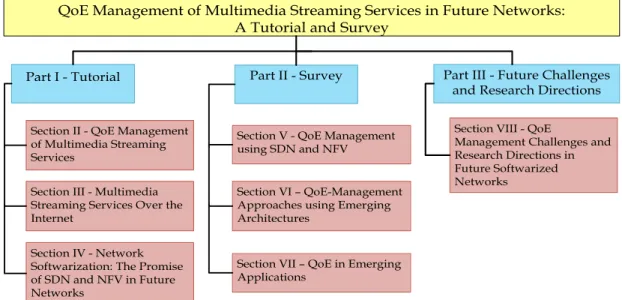
Fig. 2: Structure and organization of the paper.
presented in [24]. Peng et al. [35] gave a discussion on
QoE-oriented mobile edge service management using SDN and NFV, while Awobuluyi et al. [21] provided a discussion on the context-aware QoE management in the SDN control perspective of future networks. The works in [18] and [34] presented different approaches for the autonomic management in an SDN/NFV networking paradigm. Table I provides a summary of related survey papers on the aspect of QoE management of multimedia streaming services.
Although recent efforts explore the QoE management as-pects using SDN and/or NFV, we note that these works are limited in at least one of the following: 1) limited review and discussion of the standardization activities related to SDN and/or NFV; 2) lack of comprehensive descriptions of ongoing research projects, state-of-the-art efforts, challenges as well as concrete research directions in SDN and/or NFV, and emerging multimedia services and applications in future networks; 3) with regard to scope, they do not provide different architectural approaches, implementations and deployment strategies for QoE management using SDN and/or NFV; 4) they do not describe how QoE can be managed/measured or controlled in emerging technologies (such as cloud/fog computing, MEC or Information Centric Networking (ICN)) and new domains with new constraints (e.g., delay sensitive applications such as AR/VR or video gaming applications).
B. Scope and Contributions
The primary objective of this paper is to provide the reader with a comprehensive state-of-the-art regarding the QoE man-agement of multimedia streaming services in future networks. The contribution of this work is composed of three parts:
1) Tutorial –We first provide a discussion on the critical components of QoE management: QoE modeling; QoE monitoring and measurement, QoE optimization and control for multimedia OTT streaming services. In light of the above, we also provide a discussion on HAS
solutions as the dominant technique for streaming videos over the Internet. We also present a discussion on the server and network-assisted approach and critical issues in the multimedia service management. A tutorial of network softwarization and virtualization in the future Internet with the perspectives of multimedia streaming is also provided.
2) Survey – We present a survey of the state-of-the-art of QoE management techniques that leverage SDN and NFV paradigms. Some of the QoE management topics covered include the usage of the server and network-assisted architectures, OTTP and ISP collaboration, new applications and transport layer protocols in SDN/NFV networks. We further present a detailed description of QoE-aware/driven approaches for adaptive streaming over emerging architectures such as MEC, cloud/fog computing, and ICN. Moreover, we also extend QoE management approaches to new domains including im-mersive augmented and virtual reality, mulsemedia, light field and video gaming applications.
3) Future Research Challenges and Directions
– We identify future challenges and research
directions/recommendations concerning the QoE
management of multimedia services in the context of future softwarized networks. We explore the QoE management challenges regarding emerging multimedia applications, network management and orchestration, network slicing and collaborative service management of the multimedia services in softwarized networks. The future research directions provide foresight on the QoE management in emerging research areas such as QoE business models, QoE-based big data strategies, security, privacy and QoE-based trust models and scalability issues for QoE optimization in future softwarized networks.
TABLE I: A SUMMARY OF RELATED SURVEY PAPERS AND SYSTEMATIC DISCUSSION.
Survey Paper Year Topics Covered and Scope SDN or/and NFV
Considerations QoE in Emerging Architectures QoE in New Domains Barakovic´et al.[8] 2013 QoE modeling, monitoring and measurement No No No Liotou et al. [10],
Seufertet al.[6]
2015 QoE in HTTP adaptive video streaming [6], network-level QoE management in mobile networks [10]
No No No
Awobuluyiet al.[21] 2015 Context-aware QoE management in the SDN SDN only No No Zhao et al. [32],
Suet al.[33]
2016 QoE assessment and management in video transmission [32], QoE of video streaming [33]
No No No
Wanget al.[19] 2016 Architecture for personalized QoE management Yes No No
Penget al.[35] 2017 QoE-oriented mobile edge service management Yes MEC only No
Sousaet al.[26] 2017 QoE-based scheduling strategies No No No
Skorin-Kapovet al.[25], Petrangeliet al.[31]
2018 QoE modeling, QoE monitoring and management [25], QoE-centric management of adaptive video streaming services [31]
To some extent ICN only [31], MEC only [25]
AR/VR & multisen-sory Barman and Martini [30] 2019 QoE modelling for HTTP adaptive video streaming No No No
Barakabitzeet al.[36] 2019 Network slicing using SDN and NFV Yes Yes No
Our work 2019 (a) A tutorial on QoE modelling and assessment, QoE monitoring and measurement, QoE optimization and control; (b) a survey on QoE management in SDN and NFV, and (c) QoE management using emerging architectures and in new domains
Yes (both SDN and NFV) Yes (MEC, fog/cloud computing and ICN) Yes
** QoE in New Domains: We refer to aspects of QoE in new domains such as AR/VR, mulsemedia and gaming video streaming
applications. It is to be noted that with the exception of Skorin-Kapov et al. [25] and Petrangeli et al.[31] which discuss AR/VR & multisensory applications, other survey papers are limited in this aspect which is covered in this work.**
C. Paper Structure and Organization
The paper is organized as follows: The tutorial discus-sion on QoE management is presented in Section II along with the definition of QoE and critical components of QoE management. Section III provides a tutorial on multimedia streaming solutions over the Internet including the discussion on HAS solutions, server and network assisted DASH, and key issues in multimedia service delivery and management. Section IV discusses the current network softwarization (SDN and NFV) strategies and relevant advancements in the next generation networks for multimedia services delivery. Sec-tion V provides the survey of the state-of-the-art works on QoE-centric management in the future Internet using SDN and NFV. Section VI presents a survey of QoE management using emerging technologies such as mobile edge computing and cloud computing. Section VII provides a comprehensive description of QoE in emerging applications such as immersive AR/VR, cloud gaming, light field display and mulsemedia. Section VIII investigates the future research challenges and directionsrelated to QoE management. We finally provide our concluding remarks in Section IX. For a better understanding of the structure and organization of this paper, we refer the readers to Fig. 2. Table II shows a summary of the used acronyms in the paper.
II. QOE MANAGEMENT FORMULTIMEDIASTREAMING
SERVICES
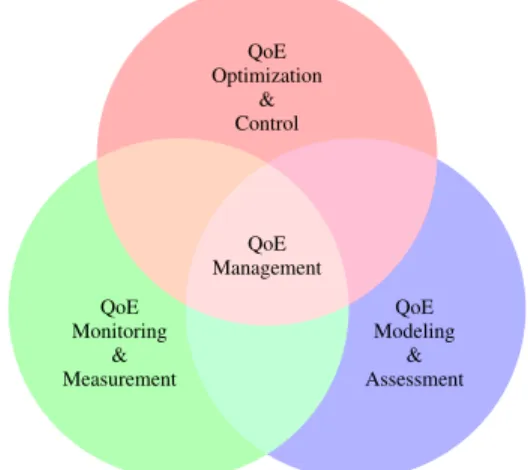
This section provides a tutorial on the aspects of QoE, QoE modeling and assessment along with some metrics and important KPIs used for QoE management evaluation. It also provides an overview of QoE monitoring and measurement, QoE optimization and control using the end-to-end multimedia services delivery chain. Fig. 3 represents the critical compo-nents of QoE management of multimedia services.
QoE Optimization & Control QoE Monitoring & Measurement QoE Modeling & Assessment QoE Management
Fig. 3: Key components of QoE management for multimedia streaming services.
A. Quality of Experience: Definition
In the past, QoS based measurements that consider network parameters (e.g., packet loss, delay and throughput) were used to define the level of satisfaction/performance of a service. As QoS metrics are not explicitly and directly linked with a customer’s satisfaction of a service, user-centric Quality of Experience (QoE) metrics (e.g. Mean Opinion Scores) have been used in recent years to assess the quality of multimedia services, in addition to QoS metrics. QoE considers the user’s subjectivity towards a specific service which can be defined as "the degree of delight or annoyance of the user of an application or service. It results from the fulfillment of his or her expectations with respect to the utility and/or enjoyment of the application or service in the light of the users’ personality and current state" [37]. The understanding of the users’ expectations and experiences from a service is vital for the success of a service.
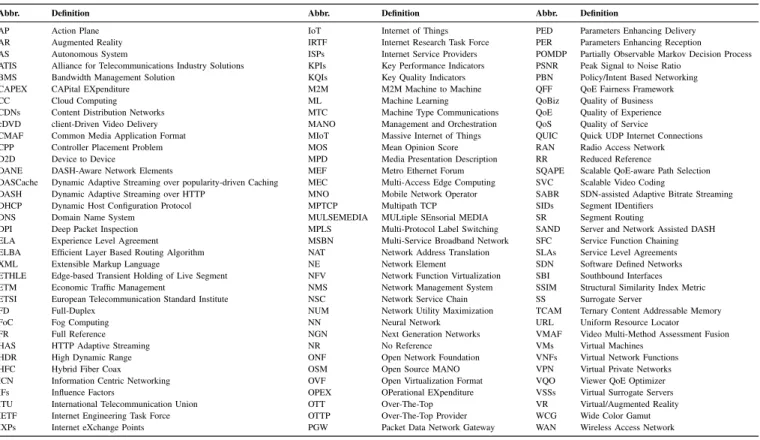
TABLE II: LIST OF COMMONLY USED ACRONYMS IN THIS PAPER.
Abbr. Definition Abbr. Definition Abbr. Definition
AP Action Plane IoT Internet of Things PED Parameters Enhancing Delivery
AR Augmented Reality IRTF Internet Research Task Force PER Parameters Enhancing Reception
AS Autonomous System ISPs Internet Service Providers POMDP Partially Observable Markov Decision Process ATIS Alliance for Telecommunications Industry Solutions KPIs Key Performance Indicators PSNR Peak Signal to Noise Ratio
BMS Bandwidth Management Solution KQIs Key Quality Indicators PBN Policy/Intent Based Networking CAPEX CAPital EXpenditure M2M M2M Machine to Machine QFF QoE Fairness Framework
CC Cloud Computing ML Machine Learning QoBiz Quality of Business
CDNs Content Distribution Networks MTC Machine Type Communications QoE Quality of Experience cDVD client-Driven Video Delivery MANO Management and Orchestration QoS Quality of Service
CMAF Common Media Application Format MIoT Massive Internet of Things QUIC Quick UDP Internet Connections CPP Controller Placement Problem MOS Mean Opinion Score RAN Radio Access Network D2D Device to Device MPD Media Presentation Description RR Reduced Reference
DANE DASH-Aware Network Elements MEF Metro Ethernet Forum SQAPE Scalable QoE-aware Path Selection DASCache Dynamic Adaptive Streaming over popularity-driven Caching MEC Multi-Access Edge Computing SVC Scalable Video Coding
DASH Dynamic Adaptive Streaming over HTTP MNO Mobile Network Operator SABR SDN-assisted Adaptive Bitrate Streaming DHCP Dynamic Host Configuration Protocol MPTCP Multipath TCP SIDs Segment IDentifiers
DNS Domain Name System MULSEMEDIA MULtiple SEnsorial MEDIA SR Segment Routing
DPI Deep Packet Inspection MPLS Multi-Protocol Label Switching SAND Server and Network Assisted DASH ELA Experience Level Agreement MSBN Multi-Service Broadband Network SFC Service Function Chaining ELBA Efficient Layer Based Routing Algorithm NAT Network Address Translation SLAs Service Level Agreements XML Extensible Markup Language NE Network Element SDN Software Defined Networks ETHLE Edge-based Transient Holding of Live Segment NFV Network Function Virtualization SBI Southbound Interfaces ETM Economic Traffic Management NMS Network Management System SSIM Structural Similarity Index Metric ETSI European Telecommunication Standard Institute NSC Network Service Chain SS Surrogate Server
FD Full-Duplex NUM Network Utility Maximization TCAM Ternary Content Addressable Memory
FoC Fog Computing NN Neural Network URL Uniform Resource Locator
FR Full Reference NGN Next Generation Networks VMAF Video Multi-Method Assessment Fusion
HAS HTTP Adaptive Streaming NR No Reference VMs Virtual Machines
HDR High Dynamic Range ONF Open Network Foundation VNFs Virtual Network Functions
HFC Hybrid Fiber Coax OSM Open Source MANO VPN Virtual Private Networks
ICN Information Centric Networking OVF Open Virtualization Format VQO Viewer QoE Optimizer IFs Influence Factors OPEX OPerational EXpenditure VSSs Virtual Surrogate Servers ITU International Telecommunication Union OTT Over-The-Top VR Virtual/Augmented Reality IETF Internet Engineering Task Force OTTP Over-The-Top Provider WCG Wide Color Gamut IXPs Internet eXchange Points PGW Packet Data Network Gateway WAN Wireless Access Network
B. QoE Modeling and Assessment: Metrics and Models
Based on the ITU-T Rec. P.10/G.100 Amendment
5 [37],QoE assessment can be defined as the process of mea-suring or estimating the QoE for a set of users of an application or service with a dedicated procedure and considering the influencing factors (possibly controlled, measured, or simply collected and reported). The QoE assessment, for example, based on SDN/NFV techniques [38]–[40] is one of the es-sential steps toward QoE-based monitoring and management. Depending on the objective and focus of the study, different subjective assessment methods and guidelines are described in the ITU-T Rec. BT.500 [41], P.910 [42] and P.913 [43].
Over the past years, the image and video research commu-nity have dedicated much efforts towards the development of metrics and models which can estimate the quality of an image or video objectively [44]–[46]. Such metrics use the image and video properties and try to predict the quality as would be perceived by the human. Depending on the amount of source information required, they can be classified as Full Reference (FR) (full source information required), Reduced Reference (RR) (partial source information required) and No-reference (NR) (no source information is required). Due to full access to source information, FR metrics are usually more accurate than RR and NR metrics. A review and classification of existing models and metrics proposed for QoE estimation for HTTP Adaptive Streaming (HAS) based applications is provided by Barman and Martini in [30] while a survey on QoE metrics and assessment methodologies is provided in [47]. For an overview of the QoE measurement approaches, we refer the reader to the survey and tutorial paper by Juluri et al.in [48]. Table III
presents some of the most commonly and widely used quality metrics of image and video quality assessment.
C. QoE Monitoring and Measurement
The process of managing and optimizing the end users’ QoE requires knowledge regarding the root cause of QoE degradation or unsatisfactory QoE levels. In that respect, relevant information and data related to terminal capabilities (e.g., screen size, display performance), application/service specific information and its quantification, QoE-related infor-mation inside the network have to be monitored, collected and measured [59]. The network parameters, as well as bitstream information, can be collected from client devices or network elements using monitoring probes. With the advancement of virtualization and data management capabilities, virtualized probes [60] can be used to provide efficient QoE monitor-ing mechanisms in future softwarized networks. The col-lected network-level Key Performance Indicators (KPIs), e.g., throughput, packet loss, delay or user-level service/application specific Key Quality Indicators (KQIs), e.g., frame rate, video resolution, service usability, and reliability, provide inputs for QoE estimation models [48], [61].
D. QoE Optimization and Control
The QoE management of multimedia services, as shown in Fig. 4, involves continuous optimization and dynamic control of relevant mechanisms, from content generation to content consumption, along the service delivery chain. One of the ultimate goals of QoE management is the maximization of the end users’ QoE level through the efficient allocation of
TABLE III: SOME OF THE COMMONLY USED IMAGE AND VIDEOQAMODELS.
Metric Year Model
Type
Modality
Peak Signal-to-Noise Ratio (PSNR) [49] FR Images - Frames
Structural Similarity Index Metric (SSIM) [44] 2004 FR Images - Frames Video Multimethod Assessment Fusion (VMAF) [45] 2016 FR Images - Frames
Visual Information Fidelity (VIF) [50] 2006 FR Images - Frames
HDR-VDP-2: A calibrated visual metric for visibility and quality predictions in all luminance conditions [51]
2011 FR HDR images
Video Quality Metric (VQM) [52] 2004 FR Video
Reduced Reference Entropic Differencing (RRED) [53] 2013 RR Video Spatial Efficient Entropic Differencing for Quality Assessment (SpEED-QA) [54] 2017 RR Video
Blind Image Quality Index (BIQI) [55] 2010 NR Images - Frames
Blind/Referenceless Image Spatial QUality Evaluator (BRISQUE) [56] 2012 NR Images - Frames Naturalness Image Quality Evaluator (NIQE) [57] 2013 NR Images - Frames HDR Image GRADient based Evaluator (HIGRADE) [58] 2017 NR HDR images
Fig. 4: Multimedia streaming chain.
available network resources. However, considering the multi-media delivery chain shown in Fig. 4, QoE optimization and control is a challenging task due to many issues, including the heterogeneity of multimedia-capable users’ devices. As stated in [8], the main challenges that arise with regards to QoE optimization and control may be summarized in the answers to the following four questions: (1) What key quality parameters to optimize and control? (2) Where to control (e.g., at the client, server and the network side)? (3) When to perform QoE optimization and control (e.g., during the service, that is, on-line control or in an off-line fashion [19])? (4) How often to control and optimize QoE? Different studies have been conducted in the literature to answer the above questions.
Fig. 5: QoE-driven cross-layer optimization strategy for wireless video transmission.
A QoE-driven service adaptation and network optimization mechanism using resource allocation was proposed in [62] based on the 3GPP IP Multimedia Subsystem architecture
(IMS). Given the available network resources and operator’s QoE service policy, the aim was to maximize the total util-ity of the active sessions and calculate the optimal service configurations using the proposed QoS/QoE matching and optimization functions [63]. The QoE-optimization process involves the calculation of the agreed service profile which contains various service level parameters (e.g., frame rate and codec type). The optimization function collects the necessary input data and invokes the optimization engine that runs the QoE optimization algorithms. The final QoE is then estimated based on the negotiated and agreed service profiles between end-users and service providers. Further solutions for 3GPP QoE control mechanisms have been proposed and studied extensively in [64] where a QoE estimation function collects a set of QoE Influence Factors (IFs) and runs at the application server. From the network operators’ perspective, QoE-driven optimization involves network resource management mecha-nisms. Such approaches are typically based on the quality-related information collected from the QoE monitoring and measurements process to provide quality assurance and service control in the network.
QoE-driven optimization has been used for resource man-agement in different networks (e.g., in mobile networks or MESH networks). For example, some of the techniques used include a cross-layer QoE-driven admission control and re-source allocation [65] for adaptive multimedia services in LTE networks [66]. Fig. 6 shows a QoE-driven resource allocation scheme for multiple users to access different contents in a wireless environment, as proposed by Thakolsriet al.[67]. A utility maximization scheme is applied such that the end-users’ perceived quality is improved through rate adaptation and net-work resources allocation mechanisms. The QoE optimizer in the core network is used as controller and a downlink resource allocator for video rate adaptation. Staehleet al.[68] propose Aquarema, a network resource management mechanism which improves the end-users’ QoE in all types of applications for
any kind of network. Using Aquarema, QoE degradation is
avoided through network management tools and the interaction of application monitoring tools, running at the clients’ side.
Fig. 6: QoE optimization of multimedia services in access networks.
Wamseret al.[69] introduce a YouTube Performance Monitor-ing Application (YoMoApp), an Android application that can monitor passively KPIs of YouTube adaptive video streaming on end-user smartphones. The monitoring tool runs at the client side to provide a quantification of status for the running applications and enables to predict the end-users QoE. Also, a network advisor is used for triggering different resource management tools during QoE degradation. Such interaction is made possible by using the YoMo[70] tool which continually monitors the amount of playtime buffered by the YouTube player.
An autonomic architecture that can optimize the end-users’ QoE in the context of multimedia access networks, as shown in Fig. 5, is proposed in [71]. The authors use the monitoring plane to monitor the network and utilize the knowledge plane to analyze and determine the ideal QoE actions. The action plane is used to enforce all of these actions into the network. Two reasoners are applied in the knowledge plane to optimize the end-users’ video QoE. The first one is an analytic reasoner while the second reasoner utilizes the feed-forward neural network consisting of one hidden layer and five hidden neurons. Both reasoners are utilized to improve the video quality by reducing the packet loss on a network link as well as the switching impact caused by changing video bitrate [71].
More intelligence in the neural network reasoner can be added by incorporating online learning behaviours such as Q-Learning. In such a case, the learning controller implementing Q-learning behaviour should be capable of finding different QoE optimization actions on a particular service until a better service quality is achieved [72]. However, in another situation and system, other learning/optimization models, e.g., a Convolutional Neural Network (CNN), might be better for QoE maximization [73].
A joint optimization approach of network resource alloca-tion and video quality adaptaalloca-tion that fairly maximizes video clients’ QoE is given in [74]. Minimizing energy consumption, especially in the context of mobile services, has been another important considered objective when optimizing the end user’s QoE [75]. Tao et al. [76] propose an energy-efficient video QoE optimization solution for DASH over wireless networks. The proposed scheme allocates network resource efficiently and make optimal bitrate selection to clients in order to achieve a QoE maximization. Bouten et al. in [77] and [78] present in-network quality optimization agents, which monitor the available throughput using sampling-based measurement techniques. That way, the quality of each client is optimized
based on a HAS QoE metric.
Triki et al.[79] propose a dynamic closed-loop QoE opti-mization for video adaptation and delivery while Xuet al.[80] investigate the buffer starvation of video streaming services. The authors exploit the trade-off between startup/rebuffering delay and starvation to optimize the end-users’ QoE of video streaming services. Zhao et al. [81] propose a cooperative transmission strategy for video transmission in small-cell networks that reduces video freezes and improves the QoE. The system performance is significantly improved when there are many active users in the network. In that aspect, the greedy algorithm transmits the video-file segments using distributed caching. Furthermore, in [82], the authors propose a central
Fig. 7: QoE-based management in mobile cellular networks [82].
QoE management entity to monitor and manage the QoE level of the end-user. The proposed framework, shown in Fig. 7, can collect QoE-related inputs and apply QoE-driven net-work management decisions. It consists of three components, namely the QoE monitor, QoE manager and QoE controller. The QoE controller is the interface which synchronize com-munication exchange between the central QoE management entity and the underlying network. It collects the required data and provides them as inputs to QoE monitor and QoE manager. The QoE monitor is used to estimate the QoE per-flow and report this to the QoE manager. It performs traffic classification using statistical analysis and different built-in "QoE models" based on traffic/service type. The QoE manager is responsible to manage the customer’s watching experience and the network. It uses inputs from the QoE controller regarding the state of the network to estimate the end-users’ QoE. Two or more QoE controllers can be used to improve the end-users’ QoE, increase reliability and availability as well as avoid service interruptions during video streaming. More recently, Khan and Martini [83] presented a solution to reduce cross-layer signaling for QoE-driven optimization of scalable video streaming over LTE wireless systems, as also presented in [84],[85].
In order to optimize QoE, Latré and Turck utilize traffic-flow adaptation, admission control, or video rate adaptation mechanisms to achieve a QoE control and management of multimedia services as shown in Fig. 8. The traffic-flow adap-tation is used to modify the network delivery of a traffic flow
Fig. 8: QoE in multimedia network. QoE is automatically managed using three different axes, namely, (a) traffic-flow adaptation, (b)
admission control, and (c) video rate adaptation [86].
by using redundant data that accompany the application data. The admission control admits or blocks new connections in order to avoid network congestion. The video rate adaptation changes the video quality level as part of the multimedia service transmitted from server to clients. Although the authors in [86] show that these techniques can improve the end-users’ QoE, they introduce large deployment complexity because of exchanging information between layers.
E. Summary
QoE- based modelling, monitoring, control and manage-ment has become topics of high interest in the multimedia communication research community for the QoE-based user-centric service management of the streaming services. The QoE-aware management of multimedia streaming services
consists of three major components: 1) QoE modeling and
assessment– that includes the creation of predictive mathe-matical models (QoE model) from the data related to KQIs; 2) QoE monitoring and measurement–that includes the mon-itoring of the KQIs of the multimedia streaming service and measurement of the QoE from the predictive QoE models; 3) QoE optimization and control–mainly to perform optimization of the resources (network resources, content delivery network or client side adaptation) through control actions based on the QoE measurements.
As stated before, QoE optimization can be performed at various points using different QoE mechanisms, for example at the base stations within the access networks (e.g., using optimal network and radio resource allocation) [87]–[91]. It can be also performed by conducting adjustments of servers in the service/application [71], [91]–[93], applying QoE-based policy management within the core networks [67], [68], [90], [91], or an optimized handover decision [91], on end-user device (e.g., battery consumption) [94]. In addition, QoE optimization can be performed at different levels ranging from link to application-layer [95], [64], or using a common cross-layer approach [67], [68], [90], [91], [83], [96].
III. MULTIMEDIASTREAMINGSERVICES OVER THE
INTERNET
With the growth of streaming video traffic, it has become imperative to exploit various factors along the multimedia
delivery chain to optimize the video service delivery by considering the end users’ QoE. This section presents a com-prehensive discussion on HTTP adaptive streaming solutions over the Internet. In particular, it presents the server and client side optimization of video streaming, including Dynamic Adaptive Streaming over HTTP (DASH) as well as Server and Network Assisted DASH (SAND). Furthermore, multimedia delivery chain and service management issues are discussed with a focus on OTTP, ISPs, CDNs, transit providers and IXPs.
A. HTTP Adaptive Streaming (HAS) Solutions
The majority of Internet video traffic today is delivered via HAS [6]. The advantages of HAS include: (a) providing a reliable transmission, (b) cache infrastructure reuse capability, and (c) enabling firewall traversal. Based on these benefits, HAS has been adopted commercially as shown in Table IV by Microsoft Smooth Streaming, Adobe Dynamic Streaming, Netflix and Apple HTTP Live Streaming for multimedia streaming service [102]. HAS has been widely used in OTTP video services such as Netflix and YouTube [103] as the de-facto standard for adaptive streaming solutions. The underlying logic is common in all these implementations with some differences in the manifest file, recommended segment size, etc. (see Table IV). HAS solutions use reliable delivery mech-anisms such as TCP and very recently Quick UDP Internet Connections (QUIC). However, due to the disparity of these proprietary HAS solutions and the media formats, the 3GPP in close collaboration with MPEG has developed the Dynamic Adaptive Streaming over HTTP (DASH) standard [100].
Fig. 9 illustrates the concept of DASH assuming a video rate adaptation method (e.g., throughput-based, buffer-based, or hybrid) for video streaming. It can be observed that the client, based on its network condition, adapts the quality of the video to provide a smooth streaming experience to the end user. The video is encoded at different representation levels (spatial/temporal/quality) and then divided into chunks (also referred to as segments) of equal duration, which are then stored on a server. When the client makes the first request for the video file, the server sends the corresponding manifest file (e.g., .mpd, .m3u8) which consists of the details about the video file such as duration, segment size, representation levels or codec type [6]. The client then measures/predicts the
Time (sec) Quality High Medium Low Video Segments DASH Client Network with variable bandwidth Time (sec) Bitr ate ( Mb/s)
Fig. 9: Dynamic adaptation according to network conditions.
current bandwidth and buffer status and requests the next part of the video segment with an appropriate bitrate. This way, the number and duration of stalling (interruption of playback due to empty playout buffers) could be decreased and the available bandwidth is best possibly utilized [6]. The success of HAS can be attributed to these benefits compared to the traditional
TABLE IV: ACOMPARISON OFHTTPADAPTIVE STREAMING SOLUTIONS.
HAS Category Company Video Codec Segment Length (sec) Data Description Format
Microsoft Smooth Streaming [97] Microsoft Corporation H.264, VC-1 2 Manifest (XML) fMP4 Apple HTTP Live Streaming (HLS) [98] Apple Inc. H.264 10 Playlist file (M3U8) M2TS, *.ts files Adobe HTTP Dynamic Streaming (HDS) [99] Adobe Systems Inc. H.264, VP6 2 - 5 Manifest (F4M) fMP4 MPEG-DASH [100] Standard Any Not specified Media Presentation Description (MPD) files (XML) MP4 or M2TS
3GP-DASH [101] Standard H.264 Not specified MPD files (XML) 3GPP File Format
M2TS = MPEG-2 Transport Stream; fMP4 is a fragmented MP4; MPD = Media Presentation Description
streaming technologies: 1) video service providers can offer multiple quality levels to the end-users’ demands by adapting video bitrates; and 2) different QoE-tailored personalized ser-vice levels and/or pricing schemes can be offered to customers. It is worth noting that DASH enables both live and on-demand delivery of media streams over HTTP. On-demand video streaming applications can benefit from optimized encoding methods such as multi-pass and variable bitrate encoding. As an example, Netflix proposed a content-aware video encoding optimization [104] strategy where using content information the various optimum resolution-bitrate pairs are determined resulting in better service quality.
Despite the decentralized nature of the HAS principle, there are still some drawbacks especially in the presence of multiple DASH clients that compete for the shared network resources. Some of the HAS related issues include (1) video instability due to bitrate switching [105], (2) network resource under-utilization, and (3) QoE unfairness [106]. These problems remain a serious concern for video content providers and network operators, and they are even more aggravated in the case of heterogeneous environments. Based on these reasons, we discuss next the MPEG-SAND standard where centralized nodes within the network have been proposed recently to enhance the delivery of DASH content [107], [108].
B. Server And Network assisted DASH (SAND)
Server and Network assisted DASH (SAND) is an exten-sion of the MPEG-DASH standard that has been recently finalized, [109], [110] to enhance the delivery of DASH content. The SAND specification introduces messages be-tween DASH client and network elements or bebe-tween various network elements. SAND messages improve the streaming session by providing information about real-time operational characteristics of networks, servers, proxies, caches, CDNs as well as DASH client’s performance [109]. SAND has been specifically designed to address: (1) content-awareness and QoE-service-awareness through server/network assistance, (2) analytics and monitoring of DASH-based services, (3) unidirectional/bidirectional, point-to-point/multipoint commu-nication with and without a session (management) between servers/CDNs and DASH clients.
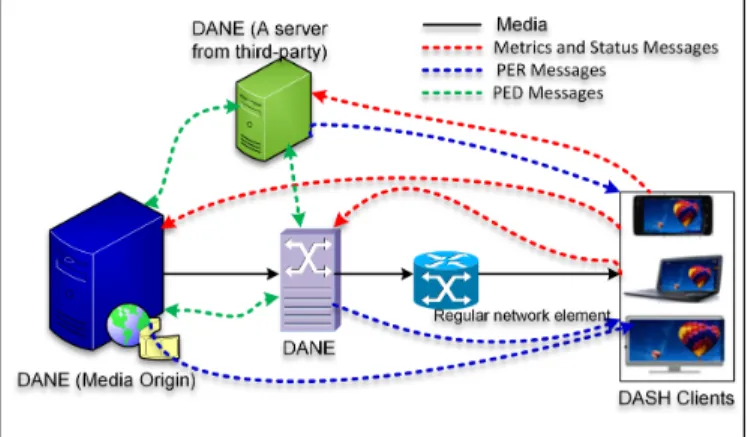
The SAND architecture, shown in Fig. 10, consists of three categories of elements, namely, the DASH clients and DASH-Aware Network Elements (DANE). It also consists of regular network elements (which are DASH unaware) that resides on the path between the origin server and DASH clients (e.g., transparent caches). DANE communicates with the DASH clients while having minimum intelligence about
DASH. For example, DANE nodes may be aware that the delivered objects are DASH-formatted objects such as the mpdor DASH segments. This way, they can prioritize, parse or even modify such objects. The MPEG-SAND standard reference architecture, shown in Fig. 10, also defines three categories of SAND messages, namely: (1) the Parameters Enhancing Reception (PER) messages which are sent from DANEs to DASH clients for enhancing and improving their video quality adaptation, (2) Parameters Enhancing Delivery (PED) messages which are exchanged between DANEs, and (3) metrics and status messages which are sent from DASH clients to DANEs.
Fig. 10: MPEG-SAND architecture. DANEs can communicate among each other and with the DASH clients to optimize the
end-to-end video quality delivery (adapted from [109]).
DANE nodes become aware of the status of DASH clients using SAND status messages. For example, QoE metrics reported by DASH clients to the network can be used for mon-itoring purposes and to simplify video data rate optimization implementations. A DANE node can use PER messages to in-form the DASH clients about the available network bandwidth. They can also inform clients about already cached segments by the DANE so that the clients can request these segments based on their device capabilities. Moreover, information about the streamed video to a particular network delivery element/node can be communicated by the server using a PED message. Generally speaking, a third-party server that receives messages concerning metrics from DASH clients and sends SAND messages to the clients is considered as a DANE element. It is important to note that the MPEG-SAND messages are delivered over HTTP using the XML format and follow a specific syntax as defined by the standard in [109]. Compared to the client or server-based solutions, the MPEG-SAND standard represents an essential enabler for solutions that
need collaboration between service/application and network providers. However, this requires a modification of the network nodes/elements to provide a set of messages that can be exchanged by the network, servers, and DASH clients during video quality delivery optimization [110]. For the practical and scalable implementation of the SAND approach, SDN can be used to provide a centralized control element. Efficient QoE-driven application and QoE-aware network management strategies using SDN and NFV appear to be vital solutions to guarantee the end users’ QoE at a minimum cost.
C. Multimedia Delivery Chain and Service Management Is-sues
The multimedia service delivery chain involves several en-tities which include OTTP, ISPs, CDNs, transit providers and IXPs, where each entity has a different role depending on their mutual agreements [111]. Currently, there are ongoing QoS based collaborations between the OTTP and ISPs concerning peering agreements and OTTP’s surrogate server (SS) hosting in ISP’s network depending on the agreement [112]. For example, Google is providing peering connections for ISPs through IXPs, and also Surrogate Servers (SSs) are being
provided under the Google Global Cache (GCC) program2.
Similarly, Netflix is providing private peering connections and SSs to the collaborating ISPs under the Netflix Open Connect program3. However, in the collaboration scheme mentioned above, the ISPs only have multi-hop peering connections with the Autonomous System (AS)4. The ISPs can host the SSs in the network edges, but the OTTP manage the distribution of the content in the SSs and the assignment of the appropriate SS to the end users.
The multimedia content delivery operations on the OTTP side can be broadly divided into two categories: 1) Client request redirection and; 2) Content distribution and replica-tion [115]. On the ISP side, the network management opera-tions are mainly composed of the traffic engineering abstrac-tions, which include optimal routing strategies, prioritization, and dynamic resource allocation. The following subsections provide the details of how OTTP and ISP may assist each other in collaborative QoE service management.
1) Client Request Redirection and Optimal Route: The
request redirection is a crucial operation in multimedia content delivery services that redirect client requests to the nearby CDN or SS to reduce the content retrieval time. The re-quest redirection mechanism can be based either on Domain Name System (DNS) unicast or on a combination of DNS and anycast for assignment of the most nearby server to the clients [116]. To control the namespace, the OTT/CDN providers have many authoritative nameservers. The names-pace is also divided into subnamesnames-paces for load balancing to resolve the request. The content to be delivered is assigned to a nameserver by the Uniform Resource Locator (URL) where
2https://peering.google.com/ 3https://openconnect.netflix.com
4The AS represents a connected group of one or more blocks of IP addresses called IP prefixes whose routing policies are under common administrative control [113,114].
the prefix represents the nameserver, and the suffix identifies the multimedia content.
However, the DNS based request redirection relies only on the link layer-information for CDN/SS assignment to the clients, which does not allow it to react to the congestion in the ISP’s network. In this case, the OTTP cannot deliver adequate quality to the end users while the ISP has to transport data through a non-optimal path since no information is being shared between the OTTP and ISPs. In the worst case, the client is assigned to a CDN outside the ISPs network which will not only decrease the quality but also results in a high cost for the ISP and an increased network load in the ISP’s core network. In this case, SDN can provide an opportunity to the ISPs to assist OTTP for the optimal selection of a CDN/SS considering their network [116].
2) Content Distribution/Replication and Cache Miss Han-dling: Content distribution and replication into CDNs and SSs from the original server can be performed in two ways: Hierarchical and Flat. In the Hierarchical organization, the content distribution/replication is performed in a multi-tree like fashion where HTTP redirect is used for moving the content up and down in the tree between original server, CDNs, and SSs. In this case, information of the content location can be embedded into the overlay to avoid cache misses. For example, Google has implemented a hierarchical distribution of content for YouTube and other Google services [117], [118]. On the other hand, the OTTP services utilizing Akamai CDNs deliver the content based on the flat organization where cache misses is avoided by fetching the content directly from the original server [119]. However, if the content is not available in the last mile SS, the client is served by the CDN/SS located far from the client’s location. This can lead to cache misses and higher end-to-end delay which can decrease the delivered quality.
Moreover, all SSs can serve many clients that request a video content simultaneously. In order to balance the load, some of the clients are served from the last mile servers [120]. Since the OTTP’s SSs are physically located in the ISP’s network, the SSs cannot be shifted in case of the appearance of a flash crowd or congestion in the network. However, NFV can provide an opportunity for the secure deployment and movement of Virtual Surrogate Servers (VSSs) as VNF to avoid the quality degradation cases mentioned above. Nonetheless, this calls for collaboration among OTTP and ISPs, which indeed requires an interface for the exchange of information among the two entities [2]. The ISPs have to provide OTTP with the access to the VNF infrastructure for content replication/distribution [121].
D. Summary
Multimedia streaming services by OTTP are using HTTP adaptive video streaming based on the MPEG-DASH standard introduced in section III-A. While the MPEG-DASH standard can provide excellent video quality to the end-users, there are some issues when multiple clients are competing for the shared limited resources leading to QoE unfairness, video instability and under-utilization of the network resources [105], [106]. To overcome these challenges, the MPEG-SAND standard
has been proposed recently with the aim to enhance the delivery of DASH contents, thanks to its ability to provide information of the network, servers, and the streaming DASH clients in real-time. DASH clients can announce informa-tion to DANEs regarding their required operating video data rate, a set of segments and video quality. DANEs can send information to the DASH clients about the video segment and the network throughput availability, as well as caching status of the segments. From the multimedia delivery chain and service management perspective, OTTP and ISPs may assist each other in collaborative QoE service management paradigm using a) client request, redirection and optimal route, b) content distribution and replication.
IV. NETWORKSOFTWARIZATION ANDVIRTUALIZATION:
THEPROMISE OFSDNANDNFVINFUTURENETWORKS
Network softwarization [122] and virtualization using SDN and NFV is expected to impact several aspects in the devel-opment and deployment of network services, such as CDN and video accelerators [123], [124]. Before discussing ap-proaches for QoE management using SDN and NFV in Section V, we introduce the reader to the recent advancements in SDN and NFV as an important technology for management and orchestration of resources in future networks. In that respect, Section IV-A discusses the SDN controller design and practical issues. This is followed by Section IV-B, which describes the NFV Management and Orchestration (NFV MANO) framework, NFV use cases and application scenarios as proposed by the ETSI. A description of the relevant ongoing research projects and standardization activities from different bodies/consortia that are pushing forward the adoption of SDN and NFV for multimedia delivery is given as well.
A. Software Defined Networking (SDN)
SDN [12] is an approach that brings intelligence and flexi-bility in programmable networks to allow for orchestrating and controlling the running applications and services in a more fine-grained and network-wide manner with respect to past approaches [125]. The Open Network Foundation (ONF) [126] defines SDN as “the physical separation of the network control plane from the forwarding plane, and where a control plane controls several devices". Notable advantages of the SDN architecture include enhanced network programmabil-ity, centralized control and management, increased network flexibility and reliability, data flow optimization [126]. As shown in Fig. 11, SDN creates a virtualized control plane that can enforce intelligent management decisions among network functions bridging the gap between service provisioning and QoE management. The QoE control and management plane of an SDN network can be implemented as a software that runs on commodity hardware devices. With SDN, the network con-trol becomes directly programmable using standardized South-bound Interfaces (SBI) such as OpFlex [127], FoRCES [128], and OpenFlow [129]. The forwarding plane of SDN can be implemented on a specific commodity server [130] such as VMware’s NSX platform [131] which consists of a controller and a virtual switch (vSwitch).
Network/ Business Apps Network/ Business Apps Network/ Business Apps Network/ Business Apps
Network Abstractions (e.g., Performance, Topology Discovery, QoE-based Resource Allocation, Configuration)
Northbound Interface (NBI)
SDN Controller (POX, Floodlight) Network Global View
Southbound Interface (SBI)
OF OF OF OF OF (e.g., Openflow) Q oE -C on tr ol a n d Ma na ge m en t D at a P la ne A p ps
Fig. 11: Main layers of the SDN architecture.
1) SDN Controller Design and Implementation: The design and implementation choice of an SDN controller significantly affects the overall performance of SDN-based networks [12]. Key design and architectural choices for the controller are: centralizedordistributed. A centralized SDN controller is best suited to manage small networks or a single domain. However, network management using the centralized controller can face scalability and reliability problems [132]. The controller itself can be a point of failure which can negatively affect the performance of the network and the end-users’ QoE. SDN controllers such as Floodlight [133], Beacon [134], and Ryu NOS [135] have been designed to fulfill the needs of managing network resources in data centers, carrier-grade networks, and cloud infrastructures. It is important to note that a centralized controller is not enough for large-scale network management. Scalability and reliability in large-scale networks that span multiple control domains can be achieved by distributed SDN control architectures such as Hyperflow [136], HP VAN SDN [137], DISCO [138], and ONOS [139]. In essence, a distributed SDN controller implementation can be either a set of elements distributed physically or a centralized cluster of nodes [12]. It is worth mentioning that a distributed SDN controller reduces the network partitioning5 problems and improves the scalability and resilience of the control plane in SDN [140].
2) Standardization Activities in the SDN Domain: Driven by the potential of SDN towards simplifying the QoE control and management of multimedia services in the Next Genera-tion Networks (NGN), major standard providers such as the ONF, 3GPP, ETSI, IEEE, and the Internet Engineering Task Force (IETF) are working on different standardization activi-ties of SDN. For example, the ONF [126] introduced the SDN architecture and developed the OpenFlow standard that is now used for commercial deployments. The IETF working group FORCES [141] defines interfaces and protocols for network infrastructure abstraction, the separation of forwarding and 5A network partitioning refers to network decomposition into relatively independent subnets for their separate optimization as well as network split due to the failure of network devices
centralized network control. The SDNRG [142] investigates technical aspects of SDN including solutions for scalability, abstractions, programming languages and paradigms partic-ularly useful in the context of SDN. The IEEE standards such as IEEE P1915.1 [143], IEEE P1916.1 [144], and IEEE P1917.1 [145] specify requirements, frameworks, and models on the aspects of security, performance, and reliability of SDN. ITU-T SDN standardization activities span across several Study Groups (SGs). For example, SG11 investigates signaling requirements and protocols of SDN for Wireless Access Net-work (WAN) services and bandwidth adjustment on the broad-band network gateway. SG13 specifies use-cases, require-ments, and architecture of SDN for NGN. The Metro Ethernet Forum (MEF) [146] has now introduced SDN technologies to the carrier Ethernet services. Continually evolving, the MEF facilitates industry-neutral implementation environments for service orchestration and L2-L7 connectivity services based on open source SDN and NFV. The open source software community such as OpenStack [147], CloudStack [148] and OpenDaylight [149] are accelerating the adoption and fos-tering innovation by developing the basic building blocks of SDN.
B. Network Function Virtualization (NFV)
NFV [13] is the decoupling of physical network equipment from the network functions such as Firewalls and Deep Packet Inspection (DPI) that run on them. NFV envisages the instan-tiation of Virtual Network Functions (VNFs) on commodity hardware. With NFV, Network Functions (NFs) can be quickly deployed and dynamically allocated [150]. Also, network re-sources can be efficiently allocated for these VNFs to achieve Service Function Chaining (SFC)6. For ISPs, NFV promises to provide the needed flexibility that would enable them to support new network services faster and cheaper. It also enable them to realize better service agility and reduce their CAPital EXpenditure (CAPEX) and OPerational EXpenditure (OPEX) through lower-cost flexible network infrastructures. NFV also aims to decrease the deployment time of new network services to market and support changing business requirements. To achieve the above benefits, NFV brings three differences in the network services provisioning as compared to the traditional practice [13], [152], by (a) decoupling software from hardware platform, (b) providing greater flexibility for NFs deployment, and (c) enabling dynamic network operation and service provisioning. The question is whether the NFV design considerations can meet all the technical performance requirements needed by Telco Cloud or service providers. The NFV Management and Orchestration (MANO) framework as proposed by the European Telecommunication Standard Institute (ETSI) is discussed next.
1) NFV Management and Orchestration (NFV MANO)
Framework: The NFV concept in operator
infrastruc-tures [153] was first explored by the ETSI, mostly to address the challenges towards flexible and agile services and to 6Service Function Chaining (SFC) is an ordered list of general service functions that should be applied to a packet and flows selected as a result of classification [151].
create a platform for future network monetization. Since then, the NFV reference architecture, as shown in Fig. 12 was proposed [154], followed by a proof of concept (PoC) [155]. The ETSI MANO framework consists of functional blocks which can be grouped into the following categories: the NFV Infrastructure (NFVI), NFV Orchestrator (NFVO), Network Management System (NMS) and VNFs and Services. These entities or blocks are connected using reference points7.
vCompute vStorage vNetwork
Computing Virtual Resources Storage Network Physical Resources NFV Infrastructure (NFVI) Virtualization Layer Virtual Network Functions
VNF1 VNF2 VNF3 VNFn
EMS1 EMS2 EMS3 EMSn
Element Management System
Virtualized Infrastructure Manager (VIM) VNF Managers (VNFM) NFV Orchestrator (NFVO) Data Repositories VNF Catalog VNF instance NFV I Resources
Operation Support System (OSS) , Business Support System (BSS)
NFV Management and Orchestration (MANO) Network Management System
Fig. 12: The ETSI NFV MANO framework.
The NFVI forms an environment consisting of both physi-cal and software/virtual resources. While physiphysi-cal resources indicate the computing hardware such as storage and net-work resources, virtual resources are the abstractions of the computing, storage and network resources achieved through a virtualization layer (e.g., based on a hypervisor which is a typical solution for VNFs deployment today). NMS is a critical aspect of the overall operation of both VNFs and physical resources. It potentially deals with functions related to network management such as fault management, security, configuration and performance management. The fault management provides a key role for QoE assurance by making sure that network fail-ures or problems are recovered before users are disconnected from the network services.
The NFVO performs orchestration and lifecycle manage-ment of physical and software resources that support the virtualized infrastructure. The NFVO also performs global resource management, network service instantiation, valida-tion, and authorization of NFVI resource requests. The VNFM is responsible for lifecycle management of VNF instances, overall coordination for configuration and event reporting between NFVI. A VNFM can manage a single or multiple VNF instances of the same or different types. The VIM controls and manages NFVI physical and virtual resources (vCompute, vStorage, and vNetwork resources) within op-erator’s infrastructure domain. The NFV MANO contains a database that keeps the VNF catalog, VNF instances, NFVI resources, and network services catalog. The NFVI resource 7A reference point defines a point where two communicating functional entities or blocks are connected.
repository holds information of all allocated or available NFVI resources.
2) NFV Use Cases, Application Scenarios and Implementa-tion: As NFV became important, many use cases and applica-tion scenarios from both the academia and industry have been designed and implemented. Most of these use cases are based on those defined by the ETSI [156]. Some of the use cases from the academia include those pertaining to QoE-based multipath routing [157] or virtual function implementation for broadband remote access server [158], deep packet inspec-tion [159], radio access network (RAN) [160]–[162], customer premises equipment (CPE) [163]–[165], evolved packet core (EPC) [166]–[168] and QoE monitoring through virtualized probes [60]. From the industry, key NFV implementations and products include the CloudNFV [169], Huawei NFV Open Lab [170], HP OpenNFV [171], Intel Open Network Plat-form (Intel ONP) [172], Cisco Open Network Strategy [173], Alcatel-Lucent CloudBand [174], [175], Broadcom Open NFV [176] and F5 Software Defined Application Services (F5 DAS) [13]. It is worth noting that all of the existing NFV implementations and platforms are focusing on open source and orchestration of operator’s end-to-end service over NFVI supported by SDN and cloud technologies.
3) NFV Standardization Activities: Current NFV standard-ization activities span across many domains. The NFV Re-search Group (NFVRG) [177] of the Internet ReRe-search Task Force (IRTF) is active in developing new virtualized architec-tures with capabilities to provide support for NFs. The IETF SFC Working Group (IETF SFC WG) [178] has put efforts to develop SFC architectural building blocks that address mechanisms for autonomic specification, instantiation of NFV instances and steering data traffic through service functions. The ETSI’s Industry Specification Group for NFV (ETSI NFV ISG) [179] provides use cases for NFV requirements, architec-tural framework [154], [153], interfaces and abstractions for NFVI, NFV security [180], performance and resiliency [181]. As a follow-on activity, the Alliance for Telecommuni-cations Industry Solutions (ATIS) NFV Forum (ATIS NFV Forum) [182] is devoted to identify, define and prioritize use cases for collaboration among service providers where NFV capabilities are required to generate new value. In partnership with the ETSI, the Broadband Forum [183] has been working on introducing NFV into the Multi-Service Broadband Net-work (MSBN) and has established a virtualized platform for virtual business gateway and flexible service chaining [184]. Other bodies such as the Open Virtualization Format (OVF) and the ITU-T SG13 have been working towards defining the functional requirements and architecture of the network virtu-alization for NGN as well as the portability and deployment of both virtual and physical machines across multiple platforms. Along with the above standardization activities, many col-laborative projects pushing the NFV implementations include the Open Platform for NFV (OPNFV) [185], the Zero-time Orchestration, Operations and Management (ZOOM) [186] and OpenMANO [187], Unifying compute and network virtu-alization (UNIFY) [188], [189] among others.
C. Summary
Standardization activities have been focused on identifying how network services and the associated resources that are implemented, according to an SDN architecture, might be integrated within the NFV architectural framework [190]. It is worth noting that both SDN and NFV seek to create a future software-based networking solution that offers flexible and automated network connectivity and QoE provisioning to the end-users. For example, while SDN decouples the control plane from the data/packet forwarding plane, the NFV decouples NFs from dedicated hardware devices. Although the two (SDN and NFV) have a lot in common, yet their main difference is that SDN requires a new network platform where the control and data forwarding planes are decoupled. This is not the case with NFV which can run on legacy networks since NFs can reside on commodity servers.
V. QOEMANAGEMENT USINGSDNANDNFV Since the MPEG-DASH standard was defined, a lot of efforts from both the academia and the industry have inves-tigated how to improve the end-users’ QoE. Many studies have been focusing on enhancing the QoE by optimizing the video quality adaptation algorithms on the client and/or the server-side [6], [191]. In recent years, the attention has been towards developing approaches that fully optimize the video quality [192], [107] and maximize the QoE while ensuring fairness among users [193]–[195]. As of today, many SDN/NFV based solutions have been proposed, implemented and tested to see the value and benefits offered by these technologies. Recent efforts include a QoE-aware bandwidth broker [196] and a rate-guided QoE-aware SDN-APP [197].
In this section, we focus on different research areas. Server and network-assisted optimization approaches using SDN are analysed in Section V-A, whereas QoE-fairness and per-sonalized QoE-centric control are reviewed in Section V-B. Section V-C describes a detailed QoE-centric routing while Section V-D presents QoE-aware approaches based on the Multipath Transmission Control Protocol (MPTCP) and Seg-ment Routing (SR). The SDN/NFV-based collaborative service QoE management by OTTP and ISPs is described in section V-E. Finally, Section V-F analyzes proposals that employ "full adoption" of SDN and NFV during QoE-optimization. The final subsection summarizes these QoE-centric management approaches with the help of Table V.
A. Server and Network-assisted Optimization Approaches us-ing SDN
In order to improve the efficiency of HTTP video streaming, SAND provides standardized messages between DASH clients and network elements. It also enables service providers and op-erators to improve network bandwidth utilization and enhance the end-users’ video streaming experience. SAND enables HAS based streaming solutions to provide a fair distribution of bandwidth among users. With SAND, bandwidth reservation and bitrate guidance strategies have attracted much attention in the multimedia streaming community [7], [107] [198], [196]. Most research works following this approach share a


![Fig. 7: QoE-based management in mobile cellular networks [82].](https://thumb-us.123doks.com/thumbv2/123dok_us/10133285.2914306/8.918.470.841.343.558/fig-qoe-based-management-mobile-cellular-networks.webp)