Sibship Reconstruction From Genetic Data With Typing Errors
Jinliang Wang
1Institute of Zoology, Zoological Society of London, London NW1 4RY, United Kingdom
Manuscript received October 31, 2003 Accepted for publication December 31, 2003
ABSTRACT
Likelihood methods have been developed to partition individuals in a sample into full-sib and half-sib families using genetic marker data without parental information. They invariably make the critical assump-tion that marker data are free of genotyping errors and mutaassump-tions and are thus completely reliable in inferring sibships. Unfortunately, however, this assumption is rarely tenable for virtually all kinds of genetic markers in practical use and, if violated, can severely bias sibship estimates as shown by simulations in this article. I propose a new likelihood method with simple and robust models of typing error incorporated into it. Simulations show that the new method can be used to infer full- and half-sibships accurately from marker data with a high error rate and to identify typing errors at each locus in each reconstructed sib family. The new method also improves previous ones by adopting a fresh iterative procedure for updating allele frequencies with reconstructed sibships taken into account, by allowing for the use of parental information, and by using efficient algorithms for calculating the likelihood function and searching for the maximum-likelihood configuration. It is tested extensively on simulated data with a varying number of marker loci, different rates of typing errors, and various sample sizes and family structures and applied to two empirical data sets to demonstrate its usefulness.
K
NOWLEDGE of the genealogical relationships lar relationship is calculated as the likelihood of therelationship, and the inferred relationship is the one among individuals in a population (sample) is
im-portant in many research areas in behavioral, ecological, with the maximum likelihood (e.g., Thompson 1975;
BoehnkeandCox 1997;Epstein et al. 2000;McPeek
and evolutionary genetics and in conservation biology.
It is crucial in studying the social behavior, mating sys- andSun2000). These methods can potentially infer any
possible relationships in data, although they have difficul-tem, and sex and reproductive allocations in social insect
and other species (QuellerandStrassmann1998); in ties in distinguishing relationships similar in
identity-by-descent (IBD) sharing, such as half-sibs, grandparent-managing the conservation of populations of
endan-gered species (Frankham 1995); and in assessing the grandchild, and avuncular (Epsteinet al. 2000;McPeek
and Sun 2000). Pairwise methods are also simple to
genetic variation and inheritance of quantitative traits
(Lynch and Walsh 1998). In practice, relationships implement because all individuals (and their potential impact) other than the pair under consideration are can be estimated easily from pedigree records.
Unfortu-nately, however, detailed pedigree information is rarely ignored. However, valuable information may be lost in
breaking the sampled individuals into pairs and consid-available for most natural populations. Genetic markers
can be used, instead, to infer the relationships among ering each in isolation (Thomasand Hill 2000;
Sie-bertset al. 2002). All individuals in a sample may pro-individuals without pedigree information. Recent
de-velopments of highly polymorphic markers, such as mi- vide direct and indirect information concerning the
relationship of a dyad, especially those closely related crosatellites, have greatly increased the power of
rela-to the dyad. In diploid species, for example, exclusion tionship inference from markers and enabled many
of sibships is impossible for pairs but is possible for fine-scaled analyses across various species.
trios of individuals using autosomal markers, and more Numerous methods have been advanced for inferring
accurate relationship inferences are achieved from trios relationships among individuals solely from marker
infor-than from pairs of individuals (Siebertset al. 2002). In
mation (Blouin 2003). They can be classified broadly
addition to a possible loss of power due to the insuf-into two categories, the pairwise and group approaches.
ficient use of data, pairwise approaches infer relation-Pairwise approaches infer the relationship of a pair of
ships directly at the lowest level, between a pair of indi-individuals (dyad) using their marker genotypes,
ignor-viduals only. Such pairwise relationships suffice in some ing the other individuals in the sample. Typically, the
instances when they are used, for example, to avoid probability of the marker data of a dyad under a
particu-mating between relatives (Herbinger et al. 1995). In
most cases, however, knowledge of higher-order rela-tionships is desirable, which requires all the individuals
1Address for correspondence:Institute of Zoology, Regent’s Park,
Lon-don NW1 4RY, United Kingdom. E-mail: [email protected] in a sample to be allocated into distinctive genetic groups
of a variable size (Smithet al. 2001). Further informa- al. 1998;Neffet al. 2002) and other relationships (e.g.,
Douglaset al. 2000;Epsteinet al. 2000). Several empiri-tion may be lost in subsequent analyses, such as
estimat-ing heritability (ThomasandHill2000), if only pair- cal studies verified the importance of typing errors in
affecting parentage determinations (e.g.,Blouin et al.
wise relationships are inferred and used. Some methods
consider trios of individuals for the candidate relation- 1996;O’Reillyet al. 1998).
In contrast, all previous group-likelihood approaches
ship of a parental pair and an offspring (Jones and
Ardren 2003) or combinations of candidate relation- ignored typing errors and mutations completely. This is unfortunate because, on one hand, typing errors are ships of full- and half-sibs, unrelated individuals, and
identical twins (Siebertset al. 2002). These share essen- expected to have a much more devastating consequence
on relationship inference for group approaches than tially the same properties (e.g., fixed group size) as
pair-wise methods and are thus loosely categorized into pair- for pairwise approaches. For the former, a typing error
may not only cause the individual carrying it to be incor-wise approaches.
Group-likelihood approaches consider all individuals rectly assigned into a genetic group, but also affect the
assignment of the sibs of this individual. When the indi-in the entire sample and partition them simultaneously
into distinctive genetic groups of variable sizes (Painter vidual with a typing error is assigned incorrectly to a sib
family, it may drag along with it some of its sibs with
1997;ThomasandHill2000, 2002;Smithet al. 2001).
Currently, they are applicable to a sample of individuals similar genotypes into the same false family. On the
other hand, typing errors can be potentially identified coming from a single cohort consisting of full- and
half-sibships only (e.g., tadpoles in a pond). In such circum- and accounted for more effectively by group approaches
than by pairwise approaches. This is because the multi-stances, group approaches are expected to be more
powerful than pairwise approaches because the former locus genotypes of a group of individuals serve as mutual
references and collectively they provide information uses information of the multilocus genotypes of all
sam-pled individuals in assigning them simultaneously into about both a given relationship and possible typing
er-rors. The larger the group, the more effectively group-sib groups. Group approaches can also refine allele
fre-quency estimates by accounting for the estimated rela- likelihood approaches can detect and account for typing
errors in relationship determination. tionships in a sample, which are then used to improve
relationship inference (ThomasandHill 2000, 2002; It is possible to accommodate typing errors in marker
data in group-likelihood approaches to sibship
recon-Smith et al. 2001). Such an iterative procedure is
ex-pected to improve estimates of both relationships and struction. If a typing error occurs at a locus of an
individ-ual and leads to a genotype incompatible with those of allele frequencies from a sample.
The accuracy of both pairwise and group approaches its full-sibs, then the likelihood of the full-sib family is
zero no matter how many other loci are correctly typed relies heavily on the reliability of marker information
used in relationship inference. The exclusion of a given and thus support the full-sib relationship. When typing
errors are allowed for in an appropriate model, however, relationship because of its incompatibility with the
ob-served genotypes is legitimate only when the genetic the likelihood of this full-sib family is always greater
than zero and the family can be correctly recovered if data are perfect. Unfortunately, however, genotype
er-rors can be quite common in practice and are difficult genotypes at most loci of most individuals support the
full-sib relationship even though one or more individu-to avoid. Even in the most favorable situation where a
large amount of high-quality DNA is available for re- als are incorrectly typed at one or more loci. In this
article, I propose two simple models of typing errors peated genotyping under optimized PCR conditions,
relationship inference can still suffer from mutations and incorporate them into a group-likelihood approach
to sibship reconstruction. I use simulations to show that
that may occur at a rate as high as 1.4⫻10⫺2for
micro-satellites (Talbotet al. 1995). In practice, typing errors typing errors can cause severe biases in sibship
infer-ence if they are ignored. Yet, sibships can be inferred may occur frequently, especially when repeated typing
is limited or even impossible due to the constraint of accurately from data in which typing errors occur at high
rates, if typing errors are taken properly into account in DNA amount or typing cost, when the quality of DNA
is poor and/or PCR is not optimized. Such typing errors estimation. I also propose a novel method based on
Bayes’ theorem to estimate allele frequencies from sam-and mutations could have a devastating effect on
rela-tionship inference if they are not accounted for. A single ples using the inferred relationships, a method to
iden-tify typing errors at each locus of each reconstructed scoring error (mutation) at just one locus of an
individ-ual may lead to its exclusion from being assigned the family, and a method to infer parental genotypes. The
performance of these methods and their robustness to correct relationship with others no matter how many
other loci of the individual are correctly scored. Some the violation of some assumptions are checked by
exten-sive simulations. Finally, I apply the proposed methods pairwise approaches have been developed to account
for typing errors and mutations in inferring parentage to two empirical data sets to infer the sibship structures
METHODS is difficult or impossible to provide a universal model that reflects the detailed patterns of all kinds of typing First, I briefly review the factors affecting sibship
infer-errors in all marker data sets. Here I focus on microsatel-ence from markers. In particular, the effects of genotype
lite markers, which are used widely in ecological, behav-errors and how to correct for them in sibship
reconstruc-ioral, and evolutionary studies, and categorize their tion are described. Second, the likelihood functions of
common typing errors into two classes that are modeled a nested half-sib family given population allele
frequen-separately. cies are derived for both diploid and haplo-diploid
spe-Class I includes allelic dropouts only. An allelic drop-cies. Third, an algorithm to search for the
maximum-out occurs when PCR fails to amplify one of an individu-likelihood configuration of sibship structures for an
al’s two homologous genes (one from each parent) at a entire sample is presented. Fourth, a method to estimate
locus. If the individual is a heterozygote, then a dropout population allele frequencies from a sample with the
yields a false homozygote. When dropouts are the sole reconstructed sibships accounted for is described. Fifth,
source of typing errors, an observed heterozygote is I propose a method to detect typing errors at each locus
always correct but an observed homozygote can be ei-within each reconstructed family in data and a method
ther correct or incorrect. If incorrect, the actual (true) to infer parental genotypes. Last, I describe the
simula-genotype can be any heterozygotes containing the ob-tion procedures employed to generate simulated data
served allele. For microsatellites, allelic dropouts seem sets and the statistics used to measure the accuracy and
to be the most serious problem (Gagneuxet al. 1997)
precision of the proposed methods in inferring
relation-and could occur at an extremely high rate with low DNA ships, typing errors, and allele frequencies.
concentration in PCR (Taberletet al. 1996). Because of
Assumptions and models of typing errors: To infer
their common occurrence and the special error pattern sibships from genetic markers without parental
informa-(affecting heterozygotes only), allelic dropouts are con-tion, several assumptions are necessary in either
pair-sidered individually. To account for allelic dropouts in
wise- (Smith et al. 2001) or group- (Painter 1997;
sibship inference, I assume that each of the two alleles
AlmudevarandField 1999;ThomasandHill 2000,
in any heterozygote at a locus is equally likely to drop
2002;Smithet al. 2001) likelihood approaches.
out, at rate ε1. Ignoring double dropouts at the same
A sample of individuals is assumed to be taken from
locus and individual (which rarely occurs and, if it does, a single cohort in a large random-mating population.
can be easily detected and thus rectified by regenotyping This assumption implies that the genotype frequencies
in practice), we obtain the probabilities of 1⫺2e1,e1, and
of the parents of sampled individuals can be calculated
e1[wheree1⫽ε1/(1⫹ε1)] for an actual heterozygote, say
from population allele frequencies under Hardy-Wein- A
1A2, being observed as A1A2, A1A1, and A2A2,
respec-berg equilibrium and that the probability of a given tively. Error rateε
1is allowed to vary across loci.
mating type is just the product of the frequencies of Class II includes all kinds of stochastic typing errors
the two parental genotypes. It is possible to relax this other than allelic dropouts. These errors can come from
assumption and incorporate nonrandom mating into mutations, false alleles (polymerase errors rendering
the framework, if information about mating system (e.g., an allele other than the true one), miscalling (allele
selfing rate) is available. identification error), contaminant DNA, and data entry.
All genetic markers used in sibship inference are as- Systematic typing errors, such as misplacing or admixing
sumed to be neutral, unlinked between loci, and in samples during DNA extraction, which may cause the
linkage equilibrium. Each marker locus is assumed to entire multilocus genotype of an individual to be
errone-have two or more codominant alleles and to follow Men- ous, are excluded. Compared with class I, class II errors
delian segregation. All of the observed genotypes in a are usually less frequent and can affect any homozygous
sample are free of errors and mutations, so that they or heterozygous genotype. To account for class II errors
can be trusted completely in inferring sibships. in data, I assume that the two homologous genes in any
Here, I follow previous studies in adopting the above individual genotype at a locus are independently and
assumptions, except for typing errors. In this study, typ- equally likely to be incorrectly observed, with rateε2. I
ing errors are broadly defined as any changes in a geno- also assume that, for a locus withkcodominant alleles,
type that could potentially cause incorrect relationship any allele is observed to be any one of the other alleles
inference. They can come from the inheritance process with an equal probability, e2 ⫽ ε2/(k⫺ 1). This error
(e.g., mutations), the genotyping procedure (e.g., mis- model is similar to that ofSieberts et al. (2002) but
calling or allelic dropout), and the course of data analy- removes the restriction that only one error per locus
ses (e.g., data entry error). The detailed patterns of per individual is allowed. Similar toε1,ε2can be variable
changes in genotype are different among various kinds among loci. Bothε1andε2are assumed known for each
of typing errors and may vary among marker types [e.g., locus in data.
microsatellitesvs. restriction fragment length polymor- Hereafter, observed and actual genotypes are
tively, for simplicity. Genotypes and phenotypes are de- number offputative sib families. Suppose, in
full-noted byGandR, respectively, when subscripts indexing sib family j (j ⫽ 1, . . . , f), we observe dj distinctive
alleles are used. Phenotypes are also denoted byrwhen phenotypes {r1,j,r2,j, . . . ,rdj,j} with corresponding counts
subscripts indexing individuals and families are used. {n1,j,n2,j, . . . ,nd
j,j}. Under random mating, the probability
For a locus withkcodominant alleles (denoted byAw of the phenotype data of the putative half-sib family
with indexw⫽1, . . . ,k), there arek(k⫹1)/2 possible (i.e., likelihood) is
(ordered) genotypes and phenotypes,Gw,x⬅AwAx, and
Rw,x⬅ AwAxforwⱕx⫽1, . . . ,k. Taking typing errors
L⫽
兺
k
w⫽1
兺
kx⫽w
Qw,x
兿
fj⫽1
兺
ky⫽1
兺
kz⫽y
Qy,z
兿
dji⫽1
(Pr[ri,j|Gw,x,Gy,z])ni,j. (3)
of both classes into account, I obtain the transitional probability from a genotypeGw,xto a phenotypeRu,v,
In (3), the probability of observing an offspring pheno-type ri,j (i ⫽ 1, . . . , dj) given parental genotypes Gw,x
andGy,zis derived from Mendelian segregation:
Pr[ri,j|Gw,x,Gy,z]⫽ 1⁄4(Pr[ri,j|Gw,y]⫹Pr[ri,j|Gw,z]
Pr[Ru,v|Gw,x]⫽
(1⫺ε2)2⫹e22⫺2e1(1⫺ε2⫺e2)2
(u⫽w,v⫽x)
e2(1⫺ε2)⫹e1(1⫺ε2⫺e2)2
(u⫽v⫽w) or (u⫽v⫽x) (2⫺ ␦u,v)e22
(u⬆w,u⬆x,v⬆w,v⬆x)
e2(1⫺ε2⫹e2)
(otherwise)
(1)
⫹Pr[ri,j|Gx,y]⫹Pr[ri,j|Gx,z]). (4)
For a given offspring phenotype ri,j ⫽AuAv, each term
on the right side of (4) is calculated by (1) or (2). Although (1–4) are complete for calculating the likeli-ifGw,xis a heterozygote (w⬆x), and
hood of a half-sib family, they require substantial compu-tation. This problem becomes especially important when Monte Carlo techniques are used in searching for the sibship configuration with the maximum likelihood
(below) and the markers are highly polymorphic (k
Pr[Ru,v|Gw,x]⫽
(1⫺ε2)2
(u⫽v⫽w)
2e2(1⫺ε2)
(u⫽w,v⬆w) or (v⫽w,u⬆w)
(2⫺ ␦u,v)e22
(u⬆w,v⬆w)
(2)
large). Computation can be reduced dramatically by considering just the observed alleles and an “allele” pooled over all the unobserved alleles for a putative if Gw,x is a homozygote (w⫽ x). In (1) and (2), ␦u,v is
family.
Kronecker delta variable with values 1 and 0 whenu⫽
Suppose a number of mj distinctive alleles are
ob-vandu⬆v, respectively. In deriving the first two
equa-served in thejth full-sib family in a given putative half-tions in (1), I assumed that class II errors occur after
sib family. We pool the k ⫺ mj unobserved alleles as
class I errors, because the latter are generally more
alleleAk⫹j⫹1, whose population frequency is the sum of
frequent than the former. A reversed sequence of error
those of the unobserved alleles. Denote the set of in-events leads to a different formulation of but little
nu-dexes of the mjobserved alleles and the pooled
unob-merical difference in Pr[Ru,v|Gw,x] whenε1andε2are not
served allele by⍀j. Similarly, for the entire half-sib
fam-high, as is expected because the probability of both error
ily, the set of indexes of them0observed alleles and the
events occurring to a single-locus genotype is minute.
single allele (Ak⫹1) pooled over all unobserved ones is
The likelihood of a putative half-sib family:I assume
denoted by ⍀0. By these arrangements, the likelihood
a population of a dioecious species with one sex
monog-function (3) reduces to amous and the other sex polygamous. The polygamous
sex can be either males or females. A sample of
individu-L⫽
兺
w僆⍀0
兺
x僆⍀0 xⱖw
Qw,x
兿
fj⫽1y
兺
僆⍀j兺
z僆⍀j
zⱖy
Qy,z
兿
dji⫽1
(Pr[ri,j|Gw,x,Gy,z])ni,j. (5)
als taken from a single cohort in the population may thus contain full-sib families nested within half-sib fami-lies. I derive the likelihood of such a half-sib family for
The computational cost of (5) can be a tiny fraction of a single locus. If markers are statistically independent,
that of (3) because generally only a small subset of the multilocus likelihood of a putative sib family is
sim-alleles is observed in a sib family. ply the product of the single-locus likelihoods.
Note that (3) and (5) are derived for a family withf
For a locus with k codominant alleles, denote the
(fⱖ 1) full-sibships nested within a half-sibship.
Obvi-population frequency of alleleAwbypw(w⫽1, . . . ,k)
ously, they apply to pure half-sib and pure full-sib fami-and the population frequency of the parental diploid
lies, which are just two special cases when f ⬎ 1 and
genotype Gw,x ⬅ AwAx by Qw,x. Under Hardy-Weinberg
each full-sibship has just one offspring and whenf ⬅
equilibrium,Qw,x⫽(2⫺ ␦w,x)pwpx, where␦w,xis the
Kro-1, respectively. For a pure full-sib family (f⬅1 and⍀0⬅
necker delta variable with values 1 and 0 when w⫽ x
⍀1), the likelihood computational load can be further
andw⬆ x, respectively.
For a given offspring phenotypegi,j ⫽ AuAv, the
right-L⫽
兺
w僆⍀1
兺
x僆⍀1
xⱖw
Qw,x⫻
冢
兺
z僆⍀1zⱖx
Qw,z(2⫺ ␦x,z)
兿
d1i⫽1
(Pr[ri,1|Gw,x,Gw,z])ni,1 side terms of (7) are calculated by (1) and (2).
A phenotype of a diploid parent, if available, can be used in sibship inference in the same way as the diploid case. Any phenotype of a haploid parent can also be
⫹2
兺
y僆⍀1
yⱖw⫹1
兺
z僆⍀1
zⱖy
Qy,z
兿
d1i⫽1
(Pr[ri,1|Gw,x,Gy,z])ni,1
冣
incorporated in sibship inference after considering its possible typing errors. Suppose the haploid phenotype
(5⬘) of the parent of thejth full-sib family is observed asAu;
then the sum over all possible genotypes of this haploid
instead of (5). The computational burden of (5⬘) is parent in (6),兺
z僆⍀jpz, should be replaced by
approximately half of that of (5).
Group-likelihood methods can use the phenotype
兺
z僆⍀j
pz(␦z,u(1⫺ ε2)⫹ (1⫺ ␦z,u)e2)
pu(1⫺ ε2)⫹ (1⫺pu)e2
data of individuals in a sample to partition them into sib families without the need for any parental information.
derived from Bayes’ theorem. However, if parental phenotypes are available, they
Algorithm for searching the maximum likelihood:
should be used in sibship inference because they could
Suppose a number ofNoffspring are sampled and
geno-improve the inference dramatically. Previous
group-like-typed to infer their relationships. A particular partition lihood methods invariably ignored the use of parental
of these N offspring into a number of sib families is
genotypes in sibship inference (e.g., Painter 1997;
called a sibship configuration. The total likelihood of
AlmudevarandField 1999;ThomasandHill 2000,
a given configuration is the product of single-family
2002;Smith et al. 2001). Here I present a method to
likelihoods, each being calculated as shown above. Any use parental phenotypes in sibship reconstruction, after
prior information about the distribution of sib family accounting for their possible typing errors.
sizes in the sample, if available, can be readily incorpo-Suppose the phenotype of the parent in the
monoga-rated into the likelihood function. mous sex of thejth full-sib family is observed asRu,v⬅
There are many possible configurations even for a
AuAv. Given Ru,v, the posterior probability of genotype
small sample size (N). WithN⫽10 and possible
relation-Gs,t (s ⱕ t 僆 ⍀j) of the parent is calculated as Q*s,t ⫽
ships constrained to either full-sibs or unrelated, for
Qs,tPr[Ru,v|Gs,t]/(兺y僆⍀j兺z僆⍀j
zⱖyQy,zPr[Ru,v|Gy,z]) from Bayes’ theo- example, there are still 115,975 possible configurations
rem. The sum over all possible genotypes,兺y僆⍀j兺z僆⍀j
zⱖyQy,z, (ThomasandHill2000). In fact, the feasible
configu-of that parent in calculating (5) should then be replaced
rations quickly become too numerous to enumerate by兺y僆⍀j兺z僆⍀j
zⱖyQ*y,z. A known phenotype of a parent of the with an increasingN. Our task is to search for, through
polygamous sex can be treated similarly.
this vast configuration space, the best configuration with
Likelihood of a sib family in haplo-diploid species:
the maximum likelihood without considering all the For haplo-diploid species, there are two possible
scenar-possible configurations. This is accomplished by the ios for the hierarchical sibship structure of full-sib
fami-algorithm described below, based on the simulated an-lies nested within a half-sib family: the polygamous and
nealing technique (Kirkpatricket al. 1983).
monogamous sexes are diploid and haploid,
respec-1. Generate an initial configuration by allocating those tively, or are haploid and diploid, respectively. Here I
offspring known to be full-sibs to a full-sib family, consider the first scenario only since the second one
those known to be half-sibs to a half-sib family, and can be treated similarly. Assuming sampled offspring
those with unknown relationships each to a single are all diploids, the likelihood of a nested half-sib
fam-half-sib family (ThomasandHill2000;Smithet al.
ily is
2001). Calculate and store the likelihood of each sib family in the initial configuration.
L⫽
兺
w僆⍀0
兺
x僆⍀0
xⱖw
Qw,x
兿
fj⫽1z
兺
僆⍀j pz兿
dj
i⫽1
(Pr[ri,j|Gw,x,Gy,z])ni,j. (6)
2. Generate a proposal configuration by changing part of the old one. Changes within and between half-sib families are allowed to occur with an equal
proba-In (6), Qw,x is the probability of the diploid parent’s
bility. For a within-half-sib-family change, a full-sib genotype beingGw,x⬅ AwAxcalculated as above, andpz
family, F1, is drawn uniformly from the filled ones
is the probability of the haploid parent’s genotype being
(containing at least one individual) in the current
Gz⬅Az, which is the population frequency of alleleAz.
configuration. If F1is known to be a genuine full-sib
The probability of observing theith distinctive offspring
family (whether the parents’ phenotypes are avail-phenotype in thejth full-sib family (ri,j) given parental
able or not) from another source of information, genotypesGw,xandGzis derived from Mendelian
segrega-then it is replaced by another draw. Repeat this pro-tion:
cess until a full-sib family, F1, without prior
formly from [1, nF,1] (where nF,1 is the number of process is stopped and the best configuration with
the maximum likelihood is reported.
individuals in F1) and choose at random that number
of individuals from F1. These chosen individuals are
Estimating population allele frequency: Sibship
re-to be moved re-to another family, F2, selected at random
construction must use the allele frequencies in the pa-from the full-sib families (including an empty one
rental population, which are assumed known above. with no individual in it) within the half-sib family
In practice, however, population allele frequencies are from which F1comes. Like F1, F2must not be a
full-generally unavailable and have to be estimated from sib family known to be genuine from prior
informa-the sample in which sibships are to be inferred. In oinforma-ther tion. For a between-half-sib-family change, a half-sib
words, usually the only information available is the
sam-family, H1, is chosen uniformly from the filled ones.
ple from which we have to deduce population allele
Draw an integer number uniformly from [1, nH,1]
frequencies necessary for sibship reconstruction. To bet-(wherenH,1is the number of filled full-sib families in
ter estimate population allele frequencies, sibships in a
H1) and choose at random that number of full-sib
sample should be taken into account, especially when
families from H1to be moved into another half-sib
a sample is dominated by a few large families. Ignoring
family, H2, chosen at random from the half-sib
fami-sibships in a sample leads to overestimates of population lies (including an empty one with no individual in
frequencies for the alleles present in large families, it) in the current configuration. Similar to
within-which results in the likelihoods of large families being
half-sib-family changes, both H1and H2must not be
too small and those of small families being too large. A half-sib families known to be authentic from prior
possible consequence is that large families tend to split information.
into smaller ones (ThomasandHill2000).
3. Calculate the old likelihood (Lold) of the parts of the
Thomas and Hill (2000) used a weighted
least-configuration proposed to be changed. For a
within-squares approach to estimating allele frequencies, with
half-sib-family change, Lold is the likelihood of the
the sample’s family structure accounted for by the
rela-half-sib family from which F1 and F2 come. For a
tionship matrix based on current inference of sibship
between-half-sib-family change,Loldis the product of
structure.Smithet al. (2001) proposed a simpler method
the likelihoods of half-sib families H1and H2.
to estimate allele frequencies using weights inversely
4. Calculate the new likelihood (Lnew) of the parts of
proportional to the estimated sibship size. In spirit, the the proposal configuration that have been changed.
two methods are similar, both weighting the informa-For a within-half-sib-family change,Lnewis the
likeli-tion from a (putative) sib family inversely to its size. The hood of the half-sib family that has been altered. For
weighted least-squares approach, however, is
computa-a between-hcomputa-alf-sib-fcomputa-amily chcomputa-ange,Lnewis the product
tionally intensive because theN⫻Nrelationship matrix
of the likelihoods of the two half-sib families that
must be inverted repeatedly over the iterative proce-have been changed.
dure. 5. Determine whether to accept or reject the new
con-Here, I propose a simple method to estimate allele figuration. Calculate ⫽Min[(Lnew/Lold)1/T, 1], where
frequencies of the parental population by using
likeli-Tis the annealing temperature governing the rate
hood rather than family size as the weight. Consider, at which a new configuration is accepted. Generate
as an example, a half-sib family consisting of f full-sib
a random number uniformly distributed between 0
families in a diploid species and the phenotypes of the and 1, and compare it with. If it is smaller than,
f ⫹ 1 parents are unavailable. The count of an allele,
the new configuration is regarded as successful and
Au, in parent s(indexed as s ⫽ 0 for the polygamous
is thus accepted; otherwise, the new configuration is
parent and s ⫽ 1, . . . , f for the sth parent of the
rejected and the old one is recovered.
monogamous sex) can be estimated from Bayes’ theo-6. Repeat steps 2–5 a sufficiently large number of times.
rem as This iterative procedure ensures the likelihood to
go uphill in general, but allows it to go downhill
c
៣
u(s)⫽ 1
Lw
兺
僆⍀0兺
x僆⍀0
xⱖw
Qw,x(␦0,s(␦u,w⫹ ␦u,x⫺1)⫹1)
occasionally to avoid it being stuck on a local maxi-mum. The probability of a downhill tour is controlled
by T, which is decreased as the annealing process
⫻
兿
fj⫽1y
兺
僆⍀j兺
z僆⍀j zⱖy
Qy,z(␦j,s(␦u,y⫹ ␦u,z⫺1)⫹1)
兿
dji⫽1
(Pr[ri,j|Gw,x,Gy,z])ni,j,
proceeds so that a new configuration with a smaller likelihood than the old one becomes less and less
(8) frequently accepted.Tis set initially at a value of one
and reduced in multiplicative steps, each amounting whereLis calculated by (5). For an unobserved allele,
to a 10% decrease. Each new value ofTis held con- A
v, pooled into alleleAk⫹s⫹1, we first estimate the count
stant for 5000Nreconfigurations or for 100Nsuccess- (៣c
k⫹s⫹1(s)) of the pooled allele by (8). The count of Av
ful reconfigurations, whichever comes first. When in thesth (s⫽0, 1, . . . ,f) parent is then estimated by
efforts to improve configurations (increase
where pˆv and pˆk⫹s⫹1 are the estimated population
fre-Pr[Gu,v|data]⫽
兺
kw⫽1
兺
kx⫽w
Qw,x
兿
fj⫽1 j⬆s
兺
ky⫽1
兺
kz⫽y
Qy,z
兿
dji⫽1
(Pr[ri,j|Gw,x,Gy,z])ni,j
quencies of Av and Ak⫹s⫹1 before updating. Estimate
allele counts for each parent in each putative half-sib family in the current configuration, and update
popula-⫻
冢
Qu,vL
兿
ds
i⫽1
(Pr[ri,s|Gw,x,Gu,v])ni,s
冣
(10b)tion allele frequencies by the mean of the estimated allele counts across parents. The computational load of
for thesth parent of the monogamous sex, whereLis
(8) and (9) is minimal, because all quantities in them
the family likelihood calculated by (3). The
maximum-are already known from the calculation ofL.
likelihood estimate of a parental genotype is the one For half-sib families with partially known parental
ge-with the maximal posterior probability. For a parent notypes, and for the case of haplo-diploid species,
popu-with observed phenotypes, its actual genotypes can be lation allele frequencies are estimated similarly, using
inferred similarly. Bayes’ theorem and the corresponding likelihood
func-As is intuitively obvious, parental genotype inference tions.
relies heavily on the correctness of sibship reconstruc-Population allele frequencies are estimated initially
tion. It is likely to be inaccurate for an incorrectly recon-by the method from the initial configuration and
up-structed sib family. Even for a correctly reconup-structed dated periodically after a certain number of successful
family, the inferred parental genotypes are not guaran-reconfigurations. Because of the minimal computational
teed to be correct, especially when family size is small. cost of the proposed method, it is possible to update
For a pure full-sib family (f⫽1) in a diploid species, it allele frequencies after each reconfiguration. However,
is impossible to resolve the male and female parental it is usually unnecessary to update so frequently because
genotypes no matter how much marker information is a few improvements on the configuration do not change
available. The parental genotype combination (乆⫻么),
allele frequencies much (ThomasandHill2000).
A1A2⫻A3A4, has exactly the same posterior probability
Identifying possible typing errors: The
group-likeli-asA3A4⫻A1A2, for example. In such situations, one has
hood approach shown above also allows us to identify
to genotype one of the parents to infer accurately the possible typing errors in data that occurred at each locus
genotypes of both. For a pure full-sib family in haplo-within each reconstructed sib family. From the best
con-diploid species, the power of parental genotype infer-figuration with the maximum likelihood that is finally
ence is also reduced if the diploid parent is homozygous rendered by the method, we can calculate, for each
at a locus. In any case, the reliability of an inferred
family and each locus, the likelihoods considering both parental genotype is indicated by its posterior
probabil-class I and II errors (L), class I errors only (L1, setting ity. The higher this value is in comparison with those
ε2⫽0), class II errors only (L2, settingε1⫽0), and no of alternative genotypes, the higher the confidence we
typing errors (L3, settingε1⫽ε2⫽0). A likelihood-ratio have in it.
test can then be carried out to screen the most likely Simulations:To assess the precision and accuracy of
hypothesis. Allelic dropouts are inferred to have oc- the proposed methods and their robustness when some
curred at a locus in a family whenL1calculated for the assumptions are violated, I generate simulated data with
given locus and family is significantly larger thanL3, for known parameters by Monte Carlo, reconstruct sibships
example. from the simulated data by the proposed methods, and
Obviously, not all typing errors are identifiable. If a measure (below) the fit between the true and estimated
typing error causes little change in family likelihood, sibships. Different combinations of parameter values
then it is unlikely to be detected. The power of error are used in simulations to check the performance of
detection also depends critically on family size. In the the methods and to investigate the effects of different
extreme case of a family containing just a single individ- factors on the estimation. Full-sib family sizes in a sample
ual, it is impossible to ascertain typing errors. Therefore, are assumed to follow either a Poisson distribution with
the typing errors identified should be treated as conser- parameter or a negative binomial distribution with
vative. parameters (probability of success) and ␥ (number
Inferring parental genotypes:From the offspring phe- of successes). For both distributions, families with no
notypes and the reconstructed sibships, we can also infer offspring are obviously not represented in a sample.
the parental genotypes using Bayes’ theorem. As an The mean and variance of full-sib family sizes in a sample
example, consider a half-sib family consisting of a num- are therefore/(1 ⫺e⫺) ande(e⫺ 1⫺ )/(1⫺
ber offfull-sib families in a diploid species. The poste- e)2, respectively, for the Poisson distribution and (1⫺
rior probability of a parental genotype,Gu,v, given data )␥/((1⫺ ␥)) and (1⫺ )␥(1⫺ ␥(1⫹(1⫺ )␥))/
and the reconstructed sibships, is ((1 ⫺ ␥))2, respectively, for the negative binomial
distribution. The number of full-sib families nested within a half-sib family is also assumed to follow a Poisson Pr[Gu,v|data]⫽
Qu,v
L
兿
f
j⫽1
兺
ky⫽1
兺
kz⫽y
Qy,z
兿
dji⫽1
(Pr[ri,j|Gw,x,Gy,z])ni,j (10a)
when their actual relationship is b(ThomasandHill
2002). In samples containing half-sib families consisting of full-sib families, full-sib (FS), half-sib (HS), and
non-sib (NS) relationships are posnon-sible so that a, b ⫽ FS,
HS, or NS.
To assess the accuracy of allele frequency estimates, I use the square root of mean-squared deviation (RMSD) of estimates from true frequencies of all alleles within and between loci. The power of the method for detecting typing errors is measured by the proportion
of typing errors being correctly identified (1⫽number
of correctly detected errors/total number of detected errors) and the proportion of typing errors being
de-tected (2⫽total number of detected errors/total actual
number of errors) across loci and reconstructed families in a sample. For parental genotype inference, I use the average proportion of parental genotypes being
cor-rectly inferred (⌿) to measure the accuracy of the
method. For a single diploid parent,⌿⬅1,1⁄
2, and 0 if
2, 1, and 0 of its alleles at a locus are correctly inferred,
respectively. For a haploid parent,⌿⬅ 1 and 0 when
Figure1.—The effect of typing errors on full-sib
relation-its genotype is correctly and incorrectly inferred, respec-ship inference in haplo-diploid and diploid species. A sample
tively. When a parental genotype is unresolved for a of 100 diploid offspring, consisting of full-sib families with a
family size in the Poisson distribution of parameter 5, are pure full-sib family,⌿is calculated as the mean of the
genotyped for a variable number of loci, each having 10 co- ⌿ values calculated for the two alternative genotypes
dominant alleles of equal frequency. Typing errors of both inferred.⌿is then calculated as the average of⌿across
classes occur at rate 0.05 for each locus and individual. For
the two parents of all the sampled individuals and across each number of marker loci, 50 data sets are simulated and
loci. analyzed comparatively with typing errors either ignored or
accounted for in sibship inference. The estimation accuracy is indicated by the proportion of correctly inferred full-sib
RESULTS
pairs in the sample,P(FS|FS).
Simulation results: Number of loci: Assuming typing errors of both classes occur at rate 0.05 at each locus,
random mating and Hardy-Weinberg equilibrium, and I generated simulated data that were then analyzed
com-offspring genotypes are generated from parental geno- paratively with typing errors ignored and taken into
types following Mendelian segregation. These parents account, respectively. The proportions of correctly
as-and offspring genotypes are then changed, at a given signed full-sib pairs (P[FS|FS]) are shown in Figure 1
rate, following the models of class I and II typing errors as a function of the number of loci used in estimation.
to give their corresponding phenotypes. The pheno- The proportions of correctly assigned unrelated pairs
types are then taken as observed data, which are used (P[NS|NS]) are not shown because they are always close
in sibship reconstruction. For a given parameter combi- to 1 regardless of the number of loci and whether typing
nation, 50 independent data sets are generated and errors are ignored or not. Typing errors, if ignored in
analyzed. sibship reconstruction, lead to true full-sibs showing
sib-Statistics measuring the performance of the estima- incompatible phenotypes and thus to a full-sib family tion:Several statistics can be employed to measure the being broken up into several smaller ones. With an
fit of the reconstructed to the actual sibships in simu- increasing number of loci used in sibship inference,
lated data. A stringent measurement of the overall fit both information and noise due to typing errors
in-is the number of full-sib (FS) and half-sib (HS) families crease. However, the impact of typing errors overwhelms
being completely recovered relative to the actual num- that of information, and, as a result, sibship inference
bers in a sample. Obviously FS ⫽ 1 and HS ⫽ 1 for becomes increasingly inaccurate with an increasing
a sample containing full-sib families only and half-sib number of marker loci used in estimation. This is
under-families, respectively, mean the reconstructed sibships standable because no matter how many loci are correctly
are perfect, with no individual being incorrectly as- typed and thus support a true sib family, it still breaks
signed a relationship with any other individual. To gain up into two families in reconstruction if one typing error
insight into the causes of an imperfect sibship recon- occurring at a single locus in a single individual leads
struction (FS ⬍ 1 or HS ⬍ 1), I examine the statistic to a phenotype incompatible with others as sibs. The
total multilocus likelihood for a group of individuals as
a sib family is the product of single-locus likelihoods and is zero if a single-locus likelihood is zero. When
typing errors are accounted for in estimation,P[FS|FS]
increases rapidly with an increasing number of loci and the full-sib relationships of a sample are completely
re-constructed (FS⫽1) once the number of loci is
approxi-mately equal to eight. The large impact of typing errors shown in Figure 1 highlights the importance of account-ing for typaccount-ing errors of data in group-likelihood ap-proaches to relationship inference.
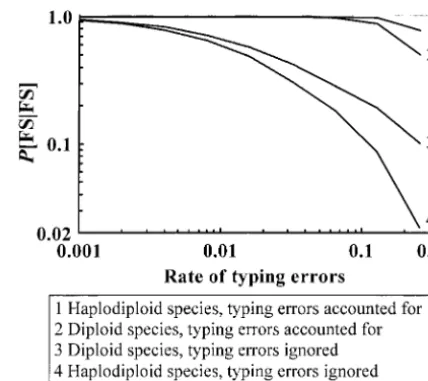
Rate of typing errors: The effect of the rate of typing errors in data on relationship inference is shown in Figure 2. When typing errors are ignored in estimation,
P[FS|FS] declines rapidly with an increasing rate of
typ-ing errors in data. An error rate as low as 0.001, which is possible from mutations alone for microsatellites (e.g.,
Talbot et al. 1995), can affect sibship reconstruction Figure2.—The effect of the rate of typing errors on
full-significantly. When typing errors are accounted for in sib relationship inference. A total of 100 diploid offspring
the estimation, however, the estimator becomes very are sampled from a population of a diploid or haplo-diploid
species and are genotyped for eight loci, each having 10 co-robust and can provide accurate estimates even when
dominant alleles of equal frequency. The sample consists of typing errors occur at an extremely high rate. In the
full-sib families with a family size in a Poisson distribution with
simulated data, the probabilities of a heterozygous and parameter 5. Typing errors of both classes occur at the same
homozygous genotype at a single locus being incorrectly rate for each locus and individual. Simulated data are
gener-typed are as high as 0.65 and 0.45, respectively, when ated assuming various values of error rate in the rangeⵑ0.001–
0.256 (shown on thex-axis) and are analyzed comparatively
ε1 ⫽ ε2 ⫽ 0.256. Even if in such situations where an
with typing errors either ignored or taken into account. The observed phenotype is more likely to be erroneous than
estimation accuracy is indicated by the mean (over 50
repli-correct, 78% of the full-sib pairs are correctly identified cates) proportion of correctly inferred full-sib pairs in the
and 40% of the full-sib families are fully reconstructed sample,P(FS|FS).
for a haplo-diploid species when typing errors are
ac-counted for. In contrast, P[FS|FS] and FS are only 2
and 4%, respectively, when typing errors are ignored ing procedure in estimating allele frequencies also
in-creases with an increasing variance in family size (Fig-in estimation.
The rate of typing errors that the method can tolerate ure 3B).
Robustness of the models of typing errors: In the above, to yield satisfactory estimation depends on the amount
of information available from data (number of marker the rates of typing errors (ε1andε2) actually employed
in generating simulated data are used in sibship infer-loci and alleles per locus) and actual family sizes. With
an increasing amount of marker information and/or ence. In application, usuallyε1andε2are unknown but
are guessed from prior information or estimated by family size in data, the method can cope with an error
rate⬎0.256 as shown in Figure 2. In practice, probably repeated genotyping (Gagneuxet al. 1997). How robust
the method is to sampling errors ofε1andε2is obviously
no data are so dirty.
From Figures 1 and 2, we can see that typing errors of concern for practical applications. In Figure 4, the
data are generated withε1⫽ε2⫽0.05 but are analyzed
have a greater impact on sibship inference for
haplo-diploid species than for haplo-diploid species. This is because assuming various values ofε1andε2. As can be seen, the
accuracy of sibship inference (indicated by P[FS|FS]
typing errors result in a larger probability of false
exclu-sion of sibships in haplo-diploid than in diploid species. andFS) is quite high even though the assumed values
ofε1andε2 deviate over several orders from their true
Updating allele frequencies:Figure 3 depicts the impact
of updating allele frequencies on estimating relation- value (0.05) used in simulation. Full-sibs tend to be
assigned as unrelated and unrelated individuals tend to ships and allele frequencies. As is expected, the benefit
from updating allele frequencies increases with an in- be assigned as full-sibs when the assumed error rate is
much smaller and much larger than the actual value, creasing imbalance (variance) in family sizes (Figure
3A). When allele frequencies are not updated, large respectively. All such incorrect assignments occur at a
very low frequency, however, even if the assumed error families tend to split into smaller ones, resulting in some
full-sibs being incorrectly assigned as unrelated. With a rates are many times greater or smaller than the true
values. It seems that accurate sibship inference can be variance of family size of 50 in Figure 3, for example,
the proportions of full-sib pairs being inferred as unre- obtained using a wildly guessed, rather inaccurate rate
of typing errors provided sufficient information is con-lated are 2.0 and 6.4% when allele frequencies are and
Figure4.—The effect of the error rate assumed in analyses on full-sib relationship inference. A total of 100 diploid off-spring, consisting of full-sib families with a family size in a Poisson distribution with parameter 5, are sampled from a population of haplo-diploid species and are genotyped for eight loci, each having 10 codominant alleles of equal fre-quency. Typing errors of both classes occur at rate 0.05 for each locus and individual, but different values of error rate
(shown on thex-axis) are assumed in sibship reconstruction.
The solid and dashed lines indicate the mean (over 50 repli-cates) proportions of full-sib pairs that are correctly assigned [P(FS|FS)] and of fully recovered full-sib families (FS),
respec-Figure3.—The effect of updating allele frequencies on
full-tively. sib relationship and allele frequency estimation. Simulated
samples contain full-sib families, with family sizes following a negative binomial distribution with different parameter values
to yield the same mean (5) but various variances of family typing error occurs at a locus for an individual, then
size. Each sample has 100 diploid individuals taken from a
typing errors are more likely to occur at other loci of haplo-diploid species, and each sampled individual is
geno-the same individual than at a locus of an individual typed for five loci, each having 10 codominant alleles of equal
taken at random from the sample. To investigate the frequency. Typing errors of both classes occur at rate 0.05 for
each locus and individual and are accounted for in sibship robustness of the model to such concordant occurrence
reconstruction. The simulated data are analyzed compara- of errors within an individual, simulated data are
ob-tively with allele frequencies updated every 1000 successful
tained by drawing an error rate from a truncated (nega-reconfigurations or left unchanged during the process in
tive values are discarded) Gaussian distribution with searching for the maximum-likelihood configuration. (A)
Lines marked by 1 and 2 indicate the mean (over 50 replicates) mean 0.05 and standard deviation and using it in
proportions of full-sib pairs that are correctly assigned generating typing errors of both classes across loci for
[P(FS|FS)] when allele frequencies are updated and not up- a given individual. Therefore, the larger the value of
dated, respectively, and lines marked by 3 and 4 indicate the
, the higher the intra-individual correlation of error
mean proportions of fully recovered full-sib families (FS) when
occurrences among loci. The effect ofon sibship
infer-allele frequencies are updated and not updated, respectively.
(B) The solid and dashed lines indicate the square roots of ence is shown in Figure 5, where P[FS|FS] andFSare
mean-squared deviation of estimated from true allele frequen- plotted against. As can be seen, the model is robust to
cies (RMSD) when allele frequencies are updated and not, moderate levels of variation in typing error rate among
respectively.
individuals. With an increasing value of, the
propor-tion of individuals carrying erroneous genotypes at al-most all loci increases. For these individuals, it is
obvi-SanCristobalandChevalet(1997) in their
pairwise-ously impossible to correctly assign relationships between
likelihood inference for parentage and by Siebertset
one of them and any others in the sample. Whenε1⫽
al. (2002) in relationship inference from trios of
indi-ε2 ⱖ 0.25, an individual’s phenotype is more likely to
viduals.
be erroneous than correct at each locus. The propor-The error model assumed that typing errors occur
tions of such individuals areⵑ3.3 and 27% for ⫽0.1
independently across loci within an individual. This
as-and ⫽0.2, respectively, in the simulated data sets.
sumption can be violated if DNA quality, quantity, or
With miscalling or mutations in the single-stepwise both vary considerably among individuals. When DNA
model for microsatellites, a typing error usually involves is extracted from noninvasive sources such as hair and
a single tandem repeat change and an allele is more feces or from ancient material such as bones and scales,
likely to be observed if its size is closer to that of the for example, both its quantity and quality can be highly
actual allele. In heterozygotes, larger alleles may be variable among individual samples, resulting in
signifi-more likely than smaller alleles to drop out. Such
size-cantly different error rates between individuals (e.g.,
estima-tion, which may further affect sibship inference. Fami-lies with partially known parental genotypes may suffer a smaller rate of typing errors than families with no parental information available, because in the former case some typing errors may be identified and corrected using the known parent-offspring relationship before the genotype data are analyzed for sibship inference. Simulated data were generated following these error patterns but analyzed using the proposed simple error models. In all cases considered, accurate inference of sibships was obtained (results not shown) when typing
error rate was not very high (say, ⬍0.15), indicating
that the proposed models of typing errors are quite
Figure5.—The effect of the dependence between typing robust. This is not surprising given the results in Figures
error occurrences at different loci within an individual on
4 and 5. full-sib relationship inference. A total of 100 diploid offspring,
Hierarchical sibship structures and sample sizes:Figure 6 consisting of full-sib families with a family size in a Poisson distribution with parameter 5, are sampled from a population shows the proportions of the actual full-sib and
half-of haplo-diploid species and are genotyped for eight loci, each sib pairs being assigned different relationships by the
having 10 codominant alleles of equal frequency. For each estimator applied to samples of various sizes and
com-sampled individual, an error rate is drawn from a truncated
posed of full-sib families nested within half-sib families. Gaussian distribution with mean 0.05 and standard deviation
The assignments of unrelated pairs are almost perfect , and typing errors of both classes are simulated to occur at
the same sampled rate across loci. The simulated data are
[P(NS|NS) very close to 1] for various sample sizes and
analyzed with an assumed error rate of 0.05 for both classes are omitted from the figure. Sibship inference becomes
of errors, each individual, and each locus. The solid and increasingly inaccurate with a decreasing sample size
dashed lines with error bars indicate the means and standard
once it becomes very small (⬍50) and with an increasing deviations (over 50 replicates) of the proportions of full-sib
sample size once it becomes very large (⬎800). The pairs that are correctly assigned [P(FS|FS)] and of fully
recov-ered full-sib families (FS), respectively.
former is due to the fact that allele frequencies used in sibship inference are less accurately estimated with a smaller sample size. The latter is caused mainly by the
increasing probability with sample size that individuals number of loci used in sibship inference isⱕ2 and⬎2,
respectively, in Figure 1. 1 ⬎ 0.99 is obtained even
in a sibship could have, by chance, disparate albeit
com-patible genotypes and thus the sibship may be split in though the assumed error rate is several orders larger
or smaller than the actual value (Figure 4) or the error reconstruction. The magnitude of the effect of sample
size on sibship inference depends on the amount of model assumptions are violated (Figure 5). On the other
hand, the proportion of overall typing errors detected marker information and family size.
Overall, sibships are quite accurately inferred for (2) by the likelihood method is generally low, being
⬍80% in simulations shown in Figures 1–5. This is not
haplo-diploid species using only five microsatellites, with
at least 95% full- and half-sib pairs being correctly in- surprising because some typing errors cause no or little
change in likelihood and are thus not detectable. These
ferred when sample size isⵑ50–800. Even if the sample
size is as large as 1600, P(FS|FS) and P(HS|HS) are results indicate that a typing error identified by the
method is highly likely to be genuine, but not all typing
still⬎92% in the examples shown in Figure 6. Sibship
inference is much less accurate for diploid than for errors are identifiable.
The inference of parental genotypes is generally less haplo-diploid species, as expected. The contrast is
espe-cially evident when the sample size is very large or small. accurate than sibship inference and typing error
detec-tion (1). This is because it relies on correct sibship
Obviously, the amount of marker information (five
mi-crosatellites, each with 10 alleles at equal frequency) is reconstruction and sometimes male and female
paren-tal genotypes are unresolved for full-sib families. In Fig-insufficient for accurate sibship inference in diploid
species. In Figure 6,P(FS|FS) and P(HS|HS) are 0.51 ure 1, for example, the proportion of parental
geno-types being correctly inferred (⌿) isⵑ80 and 50% for
and 0.38, respectively, when N ⫽ 1600 for a diploid
species. When the number of loci used in the estimation haplo-diploid and diploid species, respectively, when
three to six loci are used in estimation. The accuracy is increased to 10 loci, the corresponding values are
0.97 and 0.98, respectively. of parental genotype inference improves with nested
half-sib families, larger family sizes, and more marker
Identifying typing errors and inferring parental genotypes:
The proportion of typing errors being correctly de- information. When eight loci, each having 10 alleles of
equal frequency and a typing error rate of 0.05, are
tected (1) by the likelihood method is generally high.
For example,1⬎0.99 for various error rates assumed used in estimating the relationships of 100 offspring
coming from nested half-sib families with the numbers
Figure 6.—The effect of sample size on relationship in-ference. Samples of various sizes containing full-sib lies nested within half-sib fami-lies are simulated, assuming a diploid species or a haplo-dip-loid species with the polyga-mous and monogapolyga-mous par-ents being diploid and haploid, respectively. The number and size of full-sib families within a half-sib family are drawn from Poisson distributions with pa-rameters 2 and 5, respectively.
Each sampled diploid
off-spring is genotyped for five loci, each having 10 codomi-nant alleles of equal frequency. Typing errors of both classes occur at rate 0.05 for each locus and individual and are ac-counted for in sibship recon-struction. Lines marked by FS, HS, and NS show the propor-tions of actual full-sib (top) or half-sib (bottom) pairs being inferred as full-sib, half-sib, and non-sib relationships, respec-tively.
and sizes of full-sib families being in Poisson distribu- checking the accuracy of parental genotype inference.
The rates for both allelic dropouts and other kinds of
tions with parameters of 3 and 5, respectively,⌿ is 96
and 80% for haplo-diploid and diploid species, respec- errors in this data set are unknown and are assumed to
take various values in the analyses. Allele frequencies tively.
Applications:The method developed in this study has are updated using reconstructed sibships every 1000 successful reconfigurations.
been applied to estimating the number of colonies of
two bumble bee species (Bombus terrestrisandB. pascu- The likelihood method completely reconstructed the
sibships of the sampled 377 workers, using their
pheno-orum) whose workers visit and use a given foraging site
(Chapmanet al. 2003). As further demonstrations of its type information only, without a single worker being assigned an incorrect relationship with any other worker. usefulness, the method is applied to two empirical data
sets. The 100% successful assignments (FS ⫽ 1) were
ob-tained with a wide range of possible typing error rates
Analysis on an ant data set:The data set is from a study
on the mating frequency of an ant species,Leptothorax (ⵑ0.001–0.40) assumed in the analyses. However, if
typ-ing errors are ignored by setttyp-ing the error rate as zero,
acervorum(Hammondet al. 2001). It consists of 377 ant
workers (diploid) sampled from 10 known colonies, only 6 colonies are fully recovered (FS ⫽ 60%) and
each of the remaining 4 colonies is split into 2 colonies, with each of 6 colonies contributing 45 workers and
the remaining 4 colonies contributing 47, 44, 9, and 7 resulting in a total number of 14 reconstructed colonies
andP[FS|FS]⫽ 0.96. The split of the four colonies is
workers to the sample. Each sampled colony is headed
by a single (diploid) queen mated with a single (hap- due to typing errors. Indeed, a typing error at a single
locus in each of the four colonies is identified and re-loid) male. Therefore, the sampled workers are either
full-sibs from the same colony or non-sibs from different ported by the analysis when typing errors are accounted
for. Among the four typing errors identified, three can colonies. These 377 workers are genotyped at up to six
microsatellite loci, which have a number of observed be verified because the observed data show Mendelian
inconsistency (e.g., four or more alleles at a locus are
alleles varying between 3 and 22. Genotypes at the six
loci of nine queens and four of their mates from the observed among workers from a single colony). The
other typing error is highly supported by the original 10 sampled colonies were also partially ascertained. The
phenotypes of the sampled workers are used alone in data, if Mendelian segregation applies to the locus and
colony. estimating the allele frequencies of the population and
reconstructing the sibships (colonies) of the sample. The analysis also inferred the parental genotypes at