Uitnodiging
Voor het bijwonen van de
openbare verdediging van het
proefschrift:
Outcome and
Comparative
Effectiveness Research
in Traumatic Brain
Injury: A methodological
perspective
woensdag 13 december 2017
om 13.30u
Prof. Dr. Andries Queridozaal
Faculteitsgebouw Erasmus MC
Wytemaweg 80
3015 CN Rotterdam
Na afloop bent u van harte
welkom op de borrel.
Maryse Cnossen
Schiebroekselaan 41A
3037RK Rotterdam
[email protected]
Paranimfen
Lea Jabbarian
Jilske Huijben
Outcome and Comparative Effectiveness
Research in Traumatic Brain Injury:
A methodological perspective
Maryse Cnossen
come and Compar
ativ
e E
ff
ectiv
eness R
esear
ch in T
rauma
tic Br
ain Injur
y: A me
thodologic
al per
spectiv
e
Mar
yse Cnossen
Uitnodiging
Voor het bijwonen van de
openbare verdediging van het
proefschrift:
Outcome and
Comparative
Effectiveness Research
in Traumatic Brain
Injury: A methodological
perspective
woensdag 13 december 2017
om 13.30u
Prof. Dr. Andries Queridozaal
Faculteitsgebouw Erasmus MC
Wytemaweg 80
3015 CN Rotterdam
Na afloop bent u van harte
welkom op de borrel.
Maryse Cnossen
Schiebroekselaan 41A
3037RK Rotterdam
[email protected]
Paranimfen
Lea Jabbarian
Jilske Huijben
Outcome and Comparative Effectiveness
Research in Traumatic Brain Injury:
A methodological perspective
Maryse Cnossen
come and Compar
ativ
e E
ff
ectiv
eness R
esear
ch in T
rauma
tic Br
ain Injur
y: A me
thodologic
al per
spectiv
e
Mar
yse Cnossen
514841-sub01-os-Cnossen.indd 1,6 23-10-17 14:10Outcome and Comparative Effectiveness
Research in Traumatic Brain Injury:
A methodological perspective
permission of the author or the copyright-owning journals from previously published chapters. Cover design: Bas Bulten
Lay-out: Legatron Electronic Publishing Print: Ipskamp Printing, Enschede
Financial support for the publication of this thesis was provided by the Department of Public Helath of the Erasmus MC.
Outcome and Comparative Effectiveness Research in
Traumatic Brain Injury: A methodological perspective
Uitkomsten en vergelijkend effectiviteitsonderzoek bij
traumatisch hersenletsel: Een methodologisch perspectief
Proefschrift
ter verkrijging van de graad van doctor aan de
Erasmus Universiteit Rotterdam
op gezag van de rector magnificus
Prof.dr. H.A.P. Pols
en volgens besluit van het College voor Promoties.
De openbare verdediging zal plaatsvinden op
woensdag 13 december 2017 om 13.30 uur
door
Maria Catharina Cnossen
geboren te Den Helder
Promotor: Prof.dr. E.W. Steyerberg Overige leden: Prof.dr. D.W.J. Dippel
Prof.dr. A.I.R. Maas Prof.dr. J. van der Naalt
Copromotoren Dr. H.F. Lingsma Dr. S. Polinder
“Life is like a box of chocolates, you never know what you gonna get”
Forrest Gump, 1994
Contents
1 General introduction 1
Part I: Outcome following traumatic brain injury
2 Mild traumatic brain injury: A multidimensional approach to post-concussion 21
symptoms
Submitted
3 Divergent classification methods of post-concussion syndrome after mild 47 traumatic brain injury: Prevalence rates, risk factors and functional outcome
Submitted
4 Prevalence of and risk factors for anxiety and depressive disorders after 65
traumatic brain injury: A systematic review
Journal of Neurotrauma 2016
5 Predictors of major depression and posttraumatic stress disorder following 103
traumatic brain injury: A systematic review and meta-analysis
Journal of Neuropsychiatry and Clinical Neurosciences 2017
6 Development of a prediction model for post-concussive symptoms following 135
mild traumatic brain injury: A TRACK-TBI Pilot study
Journal of Neurotrauma 2017
7 Prediction of persistent post-concussion symptoms following mild traumatic 159 brain injury: External validation of existing models and the development
of a new model
Submitted
8 Comparing health-related quality of life of Dutch and Chinese patients with 177
traumatic brain injury: Do cultural differences play a role?
9 Adherence to guidelines in adult patients with traumatic brain injury: 199 A living systematic review
Journal of Neurotrauma 2016
10 Variation in structure and process of care in traumatic brain injury: 235
Provider profiles of European neurotrauma centers participating in the CENTER-TBI study
Plos One 2016
11 Management of mild traumatic brain injury at the emergency department 257
and hospital admission in Europe: A survey of 71 neurotrauma centers participating in the CENTER-TBI study
Journal of Neurotrauma 2017
12 Variation in monitoring and treatment policies for intracranial hypertension in 273
traumatic brain injury: A survey in 66 neurotrauma centers participating in the CENTER TBI study
Critical Care 2017
13 Rehabilitation after traumatic brain injury: A survey in 70 neurotrauma centers 291 participating in the CENTER TBI study
Journal of Rehabilitation Medicine 2017
14 Causes and consequences of treatment variation in moderate and severe 309 traumatic brain injury: A multicenter study
Critical Care Medicine 2017
15 Estimating treatment effectiveness of intracranial pressure monitoring 331
in traumatic brain injury
Critical Care Medicine 2015
16 Adjusting for confounding by indication in observational studies in traumatic 337
brain injury
17 General discussion 359 Summary 381 Samenvatting 389 Dankwoord 401 List of Publications 407 PhD Portfolio 413
1
General introduction
1
Traumatic brain injury (TBI) is one of the leading causes of death and disability worldwide. In Europe, approximately 2.5 million people sustain a TBI annually, of whom 75,000 die.1,2 Survivors
are challenged with a range of disabilities and symptoms that may drastically reduce quality of life and result in huge societal costs.3-5
TBI is often referred to as “the most complex disease in our most complex organ”. Our brain is an extremely complex structure and a TBI may damage one or more of its areas resulting in various symptoms. The severity of TBI ranges from mild concussion to persistent coma and death, with the large majority of patients at the mild end of the spectrum. The word ‘mild’ might however be misleading because a substantial part of these patients report cognitive, somatic, and emotional symptoms that may last for months or even years after sustaining a TBI.6-8 This
was already acknowledged by Hippocrates (460-377BC). His famous aphorism “No head injury is
too severe to despair of, nor too trivial to ignore” indicates that even mild TBI (mTBI) might have
serious consequences. Notwithstanding, millennia later, it is still unknown why some patients develop prolonged sequelae following mTBI whereas others recover within a few weeks. Since TBI is recognized as a serious public health concern, it has emerged as an important topic in medical research. In the year 2016, more than 1,500 papers have been published in English language journals studying TBI in humans, which is a fourfold of the number of papers that was published in the year 1990 (Figure 1). In comparison, the total number of papers in English language journals about human subjects has only doubled since 1990. Nevertheless, all these research endeavors have not yet resulted in major advances in our understanding of TBI, nor in an improvement of patient outcomes.9-11
Figure 1. Number of published papers from 1990 to 2016 on TBI in human subjects
0 500 1000 1500 2000 1990 1995 2000 2005 2010 2015
No. TBI publica!on
The following EMBASE search was employed: [article]/lim AND [english]/lim AND [humans]/lim AND [xxxx-xxxx]/py AND (‘traumatic brain injury’:ab,ti OR ‘head injury’:ab,ti OR tbi:ab,ti OR concuss*:ab,ti). The total number of papers has increased from 327 in 1990 to 665 (103%) in 2000, to 1233 (277%) in 2010 and to 1631 (400%) in 2016. In comparison, the total number of papers with the search strategy: [article]/lim AND [english]/lim AND [humans]/lim AND [xxxx-xxxx]/py has increased from 146,545 in 1990 to 212,278 (45%) in 2000 to 363,573 (148%) in 2010 and 396,607 (171%) in 2016.
Research in TBI is hampered by the heterogeneity of the patient population, the lack of standardized outcome instruments, and the fact that secondary insults and complications are common and may interact with the effects of a possibly beneficial treatment.10,12 Moreover,
many randomized controlled trials (RCTs) have methodological shortcomings, including a lack of statistical power and focus on isolated disease mechanisms.10 In addition, prognostic studies
often include too many predictors and do not use internal or external validation approaches.13,14
As a consequence, the evidence derived from many studies is modest.
In this thesis we address two important and emerging topics in TBI research. First, we focus on outcome following TBI, with an emphasis on prevalence, predictors, and prediction modeling. Second, we focus on whether comparative effectiveness research (CER) could contribute to evidence generation in TBI, by analyzing current guideline adherence, treatment variation, and analytical methods. For both purposes, we follow a methodological perspective. This chapter will introduce some concepts related to outcome and CER in TBI. In addition, the research questions will be explained and an outline for this thesis will be provided.
1.1 Traumatic Brain Injury
Traumatic Brain Injury (TBI) is generally defined as “an alteration in brain function or other evidence of brain pathology, caused by an external force”15 (Box 1). TBI was historically considered
a single event. However, it is now recognized as a progressive disease in which both primary and secondary damage might be detrimental,16 and where final outcome is determined based on
complex interactions between genetic make-up, pre-injury characteristics, injury mechanism, secondary complications, and psycho(social) characteristics.8,17,18
The incidence of TBI is increasing substantially all over the globe as a consequence of an increase in motor vehicle crashes in low- and middle-income countries and an increase in fall incidents in high-income countries.5,19 Consistent epidemiological data are however lacking because of
heterogeneity in TBI definitions and data collection methods.11 Consequently, reported annual
incidence rates vary from 47 to 849 per 100,000 in the European population.11
The severity of TBI is most often indicated by the Glasgow Coma Scale (GCS) score; a score ranging from 3 to 15 based on eye reactivity (e.g. being able to open the eyes), verbal activity (e.g. being confused) and motor activity (e.g. obeying commands).20 Based on the GCS score, TBI severity
is often trichotomized into mild (GCS score 13-15; in some studies 14-15), moderate (GCS score 9-12) and severe (GCS score 3-8). The large majority of TBI patients (70-90%) sustained a mTBI according to this classification.21 In addition to the GCS score, studies in mTBI patients frequently
use additional diagnostic criteria as recommended by the American Congress of Rehabilitation Medicine22 (Box 1).
1
Box 1. Definitions for Traumatic Brain Injury
Traumatic Brain Injury (Menon et al. 2010)15
• An alteration in brain function or other evidence of brain pathology, caused by an external force. • An alteration in brain functioning includes at least one of the following:
○ Any period of loss or decreased consciousness
○ Any loss of memory before or after the injury
○ Neurologic deficits
○ Any alteration in mental state at time of injury
Mild Traumatic Brain Injury (American Congress of Rehabilitation Medicine)23
Same criteria but with the following restrictions: • Loss of consciousness between 0-30 minutes • A Glasgow Coma Scale (GCS) of 13-15 after 30 minutes • Loss of memory no longer than 24 hours
1.2 Outcome following TBI
Studying outcome following TBI aims to identify the objective and subjective burden experienced after sustaining a TBI. Subsequently, factors influencing outcome can be studied to identify patients at enhanced risk for persistent sequelae, which can be defined as the experience of residual symptoms (e.g. fatigue, headache, depression). Outcome research is also critically important in the evaluation of treatment effectiveness; e.g. we can compare outcome in patients receiving and not receiving a particular treatment. Outcome following TBI is however complex and multidimensional and there is no consensus on how and when outcome should be assessed. As a consequence, comparing results of different studies is challenging.
Some studies examining outcome focus on mortality, which is a hard endpoint. Since approximately 40% of patients with severe TBI die,9 it is considered important in this subgroup
of patients. However, mortality rates in mild and moderate TBI are much lower and survivors of TBI are frequently challenged with cognitive, somatic, and emotional symptoms that may drastically influence functioning and quality of life. Therefore, the emphasis of outcome research had shifted towards other outcome measurements including clinical outcome, post-concussion symptoms, psychiatric disorders, and health-related quality of life (HRQoL).9,24
1.2.1 Clinical outcome
Clinical outcome refers to the degree to which TBI survivors are able to function independently, fulfill occupational and social roles, and have returned to daily functioning (definition based on Wilson et al.25). It is usually measured with either the Glasgow Outcome Scale (GOS; 5-point
scale)26 or the Glasgow Outcome Scale Extended (GOSE; 8-point scale).25 Both scales divide
Scales range from death to good recovery (GOS) or upper good recovery (GOSE). In research practice, both the GOS and GOSE are commonly collapsed into a binary scale (favorable outcome vs. unfavorable outcome). It should however be noted that this results in loss of information and statistical power,27,28 and should therefore be discouraged. A proportional odds model in which
the GOS/GOSE is used as an ordinal outcome variable has been proposed as an alternative.27,29 In
such a model, a summary odds ratio is calculated based on all possible transitions on the scale.27
As a consequence, all patients who improved with at least one point on the GOS or GOSE can contribute towards demonstrating a beneficial treatment effect, rather than only those patients who shifted from having an unfavorable outcome towards having a favorable outcome. Although the GOSE is recommended as standard end-point measurement for outcome following TBI,24,30 its
ability to detect burden following mTBI can be debated since the large majority of mTBI patients function in the upper levels.31
1.2.2 Post-concussion symptoms
Post-concussion symptoms refer to physical (e.g. headache, dizziness), cognitive (e.g. memory deficits, concentration problems), and emotional (e.g. depression, irritability) problems that can be experienced after sustaining a TBI. It has been assumed that post-concussion symptoms are relatively common following injury but resolve within weeks to months in the large majority of patients.32-34 This assumption has however been challenged by recent prognostic studies reporting
that up to 50% of mTBI patients experience persistent post-concussion symptoms.7,35 Persistence
of post-concussion symptoms can be diagnosed according to the International Classification of Diseases Tenth Edition (ICD-10) as Post-Concussion Syndrome (PCS). This diagnosis is however highly controversial, because post-concussion symptoms are neither unique to TBI nor do they cluster together in a predictable manner.36,37
Despite controversy on diagnostic criteria, persistent post-concussion symptoms represent a substantial burden to patients and relatives and are associated with reduced HRQoL, lower functioning, and work absentism.38-40 Therefore, they are currently the topic of active research
investigation. Post-concussion symptoms are commonly measured using self-reported questionnaires, among which the Rivermead Post-concussion Questionnaire (RPQ)41 is the
most frequently used. The RPQ is a 16-item questionnaire that measures the prevalence and severity of post-concussion symptoms in comparison to before the injury. There has however been substantial variability among studies in the use of the RPQ; e.g. the scale can be used as a linear total scale41,42 or can be divided into two (RPQ3 and RPQ13),43 or three (cognitive, somatic
and emotional)44 subscales. In addition, many studies dichotomize the RPQ into ‘PCS’ vs. ‘no
PCS’ using different symptoms (all RPQ symptoms vs. only those RPQ symptoms described in the ICD-10 criteria) and different cut-off points (including symptoms that are indicated to be mild or worse or symptoms that are indicated to be moderate or worse).12 This substantial variation in
study design and analysis hampers comparability of studies on post-concussion symptoms, and subsequently slows down evidence generation.
1
1.2.3 Psychiatric disorders
Psychiatric disorders such as depression and post-traumatic stress disorder (PTSD) are relatively common following TBI.24,45 They are also more common following TBI than following other
injuries.46 Psychiatric disorders are associated with adverse outcomes, such as lower quality of
life,45 lower societal and occupational participation,47,48 and less life satisfaction.47 In addition,
they may interfere with rehabilitation interventions49 and are consequently considered important
in outcome assessment following TBI. Psychiatric disorders can be assessed with either self-reported questionnaires or diagnostic interviews. Self-self-reported questionnaires are relatively efficient in terms of costs and labor intensity, but cannot confirm the presence of a psychiatric disorder. In addition, they might not be reliable in a TBI population as a consequence of memory deficits, attention problems and because of overlap between TBI symptoms and symptoms of a
psychiatric disorder.50-54 Therefore, the use of diagnostic interviews is recommended to reliably
assess psychiatric disorders following TBI.
1.2.4. Health-related quality of life (HRQoL)
HRQoL reflects a patient’s perspective on how an illness and its treatment affect physical, affective, cognitive, and social daily life aspects.55-57 HRQoL can be measured with generic (e.g.
SF-36) or disease specific measurements (e.g. QOLIBRI). The SF-36 is a frequently used generic HRQoL instrument and yields a profile of eight domains relevant to quality of life, including: physical functioning, role limitations related to physical health problems, role limitations related to emotional health problems, bodily pain, general health perceptions, social role functioning, vitality, and mental health. From these subscales, a physical and mental health summary score can be calculated, which is often performed in studies assessing HRQoL following TBI.57 However,
no convincing validation, such as confirmatory factor analysis, has been performed for the adequacy of this two-dimensional structure in TBI patients.
1.2.5 Outcome prediction following TBI
The identification of prognostic factors for TBI outcome is relevant for both clinical practice and research.13,18 It might be especially relevant to combine various prognostic factors into a
prediction model, which can be defined as a mathematical formula estimating prognosis in individual patients.
For moderate and severe TBI, prognostic modeling is relatively advanced with two well-established models predicting mortality and clinical outcome.58,59 For mTBI patients, however, prognostic
modeling has received relatively limited attention. Information on prognostic factors and the development of a prognostic model can however be used to identify patients at increased risk of long-term sequelae who may benefit from additional monitoring or (preventive) treatment, and thereby has the potential to reduce mTBI burden.
Applying prediction modeling to mTBI patients is challenging because there is lack of standardized outcomes and unequivocal predictors. Next to these challenges, prior prediction modeling studies can be criticized for methodological shortcomings. For example, studies often included too many candidate predictors given the number of patients in their sample.14 Also, only a limited
number of studies used internal validation techniques and more advanced statistical techniques such as shrinkage. This may result in statistical overfitting, meaning that a model performs well in the developmental set but poorly in new patients.13,60 Furthermore, none of the developed
prognostic models for post-concussion symptoms or psychiatric disorders has been externally validated in an independent dataset,14,61 whereas this is a prerequisite for implementation in
clinical practice.9,60
1.3 Comparative effectiveness research in TBI
1.3.1 Evidence generation in TBIThe scientific evidence underpinning international guideline recommendations for the medical and surgical management of TBI is weak.62 Although there have been major advances in the
understanding of molecular and cellular mechanisms of TBI,63 this has not yet resulted in an
increase in evidence-based treatment,5,64 nor has it changed patient outcomes.10
Randomized Controlled Trials (RCTs) are regarded the cornerstone of evidence-based medicine. The contribution of RCTs to the field of TBI is however relatively disappointing. According to a 2016 state-of-the-science overview, nearly three-quarters of all RCTs in TBI failed to detect a statistically significant difference between treatment and comparison groups.10 This might be
caused by the limited effectiveness of new interventions, but also by the heterogeneity of TBI,65
as well as by methodological shortcomings such as small sample sizes and focus on isolated disease mechanisms.65,66
Observational studies constitute the main alternative for RCTs. They have the potential to contribute to the evaluation of treatment effectiveness in a real-world setting. A major methodological challenge in observational studies is confounding by indication, referring to a situation where the treatment indication is a confounder in the association between treatment and outcome. For example, aggressive, risky treatments might be more often performed in patients with a relatively unfavorable prognosis compared to patients with a relatively favorable prognosis.67,68 As a consequence, it remains uncertain whether differences in outcome among
treated and non-treated patients are caused by the treatment under study or by differences in patient characteristics between treated and non-treated patients (Figure 2).
1
Figure 2. The influence of patient characteristics on treatment allocation in RCTs and observational studies
RCT: random treatment alloca!on Observa!onal study: treatment alloca!on pa!ent dependent
Treatment Outcome
Pa!ent characteris!cs
Treatment Outcome
Pa!ent characteris!cs
1.3.2 Variation in structures and processes of care
Since the current body of evidence underpinning the management of TBI is inconclusive, large between-center variation in both structures and processes of care are expected, which may arise from local traditions, personal preferences, and resource availability.69-71 Structures refer
to the conditions under which patient care is provided (e.g. the number of beds, nurse-to-patient ratio) and processes refer to activities that constitute nurse-to-patient care (e.g. treatment policy). Previous studies investigating structures and processes of TBI care indeed reported substantial heterogeneity among centers.70,72-76 One might argue that large variation is worrisome since this
may imply that some patients are not receiving the best care and are therefore at risk for a less favorable outcome. On the other hand, since we do not know the effectiveness of current structures and processes of care, one might also regard variation as an opportunity to study the comparative effectiveness of interventions that all have the potential to be best practices.
1.3.3 Comparative Effectiveness Research
Comparative Effectiveness Research (CER) refers to “the generation and synthesis of evidence that compares the benefits and harms of alternative methods to prevent, diagnose, treat and monitor a clinical condition or improve the delivery of care.”77 CER provides a promising
framework to identify best practices for the treatment of TBI.78 While traditional RCTs are often
conducted in rather selected patient populations, CER aims to demonstrate effectiveness of real-life interventions and thereby may directly inform consumers, clinicians and policy makers.77
It has been recognized that the methodological quality underpinning CER studies is critically important for its success. Therefore the Good Research for Comparative Effectiveness (GRACE) checklist has been proposed.79,80 This checklist consists of 11 items with quality criteria about
both the data and the methods used in CER studies, including items on adequate recording of treatment, the use of validated outcome measurements, and adjustment for confounding factors. For confounding factors, the GRACE checklist recommends considering restriction, stratification, multivariable analysis, propensity score matching, instrumental variables or other
confounders (e.g. factors related to clinical intuition), while these factors may comprise important determinants of both treatment indication and patient outcome.
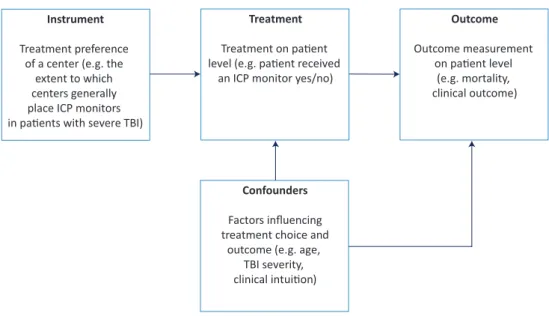
A method that may adjust for unmeasured confounders is instrumental variable analysis. In instrumental variable analysis, the association between an ‘instrument’ and outcome is analyzed.81 This instrument should be associated with the treatment under study, should cause
the outcome only through the treatment under study and its effect should not be associated with the confounders (Figure 3).81 Treatment preference may potentially serve as an instrument
in multicenter observational CER studies, for example, by comparing patient outcomes in centers with a high preference for a particular intervention to patient outcomes in centers with a lower preference for the intervention. This strategy was recently used in two observational multicenter studies on ICP monitoring.82,83
In order to obtain valid estimates of the treatment effect in instrumental variable analyses, it is crucial that the underlying assumptions are met (i.e. instrument is associated with treatment, causes outcome only through the treatment and is not associated with confounders). However, a 2014 systematic review found that these assumptions are often violated.84 For example,
the instrument treatment preference could be associated with geographic location, patient characteristics, facility characteristics and the provision of co-occurring treatments,84 which may
influence the validity of the effect estimate.
Figure 3. Instrumental variable analysis with treatment preference as instrument
Instrument
Treatment preference of a center (e.g. the
extent to which centers generally place ICP monitors in pa!ents with severe TBI)
Treatment
Treatment on pa!ent level (e.g. pa!ent received
an ICP monitor yes/no)
Outcome Outcome measurement on pa!ent level (e.g. mortality, clinical outcome) Confounders Factors influencing treatment choice and
outcome (e.g. age, TBI severity, clinical intui!on)
1
1.3.4 Valorization of scientific knowledge
Valorization refers to the utilization of research findings in clinical practice. Valorization of research might be accomplished by the conduct of systematic reviews and the development of guidelines. Systematic reviews summarize and weight scientific information on the same topic and provide recommendations that may directly inform doctors and policy-makers. Nevertheless, a recent evidence-mapping approach found that only half of the systematic reviews in the acute management of TBI were current (i.e. included the most recent RCTs) and only two-thirds were complete (i.e. including all available RCTs that met the inclusion criteria of the review, taking into account when the review was conducted). Also, for some topics, there were multiple systematic reviews available with sometimes conflicting conclusions.85 Hence, current information from
systematic reviews might be outdated, incomplete and contradictory, which may decrease the translation of research endeavors to clinical practice.
Guidelines are developed to improve quality of care, reduce practice variation and ensure that evidence-based care is optimally implemented.86 The use of guidelines might be associated
with more favorable outcomes in TBI patients.87 However, guidelines can only improve patient
outcomes if they are based on high-quality evidence, properly implemented and adhered to.
1.4 Aims and outline of this thesis
The aim of this thesis is to expand our knowledge on outcome and opportunities for CER in patients with TBI. We maintain an integrative approach by using a wide range of methodologies, including systematic reviews of the literature, analysis of patient data, survey data and a simulation study to address methodological challenges.
The aim of this thesis was operationalized in the following two main research questions:
1. What is the prevalence and what are predictors of outcome following TBI?
a. What is the prevalence of TBI outcome in terms of persistent post-concussion symptoms, psychiatric disorders and HRQoL?
b. What are predictors of TBI outcome?
c. Can we identify patients at greatest risk for suffering post-concussion symptoms? 2. To what extent can CER contribute to evidence generation in TBI?
a. To what extent do clinicians adhere to current evidence from guidelines?
b. To what extent does variation in structure and process characteristics exist among centers treating patients with TBI?
c. What is the influence of analytical methods on the estimate of treatment effectiveness in observational studies? And which method may provide a valid estimate in case of confounding by indication?
This thesis consists of two parts. In Part I (Chapter 2-8) prevalence and predictors of TBI sequelae are described and the possibility of identifying patients at greatest risk for post-concussion symptoms is examined. Specifically, Chapter 2 provides an overview of current knowledge on prevalence, predictors, assessment and treatment of post-concussion symptoms. Chapter
3 examines the influence of definition of post-concussion syndrome on prevalence rates and
predictors. Chapter 4 and 5 study the prevalence and predictors of psychiatric disorders following TBI. Prediction models for six-month post-concussion symptoms were developed and externally validated in Chapter 6 and 7. Chapter 8 assesses HRQoL of Dutch and Chinese TBI patients and examines psychometric properties of the SF-36.
In Part II (Chapter 9-16) of this thesis we examine how CER could contribute to evidence generation in TBI. We start with an overview of current guideline adherence in Chapter 9.
In the Chapters 10 to 13 we describe variation in structures and processes of care, which is a prerequisite for CER. Specifically we focus on general characteristics (Chapter 10), structures and processes during emergency department and hospital admission (Chapter 11), intracranial pressure monitoring and treatment policy (Chapter 12) and rehabilitation (Chapter 13). Chapter 14 describes variation of ICU management across five neurotrauma centers in the Netherlands and uses instrumental variable analysis to analyze the effect of intracranial pressure monitoring. The influence of analytical techniques on effect estimates is further examined in Chapter 15 and
16.
The results of the studies included in this thesis are further discussed in Chapter 17, together with their interpretation and recommendations for future research, policy and clinical practice. This thesis is part of the Collaborative European NeuroTrauma Effectiveness Research in Traumatic Brain Injury (CENTER-TBI; European Union FP 7th Framework program; grant 602150) project;
a prospective longitudinal observational study that is currently recruiting patients from 68 European neurotrauma centers. CENTER-TBI aims to improve characterization and classification of TBI and to identify best clinical care, by using a comparative effectiveness approach. One of the tasks within CENTER-TBI is the characterization of center characteristics by sending out a survey (‘the provider profiling questionnaires’) to the participating neurotrauma centers addressing structural and process characteristics of different phases of care. The development of this survey is described in chapter 10 and the results are presented in chapters 10-13. How the results of this survey can be used for the CENTER-TBI CER analyses, will subsequently be described in the discussion section (Chapter 17).
1
References
1. Peeters W, van den Brande R, Polinder S, et al. Epidemiology of traumatic brain injury in Europe. Acta
Neurochir (Wien) 2015; 157(10): 1683-96.
2. Tagliaferri F, Compagnone C, Korsic M, Servadei F, Kraus J. A systematic review of brain injury epidemiology
in Europe. Acta Neurochir (Wien) 2006; 148(3): 255-68; discussion 68.
3. Ponsford J, Draper K, Schonberger M. Functional outcome 10 years after traumatic brain injury: its
relationship with demographic, injury severity, and cognitive and emotional status. J Int Neuropsychol Soc
2008; 14(2): 233-42.
4. Ponsford JL, Spitz G, Cromarty F, Gifford D, Attwood D. Costs of care after traumatic brain injury. Journal of
Neurotrauma 2013; 30(17): 1498-505.
5. Maas AI, Stocchetti N, Bullock R. Moderate and severe traumatic brain injury in adults. Lancet Neurol 2008;
7(8): 728-41.
6. Broshek DK, De Marco AP, Freeman JR. A review of post-concussion syndrome and psychological factors
associated with concussion. Brain Inj 2015; 29(2): 228-37.
7. McMahon P, Hricik A, Yue JK, et al. Symptomatology and functional outcome in mild traumatic brain injury:
Results from the prospective TRACK-TBI study. J Neurotrauma 2014; 31(1): 26-33.
8. Silverberg ND, Iverson GL. Etiology of the post-concussion syndrome: Physiogenesis and psychogenesis
revisited. NeuroRehabilitation 2011; 29(4): 317-29.
9. Rosenfeld JV, Maas AI, Bragge P, Morganti-Kossmann MC, Manley GT, Gruen RL. Early management of severe
traumatic brain injury. Lancet 2012; 380(9847): 1088-98.
10. Bragge P, Synnot A, Maas AI, et al. A State-of-the-Science Overview of Randomized Controlled Trials
Evaluating Acute Management of Moderate-to-Severe Traumatic Brain Injury. J Neurotrauma 2016; 33(16):
1461-78.
11. Brazinova A, Rehorcikova V, Taylor MS, et al. Epidemiology of traumatic brain injury in Europe: a living
systematic review. J Neurotrauma 2015.
12. Waljas M, Iverson GL, Lange RT, et al. A prospective biopsychosocial study of the persistent post-concussion
symptoms following mild traumatic brain injury. J Neurotrauma 2015; 32(8): 534-47.
13. Mushkudiani NA, Hukkelhoven CW, Hernandez AV, et al. A systematic review finds methodological
improvements necessary for prognostic models in determining traumatic brain injury outcomes. J Clin
Epidemiol 2008; 61(4): 331-43.
14. Kristman V, Borg J, Godbolt A, et al. Methodological issues and research recommendations for prognosis
after mild traumatic brain injury: Results of the International Collaboration on MTBI Prognosis (ICoMP).
Brain Injury 2014; 28(5-6): 817-8.
15. Menon DK, Schwab K, Wright DW, Maas AI. Position statement: definition of traumatic brain injury. Arch Phys
Med Rehabil 2010; 91(11): 1637-40.
16. Maas A. Traumatic brain injury: Changing concepts and approaches. Chin J Traumatol 2016; 19(1): 3-6.
17. Cassidy JD, Cancelliere C, Carroll LJ, et al. Systematic review of self-reported prognosis in adults after mild
traumatic brain injury: results of the International Collaboration on Mild Traumatic Brain Injury Prognosis.
Arch Phys Med Rehabil 2014; 95(3 Suppl): S132-51.
18. Maas AIR MD, Adelson PD, Andelic N. . Traumatic brain injury - integrated approaches to improving clinical
care and research. Lancet Neurology 2017.
19. Roozenbeek B, Maas AI, Menon DK. Changing patterns in the epidemiology of traumatic brain injury. Nat
Rev Neurol 2013; 9(4): 231-6.
20. Teasdale G, Jennett, B.,. Assessment of coma and impaired consciousness. A practical scale. Lancet 1974;
2: 375-7.
21. Koskinen S, Alaranta H. Traumatic brain injury in Finland 1991-2005: a nationwide register study of
22. Cassidy JD, Carroll LJ, Peloso PM, et al. Incidence, risk factors and prevention of mild traumatic brain injury:
results of the WHO Collaborating Centre Task Force on Mild Traumatic Brain Injury. J Rehabil Med 2004; (43
Suppl): 28-60.
23. American Congress of Rehabilitation Medicine (ACRM). Definition of mild traumatic brain injury. 1993.
https://www.acrm.org/pdf/TBIDef_English_Oct2010.pdf (accessed April, 9th 2014).
24. Maas AI, Menon DK, Lingsma HF, Pineda JA, Sandel ME, Manley GT. Re-orientation of clinical research
in traumatic brain injury: report of an international workshop on comparative effectiveness research. J
Neurotrauma 2012; 29(1): 32-46.
25. Wilson JT, Pettigrew LE, Teasdale GM. Structured interviews for the Glasgow Outcome Scale and the
extended Glasgow Outcome Scale: guidelines for their use. J Neurotrauma 1998; 15(8): 573-85.
26. Jennett B BM. Assessment of outcome after severe brain damage. A practical scale. Lancet 1975; 1: 480-4.
27. Roozenbeek B, Lingsma HF, Perel P, et al. The added value of ordinal analysis in clinical trials: An example in
traumatic brain injury. Crit Care 2011; 15(3).
28. Altman DG, Royston P. The cost of dichotomising continuous variables. Bmj 2006; 332(7549): 1080.
29. Maas AIR, Steyerberg EW, Marmarou A, et al. IMPACT Recommendations for Improving the Design and
Analysis of Clinical Trials in Moderate to Severe Traumatic Brain Injury. Neurotherapeutics 2010; 7(1): 127-34.
30. Hicks R, Giacino J, Harrison-Felix C, Manley G, Valadka A, Wilde EA. Progress in developing common data
elements for traumatic brain injury research: Version two-the end of the beginning. Journal of Neurotrauma
2013; 30(22): 1852-61.
31. Dikmen S, Machamer J, Temkin N. Mild Traumatic Brain Injury: Longitudinal Study of Cognition, Functional
Status, and Post-Traumatic Symptoms. J Neurotrauma 2016.
32. Levin HS, Diaz-Arrastia RR. Diagnosis, prognosis, and clinical management of mild traumatic brain injury. The
Lancet Neurology 2015; 14(5): 506-17.
33. Spinos P, Sakellaropoulos G, Georgiopoulos M, et al. Postconcussion syndrome after mild traumatic brain
injury in Western Greece. J Trauma Inj Infect Crit Care 2010; 69(4): 789-93.
34. Ruff RM. Mild traumatic brain injury and neural recovery: Rethinking the debate. NeuroRehabilitation 2011;
28(3): 167-80.
35. Theadom A, Parag V, Dowell T, et al. Persistent problems 1 year after mild traumatic brain injury: A
longitudinal population study in New Zealand. Br J Gen Pract 2016; 66(642): e16-e23.
36. Arciniegas DB, Anderson CA, Topkoff J, McAllister TW. Mild traumatic brain injury: a neuropsychiatric
approach to diagnosis, evaluation, and treatment. Neuropsychiatric disease and treatment 2005; 1(4):
311-27.
37. Zasler ND KD, Zafonte RD,. Post-concussive disorder. Brain Injury Medicine: Principles and Practice: Demos
Medical Publishing; 2006: 374-85.
38. Stalnacke BM. Community integration, social support and life satisfaction in relation to symptoms 3 years
after mild traumatic brain injury. Brain Inj 2007; 21(9): 933-42.
39. King NS, Kirwilliam S. The nature of permanent post-concussion symptoms after mild traumatic brain injury.
Brain Impairment 2013; 14(2): 235-42.
40. Nolin P, Heroux L. Relations among sociodemographic, neurologic, clinical, and neuropsychologic variables,
and vocational status following mild traumatic brain injury: A follow-up study. Journal of Head Trauma
Rehabilitation 2006; 21(6): 514-26.
41. King NS, Crawford S, Wenden FJ, Moss NE, Wade DT. The Rivermead Post Concussion Symptoms
Questionnaire: a measure of symptoms commonly experienced after head injury and its reliability. J Neurol
1995; 242(9): 587-92.
42. Potter S, Leigh E, Wade D, Fleminger S. The Rivermead Post Concussion Symptoms Questionnaire: a
confirmatory factor analysis. J Neurol 2006; 253(12): 1603-14.
43. Eyres S, Carey A, Gilworth G, Neumann V, Tennant A. Construct validity and reliability of the Rivermead
Post-Concussion Symptoms Questionnaire. Clin Rehabil 2005; 19(8): 878-87.
44. Smith-Seemiller L, Fow NR, Kant R, Franzen MD. Presence of post-concussion syndrome symptoms in
1
45. Bombardier CH, Fann JR, Temkin NR, Esselman PC, Barber J, Dikmen SS. Rates of major depressive disorder
and clinical outcomes following traumatic brain injury. Jama 2010; 303(19): 1938-45.
46. Warren AM, Boals A, Elliott TR, et al. Mild traumatic brain injury increases risk for the development of
posttraumatic stress disorder. J Trauma Acute Care Surg 2015; 79(6): 1062-6.
47. Hart T, Brenner L, Clark AN, et al. Major and minor depression after traumatic brain injury. Arch Phys Med
Rehabil 2011; 92(8): 1211-9.
48. Whelan-Goodinson R, Ponsford J, Schonberger M. Association between psychiatric state and outcome
following traumatic brain injury. J Rehabil Med 2008; 40(10): 850-7.
49. Kim E, Lauterbach EC, Reeve A, et al. Neuropsychiatric complications of traumatic brain injury: a critical
review of the literature (a report by the ANPA Committee on Research). J Neuropsychiatry Clin Neurosci
2007; 19(2): 106-27.
50. Rapoport MJ, McCullagh S, Streiner D, Feinstein A. The clinical significance of major depression following
mild traumatic brain injury. Psychosomatics 2003; 44(1): 31-7.
51. Kennedy RE, Livingston L, Riddick A, Marwitz JH, Kreutzer JS, Zasler ND. Evaluation of the Neurobehavioral
Functioning Inventory as a depression screening tool after traumatic brain injury. J Head Trauma Rehabil
2005; 20(6): 512-26.
52. Sumpter RE, McMillan TM. Errors in self-report of post-traumatic stress disorder after severe traumatic brain
injury. Brain Inj 2006; 20(1): 93-9.
53. Rogers JM, Read CA. Psychiatric comorbidity following traumatic brain injury. Brain Injury 2007; 21(13-14):
1321-33.
54. Zaninotto AL, Vicentini JE, Fregni F, et al. Updates and current perspectives of psychiatric assessments after
traumatic brain injury: A systematic review. Frontiers in Psychiatry 2016; 7(JUN).
55. von Steinbuechel N, Petersen C, Bullinger M. Assessment of health-related quality of life in persons after
traumatic brain injury--development of the Qolibri, a specific measure. Acta neurochirurgica Supplement
2005; 93((von Steinbuechel N.; Petersen C.; Bullinger M.) Center of Neurogerontopsychologie, Psychogeriatric University Clinic of Geneva, Geneva, Switzerland.): 43-9.
56. von Steinbuechel N, Covic A, Polinder S, et al. Assessment of Health-Related Quality of Life after TBI:
Comparison of a Disease-Specific (QOLIBRI) with a Generic (SF-36) Instrument. Behav Neurol 2016; 2016:
7928014.
57. Polinder S, Haagsma JA, van Klaveren D, Steyerberg EW, van Beeck EF. Health-related quality of life after
TBI: a systematic review of study design, instruments, measurement properties, and outcome. Popul Health
Metr 2015; 13: 4.
58. Maas AIR, Marmarou A, Murray GD, Teasdale GM, Steyerberg EW. Prognosis and clinical trial design in
traumatic brain injury: The IMPACT study. J Neurotrauma 2007; 24(2): 232-8.
59. Collaborators MCT, Perel P, Arango M, et al. Predicting outcome after traumatic brain injury: practical
prognostic models based on large cohort of international patients. Bmj 2008; 336(7641): 425-9.
60. Steyerberg EW. Clinical prediction models. New York: Springer Sciences and Business Media; 2009.
61. Silverberg ND, Gardner AJ, Brubacher JR, Panenka WJ, Li JJ, Iverson GL. Systematic review of multivariable
prognostic models for mild traumatic brain injury. J Neurotrauma 2015; 32(8): 517-26.
62. Carney N, Totten AM, O’Reilly C, et al. Guidelines for the Management of Severe Traumatic Brain Injury,
Fourth Edition. Neurosurgery 2016.
63. Marklund N, Bakshi A, Castelbuono DJ, Conte V, McIntosh TK. Evaluation of pharmacological treatment
strategies in traumatic brain injury. Curr Pharm Des 2006; 12(13): 1645-80.
64. Manley GT, Maas AIR. Traumatic brain injury: An international knowledge-based approach. JAMA - Journal of
the American Medical Association 2013; 310(5): 473-4.
65. Maas AI, Marmarou A, Murray GD, Teasdale SG, Steyerberg EW. Prognosis and clinical trial design in traumatic
brain injury: the IMPACT study. J Neurotrauma 2007; 24(2): 232-8.
66. Roozenbeek B, Maas AI, Lingsma HF, et al. Baseline characteristics and statistical power in randomized
controlled trials: selection, prognostic targeting, or covariate adjustment? Crit Care Med 2009; 37(10):
67. Signorello LB, McLaughlin JK, Lipworth L, Friis S, Sorensen HT, Blot WJ. Confounding by indication in
epidemiologic studies of commonly used analgesics. Am J Ther 2002; 9(3): 199-205.
68. Bosco JL, Silliman RA, Thwin SS, et al. A most stubborn bias: no adjustment method fully resolves confounding
by indication in observational studies. J Clin Epidemiol 2010; 63(1): 64-74.
69. Sharma S, Gomez D, de Mestral C, Hsiao M, Rutka J, Nathens AB. Emergency access to neurosurgical care for
patients with traumatic brain injury. J Am Coll Surg 2014; 218(1): 51-7.
70. Skoglund K, Enblad P, Marklund N. Monitoring and sedation differences in the management of severe head
injury and subarachnoid hemorrhage among neurocritical care centers. J Neurosci Nurs 2013; 45(6): 360-8.
71. van Essen TA, de Ruiter GC, Kho KH, Peul WC. Neurosurgical Treatment Variation of Traumatic Brain Injury:
Evaluation of Acute Subdural Hematoma Management in Belgium and The Netherlands. J Neurotrauma
2017; 34(4): 881-9.
72. Hesdorffer DC, Ghajar J. Marked improvement in adherence to traumatic brain injury guidelines in United
States trauma centers. J Trauma 2007; 63(4): 841-7; discussion 7-8.
73. Hesdorffer DC, Ghajar J, Iacono L. Predictors of compliance with the evidence-based guidelines for traumatic
brain injury care: a survey of United States trauma centers. J Trauma 2002; 52(6): 1202-9.
74. Enblad P, Nilsson P, Chambers I, et al. R3-Survey of traumatic brain injury management in European Brain IT
centres year 2001. Intensive Care Medicine 2004; 30(6): 1058-65.
75. Wijayatilake DS, Talati C, Panchatsharam S. The Monitoring and Management of Severe Traumatic Brain
Injury in the United Kingdom: Is there a Consensus?: A National Survey. J Neurosurg Anesthesiol 2015; 27(3):
241-5.
76. Stocchetti N, Penny KI, Dearden M, et al. Intensive care management of head-injured patients in Europe: a
survey from the European brain injury consortium. Intensive Care Med 2001; 27(2): 400-6.
77. Medicine Io. Initial National Priorities for Comparative Effectiveness Research. Washington, DC: National
Academies Press; 2009.
78. Maas AI, Menon DK, Steyerberg EW, et al. Collaborative European NeuroTrauma Effectiveness Research in
Traumatic Brain Injury (CENTER-TBI): A Prospective Longitudinal Observational Study. Neurosurgery 2015;
76(1): 67-80.
79. Dreyer NA, Velentgas P, Westrich K, Dubois R. The GRACE checklist for rating the quality of observational
studies of comparative effectiveness: a tale of hope and caution. J Manag Care Spec Pharm 2014; 20(3):
301-8.
80. Dreyer NA, Bryant A, Velentgas P. The GRACE Checklist: A Validated Assessment Tool for High Quality
Observational Studies of Comparative Effectiveness. J Manag Care Spec Pharm 2016; 22(10): 1107-13.
81. Brookhart MA, Schneeweiss S. Preference-based instrumental variable methods for the estimation of
treatment effects: Assessing validity and interpreting results. Int J Biostat 2007; 3(1).
82. Dawes AJ, Sacks GD, Cryer HG, et al. Compliance With Evidence-Based Guidelines and Interhospital Variation
in Mortality for Patients With Severe Traumatic Brain Injury. JAMA Surg 2015; 150(10): 965-72.
83. Alali AS, Fowler RA, Mainprize TG, et al. Intracranial pressure monitoring in severe traumatic brain injury:
results from the American College of Surgeons Trauma Quality Improvement Program. J Neurotrauma 2013;
30(20): 1737-46.
84. Garabedian LF, Chu P, Toh S, Zaslavsky AM, Soumerai SB. Potential bias of instrumental variable analyses for
observational comparative effectiveness research. Annals of Internal Medicine 2014; 161(2): 131-8.
85. Synnot A, Bragge, P., Lunny, C., Menon, D., Clavisi, O., Pattuwage, L., Volovici, V., Mondello, S., Cnossen, M.C.,
Donoghue, E., Gruen, R.L., Maas, A. The currency, completeness and quality of systematic reviews of acute
management of moderate to severe traumatic brain injury: A comprehensive evidence map. Plos One 2017.
86. Thomas L, Cullum N, McColl E, Rousseau N, Soutter J, Steen N. Guidelines in professions allied to medicine.
Cochrane Database Syst Rev 2000; (2): CD000349.
87. English SW, Turgeon AF, Owen E, Doucette S, Pagliarello G, McIntyre L. Protocol management of severe
1
Out
come f
ollo
wing tr
auma
tic br
ain injur
y
2
Mild traumatic brain injury:
A multidimensional approach
to post-concussion symptoms
Suzanne Polinder
Maryse C. Cnossen
Ruben G.L. Real
Amra Covic
Anastacia Gorbunova
Daphne C. Voormolen
Christina L. Master
Juanita A. Haagsma
Ramon Diaz-Arrastia
Nada Andelic
Nicole von Steinbuechel
2
Abstract
Mild traumatic brain injury (mTBI) can present a substantial burden to patients, relatives, and health systems. Whereas recovery is expected in the majority of patients, a subset continues to report persisting somatic, cognitive, emotional, and/or behavioral problems, referred to as post-concussion syndrome (PCS). However, this term has been subject of debate since the mechanisms underlying post-concussion symptoms and the role of pre- and post-injury-related factors are still poorly understood.
Current evidence and controversies concerning the use of the terms post-concussion symptoms versus syndrome, its diagnosis, etiology, prevalence, assessment and treatment in both adults and children are reviewed. Post-concussion symptoms are dependent on complex interactions between somatic, psychological, and social factors. Progress in understanding has been hampered
by inconsistent classification and variable assessment procedures. There are substantial limitations in research to date, resulting in gaps in our understanding, leading to uncertainty regarding epidemiology, etiology, prognosis, and treatment.
Future directions concerning the identification of potential mechanisms, new imaging techniques, comprehensive, multidisciplinary assessment and treatment options are discussed. Longitudinal studies applying standardized assessment strategies, diagnoses, and evidence-based interventions are required in adult and pediatric mTBI populations to optimize recovery and reduce burden of post-concussion symptoms.
2
Introduction
Mild traumatic brain injuries (mTBI) are among the most common neurologic conditions, representing a substantial burden worldwide.1,2 A subset of mTBI patients suffers from acute
post-concussion symptoms that may manifest as somatic, cognitive, emotional, and/or behavioral problems. In a small portion of mTBI patients, post-concussion symptoms persist over time,3,4 which is often referred to as post-concussion syndrome (PCS). PCS is usually diagnosed
according to the International Classification of Diseases (ICD)-105, or following Diagnostic and
Statistical Manual of Mental Disorders (DSM)-IV criteria.6 However, over the last 15 years the
concept of PCS as a reliably identifiable, unique syndrome has been questioned.7,8 Therefore, we
will use the term post-concussion symptoms to describe symptoms following mTBI and will refer to persistent post-concussion symptoms when these persist for at least three months after TBI. This narrative review (based on a systematic literature search till April 5th 2017, see search strategy
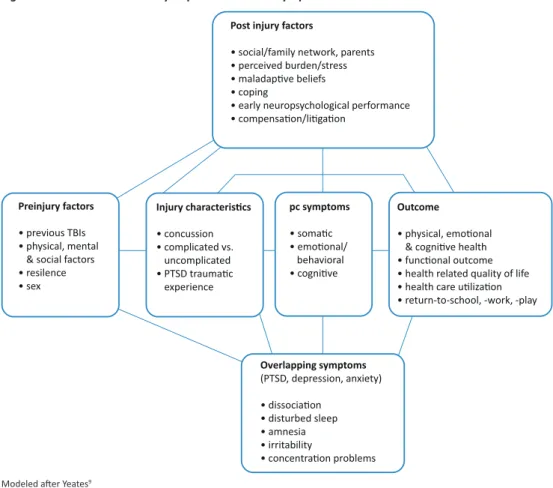
and selection criteria and appendix) adds to the literature by summarizing current knowledge on epidemiology, etiology, assessment and treatment of post-concussion symptoms, using a multidimensional comprehensive coverage of topics, both in adults and children. Understanding the various factors leading to post-concussion symptoms (Figure 1), and the complex interactions between temporal onset, biological, psychological and social factors, as well as the relative influence of injury-related and non-injury related factors may contribute towards the understanding, diagnosis and classification of post-concussion symptoms. In addition, an insight into the wide range of assessment methods and possible treatments may provide guidance for both physicians and policy-makers. Furthermore, this review will provide directions for future research and clinical services, including recommendations on the investigation of etiological factors, assessment and treatment of post-concussion symptoms.
Definitions and epidemiology
Mild Traumatic Brain Injury (mTBI)The American Congress of Rehabilitation Medicine (ACRM)10 defines mTBI as an “acute brain
injury resulting from mechanical energy to the head from external physical forces”, with any of the following symptoms: loss of consciousness (LOC) not exceeding 30 minutes, post-traumatic amnesia (PTA) of no more than 24 hours, a score of no less than 13 on the Glasgow Coma Scale (GCS) after 30 minutes post injury (or upon presentation),11 and an (unspecified) period of
confusion (feeling dazed, disoriented, confused), or other transient neurologic abnormalities such as focal signs or seizures.
Figure 1. A model for the study of post-concussion symptoms after mTBI
Post injury factors
• social/family network, parents • perceived burden/stress • maladap!ve beliefs • coping
• early neuropsychological performance • compensa!on/li!ga!on
Preinjury factors
• previous TBIs • physical, mental
& social factors • resilence • sex Injury characteris!cs • concussion • complicated vs. uncomplicated • PTSD trauma!c experience pc symptoms • soma!c • emo!onal/ behavioral • cogni!ve Outcome • physical, emo!onal & cogni!ve health • func!onal outcome • health related quality of life • health care u!liza!on • return-to-school, -work, -play
Overlapping symptoms (PTSD, depression, anxiety) • dissocia!on • disturbed sleep • amnesia • irritability • concentra!on problems
Modeled after Yeates9
Literature on mTBI frequently distinguishes between complicated and uncomplicated mTBI. Most mTBI patients do not show trauma-related abnormalities on computed tomography (CT) scans. However, the term “complicated mTBI” can be used to refer to the, e.g. 5-10% of emergency department (ED) patients12 showing abnormalities, such as subarachnoid hemorrhage,
intracranial contusions, or small extra-axial hematomas.
Controversies related to definitions
Post-concussion symptoms following mTBI refer to somatic symptoms of brain injury (nausea, dizziness, headache, blurred vision, auditory disturbance, fatigue), cognitive deficits involving memory and executive function, or emotional/behavioral changes (disinhibition and emotional lability).5,6,10 The literature on mTBI frequently uses the term “symptom” to refer to all changes
experienced after a concussion, regardless of whether they refer to the patient’s subjective report, for which the term “complaints” might be more appropriate. In this review, the term “symptoms” will be applied to remain consistent with the literature.
2
Post-concussion symptoms do not always cluster in a consistent and predictable manner, and it is controversial whether they truly represent a specific, cohesive, and predictable syndrome.8,13
Although the term post-concussion symptoms might suggest otherwise, these symptoms are not specific to TBI but are also frequently reported in non-brain injured trauma patients14, including
patients with whiplash injuries15 and even in healthy adults and children.16-18
PCS is usually defined according to DSM-IV or ICD-10 criteria, with both focusing on symptom presentation.13 These manuals agree on the prerequisite history of brain trauma for the diagnosis
of post-concussional disorder (DSM-IV6) or PCS (ICD-105). Differences between diagnostic systems
are presented in Table 1. An important difference is that DSM-IV requires immediate symptom onset and persistence for at least three months whereas ICD-10 does not. In addition, DSM-IV requires objective evidence of memory or attention deficits (criterion B), but ICD-10 explicitly precludes such evidence (criterion C-3). The variability in terminology and associated criteria of the DSM-IV and ICD-10 hampers accurate identification and diagnosis of patients with PCS.9
Different classification methods may result in overestimation or underestimation of symptoms, particularly when relying on subjective endorsement of symptoms by patients. This was shown in a cross-sectional study in which 61 patients were referred to a concussion clinic following mTBI.19
Table 1. Comparison of three definitions of post-concussion symptoms
ICD-10 DSM-IV DSM-5 Headache ✓ ✓ Dizziness ✓ ✓ Fatigue ✓ ✓ Noise intolerance ✓ ✓ Irritability/lability/anxiety/depression ✓ ✓ Sleep problems ✓ ✓ Concentration problems ✓A ✓B ✓B Memory deficit ✓A ✓B ✓B Intolerance of alcohol ✓
Preoccupation with symptoms ✓
Personality change ✓
Apathy ✓
Perceptual-motor ✓B
Social cognition ✓B
Table shows symptoms presented in the International Classification of Diseases (ICD)-10 definition of PCS (diagnosis code F07.02), the Diagnostic and Statistical Manual of Mental Disorders (DSM)-IV definition of postconcussional disorder and the DSM-V definition of
neurocognitive disorder. A Subjective report; B Objective test.
Post-concussional disorder was not included in the last DSM-5 edition.20 Instead, DSM-5 includes
“mild neurocognitive disorder due to TBI”, a neurocognitive disorder, which strongly suggests – but not formally requires- performance-based, quantifiable evidence of acquired cognitive
deficits after mTBI (Table 1). Importantly, in DSM-5 the most frequently reported post-concussion symptoms are reduced to the status of “associated features”. In addition, DSM-5 emphasizes the broad differential diagnoses, especially when symptom severity “appears to be inconsistent with the severity of the TBI”.21
Prevalence of post-concussion symptoms
Prevalence of post-concussion symptoms varies and depends on pre-injury factors,14,22 patient
population (see panel 1),23 assessment,23 analysis strategies, and diagnostic criteria.23,24 Overall,
single symptoms (e.g. headache or depression) are very common25 (Figure 2), whereas multiple
concurrent symptoms are less frequent.23
Neuropsychological testing consistently shows minor cognitive deficits within the first two weeks after injury, with some exploratory evidence suggestion deficits lasting up to six months.26 It has
been suggested that self-reported somatic symptoms (headaches, dizziness) are more prevalent immediately after the injury (1-2 weeks)27, whereas cognitive and emotional symptoms resolve
more slowly and may still be above baseline levels at three months post injury.28 However, as
these are cross-sectional analyses, which do not track the evolution of symptoms in single patients, evidence supporting a differential trajectory between self-reported somatic and cognitive/emotional subacute symptoms is limited.
ICD-10 prevalence rates at three months post-injury vary between 6%,29 22%30 and 64%.24
DSM-IV diagnostic criteria appear to be stricter than ICD-10 criteria leading to lower estimates when using DSM-IV: a cohort study of patients after mTBI found a prevalence of PCS at three months of 64% based on ICD-10 criteria, but only a prevalence of 11% when using DSM-IV.24
Only few pediatric studies report prevalence of post-concussion symptoms based on ICD-10 or DSM-IV diagnostic criteria; one-month prevalence for children recruited from ED based on ICD-10 reach 52%18 and three-month prevalence based on DSM-IV constitutes 29.3%.31 Some
studies define symptomatic children as having an increase at least in one symptom and arrive at estimates between 24.5-52.5% at one month post injury,18,32 11-39% after three months,
and 2.3% at 12 months,18 which makes comparison of symptom development trends between
children and adults challenging. An additional complication in capturing prevalence rates in children is that younger children may not be able to describe their symptoms reliably. Therefore, such prevalence estimates should be treated with caution.
2
Figure 2. The prevalence of post-concussion symptoms over timeHearing Mid back pain Vision Depression Memory Low back pain Headache Dizziness Neck pain Tiredness Sleep 0 20 40 60
Percent of mTBI pa!ents
Timepoint 6 weeks (n = 1442) 3 months (n = 1415) 6 months (n = 1321) 9 months (n = 1193) 12 months (n = 1158)
Figure is based on data presented in Hartvigsen et al.25
Etiology
Acute and persistent post-concussion symptoms
Acute symptoms post-injury, such as headache, dizziness, sensitivity to light or noise, double vision or tinnitus, are associated with the development of persistent symptoms.13,33,34 A clinical
risk score in children has identified headache, sensitivity to noise, fatigue and answering questions slowly as predictive of post-concussion symptoms at 28 days post-injury.35 In addition,