EMPIRICAL CAPACITY MODELLING OF
ROUNDABOUTS FOR MID-SIZED CITIES
A DISSERTATION SUBMITTED
BY
DIGBIJAYEE HIAL (711CE3003)
In partial fulfilment of requirements for the award of
the degree of
Master of Technology
(Dual Degree)
In
Civil Engineering
Specialization Transportation Engineering
DEPARMENT OF CIVIL ENGINEERING NATIONAL INSTITUTE OF TECHNOLOGY
ROURKELA-769008, ODISHA, INDIA MAY 2016
Dedicated to my parents
Mr. Dilip Kumar Hial
&
Mrs. Kunjalata Hial
And my loved one.
Department of Civil Engineering
National Institute of Technology, Rourkela
CERTIFICATE
This is to certify that the thesis entitled,
“EMPIRICAL CAPACITY
MODELLING OF ROUNDABOUT FOR MID-SIZED CITIES”submitted
by Mr.Digbijayee Hial in partial fulfilment of the requirements for the award of
Master of Technology in Civil Engineering with specialization in
Transportation Engineering at the National Institute of Technology, Rourkela is
an authentic work carried out by him under my supervision and guidance.
To the best of my knowledge, the matter embodied in this dissertation has not
been submitted to any other Institute or organisation for the award of any degree
or diploma.
Prof. Prasanta Kumar Bhuyan
(Project supervisor)ACKNOWLEDGEMENT
As a matter of prominence, I want to express my profound feeling of admiration and
appreciation towards my guru and mentor Prof. Prasanta Kumar Bhuyan, who has been the
principal power behind this work. I am incredibly obligated to him for his consistent
succour, imperative reinforcement and for driving me further in each part of my scholastic
life. His nearness and hopefulness have given a priceless impact on my vocation and
standpoint for what's to come. I think of it as my favourable luck to have a chance to work
with such a splendid individual.
Next, I need to express my regards to our Director, NIT Rourkela, HOD Civil Engineering
Department Prof. S.K Sahu, Prof. M. Panda and Prof. U. Chattaraj for showing me
furthermore helping me how to learn. They have been awesome wellsprings of motivation to
me and I express in all seriousness.
I might want to thank every one of my companions and friends insightful and brain
empowering exchanges we had and particularly my colleague Ashish Kumar Patnaik,
Research Scholar (PhD) for all the work and we have done together , which incited us to
think past the away from palpable. I have made the most of their fraternity such a great
amount amid my stay at NIT, Rourkela.
I am particularly obligated to my family for their affection, sacrifices, and strengthening.
They are my first educators after I am born in this world and have set incredible instance for
me about how to live, study and work.
Digbijayee Hial
(711CE3003)
ABSTRACT
plays an essential role in terms of its ability to deal with the present traffic scenario. The changing geometrics of roundabout causes Measurement of Performance of existing roundabout vast variation in the entry capacity of the roundabout. A of weaving section, Width of non-, length of weaving, weaving section, section, Width and traffic characteristics. was very precise of approach way study was conducted to gather data from roundabouts with varying geometric parameters which are Central, Entry width, width found to be significant relationship Five geometric parameter with c island diameter capacity but Width of approach way does not fit So using empirical analysis based on five geometric to be significant for figuring the capacity. Every parameter used in this equation has a multiplicative relation with the parameter a model was developed which appropriate for Indian traffic scenario authenticated entry flow.
1.0 INTRODUCTION
1.1
General
One of the very essential component of large cities concerns immensely to grow a web which would be able to live up to the objects of this new era traffic. To deal with the traffic efficiency an authoritative role is played by the design Transportation system is a well-managed Road network which connects every place irrespective of human habitat at that place or not. Today’s of inter A roundabout is a type of circular node or joint in which road traffic flows nearly endlessly in one direction round the central island.
sections which must be done very precisely. In proper channelization requirement of traffic in small lanes increases, the drivers, pedestrians, and cyclists are generally simpler than other intersection at roundabouts are with lesser vehicle delay than agitation at the joining also increases violently. nalized intersections plays a huge role in road network. Unlike signalized intersectionsignalized intersection that it has many points of conflict.
As the total over the years, several signalized intersection movement of traffic arise without any obstruction. Drawback of un- Un-sigman controlled by traffic police. Later years to reduce the human effort rotaries were introduced. Then the basic of rotaries was then transformed to what we call as roundabouts. Vehi rectification have been through to bring it down. From ages, the traffic intersections was and of the traffic Un-signalized intersections plays a huge role in road network. Unlike cles travels in same direction at Roundabouts, It also eliminate the right angle and left turn conflicts which was associated with the traditional roundabouts. Well-designed Roundabouts emphasises the controlling of velocity of vehicles. Speed control can be manifested cles travels in same direction at Roundabouts, It also eliminate the right angle and left turn conflicts which was associated with the traditional roundabouts. Well-designed Rouby good geometric features.. The Roundabouts design allows walkers to cross one way of road traffic at a period on each leg of roundabout, it is simpler than other intersection.
Typical Operation So safety in roundabout is more predominant than older intersections. At Roundabouts decision made by other control type intersections. As for
roundabout, usually with very low average delay. Using traffic signal in roundabouts make it more efficient for having it is not required for the road traffic to come to a complete pause without a conflict. Performance of roundabout although the early building cost region of 25 years, equalled with 10 years for classic intersections. It also provides much cost saving to society due to minimizing the fatal crashes and injuries during off-pick period is better compared to other intersections, maximum volume junctions.
it allows to move them slowly and it reduces the sum of acceleration or deceleration cycle and the time spent wasting, Roundabouts are environmental friendly because it prevent vehicles to come to a complete of roundabout possibly will be more but it can have a smaller amount of operating and keep cost than other, it’s service life is ominously extended, in the pause rather so this may reduce the noise and air pollution. Over their service life.
1.2 Organization of the Report
This report is organized by the following chapters:
Chapter 1 provides an overview about the inevitability and prominence of roundabout in contemporary road traffic situation. It offers the intention and choice of study to be conducted in epitome.
Chapter 2 delivers a facet of the numerous works existing on the operational analysis of roundabouts around the world till date models for capacity valuation. The outcome of change in geometrics on capacity is also showed using graphs.
Chapter 3 defines the comprehensive prevailing models on empirical analysis used around the world are clarified, which has been additionally process for establishment of an empirical model to evaluate the entry volume of roundabout and the factors reflected for the same. Along with these a short-term explanation of used for evaluation with established model.
Chapter 4 represents the position of study area assumed to detect the road traffic actions at the roundabouts. Which have been gathered from the field study are pronounced.
Chapter 5 shows the outcomes gained using the collected data, as well as the data extracted from the location data, it also pronounces the practises used to gather data at the location and phase of collection. Numerous constituents’ equation gained for capacity and evaluation of developed model with present Chapter 6 provides the condensed and conclusion of the study
done on the entry capacity in Indian situation and also the upcoming choice which can be achieved on the subject.
2.0 LITERATURE REVIEW
2.1 General
It has been done around the world to develop empirical capacity model considering the local traffic and geometric variations. This result in many countries capacity model, which perhaps Thus consequences of that many course is the UK TRRL model advanced by Kimber (1980) based on experimental analysis cannot has developed their own empirical be applied in Indian conditions. To existence that is roundabouts, since that era roundabout became a topic of enormous scope for researchers & early day publish of roundabout traffic problems in many states and known cities around the globe gave a new practice engineers. Some research of action have been put out by European and American countries asserting the process to appraisal the capacity of roundabouts and also additional aspects affecting the presentation and scheme of roundabouts.
Top model software for transportation is developed that is SIDRA INTERSECTION. The term SIDRA Typical exemplary Implementing three models are utilised to differentiate among the two exemplary option in SIDRA INTERSECTION .The structures associated contain to denote driver behaviour and roundabout geometry and exemplary correction systems methodology, exemplary level of parameter used in the model.
USA and improvised to is a guide of information ,design and performance includes roundabout all over the world It also describes of roundabout. It includes various design and analysis aspects capacity estimation method of roundabouts like level of service, data inputs for the analysis and also the scope and limitation of the methodology. Of the roundabout, the regression regarding the calculation of capacity analysis and the had been considered. It explains in detail the theory to develop the model based on. A web document on regarding the roundabouts states in detail the various literature available around the world on roundabout regarding
A book on Calculation of was written by defines capacity of entry as the leg movement that origins the Capacity is dependable on a series of variables demonstrating the geometrical lasting occurrence of automobiles form a queue to move in. design of the roundabout. In two way a capacity formulation can be achieved.
a with empirical statistics of queuing concept prototypes, i.e. ) It possibly will be accomplished by the standardisation prototypes based on the gap-acceptance theory.
b) It may possibly be acquired to specimen of road through experiential regression practices applied traffic data deprived of using the queuing philosophy.
Capacity
Enough, which is seen now days. As the time changes the requirement of features in roundabout has grown. The traffic Earlier roundabouts were just a post in the centre of the intersection which have been evolving day by day and become modern premise made the designer to width of roundabouts change the diameter of circle and circulatory track as obligatory .The modern roundabouts are so designed that the traffic flow could be handled efficiently.
3.0 METHODOLOGY
3.1 General
Method it requires a huge number of data Various methodologies many countries have studied the facet of finding out the various performances of used to determine capacity and other capabilities road elements for behaviour of traffic. Have been of different relationship among considered parameter roundabouts in various countries which considered different parameters and performance of roundabout. The parameters considered to decide the are generally. Empirical methods are based parameters which affect it and on capacity measurement by calibration using that is again geometric parameters affects very much to the capacity of the roundabout. From long back, empirical methods have been. used to determine the capacity in many countries and they satisfied their validated with real traffic scenario requirement for their required time length. As empirical other countries and to calibrate the methods possess some advantages, it also possess some greater disadvantages too like poor transferability to empirical set. Which make the method troublesome to handle.
capacity model
Al-Masaeid built up this model in. The methodology utilizing relapse investigation was utilized to build up the passage limit 1997 to figure the limit of the roundabouts in utilizing exact techniques model as a component of circling stream and the indirect geometry. on the results, the following Multivariate relapse examination was directed to build up a general limit model. Based regression equation was established to greatest fitting the capacity statistics:
Where,
Gave legitimate results about the limit of circuitous. In addition, it was found that the outcomes so acquired match the outcomes This technique has not been connection got by other European models. The This technique has not been.
information gathered to get this is minutes, which is far outcomes got utilizing this condition were found to fit the activity design in. The exponential less to acquire an exact condition to fulfil a utilized as a part of whatever other nation yet, so its ease of use in different nations is not yet known wide range of activity.
4.0 STUDY AREA AND DATA COLLECTION
4.1 General
Various parts of assemblage are as follows purpose of model development some ideologies India for people of different lifestyle also varies in terms of substructure in field of profession, existing varies extensively with different cultures, customs, and the behaviour is a questionable thing traffic along of peoples. The term development surroundings and the transference. Thus it can in different portions of India. Be shortened that the performance and configuration of road to select the appropriate site of the existing many roundabouts in India with boulevard substructure is diverse So, to wonder. To pursue the down for choice of location for data which placed.
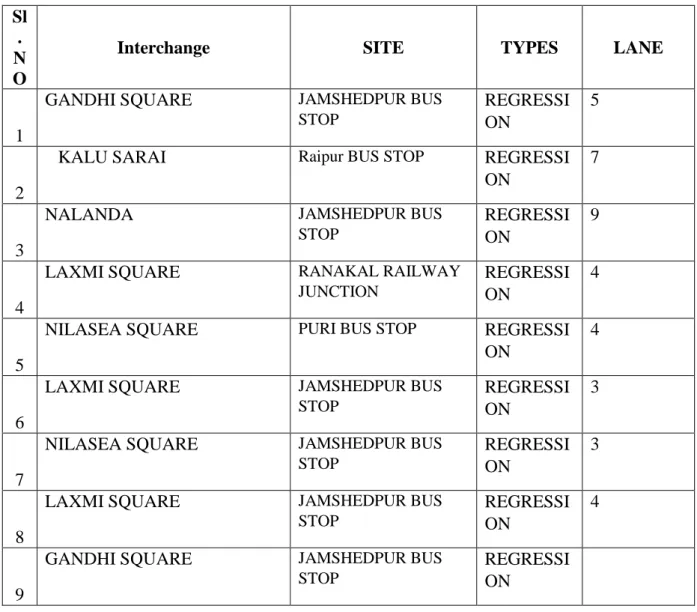
Table 4.1 model development
Sl . N O
Interchange SITE TYPES LANE
1
GANDHI SQUARE JAMSHEDPUR BUS
STOP
REGRESSI ON
5
2
AKALU SARAI Raipur BUS STOP REGRESSI
ON
7
3
NALANDA JAMSHEDPUR BUS
STOP
REGRESSI ON
9
4
LAXMI SQUARE RANAKAL RAILWAY
JUNCTION
REGRESSI ON
4
5
NILASEA SQUARE PURI BUS STOP REGRESSI
ON
4
6
LAXMI SQUARE JAMSHEDPUR BUS
STOP
REGRESSI ON
3
7
NILASEA SQUARE JAMSHEDPUR BUS STOP
REGRESSI ON
3
8
LAXMI SQUARE JAMSHEDPUR BUS
STOP
REGRESSI ON
4
9
GANDHI SQUARE JAMSHEDPUR BUS
STOP
REGRESSI ON
10
AKALU SARAI JAMSHEDPUR BUS
STOP
REGRESSI ON
50
11
GANDHI SQUARE JAMSHEDPUR BUS
STOP
REGRESSI ON
50
12
AKALU SARAI JAMSHEDPUR BUS
STOP
REGRESSI ON
5
13
NALANDA JAMSHEDPUR BUS
STOP
REGRESSI ON
7
14
KALU SARAI HIRALAL JUNCTION REGRESSI
ON
9
15
NALANDA MAHAVEER SQUARE REGRESSI
ON
4
16
KALU SARAI HIRALAL JUNCTION REGRESSI
ON
4
17
NALANDA MAHAVEER SQUARE REGRESSI
ON
3
18
LAXMI SQUARE JAMSHEDPUR BUS
STOP
REGRESSI ON
3
19
NILASEA SQUARE JAMSHEDPUR BUS STOP
REGRESSI ON
4
20
KALU SARAI HIRALAL JUNCTION REGRESSI
ON
21
NALANDA MAHAVEER SQUARE REGRESSI
ON
50
22
KALU SARAI JAMSHEDPUR BUS
STOP
REGRESSI ON
50
23
NALANDA JAMSHEDPUR BUS
STOP
REGRESSI ON
5
24
KALU SARAI Raipur BUS STOP REGRESSI
ON
7
25
NALANDA JAMSHEDPUR BUS
STOP
REGRESSI ON
9
26
KALU SARAI RANAKAL RAILWAY
JUNCTION
REGRESSI ON
4
27
NALANDA PURI BUS STOP REGRESSI
ON
Coefficients for sites Sl. No INTERCHANGE M N H 1 GANDHI SQUARE 4 25 1 2 AKALU SARAI 5 24 4 3 NALANDA 6 89 5 4 LAXMI SQUARE 3 43 2 5 NILASEA SQUARE 5 54 4 6 LAXMI SQUARE 2 43 5 7 NILASEA SQUARE 1 54 2 8 LAXMI SQUARE 4 23 3 9 GANDHI SQUARE 9 21 1 10 AKALU SARAI 7 54 0 11 GANDHI SQUARE 4 54 9 12 AKALU SARAI 5 54 4 13 NALANDA 6 54 6 14 KALU SARAI 3 54 54 15 NALANDA 5 25 1 16 KALU SARAI 2 24 4 17 NALANDA 1 89 5 18 LAXMI SQUARE 4 43 2 19 NILASEA SQUARE 5 54 4 20 KALU SARAI 6 43 5 21 NALANDA 3 54 2 22 KALU SARAI 2 23 3 23 NALANDA 1 21 1 24 KALU SARAI 4 54 0
25 NALANDA 9 54 9
26 KALU SARAI 7 54 4
27 NALANDA 2 54 6
Plays a significant role. So checking for the determination of capacity geometrics of extremely important task. The roundabout variation of entry flow with geometric parameter is a distinction of and the each geometric per the entering stream was formed independently identical was chosen for the establishment of final model grounded on all geometrics by means for entry capacity is observed for every of circulating stream engaged together. Different type of variation geometric.
5.0 ANALYSIS AND RESULTS
5.1 Data Extraction
At the point when the information gathering was over for twenty seven roundabouts having activity stream recordings amid separate crest periods for over 2 hours. Required information was extricated in the wake of dissecting the video. For each passage way the entering stream was figured moment insightful. The quantity of substantial autos, light cars, bicycles, bikes a creature drawn vehicles inflowing the circuitous were ascertained particularly and joined to give the aggregate number of vehicles inflowing from side to side that track. Redundancy of this system was accomplished for each path. In like manner coursing stream was additionally figured for every path to adjust limit. Both the passage stream and coursing stream information was changed over as far as traveler auto units (PCU). Relationship between coursing stream and section stream requires this information.
5.2 Analysis of data
5.2.1 Linkage among entering and circulating stream
The alliance among entering and circling stream was then settled for every single methodology contemplated. The sections for displaying among every one of the legs such that they give greatest number of at limit stream values, for getting appropriate relationship between them. Direct bond amongst entering and circling stream demonstrated that the coursing stream drew nearer to zero when section stream is high, yet it's never the case. Exponential relationship was endeavored in the model improvement process.
5.3 Model Development
Focal Island Diameter (D) shifts as force for best fit with Entry stream. In any case, other four parameters Weaving Width (WW), Entry Width (EW), Weaving Length (WL), Width of non-weaving area (NW) differ exponentially with Entry stream. Carriage width of methodology
31
street does not demonstrate any noteworthy association with section stream.
5.4 Validation of model
Verification is the strategy of figuring out if the arithmetical results measuring the created connections amongst variables, accomplished after relapse examination, are agreeable as records of the insights. Confirmation of model are utilized to evaluate genuinely the presumable execution of the model on another information set.
6.0 Conclusion
It has been found to be diverse and greater given in all the sites. had a boundless fluctuation in every aspect from domicile to domicile which is dissimilar to any other The in terms of possess a prime deciding factor of capacity and performance of roundabout. So, this concept has geometry was observed. Afterward emphasis on geometry has been road medium and small sized cities country’s traffic condition. The traffic condition in Indian scenario consisted and conceived of fluctuating number of It is known from the studies that number of roundabout in rode network has increased over the past few years. In early established. Capacity days outdated methods were used to estimate signifies the capacity of roundabouts for developing the model in Indian context as wide variation model determination was desired to be capacity of roundabout, so an innovative aspect which been taken as base has a history around the globe considering geometric as one of its.
7.0 References
Al-Masaeid, H.R., and Faddah, M.Z. 1997. Capacity of roundabouts in Jordan, Transportation Research Record: Journal of the Transportation Research Board, No.1572, 76-85.
IRC 65: Recommended Practice for Traffic Rotaries, 1976, Indian Road Congress.
Malhotra, H. C., Kadiyali, L. R., Srinivasan, N. S. and Sikka R. P. 1976. Recommended practice for traffic rotaries, Indian Road Congress, New Delhi, Code - No. 65.
NCHRP Web-only Document 94: Appendixes to NCHRP 572: Roundabout in United States, Transportation Research Board, 2006.
ARR 321, Roundabouts: Capacity and Performance Analysis, arrb Transport Research, 1998.
Bie, J, H K. Lo and S. C. Wong (2006), “Capacity of Multi-Lane Roundabout: Methodology Based on Lane Utilization”, American Society of Civil Engineers, pp.590-595.