University of South Florida
Scholar Commons
Graduate Theses and Dissertations Graduate School
1-15-2014
A Phenomenological Study of the Experiences of
Higher Education Students with Disabilities
Allen J. Heindel
University of South Florida, [email protected]
Follow this and additional works at:https://scholarcommons.usf.edu/etd
Part of theHigher Education and Teaching Commons,Instructional Media Design Commons, and theSpecial Education and Teaching Commons
This Dissertation is brought to you for free and open access by the Graduate School at Scholar Commons. It has been accepted for inclusion in Graduate Theses and Dissertations by an authorized administrator of Scholar Commons. For more information, please contact
Scholar Commons Citation
Heindel, Allen J., "A Phenomenological Study of the Experiences of Higher Education Students with Disabilities" (2014).Graduate Theses and Dissertations.
A Phenomenological Study of the Experiences of Higher Education Students with Disabilities with Online Coursework
by
Allen J. Heindel
A dissertation submitted in partial fulfillment of the requirements for the degree of
Doctor of Philosophy
Department of Secondary Education College of Education
University of South Florida
Major Professor: Glenn G. Smith, Ph.D. Daphne D. Thomas, Ph.D.
Stephen J. Thornton, Ph.D. Jennifer R. Wolgemuth, Ph.D.
Date of Approval: January 15, 2014
Keywords: distance education, disabled students, phenomenology, qualitative research Copyright © 2014, Allen J. Heindel
DEDICATION
It is with gratitude that I dedicate this achievement to my wife, Mary Heindel, my aunt, Marilyn Katzenmeyer, and my late mother, Marion Dawn Allen. In their own ways, each of these wonderful women has shown an unwavering willingness to support me in this pursuit. Without their guidance, inspiration, and support this project would never have reached fruition. They each showed confidence in me when I needed it and helped me to persevere; I hope I can make you proud. I thank you and I love you.
ACKNOWLEDGMENTS
Thank you to Dr. William G. Katzenmeyer, my “Uncle Bill,” a lifetime educator whose kind and generous support made this achievement possible and whose unique way of thinking and continued thirst for learning inspires me. I am much obliged to both you and Marilyn for all you have done to get me to this point.
Thank you to my father, George Heindel, Jr., for generously supplying me with a new computer in early 2011 when I was in dire need. Your support and much needed gift were, and still are, greatly appreciated.
Thank you to my Major Professor, Dr. Glenn G. Smith, for his guidance and support in both my personal and professional development. Thank you also to my doctoral committee, Dr. Daphne D. Thomas, Dr. Stephen J. Thornton, and Dr. Jennifer R. Wolgemuth for their
constructive feedback throughout this process.
Lastly, thank you to the students who consented to participate in this research. They are to be commended for helping advance research for students with disabilities in online courses in higher education. Without their generosity, this dissertation could not have been written.
TABLE OF CONTENTS
List of Figures ... iv
List of Tables ... v
Definitions of Terms ... vi
Abstract ... x
Chapter One: Introduction ... 1
Introduction ... 1 Statement of Problem ... 3 Purpose of Study ... 4 Theoretical Rationale ... 5 Importance of Study ... 7 Research Questions ... 7 Delimitations ... 7 Limitations ... 8 Conclusion ... 10
Chapter Two: Literature Review ... 11
Introduction ... 11
The experiences of students with disabilities in higher education settings ... 13
Accessibility ... 16
The quality of effective learning environments ... 19
Transactional Distance ... 19
Interaction ... 20
Collaboration / Social Learning ... 27
The Community of Inquiry Model ... 30
Support ... 31
Assistive Technology ... 34
Learner Satisfaction ... 36
Prior Computer Experience / Number of Courses Taken ... 38
Conclusion ... 41
Chapter Three: Method ... 47
Introduction / Overview of Qualitative Methodology ... 47
Phenomenology ... 47
Self as Researcher... 52
Data Collection ... 56
Surveys... 56
Interviews ... 59
Ethics and Reflexivity... 62
Data Analysis ... 63 Trustworthiness ... 66 Credibility ... 67 Transferability... 68 Dependability ... 69 Confirmability... 70 Conclusion ... 71
Chapter Four: Participant Profiles ... 72
Introduction ... 72 Participant Profiles ... 75 Participant 1 ... 75 Participant 2 ... 76 Participant 3 ... 78 Participant 4 ... 82 Participant 5 ... 85 Participant 6 ... 89 Participant 7 ... 96 Participant 8 ... 99 Participant 9 ... 104 Participant 10 ... 107 Participant 11 ... 112 Participant 12 ... 116
Emergent Themes / Essence ... 121
Chapter Five: Summary... 124
Introduction ... 124 Research Question 1 ... 124 Learner Satisfaction ... 124 Research Question 2 ... 129 Structure ... 129 Support ... 132 Interaction ... 135 Research Question 3 ... 137 Support ... 137 Presence ... 140 Research Question 4 ... 144 Summary ... 148 Implications ... 158
Difference between K-12 classes and universities ... 158
Universal Design for Instruction (UDI) ... 162
The Office of Students with Disabilities Services ... 163
Future Research ... 164
References ... 166
Appendix A: Authorization of Study by Institutional Review Board ... 183
Appendix B: Study Participant Solicitation Letter ... 184
Appendix C: Letter requesting permission to use Course Interaction Structure and Support (CISS) instrument, with lead author’s subsequent response... 185
Appendix D: Course Interaction Structure and Support (CISS) instrument – Original ... 187
Appendix E: Course Interaction Structure and Support (CISSS-M) instrument – Modified ... 191
LIST OF FIGURES
LIST OF TABLES
Table 1: Distance Learning Constructs ... 9
Table 2: Importance of Constructs to Study ... 42
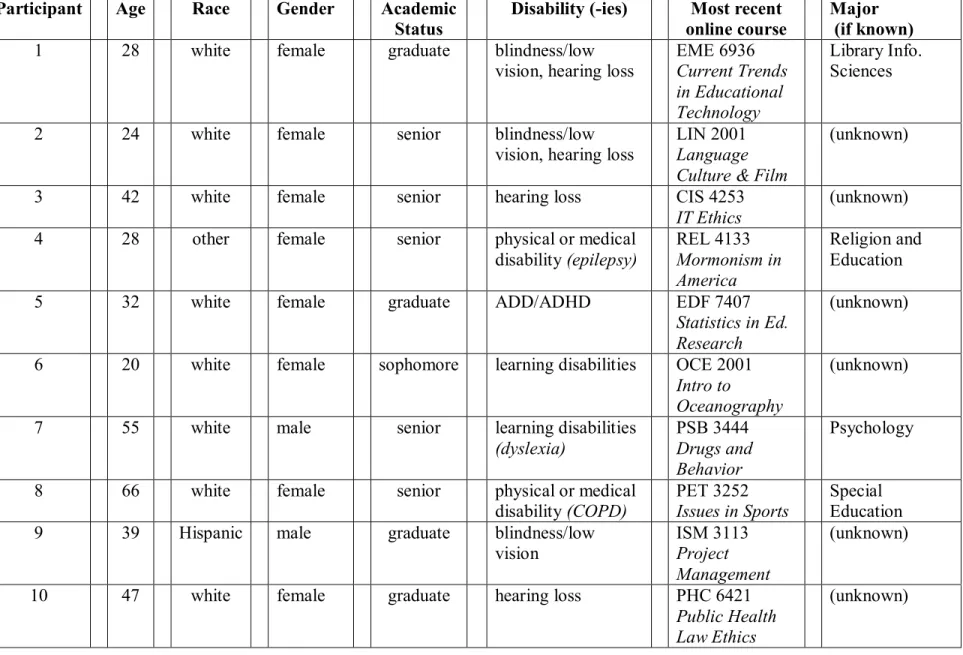
Table 3: Study Sample Overview ... 73
DEFINITIONS OF TERMS
Accommodation: (see Reasonable Accommodation).
Assistive technology: any item, piece of equipment, or product system, whether acquired commercially off-the-shelf, modified, or customized, that is used to increase, maintain, or improve the functional capabilities of individuals with disabilities (Technology Related Assistance for Individuals with Disabilities Act of 1988, 1988).
Asynchronous: a mode of education that does not take place simultaneously, in real time. The instructor may deliver instruction via video, computer, or other means, and the students view and respond at a later time. For example, feedback could be delivered via the web or videotapes, and the feedback could be sent via e-mail messages (Barron, 1999). Common forms of online
asynchronous communication include e-mail, blogs, and threaded discussion forums (Thomas and Maddux, 2009).
Cognitive disabilities: a limitation in sensorimotor actions originating in the physical or chemical structures of the brain and producing observable and assessable limitations in routine task
behavior. Broadly stated, a limitation of the ability to perceive, recognize, understand, interpret, and/or respond to information. A person with a cognitive disability has greater difficulty with one or more types of mental tasks than the average person. Most cognitive disabilities have some sort of basis in the biology and mental processes is the most obvious in the case of
traumatic brain injury and genetic diseases, but even the more subtle cognitive disabilities often have basis in the structure or chemistry of the brain (Allen, 1987).
Cognitive presence: is an exploration phase where learners are gathering, confirming and sharing information from a range of resources. This includes dialogue where learners
deconstruct their own experiences, brainstorm ideas and question themselves and others. “The extent to which learners are able to construct and confirm their own meaning through sustained reflection and discourse in a critical community of inquiry” (Garrison, Anderson, and Archer, 2001, p. 11).
convenience sample: results when the more convenient elementary units are chosen from a population for observation. Retrieved March 10, 2010 from
http://www.socialresearchmethods.net/tutorial/Mugo/tutorial.htm
Critical discourse: characterized by the integration and analysis of information from multiple sources. Learners use this knowledge to begin to resolve their initial feeling of dissonance experienced from the triggering event. It is here where dialogue with an informed voice and higher order thinking influences proposed future actions and reflection (Lock and Redmond,
Disability: with respect to an individual, (a) a physical or mental impairment that substantially limits one or more of the major life activities of an individual, (b) a record of such an
impairment, or (c) being regarded as having such an impairment (see, e.g., 42 U.S.C. § 12102 (2)(A)). If the individual meets any one of these three tests, he/she is considered to be an individual with a disability for purposes of coverage under the Americans with Disabilities Act (Americans with Disabilities Act, 1990). Retrieved October 2, 2009 from .. Both working and learning are major life activities under the ADA (29 C.F.R. § 1630.2 (i)). Retrieved October 2, 2009 from http://edocket.access.gpo.gov/cfr_2001/julqtr/pdf/29cfr1630.2.pdf.
Distance education: at its most basic level “education [that] takes place when a teacher and student(s) are separated by physical distance, and technology (i.e., voice, video, data, and print), often in concert with face-to-face communication, is used to bridge the instructional gap (Willis, 1995).
Externally heterogeneous: in data analysis, the term used to describe bold and clear differences between categories.
Interaction: for purposes of this study relates to characteristics of a learning environment that supports student communications, shared learning experiences, teamwork, building a sense of community, and promoting an increase in student contacts (Johnson, Aragon, Shaik, and Palma-Rivas, 2000).
Internally homogeneous: in data analysis, the term used to indicate that everything in one category holds together in some meaningful way.
Knowledge in action: is the goal of online collaborative learning experiences. It is the center of the framework and is the culmination of all the work that has occurred previously. Learners apply their knowledge conceptually or within the real world. This should provide opportunities for learners to further explore new questions that emerge from the work and foster the iterative inquiry cycle.
Learning community: in the online environment, is “a general sense of connection, belonging, and comfort that develops over time among members of a group who share purpose or
commitment to a common goal”. The community within online collaborative learning is initially created through teaching presence where the educator intentionally plans activities that promote social presence and a sense of belonging. All participants within a learning community have a role in sustaining and nurturing the learning community enabling critical discourse that is crucial to collaborative learning (Conrad, 2005, pg. 2).
Motor (or dexterity) disabilities: disabilities that affect one’s ability to learn motor tasks
(moving and manipulating objects) such as tying shoes, walking, writing, etc. To be considered a disability, the problem must cause a person to have motor coordination that is significantly below what would be expected for his/her age, and the problem must interfere with the activities of learning and daily living. Retrieved October 3, 2009 from
Online education: (sometimes referred to as virtual education, internet-based education, web-based education)is characterized by (1) the separation of teachers and learners which
distinguishes it from face-to-face education, (2) the influence of an educational organization which distinguishes it from self-study and private tutoring, (3)the use of a computer network to present or distribute some educational content, and (4) the provision of two-way communication via a computer network so students may benefit from communication with each other, teachers and staff (Keegan, 1988).
Physical disabilities: under the first test, test A for “disability”, an individual must have a
physical or mental impairment. As explained in paragraph (1)(i) of the definition, “impairment” means any physiological disorder or condition, cosmetic disfigurement, or anatomical loss affecting one or more of the following body systems: neurological, musculoskeletal, special sense organs (which would include speech organs that are not respiratory such as vocal cords, soft palate, tongue, etc.), cardiovascular, reproductive, digestive, genitourinary, hemic and lymphatic, skin, and endocrine. It also means any mental or psychological disorder, such as mental retardation, organic brain syndrome, emotional or mental illness, and specific learning disabilities (Americans with Disabilities Act, 1990). Retrieved October 2, 2009 from
http://www.ada.gov/reg2.html.
Purposive sample: selected in a deliberative and nonrandom fashion to achieve a certain goal.
Retrieved March 10, 2010 from http://www.cmh.edu/stats/definitions/purposive.htm
Reasonable Accommodation: under Title I, a modification or adjustment to a job, the work environment, or the way things usually are done that enables a qualified individual with a disability to enjoy an equal employment opportunity. Reasonable Accommodation is a key nondiscrimination requirement of the Americans with Disabilities Act (ADA). Retrieved
February 26, 2010 from http://www.jan.wvu.edu/LINKS/adaglossary.htm.
Satisfaction: relates to perceptions of being able to achieve success and feelings about the achieved outcomes (Keller, 1983).
Structured interview: though also used as a quantitative research method, structured interviews can also be used as a qualitative research methodology (Kvale and Brinkman, 2008). These types of interviews are best suited for engaging in respondent or focus group studies in which it would be beneficial to compare/contrast participant responses in order to answer a research question (Lindlof and Taylor, 2002). Retrieved March 19, 2010 from
Sensory disabilities: the term shall include the following:
1. Hearing - The capacity to hear, with amplification, is limited, impaired, or absent and results in one or more of the following: reduced performance in hearing acuity tasks; difficulty with oral communication; and/or difficulty in understanding auditorally-presented information in the education environment. The term includes students who are deaf and students who are hard-of -hearing.
2. Vision - The capacity to see, after correction, is limited, impaired, or absent and results in one or more of the following: reduced performance in visual acuity tasks; difficulty with written communication; and/or difficulty with understanding information presented visually in the education environment. The term includes students who are blind and students with limited vision.
3. Deaf-Blind - Concomitant hearing and visual impairments, the combination of which
causes severe communication and other developmental and educational needs. Retrieved February 26, 2010 from http://www.doe.mass.edu/sped/definitions.html.
Social presence: “the ability of participants in a community of inquiry to project themselves socially and emotionally, as ‘real’ people (i.e., their full personality), through the medium of communication being used”. The online environment needs to be a safe place for participants to express their thoughts and experiences and where all perspectives are valued and accepted to promote sustained critical discourse (Garrison, Anderson, and Archer, 2001, pg. 94).
Structure: for purposes of this study, course structure is measured by assessment of a learning environment that allows students to work at their own pace, quality of the course syllabus, structure of course activities, organization of the content, student input into topics selection, teaching methods, and student assessment (Johnson, Aragon, Shaik, and Palma-Rivas, 2000).
Support: for purposes of this study, support is defined in two ways:
Instructorsupport: student perceptions of the comprehensiveness and usefulness of feedback, student encouragement, and the instructor being able to help students identify problem areas with their studies;
Departmental support: student perceptions regarding the information the department provided to them, inquiring about their learning needs, and providing a communication link between the students and the instructor (Johnson, Aragon, Shaik, and Palma-Rivas, 2000).
Teaching presence: “the design, facilitation and direction of cognitive and social processes for the purpose of realizing personally meaningful and educationally worthwhile learning
outcomes.” Teaching presence needs to be developed over the course of the project to achieve knowledge in action. It anchors the other six elements of the online collaborative framework (Anderson, Rourke, Garrison, and Archer, 2001, pg. 5).
ABSTRACT
Distance education has the potential to offer a meaningful alternative for students with disabilities. Colleges and universities have opportunities to provide quality online courses to students with disabilities; yet data show these students may often choose to discontinue higher education pursuits. Little is currently known about how students with disabilities experience the distance learning environment or how institutions of higher education. This phenomenological study focuses on the quality of the learning experiences and learner satisfaction of students with disabilities in distance education courses.
The purpose of this study is to investigate 1) how online learning is experienced by students with disabilities, 2) what factors facilitate or inhibit their online learning, and 3) how what instructors do to facilitate online learning is perceived by students with various disabilities. This study examines how students with various disabilities assess the quality of distance
education coursework in terms of three constructs: course interaction, structure, and support. Data was gathered via interviews with consenting participants who had affirmatively responded to a study participation solicitation email and completed a brief survey.
Sadly, discussions of topics related to students with disabilities experiences are still rare in the distance education literature. These interview data suggest that, despite having many tasks to which they must attend, more training for instructors is needed on how to work with students with disabilities. The Offices of Students with Disabilities Services and instructors should develop a way to work together, rather than separately, in a proactive rather than reactive
fashion, to better serve the needs of students with disabilities. Further research in this area may allow students with disabilities with online courses in higher education to become more vocal about their needs from their individual perspectives and in their own words, and pave the way for improving the quality of the online learning environment for them.
CHAPTER ONE: INTRODUCTION
Introduction
According to the U. S. Census Bureau, 100% of the nation’s colleges and universities now provide internet access to students (U. S. Census Bureau, 2012). This universal access to the internet, coupled with myriad ideas and information made available has created new challenges and opportunities for educators. With almost seven million students using online technology to access postsecondary courses, distance education has emerged as a viable
alternative and supplement to the traditional in-class university experience (Commission on the Regulation of Postsecondary Distance Education, 2013).
The Sloan Foundation found in its 2010 survey of 2,500 colleges and universities that the “21% growth rate for online enrollments far exceeds the less than 2% growth of the overall higher education student population. Over 5.6 million students were taking at least one online course during the Fall 2009 semester; an increase of nearly one million students over the number reported the previous year (Allen and Seaman, 2010). In a five-year period from 2002-2007, the (university where this research study was conducted) has seen a 54% increase in the number of distance course sections offered (Smith, Heindel, and Torres-Ayala, 2008). Nearly 30% of all U. S. higher education students now take at least one online course (Allen and Seaman, 2010). Distance education will continue to be an area of interest for research as colleges aim to improve their levels of services and to serve the students and faculty who participate in such programs
(Instructional Technology Council, 2008). Three-quarters of postsecondary institutions report that the recent economic downturn has increased demand for online courses and programs (Allen & Seaman, 2010). Given the promise of distance education to serve larger numbers of students, higher education institutions are challenged to assure the effectiveness of the students’
educational experiences delivered through distance education.
Distance education has the potential to offer a meaningful alternative for students with disabilities. The National Center for Education Statistics (NCES) reports that 10.8% of
undergraduate college students identified themselves as having a disability in 2007-2008 (U. S. Census Bureau, 2008). The numbers of students with disabilities participating in higher
education continues to grow; however, the graduation rate for college students with disabilities is only half that of their non-disabled classmates (Rutowski and Cocchiarella, 2009). Colleges and universities have opportunities to provide quality online courses to students with disabilities; yet data show these students may often choose to discontinue higher education pursuits. The reasons for their lack of persistence and their retention may include academic failure and/or
organizational stereotyping. These reasons, coupled with adult situational factors as family responsibilities and fear of repeating earlier educational experiences, further decrease the likelihood that these students will develop lifelong learning strategies and seek out either formal or informal educational opportunities (LaPlante, Kennedy, Kaye, and Wenger, 1996). Since educational level is closely linked to vocational and economic success, lifelong success for those with disabilities may be linked to the effectiveness of their higher education experiences. This study focuses on the quality of the learning experiences and learner satisfaction of students with disabilities in distance education courses.
Statement of Problem
Despite the increase in online course offerings in higher education (Allen & Seaman, 2010), many question the effectiveness of this mode of learning. While the “No Significant Difference” findings between face-to-face and online distance learning classes in higher
education are established in the literature (Barry and Runyan, 1995; Russell, 1999), it is probably accurate to say that a summation of this research to date fails to demonstrate any evidence of any significant performance differences. The problem with “no significant difference” is that it glosses over the differences in the online medium that might be uniquely supportive of particular ways of learning and knowing. Computer-based telecommunications connect people beyond limitations of time and space to promote interactions among people who might not otherwise interact (Swan, 2003). These connections afforded by the technology may be especially
important to higher education students with disabilities. This notion is bolstered by a subsequent review which concludes that designing interactions into the distance education courses, whether to increase interaction with the material to be learned, with the course instructor, or with peers, positively affects student learning (Bernard, et al., 2009). As you will read in chapter four, there may be no online courses into which there is no interaction, but there are online courses that offer very little in the way meaningful interactions, either with the course material, with the course instructor, or with peers.
Little is currently known about how students with disabilities experience the distance learning environment or how institutions of higher education and their faculty members can do a better job of facilitating online learning for students with disabilities. Hurst (1996) noted that the lived experience of disabled students has been missing from previous studies (as cited in Fuller, et al., 2004). Seven years later, Tinklin, et al. (2004) pointed out the continued need for such an
emphasis: ‘Until institutions consult their disabled students directly they will remain ignorant of the difficulties and barriers faced by disabled students as they go about their daily business.
The focus this study was to understand how students with various disabilities experience online learning. The study sought descriptions of the quality of the online learning environments they experienced; more specifically, to understand the degree of interaction, structure, and support, which are characteristics of quality online learning environments. These component parts of distance learning were explored from the unique perspective of students with various disabilities. These unique perspectives can be helpful to instructors in discovering how they might better facilitate online learning for students with various disabilities. This study identified ways to improve the quality of the distance learning experience for these students and to inform faculty of strategies to more effectively support the unique learning needs of students with various disabilities. A primary challenge is how online courses can provide a satisfying and effective learning environment for all students. Research done by Open Institute of the United Kingdom and Rochester Institute of Technology’s National Institute for the Deaf indicates online learning is effective for students with hearing disabilities (Long and Bell, 2006). Based on information gathered from higher education students across disability groups, this study will contribute to the scant body of research investigating whether underserved populations, e.g., students with disabilities, find success in coursework delivered through distance education.
Purpose of Study
The purpose of this study is to investigate 1) how online learning is experienced by students with disabilities, 2) what factors facilitate or inhibit their online learning, and 3) how what instructors do to facilitate online learning is perceived by students with various disabilities.
This study examines how students with various disabilities assess the quality of distance education coursework in terms of three constructs: course interaction, structure, and support.
Kim-Rupnow, Dowrick, and Burke (2001) investigated, through an analysis of the literature, whether the increase of distance education programs led to better access and better outcomes for students with disabilities. The findings of these authors was positive, however inconclusive due to the lack of studies in the field of online learning, specifically as relates to students with disabilities in higher education. Questions of how to structure coursework to make courses accessible to learners with disabilities, how to accommodate particular support needs, and how the institution and the instructor can accommodate students with disabilities need to have informed answers. This study is important to providing information that will be valuable to improving the distance education learning experiences of students with disabilities in higher education settings and to provide insights to higher education institutions and faculty members about improving the distance education experiences for students with disabilities.
Theoretical Rationale
Online learning has evolved from a teacher-directed and static content environment to a constructivist environment that is learner-centered and collaborative (Lock and Redmond, 2006). A range of theoretical constructs discussed in recent years are relevant to the understanding of distance education and the distance learner. Three such concepts deriving from Cognitive Theory are (1) interaction (Hillman, Willis, and Gunawardena, 1994; Johnson, Aragon, Shaik, and Palma-Rivas, 2000; Kirby, 1999; Moore, 1989; Moore and Kearsley,1996; Murphy, Drabier, and Epps, 1998; Vrasidas and McIsaac, 1999), (2) transactional distance (Jung, 2001; Moore, 1990; Saba and Shearer, 1994), and (3) social learning (Feenberg and Bellman, 1990; Hackman
provide a framework for how learning occurs in distance education. Also, interaction and social learning theory, both key components of transactional distance, have been shown to be effective ways to improve learning outcomes.
Other relevant constructs include collaboration and constructivism. Effective collaboration “involves interactions with other people, reciprocal exchanges of support and ideas, joint work on the development of performances and products, and co-construction of understandings through comparing alternative ideas, interpretations, and representations” (Wiske, Franz, and Breit, 2005, p. 105). The underlying principle of constructivism is that learners “construct their own understandings of the world in which they live” (Sergiovanni, 1996, p. 38). “Social constructivism reminds us that learning is essentially a social activity, that meaning is constructed through communication, collaborative activity, and interactions with others (Swan, 2005, p. 5). Some researchers perceive online learning as more equitable and more democratic than classroom learning (Harasim, 1990; Levin, Kim, and Riel, 1990) because it allows for multiple points of view.
The Community of Inquiry model is consistent with a social constructivist view of learning (Lapadat, 2002), which states that knowledge is not handed down by instructors, but is constructed by students as they engage course content and one another in discourse. However, as with any other pedagogy, there are limits to the effectiveness of learning communities. Some students do not like learning with others, and some faculty find collaborating with students and other faculty to be difficult. Nevertheless, there is ample evidence to support the notion that learning communities enhance student learning (Cross, 1998).
Importance of Study
1.Larger numbers of online courses in higher education settings require significant research so that institutions can improve quality.
2.700+ students at the research study site are identified as disabled. Data can improve their experiences and possibly retention.
Research Questions
How do students with various disabilities assess the quality of their learning experience in terms of course interaction, structure and support provided in online learning environments?
1.How do students with various disabilities experience online learning?
2.How do students with various disabilities describe quality in terms of interaction, structure, and support?
3.What factors are reported by students with various disabilities that facilitate or inhibit their learning in an online environment?
4.How do students with disabilities perceive what instructors do to better facilitate their students’ online learning?
Delimitations
This study was limited to postsecondary students with disabilities at one southeastern university who had registered with the Office of Students with Disabilities Services. As such, generalization is necessarily limited to similar groups of students.
This was a qualitative research study utilizing phenomenology to examine the experiences with online learning of students with various disabilities in higher education. Qualitative research tends to ask more open-ended questions, exploring the implications of each. Further, qualitative research values local, idiosyncratic findings without any claim of statistical generalizability (Paul, Kleinhammer-Trammill, and Fowler, 2006). Phenomenology is a philosophy as well as a methodology for understanding lived experience.
The identification of participants for a study of students with disabilities required special attention to protecting the privacy of the participants. Following the recommendation of the Registrar’s Office, the researcher worked with the Director of the Office of Student Disability Services to solicit students with disabilities who would volunteer to be study participants. Due to federal privacy laws, permission for the inclusion of students with disabilities in this research study was contingent upon direct e-mail responses from students with disabilities. The necessary approval was subsequently granted by the Institutional Review Board (IRB).
Limitations
One possible limitation of this research study is the sample size; there were 12 interview participants. Small sample sizes are typical in the literature regarding students with various disabilities in higher education. The sampling of students with disabilities to participate in this study was purposive. In purposive sampling, the sample is judged on the basis of the purpose and rationale for each study and the sampling strategy used to achieve the purpose of the study. The trustworthiness, meaningfulness, and insights generated from qualitative inquiry have more to do with the information-richness of the cases selected and the observational/analytical
capabilities of the researcher than the sample size (Mugo, 2000).
The sample was necessarily drawn from students with disabilities who volunteered for the study. Although this research may be limited by a small sample from a single university in the
southeastern United States, I suggest that they are, if not generalizable, strongly indicative of the experience of students with disabilities in postsecondary online courses. Of course, replications of this study should be performed to assess the reliability of its findings, and to add to the available data regarding students with disabilities in postsecondary online courses.
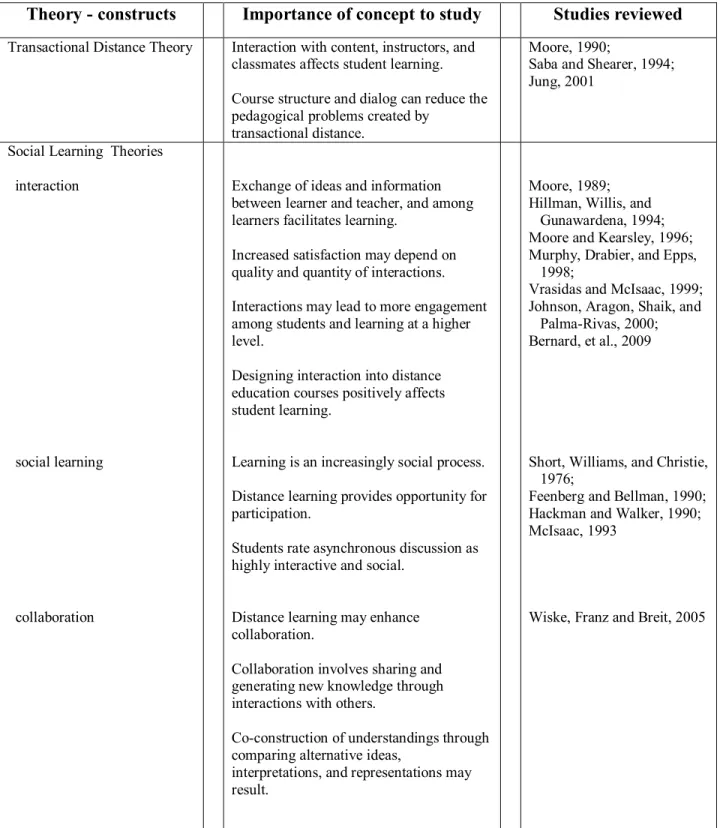
Table 1. Distance Learning Constructs
Theory - constructs Importance of concept to study Studies reviewed
Transactional Distance Theory Interaction with content, instructors, and classmates affects student learning. Course structure and dialog can reduce the pedagogical problems created by
transactional distance.
Moore, 1990;
Saba and Shearer, 1994; Jung, 2001
Social Learning Theories interaction social learning collaboration constructivism
Exchange of ideas and information between learner and teacher, and among learners facilitates learning.
Increased satisfaction may depend on quality and quantity of interactions. Interactions may lead to more engagement among students and learning at a higher level.
Designing interaction into distance education courses positively affects student learning.
Learning is an increasingly social process. Distance learning provides opportunity for participation.
Students rate asynchronous discussion as highly interactive and social.
Distance learning may enhance collaboration.
Collaboration involves sharing and generating new knowledge through interactions with others.
Co-construction of understandings through comparing alternative ideas,
interpretations, and representations may result.
Meaning is constructed through
communication, collaborative activity, and interactions with others.
Moore, 1989;
Hillman, Willis, and Gunawardena, 1994; Moore and Kearsley, 1996; Murphy, Drabier, and Epps, 1998;
Vrasidas and McIsaac, 1999; Johnson, Aragon, Shaik, and Palma-Rivas, 2000; Bernard, et al., 2009
Short, Williams, and Christie, 1976;
Feenberg and Bellman, 1990; Hackman and Walker, 1990; McIsaac, 1993
Wiske, Franz and Breit, 2005
Sergiovanni, 1996; Lock and Redmond, 2006
Conclusion
This chapter began with a brief overview of the growth of distance education. Chapter one has also provided a general explanation of this study, a statement of the problem, the purpose of the study, the theoretical framework for the study, the research questions driving this study, delimitations and limitations, and relevant definitions important to the study. The chapter has also suggested the possibility that distance education, properly structured and delivered, may provide a quality learning environment for one or more categories of higher education students with disabilities. The remaining chapters of this dissertation will describe literature relevant to this proposed study and research methods for this study. Chapter two reviews literature in a manner that describes what is currently known about distance education as relates to students with disabilities, outlining the theoretical framework that was used as the basis of this study. Chapter three contains a detailed description of the methods of research to be used in this study. This includes how study participants were selected, how data was collected, and an overview of the data analysis methods.
CHAPTER TWO:
LITERATURE REVIEW
Introduction
A review of the literature will be organized around educational research that relates to the study focused on the following research questions:
1) How do students with various disabilities experience online learning?
2) How do students with various disabilities describe quality in terms of interaction, structure, and support?
3) What factors are reported by students with various disabilities to facilitate or inhibit their learning in an online environment?
4) How do students with various disabilities perceive what instructors do to better facilitate their students' online learning?
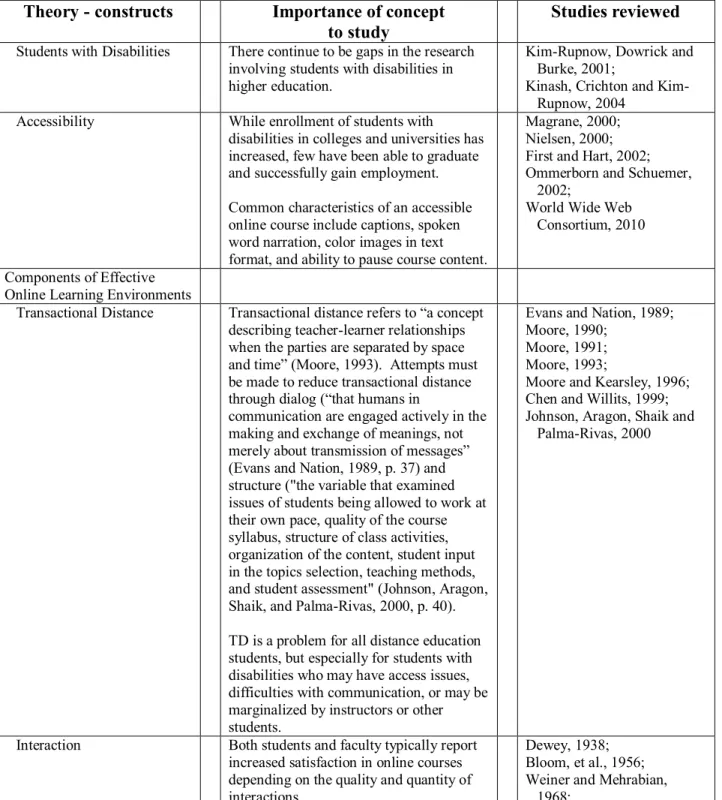
Chapter two begins with a general review of the limited amount of literature related to students with disabilities and their experiences in higher education settings, including both findings generally related to higher education, then more specifically online learning and a brief summary of accessibility. Next follows a brief outline of the literature related to effective online learning environments beginning with transactional distance, which has been traditionally
identified as a problem for all distance learners, including students with disabilities. This section will be followed by literature related to quality distance learning environments including
are all parts of the learning process. In each discussion of the components of quality distance learning environments, the literature and findings for all students will be related as well as the few specific studies relating to students with disabilities. Following this general discussion is a review of the literature related to support for students with disabilities in the online learning environment with emphasis on assistive technologies. Next, there is a brief discussion of findings related to learner satisfaction in online learning and how that learning can best be measured. Finally, the summary of literature ends with a section on prior experience with computers and number of online courses taken in distance education and the relationship to learner satisfaction and perceived outcomes.
Fuller, et al. (2004) studied the experience of higher education students with disabilities in the United Kingdom. Results suggest that there are certain barriers within higher education and that four key areas of support are necessary to assure a quality learning experience. First, there need to be a variety and flexibility in approaches to teaching and learning. Second,
assessments need to be varied and modified based on need. Third, access to information needs to be provided for both faculty and for the disabled students themselves. Finally, the actions and attitudes of staff in relating to students with disabilities are important. Though Fuller’s findings are not specific to distance education, these findings are relevant to the experience of students with disabilities in higher education settings and relate to the structure and support necessary to assure their success.
Research suggests that the unique characteristics of the online medium may both help and hinder certain kinds of learning (Gibson, 1996). A better understanding of those characteristics that aid and those that hinder would serve to improve the learning effectiveness of online
students in an effort to increase faculty ability to design instruction. The researchers wished to identify barriers, issues, and success factors from the students’ perspective that might affect learning outcomes (e.g., learning effectiveness, learner attitudes, and motivation). A large-scale exploratory factor analysis study was conducted (N=1,056) that determined the underlying constructs that comprise student barriers to online learning. The eight factors found were: (1) administrative issues, (2) social interaction, (3) academic skills, (4) technical skills, (5) learner motivation, (6) time and support for studies, (7) cost and access to the Internet, and (8) technical problems (Muilenberg and Berge, 2005). Independent variables that significantly affected student ratings of these barrier factors included: gender, age, ethnicity, type of learning
institution, self-rating of online learning skills, effectiveness of learning online, online learning enjoyment, prejudicial treatment in traditional classes, and the number of online courses completed (Muilenberg and Berge, 2005).
The experiences of students with disabilities in higher education settings
The literature involving students with disabilities remains scant at best. Most of the research in this field has centered on adults in a rehabilitation setting. The studies that do exist are largely descriptive, for the purpose of influencing policy, and thus have a limited scope. Extant studies are also largely qualitative; tools used include surveys, case studies, and
observations. Emergent themes include student and faculty perceptions of accommodations for disabilities (both physical and cognitive), and the impact upon the student.
Reviewing literature more specific to higher education students with disabilities and online learning yielded few studies. In a comprehensive search, Kinash, Crichton, and Kim-Rupnow (2004) found only forty-three publications released between 2000-2003 that were
(51%) are didactic, presenting guidelines and how-to information in regard to a single topic, or combination of topics, including accessibility, communication tools, instructional design,
pedagogy, policy, teaching strategies, and universal design. The next highest category (thirteen, or 30%) yielded only descriptions of vendor products and/or educational programs. Only five articles (10%) could be counted as research.
Two of the five articles presented as research were conference presentations by the lead author concerning preliminary results from the same research project of interactively
interviewing online learners who were blind (Kinash, 2002; Kinash, 2003). Of the three remaining articles, one centered on how an online support staff assisted a visually-impaired instructor to teach online (Tobin, 2003), and two articles were selected for review by the authors because they employed a survey approach to data gathering. Cook and Gladhart’s study (2002), entitled “A survey of online instructional issues and strategies for postsecondary students with learning disabilities,” offers guidance in accessible course design. Many of the references contained in Cook and Gladheart’s study were from articles discussing either the issue of online learning or disability, but did not consider the two issues in tandem (Kinash, Crichton, and Kim-Rupnow, 2004).
Kim-Rupnow, Dowrick and Burke’s (2001) analysis of the literature was driven by the question “Do the increase of distance education programs and use of advanced technology indicate better access and better outcomes in higher education for persons with disabilities?” (p. 25). Technology has sufficiently advanced to bring a distance classroom to the home of anyone with a computer connected to a modem and a (high-speed) telephone line. Also, the format of distance education has greatly increased access to higher education for students with disabilities, regardless of types and levels of disability (Kim-Rupnow, Dowrick, and Burke, 2001). Findings
by these researchers focused on the importance of necessary support for all students, like prior experience with computers, while some findings were tailored toward supporting students with disabilities specifically, such as technical assistance to make content accessible (Kim-Rupnow, Dowrick, and Burke, 2001).
Although advancements in technology may now allow educators to better serve students with disabilities, there is still a need to better understand the impact of distance education, specifically educational outcomes, as relates to students with disabilities (Coombs and Banks, 2000). It seems critical that higher education institutions restructure their online course offerings to meet the diverse needs of students. Newell and Debenham (2005) suggest that distance learning may be the only practical means of access to higher education for those with severe disability or chronic illness. A major reason for students with disabilities enrolling in various job-related training programs is to earn a career-related certificate or degree (Haugen and King, 1995; Leutke-Stahlman, 1998; Noren, 1995). To guide such restructuring efforts, researchers have called for a formative and summative evaluation of distance education programs at institutional, regional, and national levels at regular intervals (Bramble and Rao, 1998; Moore, 1999).
A recent study has attempted to inform universities about the educational outcomes attained by students with disabilities in higher education settings. A questionnaire was
administered to 2,351 graduates who were disabled students in distance learning programs, in the United Kingdom (Richardson, 2009). Findings indicate graduates of distance education
programs rate these programs lower; however, a significant number of the graduates obtain degrees, an indicator of high levels of achievement. Another study (Kim, Lee, and Skellenger, 2012) compared the overall level of satisfaction of 101 graduates of distance education vs.
campus based programs in university personnel preparation program in visual impairment. Of the graduates surveyed 12% had visual impairments, 5% had other disabilities and the rest had no disabilities. Findings indicate there is no significant difference between graduates of on campus programs when compared with distance education delivery systems. Yet, these students reported lower levels of faculty to student interactions and student to student interactions in the distance education environment. Similarly, several studies report no significant difference with respect to satisfaction when comparing traditional and distance education programs (Abdous and Yen, 2010; Skylar, et.al., 2005; Thurmond, et al., 2002).
Accessibility
No review of the literature related to the experience of students with disabilities would be comprehensive without looking at the issue of accessibility. Accessibility is a general term used to describe the degree to which a system is usable by as many people as possible without
modification (Nielsen, 2000). More broadly stated, accessibility means designing environments with the aim of making them accessible by everyone, people with handicaps included, with a minimum number of problems (Ommerborn and Schuemer, 2002). The accessibility of
computer-mediated information and the convenience of distance delivery in online learning have the potential to “level the playing field” for students with disabilities (Coombs and Banks, 2000), offering greater accessibility for those who may not be able to navigate the difficulties evident in attending face-to-face classes on campus. The disability rights movement advocates equal access to social, political and economic life which includes not only physical access, but access to the same tools, organizations and facilities for all, regardless of disabilities.
One of the key concepts in the right to education is access; access to the means to fully develop as human beings as well as access to the means to gain skills, knowledge, and
credentials. This is an important perspective through which to examine the solutions to access enabled by Open Educational Resources and online learning (Geith and Vignare, 2008). Nevertheless, full accessibility does not appear to be experienced by learners with disabilities (Magrane, 2000). Most online environments are still not accessible to students with disabilities or those using assistive technologies (First and Hart, 2002). People with disabilities are half as likely to have Internet access as those without disabilities: 21.6% versus 42.1% (U. S.
Department of Commerce, 2000). As access to cyberspace is surveyed each year, the gaps between groups are growing larger, even though the number of individuals gaining Internet access increases across all groups (U. S. Department of Commerce, 2000). For purposes of this research, computer accessibilityrefers to the usability of a computer system by people with disabilities or age-related limitations (Nielsen, 2000). It is largely a software concern. However, when hardware or software is used to customize a computer for a disabled person, that
equipment is known as Assistive Technology.
In studying the technology used for web access, Schmetzke (2001) investigated the degree to which distance education websites were accessible. Checking 219 websites using Bobby, a website accessibility evaluation tool (web address: http://www.cast.org.bobby),
Schmetzke found that only 15% of the beginning webpages were free of accessibility errors. His findings showed that the technology affects the accessibility of a web-based course (Schmetzke, 2001). Schmetzke also performed a literature review on the obstacles that people with
disabilities encounter in an online environment. He found that only a few articles addressed this issue, and that these articles were written from more of a technological perspective. When
Congress passed the Americans with Disabilities Act (ADA) in 1990, the World Wide Web did not exist as it does today. Most electronic information was displayed as text on the computer screen, which is easily read with screen readers. It seems fair to say that legislators and web designers were not considering poor web design issues back in 1990. Thus, it is no surprise that the original ADA, while mandating equal access to an institution’s resources, does not
specifically address the design of web-based information services. However, subsequent interpretations of the ADA do address this issue (Schmetzke, 2001).
In their 2008 study, Geith and Vignare examined Open Educational Resources in terms of acess, using the “4-A Framework of the Human Rights Obligations” by Tomasevski
(Tomasevski, 2001). The 4-A’s emphasize rights to as well as rights in education, and include availability, accessibility, acceptability, and adaptability. Under the ‘right to education,’ access can be defined in terms of the availability of schools and teachers. Also under the ‘right to
education,’ access can be defined the elimination of legal, administrative and financial barriers including obstacles to access posed by fees, distance and schedule, as well as discriminatory denials of access. Thus, the right to education depends on both the availability of key
infrastructure and its obstacle-free accessibility. However, these alone will not guarantee the full range of human rights obligations. Education must also be acceptable and adaptable, to both individuals and communities (Geith and Vignare, 2008).
Tomasevski’s fourth “A” is adaptability of education to all constituencies, including people with disabilities. This dimension helps to define access in terms of its obligation to adapt to the unique needs and cultures of a wide range of users, such as minorities, indigenous people, workers, people with disabilities, and migrants (Geith and Vignare, 2008). Burgstahler believes online distance learning can be one of the easiest ways to accommodate students with
disabilities. Text-based, asynchronous tools such as e-mail, discussion boards, and listserv distribution lists generally pose no special barrier for students with disabilities. If a prerequisite for a course is for the student to have access to electronic mail, students with disabilities can choose an accessible electronic mail program to use. A student who requires assistive
technology to access e-mail will have resolved any issues before enrolling in an online course (Schenker and Scadden, 2005). Common characteristics of an accessible online course for students with disabilities might include captions for media, spoken version of text, allowing course content to be paused, restarted or repeated, or providing color images in text format (World Wide Web Consortium, 2010).
The quality of effective online learning environments
Understanding quality online learning environments requires a review of literature related to the problem presented by transactional distance, alleviated in pedagogical practice by
interaction, collaboration and social learning. The Community of Inquiry model, which brings together the concepts of interaction, collaboration, and social learning, is also discussed.
Transactional Distance
The concept of transactional distance (TD) was first offered by Moore (1990) and has been the focus of numerous studies. Moore and Kearsley (1996) refer to transaction in distance learning as “the relationship between instructors and learners in special environments where they are geographically separated from one another and must use a resulting set of pedagogical approaches to compensate” (pg. 200). TD has been shown to be complex,
cannot be just like those used in the face-to-face classroom; pedagogical approaches must be adapted for the distance learning environment. TD is a problem for all distance education students, but especially for students with disabilities who may have access issues, difficulties with communication, or may be marginalized by instructors or other students. The proposed study provides an opportunity to understand more fully the extent to which distance learning provides an opportunity to provide a quality learning environment and increase the satisfaction and learning outcomes for those with various disabilities.
Of importance in reducing TD in online courses are two variables - dialog and structure. Dialog is the extent to which, in any educational program, learner and educator are able to respond to each other; structure describes the rigidity or flexibility of the program’s educational objectives, teaching strategies, and evaluation methods (Moore, 1991). Recent research has attempted to find ways to measure the structure and dialog elements of TD. Chen and Willits (1999) conducted an exploratory factor analysis to determine the factors that make up dialog and structure, and learner autonomy. They found that dialog consisted of three dimensions: (a) in-class discussion, (b) out-of-in-class discussion, and (c) out-of-in-class electronic discussion. This study will add to the limited knowledge about the extent to which students with disabilities in the higher education setting engage in substantive interactions in the distance education environment which have the potential to lead to greater satisfaction, and ultimately, higher rates of retention.
Interaction
The concept of interaction has been important in education historically. According to John Dewey (1938), the goal of education is to develop reflective, creative, responsible thought. Dewey believed that an optimal educational process required two key processes: interaction and the continuity of interaction. In the online environment, dialog may include both the interaction
between and among the students or interaction between the instructor and the student. The extent and natureof dialog is determined by the educational philosophy of the individual or group responsible for the design of the course, by the personalities of the teacher and learner, by the subject matter of the course, and by environmental factors (Moore, 1991). Moore (1989) suggested three kinds of interactions important to students: Learner-content, learner-instructor, and learner-learner. Interaction is defined by Moore and Kearsley (1996) as an “exchange of information, ideas, and opinions between and among learners and teachers, usually occurring through technology with the aim of facilitating learning” (pgs. 128-132).
Two recent studies by Maor and Volet (2007) and Persico, Pozzi, and Sarti (2010, as cited in Nandi, et al., 2012) support the work of theorists. Findings indicate that interactivity is important to student learning in the online environment. Earlier studies found in the literature related to online interaction (Kirby, 1999; Moore, 1989; Moore and Kearsley, 1996; Murphy, Drabier, and Epps, 1998; Vrasidas and McIsaac, 1999) provided descriptions of the various formats used, the instructor’s experiences, and participant’s reactions. A research study by Mikulecky (1998) evaluated the level of interactions and determined the critical components of online interactions. Though there are numerous options available for online interactions, those described most often in the literature included discussion board, e-mail, and listservs (Tallent-Runnels, et al., 2006).
Interactions with instructors are critical in all learning environments; they are perhaps more critical online (Mazzolini and Maddison, 2003; Picciano, 1998; Sher, 2009; Swan, et al., 2000; Thurmond and Wambach, 2004; Weiner and Mehrabian, 1968). Since there is no classroom meeting in which students may connect with their instructors, instructor-student interactions must be made explicit. In 2004, Albion and Ertmer (as cited in Nandi, et al., 2012)
further explained facilitation with instructors by defining facilitation by instructors in online courses as the ways in which faculties teach, guide, assess and support student learning. In fully online courses, the relationship of interaction to perceived success appears to be a very important one. In a 2007 study, three researchers from Florida State University examined the relative importance of 19 instructor actions in an online course. They found that instructors believe that learner performance is likely tied to instructor actions that are focused on course content and provide both models both proactive and reactive information to learners about their ability to demonstrate knowledge of course material, but learner satisfaction is more likely tied to learners’ feeling that their interpersonal communication needs are met. Learners rated items focused on communication needs and being treated as individuals as most important, aligning their stated preferences with the instructors’ perceptions of what actions are most satisfying to learners (Dennen, Darabi, and Smith, 2007). Mazzolini and Maddison (2007, as cited in Nandi, et al., 2012) suggest somewhat differing perspectives between the appropriate role of instructors when comparing perceptions of students and instructors themselves. Students believed instructors should ask follow up questions, introduce new ways of thinking or concepts, answer student questions as soon as possible, and provide feedback. Instructors reported they spent their time most frequently answering student questions, asking leading questions and asking questions to continue the discussion thread.
Both students and faculty typically report increased satisfaction in online courses depending on the quality and quantity of interactions (Hackman and Walker, 1990; Shea, Fredericksen, Pickett, Pelz, and Swan, 2001; Swan, 2001). In Spring 2000, students enrolled in courses in the SUNY (State University of New York) Learning Network (SLN) completed a survey that asked them to comment on their satisfaction with and learning in this online learning
environment (Shea, Fredericksen, Pickett, Pelz, and Swan, 2001). The survey consisted of twenty-five multiple choice questions that utilized a 4-point response scale to assess degrees of satisfaction and learning. Demographic data were collected on variables such as student age, gender, academic level, distance from campus, and previous computer skills. These
demographic data were analyzed against items that assessed student attitudes about topics such as (1) level of interaction with classmates, (2) level of learning compared to a traditional face-to-face (F2F) classroom, (3) overall satisfaction with their specific course, and (4) overall
satisfaction with online learning in general.
Results from Shea, Fredericksen, Pickett, Pelz, and Swan (2001) were divided into four categories: (1) course satisfaction, (2) reported learning, (3) participation, and (4) relationship of learning and satisfaction with other variables. The results reported support the notion that online learning is best viewed through a focus on its social nature. Regarding course satisfaction, 79% of students were satisfied with their online course regardless of background, while only 11% reported any level of dissatisfaction. Regarding reported learning, 78% of students felt their level of learning was very high in the online environment, while only 11% felt they did not learn a great deal. Regarding participation, more than twice as many students felt they participated as much or more online (47%) than in a traditional f2f classroom (17.4%). Regarding the
relationship of satisfaction and learning with other variables, when course instructors provided prompt feedback of high quality, significant correlations were found with high satisfaction and high levels of learning. The same can be said of faculty who provided clear expectations of how to proceed in the course successfully. When students received clear expectations, significant correlations were found with high levels of satisfaction and perceived learning.
Vrasidas and McIsaac (1999) examined the nature of interaction in an online course from both student and teacher perspectives. The researchers looked at a graduate online course in the use of telecommunications for instruction at a major southwestern university. Students were graded in five areas: assignments, discussions, a midterm examination, a final research paper, and subsequent presentation of the final research paper. There were eight scheduled discussions during the course moderated by students; four took place face-to-face and four occurred online. Data analysis showed that the four major factors influencing interaction were structure, class size, feedback, and prior experience with online learning (Vrasidas and McIsaac, 1999).
A paper entitled “Building Knowledge Communities: Consistency, Contact and Communication in the Virtual Classroom” reported very high correlations and relationships between interaction in online courses and student satisfaction (Swan, et al., 2000). Researchers from the SUNY (State University of New York) Learning Network reached these conclusions based on online questionnaires (N=1,406) completed at the end of the Spring 1999 semester. The Spring 1999 survey contained eight demographic questions and 12 questions relating to student satisfaction, their perceived learning, and activity in the courses they were taking.
Survey results suggested that almost half of the students who were enrolled in online courses lived within thirty minutes of the campus; of these students, both distance and time were factors in their expressed preference for and satisfaction with online learning. A second finding showed large numbers of students (88%) reported high levels of confidence in their computer skills, perhaps explaining the high levels of interaction and learner satisfaction found (Swan, et al., 2000).
Recent studies by Romiszowski and Mason (2004), Stahl (2004), Schrire (2006), and Mandernach, Dailey-Herbert, and Donnelli-Sallee (2007) (as cited in An, Shin, and Lim, 2009)
found that positive outcomes such as knowledge construction, critical thinking and problem solving are found to be enhanced by asynchronous communication in blended and online courses that require communication among students and students with their instructors. Several
researchers note that students perceive online discussion as more equitable and more democratic than traditional classroom discussions (Boshier, 1988; Harasim, 1990; Levin, Kim, and Riel, 1990; Siegel, Dubrovsky, Kiesler, and McGuire, 1998). In fact, course discussions are one of the most influential features of online courses. Wells (1992) asserts that subjects that require
brainstorming, discussion, and reflection are best suited to the online format. This may be due to the unique nature of online conversations; namely the fact that all students have a voice with no students being able to monopolize the conversation. The asynchronous nature of the discussion makes it impossible for even the instructor to control. Also, because it is asynchronous, online discussion allows students a chance to reflect on their classmates’ responses before creating their own and submitting them to the rest of the class. This helps to foster an atmosphere of
mindfulness by the students, thus resulting in more reflection in the course overall (Swan, et al., 2000). These factors may prompt students with disabilities to greater levels of interaction with their fellow students and instructors, and thus they may function more effectively in their coursework. Studies by Bhattacharaya (1999) and Davidson-Shivers, Tanner, and Muilenburg (2000) (as cited in An, Shin, and Lim, 2009) suggest that students prefer asynchronous online discussion to synchronous discussions because it allows time for students to provide thoughtful reactions to questions posed and insights to one another.
Although potentially more time consuming (Dumont, 1996), asynchronous Internet-based courses may offer the easiest means to increase student involvement in these courses. This asynchronous delivery method allows for greater access to distance education for students with
disabilities. Asynchronous courses do not require students and instructors to be online
simultaneously at any given point, which makes it easier for students to set their own schedule for participating in the course. People who may be more introverted in a group setting may participate more in an electronic format, perhaps due to perceptions of relative anonymity (Dyson, 1997), and enhanced social presence or reduced self-presentation anxiety (Corston and Colman, 1996; Gefen and Straub, 1997; Strauss, 1996). A recent study (Nandi, et al., 2012) attempted to assess the quality of discussion in fully online courses through analysis of discussion forum activities in two fully online computing courses at a large university in Australia. Findings indicate that neither fully student-centered, nor fully instructor-centered discussion is ideal; rather a combination of both approaches is advantageous to positive outcomes.
Relevant to students with disabilities in higher education are findings that suggest online interactions may lead to more engagement among students and to learning communities which ultimately can lead to student learning at higher levels of Bloom’s taxonomy (Bloom, et al., 1956). For example, students who feel a sense of connectedness rather than isolation are very likely better prepared to become more actively involved in course learning, which results in higher order thinking and knowledge building (Bober and Dennon, 2001; Engstrom, Santo, and Yost, 2008). When comparing face-to-face classrooms with asynchronous learning
environments, Swan (2003) concludes that asynchronous learning environments appear to be particularly supportive of experimentation, divergent thinking, and complex understandings. Thus, increased interaction is a particularly important element for the success of students with disabilities in higher education and may result in greater learner satisfaction.
Online communities may also provide opportunities for students with disabilities to be positively engaged with other learners. The asynchronous online environment offers students with disabilities additional time to develop ideas and formulate responses than may be afforded them in traditional face-to-face classes, as well as assistive devices which may enhance their abilities to communicate. With universal participation now expected in most online courses, in the form of minimum numbers of weekly discussion board postings, the unique communication tools afforded by the online environment provide students with disabilities with more ways to take a meaningful role in interactions. All online students, especially those with disabilities, should be made to feel secure and self-confident if they are to request assistance from instructors and have a meaningful rapport with them and with their fellow students. To further promote interaction, instructors should interact with students with disabilities about their individual situations and learning processes so they can provide students with individualized support (Schenker and Scadden, 2005).
Collaboration / Social Learning
The process of “sharing and generating new knowledge together with one’s peers” (Slotte and Tynjälä, 2005, p.193) as part of a learning community is known as collaboration. Effective collaboration “involves interactions with other people, reciprocal exchanges of support and ideas, joint work on the development of performances and products, and co-construction of understandings through comparing alternative ideas, interpretations, and representations” (Wiske, Franz, and Breit, 2005, p. 105). In education, small group activities have traditionally been used for their benefit to distance learning. The Internet shows great potential for enhancing collaboration between people and the role of social software has become increasingly relevant in