Independent Study Project (ISP) Collection SIT Study Abroad
Spring 2017
The Impact of Program Structure on Language
Acquisition and Intercultural Competence: A
Comparative Study of Study Abroad Programs in
Kunming, China
Samantha Bergman SIT Study Abroad
Follow this and additional works at:https://digitalcollections.sit.edu/isp_collection
Part of theBilingual, Multilingual, and Multicultural Education Commons,Chinese Studies Commons,Higher Education Commons,Language and Literacy Education Commons,Modern Languages Commons,Other International and Area Studies Commons, and theSocial and Cultural Anthropology Commons
This Unpublished Paper is brought to you for free and open access by the SIT Study Abroad at SIT Digital Collections. It has been accepted for inclusion in Independent Study Project (ISP) Collection by an authorized administrator of SIT Digital Collections. For more information, please [email protected].
Recommended Citation
Bergman, Samantha, "The Impact of Program Structure on Language Acquisition and Intercultural Competence: A Comparative Study of Study Abroad Programs in Kunming, China" (2017).Independent Study Project (ISP) Collection. 2646.
The Impact of Program Structure on Language Acquisition and Intercultural Competence: A Comparative Study of Study Abroad Programs in Kunming, China
Bergman, Samantha Academic Director: Lu, Yuan
Advisor: Sun, Jing Smith College
East Asian Studies and Anthropology China, Yunnan/Kunming
Submitted in partial fulfillment of the requirements for China: Language, Cultures, and Ethnic Minorities, SIT Study Abroad, Spring 2017
Abstract
According to the Project Atlas study conducted by the Institute of International Education, China is the world’s third most popular study abroad location. With over 390,000 international students currently studying in China, there are more opportunities for cultural exchange and mutual understanding than ever before. However, there is still relatively little existing research on how different study abroad program structures impact students’ Chinese language skills and cultural literacy.
This study examined the impacts of experiential learning and intensive language study abroad program structures on students’ language acquisition and intercultural competence development. Two study abroad programs based in Kunming, SIT China: Language, Cultures, and Ethnic Minorities (SIT) and Middlebury School in China: Kunming (Middlebury), were selected to represent, respectively, experiential learning and intensive language program structures. Semi-structured, one-on-one interviews were conducted with eight students, four Chinese language teachers, three program staff members, six homestay parents, and one local roommate. The final product of this study is a description of the most effective components of experiential learning and intensive language program structures and an analysis of how different program structures contribute to the students' linguistic and cross-cultural
development. Aside from examining students’ academic experiences, this paper explores the impact of program structure on students’ interactions with locals, from both student and local perspectives.
Keywords: International Education, Cultural Anthropology, Curriculum and Instruction, Experiential Learning, Intensive Language
Table of Contents I. Abstract……...ii Acknowledgments...iv Tables……...v II. Introduction 1. Background……….………...1 2. Literature Review……….………...2
3. Purpose of the Study and Research Questions……….……...3
III. Methods 1. Location……….…....…...4
2. Demographics………...………....…4
3. Fieldwork………..…....…5
4. Ethics………....…..………. 6
5. Data Collection and Analysis……….……..6
6. Limitations………...….7
7. Alternatives………....……...8
IV. Results 1. Experiential Learning Structure and Language Acquisition ………8
a. Excursions ………9
b. Homestays ………...11
2. Intensive Language Structure and Language Acquisition ………...13
a. Language Pledge ……….14
b. Local Roommates……….……17
3. Experiential Learning, Intercultural Competency, & Cross-cultural Interactions.…..19
a. Homestays ………...19
b. Research ISP………... 22
4. Intensive Language Structure, Intercultural Competency, & Cross-cultural Interactions ………23
a. Local Roommates ………..24
b. Language Class-Related Activities……… 26
VI. Conclusions……….……….28
VII. Suggestions for Further Study………...……….32
VIII. References ………...……….34
Acknowledgements
The author would like to thank Anjela Leocata, her fellow SIT student, who gave her the idea for her ISP question. She gratefully acknowledges the invaluable support provided by SIT Academic Director Lu Yuan, who provided her with detailed advice and insights regarding study abroad programs in China, as well as put her in contact with several former SIT students, including Jesse Millett. She would like to thank Jesse Millett for introducing her to Alex Nickley, the Middlebury Assistant Director. The author would also like to thank Alex Nickley and Dr. Lin Yi, the Middlebury Director, for inviting her to meet their students and subsequently interview them.
The author would like to thank the SIT Student Affairs Coordinator, Ms. Zhou Yan, who provided invaluable translation help regarding specialized vocabulary for the interview questions and answered many other ISP-related questions. The author would also like to thank Professor Sun Jing for reviewing her project proposal and providing valuable feedback about informant selection and developing a more focused research question. She is extremely grateful to all interview subjects, whose identities will remain anonymous, for generously dedicating their time and agreeing to candidly discuss their experiences. Lastly, the author would like to thank SIT Study Abroad for the opportunity to conduct independent research in China and utilize her Chinese skills in both professional and practical settings.
Tables
Table 1: International Students in China in 2015...1 Table 2: Study Participants and Demographics...5
Introduction
In today’s increasingly globalized world, knowledge of other cultures and languages is an invaluable asset for students regardless of their future career aspirations. Furthermore, with the rapid advancement of translation technologies, employers expect their employees to achieve not only linguistic fluency, but also cultural literacy. In order to improve their foreign language and intercultural competence skills, many students choose to study abroad during their college career. While some students decide to complete their entire higher education in another country, others choose to participate in short-term study abroad programs that last one or two semesters. Regardless of their length, study abroad experiences provide students with unparalleled opportunities to immerse themselves in another culture and develop meaningful relationships with people from different backgrounds.
While the U.S. and various European countries such as England and France have long histories of hosting international students, Asian countries such as China and Japan have also begun to heavily encourage educational and professional cultural exchanges. Since 2014, China has been the third most popular study abroad destination in the world (Institute of International Education (IIE) & China Scholarship Council (CSC), 2016). According to the 2016 Project Atlas study conducted by the Institute of International Education (IIE), the total international student enrollment in China increased from 110,844 students in 2004 to 397,635 students in 2015 (See Table 1). In order to ensure that these international students have positive, successful experiences in China, it is imperative that more research is conducted on study abroad programs in China.
Table 1: Total international student enrollment in China in 2015:397,635 Rank Place of Origin Number of Students Percent of Total
1 South Korea 66,675 16.8%
2 United States 21,975 5.5%
3 Thailand 19,976 5.0%
4 India 16,694 4.2%
6 Pakistan 15,654 3.9% 7 Japan 14,085 3.5% 8 Kazakhstan 13,198 3.3% 9 Indonesia 12,694 3.2% 10 France 10,436 2.6% All Others 190,054 47.8%
Source: China Scholarship Council, 2016
Literature Review
Numerous studies have been conducted on study abroad programs in order to evaluate the effectiveness of their curricula, learning outcomes, and program instructors’ teaching skills (Festervand & Tillery, 2001, Yashima, Zenuk-Nishide, Kazuaki, & Kazuaki, 2004 as cited in Tajes & Ortiz, 2010, p. 18). Other existing studies largely focused on quantifying progress in specific skills such as language acquisition, yet these projects were often limited to a single discipline and thus do not provide a complete picture of skills acquired throughout the experience (Yashima, Zenuk-Nishide, Kazuaki, & Kazuaki, 2004 as cited in Tajes & Ortiz, 2010, p. 18). These studies primarily utilized self-reporting instruments such as large-scale student surveys, self-reflection diaries, and focus group interviews.
While a few studies have examined students’ perception of their own growth and development while abroad, these studies do not include the in-depth opinions of those in contact with the students, such as their teachers and local contacts, to either validate or contest the students’ claims (Hadis, 2005 as cited in Tajes & Ortiz, 2010, p. 18). One comparative study of undergraduate foreign language programs identified the attributes of successful programs, but study abroad was only one aspect of the programs as opposed to the main purpose (Bricault, 2001). Furthermore, while the study drew on general information from interviews with students and teachers, it did not include local perspectives (Bricault, 2001, p. 17). In other words, the current literature on study abroad lacks cohesive student, teacher, and local perspectives on how specific components of program structures impact
students’ language acquisition and intercultural competence. This study seeks to fill the aforementioned gap by combining the detailed personal experiences of various individuals impacted by study abroad programs in China into a holistic picture of the characteristics that make student learning and student-local interactions successful.
Purpose of the Study and Research Questions
The purpose of this study was to examine two semester-long study abroad programs to identify, based on the individual experiences of participating students and the local people they developed relationships with, the key components within experiential learning and intensive language program structures that positively affect student growth and development, as well as the host community.
Two major research questions informed the inquiry:
1. How do experiential learning and intensive language study abroad program structures impact students’ language acquisition and intercultural competence development?
2. How do experiential learning and intensive language programs facilitate successful
cross-interactions between students and local people?
Two Kunming-based study abroad programs, SIT China: Language, Cultures, and Ethnic Minorities (SIT) and Middlebury School in China: Kunming (Middlebury), were selected for the study due to their worldwide reputations for academic excellence and their distinct education theories. These differing education theories inform every aspect of their respective program structures. Middlebury is a classic example of an intensive language program, complete with local roommates and a language pledge to encourage cultural immersion. Middlebury’s program also includes a research component that focuses on the development of formal Chinese reading and writing skills. In contrast, SIT prioritizes intercultural competency over language acquisition, and thus offers an experiential learning program that encourages students to learn about Chinese culture through direct interactions
with locals. Additionally, SIT’s program emphasizes the development of practical skills through exploration projects and a final independent study project (ISP). These fundamental differences in program structure significantly impact students’ Chinese language studies, cultural literacy development, and interactions with local peoples.
Methods
Location
Kunming, China was selected as the primary location for the study due to the abundant number of study abroad students, program staff, language teachers, and homestay families that reside there. The interviews chiefly took place in cafes and informants’ offices. In addition, informal conversations and participant observation took place in restaurants, informants’ homes, and cafes. These locations were specifically chosen with the dual purpose of putting subjects at ease and maximizing convenience out of respect for their busy
schedules.
Demographics
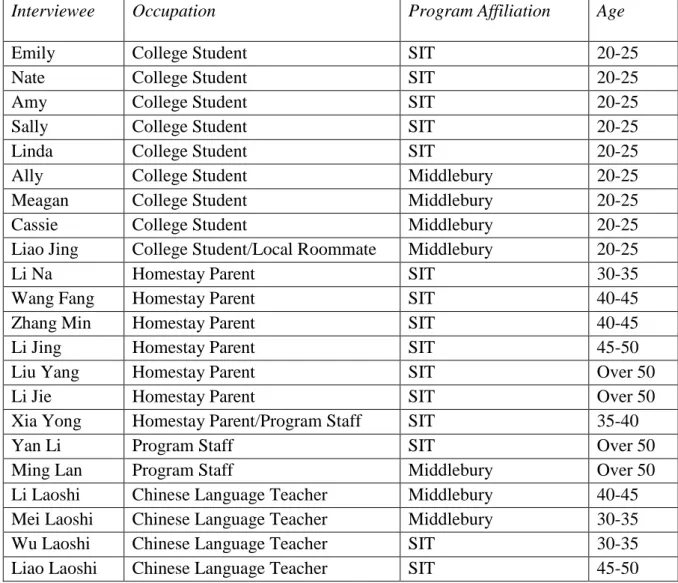
Interview subjects were selected to represent the various groups impacted by study abroad programs in Kunming (see Table 2). In order to cover the wide range of student experiences, informants were chosen based on their language level. Thus, interviews were conducted with a student from each of the five language levels offered at SIT, as well as with students from Middlebury’s two language levels. Study abroad program staff and language teachers were selected for their professional opinions on international education and language instruction, as well as to provide insight into the development of study abroad program structures and expected program outcomes for study abroad students in China. Additionally, one local roommate and seven homestay parents were interviewed to provide general
to describe how they and their families were impacted by the time they spent with their international students.
Table 2: Study Participants and Demographics
Interviewee Occupation Program Affiliation Age
Emily College Student SIT 20-25
Nate College Student SIT 20-25
Amy College Student SIT 20-25
Sally College Student SIT 20-25
Linda College Student SIT 20-25
Ally College Student Middlebury 20-25
Meagan College Student Middlebury 20-25
Cassie College Student Middlebury 20-25
Liao Jing College Student/Local Roommate Middlebury 20-25
Li Na Homestay Parent SIT 30-35
Wang Fang Homestay Parent SIT 40-45
Zhang Min Homestay Parent SIT 40-45
Li Jing Homestay Parent SIT 45-50
Liu Yang Homestay Parent SIT Over 50
Li Jie Homestay Parent SIT Over 50
Xia Yong Homestay Parent/Program Staff SIT 35-40
Yan Li Program Staff SIT Over 50
Ming Lan Program Staff Middlebury Over 50
Li Laoshi Chinese Language Teacher Middlebury 40-45
Mei Laoshi Chinese Language Teacher Middlebury 30-35
Wu Laoshi Chinese Language Teacher SIT 30-35
Liao Laoshi Chinese Language Teacher SIT 45-50
Source: Twenty-two interviews, conducted by Samantha Bergman Fieldwork
This study focuses primarily on qualitative data collected from twenty-two semi-structured, in-person interviews that were conducted over a three-week period in the city of Kunming, China. The interviews were conducted individually in order to prevent the informants from being influenced by their peers while describing their experiences. The author arranged and conducted all of the interviews independently without the aid of a translator. Interviews were typically between forty-five and one hundred twenty minutes in
length. In total, approximately eighteen hours of formal fieldwork were completed over the course of the study. The author often spent an additional two hours per interview in transit since interviews took place in locations all around Kunming. Furthermore, the author spent approximately one to seven hours on establishing rapport and engaging in informal
conversations with each informant or performing participant observation.
Ethics
The author endeavored to adhere to ethical research practices by prioritizing informants’ anonymity and confidentiality. Contacts were obtained through the informal network of SIT students and program staff. All twenty-two subjects were contacted via WeChat, the most popular private messaging app in China, and were asked to meet in-person at a later date to discuss study abroad programs in China. They were informed that they would not be obligated to answer any questions that made them feel uncomfortable and that their real names would not be attached to anything they said. The author used a list of
common Chinese names to come up with pseudonyms for each informant (Sorrentino, 2014). The author obtained verbal consent from all of her informants to record their interviews and use the information collected from them in her ISP paper. In order to establish a respectful, reciprocal relationship with her informants, the author treated them to their choice of beverage or food whenever it was culturally appropriate to do so.
Data Collection and Analysis
Due to the short timeframe and her desire to conduct as many interviews as possible, the author decided to forgo transcribing individual interviews. Instead, she took detailed notes in a combination of Chinese and English, as well as recorded each interview as subjects spoke. Pre-prepared documents with twenty-six to forty-four questions were used, and answers were recorded in the same order as the questions. At the end of the three-week
interview period, the compiled interview notes were analyzed for trends in responses and opinions.
Limitations
As a participant of SIT, the author was aware of her compromised position and the potential for bias in her portrayal of the two study abroad programs. Thus, despite
maintaining the comparative nature of her study, the author endeavored to portray both programs strictly based on informants’ descriptions of their individual experiences and back up her assertions with clear evidence from primary or secondary sources.
The language barrier was less challenging than expected and seventeen of the twenty-two interviews were conducted entirely in Chinese. Five of the student interviews were conducted in English since the students felt they could better express themselves in English, while all three of the Middlebury students were interviewed in Chinese in accordance with the Middlebury language pledge.
After determining the six groups of informants to be interviewed (Middlebury students, SIT students, teachers, program staff, homestay parents, and local roommates), the author created six sets of interview questions and translated them into Chinese (See
Appendices A-F). Since the interview questions included specialized vocabulary such as “experiential learning” and “language pledge,” the author consulted Ms. Zhou Yan, who generously agreed to provide the most accurate Chinese translation of the terms. In order to help future students who are interested in completing an ISP on international education, the author created a glossary of the specialized vocabulary utilized in her study in both English and Chinese (See Appendix G).
This method had its own limitations, as Liao Laoshi noted that “experiential learning” is not a traditional Chinese teaching method, which explains why multiple Chinese
translation efforts. In such cases, the author attempted to describe detailed examples of experiential learning in Chinese until the informant indicated they understood the term. Ultimately, until experiential learning becomes a popularized teaching method in China, initial confusion regarding such terms is unavoidable.
In order to conduct all of the interviews within the limited timeframe, the author interviewed one to three people every day. It was especially difficult to arrange interviews with homestay parents, as all of them have extremely busy schedules due to their jobs and their children’s extracurricular activities and classes. Thus, due to the aforementioned constraints, this study is limited to a sample of twenty-two subjects. Furthermore, initial difficulties contacting the Middlebury program staff and students resulted in less time than expected to write the ISP paper and prepare the final presentation. Ultimately, time
constraints proved to be the greatest limitation.
Alternatives
During the initial stages of planning the ISP, the author considered alternate research methods such as creating and implementing an anonymous paper survey, similar to the mandatory Chinese class and homestay evaluation forms completed by students at the end of the semester. The survey would include more demographic and personal questions, and would ideally be administered to all program participants, homestay parents, and local roommates in order to gain statistically significant results. While a survey would obtain valuable quantitative data, time constraints, difficulties with contacting SIT students not residing in Kunming during the ISP period, and other ethical considerations ultimately rendered this method unsuitable.
Experiential Learning Structure and Language Acquisition
Since SIT has an experiential learning program structure, its curriculum includes both lectures and hands-on activities where students get to observe or participate in aspects of
Chinese culture. Additionally, SIT includes two homestays, one in urban Kunming and one in a rural Bai village called Shaping, as well as multiple excursions to Beijing and various locations in Yunnan Province. The last section of the program is the month-long Independent Study Project (ISP) period where students have the option of either conducting a Research ISP on a topic of their choice or an Intensive Chinese ISP that includes one-on-one Chinese classes and a language pledge.
In an interview with SIT program staff member Yan Li, she explained that SIT’s program structure is specifically designed to help students develop practical skills. She stated her belief that students must focus on gaining practical language skills, “因为如果你汉语好 了,但是你不会和中国人交流,那也没有用。语言是一个工具,就看你要用它做什么。
那么我们的目的就是让这些学生在中国能够生活、工作、交流、发展”1( Yan Li,
personal communication, May 17, 2017). Yan Li’s assertions that language is simply a tool and that communication with locals is vital to students’ ability to live and work in China reveal SIT’s core emphasis on practicality and real-life applications. By interspersing lectures and readings with excursions and placing students with Chinese host families, SIT ensures that its students have plenty of opportunities to interact with local people in both formal and informal settings.
Excursions
Excursions are key part of SIT’s experiential learning structure. Aside from the
numerous day trips to religious sites and hospitals within Kunming, the program also includes a two-day orientation trip to Tonghai, a five-day trip to Beijing, and a seventeen-day
excursion to various locations in northern Yunnan, such as Dali, Lijiang, Wenshan,
1 “Because if your Chinese is good, but you cannot communicate with Chinese people, it is useless. Language is a tool, you just have to decide what you want to use it to do. Our goal is to enable these students to be capable of living, working, communicating, and developing in China.”
La, and Shaxi. While the majority of these excursions are group trips that include all of the students and program staff, students also have the chance to travel independently or in small groups through the Yunnan Exploration Project. Students have a great deal of freedom because they get to choose where they want to go and whether they will go independently or with other students on the program. This project is completed at the beginning of the semester in order to prepare students for the ISP period, since in both cases students must
independently plan everything from where they will live to what they will eat. Yan Li stated that this excursion is an important method of teaching students how to function independently in China and that students are tested on their “吃住行做的能力”2 (personal communication, May 17, 2017).
While all of the excursions provide students with the chance to practice their Chinese in new contexts, the Yunnan Exploration Project is a special opportunity for students to gain practical Chinese vocabulary. One SIT student, Linda, stated that her Chinese really
improved during her trip to Lijiang and Tiger Leaping Gorge for the Yunnan Exploration Project. In order to prepare for the trip, she had to learn how to buy bus tickets and book a hostel in Chinese. Furthermore, she and her classmates “gained confidence in [their] Chinese knowing that [they] can navigate in Chinese and get where [they] need to be” (Linda,
personal communication, May 5, 2017). Additionally, she met many friendly people on her trip, the majority of whom were Chinese, so she had a lot of informal conversations in Chinese.
Thus, the experiential learning structure enables SIT students to quickly improve their Chinese speaking and listening skills, as well as their practical Chinese language skills. While students do not spend as much time practicing their formal writing and reading skills, their experiences outside of the classroom give them unparalleled confidence when it comes to
independently navigating life in China. Furthermore, excursions take away time from formal language instruction but they provide students with real-life opportunities to practice Chinese in an immersive and authentic language environment that cannot be replicated in the U.S. Overall, the experiential learning structure and excursions provide students with a more self-directed approach to language learning since students are able to focus on learning the vocabulary that is most relevant to their own lives, as opposed to students on intensive language learning programs whose vocabulary is primarily derived from their textbooks.
Homestays
Another main source of new Chinese vocabulary for students on experiential learning programs is their homestay families. SIT students live with Chinese families in Kunming for three weeks and Bai minority families in Shaping Village for five days. Aside from giving students the rare opportunity to experience both urban and rural life in China, the homestays provide students with an abundance of vocabulary related to daily life and traditional Chinese culture. Moreover, the homestay component ensures that students develop and maintain relationships with native speakers so that they can practice their Chinese on a daily basis: “The host family often offers the only point of regular contact with native speakers that is available to students outside the classroom” (Kaplan, 1989; Tanaka, 2007 as cited in Shiri, 2015, p. 6). In particular, many students noted that they learned a lot of food-related words, words to describe the traditional Chinese way of making tea, the names of traditional Chinese medicines, and colloquial phrases from the Chinese television shows they watched with their host families.
All of the SIT students interviewed stated that the homestays had the greatest impact on their Chinese progress. According to both the students and homestay parents, almost all of the interactions between students and their host families were conducted in Chinese, with the main exception being the few times that students taught their host siblings some English
phrases. Linda explained that during her Kunming homestay, she had to speak Chinese at all times because neither of her host parents could speak English. She especially pushed herself to speak to her host family during dinner because all of the family members would gather to eat together and “if [she] didn’t start speaking Chinese, no one would talk to [her]” (Linda, personal communication, May 5, 2017). Thus, the homestays taught students to take initiative when approaching native speakers and actively practice their Chinese every day. Linda added that now wherever she goes, she will always try to start conversations with local people in Chinese, even if they respond in English (personal communication, May 5, 2017).
Another SIT student, Nate, also said that he made great progress with his Chinese during his homestay. He explained that living with a Chinese family gave him additional motivation to speak Chinese every day, especially since his host mother was very talkative and could only speak Chinese. Since he was very interested hearing more about her opinions on parenting methods and the Chinese education system, he spent at least three hours every day talking with her in Chinese. When questioned about the specific ways in which his Chinese improved, Nate said: “During the homestay period, my Chinese speaking fluency and comprehension improved a lot. I was able to just think and say what I wanted to say in Chinese without translating it from English into Chinese” (personal communication, May 9, 2017). In other words, the homestay experience encouraged students to discuss a wide variety of topics with their host families which enabled them to quickly learn new vocabulary beyond the material covered in their Chinese classes, thereby increasing their Chinese comprehension. Furthermore, the constant Chinese practice forced students to view speaking in Chinese as something as natural as speaking in English, which in turn enabled them to shift their thought process from English to Chinese.
All of the homestay parents interviewed stated that their students’ Chinese improved during the homestay period. One host parent added that she endeavored to teach the students
she hosted a lot of authentic Chinese phrases and idioms (Zhang, personal communication, May 7, 2017). Another host parent stated that she only spoke Chinese with her student because she wanted to help the student improve her Chinese as quickly as possibly (Wang, personal communication, May 6, 2017). Thus, homestays are an especially effective method for improving students’ Chinese language skills because both the students and the homestay parents work together to increase the students’ exposure to Chinese. Moreover, the homestay parents provide students with an additional source of support by encouraging them to speak Chinese frequently and correcting their grammar and pronunciation mistakes. This process further enables homestay parents to accurately assess students’ language progress.
All in all, the homestay component of the experiential learning programs is an exceptionally effective method of increasing students’ Chinese level within a short period of time. Similar to intensive language program activities, homestays ensure that students are fully immersed in Chinese and have ample motivation to speak Chinese every day. Moreover, this motivation stems from students’ natural desire and need to communicate with their host families, which is very different from the drive students derive from grades or other purely academic reasons. Furthermore, homestays create truly authentic immersion experiences because they provide students with opportunities to establish meaningful connections with native speakers and learn colloquial Chinese words that they would not learn in a formal Chinese class. In essence, homestays demonstrate the practical value of learning Chinese to students, which further supports the SIT staff’s belief that language is a tool that gains worth when properly utilized in experiential learning contexts.
Intensive Language Structure and Language Acquisition
Language may simply be a means to an end for SIT and other experiential learning programs, but it is the absolute focus of intensive language programs such as Middlebury. Middlebury students are expected to prioritize their language studies above all other aspects
of their academic and personal lives. Nevertheless, students’ focus on Chinese enables them to make impressive progress in a short amount of time, which in turn allows them to
communicate with native Chinese speakers more easily, as well as utilize their language skills in professional and formal settings. The two components of Middlebury’s program structure that enable students to make such significant advancements are the language pledge and the local roommate program. These two components work together to create a uniquely intensive language environment for students by challenging them to only speak Chinese, giving them special motivation to practice their language skills on a daily basis, and providing them with numerous opportunities to communicate with native Chinese speakers.
The Language Pledge
Middlebury has an intensive language structure that forces students to truly immerse themselves in Chinese by constantly speaking, reading, and listening to nothing but Chinese. This is primarily accomplished through Middlebury’s mandatory, all-encompassing Chinese language pledge. While language pledges are a common component of study abroad
programs that emphasize language acquisition, Middlebury has distinguished itself as a particularly intensive program due to its strict enforcement of the language pledge. For example, both Middlebury and SIT include a Chinese language pledge in their program structures. However, while Middlebury’s language pledge is mandatory for all students, SIT’s language pledge is only mandatory for the students who choose to complete an Intensive Chinese ISP rather than a Research ISP. As a result, the Middlebury students must follow the language pledge throughout their time in China, whereas SIT students only have to follow the language pledge for the one month that constitutes the ISP period at the end of the semester.
According to Nabil Abdelfattah, the director of Middlebury College’s summer Arabic School, the goal of the language pledge is to force students to view their target language as their native language, rather than a foreign language they speak only in class (Useem, 2000, p.
B2). Regardless of their program affiliation, all of the students interviewed who participated in a language pledge mentioned ways in which the pledge’s restrictions forced them to prioritize their Chinese learning. This prioritization ensures a truly immersive Chinese language environment that surpasses the basic exposure to Chinese study abroad students inherently receive on a daily basis. In other words, the language pledge adds the intensive element to study abroad program structures and increases the pressure students face in hopes that it will accelerate their language acquisition.
Middlebury language teachers Li and Mei Laoshi stated that the language pledge is essential to their students’ Chinese studies because it guarantees that “任何时候他们都在练 习说中文”3 (personal communication, May 19, 2017). Mei Laoshi explained that a major benefit of having a language pledge is that within one semester, students’ way of thinking changes from American to Chinese. She said that “学生越说越舒服,越说越觉得中文是他 们的自己语言”4 (personal communication, May 19, 2017). Li Laoshi agreed with Mei Laoshi and explained that due to the language pledge, students quickly realize that there is no time for them to translate what they want to say into English in their mind before speaking aloud. Thus, they are challenged to not just speak in Chinese, but also think in Chinese until their “思维方式,” or “mode of thinking,” takes on local cultural characteristics. Both teachers declared that without the language pledge, their students would not be able to improve their Chinese so quickly in such a limited amount of time.
For all Middlebury students interviewed, the language pledge was an integral aspect of their study abroad experiences and ultimately had a very positive impact on their Chinese language acquisition. For example, Ally said that the main reason why she really liked
3 “At any time, they are practicing speaking Chinese”
4 “The more students speak, the more comfortable they become, and the more they feel Chinese is their own language.”
Middlebury’s program structure is because she believes that the strict language pledge is the best method for improving one’s Chinese quickly (personal communication, May 21, 2017). She noted that the language pledge ensures that all of the Middlebury students constantly speak Chinese, even when they are in a group with other American students and no local Chinese people. Ally asserted that this made it easier for her to communicate with Chinese native speakers since she was used to speaking in Chinese and thus had a high level of comfort and self-confidence. She further added that the language pledge forced her to think
creatively when speaking Chinese: “由于我们的汉语誓言,我们一直在说中文,并且,如
果我们不知道一个词汇,我们需要找到办法解释我们想说什么”5 (Ally, personal
communication, May 21, 2017). Thus, the language pledge has a positive impact on students’ language acquisition because it prevents them from relying on English when they do not know the direct Chinese translation of a word. Additionally, by encouraging students to speak Chinese even when they do not automatically know what to say, the language pledge
increases students’ perseverance and ability to thrive even in challenging or more complex Chinese language environments.
However, Ally noted that the language pledge can have a negative impact on students’ Chinese pronunciation. One of her classmates constantly mixed up “地道”6 and “到底”7 and since she was constantly speaking Chinese, she was less careful about correcting her mistakes. This meant that other students such as Ally were impacted because they unconsciously
adopted the same speech habits and began making the same mistake (Ally, personal communication, May 21, 2017). This phenomenon also occurred amongst the SIT students
5“Due to our Chinese language pledge, we are constantly speaking Chinese and if we do not know a word, we have to come up with another way to explain what we want to say.” 6 Pronounced “didao”
when one of the students on the language pledge kept mixing up “坐”8 and “走”9 until their housemates also started making the same mistake (Sally, personal communication, May 16, 2017). In other words, since the language pledge causes students to unconsciously absorb the Chinese around them, being constantly surrounded by non-native speakers with a low
Chinese level can actually harm students’ language skills. As the language pledge is
guaranteed to have a significant impact on students’ Chinese language skills, it is imperative that they are exposed to many native speakers in order to ensure that their speaking patterns, grammar, and pronunciation become as standardized as possible. Ultimately, whether the language pledge has a positive or a negative effect on students’ language acquisition depends heavily on their surrounding language environment and the language input they receive from those they communicate with on a regular basis.
Local Roommates
While Middlebury does not include a homestay component, it does arrange for students to be paired with local roommates. The roommates are Chinese students who attend Yunnan University, where the Middlebury program is based. All of the Middlebury students interviewed described the local roommate program as one of the best opportunities to practice their Chinese speaking and listening skills. Although the students were already guaranteed to speak Chinese on a daily basis due to their language pledge, being matched with a local student gave them additional motivation since many students were excited to make Chinese friends. Furthermore, the local roommates provided students with positive language input by giving them authentic, standardized examples of Chinese vocabulary and pronunciation.
While only one of the three students interviewed said that she became very close with her roommate, the other two students agreed that the roommate program was a good
opportunity for students to interact with and learn from local students. Additionally, all three
8 Pronounced “zuo” 9 Pronounced “zou”
students stated that their conversations with their roommates had a positive impact on their language acquisition. One of the local roommates, a sophomore at Yunnan University named Liao Jing, described how she and the other Chinese students frequently helped their
roommates practice their Chinese. Aside from helping them answer their homework questions and editing their essays, the Chinese roommates also provided the students with informal language knowledge by teaching them authentic colloquial phrases including Chinese slang, jokes, and words to use in arguments (Liao Jing, personal communication, May 20, 2017).
The combination of the language pledge and the local roommate program enabled students to develop respectful, meaningful relationships Chinese people their own age. Furthermore, their friendships and mutual curiosity fueled their desire to communicate with each other, which in turn gave the Middlebury students additional motivation to improve their Chinese and stick to their language pledge. This is a key difference between the Middlebury and SIT language pledge students, since the SIT students lacked close Chinese friends their own age and thus were less interested in practicing their Chinese conversational skills and strictly following the pledge.
Overall, the local roommates helped students’ language acquisition because they increased students’ daily Chinese exposure and taught them words that they would not learn in a formal, class setting. In other words, the local roommates complemented Middlebury’s intensive language structure by providing students with practical Chinese vocabulary and phrases. This is especially important for an intensive language structure, because without a practical component students’ language studies become overly focused on the acquisition of extremely formal words and complex grammar patterns, the majority of which is not relevant to daily life.
In experiential learning programs, intercultural competency is valued just as much as language acquisition, if not more so. Intercultural competency is defined as “knowledge of others; knowledge of self; skills to interpret and relate; skills to discover and/or interact; valuing others’ values, beliefs and behaviors; and revitalizing one’s self” (Deardorff, 2006, p. 247 as cited in Scally, 2015, p.39). In other words, intercultural competency is both a mindset and a skillset that enables individuals to effectively communicate and interact with people from other cultures. Aside from possessing the linguistic abilities to communicate with people from other countries, one must also develop a deep understanding of their cultural values and practices, while simultaneously gaining awareness of the ways in which one’s own beliefs and behaviors are culturally situated and socially constructed.
Intercultural competence is an integral aspect of facilitating successful cross-cultural interactions. In turn, cross-cultural interactions can be used to develop students’ cultural knowledge and intercultural efficacy. There are many different ways of qualitatively measuring intercultural competency, including self-reflection diaries and focus group
interviews (Hsu, 2014, p. 76). This study based its findings on student and local perspectives of cross-cultural interactions actively facilitated by the programs. As an experiential learning program, SIT engendered interactions between students and local people in all of its classes, excursions, and activities. However, all of the students interviewed agreed that the homestays and the Research ISP offered the most opportunities for cross-cultural interactions.
Homestays
According to an SIT staff member, homestays are a special opportunity for students to “learn respect from a native viewpoint” (Yan Li, personal communication, May 17, 2017). In other words, living with Chinese families teaches students how to critically engage with Chinese culture and interact with locals in a respectful manner. Furthermore, the homestay experience enables students to connect with their host community and develop their
intercultural skills by discussing cultural attitudes and practices with locals (Shiri, 2015, p. 20). Experiential learning programs often include homestays because they provide students with the opportunity to hear local people describe the significance and meaning behind Chinese traditions and beliefs in their own words. While SIT also exposed students to local perspectives by inviting local leaders, professors, and doctors to act as guest lecturers, the homestays exposed students to the opinions and beliefs of everyday Chinese citizens. Thus, the homestay experience complements other aspects of the experiential learning structure by providing students with a more complete picture of the diverse perspectives within China.
All of the students interviewed stated that the homestay experience significantly impacted their overall study abroad experience. For example, Amy specifically chose to participate in SIT’s experiential learning study abroad program because she firmly believes that “living with host families is the best way to get to know a community” (personal
communication, April 27, 2017). One of her main study abroad goals was to “learn how to be uncomfortable,” and consequently to challenge herself to adapt to new contexts very different from her life in the U.S. Her other study abroad goal was to “develop more empathy” because she has a “drive to understand where people are coming from” (Amy, personal
communication, April 27, 2017). Amy’s homestay experiences enabled her to accomplish both of her study abroad goals because they exposed her to different ways of life and provided her with new insights into Chinese culture. Thus, the homestays had a positive impact on students’ intercultural competence by enabling them to have a variety of cross-cultural interactions.
SIT is unique in that it offers both a rural homestay and an urban homestay.
Furthermore, the rural homestay is located in a Bai minority village. Amy explained that the rural homestay was especially influential because it enabled her to “be able to put an image when someone says they’re from a rural area, because [she had] that experience, and know a
little bit about what that is like” (personal communication, April 27, 2017). In other words, the homestay experience was instrumental in teaching her how to better understand, and thus more effectively communicate with, minority peoples and people from the countryside. The other students interviewed also asserted that their newfound knowledge and interactions with many Chinese people from different backgrounds during their homestay experiences
improved their intercultural competence. Overall, the homestays created an ideal environment for students to practice their intercultural communication skills by exposing them to Chinese people from different ethnic groups and different parts of China. Furthermore, due to the development of their intercultural competence during the homestays, students were able to independently navigate various cultural contexts and demonstrate respect for local people’s beliefs and traditions during the ISP period.
Aside from positively impacting students, the homestays also provided educational and cultural exchange opportunities for the host families. The students helped the host children practice their English, as well as discussed American culture with their host parents. This enabled the homestay families to gain new insights into life in America that they would otherwise not have access to, since many of them lacked prior experience interacting with foreigners on a regular basis. For example, a host parent named Xia Yong said that by hosting American students, he hopes his children will be exposed to many different cultures and will begin to understand that America is a diverse place with many different types of people, not just the white people portrayed in popular films (personal communication, May 16, 2017).
Of the seven SIT host parents interviewed, four were first time participants, while the other three had been host parents three or more times. Two of the host parents with previous experiences still keep in contact with their former students using WeChat. All of the
informants described their hosting experience as positive and stated that if they had the time and resources, they would be willing to host more exchange students in the future.
Additionally, many host parents noted that their children greatly enjoyed the exchange students’ company and looked up to them. One host parent named Li Na added that her daughter became so attached to the student that she cried when the homestay period ended (personal communication, May 8, 2017). Thus, the homestay component ensures that experiential programs like SIT have a positive impact on their host communities by
establishing reciprocal relationships with local people and encouraging widespread cultural exchange.
Research ISP
Successful experiential learning experiences require both critical exploration and periods of deep reflection. Critical exploration provides students with numerous opportunities to examine specific aspects of other cultures, while the reflection process allows them to gain a more comprehensive understanding of a particular country or people. SIT’s research
independent study project (ISP) component provides students with the invaluable opportunity to conduct research in China on a topic they select based on their own interests. Experiential learning programs are especially effective at developing students’ intercultural competence because they, “expose students to the complexities and uncertainties in practice situations that cannot be duplicated in traditional lecture courses” (Roakes and Norris-Tirrell, 2000, as cited in Kotval, Machemer, & Keesler, 2012, p. 70-71). Thus, the ISP enables SIT students to drastically improve their intercultural competence skills by challenging them to closely examine one aspect of Chinese culture and reflect upon its impact on Chinese society. The ISP research process requires students to obtain multiple local perspectives, which means that students have ample opportunities to practice speaking Chinese with native speakers and learn effective cross-cultural communication skills.
An SIT student named Amy conducted her ISP on a traditional Chinese health practice. She interviewed numerous Chinese women to explore how the health practice is
viewed in contemporary Chinese society and to understand how individuals decide whether or not to participate in the tradition. Amy stated that the ISP had the greatest impact on her intercultural competence development because it challenged her to constantly interact with Chinese people from different backgrounds and critically reflect upon their behaviors and perspectives (personal communication, May 16, 2017). During the ISP period, Amy received a lot of help from two homestay parents in the form of translation and additional interview contacts. She explained that the ISP enabled her to further develop her friendship with her host mother, and that she felt extremely grateful to all of the women she interviewed for sharing their personal stories. Thus, the ISP has a positive impact on students’ intercultural competence because it encourages them to engage with their host community and establish reciprocal relationships with local people. Furthermore, the research process requires students to establish rapport with their informants, which challenges them to exercise their Chinese language and cultural literacy skills. While the students faced various challenges while conducting their research, including language barriers and initial difficulties finding informants, all of them concluded that the ISP experience successfully enabled them to improve knowledge of Chinese culture and productively engage with local people.
Intensive Language Structure, Intercultural Competency, & Cross-cultural Interactions
In intensive language programs, language acquisition, not cultural knowledge acquisition, is the absolute focus. Nevertheless, language fluency is an important aspect of intercultural competency and cross-cultural interactions with local people are prime opportunities for students to improve their Chinese language skills. Due to the intensive language structure, Middlebury students spend the majority of their study abroad experiences practicing their Chinese in formal, academic settings either in class or after class while doing their homework (Meagan, personal communication, May 20, 2017). While this enables student to significantly improve their formal Chinese language skills, it severely limits
students’ opportunities to explore their host community and independently engage with local people. However, Middlebury’s program structure does include two main methods for encouraging students to interact with Chinese people and improve their intercultural competence.
Local Roommates
The local roommate program is the main means through which Middlebury facilitates informal student-local interactions. By pairing each American student with a Chinese
roommate, the program structure provides students with an initial social network beyond the program staff, language teachers, and other study abroad students. According to a study conducted on Japanese students studying abroad on an intensive language program located in Canada, “Social networks outside of the classroom… can ease individuals through the
negative feelings often experienced when in a new culture” (Ellis, 1993, p. 46). In other words, engaging with local roommates enables students to navigate culture shock by providing them with an additional source of information and support. This adjustment process is key to students’ intercultural competence development because in order to gain a better understanding of Chinese culture and how to interact with locals, students must first adapt to their new environment.
One of the most successful aspects of the program structure is the reciprocal nature of the roommate relationship. Liao Jing explained that local roommates are able to help the American students adapt to their new environment more quickly by introducing them to local restaurants and special Chinese cultural practices. For example, she and her fellow Chinese students would often invite the Middlebury students to eat with them at their favorite
restaurants. If needed, they would also teach the students how to properly use chopsticks and how to make tea according to the traditional Chinese way. Liao Jing also added that the
Chinese students tried to help their American roommates avoid making common safety mistakes by warning them about “骗子”10 (personal communication, May 20, 2017).
Similarly, the Middlebury students taught their Chinese roommates about informal, yet authentic aspects of American culture. For example, Liao Jing said that she was very excited to learn about the type of party games that American college students play, which she described as “非常好玩”11 and “completely different from Chinese party games” (personal communication, May 20, 2017). She added that she often discussed more serious topics with her American roommates as well, including sensitive topics such as birth control,
relationships among college students, and sex education in China. Liao Jing stated that she really appreciated the opportunity to discuss more sensitive topics with her roommate since many of her friends were more conservative and felt too embarrassed to talk about sex (personal communication, May 20, 2017). Hence, the Middlebury roommate program has a positive impact on local students because it exposes them to other cultural values and ways of thinking, as well as provides them with a safe space to explore taboo topics and learn
important health information. This is particularly important in China, where there is still a lot of societal pressure for students to practice self-censorship and conservative ideas about premarital sex have inhibited the implementation of sex education courses for Chinese youth (Steinhauer, 2016).
While the Chinese program staff and language teachers can also provide students with local perspectives on Chinese culture, students are more likely to develop closer relationships with their roommates due to their similar ages and shared experiences as college students. For example, a Middlebury student named Cassie attributed her improved intercultural
competence skills and deeper understanding of Chinese culture to her close friendship with
10 “Swindlers” 11 “Very fun”
her Chinese roommate (personal communication, May 20, 2017). She explained that she had numerous discussions with her roommate on topics including dating issues, societal pressures to marry in different countries, and the differences between China and America’s education systems (Cassie, personal communication, May 20, 2017).
All in all, the Middlebury roommate program serves as an educational opportunity for local Chinese students as well as American international students by challenging both groups to rethink their preconceptions of each other’s culture. Furthermore, the program successfully facilitates mutual learning and cultural exchange by encouraging both groups of students to share their cultures with each other, thereby ensuring a more reciprocal relationship than certain study abroad programs that only expect American students to learn about Chinese culture. Furthermore, by exposing both groups of students to individuals with different cultural backgrounds, the program structure naturally pushes students to challenge
stereotypes and teaches both sides to think more critically about portrayals of other cultures in the media. These reflections on stereotypes and cross-cultural interactions play a key role in enhancing students’ intercultural competence.
Language Class-related Activities
Since Middlebury has an intensive language program structure, it offers students plenty of opportunities to engage in formal cross-cultural interactions. However, informal interactions with locals are integral to increasing students’ intercultural competence because they provide students with the opportunity to discuss a wide range of topics related to Chinese culture. Furthermore, being able to communicate with local people in a variety of contexts, both formal and informal, is a vital aspect of intercultural competence. Other than the roommate program, Middlebury’s primary method of facilitating informal cross-cultural interactions is through activities related to the program’s language classes.
For example, Middlebury’s program structure includes several meetings of a “Chinese language table,” where students and teachers can discuss a wide variety of topics over lunch. The language table is a classic example of an intensive language teaching method because it encourages students to further practice their Chinese. However, it also provides students with the unique opportunity to develop their relationships with their Chinese teachers. One
Middlebury student noted that while she and her local roommate were not very close due to their incompatible personalities, she became very close to one of her Chinese language teachers due to their frequent discussions during the Chinese language table activities (Meagan, personal communication, May 20, 2017).
According to Mei Laoshi, the language table is a great opportunity for students and teachers to freely communicate and learn more about each other. She described the
atmosphere at the Chinese language table as “很自由,没有限制,所以很放松”12 (Mei, personal communication, May 19, 2017). Liao Laoshi added that this informal, open
atmosphere changes the dynamics between students and teachers because in class teachers are authority figures, but at the language table they are friends (personal communication, May 19, 2017). Since all of the language teachers are Chinese, they are unparalleled linguistic and cultural resources for the students. One student explained that the teachers often incorporate their own experiences and opinions into the language classes (Meagan, personal
communication, May 20, 2017). In other words, the teachers’ personal backgrounds enable them to provide students with authentic, local perspectives to supplement the cultural information students learn from their Chinese textbooks. Thus, students’ interactions with their teachers, both in and outside of class, contribute to their knowledge of Chinese culture as well as improve their intercultural competence skills. Ultimately, language-related activities such as the language table sessions positively impact students’ cultural literacy by
increasing students’ opportunities to freely communicate with knowledgeable local people, discuss topics beyond those covered in their textbooks, and become more comfortable engaging with native speakers one-on-one.
Conclusion
In experiential learning programs, language is viewed as a means to communicate with local people and understand the local culture more deeply. In other words, language is merely a tool whose importance lies in the facilitation of successful cross-cultural interactions. Conversely, intensive language programs consider language acquisition to be the most
important aspect of a study abroad experience, and an end in itself. These contrasting views are manifested in the essential differences in program structure between experiential learning programs such as SIT and intensive language programs like Middlebury. Ultimately, program structure determines the outcome of students’ study abroad experiences by forcing them to prioritize either language acquisition or intercultural competence.
Experiential learning programs such as SIT emphasize the acquisition of practical language skills and deep engagement with the host community in order to develop students’ intercultural competence skills. A main characteristic of language study in experiential programs is frequent, prolonged interactions with native speakers. Additionally, these interactions contribute to students’ knowledge of the local culture, which ensures that students’ understanding of the study abroad location is based on not only on the information from their formal classes, but also authentic local perspectives. Thus, cross-cultural
interactions serve the dual purpose of improving students’ language skills and increasing students’ cultural literacy. SIT facilitates these cross-cultural interactions through the numerous excursions and the two homestays included in its program structure. The culmination of students’ language and intercultural skills is the research ISP, which
challenges students to independently explore a particular aspect of Chinese culture and use their Chinese skills to communicate with many local people.
While intensive language programs such as Middlebury also recognize the value of cross-cultural interactions, their main focus is on language immersion and development. Interactions with locals are used as opportunities for students to practice their Chinese outside of the classroom, but are often limited to mostly formal, highly structured settings since intensive language programs prioritize formal language skills over practical language skills. Notable exceptions include Middlebury’s local roommate program and informal language class-related activities such as the Chinese language table sessions. These program
components enable students to form meaningful connections with local people and discuss a greater variety of topics in Chinese, thereby contributing to students’ knowledge of Chinese culture and their intercultural competence skills. However, students’ overall experiences are most significantly impacted by Middlebury’s mandatory language pledge, which establishes the immersive and intensive aspects of the program. The language pledge ensures that all students practice their Chinese on a daily basis and challenges students to think and live exclusively in Chinese. Furthermore, the language pledge and local roommate program complement each other by giving students additional motivation to constantly speak Chinese and learn new Chinese vocabulary.
Like all study abroad programs, SIT and Middlebury’s program structures have many advantages and disadvantages. For example, SIT’s many excursions offer students invaluable opportunities to learn about the diverse cultures and environments within China, as well as the chance to improve their practical Chinese skills by communicating with people from many different backgrounds. However, these excursions take up a significant part of the semester and thus reduce the amount of time available for Chinese classes. Similarly, although the homestays provide students with key opportunities to practice their Chinese
outside of the classroom, learn more about Chinese culture, and have meaningful interactions with locals, they also increase academic pressure on students. Many SIT students stated that the homestays had a positive impact on their overall study abroad experiences, but that their academic performance suffered due to their inability to balance the time they spent with their host families and the time they spent on homework. Nevertheless, time management and prioritization of important tasks are important skills that all students must eventually learn.
Finally, all of the SIT students interviewed expressed their desire to develop closer ties with the host community. This could be accomplished by inviting local students and the local experts who serve as SIT’s guest lecturers to several structured reflection sessions throughout the semester. Reflection is an integral aspect of successful experiential learning and the inclusion of different local perspectives would further contribute to students’ intercultural competence development, as well as provide them with ample opportunities to make local friends. Moreover, the inclusiveness of the reflection sessions would demonstrate SIT’s commitment to cultural exchange and its recognition of the importance of local
perspectives, thereby improving its reputation within the local community.
Middlebury’s program structure has its own set of strengths and weakness. For example, Middlebury’s ambitious language curriculum enables students to significantly improve their Chinese in a short period of time. Additionally, the language pledge increases students’ confidence in their Chinese skills. Unfortunately, this newfound confidence can inadvertently lead to careless mistakes and with enough repetition those mistakes can become ingrained in students’ speech patterns. This affects not only the student who makes the
original mistake, but also the students they talk with frequently. Regardless of who they regularly communicate with, students will naturally be influenced by the spoken Chinese that surrounds them. Therefore, although the language pledge can significantly improve students’ Chinese skills, its success is dependent upon students’ exposure to native speakers and
grammatically correct Chinese. Thus, Middlebury students would greatly benefit from more opportunities to communicate with native speakers. However, students’ extremely heavy workload prevents them from exploring their surroundings, socializing with their local roommates, and making more Chinese friends because they lack the time to do so.
Decreasing the amount of homework assigned and inviting more local students to participate in cultural activities included in the program would resolve these issues by providing students with more opportunities to engage with locals independently and in group settings.
Finally, one student said that she feels the relationship between Middlebury students and their Chinese roommates is somewhat unfair since the roommates constantly help the students improve their Chinese, but the language pledge prevents students from helping the roommates practice their English. In order to resolve this issue, students could set aside one hour a week to help local people practice their English. Although this goes against
Middlebury’s strict language pledge rules, one supervised hour of English a week would most likely not compromise students’ language acquisition. Hosting English practice sessions for local people would enable students to give back to their host community while
simultaneously developing their intercultural competency skills and increasing their opportunities to make local friends other than their assigned roommates. Furthermore, the English lessons would demonstrate Middlebury’s commitment to cultural exchange and its recognition of the importance of reciprocity, thereby improving its reputation within the local community.
Ultimately, while both program structures can positively impact students’ language acquisition and intercultural competence development, selecting the most compatible program can ensure that students have a successful study abroad experience. Most negative study abroad experiences are not the result of inherently bad study abroad programs, but rather a lack of compatibility between the individual student and the program structure. If the
program structure does not match students’ preferred learning styles or prevents them from accomplishing their study abroad goals, they will naturally feel dissatisfied and dismiss their study abroad experience as negative. Therefore, students are more likely to have a successful study abroad experience if they select a study abroad program with a structure that matches their individual learning needs and aspirations.
In general, intensive language programs like Middlebury are most suitable for self-disciplined students whose primary study abroad goals are to improve their formal Chinese language skills and gain confidence in their ability to effectively communicate with native speakers. In contrast, SIT and other experiential learning programs are most suitable for independent students who thrive in less structured environments and whose main study abroad goals include gaining research experience, exploring Chinese culture, and developing their intercultural competence skills. Regardless of the program they choose, students will inevitably encounter many challenges while abroad. However, if they select a program that enables them to achieve their objectives, those challenges will simply be one part of an extremely rewarding and worthwhile experience. While informed program selection can increase the chances that a student will have a positive study abroad experience, ultimately their success or failure will be determined by the individual student’s drive, dedication, and adaptability.
Suggestions for Further Study
• Continued study of the lives of study abroad students in China
• Comparison of American students’ study abroad experiences in China and Chinese students’ study abroad experiences in the U.S.
• Comparison of short-term study abroad experiences and long-term, direct enrollment study abroad experiences
• Comparison of language learning strategies utilized in experiential learning and intensive language study abroad programs
• The impact of hosting an international student on Chinese families’ perceptions of other cultures