Investigating the Suitability of Computerised Creativity Training Activities for Teaching Creativity and Problem-Solving Skills in Engineering Education
A thesis submitted in fulfilment of the requirements for the degree of Doctor of Philosophy
Andrew James Valentine
Bachelor of Engineering (Honours) (RMIT University), Bachelor of Computer Science (RMIT University)
School of Engineering
College of Science, Engineering and Health RMIT University
Declarations
I certify that except where due acknowledgement has been made, the work is that of the author alone; the work has not been submitted previously, in whole or in part, to qualify for any other academic award; the content of the thesis is the result of work which has been carried out since the official commencement date of the approved research program; any editorial work, paid or unpaid, carried out by a third party is acknowledged; and, ethics procedures and guidelines have been followed.
I acknowledge the support I have received for my research through the provision of an Australian Government Research Training Program Scholarship.
Andrew Valentine 14 September 2018
i
Acknowledgements
I would like to express my gratitude to my research supervisors, Professor Iouri Belski and Associate Professor Margaret Hamilton at RMIT University, who have provided guidance through the entirety of my PhD candidature. Under your supervision, I have developed my skills as a researcher, and continued to build upon my understanding and appreciation of the importance of educational research within higher education.
I would like to extend my appreciation to Mr Scott Adams for the many discussions we have shared during our PhD candidatures, and the possibility to collaborate on an important research project. Our various discussions have provided valuable opportunity to reflect upon my research work, and to broaden my research skills.
I would like to thank members of the RMIT Science, Health and Engineering Education Research Centre for providing an important environment which provides a platform for the discussion, promotion, and distribution of educational research.
I would like to thank Professor Iouri Belski, Dr Alex Kootsookos, and Associate Professor Wayne Rowe for allocating time during their lecture and tutorial classes for the idea generation sessions to take place. Without the ability to engage students in these activities, this study would not have been possible.
ii
TABLE OF CONTENTS
DECLARATIONS I ACKNOWLEDGEMENTS I LIST OF FIGURES IX LIST OF TABLES XLIST OF PUBLICATIONS XII
Refereed Journal Articles xii
Conference Papers (Peer Reviewed) xii
Conference Papers (Peer Reviewed) (Non-Thesis Related) xiii
Conference Presentations xiii
Presentation of Related Work in Other Formats xiii
ABBREVIATIONS XIV
ABSTRACT XV
CHAPTER 1: INTRODUCTION AND THESIS STRUCTURE 1
1.1 Motivations and Objectives 1
1.2 Thesis Contributions 1
1.3 Thesis Structure 2
1.4 How Objectives are addressed in Thesis and Publications 4
CHAPTER 2: LITERATURE REVIEW – CREATIVITY IN ENGINEERING 5
2.1 The Need for Creativity and Thinking Skills in Engineering Education 5
2.2 Definition of Creativity 7
2.2.1 Definition of What Makes Something Creative 7
2.2.2 Standard Definition of Creativity 8
2.2.3 Creativity is Domain Dependant 8
2.3 Measuring Creativity 9
2.3.1 Dimensions of Divergent Thinking and Evaluation of Creativity 9
iii
2.3.3 Tools for Evaluating Creativity 11
2.4 Theories of Creativity 13
2.4.1 Introduction 13
2.4.2 Componential Theory of Creativity 14
2.4.3 Self-Efficacy 16
2.5 Is There An Issue in Engineering Education with Developing Creativity Skills? 17
2.5.1 Introduction 17
2.5.2 Measured Enhancement or Decline in Engineering Students‘ Creativity Skills 17 2.5.3 Factors Influencing the Creativity of Engineering Cohorts 18
2.6 Coverage of Creativity Material in Engineering Education 19
2.6.1 Measured Coverage of Creativity in Engineering Curricula 19 2.6.2 Perceptions about Coverage of Creativity in Engineering Curricula 20
2.7 Creativity in the Context of Engineering Problem-solving 22
2.7.1 Introduction 22
2.7.2 Creative Problem-solving 22
2.7.3 Problem-solving Skills of Engineering Students 22
2.7.4 The Issue of Idea Generation and Fixation 23
2.8 The Effectiveness of Formal Creativity Training on Thinking Skills 24
2.8.1 Influence of Creativity Techniques and Training on Creativity and Ideation 24 2.8.2 Influence of Creativity Courses on Creativity and Self-Efficacy 25
2.8.3 Meta-Analyses on Creativity Training 29
2.8.4 Measureable Longitudinal effects of Creativity Training 30
2.9 Teaching Creativity – What, How, and to What Extent? 32
2.9.1 How to Increase Creativity – Perspectives of Students, Educators and Industry 33
2.9.2 Specifics of Creativity Training 34
2.9.3 The Williams Model 32
2.10 Interest in Creativity Training 33
2.11 Reflection and Research Questions 35
CHAPTER 3: LITERATURE REVIEW – DIGITAL TECHNOLOGIES AND
INFLUENCE OF MODE 37
3.1 Introduction and Chapter Content 37
3.2 Digital Technology in Higher Education and Students’ Use of Digital Technologies 38
3.2.1 A Possibility for Computer-based Creativity Training? 38
3.2.2 The Increase in Online Learning 38
3.2.3 Engineering Students‘ Rate of Device Ownership 39
3.3 The ‘Mode-Effect’ 41
3.4 What Can Cause the ‘Mode-Effect’ 42
3.4.1 Benefits and Disadvantages of Digital Formats 42
3.4.2 Influence of Mode Familiarity and Expectations on Task Performance 45 3.4.3 Influence of ‗Learning Style‘ and Mode Preference on Task Performance 46
iv
3.4.4 Influence of Gender and Mode Task Performance 47
3.5 Influence of Mode on Task Performance (Non-Creativity Related) 49
3.5.1 Influence of Mode on Tests and Assessment Performance 49 3.5.2 Influence of Mode on Reading Comprehension, and Text Editing 53 3.5.3 Influence of Mode on Other Types of Tasks (Non-Creativity Related) 54
3.6 How Software Can Assist in the Creative Process 54
3.6.1 Introduction 54
3.6.2 Classification of Software for Enhancing Creativity and Ideation 55 3.6.3 Classification of How Software Assists in the Creative Process 58 3.6.4 Framework for Designing Software to Assist Creativity 59
3.7 Influence of Software on Creativity and Ideation Task Performance 60
3.7.1 Introduction 60
3.7.2 Influence of Software on Group Creativity and Ideation 61 3.7.3 Influence of Software on Individual Creativity and Ideation 62
3.8 Influence of Mode on Self-Efficacy 65
3.8.1 Introduction 65
3.8.2 Assessment Tasks and Tests 66
3.9 Preference of Mode for Completing Tasks 66
3.9.1 Preference of Mode for Tests and Assessment Tasks 67
3.9.2 Preference of Mode Reading 68
3.9.3 Preference versus Actual Usage 68
3.9.4 Longitudinal Changes in Preference over Time 69
3.10 Research Questions 70
CHAPTER 4: REVIEW OF CREATIVITY IN AUSTRALIAN AND NEW ZEALAND
ENGINEERING DEGREE PROGRAMS 72
4.1 Introduction 72
4.1.1 Existing Studies 73
4.1.2 Purpose 73
4.2 Methodology 74
4.2.1 Scope and Practicality 74
4.2.2 Compiling a List of Electrical Engineering Programs 74 4.2.3 Compiling a List of Courses within Each Electrical Engineering Program 75
4.2.4 Analysis of Engineering Courses 76
4.2.3 Evaluation Criteria 77
4.2.4 Stages of Evaluation 78
4.4 Results 80
4.5 Discussion 81
4.5.1 Coverage of Creativity-Related Material 81
4.5.2 Coverage of Creativity Training Material 83
4.5.3 Why There is Low Coverage of Creativity 84
v
4.6 Primary Outcomes and Recommendations 88
CHAPTER 5: EXPERIMENT 1 – CREATIVITY TRAINING: IS THERE A MODE
EFFECT? 90
5.1 Background 90
5.1.1 Purpose 90
5.1.2 Consideration of Template Design 91
5.1.3 Year Level of Study 92
5.2 Ethics Approval 93
5.3 Choice of Creativity Technique/Heuristic for Creativity Training 93
5.4 Experiment Details 95
5.4.1 Background 95
5.4.2 Overview of Su-Field Analysis (Systematised Rule 1) 97
5.4.3 Required Resources for the Experiment 99
5.4.3 Participants 99
5.4.4 Instructional Video for Training 99
5.4.5 Problem for Students to Resolve 100
5.4.6 Pen-and-paper and Computer-based Templates 101
5.5 Experiment Procedure 104
5.5.1 Pre-Experiment Questionnaire 105
5.5.2 Problem presentation and ideation 105
5.6 Data Analysis 105
5.6.2 Inter-rater Reliability 107
5.7 Results 109
5.7.1 Comparability of Groups 109
5.7.2 Student Ideation Performance 109
5.7.3 Influence of Mode on Performance 110
5.7.4 Influence of Extended versus Short Template on Performance 112
5.7.5 Influence of Year Level on Performance 113
5.7.6 Performance of Local versus International Students 115
5.8 Discussion 116
5.8.1 Influence of Mode on Performance 116
5.8.2 Influence of Template on Performance 117
5.8.3 Influence of Year Level on Performance 118
5.8.4 Influence of Enrolment Status on Performance 119
5.8.6 Conclusion and General Remarks 121
5.8.7 Limitations 121
5.9 Summary and Recommendations 122
CHAPTER 6: EXPERIMENT 2 – INFLUENCE OF CREATIVITY TRAINING
MODE ON LONG-TERM IDEATION PERFORMANCE 123
vi 6.1.1 Purpose 123 6.2 Experiment Details 123 6.2.1 Participants 123 6.2.2 Longitudinal Timeframe 124 6.2.3 Control Group 124
6.2.4 Required Resources for the Experiment 124
6.3 Experiment Procedure 126
6.4 Data Analysis 126
6.5 Results 127
6.5.1 Influence of Creativity Training on Future Performance 128
6.5.2 Influence of Mode on Future Performance 128
6.5.3 Influence of Template on Future Performance 129
6.6 Discussion 131
6.6.1 Influence of Creativity Training on Future Performance 131
6.6.2 Influence of Mode on Future Performance 131
6.6.3 Influence of Template on Future Performance 132
6.6.4 General Discussion 133
6.6.5 Limitations 133
6.7 Summary and Recommendations 134
Chapter 7: Experiment 3 – Influence of Mode on Self-Efficacy 136
7.1 Background and Purpose 136
7.1.1 Background 136
7.1.2 Purpose 136
7.2 Experiment Resources 137
7.2.1 Participants 137
7.2.2 Problem to Solve 137
7.2.3 Creativity Technique Error! Bookmark not defined.
7.2.4 Measuring Self-efficacy 138
7.2.5 Measuring Students Interest in Creativity Training and Preference of Mode 139
7.2.6 Templates 139
7.3 Methodology 139
7.4 Data Analysis 140
7.5 Results 141
7.5.1 Comparability of Groups 141
7.5.2 Student Ideation Performance 142
7.5.3 Influence of Mode on Self-efficacy 142
7.5.4 Student Interest in Creativity Training and Preference of Mode 143 7.5.5 Influence of Self-efficacy on Ideation Performance 143
7.6 Discussion 144
7.6.1 Ideation Performance 144
vii
7.6.3 Student Interest in Creativity Training Activities 145 7.6.4 Preference of Mode for Creativity Training Activities 145
7.6.5 Limitations 146
7.7 Summary and Recommendations 147
CHAPTER 8: MODELS OF INFLUENCING FACTORS IN CREATIVITY
HEURISTICS TRAINING 148
8.1 Model of Factors Influencing Ideation Performance during Creativity Training 148
8.1.1 Practical Implications 149
8.2 Model of Factors Influencing Long-term Ideation Performance after Creativity Training 149
8.2.1 Practical Implications 150
CHAPTER 9: CONCLUSION AND FUTURE RESEARCH 151
9.1 Conclusion 151
9.2 Future research 152
APPENDIX A: ETHICS APPROVAL 154
APPENDIX B: REVIEW OF THE INFLUENCE OF MODE ON TEST AND
ASSESSMENT TASK PERFORMANCE 155
APPENDIX C: REVIEW OF THE INFLUENCE OF MODE ON READING
COMPREHENSION 157
APPENDIX D: REVIEW OF THE INFLUENCE OF MODE ON CREATIVITY AND
IDEATION PERFORMANCE 158
APPENDIX E: REVIEW OF THE INFLUENCE OF MODE ON MISCELLANEOUS
TASKS 161
APPENDIX F: EVALUATED ACCREDITED ENGINEERING PROGRAMS 162
F.1 Accredited by Engineers Australia 162
F.2 Accredited by Engineering New Zealand 163
APPENDIX G: EXPERIMENT 1 CREATIVITY TRAINING TEMPLATES 164
G.1 Pen-and-paper Extended Template 164
viii
G.3 Pen-and-paper Short Template 171
G.4 Computer-based Short Template 173
APPENDIX H: EXPERIMENT 1 QUESTIONNAIRES 176
H.1 First Year Student Pre-Experiment Questionnaire 176 H.2 Third and Postgraduate Year Pre-Experiment Questionnaire 177 H.3 Third and Postgraduate Year Student Post-Experiment Questionnaire 178
H.4 Responses to Questionnaires 179
APPENDIX I: EXAMPLE RETURNED TEMPLATES 181
I.1 Returned Pen-and-paper Template (one page only) 181 I.2 Submitted Ideas from Computer-Based Template (extracted from database) 182
APPENDIX J: EXPERIMENT 2 TEMPLATE 183
APPENDIX K: EXPERIMENT 3 TEMPLATES 185
K1 Pen-and-paper Template 185
K.2 Computerised Template 188
APPENDIX L: CONTRIBUTIONS TO RESEARCH PUBLICATIONS DURING
CANDIDATURE 191
ix
List of Figures
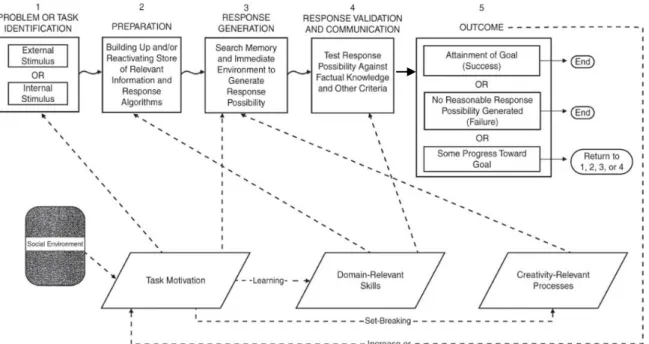
Figure 1: Componential framework of creativity. Broken lines indicate the influence of particular factors on others. Solid lines indicate the sequence of steps in the process. Only
direct and primary influences are depicted here (Amabile (1983)). ... 14
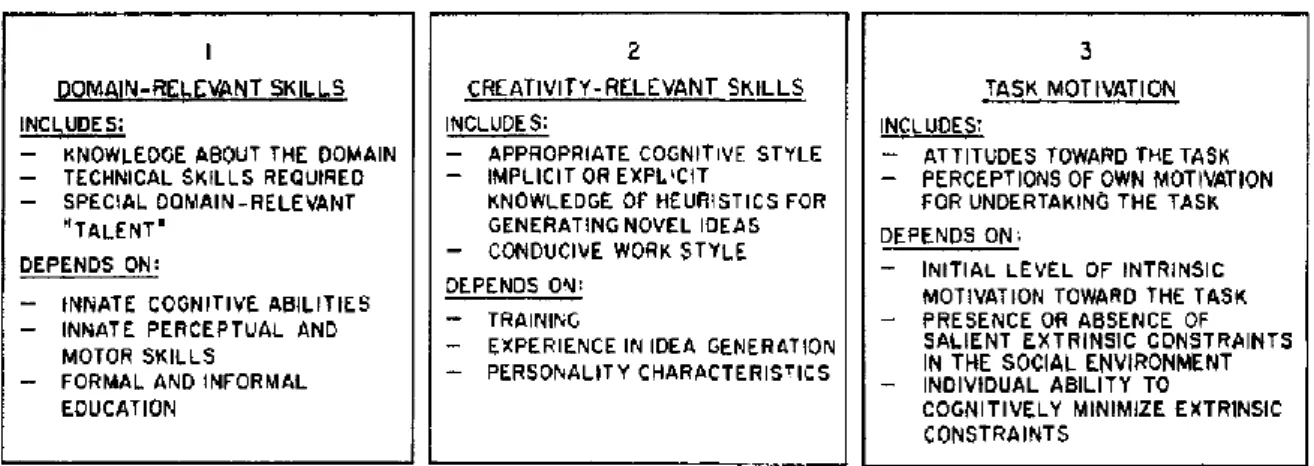
Figure 2: Components of creative performance. Source: Amabile (1983). ... 15
Figure 3: Categorisation of Software for Enhancing Creativity. In this thesis, CSS will refer to all software which enhances creativity. ... 58
Figure 4: Data analysis process of courses outlines ... 79
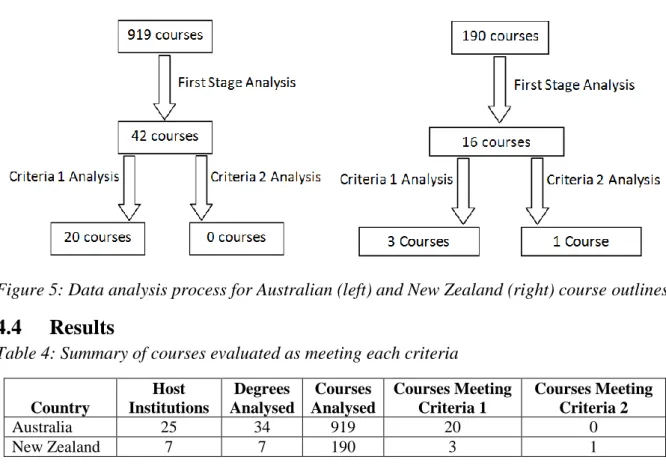
Figure 5: Data analysis process for Australian (left) and New Zealand (right) course outlines ... 80
Figure 6: Number of Australian Courses from Each Year Level Including Creativity-Related Content ... 81
Figure 7: Simplest Su-Field Analysis model of a functioning system showing interaction between substances and fields (Belski, 2007, p. 29; Gadd, 2011, pp. 377-378) ... 97
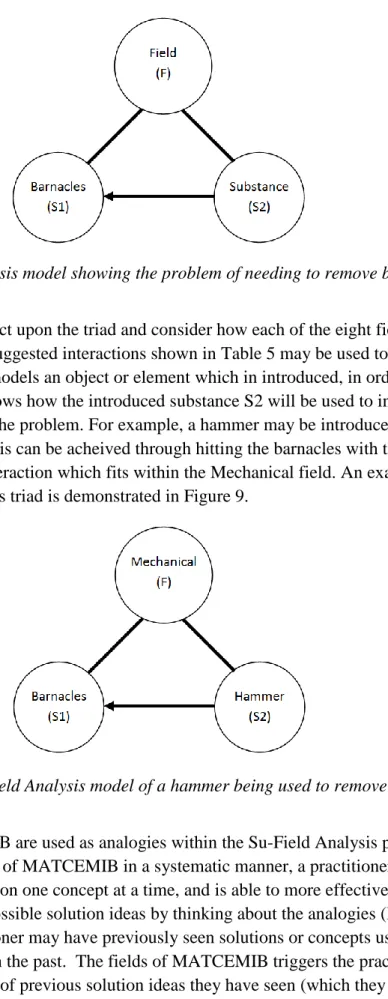
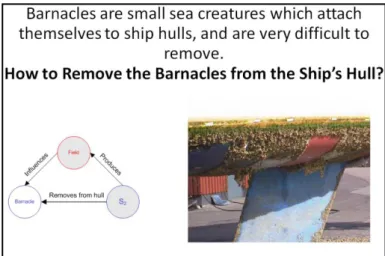
Figure 8: Su-Field Analysis model showing the problem of needing to remove barnacles from a ship ... 98
Figure 9: Example Su-Field Analysis model of a hammer being used to remove barnacles from a ship ... 98
Figure 10: Screenshot of instructional video showing how to apply Su-Field Analysis technique through an example of removing annoying flies ... 100
Figure 11: Problem description presented to students ... 101
Figure 12: Mean number of ideas proposed in each field by each year level ... 114
Figure 13: Mean number of ideas proposed in each field by third year local and international students ... 116
Figure 14: Fluency performance of students based on year level of study ... 118
Figure 15: Fluency performance of students based on enrolment status ... 120
Figure 16: Problem description presented to students ... 125
Figure 17: Model of Factors Influencing Ideation during Creativity Training ... 148
Figure 18: Model of Factors in Creativity Training Which Influence Long-Term Ideation Performance ... 149
x
List of Tables
Table 1: How Objectives are addressed in Thesis and Publications ... 4
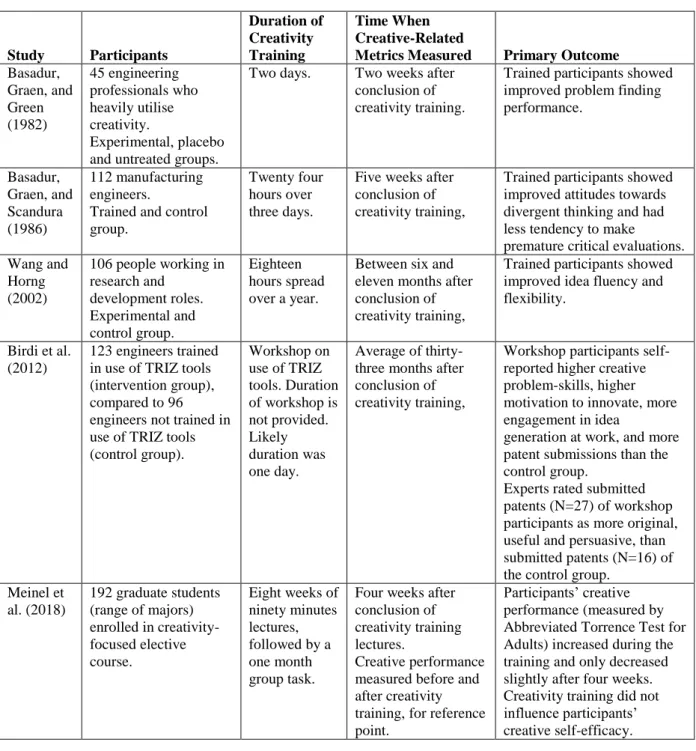
Table 2: Summary of studies investigating the long-term influence of creativity training ... 31
Table 3: Overview of the total number of degrees and courses that were analysed ... 76
Table 4: Summary of courses evaluated as meeting each criteria ... 80
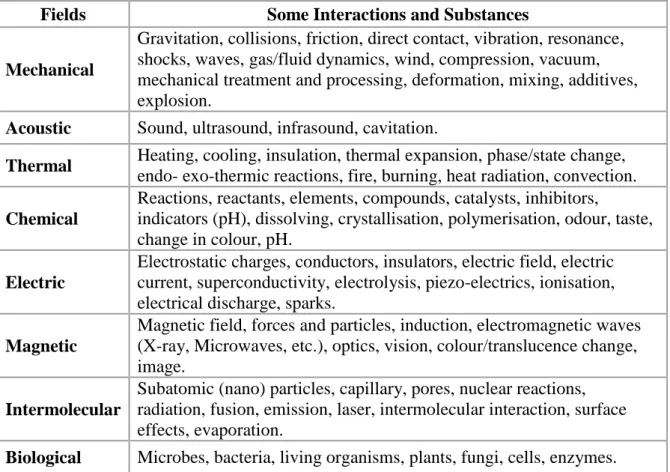
Table 5: The eight fields of MATCEMIB used in systematised Su-Field Analysis (Belski, 2007, p. 17) ... 96
Table 6: Evaluation of Inter-rater Reliability ... 107
Table 7: Evaluation of Inter-rater Reliability – Subgroups ... 108
Table 8: Example Calculation of Creativity Dimensions Using Assessor Evaluations ... 109
Table 9: Idea Generation Performance ... 109
Table 10: Shapiro-Wilk Test of Normality ... 110
Table 11: Comparison of Pen-and-paper and Computer Based Performance ... 111
Table 12: Idea Generation Performance –Short and Extended Templates ... 112
Table 13: Comparison of Short and Extended Templates on Performance ... 113
Table 14: Idea Generation Performance – Comparison of Year Level ... 113
Table 15: Comparison of Year Level on Performance ... 114
Table 16: Idea Generation Performance – Comparison of Enrolment Type ... 115
Table 17: Comparison of Enrolment Type on Performance ... 116
Table 18: Evaluation of Inter-rater Reliability ... 127
Table 19: Evaluation of Inter-rater Reliability – Subgroups ... 127
Table 20: Student Idea Generation Performance ... 127
Table 21: Idea Generation Performance – Control and Intervention Groups ... 128
Table 22: Comparison of participants who had and had not participated in previous creativity training ... 128
Table 23: Idea Generation Performance – Mode Used in Experiment 1 ... 129
Table 24: Comparison of mode used in creativity training, influence on future ideation performance ... 129
Table 25: Idea Generation Performance – Mode Used in Experiment 1 ... 130
Table 26: Comparison of template used in creativity training, influence on future ideation performance ... 130
Table 27: Comparison of control group and extended template group from Experiment 1 .. 130
Table 28: Self-efficacy questions students were asked to complete. Likert Scale ranges from 1 (strongly disagree) to 7 (strongly agree). ... 138
Table 29: Evaluation of Inter-rater Reliability ... 141
Table 30: Evaluation of Inter-rater Reliability – Subgroups ... 141
Table 31: Responses to pre-experiment questionnaire ... 141
Table 32: Student Idea Generation Performance ... 142
Table 33: Comparison of ideation performance of PPG and CBG ... 142
Table 34: Changes to students‘ self-efficacy during the experiment. Ranges from 1 (strongly disagree) to 7 (strongly agree). ... 142
Table 35: Comparison of change in self-efficacy of PPG and CBG ... 143
xi
Table 37: Correlation between pre-experimental self-efficacy and ideation metrics (PPG & CBG) ... 144 Table 38: Review of the Influence of Mode on Test and Assessment Task Performance ... 155 Table 39: Review of the Influence of Mode on Reading Comprehension ... 157 Table 40: Review of the Influence of Mode on Group Creativity and Ideation Performance 158 Table 41: Review of the Influence of Software on Individual Creativity and Ideation
Performance, Compared to Control using No Software ... 160 Table 42: Review of the Influence of Software on Individual Creativity and Ideation
Performance, Compared to using a ‗Control‘ Software (e.g. word processor) ... 160 Table 43: Review of the Influence of Mode on Miscellaneous Tasks ... 161 Table 44: Questionnaire Metrics and Associated Questions ... 179 Table 45: Responses to Questions. All except ATAR used Likert Scale 1-Strongly Disagree to 7-Strongly Agree. ... 179 Table 46: Statistical Significance between groups ... 180
xii
List of Publications
This section outlines the related works that Andrew has contributed to during this course of study.
The following publications and in-progress works have resulted from this work:
Refereed Journal Articles
Valentine, A., Belski, I., & Hamilton, M. (2017). Developing creativity and problem solving skills of engineering students: A comparison of web and pen and paper based approaches. European Journal of Engineering Education, 42 (6), 1309-1329. DOI: 10.1080/03043797.2017.1291584
Valentine, A., Belski, I., & Hamilton, M. Investigating the presence of a mode-effect on engineering students‘ self-efficacy during idea generation. (Under Review)
Valentine, A., Belski, I., & Hamilton, M. Creativity in electrical engineering degree programs: where is the content? (Under Revision)
Conference Papers (Peer Reviewed)
1. Valentine, A., Belski, I., & Hamilton, M. (2015). A comparison of web and paper based approaches for idea generation. In A. Oo, A. Patel, T. Hilditch, & S. Chandran (Eds.), Proceedings of the 26th Annual Conference of the Australasian Association for Engineering Education (pp. 567-576). Geelong, Australia: School of Engineering, Deakin University.
2. Valentine, A., Belski, I., & Hamilton, M. (2016). Engaging engineering students in creative problem solving tasks: How does it influence future performance?
Proceedings of the 44th Annual Conference of the European Society for Engineering Education (pp. 1-9). Tampere, Finland.
3. Valentine, A., Belski, I., & Hamilton, M. (2016). Perceptions of computer and pen-and-paper based learning environments for engaging in creative problem solving activities. Proceedings of the 27th Annual Conference of the Australasian Association for Engineering Education (pp. 1-8). Coffs Harbour, Australia: Southern Cross University.
4. Valentine, A., Belski, I., Hamilton, M., & Adams, S. (2017). Analysis of Usage for Two Digital Format Ideation Templates. In N. Huda, D. Inglis, N. Tse, & G. Town (Eds.), Proceedings of the 28th Annual Conference of the Australasian Association for Engineering Education (pp. 1117-1124). Manly, Australia: School of Engineering, Macquarie University.
5. Valentine, A., Belski, I., Hamilton, M., & Adams, S. (2017). Australian electrical engineering curricula and development of creativity skills: How do we rate? In N. Huda, D. Inglis, N. Tse, & G. Town (Eds.), Proceedings of the 28th Annual Conference of the Australasian Association for Engineering Education (pp. 1125-1132). Manly, Australia: School of Engineering, Macquarie University.
6. Valentine, A., Belski, I., Hamilton, M., & Adams, S. (2017). Can Idea Generation Techniques Impede Effective Ideation? In N. Huda, D. Inglis, N. Tse, & G. Town (Eds.), Proceedings of the 28th Annual Conference of the Australasian Association for
xiii
Engineering Education (pp. 1109-1116). Manly, Australia: School of Engineering, Macquarie University
7. Valentine, A. Belski, I., & Hamilton, M. Development of creativity in engineering students: a cause for concern? Proceedings of the 125th Annual Conference of the Australasian Association for Engineering Education (pp. 1-13). Salt Lake City, Utah, United States.
Conference Papers (Peer Reviewed) (Non-Thesis Related)
Andrew has contributed to the following publications during this period of study which are not related to the thesis:
1. Liono, J., Valentine, A., Khoo, C. K., & Salim, F. D. (2016). Measuring passers-by engagement with AmPost: a printed interactive audio poster. Proceedings of the 28th Australian Conference on Computer-Human Interaction - OzCHI 2016 (pp. 215-219). Launceston, Australia: ACM.
Conference Presentations
Andrew has presented at the following conferences during this course of study: 1. Oral Presentation, 26th Annual Conference of the Australasian Association for
Engineering Education, Geelong, Australia, December 2015.
2. Oral Presentation, 44th Annual Conference of the European Society for Engineering Education, Tampere, Finland, September 2016.
3. Oral Presentation, 28th Australian Conference on Computer-Human Interaction, Launceston, Australia, November 2016. (Non-thesis related).
4. Three Oral Presentations, 28th Annual Conference of the Australasian Association for Engineering Education, Sydney, Australia, December 2017.
5. Oral Presentation, 125th Annual Conference of the American Society for Engineering Education, Salt Lake City, United States, June 2018.
Presentation of Related Work in Other Formats
1. Oral Presentation, Lappeenranta University of Technology, Finland, September 2016. 2. Oral Presentation, School of Electrical and Computer Engineering 3 Minute Thesis
Competition RMIT University, Australia, July 2016. Best Student Presentation Award.
3. Oral Presentation, School of Engineering 3 Minute Thesis Competition RMIT University, Australia, July 2017.
xiv
Abbreviations
CBG Computer Based Group CBT Computer Based Test
CG Control Group
CSS Creativity Support System DSS Decision Support System EBS Electronic Brainstorming
GDSS Group Decision Support System ICSS Individual Creativity Support System
KTCPI Khatena-Torrence Creative Perception Inventory MIS Management Information Systems
NBS Nominal Brainstorming
OECD Organisation for Economic Co-operation Development PBT Paper Based Test
PISA Programme for International Student Assessment PPG Pen-and-Paper Group
STEM Science, Technology, Engineering and Mathematics TRIZ Teoriya Resheniya Izobretatelskikh Zadach (Russian)
Theory of Inventive Problem Solving (English) TTCT Torrence Test of Creative Thinking
xv
Abstract
Creativity and problem-solving are key skills which engineering graduates are expected to possess. While some studies report completing a four-year engineering program has a positive influence on creativity and problem-solving skills, others highlight that creativity skills may actually decrease over this time. Several studies report that creativity is given insufficient space within engineering curriculum, highlighting a contributing factor to this issue. Creativity is a complex process involving numerous phases. The scope of this thesis is focused on the development of idea generation skills, and overcoming the issue of fixation. This thesis will primarily focus on the development of creativity skills through training in the use of creativity heuristics. Due to scope limitations, the practicality or viability of ideas will not be evaluated.
The purpose of this study was to:
Quantify the coverage of creativity material within engineering curricula in Australia and New Zealand.
Establish whether creativity training learning activities traditionally completed using pen-and-paper in a classroom environment can be successfully migrated to an online environment, without the influence of negative mode-effects on student learning outcomes.
Establish whether online creativity training activities are a viable way for teaching engineering students creativity and problem-solving skills.
The following research objectives were investigated:
Establish the extent that creativity-related topics are explicitly taught within
engineering curricula in Australia and New Zealand, specifically including creativity heuristics training.
Establish whether there is a mode-effect in the context of creativity heuristics training, based upon ideation performance and self-efficacy.
Establish whether there is any measurable long-term benefit for students to spend time engaged in tasks that expose them to the use of creativity heuristics, and whether there is a long-term mode-effect on ideation performance.
Establish from an educator‘s point of view whether creativity heuristics training is viable, and when and how it should be introduced to engineering curricula.
Establish whether students prefer to complete creativity heuristics training using one mode or the other (computer or pen-and-paper).
This study utilised a mixed methods approach using both quantitative and qualitative methods in different stages of the study:
The first phase was a mixed methods research design. 1109 publicly accessible course outlines from forty-nine Australian and New Zealand electrical engineering programs hosted by thirty-two different institutions, were analysed to collect data and carry out evaluations.
xvi
The second phase included three quasi-experiments, using a primarily quantitative research design. The first experiment involved seventy first year students, one
hundred and fifty-three third year students and thirty-eight postgraduate students. The second experiment involved ninety third year students. The third experiment involved forty-eight first year students.
The key findings of the study are:
Quantification of the coverage of creativity-related material in engineering curricula on a national level as opposed to being limited to one or two tertiary institutions. There is no observable mode-effect in the context of creativity training where students
learn to apply creativity heuristics, based upon either ideation performance or self-efficacy.
Engaging engineering students in a standalone idea generation activity of less than an hour duration has measurable performance benefits, and there was no observable difference in longitudinal ideation performance based on mode used in the creativity training.
Students show positive interest towards standalone learning activities designed to enhance their creativity and idea generation skills. As an overall cohort, students show slight preference for completing such activities using computer over pen-and-paper.
First year students may be more willing or able to make use of creativity heuristics training. Students in higher year levels may be more resistant to learning such topics. The key findings have implications for practice. When designing engineering curricula, the following factors should be taken into account regarding the development of creativity and problem-solving skills:
Engineers Australia and Engineering New Zealand may adapt their criteria for assessing whether engineering programs foster creativity skills or not. Engineering programs should require students to explicitly learn about creative theory and creativity techniques, as opposed to implicitly only through the completion of engineering design projects.
It is recommended courses focused on developing creativity and problem-solving skills are introduced to first year of study. Additionally, creativity material should be increased throughout the engineering program.
Developing online creativity training activities and making them widely available may be one way which the creativity and problem-solving skills of engineering students may be effectively enhanced throughout an engineering degree. Especially where an institution otherwise has a lack of creativity-related material throughout their
engineering curricula.
Making creativity training available in students‘ first year of study is ideal as students may be more willing to engage with the activity, and it provides more time throughout their degree when they can practice and make use of the training.
xvii
The research findings of the study contribute to the existing literature in the following ways: Much more comprehensive understanding of the extent of coverage of
creativity-related material within Australian and New Zealand engineering education. Better understanding of the influence that creativity heuristics training is has on
students‘ longitudinal idea generation performance.
Substantial addition to the available literature in regards to mode-effect in the context of creativity training activities, both in terms of initial and longitudinal effects. Contribution to the understanding of mode-preference within different contexts.
Within creativity heuristics training, students show preference for using computers. Identification that students show positive attitudes specifically towards creativity
heuristics training activities, as opposed to creativity in general or courses focused on creativity.
Results of this study provide useful information for educators relevant to teaching creativity and problem-solving skills within engineering education.
Findings in this thesis can lead to the increased adoption of creativity material within engineering curricula, and the development of online applications which can engage engineering students in building their creativity and problem-solving skills.
Future work may conduct longitudinal research to establish whether engaging students in creativity heuristics training regularly throughout their program of study, can lead to
observable benefits to their creativity skills upon graduation. Future research may expand the types of creativity training considered, and broaden the focus to include aspects of creativity training other than heuristics.
1
Chapter 1:
Introduction and Thesis Structure
This section will present a concise summary of the motivations and objectives for this project, contributions of the thesis to the literature, and an overview of how the objectives are met the thesis structure and relevant publications.
The motivations and objectives are derived from the literature reviews covered throughout Chapters 2 and 3.
1.1
Motivations and Objectives
1. Establish the extent to which creativity and innovation related topics are explicitly taught within engineering curricula in Australia and New Zealand, specifically including ideation-based creativity heuristics training.
2. Establish whether there is a mode-effect in the context of ideation-based creativity heuristics training.
a. Mode-effect on ideation performance. b. Mode-effect on self-efficacy.
3. Establish whether there is any measurable long-term benefit for students to spend time engaged in standalone tasks that expose them to the use of creativity heuristics, and whether there is a long-term mode-effect on ideation performance.
4. Establish from an educator‘s point of view whether ideation-based creativity heuristics training is viable, and when and how it should be introduced to engineering curricula.
a. Whether students see benefit and are interested in ideation-based creativity heuristics training.
b. What year level of study should students learn such material.
5. Establish whether students prefer to complete ideation-based creativity heuristics training using one mode or the other, specifically pen-and-paper or computer.
1.2 Thesis Contributions
1. First study in the literature to conduct a review and quantify the coverage of creativity related material in engineering curricula on a national level (Australia and New Zealand), opposed to being limited to the study of one or two tertiary institutions. 2. First study in the literature to demonstrate that there is no observable mode-effect in
the context of creativity training where students learn to apply creativity heuristics, based upon either ideation performance or self-efficacy.
3. First study in the literature to demonstrate that engaging engineering students in a standalone idea generation activity of less than an hour duration has measurable performance benefits, and that there is no observable mode-effect on ideation performance based upon the mode used in the initial creativity training.
4. First study in the literature to demonstrate that students show positive interest towards short standalone learning activities designed to enhance their creativity and idea generation skills.
5. First study in the literature to demonstrate that students show a slight preference for completing creativity training activities using a computer-based interface over
pen-2
and-paper. In addition, this is the first study in the literature to directly compare and evaluate the usage rates of learning resources which were made available in two digital formats, where students had the option of which (or both) digital format to use.
1.3
Thesis Structure
This section will provide an overview of the structure of the thesis, and the contents of each Chapter.
Chapter 2 will detail a literature review of creativity within the context of engineering
education. This will include discussion of what is creativity, why creativity is important, how well engineering curricula enhances the creativity or students and potential shortcomings , creativity in the context of engineering problem solving, self-efficacy, stakeholders‘ interest in creativity, and how creativity can be enhanced in higher education settings.
Chapter 3 will detail a literature review of digital technologies, focusing on the mode-effect. This will include discussion of what the mode-effect is, what may cause the mode-effect, tasks where the mode-effect is observed, what may be done to overcome the mode-effect, and how mode preference may or may not relate to task performance. The Chapter will also include detailed analysis of how computers can assist people to be creative, and the types of software which assist people to be creative and how they work.
Chapter 4 will detail a review that was undertaken to establish to what extent creativity-related material, and specifically creativity heuristics and techniques, are explicitly taught within electrical engineering curricula within Australia and New Zealand.
Chapter 5 will detail an experiment designed to answer objectives 2a and 4b, as well as some other factors in creativity heuristics training. This Chapter will focus on whether there is an observable mode-effect in the context of creativity heuristics training. In addition, the experiment will investigate whether other factors including template design and student enrolment type (local or international) are important factors which educators must consider when designing creativity heuristics training activities.
Chapter 6 will detail an experiment designed to answer objective 3. This Chapter will focus on identifying whether involvement in the experiment from Chapter 4 lead to measureable long-term ideation performance benefits, and whether the mode used in creativity heuristic training influenced long-term ideation performance. In other words, whether there is an observable long-term mode-effect on ideation performance.
Chapter 7 will provide details of an experiment designed to answer objectives 2b, 4a, and 5a. This will include whether there is an observable mode-effect on self-efficacy during creativity heuristics training, whether students show interest in creativity training activities, and whether students prefer to complete creativity training activities using pen-and-paper or computer. Chapter 8 will present a model of factors which were found to influence (or not) ideation performance and self-efficacy during creativity training activities. The models are based upon the experiment findings and are applicable for educators who wish to introduce creativity training to engineering curriculum. The models allow educators to comprehend which factors
3
are most likely to be important or influential, and need to be accounted for when designing the creativity training and introducing it to curriculum.
Chapter 9 will summarise the findings of the thesis and provide conclusions, and detail possible areas for future research.
4
1.4 How Objectives are addressed in Thesis and Publications
Table 1 details how each of the objectives are addressed in the thesis, and the current state of publication for each objective.
Some of the research outputs address multiple non-consecutive objectives. Objective descriptions can be observed in section 1.1.
Appendix L provides a more in-depth breakdown of the candidate‘s contribution to each of the research publications and in-progress manuscripts, so that this is apparent to the reader. Table 1: How Objectives are addressed in Thesis and Publications
Research Outputs/Papers Title
Journal/
Conference Proceedings Status
Thesis Objective Chapter Where paper appears in thesis 1. Australian electrical engineering curricula and development of creativity skills: How do we rate?
28th Annual Conference of the Australasian Association for Engineering Education
Published 1 Chapter 4
2. Creativity in electrical engineering degree programs - where is the content?
Under Revision
1 Chapter 4
3. Developing creativity and problem solving skills of engineering students: A comparison of web and pen and paper based
approaches
European Journal of Engineering Education
Published 2a Chapter 5
4. A comparison of web and paper based approaches for idea generation
26th Annual Conference of the Australasian Association for Engineering Education
Published 2a Chapter 5
5. Development of creativity of engineering students: a cause for concern?
125th Annual Conference of the American Society for Engineering Education
Published 4b Chapter 5
6. Engaging engineering students in creative problem solving tasks: How does it influence future performance?
44th Annual Conference of the European Society for Engineering Education
Published 3 Chapter 6
7. Perceptions of computer and pen-and-paper based learning environments for engaging in creative problem solving activities
27th Annual Conference of the Australasian Association for Engineering Education
Published 3 Chapter 6
8. Investigating the presence of a mode-effect on engineering students‘ self-efficacy during idea generation
5
Chapter 2:
Literature Review – Creativity in Engineering
It is important to highlight to the reader that the literature review was conducted using a traditional (i.e. ―narrative‖) style, as opposed to a systematic style.
The snowballing approach was heavily utilised during the literature review. Cited references in the bibliography of an article were regularly accessed and evaluated for their relevance to specific sub-topics, in an iterative manner.
Databases which were utilised included in construction of the literature review were primarily SCOPUS and Web of Science.
2.1 The Need for Creativity and Thinking Skills in Engineering
Education
The World Economic Forum is an international non-profit organisation with strategic partners from over 100 of the world‘s largest companies including Apple, Google, Ericsson, Siemens, IBM, Microsoft and many others (World Economic Forum, 2018). In 2016, the World Economic Forum (2016) released a report titled ―Future of Jobs‖ which focused on analysing and identifying the skills which businesses would need to be able to remain competitive in the global market, into the future. A focal point of the report was identification of a list of ten primary skills which businesses required in 2015, and the ten skills which businesses would required in 2020. Creativity was identified as an important skill that businesses required both in 2015, and 2020. However, whereas creativity was considered as the tenth most important skill in 2015, this ranking increased to the third most important skill that would be required in 2020. This report highlights the fact that creativity and thinking skills are seen by many of the world‘s leading companies as skills that are becoming increasingly important for their
employees to possess during this time period.
The need for creativity and innovation skills is acknowledged by the Australian government as being paramount to the success of the Australian business. In 2016 the Australian
government launched an inquiry to establish ways in which the Australian tertiary education system may aim to produce a workforce which is focused on creativity and innovation
(Commonwealth of Australia, 2017). It was recommended that there was a need for increased focus on STEM (Science, Technology, Engineering and Mathematics) subjects in pre-tertiary education. Regarding the field of engineering in tertiary institutions, it was concluded that there was a need to ensure mathematics was included as a pre-requisite for tertiary
undergraduate courses (Commonwealth of Australia, 2017, p. 92). However, there was an apparent lack of further recommendations for how the creativity and innovation skills of engineering students may be enhanced in Australian tertiary education.
Specifically related to the domain of engineering, the need for engineering graduates to possess creativity and innovation skills has been widely acknowledged in reports and studies conducted worldwide. Reflecting upon the skills which engineering graduates of 2020 would need to possess, the United States National Academy of Engineering reported creativity ―is an indispensable quality for engineering‖ and that it is a key skill which professional engineers
6
would need to be able to effectively demonstrate into the future (National Academy of Engineering, 2005). Similar assertions have also been made by the Royal Academy of Engineering in the United Kingdom. It was reported that there was a need for tertiary
institutions of the United Kingdom to produce, and industry to employ, engineering graduates who are able to effectively show creativity skills, in order for industry to be able to meet the requirements of professional engineers in the 21st century. The need for the Australian
engineering industry to show creativity and innovation has also been highlighted by Engineers Australia, who report that the engineering industry is key to Australia‘s ―ambition of
becoming an innovative and globally competitive nation‖ (Kaspura, 2017).
Academic studies have also highlighted the importance that professional engineers and engineering employers place upon creativity and innovation. A study conducted by Male, Bush, and Chapman (2009a) investigated the perceptions of 300 engineering graduates about the importance of various competencies for graduates in Australia. It was reported that creativity was rated as an attribute which was important for work as a professional engineer. A further Australian study investigated the importance that engineering employers placed upon ten nominated graduate attributes, that engineering graduates of a specific tertiary institution were expected to possess (Nair, Patil, & Mertova, 2009). Graduates‘ ability to develop new or innovative ideas was rated as being important by the engineering employers, although it should be noted that attribute was only rated as the eight most important out of the list of ten nominated attributes (Nair et al., 2009). Similarly, a study which investigated the perceptions of various stakeholders from the field of engineering and computer science about the importance of various employability skills (54 graduates, 26 employers, and academics), established that all groups positively considered creativity and innovative thinking skills as being important for graduates (Wickramasinghe & Perera, 2010).
This apparent need for engineering students and graduates to possess and demonstrate
creativity and innovation skills can be specifically linked to the competency standards that are presented by the engineering accreditation bodies of Australia and New Zealand; Engineers Australia and Engineering New Zealand. The stage 1 competency standard for a professional engineer (expected of a graduate engineer) as set out by Engineers Australia (2017d)
specifically notes that professional engineers must demonstrate a ―creative, innovative and proactive demeanour‖. This need to demonstrate creativity remains an integral skill that an engineer must continue to develop as they acquire more professional experience. The stage 2 competency standards by Engineers Australia (2014) outline the skills that an advanced engineer (aimed towards leaders and managers) is expected to possess. The stage 2
competency standard notes that ―creativity and innovation‖ is a key competency of advanced engineers, and that they must ―cultivate an attitude of innovation and creativity to add value for clients or sponsors of the service, process or system‖ (Engineers Australia, 2014). Likewise, Engineering New Zealand requires that professional engineers must ―demonstrate creativity when proposing solutions‖ to complex engineering problems (Engineering New Zealand, 2017). This shows that engineering accreditation bodies consider creativity is an important skill for professional engineers of all experience levels to possess, and it is
7
important that engineering programs which are accredited by these organisations do effectively develop creativity skills.
The importance of fostering creativity and innovation within engineering education is acknowledged at the highest level by tertiary engineering departments within Australia. In a report addressing the skills which Australian engineering graduates would require in the 21st century, the Australian Council of Engineering Deans stated that Australian ―engineering programs have a strong emphasis on ... creativity problem solving and innovation‖ (King, 2008, p. v). As a result, it is clear that engineering departments of tertiary instructions are highly aware of the need to endure students effectively build upon their creativity and innovation skills, and that institutions assert that their courses effectively ensure this is the case.
2.2
Definition of Creativity
Throughout the past one hundred years or so, numerous definitions of creativity have been provided or proposed by researchers. In a report which highlighted the state of engineering education in the United States one hundred years ago, Mann (1918, p. 74) contended that a person who was creative was ‗original‘. Since then, the plethora of creativity definitions which have been provided have created debates, confusion and some misconceptions about what ‗creativity‘ actually means. This has made it difficult to address the topic of creativity with clarity in some instances, while ensuring that the meaning of creativity is comprehended by all.
In 1961, Mel Rhodes introduced the 4 P‘s model of creativity (Rhodes, 1961). Since then, the model has been one of the most widely used models when exploring and explaining aspects of creativity (Gruszka & Tang, 2017). In brief, the 4 P‘s model of creativity suggests that there are four ―strands‖ which relate to, and may influence, creativity. The four P‘s are defined as follows (Rhodes, 1961):
Person – ―pertains essentially to the person as a human being‖
Process – ―pertains to the mental processes that are operative in creating ideas‖ Press – ―pertains to the influence of the ecological press on the person and upon his
mental processes‖
Products – ―pertains to ideas‖
Each of the 4 P‘s covers fundamentally different aspects that may influence creativity.
Regarding the definition of creativity, the model is important because a lot of recent literature on creativity has built upon this work, and it demonstrates that the definition may change depending on what exactly is being considered or evaluated. For example, the definition of creativity may change when discussing a person, as opposed to a product. This aims to serve as a basis for the reader to understand the wide-ranging literature on creativity which will be discussed in sections 2.2-2.4.
2.2.1 Definition of What Makes Something Creative
Some definitions of creativity are relatively straightforward to interpret, but are limited in their ability to explore the overall creative process. A common example of this is that
8
creativity is defined as the process of generating ideas, and that a creative person or group is one which generates many ideas (Adánez, 2005). Cropley (2015b) defines that creativity is linked to the capability to generate ideas that are novel and unobvious when faced with a problem which is unfamiliar. Creativity is defined by Amabile (1996) as the generation of ideas or products which are novel and useful.
It is important to reflect upon these definitions and note that arguably, they are defining creativity based upon how it should be measure (the metrics).This demonstrates that many researchers may define or interpret creativity as what makes an object or outcome creative, as opposed to focusing on what exactly creativity as a process actually means.
2.2.2 Standard Definition of Creativity
In an effort to address the problem that there are many definitions of creativity, Runco and Jaeger (2012) attempted to identify what may be considered as the first ―standardised definition‖ of creativity. Reflecting upon the progress of creativity work since the 1930‘s, Runco and Jaeger (2012) credit Stein (1953) with proposing the first standardised definition of creativity which involved unambiguous wording. Stein (1953) writes that:
“The creative work is a novel work that is accepted as tenable or useful or satisfying by a group in some point in time ... [novel means] that the creative product did not exist previously in precisely the same form ... The extent to which a work is novel depends on the extent to which it deviates from the traditional or the status quo. This may well depend on the nature of the problem that is attacked, the fund of knowledge or experience that exists in the field at the time, and the characteristics of the creative individual and those of the individuals with whom he [or she] is communicating.” In response, Runco and Jaeger (2012) contend that ideas and products are creative if they are original, and are useful.
2.2.3 Creativity is Domain Dependant
Research has demonstrated that creativity is domain dependant (Baer, 2015), and that having a high level of creativity in one domain does not mean that creativity will be transferred to other domains (Baer, 2012). D. H. Cropley and A. J. Cropley (2005) contend that there are aspects of creativity which are shared across all domains, but that ―creativity in engineering clearly differs from creativity in, for example, fine arts‖. It can therefore be reasoned that measurement and definitions of creativity should be specific to the domain of interest. Reflecting upon the domain-specificity of creativity, (Belski, 2017) proposed the following definition of creativity as it relates to the domain of engineering: ―Engineering creativity is the ability to generate novel solution ideas for open-ended problems, ideas that are not obvious to experts in a particular engineering discipline and that are considered by them as potentially useful‖.
Overall, it is apparent that creativity focuses on the process of generating of solution idea(s) which are considered as potentially useful for resolving the problem being faced, and which are also not obvious existing ways of resolving the problem (i.e. they are novel or original).
9
On the other hand, the definition of whether something is creative appears to be different, as it focuses on evaluating certain aspects about a ‗thing‘ (i.e. a product, a person or a processes) in comparison to other things of the same type.
2.3 Measuring Creativity
In the same way that numerous definitions of creativity have been provided by researchers, numerous tests have been developed with the aim of measuring or assessing creativity. Torrance and Goff (1989) found that there were over two hundred and fifty tools which had been developed for the purpose of assessing creativity up until that point. More recently, in a literature review which assessed over half a century of research into creativity tests, Thys, Sabbe, and De Hert (2014) evaluated that over one hundred and ten tools had been developed for measuring creativity. These reviews highlight that there are many specific tools which have been developed for measuring creativity, as each is designed to measure certain traits or characteristics related to creativity which may not be covered by other tools, or may not be appropriate for the specific context.
As previously discussed, creativity is domain dependant (Baer, 2015), meaning that tools and metrics for measuring creativity are likely to vary based upon the context. A person who has extensive experience in creative figure skating may be able to accurately evaluate the
creativity of figure skating, but it is unlikely that they will be able to accurately evaluate products from the fine arts without relevant expertise. Likewise, a tool which is developed for measuring the creativity of figure skating is unlikely to be suitable for evaluating the
creativity of products from the fine arts, or engineering.
2.3.1 Dimensions of Divergent Thinking and Evaluation of Creativity
In order to be able to measure any form of creativity, identification of appropriate metrics is first required. While some measurement tools or studies use metrics which are specific to the tool or study being considered, there are several metrics which are widely utilised across tools and studies which assess and evaluate creativity. It is important to note that evaluation of some of these metrics is more subjective than others, and therefore the way in which some of these metrics are evaluated may be slightly different, despite the fact that study authors may use the same name for the metric. This section will discuss several of these widely used metrics, and how they relate to divergent thinking and creativity.
Four of the most widely used metrics are fluency, flexibility, originality, and elaboration. Although not necessarily the first to use these metrics, Guilford (1956) was one of the first to classify these metrics as factors which were important for divergent thinking. Since then, many aptitude tests which utilise these metrics have been developed and numerous studies have utilised these metrics to assess creative performance. Urban (1991) states that fluency, flexibility, originality and elaboration are ―substantial components of the creative process, but may not be seen synonymously with creativity‖. Contradicting this viewpoint is Cropley (2015a, p. 55), who states that creativity is characterised by these dimensions of divergent thinking, and in order to successfully produce solutions, a person must be free from
constraints as much as possible (i.e. time, cost, technology). Cropley (2015a, p. 55) concludes that ―the only way that we hope to identify and develop effective, competitive, technological
10
solutions to engineering problems is to explore the largest possible design space—that is, to maximize fluency, flexibility, originality, and elaboration‖.
Fluency refers to the number of relevant (not necessarily useful) responses which are given in regards to the problem being resolved (Charyton & Merrill, 2009; Cramond, Matthews-Morgan, Bandalos, & Zuo, 2005; Cropley, 2015a; Treffinger, Isaksen, & Stead-Dorval, 2006, p. 55). Fluency can be established by simply counting the number of ideas (Cropley, 2000), meaning it is relatively non-subjective. Examples of studies which include evaluating
creativity based on fluency include Adánez (2005); Ames and Runco (2005); Belski, Hourani, Valentine, and Belski (2014); Bouchard (1972); Del Missier, Visentini, and Mäntylä (2015); Dewett and Gruys (2007); Hao, Wu, Runco, and Pina (2015); Nazzal (2015); Reiter-Palmon and Arreola (2015); Saad, Cleveland, and Ho (2015); Shaw, Arnason, and Belardo (1993). Flexibility refers to the variety (Treffinger et al., 2006, p. 55), different types (Cropley, 2015a), or number of categories (Charyton & Merrill, 2009; Cramond et al., 2005) which are used to generate responses. Like fluency, flexibility can also be established by simply
counting the number of categories (Cropley, 2000), meaning it is relatively non-subjective. Examples of studies which include evaluating creativity based on flexibility include Adánez (2005); Hao et al. (2015); Reiter-Palmon and Arreola (2015); Shaw et al. (1993).
Originality refers to how rare or unusual (Cropley, 2015a) an idea is based upon the number of times which other people have already suggested it (Cramond et al., 2005; Treffinger et al., 2006, p. 55), this is, whether it is statistically infrequent (Cramond et al., 2005; Cropley, 2000). Originality may be evaluated through the use of statistical methods. Alternatively, originality may be rated on a scale, such as a Likert Scale (Cropley, 2000). In order to increase validity when a scale is used for evaluation, experts from the field may be engaged for evaluation using a method such as the Consensual Assessment Technique. Examples of studies which include evaluating creativity based on originality include Adánez (2005); (Charyton & Merrill, 2009); Hao et al. (2015); Reiter-Palmon and Arreola (2015); Shaw et al. (1993); (Treffinger et al., 2006).
Elaboration refers to the level of detail or number of details which are provided (Cramond et al., 2005; Treffinger et al., 2006, p. 55). Evaluation of elaboration is ultimately subjective, and may be evaluated based upon methods such as use of a Likert Scale. Examples of studies which include evaluating creativity based on elaboration include Adánez (2005); Reinig and Briggs (2008); Reiter-Palmon and Arreola (2015); Saad et al. (2015).
By using these metrics, it is possible to evaluate divergent thinking and creativity in a number of contexts. For example, Charyton and Merrill (2009) specifically utilise fluency, flexibility and originality for evaluating creativity in the context of engineering design, agreeing with the viewpoint of Cropley (2015a, p. 55), minus the inclusion of elaboration. Meanwhile, Belski (2017) contests that engineering creativity may be measured in the context of solving open-ended problems by engaging subjects in generating ideas and evaluating the number of independent ideas (akin to fluency) and breadth of ideas (analogous to flexibility). Overall, it is apparent that these dimensions of divergent thinking are widely utilised for assessing creativity, including within the domain of engineering.
11 2.3.2 Use of ‘Quality’ in Evaluating Creativity
Ideas or products may also be rated according to their ‗quality‘, usually through use of a scale (such as Likert Scale), on which experts judges are requested to independently evaluate the products. Methods such as the Consensual Assessment Technique may then be used to check for agreement between the expert judges, and verify that the product is of high quality if the level of agreement between the judges.
However, while it is important to assess quality in certain situations, it is important to discuss that evaluating idea quality is a process which focuses on the use of convergent thinking skills, as opposed to divergent thinking skills. Referring to the four stages of creative
problem-solving as detailed by Cropley (2015a, p. 43) (problem recognition, idea generation, idea evaluation, and solution validation), it is clear that this process actually conforms to the idea evaluation stage, as opposed to the idea generation stage, and focuses on the use of convergent thinking skills as opposed to divergent thinking skills.
Another issue is that the definition of quality and how it is rated may change depending on the study being considered. For example, Nazzal (2015) evaluated the ‗quality‘ of students‘ overall performance during the idea generation phase in an engineering design context, based upon use of a scale and the Consensual Assessment Technique. In other words, Nazzal (2015) rated quality of the overall ideation phase, as opposed the quality of each individial idea. When rating the quality of each individual idea, Saad et al. (2015) referred to quality as the ‗originality‘ of each idea. Other studies have also linked the quality of each individual idea to ‗solution effectiveness‘ (McLeod, Lobel, & Cox Jr, 1996) or even ‗originality‘ and
‗feasibility‘ (Diehl & Stroebe, 1991).
While evaluating idea quality is important in some cases, it is arguable that it is not when focusing on divergent thinking. Clearly, this makes it difficult to compare the quality of ideas between studies, unless the same definition of quality, and method for evaluating it are the same in both studies. In response to the wide array of methods for assessing idea quality, Saad et al. (2015) concludes that ―the plethora of methods for assessing idea quality explains why the findings are equivocal when compared against idea quantity results‖.
2.3.3 Tools for Evaluating Creativity
In addition to the fact that there are hundreds of tools for measuring creativity (Torrance & Goff, 1989), there is also the issue that such tools may be categorised in different ways by different researchers. Cropley (2000) contests that creativity tests may be categorised into one of three primary categories; creative products, the creative process, and the creative person. Upon reviewing the various types of creativity measures which exist, Reiter-Palmon and Arreola (2015) summarised that were eight different types of creativity measures including creative personality, creative accomplishments, creative behaviours, creative self-assessment, creative problem-solving, divergent thinking and the creative product.
This section will discuss some of the tool which exists for measuring creativity, in order to provide context about the different types of tools which exist. The categories covered below are adapted from those outlined by Cropley (2000).
12
2.3.3.1 Creative Products
Products or ideas that are generated by a person or machine can be assessed in terms of whether they may be considered as being creative or not. A creative product may be considered as a product that has deemed to fit various descriptions such as novel, original, unusual, or non-obvious. Various models have been proposed as ways to measure the creativity of a product or work. For example, the Creative Solution Diagnosis Scale (CSDS) was introduced by D. H. Cropley and A. J. Cropley (2005) as a way to measure the creativity of a problem solution. Four dimensions are used in the scale to assess creativity; relevance and effectiveness, novelty, elegance, generalisability. Products are categorised as either routine, original, elegant, or innovative depending with whether certain dimensions are regarded positively or not (D. H. Cropley & A. J. Cropley, 2005).
The Taxonomy of Creative Design proposed by Nilsson (2011) suggests a framework that products can be classified into one of five categories: imitation, variation, combination, transformation, and original creation. The imitation category references that the product is the same or very similar as something which already exists, variation infers that the product is only slightly different to what already exists, while combination refers to the action of taking two existing products and combining them in some way, taking some characteristics form each product (Nilsson, 2011). The transformation category covers products which exist but have been re-created in another form (e.g. a movie which is adapted from a stage play), while an original creation is a product which shares no clear characteristics with an existing product (Nilsson, 2011). Original creations are considered as being most creative in the framework. However, other researchers such as Albert (1990), have reached conclusions which suggest that it is there are significant challenges in attempting to objectively define the creativity of a product, because any such process is inherently too subjective and open to interpretation. Products may also be rated for their creativity through use of the Consensual Assessment Technique (Amabile, 1982). The Consensual Assessment Technique is based upon the assertion that ―a product or response is creative to the extent that appropriate observers independently agree it is creative‖ (Amabile, 1982). In other words, the technique considers that a product is creative if several expert evaluators, who have extensive experience and relevant knowledge of the field, agree that it is. If evaluators disagree on whether the product is creative, it is difficult to assert that the product. Creativity is often rated by evaluators using a scale, such as the 5-point Likert Scale. When utilising the technique it is important that the evaluators have a high level of expertise relevant to the field. Research has demonstrated that novices (non-experts) tend to have a much lower level of agreement than those who are experienced in the field. For example, a study by Kaufman, Baer, Cole, and Sexton (2008) asked 10 experts (established poets with multiple published books of poetry) and 106 non-experts (college students) to rate the creativity of 205 poems. It was found that non-non-experts on average awarded a higher creativity rating to the poems than the experts, and that the level of agreement (based upon inter-rater reliability) between non-experts was lower than that of the experts.