The Stockholm Environment Institute
SEI is an independent, international research institute. It has been engaged in environment and development issues at local, national, regional and global policy levels for more than a quarter of a century. SEI supports decision making for sustainable development by bridging science and policy.
sei-international.org
SEI - Stockholm Kräftriket 2B SE -106 91 Stockholm Tel+46 8 674 7070 Sweden SEI - York University of York Heslington York YO10 5DD Tel+44 1904 43 2897 UK SEI - U.S. 11 Curtis Avenue Somerville, MA 02144 Tel+1 617 627-3786 USA SEI - Tallinn Lai 34, Box 160 EE-10502, Tallinn Tel+372 6 276 100 Estonia SEI - Oxford Suite 193 266 Banbury Road, Oxford, OX2 7DL UK Tel+44 1865 426316 SEI - Asia15th Floor, Witthyakit Building 254 Chulalongkorn University Chulalongkorn Soi 64 Phyathai Road, Pathumwan Bangkok 10330
Tel+(66) 22514415
Thailand
P.O. Box 35097, Dar es Salaam
Tanzania
Tel: +255-(0)766079061
Aaron Atteridge and Elise Remling
The Indirect Effects of Adaptation: Pathways for
Vulnerability Redistribution in the Colombian Coffee Sector
Stockholm Environment Institute, Working Paper 2013-10
104 51 Stockholm Sweden Tel: +46 8 674 7070 Fax: +46 8 674 7020 Web: www.sei-international.org Author contact: Aaron Atteridge [email protected] Director of Communications: Ylva Rylander Editor: Marion Davis
Cover photo: A coffee farmer near La Celia, in Colombia’s Eje Cafetero, rakes coffee beans laid out to dry. © Aaron Atteridge
This publication may be reproduced in whole or in part and in any form for educa-tional or non-profit purposes, without special permission from the copyright holder(s) provided acknowledgement of the source is made. No use of this publication may be made for resale or other commercial purpose, without the written permission of the copyright holder(s).
About SEI Working Papers:
The SEI working paper series aims to expand and accelerate the availability of our research, stimulate discussion, and elicit feedback. SEI working papers are work in progress and typically contain preliminary research, analysis, findings, and recom -mendations. Many SEI working papers are drafts that will be subsequently revised for a refereed journal or book. Other papers share timely and innovative knowledge that we consider valuable and policy-relevant, but which may not be intended for later publication.
STOCKHOLM ENVIRONMENT INSTITUTE
WORKING PAPER NO. 2013-10
The indirect effects of adaptation: Pathways for vulnerability
redistribution in the Colombian coffee sector
Aaron Atteridge and Elise Remling
Stockholm Environment Institute
ABSTRACT
This paper examines the possibility that measures taken to bolster livelihoods and adapt to climate change in one place could increase vulnerability elsewhere. In a world characterized by increasingly complex economic, social and biophysical interconnections, vulnerability redistribution may in fact represent the norm rather than an exception. We examine the literature on globalization, development and adaptation to understand how adaptation interventions might create indirect effects that undermine the livelihoods of other people, and how we might predict and/or measure such indirect effects. We then propose a framework that practitioners could use to analyse planned adaptation interventions – specifically, those focused on strengthening livelihoods – in order to identify potential indirect impacts. We apply the framework to a case study of Colombia’s coffee sector, and find several examples of how, because of the connections between farmers in Colombia, and the global nature of the coffee market, adaptation actions within Colombia and abroad could redistribute vulnerability. Finally, we discuss how these insights might inform decisions by adaptation and development practitioners, and suggest areas for further research.
CONTENTS
Acknowledgements ... 4
Executive summary ... 5
1. Introduction ... 7
1.1 The indirect effects of adaptation ... 7
1.2 Objectives and outline of the paper ... 9
2. Does adaptation reduce vulnerability or simply redistribute it? ... 10
3. A framework for assessing indirect effects ... 12
4. Indirect effects in the coffee sector ... 15
4.1 Previous studies on indirect effects in the coffee sector ... 17
4.2 Data generation ... 19
5. Indirect effects and coffee-sector livelihoods in Colombia ... 20
5.1 Sources of livelihood vulnerability ... 20
5.2 Indirect influences on grower vulnerability ... 21
Influences on prices for growers ... 21
Influences on access to finance ... 22
Influences on the harvest ... 22
Influences on production costs ... 23
5.3 Possible indirect effects and pathways for transferring risk and vulnerability... 23
Economic competition between producers and effects on prices ... 23
Donor interventions and effects on domestic institutional priorities ... 26
6. Discussion ... 28
6.1 Designing future adaptation interventions ... 29
6.2 Concluding remarks ... 30
ACKNOWLEDGEMENTS
This study has benefited immensely from time, expertise, and assistance generously provided by many people. First and foremost, the authors would like to thank Diana María Rodríguez Herrera (Universidad Tecnológica de Pereira) for her wonderfully generous gifts of time and knowledge, which made our visits to the Eje Cafetero so productive and enjoyable.
We also warmly thank the following for their time and insights: Andrés Guhl Corpas (Profesor Asociado, Departamento de Historia, Facultad de Ciencias Sociales, Universidad de los Andes); Ángelo Giraldo García (Alcaldía de La Celia); Benjamín Pardo (FNC – División Cooperación Internacional); Carlos Alberto González (FNC – Director Comercial); Carlos Armando Uribe F. (FNC – Coordinador de Programa y "Prof. Yarumo"); Carlos Marino (intermediario) in La Celia: Christopher Abrams (USAID Colombia); Cristina Barrera (USAID Colombia); Daniel Cifuentes (ExpoCafé); Fernando Gast (Cenicafé – FNC); Francisco José Herrera Gallego (Asociación de cultivadores de Apia – ASOAPIA); Hernando Duque Orrego (FNC – Líder de Extensión Rural del Servicio de Extensión del Comité de Cafeteros de Caldas); Jesús Salinas (cafecultor and intermediario); Jhon Jaime Arias (Ministerio de Ambiente y Desarrollo Sostenible); Juan Carlos Arenas (Comité Municipal de Apia – Director del Comité Municipal de Apia); Juan Carlos Arenas Rías (Extensionista del Comité Municipal de Cafeteros de La Celia); Juan Mauricio Rojas Acosta (Cenicafé – FNC); Luis Eduardo Quintero González (Ministerio de Ambiente y Desarrollo Sostenible); Magnolia Hernández (FNC – Comité Departamental de Cafeteros de Risaralda Coordinadora educación y desarrollo social); Raúl Jaime Hernández Restrepo (FNC – Coordinador Nacional Programa Medio Ambiente Gerencia Técnica); Sebastián Giraldo Naranjo (FNC – Coordinador de Programa Cooperación Internacional); Wilmer Andrés Acevedo (Extensionista del Comité Municipal de Cafeteros de Apia).
Finally, but certainly not least, we humbly thank the many coffee growers, pickers and their families who spent time with us and invited us into their homes: Rosa Irma Betancourt; Don Dago; Doña Ester; Gloria; Luis Eduardo Lanchero Gutiérrez; Doña Rubiela; Doña Amparo and Don Luis Alfonso; Don Alirio (also an extensionista for the Alcaldía de La Celia); and Carlos Emilio Cortés.
EXECUTIVE SUMMARY
This paper is concerned with the possibility that interventions intended to bolster livelihoods as a means of adaptation to climate change might, instead of reducing vulnerability, simply redistribute vulnerability between people and places. In a world characterized by increasingly complex economic, social and biophysical interconnections, vulnerability redistribution may in fact represent the norm rather than an exception. However, very little has been written about this possibility, aside from a very thin literature on the concept of maladaptation. It has garnered even less attention in adaptation practice or monitoring and evaluation frameworks. Our analysis focuses specifically on the possibility of adaptation creating indirect effects. We use this term to refer to the creation of geographically and/or socially distinct outcomes (i.e. impacts on people and/or ecosystems other than the intended beneficiaries of an adaptation action). We address the following questions:
1. How might adaptation interventions create indirect effects that undermine the livelihoods of other people?
2. How might we predict and/or measure such indirect effects?
3. What are the implications of those effects for adaptation decision-makers?
We depart from an observation about the way globalization processes create economic, social and biophysical links between people and places in distant locations, seeing these as mechanisms by which adaptation interventions in one place could trigger indirect effects on groups or ecosystems beyond its intended beneficiaries.
We sketch an analytical framework that might be useful for trying to predict indirect effects. Attempting to measure and attribute indirect livelihood (or vulnerability) outcomes is virtually impossible in the complex systems in which ecosystems and particularly people are embedded, so we propose an alternative. Indirect effects on livelihoods might manifest through disturbance to any of the various “assets” that people rely on to make a living, so the
A coffee farm in Colombia. Photo by David Bonilla Abreo. © FNC-Ministerio de Cultura, 2011.
Two women cooking with firewood in Guatemala. Photo © by Rodney Rascona, used courtesy of The Paradigm Project.
“sustainable livelihoods” approach can be used to identify the range of different factors that might create or influence vulnerability in a particular group of people, as well as how these factors are influenced by happenings further afield. Such an analysis could provide an understanding of the pathways by which specific adaptation actions might redistribute risk and vulnerability. Thus, the potential for creation of indirect effects becomes at least more transparent, even if it is not crystal-clear.
The paper then shifts to a detailed empirical analysis, applying this framework to the Colombian coffee sector to highlight some concrete examples of how connections between communities might act to redistribute vulnerability as a result of adaptation actions. We identify a number of ways in which undesirable indirect effects might be, or in several cases already have been, created. First, as a result of economic competition in the global coffee market, adaptation actions that change the production volume and/or cost-competitiveness of particular growers could undermine livelihoods for other growers. How, and to whom, these changes might be transmitted elsewhere depends to a degree on the type of coffee exported (Arabica or Robusta, particular certification, if any, and quality rating). Second, we find that activity by international donors in the coffee sector has sometimes diverted some of the resources of the national coffee federation, and in doing so reduced the crucial support that Colombian growers otherwise receive from the federation’s extension services. Third, we find that private initiatives to improve local infrastructure and thus reduce the time farmers must spend processing their coffee may indirectly reduce demand for coffee pickers, particularly women. These concrete examples provide some empirical evidence of the potential for indirect effects to result from adaptation.
Finally, we discuss how these insights might inform decisions by adaptation and development practitioners, while also making plain some of the challenges with trying to empirically measure indirect effects. Further work, including more empirical analysis, is needed to translate our conceptual awareness of indirect effects into tools and methods that can be useful in the design of adaptation interventions.
1. INTRODUCTION
1.1 The indirect effects of adaptation
Scientific consensus around some degree of unavoidable climate change creates an imperative for individuals, communities, governments and the private sector to take action to adapt. Adaptation is essentially about responding to new opportunities or vulnerabilities with the goal of protecting and enhancing livelihoods and ecosystems. Livelihoods depend on the interaction of many factors combined, meaning climate change is just one among many potential stressors that affect the ability of people or ecosystems to cope with changing circumstances. Adaptation, in its broadest sense, thus includes potential actions ranging from those designed to respond to a direct climate risk, to those which tackle the underlying drivers of social and/or ecosystem vulnerability.1
Although adaptation may often target outcomes at the local scale, for instance in the form of agricultural irrigation measures or livelihood diversification strategies, the “beneficiaries” are usually part of larger, interconnected biophysical, economic and/or social systems. Literature from a range of disciplines describing globalisation point to the fact that individuals, households, communities and ecosystems are complexly – and increasingly – interconnected on a global scale.
Livelihood outcomes for people in any part of the world are increasingly influenced by a deepening economic integration of communities into a global market economy. At the same time, the emergence of new forms of market institution and engagement – increasing “financialization”, for instance (Bellamy Foster 2007; Lapavitsas 2011) – is changing the character of global markets and widening the range of factors that influence market behaviour and thus “reworking” livelihood outcomes (Bebbington and Batterbury 2001).2
Livelihoods are also shaped by social connections across scales and between places, connections that are being forged and re-worked continuously in response to, for instance, the physical movement of people (migration), or the constant creation, transformation and/or degradation of social institutions, from the local to the global level. Rules of international trade adopted under the World Trade Organization, for instance, or the economic liberalization agenda of international institutions such as the International Monetary Fund, can erode national sectoral institutions and, in doing so, may either undermine local livelihoods, open up new opportunities, or both.
Biophysical linkages across different scales are increasingly prominent within the globalization discourse. A proliferation of international agreements designed to manage shared environmental services, for instance regimes for managing transboundary waters,3
highlights the way these resources create interconnections and interdependencies between
1 A contextual approach views the vulnerability of peoples, places and systems as being influenced by a wide range of potential stresses, including access to livelihood options and resources and health, and is often linked with variables such as gender. By contrast, an outcome-based approach frames climate change as the root cause of vulnerability, and thus focuses adaptation responses on reducing or removing specific climate risks. See O’Brien et al. (2007) for an overview of the separate epistemological positions on “outcome” versus “contextual” approaches to vulnerability.
2 For example, as described in the case study later, the global price of crops such as coffee is no longer determined solely – or perhaps even primarily – by the balance between supply and demand of the crop itself, but perhaps more strongly by the general global financial condition and opportunity costs related to other sectors, since these influence trading behaviour by financial speculators on world stock exchanges.
3 For example, establishment of the UN-Water Task Force on Trans-boundary Waters and the more than 3,600 transboundary water agreements and treaties signed internationally to date.
different communities. Environmental disturbances at the local level aggregate to produce regional changes such as urban air pollution, as well as global changes such as rising atmospheric concentrations of greenhouse gases, while global changes then cascade back down to the local level, perhaps in the form of altered rainfall patterns, more intense storms, or in the deposition of chemical contamination.
Interconnectedness is not new to the modern era (see Hopkins 2002 for perspectives on globalization throughout world history). However, even among those scholars with a longer historical view on world development, certain features of contemporary globalization tend to be singled out as novel. One is an increasing number of connections between livelihood outcomes in different places and even between producers of different commodities. Another is the increasing speed with which a change in one part of the market is transferred to other places as an impact of some kind (Young et al. 2006; Held et al. 1999). Increasing diversity in the way connections are formed (i.e. increasing connectedness between actors at different geographic scales) has also been highlighted, which it is argued produces less hierarchical global systems (Young et al. 2006). These descriptions relate to the notions of “time-space compression” (Harvey 1989; Massey 1991), and to what Reynolds (2002) calls the “multiplier effect” created by modern technology.
In sum, these features of contemporary globalization – increasing interconnectedness and the formation of new kinds of connections between people and places – prompt the question of whether and how interventions of the kind that might be considered adaptation to climate change might trigger indirect effects. In other words, do adaptation actions generate net benefits or instead simply redistribute vulnerability from one group to others? In this paper we consider indirect effects as outcomes that are geographically and/or socially distinct from the intended beneficiaries. Indirect effects may be less obvious or immediate than unintended consequences that occur in the direct proximity of an adaptation action, but are no less important.
This is a particularly important question for external providers of support for adaptation interventions. Actors making adaptation decisions on their own behalf (whether individuals, companies or governments) might be expected to have little or no concern for “losers”, especially if those suffering increased vulnerability are in distant locations (as implied by Markowitz and Shariff 2012). However, this question should weigh more heavily on international development partners who are supporting adaptation interventions in developing countries – not least since their own institutional objectives in reducing vulnerability extend far beyond the local scale.
The unintended creation of indirect effects has already become an important topic in the design of responses to mitigate greenhouse gas emissions. The issue of “carbon leakage”, for instance, has been contentious in relation to carbon pricing policies, while concerns about indirect land use change have been raised in response to policies such as the EU Renewable Energy Directive, which stimulates crop production for biofuels.
By contrast, relatively little attention has been given to indirect effects within adaptation literature or practice. The concept of “maladaptation”, as it is used in both adaptation literature and policy documents, recognizes the possibility of actions producing unintended and undesirable consequences that might actually increase vulnerability in certain groups or systems. However, there has been little articulation of what these consequences could be or how to assess for them. In particular, attention has rarely been given to perverse effects that may occur in spaces far from the original action, although a few papers (further discussed in
Coffee from Colombia being packaged for export. Photo by Elise Remling.
Two women cooking with firewood in Guatemala. Photo © by Rodney Rascona, used courtesy of The Paradigm Project.
Section 2) do begin to trace the conceptual linkages that might lead to so-called “spatial spillovers” (Adger et al. 2009; Eakin et al. 2009; Klein et al. 2001).
1.2 Objectives and outline of the paper This paper focuses on actions designed to support adaptation to climate change, but the analysis may be equally pertinent for more broadly focused development interventions that have livelihood improvement as their goal. The paper has two main aims. The first is to propose an analytical framework by which the potential for indirect effects might be assessed ex-ante by adaptation and development practitioners,4 in order to help
improve the design of interventions. The second is to make an empirical contribution to the field, by presenting a case study highlighting the ways in which livelihoods of coffee farmers in Colombia are linked to actions initiated in other places and by other groups, and evaluating the ways in which adaptation interventions might actually redistribute risks and vulnerabilities.
We begin by identifying the problem of indirect consequences arising from adaptation interventions, contending that in
a world characterized by increasing interconnections between social, biophysical and economic systems at all scales between the local and the global levels, adaptation (and livelihood) outcomes are linked. Second, we look at how we might empirically analyse the ways these linkages could act to redistribute vulnerability, suggesting a practical analytical framework that might be useful as a tool for predicting indirect effects. By applying this framework in a case study of coffee growers in Colombia, we highlight some concrete examples of how connections between communities might act to redistribute vulnerability. We end by discussing how these insights might inform decisions by adaptation and development practitioners, while also making plain some of the challenges with trying to empirically measure indirect effects.
The framework we present, though incomplete and in need of further critique and development, is an attempt to move beyond simply pointing at complexity, and towards some useful guidance that might help communities, governments, development practitioners and the private sector reduce the likelihood of adaptation creating perverse indirect effects.
4We use the term “practitioners” in reference to people and organizations – whether in the public or private sector
– who have the task of designing, planning and/or implementing specific actions or policies that are intended to reduce vulnerability. We use the terms “interventions” and “adaptation actions” interchangeably, to refer to activities, projects, programmes and policies that include the goal of reducing vulnerability.
2. DOES ADAPTATION REDUCE VULNERABILITY OR SIMPLY REDISTRIBUTE IT? Within the field of adaptation, literature on the concept of “maladaptation” already points at the possibility for adaptation to create unexpected impacts, recognizing that some actions designed to reduce one group’s vulnerability may inadvertently increase vulnerability for others.5 Various kinds of maladaptive outcomes are described, including geographic
“downstream” effects (Adger et al. 2005); effects on other sectors and groups, including minority groups or low-income households (Barnett and O’Neill 2010); and long-term effects for communities and societies when adaptations are undertaken by individuals with regard to their own interest only (Fazey et al. 2011).
As a concept, maladaptation is a useful prompt to practitioners to consider not only the outcome they hope to produce (i.e. reduced vulnerability for specific people/ecosystem in a specific place), but also unintended effects, either in the same place or elsewhere. However, far less has been written on how a practitioner might actually assess for perverse outcomes, or how one might analytically approach the complexity of natural and especially social systems in order to identify the possibility for risk and vulnerability to be transferred between different places and groups. Barnett and O’Neill (2010) list five “pathways to maladaptation”,6 but
none relates to the risk of indirect effects in geographically distinct locations, and the authors themselves lament that few descriptions of how maladaptive practices actually arise are to be found in the literature.
This gap is also visible in practice. Our own review of some of the more advanced frameworks which have emerged for monitoring and evaluation (M&E) of adaptation7 reveals
that, in current practice, the potential for indirect effects to arise is often overlooked. The more advanced of these frameworks, such as Villanueva (2011) and Pringle (2011) mention the need to consider unintended consequences on other groups or sectors, but do not articulate how wide to set the lens when looking for these consequences or provide any insights into how to do this in practice. Most M&E frameworks acknowledge the difficulty of dealing with uncertainty in a temporal sense (e.g. shifting baselines in terms of both climate impacts and adaptive capacities) and thus the possibility of unintended impacts emerging beyond the life of the project, but none actively looks beyond the project’s geographic scale at the possibility for wider economic and societal effects.
Perhaps part of the difficulty in advancing practical use of the maladaptation concept is, as Fazey et al. (2011) argue, that the term itself is somewhat problematic: “whether an adaptive response is considered desirable is subjective, with any response likely to have both winners and losers” (p.1275).
5 Barnett and O’Neill (2010) define maladaptation as “action taken ostensibly to avoid or reduce vulnerability to climate change that impacts adversely on, or increases the vulnerability of other systems, sectors or social groups” (p.211). The IPCC’s Fourth Assessment Report (IPCC 2007) does not define the term, though the Third Assessment Report did, as “any changes in natural or human systems that inadvertently increase vulnerability to climatic stimuli” or as “an adaptation that does not succeed in reducing vulnerability but increases it instead” (IPCC 2001, p.378). Note that maladaptation can also involve actions that increase one’s own vulnerability. In the context of our study, however, we focus on maladaptive actions that increase others’ vulnerability.
6 According to Barnett and O’Neill, the five distinct types or pathways through which maladaptation arises are actions i) that increase GHG emissions; ii) disproportionally burden the most vulnerable; iii) have high opportunity costs; iv) reduce incentives to adapt; and/or v) set paths that limit choices available to future generations. With regard to impacts on the most vulnerable, the authors refer to minority groups or low-income households (Barnett and O’Neill 2010). There is no connection made to non-place-based actors.
There is a small amount of adaptation-oriented literature focused on more concretely conceptualizing the concern we raise here about indirect effects. The notion that actions taken in one place could trigger changes in risk and vulnerability elsewhere is pointed at by Adger et al. (2005), who refer to such outcomes as “spatial spillovers”. In this case, the authors offer the example of a new flood embankment that protects one community yet potentially increases the hazard for other communities downstream. Continuing this theme, Adger (2006) argues that measures of vulnerability should be sensitive to possible changes in the distribution of risk, such that as some people/places reduce their overall vulnerability to stressors, the vulnerability of other people/places is inadvertently increased, so overall vulnerability is not reduced. Using an example of coastal adaptation measures, Klein et al. (2001) also point at this possibility.
A number of subsequent papers attempt to show this transfer of vulnerability in practice, and provide useful conceptualizations of the phenomenon. Both Eakin et al. (2009) and Adger et al. (2009) offer examples from
within the coffee sector, asserting that the actions of one group of coffee growers triggers new vulnerabilities in another group. Eakin et al. (2009, p.399, citing Young et al. 2006; Leichenko and O’Brien 2008) argue that environmental, political and economic connections between distant households mean that changes in one place are transmitted to – and influence – others. In a similar vein, Adger et al. (2009, p.151) argue that “increased interdependence creates novel and difficult to
foresee vulnerabilities in social-ecological systems, which often appear unrelated and which may have considerable geographical distance between them”. Continuing the theme, Eriksen et al. (2011) argue that adaptation is not exclusively positive or neutral, and will inevitably imply trade-offs, feedbacks and negative consequences. Interactions between local and global processes can create both positive and negative feedbacks, and thus individual adaptation actions need to be designed with sensitivity to their spatial and temporal consequences. They argue that adaptation strategies and policies must take account of these wider effects on other groups and places, if they are to avoid undermining the goals of sustainable development. Highlighting the fact that complex social, economic and biophysical linkages can bind livelihood outcomes between different and geographically distinct populations, as these authors do, is important. A gap remains, however, in how we might actually identify and evaluate potential indirect effects that may result from a discrete adaptation project.
Rueda and Lambin (2013) suggest that although we recognize globalization has created many direct and also indirect interactions between markets and land uses, our understanding of by which channels global market signals are received by farmers is still very poor. The limitations of the case study analyses presented in both Eakin et al. (2009) and Adger et al. (2009) reveal how difficult it is to analytically define the consequences of interconnectedness A coffee farm near in Dalat, Vietnam, near the Elephant Falls. Photo © by Mr. & Mrs. Backpacker, http://goo.gl/vtim57.
in specific cases, particularly when looking at outcomes transmitted through social and market connections. Though both papers, particularly the former, piece together elements of a framework for identifying and evaluating the way livelihoods are linked, their analyses fall short in the task of demonstrating the links in the real world. Instead, they settle for describing coinciding events in two different countries and assuming a connection.8 Unfortunately this
tells us nothing of how such events influenced each other, nor about how we might more generally predict the possibility for indirect effects.
Adaptation practitioners are faced with the task of doing more than simply acknowledging complexity, but must also somehow incorporate that awareness into the design of specific actions. Hence, there is a need for some practical means by which the potential for indirect effects can be meaningfully considered, preferably in advance (as an input to the design of adaptation actions) though analysis after the fact is also relevant (to assess actual outcomes). 3. A FRAMEWORK FOR ASSESSING INDIRECT EFFECTS
Finding robust metrics by which to assess vulnerability has proved a challenge (Adger 2006). Vulnerability itself is dynamic in nature (for an in-depth discussion, see IPCC 2012), and it is influenced by both social and material outcomes as well as by complex linkages between individuals and systems that can be difficult to “pin down”. Thus, it is difficult to precisely measure vulnerability even as a “snapshot in time”. Measuring the specific impact on someone’s vulnerability of an action by others far away – much less predicting such an impact – can be impossibly difficult, given the number of variables involved.
In the face of these challenges, we argue for an alternative approach: to identify in more general terms how the elements underpinning people’s livelihoods might be affected by the actions of others. By understanding the core elements of people’s livelihoods and what factors influence these, we can identify some of the pathways by which risk and vulnerability might be transferred between people and places (what we refer to throughout the remainder of the paper as “risk transfer pathways”). Though such an approach tells us nothing about actual outcomes in specific cases, it still offers a way to assess the possibility that a given intervention will produce indirect effects. Towards this goal, we propose an analytical framework based on the following two-step logic:
1. Any actual indirect effects triggered by an adaptation action will manifest for people elsewhere in terms of disturbances to their livelihood assets, since these form the basis of their capacities and opportunities to respond to their situation.
2. We therefore need to understand how particular livelihood assets for a group of adaptation beneficiaries are connected to those of others, and how changes elsewhere might create or exacerbate vulnerability.
The elements of people’s livelihoods that may be disturbed by vulnerability redistribution are the various “assets” (or “capitals”) described in so-called livelihoods approaches to poverty
8 For clarification, there are significant weaknesses in the method by which both papers draw their conclusion that the actions of Vietnamese coffee farmers affected livelihoods of Mexican coffee farmers. The main connection the authors make is a reliance on the popular claim that Vietnamese coffee expansion was partly responsible for the crash in global prices – a claim that is not uncontested (Stockman 2010; Giovannucci et al. 2002, who point also to the contribution of Brazil to global overproduction) – to argue that Mexican farmers suffered because of Vietnamese actions. In reality, the prices received by Mexican farmers are determined not only, nor can we assume significantly, by the actions of Vietnamese farmers, but by a potentially wide range of factors: other influences on international prices, local market contexts, national institutional settings, and the political economy of currency exchange rates to name a few. These need to be better understood in each individual context if we are to come closer to identifying real cause-and-effect relationships.
and development. Emerging from development economics, and in particular from earlier entitlements analysis of poverty (Sen 1982), livelihoods approaches focus on specific characteristics of the resources with which people can construct a livelihood, and the way these resources are connected to those of others.9 Specifically, they draw attention to people’s
ability to access different kinds of “assets”; Chambers and Conway (1992) identify five crucial asset types: natural, physical, social, financial and human (individual) assets.10
Examples of each are given in the table below. These assets underpin the livelihood strategies pursued by people, which typically consist of a range and combination of activities and choices, not just a single one, and may change as new opportunities or constraints arise (Chambers and Conway 1992).
Table 1: Types of livelihood ‘assets’
Natural assets Land, water, forests, clean air, biodiversity, environmental services Physical assets Livestock, crop stock, shelter, raw material inputs (such as fertilizer), infrastructure (such as for health, education and transportation),
energy, mechanical inputs such as tools, production and processing facilities, transportation
Social assets
Sectoral institutions (either private or public) which provide regulatory or knowledge support, local cooperatives and other producer organizations, social networks on the local level such as neighbours and extended families that facilitate learning and companionship
Financial assets Income, remittances, access to credit, savings, insurance Human assets Education, skills, knowledge, ability to labour, personal health,
ability to innovate
Source: Own representation, partly based on Jones et al. (2010).
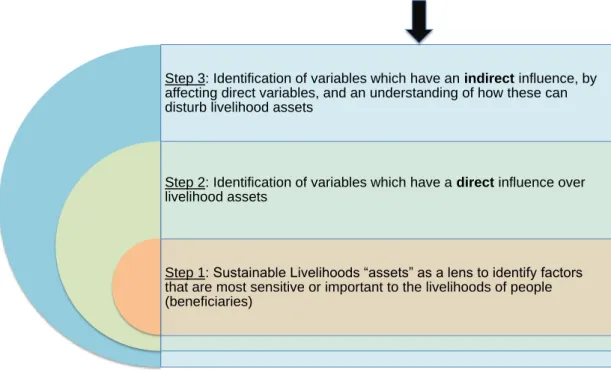
Our framework, represented in Figure 1, directs practitioners to focus on the following questions:
1. What are the main sources of vulnerability for the target group?
2. How do these variables connect with other people, places and events? In other words, what factors affect these variables, directly and indirectly?
3. What kind of adaptation or development interventions might disturb or influence one or more of these connections?
Figure 1 indicates the steps in utilizing this framework to evaluate the potential for adaptation to create indirect effects.
9 Eakin et al. (2009) describe livelihoods frameworks are an attempt to bridge the literatures on vulnerability to poverty and vulnerability to global environmental change. There are different definitions of “livelihood” in these literatures: some have focused on more materialistic components; for instance, Chambers and Conway (1992) propose that a livelihood is “a means of gaining a living” (p.5) and that “comprises the capabilities, assets… and activities required for a means of living” (p.6). Others have broadened the notion to include how people are able to construct meaning for their lives, and what capability they have to challenge their situation. For example, Bebbington (1999) sees the resources people have available as “vehicles for instrumental action (making a living), hermeneutic action (making living meaningful) and emancipatory action (challenging the structures under which one makes a living) (cf Habernas 1971)” (p.2011).
10 The Chambers and Conway (1992) classification was adopted and formalized in the UK Department for International Development’s Sustainable Livelihoods Framework (DFID 1999). An alternative, but similar construction is offered by Bebbington (1999): produced, human, natural, social and cultural assets.
Figure 1: Analytical framework for identifying risk transfer pathways
The livelihoods approach compels the analyst to look without prejudice across a range of potential variables that might be affected indirectly by action elsewhere, rather than emphasize one (such as household income levels) at the expense of others.
To meaningfully generate the data needed to answer these questions, practitioners need to undertake place-specific analysis of how livelihoods are constructed and how these are connected to others through economic, social and biophysical linkages.11 As Bebbington
(1999) argues:
The principal assets that people draw upon in building their livelihoods… vary across space and also across different social, gender and ethnic groups. If this is so, it becomes important to have a clearer sense of the most important assets for different people in different places in order to identify the most useful (and most damaging) sorts of public investment in such areas. (p.2031f)
One challenge for adaptation practitioners is that while the intended beneficiaries of adaptation actions are known in advance, those who may experience indirect effects are not. Thus, the analyst is left to trace interconnections outwards from beneficiaries and make assumptions about how changes here might be experienced there.
11 Bebbington and Batterbury (2001) acknowledge the significant methodological difficulties associated with trying to empirically analyse transformations in particular places and livelihoods and their connections to processes at other scales. Ethnographic “intensive place-based studies” offer one possible method of inquiry into complex linkages between and within communities. Alternatively, they argue comparative studies (such as between households or between sectors in different countries) may allow conclusions to be drawn about more general patterns that seem to be influential in transmitting signals between local livelihoods and global processes.
Step 3: Identification of variables which have an indirectinfluence, by affecting direct variables, and an understanding of how these can disturb livelihood assets
Step 2: Identification of variables which have a directinfluence over livelihood assets
Step 1: Sustainable Livelihoods “assets” as a lens to identify factors that are most sensitive or important to the livelihoods of people (beneficiaries)
Step 4: Analysis of which indirect variables could be influenced by an adaptation action to such a degree that indirect effects might be transmitted
4. INDIRECT EFFECTS IN THE COFFEE SECTOR
In this section we apply the framework described above to a case study of the Colombian coffee sector. We examine the ways in which the livelihoods of growers are connected to, influence and are influenced by events outside their immediate geographic environment, generating data on indirect effects and the pathways through which these may be transmitted. Coffee has been grown in Colombia for around 200 years, and the country has the reputation of exporting some of the highest-quality washed Arabicas on the international market (Stockman 2010; Giovannucci et al. 2002).
The crop is both an economic and livelihood staple, as well as a defining cultural feature of the country’s social and natural landscapes.12 It is grown mainly by
smallholder farmers, with around 96% of farmers working with an area of less than 1.6 hectares (FNC 2012). Around 19% of Colombia’s total land area is under coffee production (Forero Álvarez 2010), spread across more than half of the country’s 1,102 municipalities. Colombia is one of the few countries to have retained a strong national industry body after the collapse of the International Coffee Agreement in 1989
and subsequent global market
liberalization. The Federación Nacional de Cafeteros (FNC) continues to play a very active role in influencing national policy, managing a national coffee fund,13
providing extension services to growers, and funding the national coffee research
institute Cenicafé. The FNC is also one of the main exporters of Colombian coffee, hence an important market player in its own right, and it has strong links to many of the roughly 500 local cooperatives that buy coffee from farmers.
The coffee sector is an appealing analytical case for studying indirect effects. First, like other heavily traded crops such as cocoa, coffee is grown almost exclusively in developing countries, where it is a core part of millions of people’s livelihoods. Globally, around 26 million mostly smallholder farmers grow coffee (ICO 2011), and many more depend on the sector for employment. In Colombia alone, more than 563,000 families earn their livelihoods as coffee growers, while nearly 4 million people derive their livelihoods from the crop in
12 In 2011, the UNESCO declared areas in four departments (Risaralda, Caldas, Valle del Cauca and Quindío) on the ranges of the Cordillera de los Andes in the west of Colombia as world heritage site and recognized the “Coffee Cultural Landscape of Colombia” as an exceptional example of a cultural heritage (FNC 2012).
13 The Fondo National de Cafeteros (FoNC) was founded in 1940 with the purpose of strengthening the sector and stabilizing the income of producers. Its revenue comes mainly from contributions made by coffee growers; they are directly discounted from the price paid to producers in their local communities for their beans and transferred to the FNC when Colombian coffee is exported (nonfiscal tax). Currently, the contribution to the FoNC is equivalent to 0.027 USD per kilo of green coffee exported. The fund provides public services such as a purchase guarantee at market prices, technical assistance for coffee growers, and scientific research through Cenicafé (Forero Álvarez 2010; FNC 2012). According to the FNC (2012), in 2011 coffee growers received direct benefits from their collective savings of the equivalent of more than four times their total contributions to the FoNC.
Freshly picked Colombian coffee cherries. Photo by Aaron Atteridge.
some way (including picking coffee), more than any other agricultural activity in the country (FNC 2012). In some poor countries, coffee is a key source of foreign earnings; in Burundi the crop generates an estimated 79% of total foreign income, in Ethiopia around 54%, and in Uganda 45% (Gresser and Tickell 2002). In Colombia, coffee’s significance has diminished as other sectors have expanded, but it still generates around 6% of total foreign income (Forero Álvarez 2010).
Second, the coffee market is global, wherein prices received by all growers are determined, either directly or indirectly, by trading on the New York and London stock exchanges for Arabica and Robusta respectively.14 Thus, coffee growers across developing countries
compete with one another. Moreover, as emphasized in previous literature (Newman 2009) and also by a number of interviewees during this study, financial speculation on coffee trade increasingly brings into play an even wider array of factors that could influence global prices but which are unrelated to coffee production and consumption.
Third, economic theory on the “fallacy of composition” (see Mayer 2002 for an overview of the extensive literature) argues that as many developing countries pursue export-oriented development strategies, they start competing directly with one another in ways that undermine their shared goals.15 The same logic thus prompts a concern about whether specific
kinds of adaptation activities focused on export commodities in developing countries might be counterproductive to the livelihoods of other export-focused communities. It points us to look at the way in which developing country producers of coffee compete with one another and can, through global markets, affect one another’s livelihood outcomes.
Finally, the coffee sector is a common target for international development assistance. In our own coarse review of a subset of development organization databases and websites, we found more than 170 such interventions between 1964 and 2012.16 In Colombia, interventions have
typically aimed at improving quality, yield and/or “sustainability” of particular growers within the country.17 Further, some developing countries are already explicitly or implicitly
prioritizing the coffee sector for support in their climate adaptation strategies.18 Various
14 The two primary coffee varieties commercially grown are Arabicas and Robustas. Arabica beans are generally considered of higher quality and are sold at slightly higher prices. Robustas, more resistant to pests and diseases, have a more acid taste and are widely used for soluble coffee and stronger roasts as well as in blends.
15 In one configuration of the fallacy, demand-side constraints in the global market ultimately limit the potential for certain kinds of goods to provide export income, because as more and more countries follow a similar strategy, the supply begins to undermine prices, and hence all producers suffer from declining terms of trade and declining profitability. The fallacy of composition is often described in relation to manufactured goods (Mayer 2002; Blecker and Razmi 2010); however, it has been argued that it is also relevant to various agricultural commodities, including coffee, tea, bananas, cotton and cocoa (for example, Bleaney 1993; Akiyama and Larson 1994; Schiff 1995; as cited in Mayer 2002).
16 This is an incomplete list of all donor activity in the coffee sector, which was compiled to examine patterns in the focus of donors rather than to produce a complete inventory.
17 Coffee sector interventions in Colombia have been supported by a range of international organizations including the UN Food and Agriculture Organization (FAO), the Inter-American Development Bank (IADB), the United Nations Development Programme (UNDP), the Global Environment Facility (GEF), USAID and Kreditanstalt fuer Wiederaufbau (KfW). The private sector has also been active, including major roasters such as Nespresso, Nestlé, Tchibo and Starbucks (FNC 2012).
18 For example, several of the National Adaptation Programmes of Action (NAPAs) prepared by Least Developed Countries have identified the coffee sector as vulnerable, and some include specific actions focused on the sector. In Tanzania, land clearing for coffee is said to be driven by climate change vulnerability (United Republic of Tanzania 2007). In Rwanda and Uganda, coffee is identified as a vulnerable sector, as trees are at very high risk of prolonged seasonal droughts, which is problematic for the social and economic development of the countries (Republic of Rwanda 2006; Republic of Uganda 2007). Although Ethiopia’s NAPA makes no specific reference to coffee, four out of 11 adaptation priorities are focused on agriculture, which is likely to include coffee as it is Ethiopia’s No. 1 export commodity (Petit 2007; Baffes et al. 2005).
private-sector activities listed on the website of the United Nations Framework Convention on Climate Change (UNFCCC) Private Sector Initiative also claim to be supporting adaptation among coffee growers in particular regions.19
In sum, the sector involves complex global linkages and is also likely to continue being a target for external interventions.
4.1 Previous studies on indirect effects in the coffee sector
There is a wide literature on the coffee commodity chain and the farmers who derive their income from it, with a significant number of papers published since the market was liberalized in 1989. Analysts generally agree that the international coffee landscape has changed substantially in the last two decades, leading to several episodes of market crises (i.e. price collapses). A range of reasons for this have been presented, as well as some empirical evidence of the consequences for growers and other people who depend on the sector, suggesting some ways in which grower livelihoods might be interconnected.
In terms of causes of the international “coffee crisis”, many attribute this to Vietnam’s massive expansion in the late 1990s to become a major exporter of Robusta coffees, though others have argued that there is inadequate evidence to suggest a causal relationship between this and the coincident drop in world prices (Stockman 2010).20 Our review of the literature
suggests that there is no simple “yes” or “no” answer; livelihood outcomes for growers seem to be more nuanced. A scan of the wider literature indicates that a sudden oversupply of coffee was one important factor behind the dramatic fall in prices, but several reasons also played a role, including:
The demise of the International Coffee Agreement (ICA), which significantly diminished the influence of many national coffee institutions in producer countries (Petit 2007; Brown 2004; Baffes et al. 2005; Topik et al. 2010; Bacon 2005);
Domestic market liberalization promoted (or imposed) by, among others, the International Monetary Fund and World Bank (Petit 2007);
Changes in global supply, particularly Robusta from Vietnam and Arabica from Brazil, as well as changes in demand – particularly the rise of “niche” markets such as organic and Fair Trade coffee (Petit 2007; Baffes et al. 2005; Topik et al. 2010; Bacon 2005); New coffee-processing technologies that allow roasters more flexibility in blending and
making greater use of Robusta, which has intensified market competition amongst producers of Arabica beans, whose market share has decreased (Petit 2007; Baffes et al. 2005; Topik et al. 2010; Bacon 2005; Ponte 2001); and
19 For instance, the Adaptation for Smallholders to Climate Change (AdapCC) project in Peru; grower vulnerability assessments and adaptation projects in Central America and Mexico funded by Green Mountain Coffee Roasters and other partners; and projects supported by Starbucks in southern Mexico. For more information, see the UNFCCC Private Sector Initiative website, http://unfccc.int/adaptation/workstreams/ Nairobi_work_program/items/4623.php.
20 Vietnam’s meteoric rise in the coffee sector, which coincided with an increase in Brazilian production, has often been blamed for creating a global oversupply and thus a drop in prices. The Vietnamese case has been linked by some observers to World Bank financing of agricultural reforms in the country (Wild 2004; Wassermann 2002; Pérez-Grovas et al. 2001) – a claim the bank itself denies (Baffes 2005; Giovannucci et al. 2002) – as well as anecdotally to support from the French Institut de Recherche pour le Développement (Giovannucci et al. 2002). Whatever the funding sources that drove the Vietnamese expansion, its global effects have been heavily criticized by development organizations and by coffee industries in other parts of the world (Mitra 2002; Wassermann 2002; Stockman 2010).
A shift of the power balance within the global commodity chain which means that, compared to previously, value has increasingly accrued to downstream actors such as traders, roasters and retailers at the expense of coffee producers (Petit 2007; Mitra 2002; Bacon 2005).
In terms of the consequences, many papers discuss the impacts of the coffee crisis on farmer livelihoods, for example in Ethiopia (Petit 2007), Nicaragua (Bacon 2005) and other Latin American countries (Topik et al. 2010). Rueda and Lambin (2013) evaluate how changes in market trends and
short-term volatilities are actually transferred to land users, and what role those remote forces play in shaping local land use. They show how world coffee prices have driven land use change in
Colombia, motivating
farmers in regions with good conditions to increase the supply of high-quality and sustainable coffees while leading others regions to reduce production. The authors conclude that “policies designed to improve the livelihoods of
rural people need to take into account the high exposure of local actors to international markets” (p.298), although they do not specifically consider the potential for actions at the local rural level to be transferred back through market connections to others.
According to Brown (2004) the free market for coffee emerging after 1989 has generated negative spillover effects which are problematic for both producing and consuming countries. In the case of producers, she asserts that in response to the global price crash caused by over-supply, farmers cannot recover their production costs, and this has created a “domino effect” of wider social problems, including pressure on a family’s children to work in the fields and decisions to abandon coffee plantations altogether.
Negative social consequences of a change in price have been highlighted elsewhere too. In Colombia and Burundi, links have been demonstrated between coffee market fluctuations and recruitment into guerrilla activity, feeding social conflict (Rettberg 2010; Dube and Vargas 2006; Ndikumana 2001; Summit Oketch and Polzer 2002). While a strong coffee economy provided a shield against violence in Colombia’s coffee-producing regions, diminished income during periods of low prices impoverished local people, which opened up windows of opportunity for proponents of illegal activities. It has also been argued that plummeting coffee prices have forced farmers, mainly in Latin American countries, to replace their coffee with illicit crops such as coca (Rettberg 2010; Dube and Vargas 2006; Prince 2002) and landless labourers to shift to work in illegal crops rather than coffee (Forero Álvarez 2010).
Generally, literature on the coffee sector appears to focus on the impacts of international shocks (changes in market conditions), with relatively less emphasis on whether connections between domestic producers within the same country might be also be conduits for redistributing risk and vulnerability. Stein (2002) describes the way Vietnam’s expansion has
A coffee picker in Chindina-Caldas carries her harvest. Photo by David Bonilla Abreo. © FNC-Ministerio de Cultura, 2011.
also created problems for its own farmers. Others have described how expansion of cheap organic coffee in Peru is affecting not only other countries, but also other Peruvian organic growers.21
Overall, this literature provides at least cursory insights into the potential for vulnerability redistribution between coffee growers and of the implications, in terms of experienced hardship, impoverishment or greater social conflict. It suggests both the way in which global changes might cascade down to affect local livelihoods, as well as the way changes in local activities in one place influence global systems – which in turn influence local livelihoods in other places. Further, it also highlights that such effects are context-dependent in time and space, which for adaptation practitioners means place-specific assessments are needed in each case.
4.2 Data generation
In order to examine whether (and how) potential indirect effects both to and from the coffee sector in Colombia may manifest on the ground, in late 2012 we conducted a total of 27 semi-structured interviews in the Eje Cafetero (coffee triangle), one of the country’s principal coffee-growing regions, and in Bogotá. The interviewees included eight farmers, local cooperatives and private buyers, representatives of the national coffee federation (FNC) at the municipal, departmental and national levels, the national coffee research institute (Cenicafé), exporters, the national government (Ministry of Environ-ment), local government (La Celia) and several coffee pickers.
The interviews covered a wide range of topics related to the livelihoods of coffee growers, examining the importance and sensitivity of different kinds of assets (as discussed in Section 3). Interviewees were asked about any
perceived connections between changes in the coffee market in one region/group and outcomes for other groups – for instance, whether an increase in quality or productivity or a reduction in cost for one set of producers materially affects lively-hoods for other growers, and if so, how. We also discussed who is competing with whom, who might lose when another gains, and whether such effects might be measured quantitatively, as well as the narrower question of whether international interventions in the coffee sector, either within or outside the country, have had any impact on the relative competitiveness of different domestic producers.
21 See, for example, this summary by the importer Sweet Maria’s Coffee: http://www.sweetmarias.com/coffee/full-description/peru.
A farm worker prepares a section of coffee plantation in Colombia’s Eje Cafetero. Photo by Elise Remling.
The limited scope of the field study means it was not possible, nor was it our aim, to generate an exhaustive list of the ways in which farmer livelihoods might be indirectly affected by the actions of others. The results discussed in the following section should rather be seen as indicative of the pathways by which adaptation interventions might create indirect effects within the coffee sector, and as a way to enable some reflection on the concept of indirect effects and our ability to predict such effects.
5. INDIRECT EFFECTS AND COFFEE-SECTOR LIVELIHOODS IN COLOMBIA The analysis presented here synthesizes different threads about livelihoods and the construction of vulnerability, which are based on perceptions expressed by the interviewees. It follows a three-step process, in which we:
1. Identify the main triggers of potential vulnerability for growers, as well as the range of variables which have a direct influence on them;
2. Identify factors which may indirectly influence those variables; and
3. Identify the subset of those indirect factors that could feasibly be altered in some way by a distant adaptation intervention in the coffee sector, and how such alterations would manifest on the ground for growers in particular. From this we are able to ascertain some of the most probable risk transfer pathways relevant for consideration by adaptation practitioners.
5.1 Sources of livelihood vulnerability
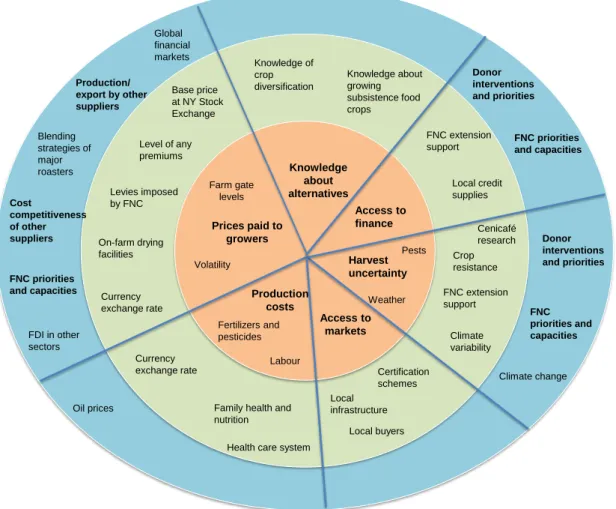
The main triggers of potential vulnerability described were prices paid to growers, including both real price level (farm gate) and volatility (the latter is significant because of the uncertainty it creates); access to markets; access to finance; harvest size and quality; production costs; and knowledge about alternative or complementary livelihood strategies. Interviews described a wide range of factors that have a direct bearing on these potential triggers of vulnerability. The different variables in the figure are not necessarily of equal significance for the growers even in a single location, nor are the all growers’ priorities/sensitivities exactly the same.22 Note that among these, all five asset types posited as
important by the livelihoods approach are visible: for example, the influence of climatic conditions (natural); access to fertilizer and to on-farm facilities for drying coffee beans (physical); the role of extension services provided by the FNC and research by Cenicafé, as well as local health services (social); market prices affecting income, access to credit for replanting or for surviving lean periods of low prices, production costs associated with labour and fertilizers (financial); and individual health, and knowledge about crop diversification strategies to enable food inter-cropping (human).
Figure 2 represents the way interviewees described different sources of vulnerability and risk for coffee growers (the inner orange ring), the direct influences over these variables (the middle green ring), and the way these variables might be affected by indirect factors (the outer blue ring). The direct influences (green) suggest variables which an adaptation action might target to improve local outcomes, such as better farmer access to local health services or markets. The indirect influences (blue) suggest potential sources of indirect disturbance to farmer livelihoods; in other words, these point to possible risk transfer pathways for the transmission of indirect effects.
22 With some tweaking of methodology, field data generation could have been tailored to produce a weighted
Prices paid to growers Base price at NY Stock Exchange Currency exchange rate Global financial markets FDI in other sectors Production costs Oil prices
Health care system Family health and nutrition Fertilizers and pesticides Production/ export by other suppliers Access to markets Blending strategies of major roasters Level of any premiums Labour Harvest uncertainty Pests Weather Climate variability Climate change Crop resistance Local infrastructure Access to finance Local buyers Certification schemes FNC extension support Local credit supplies Cenicafé research FNC extension support Currency exchange rate Volatility Farm gate levels Levies imposed by FNC Cost competitiveness of other suppliers Donor interventions and priorities Donor interventions and priorities FNC priorities and capacities FNC priorities and capacities On-farm drying facilities Knowledge about alternatives Knowledge of crop diversification Knowledge about growing subsistence food crops FNC priorities and capacities
Figure 2. Sources of perceived vulnerability for growers and variables influencing them
5.2 Indirect influences on grower vulnerability
Indirect influences are shown in the outer blue ring of Figure 2. Note that, based on interviewee perceptions, indirect variables are not presented for all of the potential sources of vulnerability. Those for which important indirect variables were described are the level and predictability of prices received by growers for their crop, access to finance, uncertainty about the harvest, and production costs.
Influences on prices for growers
Price is always important for producers, especially in developing countries where agricultural commodities are produced mostly by smallholders rather than by large industrial estates (the latter can sometimes compensate for low prices with high volumes). It is particularly crucial in the case of the Colombian coffee sector because of relatively higher cost/return ratios compared with many other coffee producing countries. At times – as in 2012 during the field study – base market prices are actually below production costs for Colombian growers. That means that in order to secure an adequate income, it is crucial for them to be able to negotiate an additional premium for quality and/or particular certifications (such as organic or fair trade). Prices were described as being shaped by:
Global financial market conditions, which influence speculative traders in coffee futures and derivatives, and have a major influence on the base market price at the New York and London stock exchanges;
Production/export levels in the global market, which influence supply-demand balance and in turn the market prices; interviewees said this currently has a stronger influence over the level of premiums received for quality and/or certifications rather than the base price itself (unless very large changes in global production occur – see below); Cost competitiveness of other suppliers, which also influences negotiations about
premiums;
Blending strategies of major roasters, which influences the link between market prices for Robusta and Arabica, because as they become substitutable for roasters, the prices for the two become increasingly connected;
Currency exchange rates, which are influenced, among other things, by the level of foreign direct investment in other sectors of the Colombian economy, and hence by government priorities and the overall domestic political economy;
Levies applied by the FNC, which in turn are a function of the priorities and fiscal health of the FNC at any time; and
Access to on-farm drying facilities, which determine whether the farmer can sell the harvest wet or dry (prices are higher if sold dry).
Some of these are direct variables, such as market price and premiums, currency exchange rates, domestic levies and access to coffee drying facilities. The others we consider indirect, and hence of further interest to our search for potential risk transfer pathways.
Influences on access to finance
Finance is needed for investment in the crop and production facilities, in housing and other assets, and to be able to supplement low income levels when prices are too low to make a living (as was the case for some growers at the time of interviews in December 2012). Variables described as directly influencing access to finance include the availability of, and access to, local credit supplies (banks and other lenders), and the level of support provided by the FNC extension services to growers to help negotiate and structure loans. Interviewees said the latter is itself influenced indirectly by broader FNC priorities and capacities at any time, and by the effect that donor activity in the sector might inadvertently have on the FNC.
Influences on the harvest
Uncertainty about the annual harvest is a challenge that all agricultural producers face. While most production costs are known, the size of the crop is not, since it depends on a variety of factors that differ from year to year, in particular on weather conditions which affect productivity of the crop and also the conditions for pest outbreaks, as well as a grower’s ability to apply fertilizer and/or pesticides (see influences on production costs, below). The voracity of pest outbreaks is a function of the resistance a grower’s particular crop (tree variety) has to the specific pests and to farmers’ knowledge of cropping techniques that might mitigate exposure to pests, which are in turn influenced by factors such as Cenicafé research to develop new resistant varieties of coffee tree, and by the level of technical extension support provided by the FNC to growers. Support for Cenicafé research and for FNC extension services is, in turn, influenced indirectly by the FNC’s priorities and capacities at any time, and again by the effect that donor activity in the sector might inadvertently have on the FNC. Weather is influenced by local climate variability and patterns of long-term climate change.23
23 The FNC (2012) has noted that changes in the climate can affect coffee producers by, for example, has described potential impacts on coffee production thus: “Changes in climate affect the plants in different ways; for example, the accumulation of biomass in the fruit is affected by higher temperatures; the changes in rainfall cycles affect