1184
Iot Based Supply Chain Traceability Using
Enhanced Naive Bayes Approach For Scheming
The Food Safety Issues
S.BALAMURUGAN, A.AYYASAMY, K.SURESH JOSEPH
Abstract: Food is one of the major needs for human to live. The worldwide food issue consists of the need of food provision for the Earth's population. Food has to undertake numerous troubles like changing climate, food safety, low nutritive value, etc. Due to the rising demand for fruits and vegetable for daily procedure by the consumers there is necessitate for smarter operation of Food Supply Chain(FCS) and also bond the producer to the customer with delivery of high quality of food products. This paper examines the design and improvement of an Internet of Things (IoT) construction that helps suppliers to manage their procedures of food safety and also tackle the food safety problems from the technological aspect, people require a trustworthy food traceability system that can follow and observe the full lifespan of food manufacture, counting the processes of food raw material farming/reproduction, processing, transporting, warehousing, and wholesale etc. The most important goal of this IoT outline is to sense food characteristics and guidance suppliers to insist farmers properly grow and treat the crops. Using the analysis of fictional data for FSC, deriving a solution for the distribution of distinguished goods with the aid of the Naive Bayes classifier which is used for food traceability enables tracking and management throughout the entire process such as manufacturer, exporter and customer. The structure organizes a collection of IoT nodes arranged in the transporting for sensing food parameters and the RF communication of IoT node is used to transmit the measured data to server. The experimental study of the proposed technique is measured based on time of execution, comparison of accuracy, and rate of error. Prospective strategies were experimented with using the RStudio IDE as the working platform with Java.
Keywords : Bayesian networks, Traceability, Food supply chain management system, Classifier, Naive Bayes, Food safety and Internet of Things (IoT).
————————————————————
1. INTRODUCTION
The Food and Agriculture Organization (FAO) describes food safety as a ―condition that subsists when all individuals, at all periods, have physical, social, and economic contact to adequate, secure, and nourishing food that assembles their nutritional requirements and food favourites for an energetic and healthy life‖. During the last decades, consumer assurance in the food industry was seriously damaged following plenty of food safety hazard occurrences and humiliations, such as mad cow disease, genetically modified food [1], toxic milk power, and trench oil [2]. As a result, additional rising consumer worries over the safety and quality of food have drained more and more special treatment from intellectual and business areas. It is crucial for farmers to perform well-organized and technological process to raise productivity diminishes the contamination [3] and nutrient-related problems. The progress in work out and data storage has afford huge quantity of information. The dispute has been to take out information from this unprocessed data that has guide to novel methods and scheme such as Internet of Things that can connect the information gap. This system designed to measure [4] the IoT techniques and concerns them to Food database to launch significant associations. The system consists of food traceability assistance the supplier, producer and consumer by using WSN technology and IoT procedures [5].
WSN devices accumulated in the cargo will bring together the objective data of sensors (temperature, humidity, moisture) of food and information send into next level. The IoT proposal is accountable for the incorporation and administration [6] of sensor data and catalogue enclosed all sensor evaluation. By using Bayes classifier method, innovative sensor interpretation contrast with original interpretation and if any severe alter in understanding then exhibits the announcement on user end [7]. In reaction to rising food safety issues, many IoT technologies, such as RFID and wireless sensor network-based procedures[8] and hardware, are functionally to supply chain traceability and transparently. Nevertheless, there is most vital issue has not been contacted is that whether the information mutual by food supply chain associates in the traceability systems can be confidential [9]. In response to growing food safety trouble, some IoT knowledge‘s, such as Radio Frequency Identifier, barcode and WSN technology are helpful to SCS [10] and supervise the structure. In the past an amplified interest in the IoT, smart linked things in instruction to execute the dissimilar attitude of the provider, maker and consumers and finalize a criterion which ultimately maintains accuracy [11] and worth of the product sustain on the approximate the advantage of smart connected things [12]. In forecast investigation, potential inclination and output results are predicted on the foundation of possibility. The forecast examination approach uses machine learning technique and deterioration methods for accomplishing predictive diagnostics. The machine learning techniques are operated in enormous way to perform predictive investigation[13]. These techniques have become fashionable because these methods are able to hold huge scale information efficiently and also illustrate high-quality performance. These techniques present output results with consistent features and noisy data [14]. The Naive Bayes methodology have been practical implemented in many fields just like health ___________________________________
S.BALAMURUGAN, A.AYYASAMY, K.SURESH JOSEPH
Ph.D., Research Scholar, Department of CSE, Annamalai University, [email protected]
Department of CSE, Annamalai University, [email protected]
care, cyber safety, knowledge, banking sectors, public medium, Big Data and so on.Sensor and barcode-based IoT data is life form useful to SCS from their list of basis to their procedures[15], principle in dispensation foliage, storage space depot, distribution points, and in the retail stores. The creatively monitoring and efficiently that barcodes and sensors offer assists accumulate chains, food products, and commodities contribute associations to quickly distinguish direct [16] of source and delivery if it's uncovered that food is spoiled.Classification is the most significant responsibilities in data withdrawal techniques. In classification, a classifier is constructed from a position of preparation instances with class attribute. The analytical capacity of a classifier is characteristically calculated by its classification accurateness or inaccuracy rate on the testing attributes. We require computing probability of an undecided cause given a number of experimental proofs [16]. Such difficulties are repeatedly mostly multifaceted with a lot of inter-connected variables. In many indications, there is more number of probable causes to acquire only the upturned conditional probabilities, i.e. possibility of the confirmation known the source, the possibility of examine indications if the food has the contamination [17]. Naive Bayes is a sequential classifier while other is not; it tends to be quicker when practical to big data. In evaluation, K-NN is typically slower for big quantity of data, since the computations need for each step in the procedure. If speed is significant, decide Naive Bayes over K-NN. In general, Naive Bayes is extremely precise when implemented to big data. A Bayesian concept is more proper in this scenario, while Bayesian theory, or on the other hand various pictorial representations, are really helpful equipments for implement with improbability, and also with complication and fundamentality. Bayesian networks have previously established their submission in healthiness conclusion investigates and in health assessment analysis, but form of fundamental casual measures and their possibility distributions may be uniformly supportive in fitness finances or in community healthiness research [18].The remaining of the research is planned as the Section 2 demonstrates the narrative Review, Section 3 presents the proposed work, Section 4 presents the Experiments and Results, and finally the conclusion of the paper.
2. LITERATURE SURVAY
In food supply chain management, food traceability is extremely multi-actor based and disseminated, with plentiful diverse performers concerned, such as farmers, transport companies, producers and seller, distributors, and provisions[19]. There is lot of sensors at each ending node in the Food supply chain, which afford us corresponding data to launch whether the product is good or not. With the help of sensing data and their substantial relationship, food supply chain configuration is closely connected to internet of things. In certainty, instantaneous decision support system is necessary in food safety concerns [20]. Every circumstance of the food supply chain traceability has been accepted and established suspiciously to development the safety of the food. HACCP is a defensive method [13] to eliminate the chemical substances in the manufacture system. The smart environment [14] urbanized which consist of broadcasting the data onto the smart system of Internet of Thing (IoT). For achievement the right decision,
decision making representation is executed on the data collected from IoT devices by the production logic. Terminate that the data investigative in a industry field offered the right decision at the right time. Moreover, it is the booming key in business [15].The contamination groundwork is unidentified for some extends, more individuals will be exposed to risk. In addition, food manufacturing industry, evaluation is almost product consuming [21]. We are not in position to take part of each part of food in each stage of the supply chain, no theme there are trouble or not, to the sensing for substantial and compound check, as it would carry food corporation a vast cost-effective failure. As a result, we would similar to to pattern food only in the finished markets with a little segment [22]. After that, with this little piece of products, we influence this information to attain a entire depiction over defect circumstances in the whole arrangement, such as the defect cause and the other concerned foods that necessitate to be recollected [23]. Food safety is the state of dispensation, supervision and accumulates food in germ-free ways, in order to avoid sickness from occurring to individual people. Food safety and value guarantee have become increasingly difficult in times of mounting worldwide flows of merchandise [24].IoT stages a familiar task in the strong connection between substantial and practical items for the intention of substitute the data. IoT background can attach millions of devices or items; each individual has its own credentials testimony. The IoT scheme is calculated one of the mainly significant knowledge [25, 26] in current prospects, and the focal point of consideration in many grounds counting manufacturing, healthcare, agriculture, industry, space science and military purpose. The IoT needs multi-dimensional safety clarification such as privacy, honesty, and verification services [27]. Furthermore, the dispute of the IoT particularly data should be analytic and the estimate approach of the IoT device and its effect on the safety procedures [28] have been estimated. The rapid enlargement of IoT and related systems has implemented it further probable and pragmatic to execute a multipart mathematical task created by a Bayesian system illustration [29].The sensor on the device within a container can transmit out alerts to an innermost network if there is a noticed fault in the heat or moisture controls, or if the sensor notice that a storage place seal has been wrecked down. This enables people in the food supply chain to instant mitigate the state, thereby dropping the threats of food defect and spoilage [30]. There is lot of sensors at each and every node in the food supply chain, which give us corresponding information to create whether the result is
form of good or satisfactory.
1186 Corporation a huge inexpensive collapse. The traceability
takes part in the fitness of the individuals and the social growth[33]. The major amount of food connected management is to activate the whole food supply chain and if any problem happens in the manufacture of food safety then it can be simply identified with the successful management [34].
3. PROPOSED SYSTEM
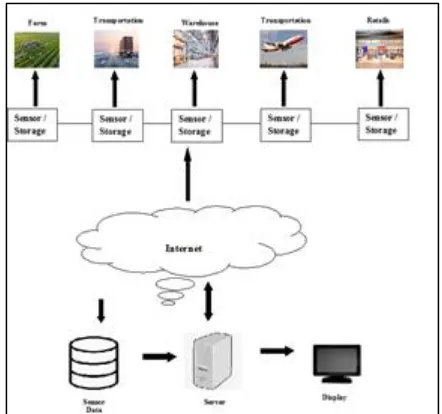
3.1 Structure of Simple Supply Chain System (SCS) A SCS or supply model points to the progression that explains how food moves from a ranch to fork on consumers. The processes include manufacture, processing, delivery, utilization and throwing away. The food reached us by means of food supply chain system throughout which food travel methodically in usually something bad movement from manufacturer to customers while the funds travel customers compensate for food goes to public who employ at different point along the SCS in the turn round way. Each and every movement of the SCS involves person and/or normal resources. Since a SCS is in critical way, whenever each piece of the food is unnatural, then the complete food supply chain management is exaggerated, which is frequently visible through modify in economic.
Fig 1: Flow diagram of food supply chain
3.1. Physical Structure of IoT Systems for Food Supply Chains.
With the increasing scale and demands of modern cities the structure of the food supply chain has become enormous and complicated. In addition, due to the enormous number of sensors attached to objects moving along it, it is typically impossible to collect and process all-food sensing data at all stages. Based on these issues, to speed up provenance solutions, we collect only a small part of sensor data on the end nodes in the chain. So in our strategy, it seems like a pending issue how to reckon on this small portion of sensor data to figure out the source of the contamination Additional questions are also posed regarding lack of precision due to small sample volume and efficiency in tracing. The question also poses more questions about the loss of precision due to the small sample volume and the efficiency of the tracing scheme. We will suggest our heuristic approach and algorithms to address this issue with additional insights into the complexities of algorithms later in this paper.
Fig 2: IoT system’s physical constitution modelled for food
supply chain 3.2 Bayesian Networks
Bayesian Networks (BN) is a class of prospect realistic representation that can be implemented to construct representations from information and/or practised view. They can be realized for a lane variety of responsibilities as well as calculation, abnormality detection, diagnostics, automated insight, analysis, time series forecast and conclusion making under uncertainty. BN is prospecting due to constructed from probability allocation and utilize the regulations of probability for forecast and abnormality recognition and for analysis and find solution, result based under ambiguity and time series calculation. A BN characterizes the fundamental probabilistic association along with a set of random variables, their provisional dependences, and it presents a solid depiction of a joint possibility distribution. For food dimension, a node may be a food province, and the situation of the nodule would be the potential reaction to that food province. If there survives a fundamental probability confidence among two arbitrary entities in the diagram, the equivalent 2 way path are associated by a concentrating end point, while the focussed boundary from a path A to path B represents that the casual entity A reason the casual entity B. Since the focussed end points characterize a motionless connecting probabilistic reliance, series are unauthorized in the diagram. In other words, the provisional possibility circulation of a unsystematic entity is defined for each feasible conclusion of the previous fundamental node(s).
In general, for events A1 and B1, where A1 depends on B1, provided that P (B1) ≠ 0,
( | ) ( ) ( | )
( ) ...(1)
probability reliance between events event1 and event2 to state the fact derived from numerical interpretation that event event2‘s probability of happening based on the possibility of event event1 happening.
Then, using the Bayesian principle, the provisional possibility of event2 happening, given the possibility of occurrence of event1 is
( | ) ( ) ( | )
( ) ...(2) Where ph (event2) is chronological probability of event2
separately from former events and p(event1|event2) specify the potency of the manipulate of event1 verification on the probability of event2, p(event1) = 1then
( | ) ( ) ( | )...(3)
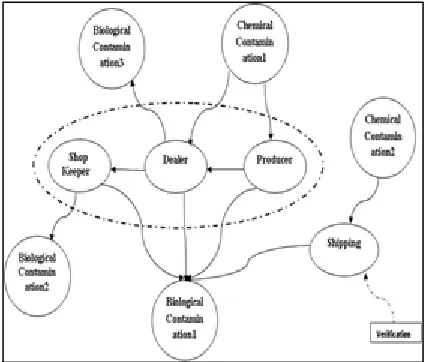
3.3 Procedure Traceability with Bayesian Network Food monitoring dilemma at procedure administration is focussed to defect tracking process, a form based on BN investigation is a useful implement to examine this dilemma. The BN associations are created by the device which is collected data from the sensor. In the verification (confirmation) that there is no contamination found in transportation makes the Chemical Contamination2 independent of the Biological Contamination1. This confirmation made from the concept of Markov chain of the Biological Contamination1 affect the producer, dealer and shopkeeper nodes.
Fig 3: Traceability with Bayesian Network
Using Bayesian rule, capable of not only to examine and approximation the probable origin of food defect, also to recognize opportunity of contamination extend such as Biological Contamination2 and Biological Contamination3.
3.4 Enhanced Naive Bayes Classifiers (NBC) Model NBC are a meeting of diverse categorization processes create on BN. It is not depends on a solo procedure conversely an ancestor‘s constituent of procedures in which it donate to a common theory, i.e. every pair of description being classified is autonomous of each other. Consider a unreal dataset that explain the food safety for efficient food traceability techniques. Given the circumstances, every tuple categorize the setting as fit (―Fit‖) or unfit (―Unfit‖) for
traceability of products. Now it is a table form illustration of our collection.
Table 1: Attribute Medium
Eating Quality Convenie nce Stabilit y Wholesome ness Nutritiv e value Foo d Safe ty
0 Appeara nce
Availabilit y
Shelf-Life Safety
Nutrient Content Unfit
1 Texture Availability Shelf-Life Safety Nutrient Content Fit
2 Flavour Availabilit y
Shelf-Life Safety
Nutrient Content Unfit
3 Appeara nce
Ease of Preparati on Quality of Retenti on
Purity Caloric Value Fit
4 Flavour
Ease of Preparati on
Shelf-Life Purity
Caloric Value Fit
5 Texture
Ease of Preparati on Quality of Retenti on
Safety Nutrient Content Unfit
6 Appeara nce Availabilit y Quality of Retenti on
Purity Caloric Value Unfit
7 Texture
Ease of Preparati on
Shelf-Life Purity
Nutrient Availabi lity
Fit
8 Flavour Availabilit y Quality of Retenti on Safety Nutrient Availabi lity Unfit
9 Appeara nce
Ease of Preparati on
Shelf-Life Purity
Caloric Value Fit
1
0 Texture
Availabilit y Quality of Retenti on
Purity Caloric Value Unfit
1 1 Appeara nce Availabilit y
Shelf-Life Safety
Caloric Value Unfit
1
2 Flavour
Ease of Preparati on Quality of Retenti on Purity Nutrient Availabi lity Fit 1
3 Texture
Ease of Preparati on
Shelf-Life Safety
Nutrient Availabi lity
Fit
The collection is separated by 2 segments which is attribute medium and the output quantity.
Attribute medium holds full rows of value in which each quantity contains of the value of reliant attributes. In above collection, attributes are ‗Consumption Quality‘, ‗Convenience‘, ‗Stability‘ ,‘ Wholesomeness‘ and ‗Nutritive Value‘.
1188 The advantages of Naive Bayes are:
It uses extremely spontaneous procedure. Bayes classification is not neural networks, not having some free limitation that must be set. These significantly make things easier the plan procedure.
Because the classifier precedes probabilities, it is easy to affect the end result to a broad mixture of responsibilities than if a random range was implemented.
No need to huge quantity of data previous to knowledge can start.
NBC are calculation for quick when building conclusion.
Limitation of Naive Bayes classifier model is
1. Major limitation of Naive Bayes is the hypothesis of self-governing predictors. Naive Bayes completely presume that all the attributes are equally independent. In actual life, it is roughly impracticable that we acquire a locate of predictors which are totally independent.
2. If unconditional variable has a group in test data set, which was not experiential in preparation data set, then representation will allocate a 0 (zero) probability and will be not capable to make a prediction. This is frequently known as Zero Frequency.
The primary of Naive Bayes statement is that each attributes makes an:
Self-governing
Equivalent input to the conclusion.
With relative to our dataset, this idea can be unstated as:
We believe that there is no couple of attributes is dependent. For example, the Eating quality being ‗Flavour‘ has not everything to do with the Nutritive Value being ‗Caloric value‘ or the wholesomeness being ‗Purity‘ has no consequence on the Stability. Hence, the characteristics are believed to be self-governing.
Secondly, every characteristic is given the indistinguishable weight (or importance). For example, perceptive only Wholesomeness and Stability only can‘t estimate the production exactness. No one of the attributes is inappropriate and supposed to be causal equally to the outcome. The assumption made by Naive Bayes is not usually precise in real-time circumstances. In reality, the self-rule hypothesis is never accurate but often workings fine in grounding.
Bayes‘ Theorem determines the opportunity of an incident occurring given the possibility of another happening that has previously happened. Bayes‘ theorem is assured mathematically as the next equation:
( | ) ( | ) ( )
( ) ...(4)
where X1 and Y1 are events. Fundamentally, we are frustrating to discover possibility of happening X1; given the
happening Y1 is correct. Event Y1 is also termed as confirmation. P(X1) is the priori of X1. The verification is an attribute value of an anonymous occasion. P (X1|Y1) is a posteriori possibility of Y1, i.e. possibility of happening after authentication is seen.
Now, with regards to our dataset, we can apply Bayes‘ theorem in following way:
( | ) ( | ) ( )
( ) ...(5)
where, y is class variable and X is a dependent attribute vector (of size n) where:
X = (x1, x2, x3, x4..., xn) ...(6)
Immediately to obvious, a model of an attribute vector and consequent class variable can be
X = (Texture. Ease of preparation, Shelf-life, purity, Nutrient Availability)
y = Fit
So essentially, P(X|y) here, way the possibility of ―Fit food safety‖ known that the traceability are ―Eating quality is Texture‖, ―Convenience is Ease of preparation ‖, ‖Stability is Shelf-life‖, ―Wholesomeness is purity‖ and ―Nutritive value is Nutrient Availability‖.
3.4 Naive assumption
At the moment, it‘s circumstance to position a naive statement to the Bayes‘ theorem, which is independence between the attributes. So now, we segregate confirmation into the independent measurements.
Now, if any 2 proceedings X and Y are self-governing, then P(X, Y) = P(X) P(Y) ...(7)
Hence, we attain to the outcome:
( |(( ) ( | ) ( | ) ( | ) ( )
( ) ( ) ( ) ...(8) which can be articulated as:
( |(( ) ( ) ∏ ( | )
( ) ( ) ( )...(9)
Now, as the denominator ruins invariable for a given contribution, we can take away that term:
P(y|((x1, x2..., xn) P(y) ∏ ( | )...(10)
Now, we involve construction a classifier model to trace the opportunity of recognized set of inputs for all possible values of the class variable y and prefer up the construction with utmost possibility. This can be expressed mathematically as:
y = argmaxy P(y) ∏ ( | )...(11)
So, at last, the task of scheming P(y) and P(xi | y) where P(y) is also described as class prospect and P(xi | y) is called uncertain opportunity. The unrelated naive Bayes classifiers diverge largely by the suggestion they create relating to the allocation of P(xi | y). To be appropriate the above method physically on our excellence of food dataset, we necessitate action for some pre-computations on our collections.
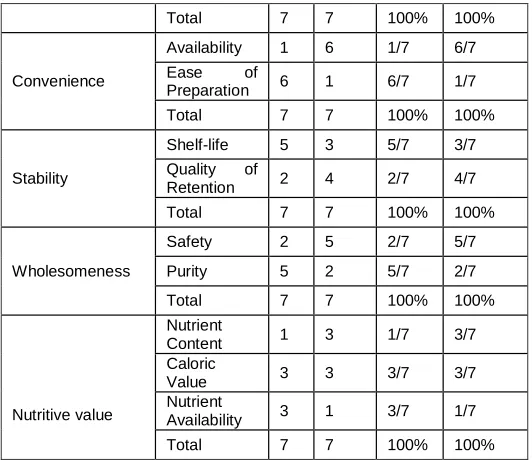
We require to find P(xi | yj) for every xi in X and yj in Y. All these estimation have been verified in the stand below:
Table 2: Probability of Food attributes
Food Safety Attributes Fit Unfit P(Fit) P(Unfit)
Eating Quality
Appearance 2 3 2/7 3/7
Texture 3 2 3/7 2/7
Total 7 7 100% 100%
Convenience
Availability 1 6 1/7 6/7 Ease of
Preparation 6 1 6/7 1/7
Total 7 7 100% 100%
Stability
Shelf-life 5 3 5/7 3/7 Quality of
Retention 2 4 2/7 4/7
Total 7 7 100% 100%
Wholesomeness
Safety 2 5 2/7 5/7
Purity 5 2 5/7 2/7
Total 7 7 100% 100%
Nutritive value
Nutrient
Content 1 3 1/7 3/7
Caloric
Value 3 3 3/7 3/7
Nutrient
Availability 3 1 3/7 1/7
Total 7 7 100% 100%
So, in the table above, we have designed P(xi | yj) for each
xi in X and yj in Y physically and for example, prospect of
food safety given that the biological contamination is no, i.e P(Eating Quality = Texture | Food safety = Fit) =
...(12)
Also, we require discovering class possibility (P(y)) which has been considered in the table 2.
Table 3: Class probability of Food Safety
Food Safety P(Fit) P(Unfit)
Fit 7 7/14
Unfit 7 7/14
Total 14 100%
For example,
P(Food Safety = Fit) =
...(13)
So at the present, we are finished with our pre-process and the classifier is equipped. Let us investigate it on a novel set of attributes (example Safety of foods from source to destination):
Safety of foods = (Texture, Ease of preparation, Shelf-life, Purity, Nutrient Availability)
So, probability of maintain the safety of foods is given by:
( | )
( | ) ( | ) ( | ) ( | ) ( | ) ( )
( ) ... (14)
and probability of not maintain the safety of foods is given by:
( | )
( | ) ( | ) ( | ) ( | ) ( | ) ( )
( ) ... (15)
Since, P(Food Safety) is frequent in both possibility, we can disregard P(Food Safety) and find relative possibility as:
( | )
... (16) and
( | )
... (17) Now, since
( | ) + ( | ) = 1... (18)
These values can be altered into a possibility by creation the computation is identical to 1 (normalization):
( | )
... (19)
and
( | )
... (20)
Since
P( ( | ) > P ( | ) ...(21)
So, prediction of Safety of foods would be ‗Fit‘.
The function that we examined over is related for disconnected statistics. In such folder of constant data, we require to create some hypothesis concerning the allotment of values of each attributes. The dissimilar Naive Bayes classifiers modify mostly by the supposition they make about the circulation of P(xi | y).
The stipulate of the Bayesian procedure is its untrustworthy simplicity. The anticipated are based totally on data meticulous from assurance the supplementary data is measured, the improved it works. Another advantage is that Bayesian models are personality- motivate, insinuation that when information alters, so do the yield. One tremendously useful Bayesian learning system is the Naive Bayes Classifier. It is so called Bayesian theorem and is mainly suitable when the dimensionality of the inputs is prominent. Despite its effortlessness, Naive Bayes can regularly better more refined classification techniques. In several fields its presentation has been shown more to be comfortable when compared to other classifier.
4. EXPERIMENTS AND RESULTS
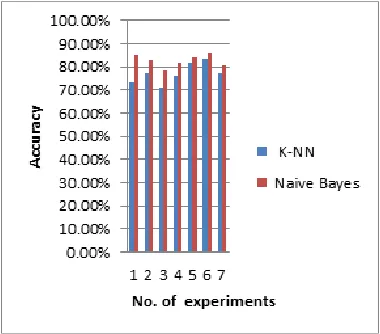
Based on the above analysis process is measured by way of the performance factors such as the classification exactness and fault rates. And also compute the competent assessment for the supply chain dataset to forecast the optimum one.
Quality is measured using the following parameters:
1) Accuracy
1190 proposed Naive Bayes algorithm has obviously been
improved.
Table 4: Comparison of accuracy measure for Naive Bayes
classifier algorithms
Number of experiment
Accuracy of K-NN algorithm
(%)
Accuracy of Naive Bayes algorithm
(%)
1 73.5% 85%
2 77% 83%
3 71% 78.5%
4 76% 81.5%
5 82% 84%
6 83.5% 85.8%
7 77.5% 80.5%
It is provisional from Table 2 that the Enhanced Naive Bayes Algorithm has extremely developed classification for accuracy compared to the K-NN classification algorithms is shown in Figure.
Fig. 4: Comparison of Accuracy Measure for classification
algorithms 2) Memory utilization
According to the results obtained, the quality of the Enhanced Naive Bayes algorithm is significantly improved after execution of the Bayesian Network Classifier. Table 5 & Fig.5 note the memory consumption analysis of K-NN results and of the proposed Naive Bayes algorithm. The memory consumption of proposed Naive Bayes algorithm has obviously been improved.
Table 5: Comparison of Memory Consumption for
classification algorithms
Number of experiment
Memory Consumption of
K-NN algorithm
(KB)
Memory Consumption of
Naive Bayes algorithm
(KB)
1 29717 29121
2 33723 33527
3 36263 36081
4 37561 36926
5 38171 37826
6 33828 32934
7 39828 39373
It is provisional from Table 2 that the Enhanced Naive Bayes Algorithm has extremely developed classification for memory consumption compared to the K-NN classification algorithms is shown in Figure.
Fig. 5: Comparison of Accuracy Measure for classification
algorithms 3) Error rate
According to the conclusion obtained, the quality of the Enhanced Naive Bayes algorithm is significantly improved after execution of the Bayesian Network Classifier. Table 6 & Fig. 6 note the error rate analysis of K-NN results and of the proposed Naive Bayes algorithm. The error rate of proposed Naive Bayes algorithm has obviously been improved.
Table 6 : Comparison of Error rate for classification algorithms
Number of experiment
Error Rate of K-NN algorithm
(%)
Error Rate of Naive Bayes algorithm
(%)
1 18.14 15
2 13.9 10.45
3 16.83 15.1
4 14.98 10.51
5 12.01 6.78
6 10.56 6.45
7 11.23 5.02
It is provisional from Table 2 that the Enhanced Naive Bayes Algorithm has extremely developed classification for error rate compared to the K-NN classification algorithms is shown in Figure.
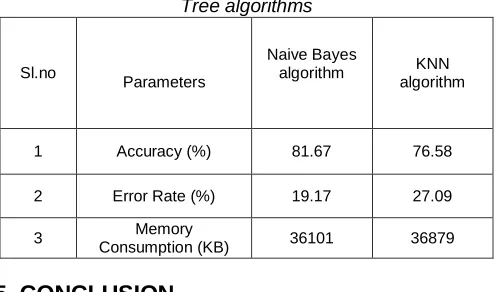
Research assesses the quality of the Food using Supply Chain management that the projected practice will have the improved compassion according to the innovative value. It mainly focuses precedent data to guess the condition of the market, but market stipulate depends on a series of multifaceted factors, quality of amenities counting, consumer groups and administration plan.The Enhanced Naive Bayes algorithm locates the optimum as compared to KNN algorithms during the results analysis. Finally, Naive Bayes algorithm is the most accurate classifier compared to any other classification algorithm based on measurements of efficiency, accuracy and error rate and Table 7 shows the overall performance of the two algorithms.
Table 7: Overall comparison of performance of Decision
Tree algorithms
Sl.no Parameters
Naive Bayes
algorithm algorithm KNN
1 Accuracy (%) 81.67 76.58
2 Error Rate (%) 19.17 27.09
3 Memory
Consumption (KB) 36101 36879
5. CONCLUSION
IoT backgrounds are symbolized by the huge volumes of data energetically in terms of varying objects and communications. In many IoT situations, it is significant to expect the excellence, safety of the food before they occurs. We measured the SCS issues to understanding the difficulty that has not been repeatedly calculated. Encouraged by present tracking/tracing data & communiqué technology, such as IoT, RFID and other wireless network technology, we challenged to pack the gap in active problem by examining a variety of viewpoints of recognition and track ability. A Naive Bayesian implemented model is additional urbanized to correlation the various levels of traceability. Potential research can also be concentrating towards result different probable classification and tracking/tracing technique other than the BN moves towards target that is measured in this study. Finally this proposed model the food supply chain traceability will assist to improve the efficiency and accumulate the time and hard work of the supplier, producer and customer.
Future Enhancement
In the future enhancement, the Bayes classification can be researched on other datasets to achieve more successful results. Also the Bayes classification can be analyzed by means of considerations such as the training set; percentage split, and supplied test set.
Ethical Responsibilities of Authors
The authors declare that they do not have any conflict of interests. This research does not involve any human or animal participation. All authors have checked and agreed the submission.
6 REFERENCES
[1] Aung, M.M., & Chang, Y.S.,(2014) Traceability in a food supply chain: Safety and quality perspectives. Food Control., 39, 172-184.
[2] Xiao, J., Liu, Z.Y., & Li, B.W., (2012) Research on a Food Supply Chain Traceability Management System Based on RFID. Journal of Agricultural Mechanization Research., 34(2), 181-184.
[3] Tsai CW, Lai CF, Vasilakos AV., (2014). Future internet of things: open issues and challenges. Wireless Networks. 20(8):2201-17.
[4] Suo H, Wan J, Zou C, Liu J., (2012). Security in the internet of things: a review. In international conference on computer science and electronics engineering (pp. 648-51). IEEE
[5] Cai H, Da Xu L, Xu B, Xie C, Qin S, Jiang L.,(2014) IoT-based configurable information service platform for product lifecycle management. IEEE Transactions on Industrial Informatics, 10(2):1558-67.
[6] Atzori L, Iera A, Morabito G., (2010) The internet of things: a survey. Computer Networks. 54(15):2787-805.
[7] L. Atzori, A. Iera, and G. Morabito., (2010) The internet of things: A survey, Computer Networks, vol. 54, no. 15, pp. 2787–2805.
[8] Z .Wen, S. Hu, D. D. Clercq, M. B. Beck, H. Zhang, H. Zhang, F. Fei, J. Liu, (2018) "Design implementation and evaluation of an Internet of Things (IoT) network system for restaurant food waste management", Waste Management, vol. 73, pp. 26-38,
[9] Scholten, H. and Verdouw, C.N. (2016), ―Defining and analyzing traceability systems in food supply chains‖, Espiñeira, M. and Santaclara, F.J. (Eds), Advances in Food Traceability Techniques and Technologies, Elsevier, New York, NY, pp. 9-33 [10] Xiao, J., Liu, Z.Y., & Li, B.W.,(2012) Research on
a Food Supply Chain Traceability Management System Based on RFID. Journal of Agricultural Mechanization Research. 34(2), 181-184.
[11] Folinas, D., Manikas, I., & Manos,(2006) B., Traceability data management for food chains. British Food Journal, 108(8), 622-633.
[12] Mishra, (2014) PM. Internet of Things and Bayesian Networks. Available from http://www.analyticbridge.com/profiles/blogs/intern et-of-things-andbayesian- networks.
[13] Chen C, Chen T, Zhang C, et al. (2014) Research on agricultural products cold-chain logistics of various applications in International conference on computer and computing technologies in agriculture, China: Springer International Publishing, pp. 247–253.
[14] Ryan, J. M. (2014) Guide to Food Safety and Quality during Transportation: Controls, Standards and Practices, Elsevier.
1192 traceability in fish supply chains—case studies,‖
British Food Journal, vol. 112, no. 9, pp. 976– 1002.
[16] D. Zhang and J. Guo,(2011) ―The development and standardization of testing methods for genetically modified organisms and their derived product,‖ Journal of Integrative Plant Biology, vol. 53,no. 7, pp. 539–551.
[17] S. Allata, A. Valero, L. Benhadja (2017], "Implementation of traceability and food safety systems (HACCP) under the ISO 22000:2005 standard in North Africa: The case study of an ice cream company in Algeria", Food Control, vol. 79, pp. 239-253.
[18] Z. Sheng, S. Yang, Y. Yu, A. Vasilakos, J. Mccann, and K. Leung,(2013) ―A survey on the ietf protocol suite for the internet of things: Standards, challenges, and opportunities,‖ IEEE Wireless Communications, vol. 20, no. 6, pp. 91– 98.
[19] Fenu, G. and Garau, P.(2009)―RFID-based supply chain traceability system‖, 35th Annual Conference of IEEE, IEEE, New York, NY, pp. 2672-2677.
[20] Moe, T.:(1998) Perspectives on traceability in food manufacture. Trends Food Sci. Technol. 9(5), 211–214
[21] S. H. Sutar, R. Koul, and R. Suryavanshi, (2016)``Integration of smart phone and IoT for development of smart public transportation system,'' in Proc. Int. Conf. Internet Things Appl.,pp. 73_78.
[22] S. M. Riazul Islam, D. Kwak, M. Humaun Kabir, M. Hossain, and K.-S. Kwak,(2015) ``The Internet of Things for health care: A comprehensive survey,'' IEEE Access, vol. 3, pp. 678_708. [23] S. Feng, P. Setoodeh, and S. Haykin,
(2017)``Smart home: Cognitive interactive people-centric Internet of Things,'' IEEE Communication. Mag., vol. 55, no. 2, pp. 34_39
[24] I. E. Etim and J. Lota,(2016) ``Power control in cognitive radios, Internet-of Things (IoT) for factories and industrial automation,'' in Proc. Annu. Conf. IEEE Ind. Electron. Soc.,, pp. 4701_4705.
[25] A. Miles, A. Zaslavsky & C. Browne (2018): IoT-based decision support system for monitoring and mitigating atmospheric pollution in smart cities, Journal of Decision Systems, DOI: 10.1080/12460125.2018.1468696
[26] Kelepouris, T., Pramatari, K., Doukidis, G.(2017): RFID-enabled traceability in the food supply chain. Ind. Manage. Data Syst. 107(2), 183–200. [27] Acid S., de Campos L. M., Fernández-Luna J. M.,
Rodríguez S., Rodríguez J. M.,Salcedo J. L. (2004): A Comparison of Learning Algorithm for Bayesian Networks:A Case Study Based on Data from an Emergency Medical Service. Artificial Intelligence in Medicine 30, p. 215-232.
[28] Airoldi E. M. (2007): Getting started in Probabilistic Graphical Models. PLoS Computational Biology 3(12), 2421-2425.
[29] Bøttcher S. G., Dethlefsen C. (2003a): deal: A Package for Learning Bayesian Networks.
[30] Bøttcher S. G., Dethlefsen C. (2003b): Learning Bayesian Networks with R. Proceedings of the 3rd International Workshop on Distributed Statistical Computing (DSC 2003), March 20–22, Vienna, Austria. ISSN 1609-395X.
[31] Bøttcher S. G. (2004): Learning Bayesian Networks with Mixed Variables. Dissertation. Department of Mathematical Sciences, Aalborg University.
[32] Cowel R. G., Dawid A. P., Lauritzen S. L., Spiegelhalter D. J. (1999): Probabilistic Networks and Expert Systems. Springer-Verlag New York. ISBN 0-387-98767-3.
[33] Abdulkadir A. Adamu , Dong Wang , Ayodeji Olalekan Salau and Olasupo Ajayi (2020): An Integrated IoT System Pathway for Smart Cities. International Journal on Emerging Technologies 11(1): 01-09.