A Visual Technique for Web Pages
Comparison
Mar´ıa Alpuente Daniel Romero
1,2 Technical University of ValenciaCamino de Vera s/n, Apdo 22012, 46071 Valencia, Spain.
Abstract
Despite the exponential WWW growth and the success of the Semantic Web, there is limited support today to handle the information found on the Web. In this scenario, techniques and tools that support effective information retrieval are becoming increasingly important. In this work, we present a technique for recognizingand comparingthe visual structural information of Web pages, The technique is based on a classification of the set of html–tags which is guided by the visual effect of each tag in the whole structure of the page. This allows us totranslate the web page to a normalized form where groups of html tags are mapped into a common canonical one. A metric to compute the distance between two different pages is also introduced. Then, by means of a compression process we are also able to reduce the complexity of recognizing similar structures as well as the processing time when comparing the differences between two Web pages. Finally, we briefly describe a prototype implementation of our tool along with several examples that demonstrate the feasibility of our approach.
Keywords: Web page comparison, visual structure, Web page compression.
1
Introduction
HTML is designed to visualize structure and information contents in an understand-able way to humans. The main problem with the use of HTML, is its mixtures of semantic content, page structure and layout [9].
The WWW is today a huge repository of information. Typical scenarios in which a suitable notion of similarity of Web pages is desirable include: search engines, testing tools, documents wrappers, detection of duplicated Web pages, and Web data mining.
Given a query for retrieving a piece of information from the web, the search for this information typically involves three aspects: textual information within the Web page, page structure layout, and the patterns of the query. However, an extra
1 This work has been partially supported by the EU (FEDER) and the Spanish MEC
TIN2007-68093-C02-02 project, UPV PAID-06-07 project, and Generalitat Valenciana GV06/285. Daniel Romero is also supported by FPI–MEC grant BES–2008–004860.
2 Email: {alpuente,dromero}@dsic.upv.es
This paper is electronically published in Electronic Notes in Theoretical Computer Science
factor that is hardly considered by current tools is whether two different pieces of code can express the same visual sensation.
A quantification of this visual similarity could lead to the querying of a docu-mental database using a docudocu-mental pattern as the query. The answer to this query can be either the most (visually) similar document of the database or the most similar document from a pre-defined set. This last type of answer can be used as a classification method [5]. Moreover, the importance of visual features of Web pages is increasing from the viewpoint of search engines optimization.
When we look at a Web page, we are not aware of the underlying HTML code, but are only able to distinguish the visual structure given by the groupings, columns, rows and data. This suggests us the idea to define as “visual structure of a Web page” the apparent structure of a Web page that is perceived by a human indepen-dently of the source code that produces it.
In this work, we develop a technique for Web pages comparison that considers its visual structure. First, we present a translation for HTML code that highlights the visible structure of a Web page given by some of HTML tags. Then, we formal-ize two compression transformations for a Web page. The horizontal compression
packs together those subterms which represent repetitive structures. The vertical compression shrinks those chains of tags that does not influence visually the per-ceived result. After applying the Web page compression, we obtain an irreducible term that represents the “essence” of the Web page concerning its visual aspect. Finally, since Web pages are provided with a tree–like structure, we define a quan-titative measure of similarity of two pages based on “edit distance” between two trees.
Related work. Although there have been other recent efforts to define new tech-niques for comparing Web pages [3,8,11,13,17], only few works have addressed the recognition of their visual structural information. Given a query for retrieving a piece of information from the web, the search for this information typically involves three aspects: textual information in the Web page, page structure layout, and the patterns of the query. A study on how the three factors affect to the Web page similarity is presented in [13]. With respect to the page structure, the authors de-fine classes for grouping the tags, then the comparison is based on counting how many elements of each class are in a given page. However, the visual aspects of each element are not considered in the work. In [8], a Web page is transformed into a sequence of tags called “HTML–string”. Then a distance measure between two strings determines the similarity degree of two pages. The comparison is de-fined tag–to–tag without considering a classification of tags according to their visual affect.
In [11] a methodology for visual comparison is proposed. The method segments a page image into several regions based on image processing, and the result is pre-sented as a graph. The similarity is then calculated by a graph matching algorithm. Unlike us, the structure based on the tags is not considered. Finally, a method for recognizing structures is presented in [3]. The method is based on automatically constructing a suitable wrapper, including the detection of repeated sequences of tags, and detecting repeated patterns of strings.
The work more closely related to ours is [17], which analyzes the structure of pages based on detecting visual similarities of the tags inside of a page. The main difference with our own work lies in how the analysis of the tags is performed. Our method is top–down thus favoring the inspection of outer structure, whereas in [17] the analysis of the tags is performed bottom–up, detecting frequent patterns of visual similarity.
Plan of paper. The paper is organized as follows. Section2recalls some standard notions, and introduces Web page descriptions. In Section3, we present a transfor-mation of HTML code that allows us to get a clear visual structure of a Web page. Section4 formalizes a compression technique for Web pages. This technique packs together those subterms which represent repetitive structures and shrinks those chains of tags that does not influence visually. In Section5, we define a measure of similarity between two Web pages based on thetree edit distance algorithm [7,18]. Section6describes the main features of our prototypical implementation. Section7
concludes and discusses future work.
2
Preliminaries
In this section, we briefly recall the essential notions and terminology used in this paper. We call a finite set of symbolsalphabet. Σ denotes a set offunction symbols
(also calledoperators), or signature. We consider varyadic signatures as in [4] (i.e., signatures in which symbols do not have a fixed arity).
Terms are viewed as labelled trees in the usual way. τ(Σ) denote theterm algebra
built on Σ. Syntactic equality between objects is represented by ≡. We also need
max(x, y) and dne, max(x, y) = if (x ≥ y) x, else y; and dne is the least integer number greater than or equal ton.
2.1 Web page description
In this work, aWeb pageis either an XML [14] or an XHTML [15] document, which we assume to be well-formed, since there are plenty of programs and online services which can be used to validate XHTML/XML syntax and perform links checking (e.g. [10,16]). Let us consider two alphabetsT and Tag. We denote the setT∗ by
Text. An object t∈ Tag is called tag element, while an elementw ∈ Text is called
textelement. Since Web pages are provided with a tree-like structure, they can be straightforwardly translated into ordinary terms of the term algebraτ(Text∪ Tag). Note that XML/XHTML tag attributes can be considered as common tagged elements, and hence translated in the same way.
3
Visual structure of Web pages
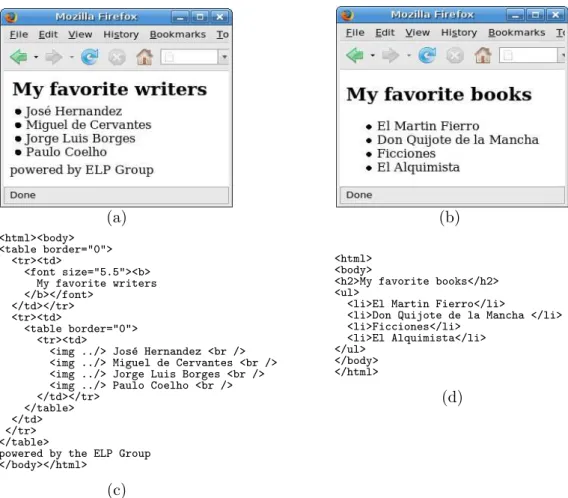
When we look at a Web page, we are not aware of the underline HTML code, but are only able to distinguish its visual structure. However, two different pieces of HTML code can express the same visual sensation. Let us illustrate this by means of a rather intuitive example.
(a) <html><body> <table border="0"> <tr><td> <font size="5.5"><b> My favorite writers </b></font> </td></tr> <tr><td> <table border="0"> <tr><td>
<img ../> Jos´e Hernandez <br /> <img ../> Miguel de Cervantes <br /> <img ../> Jorge Luis Borges <br /> <img ../> Paulo Coelho <br /> </td></tr>
</table> </td> </tr> </table>
powered by the ELP Group </body></html>
(c)
(b)
<html> <body>
<h2>My favorite books</h2> <ul>
<li>El Martin Fierro</li>
<li>Don Quijote de la Mancha </li> <li>Ficciones</li> <li>El Alquimista</li> </ul> </body> </html> (d)
Fig. 1. Example of similar Web pages
Example 3.1 Consider the Web pages in Figure1(a) and Figure1(b). At a glance, these two pages have similar appearance, however the corresponding HTML code that defines their structure is very different. Figure1(a) is defined using tables (tag
<table>), whereas Figure1(b) uses a list (tag<ul>), see Figure1(c) and Figure1(d) respectively.
Example 3.1 illustrates that, in order to provide for appropriate comparison among pages, the visual effect of each of the HTML tags should be considered. In the following we present an abstraction of Web pages, which translates each Web page to a canonical representative according to its visual structure.
3.1 Translation
The basic idea for the translation is to infer the visual structure of the page from the HTML tags in it. In Table 1 we present a classification of the HTML tags with respect to the visual effect that they produce 3. The elements grp, col, and row describe the essential properties of the pictorical structure of a Web page: grp
corresponds to an element grouping other elements, col is an element that divides into columns, androwis an element that splits into rows. Finally, the element text
3 We use a number of most common HTML tags that typically found in Web pages which allow to define
represents the concrete data contained in the Web page. Note that, in Table1, each text or tag that does not influence visually the aspect of the page is defined astext. The list of tags is not exhaustive, but only taken as “proof of concept” that could be eventually enlarged with new ones.
Visual (class) tag HTML tags
grp table,ul,html,body,tbody,div,p row tr,li,h1,h2,hr col td text otherwise Table 1 Classification of HTML tags
Let ΣV = {grp, col, row, text} be a signature of abstract (visual) HTML tags, where each ofgrp,col,row, andtextcan be seen as the “abstraction” of a numbers of different concrete HTML tags according to the classification given in the Table1. It is straightforward to translate the Web pages into ordinary terms of the term algebraτ(ΣV). This is done by means of the functiontrn.
Definition 3.2 (translate)Letf(t1, . . . , tn)∈τ(Text∪ Tag) be a Web page. The translation trnfunction is defined as:
trn::τ(Text∪ Tag)→τ(ΣV) trn(f(t1, . . . , tn)) = α(f) n= 0 α(f)(trn(t1), . . . , trn(tn)) otherwise
whereα :: (Text∪ Tag) → ΣV replace a concrete HTML tag by the corresponding visual (class) tag, according to the classification given in Table1.
Let us illustrate Definition 3.2by means of an example.
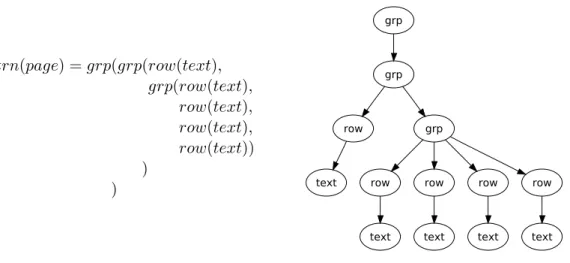
Example 3.3 Letpage∈τ(Text∪ Tag) be the term describing the HTML code of Figure1(d). The translated page is shown in Figure2.
4
Web page compression
The translation given in Section 3.1 allows us identify different HTML tags thus obtaining a clear (and simple to handle) visual structure of the Web page. Moreover, translation brings to light both the repetitive structures occurring into the Web pages and those chains of tags that do not influence visually the visual aspect of the page. In our approach, comparison of Web pages does not depend on the concrete number of child elements of a given classes, e.g. rows, provided some of them exist in the document. In the case when the considered document contains a single column, we simplify the HTML code by “using up” one of the tags.
trn(page) =grp(grp(row(text), grp(row(text), row(text), row(text), row(text)) ) ) grp grp row grp
text row row row row
text text text text
Fig. 2. Example of translation of the Web page of Figure1(d)
In this section, we present two compression functions for the term that represents a Web page which dramatically reduce the size of each singular page. Horizontal compression (hrz) packs together those subterms which represent repetitive struc-tures. Vertical compression (vrt) shrinks those chains of tags that does not influence visually the result. First of all, let us introduce the notion of marked term, which will be used in the following sections.
4.1 Marked term
In order to avoid losing information after compressing a Web page, we need to record the number of nodes before applying the compression. In the following, we consider terms of the marked term algebraτ([N]ΣV), where “[N]” represents the number of
times that the termtis duplicated “in the marked term [N]t”. For instance, consider
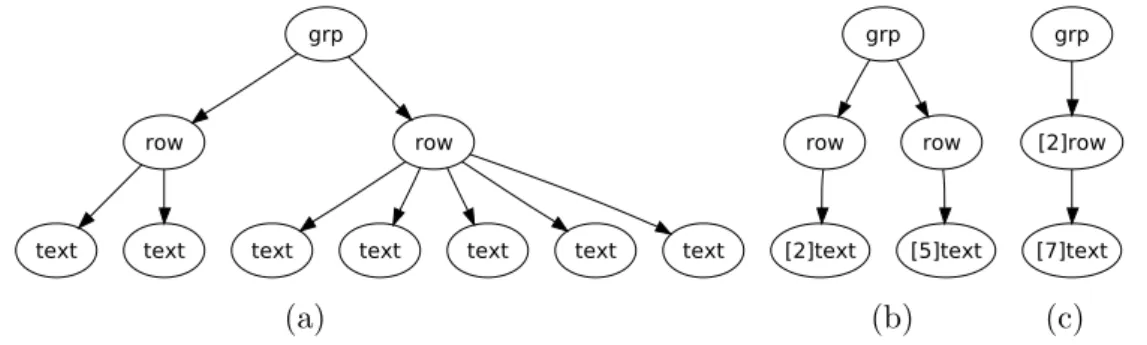
the term of Figure 3(a). The corresponding marked term is shown in Figure 3(b). The subterm “[2]row([1]text)” represents that the termrow([1]text) appears twice. Note that, the horizontal compression is not commutative, thus (in Figure 3(a)) the first subtermrow(text) cannot be packed together with the last two. When no confusion can arise, we just write [1]grp([2]row([1]text)) =grp([2]row(text)).
grp
row col row row
text text text text
[1]grp
[1]row [1]col [2]row
[1]text [1]text [1]text
(a) (b)
Fig. 3. Example of marked algebra
In the following, we say that two marked terms are equal if the corresponding (unmarked) terms are equal. In symbols
The equality between two marked trees is define as follows. Let t = f(t1, . . . , tn), s=g(v1, . . . , vn)∈τ([N]ΣV) be two marked trees. Then
t≡ΣV s iff f ≡ΣV g and ti≡ΣV vi, 1≤i≤n
The equivalence between function symbols is given by the fact that the tags are abstracted by the same visual tag or not (see Section3.1). Given function symbols
f and g,f ≡ΣV g iffα(f)≡α(g).
4.2 Horizontal compression
In order to achieve a uniform style for Web documents, it is common in practice to repeat some pieces of code. Another common use of repetitive structures ap-pears when we represent lists of elements (for instance, “a books list”). In these circumstances, repetitive structures may typically speed down the analysis of the comparison of Web pages for visual similarity. In the following, we present a com-pression function for terms that allows us to overcome both drawbacks. Let us give an example.
Example 4.1 Given the term of Figure4(a), the associated marked term is shown in Figure4(b).
grp
row row
text text text text text text text
grp row row [2]text [5]text grp [2]row [7]text (a) (b) (c)
Fig. 4. Na¨ıve term compression
However, a further compression would be possible which is shown in Figure4(c). In order to pack together some subterms without losing meaningful information about the structure of the page, we could distinguish several alternatives.
(i) Sum number of subterms: grp([2]row([7]text)) orgrp([2]row([2]text,[5]text)). (ii) Sum only the number of leafs: grp(row([7]text)).
(iii) Sum the number of roots and approximate number of the leafs:
grp([2]row([4]text)).
Let us analyze each of the above options considering the number of nodes that are in the original term (see Figure 4(a)): 1 grp node, 2 row nodes, and 7 text
nodes.
(i) This na¨ıve solution does not preserve the original number of nodes. In the example, we would get: 1 grp node, 2 row nodes, and 14 text nodes (7 for each
row) (see Figure4(c)).
(ii) In this case, the compression does not respect the visual structure of the page, that originally consisted of two rows.
(iii) This is more conservative compression that keeps both, the overall structure of the page as well as the approximated number of nodes. In the example, we get: 1 grp node, 2 row nodes, and 8 text nodes (4 for each row). This can be seen as the more accurate “approximation” of the original number of nodes.
Definition 4.2 (join for terms)Lett= [r1]f(t1, . . . , tn), s= [r2]f(v1, . . . , vn)∈ τ([N]ΣV) be two terms such thatt≡ΣV s. Then, thejoinbetweentandsis defined
as follows:
join::τ([N]ΣV)×τ([N]ΣV)→τ([N]ΣV) join(t, s) =joind(t, s,1,1,1)
where the auxiliary functionjoind is given by
d join::τ([N]ΣV)×τ([N]ΣV)×N×N×N→τ([N]ΣV) d join(t, s, k1, k2, p) = [m]f n= 0 (1) [m]f(joind(t1, v1, r1, r2, m), . . . , n >0 (2) d join(tn, vn, r1, r2, m) ) wherem=d(r1∗k1+r2∗k2)/pe
Note that, in favour of the largest numbers of repetitions, we use the integer division with round up d e. Roughly speaking, Definition 4.2 computes the mark, i.e., the number of repetitions of the currently processed node by using both the new and old values of its father. Let us illustrate this by means of an example.
Example 4.3 Consider the terms of Figure 5. Then, the join between the terms in Figure5(a) and Figure5(b), produces the term of Figure5(c).
[3]grp [4]row [8]col [5]grp [2]row [6]col [8]grp [3]row [7]col (a) (b) (c)
Fig. 5. Join of terms
Definition4.2can be generalized to a numbern≥2 of terms in the obvious way. In symbols
join(f1, . . . , fn) =join(. . .(join(f1, f2), . . .), fn) Now, we are ready to define the horizontal compression function.
Definition 4.4 (horizontal compression) Let t = f(t1, . . . , tn) ∈ τ([N]ΣV) be
defined as: hrz::τ([N]ΣV)→τ([N]ΣV) hrz(t) = t n= 0 (1) hrz(f(t1, . . . ti−1, s, tj+1, . . . tn)) ( (1≤i≤j≤n) and where s=join(ti, . . . , tj) (ti ≡ΣV ti+1. . . tj−1≡ΣV tj) ) (2) f(hrz(t1), . . . , hrz(tn)) otherwise (3)
In the above definition, the second recursive equation ensures that the general structure of the input term is preserved. That is, the consecutive terms that are equal module ≡Σ
V are packed together. Roughly speaking, Definition 4.4 states
that all the arguments that are equal w.r.t.≡ΣV and occur at the same leveli are
packed together. Then, compression recursively proceeds to level (i+ 1).
4.3 Vertical compression
XML/XHTML is a markup language for documents containing semi–structured information. In XHTML, all elements must be properly nested within each other, like this
<b><i>This text is bold and italic</i></b>
Considering the translation given in Section3.1, this structured information favours the formation of chains of tags that does not influence in the overall structure of the page. In the following, we describe how to shrink the chains of tags while preserving the overall structure.
Let us begin by characterizing the condition we need for the vertical compression. We letroot(t) denote the funcion symbol occurring at the top position oft.
Definition 4.5 (safe vertical compression) Let t = [r]f([r1]t1, . . . ,[rn]tn) ∈ τ([N]ΣV) be a term and let grp,text ∈ ΣV. Then t obeys the condition of safe vertical compressioniff the following requirements are fulfilled:
r= 1 (1)
n= 1 (2)
¬( f ≡grp ∧ root(t1)6≡grp) (3) (preserve the structure of the page) root(t1)6≡text (4) (preserve the information in the page)
In Definition4.5, the first condition ensures that no repetitions are disregarded. The second condition ensures that t consists of a chain of tags (only having one child). The third condition states that grouping (grp) has a particular higher status than other elements, and thus, should not be compressed. The last condition allows us to keep information of the term. Also note that the repetitions [r1]. . .[rn] of
Definition 4.6 (shrinking)Lett= [r]f([m]g(t1, . . . , tn))∈τ([N]ΣV) a term that
obeys thesafe vertical condition. Then, theshrinking of tis defined as:
shr::τ([N]ΣV)→τ([N]ΣV) shr([r]f([m]g(t1, . . . , tn))) = [r]f(t1, . . . , tn) m= 1 ∧ g6≡grp (1) [m]g(t1, . . . , tn) otherwise (2)
The idea behind Definition 4.6 is trying to preserve the outer structure of the term whenever possible. Note that, as in the previous definition, grouping (grp) has a particular higher status than other elements.
Now, we are ready to formalize the vertical compression transformation.
Definition 4.7 (vertical compression)Let t= [r]f(t1, . . . , tn) ∈τ([N]ΣV) be a
Web page. Then vertical compressionvrt is defined as:
vrt::τ([N]ΣV)→τ([N]ΣV) vrt(t) = t n= 0 (1)
vrt(shr(t)) t obeys thesafe vertical condition (2) [r]f(vrt(t1), . . . , vrt(tn)) otherwise (3)
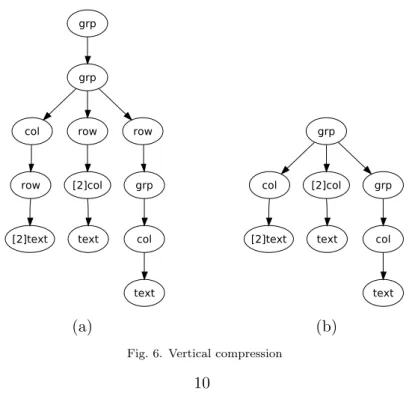
Roughly speaking, Definition4.7moves the inner more influential nodes as higher as possible in the tree. Let us illustrate this definition by means of an example.
Example 4.8 Let t ∈ τ([N]ΣV) be the term corresponding to Figure 6(a). The
vertical compression of tis shown in Figure 6(b).
grp
grp
col row row
row [2]text [2]col text grp col text grp col [2]col grp
[2]text text col
text
(a) (b)
4.4 Shrinking and Join
The operators given in Section4.2and Section4.3allow us to compute the horizontal and vertical compression of a term. This is done by shrinking chains and joining subterms. In order to formalize the overall compression of a term, we define the following operator.
Definition 4.9 (compress) Let f ∈ τ([N]ΣV) be a Web page. Let hrz, vrt :: τ([N]ΣV) → τ([N]ΣV) be the two compression functions (horizontal and vertical,
respectively) given in Definitions4.4and4.7. Then, thecompressoperator is defined as:
compress::τ([N]ΣV)→τ([N]ΣV) compress(f) =hrz(vrt(f))
Roughly speaking, we first remove the tags that belong to a chain of tags that doesn’t influence the aspect of the resulting page and then join the subterms. Since both the vertical and horizontal transformations are confluent and terminating by repeatedly applying this operation we obtain an irreducible term after an arbitrary number of steps. Given a termf, we say that the resulting termfzipis anirreducible
termforf.
Example 4.10 Consider again the termt of Example 4.8. Then, we get the irre-ducible termin Figure 7.
grp
[3]col grp
text col
text
Fig. 7. Irreducible term
The compression technique given in this section generates a representative term for the visual content of the original page as mentioned above. Starting from this term, in the following section we formulate a method to compare Web pages based on their visual structure.
5
Comparison based on visual structure
In our context, the problem of comparing Web pages essentially boils down to com-paring trees. In the literature, the most widely used approach for comcom-paring trees consists in computing the “edit distance” between the two trees, i.e., the minimum cost sequence of edit operations (node insertion, node deletion and label change)
that transforms one tree into another (see [7,18]). See [1] for a deep discussion on thetree edit distance problem.
5.1 Tree edit distance
Thetree edit distance problem assumes that there exists acost function defined on each edit operation. In the following, we follow the approach of [1] and define a
metric cost functionon pairs of nodes.
First to all, let us define the edit operations. Let λ denote a fresh constant symbol that represents the empty marked term, i.e., the term [0]t for any t. Let
nd1, nd2∈[N]ΣVbe two marked trees. Then, each edit operation is represented as:
(nd1→nd2)∈([N]ΣV×[N]ΣV)\(λ, λ)
We say that (nd1 → nd2) is a relabeling if nd1 6≡ λ and nd2 6≡ λ, a deletion if nd2 ≡λ, and an insertion ifnd1 ≡λ.
Definition 5.1 (metric cost function)Let nd1 = [r1]f, nd2 = [r2]g∈[N]ΣV be
two marked terms. Then, ametric cost functionon an edit operation is defined as:
γ :: ([N]ΣV×[N]ΣV)\(λ, λ)→R γ(nd1 →nd2) = 0 nd1 ≡ΣV nd2 r2 nd1 ≡ΣV λ (insertion) r1 nd2 ≡ΣV λ (deletion) max(r1, r2) otherwise (relabeling)
Note that the metric cost function assigns identical costs along with insertion, deletion as well as relabeling transformations. Roughly speaking, Definition 5.1
states that the cost of anedit operation between two nodes is given by the largest number of repetitions of the nodes. Also note that,γ is a distance metric4.
The cost of a sequence S = s1, . . . , sn of edit operations is given by γ(S) =
Pn
i=1γ(si). The edit distance, δ(t1, t2), between two trees t1 and t2 is formally
defined as:
δ(t1, t2) =min{γ(S)|S is a sequence of operations transformingt1 intot2 }
Sinceγ is a distance metric, δ is a distance metric too.
5.2 Comparison of Web pages
Theedit distanceδ allows us compute the distance between two trees (Web pages)
t1 and t2 depending on the edit operations that needed for transforming t1 intot2.
To measure the similarity between two Web pages, we endow the concept of edit
4 A distance metric on a setX is a function d:: X×X →
Rthat satisfies the following conditions: ∀x, y, z∈X. d(x, x) = 0,d(x, y)≥0,d(x, y) =d(y, x), andd(x, z)≤d(x, y) +d(x, z).
distance with the number of nodes of the pages. More formally, the Web pages comparison is defined as follows.
Definition 5.2 (Web pages comparison)Lett, s∈τ([N]ΣV) be two Web pages.
Let tzip and szip be two irreducible visual representatives of t and s respectively. The comparison betweentand sis formulated as:
cmp::τ([N]ΣV)×τ([N]ΣV)→[0..1] cmp(t, s) = 1− δ(tzip, szip)
|tzip|+|szip|
Definition 5.2 assigns a quantitative measure, a real number between 0 and 1, that expresses the similarity of two pages. Note that, a central question in the tree edit distance algorithm (and therefore in our comparison) is how to choose the cost values of single operations. In this work, we choose the natural (and intuitive) measure that assigns identical cost to insertion and deletion as well as relabeling (see Definition 5.1). A particular study about cost models on edit operations is discussed in [12].
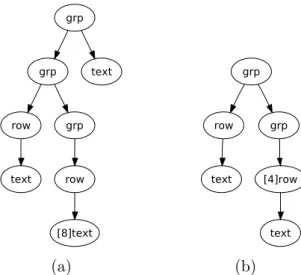
Example 5.3 Consider again the two Web pages of Example 3.1. Let t, s ∈
τ([N]ΣV) be the two marked terms corresponding to two different Web pages. The
irreducible visual representativestzip and szip are shown in Figures 8(a) and 8(b), respectively. grp grp text row grp text row [8]text grp row grp text [4]row text (a) (b)
Fig. 8. Visual representatives of two different pages
Consider also the cost functiongiven in Definition5.1. Then
|tzip|= 15 and |szip|= 12
δ(tzip, szip) = 2
cmp(t, s) = 0.92∼
6
Implementation
The comparison technique presented here has been implemented in Maude [2], with an interface developed in Java. The experimental system is publicly avail-able athttp://www.dsic.upv.es/~dromero/cmp.html. The Maude programming language, which implements the semantic as well as logical framework of rewriting logic, provides a formal analysis infrastructure (such as state-space breadth-first search) with competitive performance (see [6]).
The main features of the our tool are:
• The implementation consists of approximately 560 lines of source code written in
Maude. It includes the modules for trees and lists processing extracted from [2].
• The online parser for semistructured expressions (i.e. XML/XHTML documents)
is also written in Java. Also a Java class provides a single access point that hides the technical detail to every possible user.
• The tool includes aconfig fileto configure the initial settings for some parameters,
e.g., location of the Web pages and output folder.
Preliminary experiments with our tool demonstrate that the system works very satisfactorily on several experiments, including all the examples in this paper. We are currently coupling the system with a Web interface, with the aim of making our tool available to every Internet user.
7
Conclusion
HTML was designed to visualize structure and information in an understandable way to humans. The main problem is its mixtures of semantic content, page struc-ture and layout. Web pages comparison is currently an open problem, whose im-portance extends from search engines to Web data mining.
In this paper, we presented a top–down technique for comparison of Web pages. The key idea behind our method is that two different pieces of code can express the same visual sensation. First, a transformation of Web pages, which translates each Web page according to its visual structure, is defined. By means of two compression functions we obtain a visual representative for the original Web page. Then, we define a measure of similarity between two Web pages based on thetree edit distance
algorithm. We have developed a prototype implementation that demonstrates the feasibility of our approach. As future work, we plant to extend our analysis by also considering stylesheets.
References
[1] P. Bille. A survey on tree edit distance and related problems.Theor. Comput. Sci., 337(1-3):217–239, 2005.
[2] M. Clavel, F. Dur´an, S. Eker, P. Lincoln, N. Mart´ı-Oliet, J. Meseguer, and C. Talcott.All About Maude: A High-Performance Logical Framework, volume 4350 ofLNCS. Springer-Verlag, 2007.
[3] W. W. Cohen. Recognizing structure in Web pages using similarity queries. InAAAI ’99/IAAI ’99: Proceedings of the sixteenth national conference on Artificial intelligence and the eleventh Innovative applications of artificial intelligence, pages 59–66, Menlo Park, CA, USA, 1999.
[4] N. Dershowitz and D. Plaisted. Rewriting. Handbook of Automated Reasoning, 1:535–610, 2001.
[5] V. Eglin and S. Bres. Document page similarity based on layout visual saliency: Application to query by example and document classification. InProceedings of the Seventh International Conference on Document Analysis and Recognition (ICDAR 03), page 1208. IEEE Computer Society, 2003.
[6] A. Farzan, F. Chen, J. Meseguer, and G. Rosu. Formal analysis of Java programs in JavaFAN. In
CAV, pages 501–505, 2004.
[7] P. N. Klein. Computing the Edit–Distance between Unrooted Ordered Trees. InESA ’98: Proceedings of the 6th Annual European Symposium on Algorithms, pages 91–102, London, UK, 1998. Springer-Verlag.
[8] G. A. Di Lucca, M. Di Penta, and A. R. Fasolino. An Approach to Identify Duplicated Web Pages. In
COMPSAC ’02: Proceedings of the 26th International Computer Software and Applications Conference on Prolonging Software Life: Development and Redevelopment, pages 481–486, Washington DC, USA, 2002. IEEE Computer Society.
[9] D. Siegel. The Web Is Ruined and I Ruined It.World Wide Web Journal, 2(4):13–21, 1997.
[10] AI Internet Solutions. CSE HTML validator, 2008. Available athttp://www.htmlvalidator.com/.
[11] Y. Takama and N. Mitsuhashi. Visual Similarity Comparison for Web Page Retrieval. InWI ’05: Proceedings of the 2005 IEEE/WIC/ACM International Conference on Web Intelligence, pages 301– 304, Washington, DC, USA, 2005. IEEE Computer Society.
[12] J. Tekl, R. Chbeir, and K. Yetongnon. Semantic and Structure Based XML Similarity: An integrated Approach. In13th International Conference on Management of Data (COMAD), New Delhi, India, 2006.
[13] A. Tombros and Z. Ali. Factors Affecting Web Page Similarity. InAdvances in Information Retrieval, 27th European Conference on IR Research, ECIR 2005, Santiago de Compostela, Spain, March 21-23, 2005, volume 3408 ofLNCS, pages 487–501, 2005.
[14] World Wide Web Consortium (W3C). Extensible Markup Language (XML) 1.0, second edition, 1999. Available at:http://www.w3.org.
[15] World Wide Web Consortium (W3C). Extensible HyperText Markup Language (XHTML), 2000. Available at:http://www.w3.org.
[16] World Wide Web Consortium (W3C). Markup Validation Service, 2005. Available at:
http://validator.w3.org/.
[17] Y. Yang and H. Zhang. HTML Page Analysis Based on Visual Cues. InICDAR ’01: Proceedings of the Sixth International Conference on Document Analysis and Recognition, page 859, Washington, DC, USA, 2001. IEEE Computer Society.
[18] K. Zhang and D. Shasha. Simple fast algorithms for the editing distance between trees and related problems.SIAM J. Comput., 18(6):1245–1262, 1989.