Decision Support Systems
Marek J. Druzdzel
School of Information Sciences and Intelligent Systems Program, University of Pittsburgh, Pittsburgh, Pennsylvania, U.S.A.
Faculty of Computer Science, Bialystok Technical University, Wiejska 45A, 15-351, Bialystok, Poland
Roger R. Flynn
School of Information Sciences and Intelligent Systems Program, University of Pittsburgh, Pittsburgh, Pennsylvania, U.S.A.
Abstract
Decision support systems (DSSs) are defined as interactive computer-based systems that aid users in judgment and choice activities. The entry focuses on the core module of DSSs, notably one that directly supports modeling decision problems and identifies best alternatives. It introduces three components of decisions: decision alternatives, preferences, and uncertainty. It presents fundamental components of a DSS: the database management system, the model-base management system, and the dialog generation and management system. It discusses an emergent class of decision-analytic DSSs, based on the sound founda-tions of probability theory and decision theory. Finally, it reviews issues related to user interfaces to DSSs.
INTRODUCTION
Making decisions concerning complex systems (e.g., the management of organizational operations, industrial pro-cesses, or investment portfolios; the command and control of military units; the control of nuclear power plants) often strains our cognitive capabilities. Even though individual interactions among a system’s variables may be well under-stood, predicting how the system will react to an external manipulation such as a policy decision is often difficult. What will be, for example the effect of introducing the third shift on a factory floor? One might expect that this will increase the plant’s output by roughly 50%. Factors such as additional wages, machine weardown, maintenance breaks, raw material usage, supply logistics, and future demand also need to be considered, however, because they will all affect the total financial outcome of this decision. Many variables are involved in complex and often subtle interdependencies, and predicting the total outcome may be daunting.
There is a substantial amount of empirical evidence that human intuitive judgment and decision making can be far from optimal, and it deteriorates even further with complex-ity and stress. In many situations, the qualcomplex-ity of decisions is important; therefore, aiding the deficiencies of human judg-ment and decision making has been a major focus of science throughout history. Disciplines such as statistics, econom-ics, and operations research developed various methods for making rational choices. More recently, these methods, often enhanced by various techniques originating from information science, cognitive psychology, and artificial
intelligence, have been implemented in the form of com-puter programs, either as stand-alone tools or as integrated computing environments for complex decision making. Such environments are often given the common name of decision support systems (DSSs). The concept of DSS is extremely broad, and its definitions vary, depending on the author’s point of view. To avoid exclusion of any of the existing types of DSSs, we define them roughly as interac-tive computer-based systems that aid users in judgment and choice activities. Another name sometimes used as a syno-nym for DSS isknowledge-based systems, which refers to their attempt to formalize domain knowledge so that it is amenable to mechanized reasoning.
Decision support systems are gaining an increased popularity in various domains, including business, engi-neering, the military, and medicine. They are especially valuable in situations in which the amount of available information is prohibitive for the intuition of an unaided human decision maker, and in which precision and opti-mality are of importance. Decision support systems can aid human cognitive deficiencies by integrating various sources of information, providing intelligent access to relevant knowledge, and aiding the process of structuring decisions. They can also support choice among well-defined alternatives and build on formal approaches, such as the methods of engineering economics, operations research, statistics, and decision theory. They can also employ artificial intelligence methods to heuristically ad-dress problems that are intractable by formal techniques. Proper application of decision-making tools increases Encyclopedia of Library and Information Sciences, Third EditionDOI: 10.1081/E-ELIS3-120043887
productivity, efficiency, and effectiveness, and gives many businesses a comparative advantage over their competitors, allowing them to make optimal choices for technological processes and their parameters, planning business operations, logistics, or investments.
Although it is difficult to overestimate the importance of various computer-based tools that are relevant to decision making (e.g., databases, planning software, spreadsheets), this entry focuses primarily on the core of a DSS, the part that directly supports modeling decision problems and identifies best alternatives. We briefly discuss the charac-teristics of decision problems and how decision making can be supported by computer programs. We then cover various components of DSSs and the role that they play in decision support. We also introduce an emergent class of normative systems (i.e., DSSs based on sound theoretical principles), and in particular, decision-analytic DSSs. Finally, we review issues related to user interfaces to DSSs and stress the importance of user interfaces to the ultimate quality of decisions aided by computer programs.
DECISIONS AND DECISION MODELING Types of Decisions
A simple view of decision making is that it is a problem of choice among several alternatives. A somewhat more so-phisticated view includes the process of constructing the alternatives (i.e., given a problem statement, developing a list of choice options). A complete picture includes a search for opportunities for decisions (i.e., discovering that there is a decision to be made). A manager of a company may face a choice in which the options are clear (e.g., the choice of a supplier from among all existing suppliers). She may also face a well-defined problem for which she designs creative decision options (e.g., how to market a new product so that the profits are maximized). Finally, she may work in a less reactive fashion, and view decision problems as opportu-nities that have to be discovered by studying the operations of her company and its surrounding environment (e.g., how can she make the production process more efficient). There is much anecdotal and some empirical evidence that struc-turing decision problems and identifying creative decision alternatives determine the ultimate quality of decisions. Decision support systems aim mainly at this broadest type of decision making, and in addition to supporting choice, they aid in modeling and analyzing systems (e.g., as com-plex organizations), identifying decision opportunities, and structuring decision problems.
Human Judgment and Decision Making
Theoretical studies on rational decision making, notably that in the context of probability theory and decision theory, have been accompanied by empirical research on
whether human behavior complies with the theory. It has been rather convincingly demonstrated in numerous em-pirical studies that human judgment and decision making are based on intuitive strategies, as opposed to theore-tically sound reasoning rules. These intuitive strategies, referred to asjudgmental heuristicsin the context of deci-sion making, help us in reducing the cognitive load, but alas at the expense of optimal decision making. Effectively, our unaided judgment and choice exhibit systematic violations of probability axioms (referred to asbiases). Formal discus-sion of the most important research results, along with experimental data, can be found in an anthology edited by Kahneman, Slovic, and Tversky.[1] Dawes[2] provided an accessible introduction to what is known about people’s decision-making performance.
One might hope that people who have achieved expertise in a domain will not be subject to judgmental biases and will approach optimality in decision making. Although empiri-cal evidence shows that experts indeed are more accurate than novices, within their area of expertise, it also shows that they also are liable to the same judgmental biases as novices, and demonstrate apparent errors and inconsisten-cies in their judgment. Professionals such as practicing phy-sicians use essentially the same judgmental heuristics and are prone to the same biases, although the degree of depar-ture from the normatively prescribed judgment seems to decrease with experience. In addition to laboratory evi-dence, there are several studies of expert performance in realistic settings, showing that it is inferior even to simple linear models (an informal review of the available evidence and pointers to literature can be found in the book by Dawes[2]). For example, predictions of future violent behav-ior of psychiatric patients made by a panel of psychiatrists who had access to patient records and interviewed the patients were found to be inferior to a simple model that included only the past incidence of violent behavior. Pre-dictions of marriage counselors concerning marital happi-ness were shown to be inferior to a simple model that just subtracted the rate of fighting from the rate of sexual inter-course (again, the marriage counselors had access to all data, including interviews with the couples). Studies yield-ing similar results were conducted with bank loan officers, physicians, university admission committees, and so on. Modeling Decisions
The superiority of even simple linear models over human intuitive judgment suggests that one way to improve the quality of decisions is to decompose a decision problem into simpler components that are well defined and well understood. Studying a complex system built out of such components can be subsequently aided by a formal, theo-retically sound technique. The process of decomposing and formalizing a problem is often called modeling. Mod-eling amounts to finding an abstract representation of a real-world system that simplifies and assumes as much as
possible about the system, and while retaining the system’s essential relationships, omits unnecessary detail. Building a model of a decision problem, as opposed to reasoning about a problem in a holistic way, allows for applying scientific knowledge that can be transferred across problems and often across domains. It allows for analyzing, explaining, and arguing about a decision problem.
The desire to improve human decision making provided motivation for the development of various modeling tools in disciplines of economics, operations research, decision the-ory, decision analysis, and statistics. In each modeling tool, knowledge about a system is represented by means of alge-braic, logical, or statistical variables. Interactions among these variables are expressed by equations or logical rules, possibly enhanced with an explicit representation of uncer-tainty. When the functional form of an interaction is un-known, it is sometimes described in purely probabilistic terms (e.g., by a conditional probability distribution). Once a model has been formulated, various mathematical methods can be used to analyze it. Decision making under certainty has been addressed by economic and operations research methods, such as cash flow analysis, break-even analysis, scenario analysis, mathematical programming, inventory techniques, and various optimization algorithms for schedul-ing and logistics. Decision makschedul-ing under uncertainty enhances the above methods with statistical approaches, such as reliability analysis, simulation, and statistical decision making. Most of these methods have made it into college curricula and can be found in management textbooks. Due to space constraints, we do not discuss their details further. Components of Decision Models
Although a model mathematically consists of variables and a specification of interactions among them, from the point of view of decision making, a model and its vari-ables represent the following three components: 1) a mea-sure of preferences over decision objectives; 2) available decision options; and 3) a measure of uncertainty over variables influencing the decision and the outcomes.
Preference is widely viewed as the most important con-cept in decision making. Outcomes of a decision process are not all equally attractive, and it is crucial for a decision maker to examine these outcomes in terms of their desirability. Preferences can be ordinal (e.g., more income is preferred to less income), but it is convenient and often necessary to represent them as numerical quantities, especially if the out-come of the decision process consists of multiple attributes that need to be compared on a common scale. Even when they consist of just a single attribute but the choice is made under uncertainty, expressing preferences numerically allows for trade-offs between desirability and risk.
The second component of decision problems is avail-able decision options. Often these options can be enumer-ated (e.g., a list of possible suppliers), but sometimes they are continuous values of specified policy variables (e.g.,
the amount of raw material to be kept in stock). Listing the available decision options is an important element of model structuring.
The third element of decision models is uncertainty. Uncertainty is one of the most inherent and most prevalent properties of knowledge, originating from incomplete-ness of information, imprecision, and model approxi-mations made for the sake of simplicity. It would not be an exaggeration to state that real-world decisions not involving uncertainty either do not exist or belong to a truly limited class. As Benjamin Franklin expressed it in 1789 in a letter to his friend M. Le Roy, “in this world nothing can said to be certain, except death and taxes” (The Complete Works of Benjamin Franklin, John Bigelow (Ed.), G.P. Putnam’s Sons: New York and London, 1887; Vol. 10, 1700).
Decision making under uncertainty can be viewed as a deliberation—determining what action should be taken that will maximize the expected gain. Due to uncertainty, there is no guarantee that the result of the action will be the one intended, and the best one can hope for is to maximize the chance of a desirable outcome. The process rests on the assumption that a good decision is one that results from a good decision-making process that consid-ers all important factors and is explicit about decision alternatives, preferences, and uncertainty.
It is important to distinguish between good decisions and good outcomes. By a stroke of good luck, a poor decision can lead to a very good outcome. Similarly, a very good decision can be followed by a bad outcome. Supporting decisions means supporting the decision-making process so that better decisions are made. Better decisions can be expected to lead to better outcomes.
DECISION SUPPORT SYSTEMS
Decision support systems are interactive, computer-based systems that aid users in judgment and choice activities. They provide data storage and retrieval, but enhance the traditional information access and retrieval functions with support for model building and model-based reasoning. They support framing, modeling, and problem solving.
Typical application areas of DSSs are management and planning in business, health care, the military, and any area in which management will encounter complex deci-sion situations. Decideci-sion support systems are typically used for strategic and tactical decisions faced by upper-level management—decisions with a reasonably low fre-quency and high potential consequences—in which the time taken for thinking through and modeling the problem pays off generously in the long run.
There are three fundamental components of DSSs[3]:
Database management system (DBMS). A DBMS
quantities of data that are relevant to the class of problems for which the DSS has been designed and provides logical data structures (as opposed to the physical data structures) with which the users interact. A DBMS separates the users from the physical aspects of the database structure and processing. It should also be capable of informing the user of the types of data that are available and how to gain access to them. Model-base management system (MBMS). The role
of MBMS is analogous to that of a DBMS. Its primary function is providing independence between specific models that are used in a DSS from the applications that use them. The purpose of an MBMS is to trans-form data from the DBMS into intrans-formation that is useful in decision making. Because many problems that the user of a DSS will cope with may be unstruc-tured, the MBMS should also be capable of assisting the user in model building.
Dialog generation and management system(DGMS). The main product of an interaction with a DSS is insight. Because their users are often managers who are not computer trained, DSSs need to be equipped with intuitive and easy-to-use interfaces. These inter-faces aid in model building, but also in interaction with the model, such as gaining insight and recom-mendations from it. The primary responsibility of a DGMS is to enhance the ability of the system user to use and benefit from the DSS. In the remainder of this entry, we use the broader term user interface rather than DGMS.
Although various DSSs exists, the above three compo-nents can be found in many DSS architectures and play a prominent role in their structure. Interaction among them is shown in Fig. 1.
Essentially, the user interacts with the DSS through the DGMS. This communicates with the DBMS and MBMS, which screen the user and the user interface from the physical details of the model base and database implementation.
NORMATIVE SYSTEMS
Normative and Descriptive Approaches
Whether one trusts the quality of human intuitive reasoning strategies has a profound impact on one’s view of the philosophical and technical foundations of DSSs. There are two distinct approaches to supporting decision making. The first aims at building support procedures or systems that imitate human experts. The most prominent member of this class of DSSs are expert systems, com-puter programs based on rules elicited from human domain experts that imitate reasoning of a human expert in a given domain. Expert systems are often capable of supporting decision making in that domain at a level comparable to human experts. Although they are flexible and often able to address complex decision problems, they are based on intuitive human reasoning and lack soundness and formal guarantees with respect to the theo-retical reliability of their results. The danger of the expert system approach, increasingly appreciated by DSS builders, is that along with imitating human thinking and its efficient heuristic principles, we may also imitate its undesirable flaws.[4]
The second approach is based on the assumption that the most reliable method of dealing with complex deci-sions is through a small set of normatively sound princi-ples of how decisions should be made. Although heuristic methods and ad hoc reasoning schemes that imitate hu-man cognition may in hu-many domains perform well, most decision makers will be reluctant to rely on them when-ever the cost of making an error is high. To give an extreme example, few people would choose to fly air-planes built using heuristic principles over airair-planes built using the laws of aerodynamics enhanced with probabilis-tic reliability analysis. Application of formal methods in DSSs makes these systems philosophically distinct from those based on ad hoc heuristic artificial intelligence methods, such as rule-based systems. The goal of a DSS, according to this view, is to support unaided human intui-tion, just as the goal of using a calculator is to aid human’s limited capacity for mental arithmetic.
Decision-Analytic DSSs
An emergent class of DSSs known as decision-analytic DSSsapplies the principles of decision theory, probability theory, and decision analysis to their decision models. Decision theory is an axiomatic theory of decision making that is built on a small set of axioms of rational decision making. It expresses uncertainty in terms of probabilities and preferences in terms of utilities. These are combined using the operation of mathematical expectation. The attractiveness of probability theory, as a formalism for
Fig. 1 The architecture of a DSS.
Source: From Sage, A.P. Decision Support Systems Engineer-ing; John Wiley & Sons, Inc.: New York, 1991.[3]
handling uncertainty in DSSs, lies in its soundness and its guarantees concerning long-term performance. Probability theory is often viewed as the gold standard for rationality in reasoning under uncertainty. Following its axioms offers protection from some elementary inconsistencies. Their violation, however, can be demonstrated to lead to sure losses.[5]Decision analysis is the art and science of applying decision theory to real-world problems. It includes a wealth of techniques for model construction, such as meth-ods for elicitation of model structure and probability distri-butions that allow minimization of human bias, methods for checking the sensitivity of a model to imprecision in the data, computing the value of obtaining additional informa-tion, and presentation of results (see, e.g., Ref. [6] for a basic review of the available techniques). These methods have been under continuous scrutiny by psychologists working in the domain of behavioral decision theory and have proven to cope reasonably well with the dangers related to human judgmental biases.
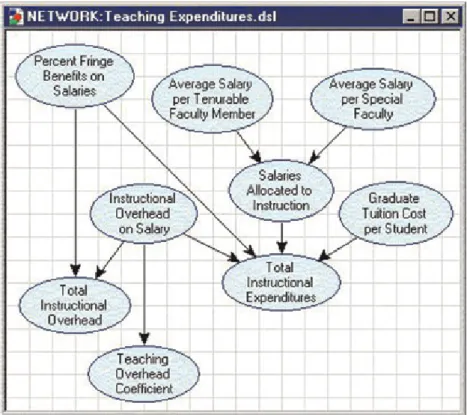
Normative systems are usually based on graphical probabilistic models, which are representations of the joint probability distribution over a model’s variables in terms of directed graphs. Directed graphs, such as the one in Fig. 2, are known as Bayesian networks (BNs) or causal networks.[7] Bayesian networks offer a compact representation of joint probability distributions and are capable of practical representation of large models, con-sisting of tens or hundreds of variables. Bayesian net-works can be easily extended with decision and value
variables for modeling decision problems. The former denote variables that are under the decision maker’s con-trol and can be directly manipulated, and the latter encode users’ preferences over various outcomes of the decision process. Such amended graphs are known as influence diagrams.[8]Both the structure and the numerical proba-bility distributions in a BN can be elicited from a human expert and are a reflection of the expert’s subjective view of a real-world system. If available, scientific knowledge about the system, both in terms of the structure and fre-quency data, can be easily incorporated in the model. Once a model has been created, it is optimized using formal decision-theoretic algorithms. Decision analysis is based on the empirically tested paradigm that people are able to reliably store and retrieve their personal beliefs about uncertainty and preferences for different outcomes, but are much less reliable in aggregating these fragments into a global inference. Although human experts are ex-cellent in structuring a problem, determining the compo-nents that are relevant to it and providing local estimates of probabilities and preferences, they are not reliable in combining many simple factors into an optimal decision. The role of a decision-analytic DSS is to support them in their weaknesses using the formal and theoretically sound principles of statistics.
The approach taken by decision analysis is compatible with that of DSSs. The goal of decision analysis is to provide insight into a decision. This insight, consisting of the analysis of all relevant factors, their uncertainty, and
the critical nature of some assumptions, is even more important than the actual recommendation.
Decision-analytic DSSs have been successfully applied to practical systems in medicine, business, and engineer-ing. Some examples of applications are described in a special issue ofCommunications of the ACMon practical applications of decision-theoretic methods (Vol. 38, No. 3, March 1995). We encourage the readers to experiment with GeNIe,[9]a development system for decision-analytic DSSs developed at the Decision Systems Laboratory, Uni-versity of Pittsburgh, available at http://genie.sis.pitt.edu/. As these systems tend to naturally evolve into three not necessarily distinct classes, it may be interesting to com-pare their structure and architectural organization. Systems with static domain models. In this class of
systems, a probabilistic domain is represented by a typically large network encoding the domain’s struc-ture and its numerical parameters. The network com-prising the domain model is normally built by decision analysts and domain experts. An example might be a medical diagnostic system covering a certain class of disorders. Queries in such a system are answered by assigning values to those nodes of the network that constitute the observations for a particular case and propagating the impact of the observation through the network to find the probability distribution of some selected nodes of interest (e.g., nodes that represent diseases). Such a network can, on a case-by-case ba-sis, be extended with decision nodes and value nodes to support decisions. Systems with static domain mod-els are conceptually similar to rule-based expert sys-tems covering an area of expertise.
Systems with customized decision models. The main idea behind this approach is automatic generation of a graphical decision model on a per-case basis in an interactive effort between the DSS and the decision maker. The DSS has domain expertise in a certain area and plays the role of a decision analyst. During this interaction, the program creates a customized influ-ence diagram, which is later used for generating ad-vice. The main motivation for this approach is the premise that every decision is unique and needs to be looked at individually; an influence diagram needs to be tailored to individual needs.[10]
Systems capable of learning a model from data. The third class of systems employs computer-intensive statis-tical methods for learning models from data.[11–15] Whenever there are sufficient data available, the systems can literally learn a graphical model from these data. This model can be subsequently used to support deci-sions within the same domain.
The first two approaches are suited for slightly different applications. The customized model generation approach is an attempt to automate the most laborious part of
decision making, structuring a problem, so far done with significant assistance from trained decision analysts. A session with the program that assists the decision maker in building an influence diagram is laborious. This makes the customized model generation approach particularly suitable for decision problems that are infrequent and serious enough to be treated individually. Because in the static domain model approach, an existing domain model needs to be customized by the case data only, the decision-making cycle is rather short. This makes it particularly suitable for those decisions that are highly repetitive and need to be made under time constraints.
A practical system can combine the three approaches. A static domain model can be slightly customized for a case that needs individual treatment. Once completed, a customized model can be blended into the large static model. Learning systems can support both the static and the customized model approach. However, the learning process can be greatly enhanced by prior knowledge from domain experts or by a prior model.
Equation-Based and Mixed Systems
In many business and engineering problems, interactions among model variables can be described by equations that, when solved simultaneously, can be used to predict the effect of decisions on the system, and hence support decision making. One special type of simultaneous equa-tion model is known as the structural equaequa-tion model (SEM), which has been a popular method of representing systems in econometrics. An equation is structural if it describes a unique, independent causal mechanism acting in the system. Structural equations are based on expert knowledge of the system combined with theoretical con-siderations. Structural equations allow for a natural, mod-ular description of a system—each equation represents its individual component, a separable and independent mech-anism acting in the system—yet, the main advantage of having a structural model is, as explicated by Simon,[16] that it includes causal information and aids predictions of the effects of external interventions. In addition, the causal structure of a SEM can be represented graphi-cally,[16] which allows for combining them with deci-sion-analytic graphical models in practical systems.[16,17]
Structural equation models offer significant advantages for policy making. Often a decision maker confronted with a complex system needs to decide not only the values of policy variables, but also which variables should be manipulated. A change in the set of policy variables has a profound impact on the structure of the problem and on how their values will propagate through the system. The user chooses which variables are policy variables and which are determined within the model. A change in the SEMs or the set of policy variables can be reflected by a rapid restructuring of the model and predictions involving this new structure.[18]
Our long-term project, the Environment for Strategic Planning (ESP),[19]is based on a hybrid graphical mod-eling tool that combines SEMs with decision-analytic principles. The ESP is capable of representing both discrete and continuous variables involved in deterministic and probabilistic relationships. The powerful features of SEMs allow the ESP to act as a graphical spreadsheet integrat-ing numerical and symbolic methods, and allowintegrat-ing the independent variables to be selected at will without hav-ing to reformulate the model each time. This provides an immense flexibility that is not afforded by ordinary spreadsheets in evaluating alternate policy options.
USER INTERFACES TO DSSs
Although the quality and reliability of modeling tools and the internal architectures of DSSs are important, the most crucial aspect of DSSs is, by far, their user interface. Systems with user interfaces that are cumbersome or un-clear or that require unusual skills are rarely useful and accepted in practice. The most important result of a ses-sion with a DSS is insight into the decises-sion problem. In addition, when the system is based on normative princi-ples, it can play a tutoring role; one might hope that users will learn the domain model and how to reason with it over time, and improve their own thinking.
A good user interface to DSSs should support model construction and model analysis, reasoning about the problem structure in addition to numerical calculations, and both choice and optimization of decision variables. We discuss these in the following sections.
Support for Model Construction and Model Analysis
User interface is the vehicle for both model construction (or model choice) and for investigating the results. Even if a system is based on a theoretically sound reasoning scheme, its recommendations will only be as good as the model on which they are based. Furthermore, even if the model is a very good approximation of reality and its recommendations are correct, they will not be fol-lowed if they are not understood. Without understanding, the users may accept or reject a system’s advice for the wrong reasons and the combined decision-making per-formance may deteriorate even below unaided perfor-mance.[20]A good user interface should make the model on which the system’s reasoning is based transparent to the user.
Modeling is rarely a one-shot process, and good mod-els are usually refined and enhanced as their users gather practical experiences with the system recommendations. It is important to strike a careful balance between preci-sion and modeling efforts; some parts of a model need to be very precise, whereas others do not. A good user
interface should include tools for examining the model and identifying its most sensitive parts, which can be subsequently elaborated on. Systems employed in prac-tice will need their models refined, and a good user inter-face should make it easy to access, examine, and refine its models. Some pointers to work on support for building decision-analytic systems can be found in Refs. [21–24]. Support for Reasoning About the Problem Structure in Addition to Numerical Calculations Although numerical calculations are important in deci-sion support, reasoning about the problem structure is even more important. Often when the system and its model are complex, it is insightful for the decision maker to realize how the system variables are interrelated. This is helpful not only in designing creative decision options, but also in understanding how a policy decision will affect the objective.
Graphical models, such as those used in decision anal-ysis or in equation-based and hybrid systems, are particu-larly suitable for reasoning about structure. Under certain assumptions, a directed graphical model can be given a causal interpretation. This is especially convenient in situations where the DSS autonomically suggests decision options; given a causal interpretation of its model, it is capable of predicting effects of interventions. A causal graph facilitates building an effective user interface. The system can refer to causal interactions during its dialogue with the user, which is known to enhance user insight.[25] Support for Both Choice and Optimization of Decision Variables
Many DSSs have an inflexible structure in the sense that the variables that will be manipulated are determined at the model-building stage. This is not very suitable for planning of the strategic type when the object of the decision-making process is identifying both the objectives and the methods of achieving them. For example, chang-ing policy variables in a spreadsheet-based model often requires that the entire spreadsheet be rebuilt. If there is no support for that, few users will consider it as an option. This closes the world of possibilities for flexible refram-ing of a decision problem in the exploratory process of searching for opportunities. Support for both choice and optimization of decision variables should be an inherent part of DSSs.
Graphical Interface
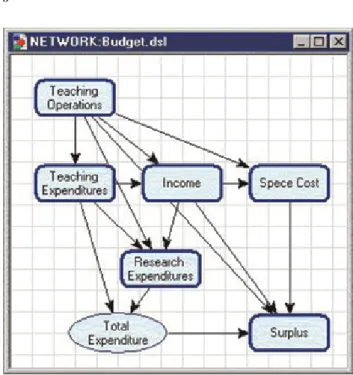
Insight into a model can be increased greatly at the user interface level by a diagram representing the interactions among its components (e.g., a drawing of a graph on which a model is based, such as in Fig. 2). This graph is a qualitative, structural explanation of how information
flows from the independent variables to the dependent variables of interest. Because models may become very large, it is convenient to structure them into submodels, groups of variables that form a subsystem of the modeled system.[2,6] Such submodels can be again shown graphi-cally with interactions among them, increasing simplicity and clarity of the interface. Fig. 3 shows a submodel-level view of a model developed in our ESP project. Note that the graph in Fig. 2 is an expanded version of theTeaching Expenditures submodel in Fig. 3. The user can navigate through the hierarchy of the entire model in her quest for insight, opening and closing submodels on demand. Some pointers to work on user interfaces of decision-analytic systems can be found in Refs. [24,26,27,28].
CONCLUSION
Decision support systems are powerful tools integrating scientific methods for supporting complex decisions with techniques developed in information science and are gain-ing an increased popularity in many domains. They are especially valuable in situations in which the amount of available information is prohibitive for the intuition of an unaided human decision maker, and in which precision and optimality are of importance. Decision support sys-tems aid human cognitive deficiencies by integrating var-ious sources of information, providing intelligent access to relevant knowledge, aiding the process of structuring, and optimizing decisions.
Normative DSSs offer a theoretically correct and ap-pealing way of handling uncertainty and preferences in decision problems. They are based on carefully studied empirical principles underlying the discipline of decision
analysis, and they have been successfully applied in many practical systems. We believe that they offer several at-tractive features that are likely to prevail in the long run as far as the technical developments are concerned.
Because DSSs do not replace humans but rather aug-ment their limited capacity to deal with complex pro-blems, their user interfaces are critical. The user interface determines whether a DSS will be used at all and, if so, whether the ultimate quality of decisions will be higher than that of an unaided decision maker.
ACKNOWLEDGMENTS
Work on this entry was supported by the National Science Foundation under Faculty Early Career Development (CAREER) Program, grant IRI-9624629, by the Air Force Office of Scientific Research under grants F49620-97-1-0225, F49620-00-1-0112, and FA9550-06-1-0243 and by the University of Pittsburgh Central Research Develop-ment Fund. Figs. 2 and 3 are snapshots of GeNIe, a general purpose development environment for graphical DSSs developed by the Decision Systems Laboratory, University of Pittsburgh, and available at http://genie.sis. pitt.edu/. We want to thank Ms. Nanette Yurcik for her assistance with technical editing.
REFERENCES
1. Kahneman, D.; Slovic, P.; Tversky, A., Eds. Judgment Under Uncertainty: Heuristics and Biases; Cambridge University Press: Cambridge, 1982.
2. Dawes, R.M. Rational Choice in an Uncertain World; Hartcourt Brace Jovanovich: San Diego, CA, 1988. 3. Sage, A.P.Decision Support Systems Engineering; John
Wiley & Sons, Inc.: New York, 1991.
4. Henrion, M.; Breese, J.S.; Horvitz, E.J. Decision analysis and expert systems. AI Mag.Winter 1991,12(4), 64–91. 5. Savage, L.J.The Foundations of Statistics,2ndrevised Ed.;
Dover Publications: New York, 1972.
6. von Winterfeldt, D.; Edwards, W.Decision Analysis and Behavioral Research; Cambridge University Press: Cambridge, 1988.
7. Pearl, J. Probabilistic Reasoning in Intelligent Systems: Networks of Plausible Inference; Morgan Kaufmann Pub-lishers, Inc.: San Mateo, CA, 1988.
8. Howard, R.A.; Matheson, J.E. Influence diagrams. InThe Principles and Applications of Decision Analysis; Howard, R.A., Matheson, J.E., Eds.; Strategic Decisions Group: Menlo Park, CA, 1984; 719–762.
9. Druzdzel, M.J. SMILE: Structural Modeling, Inference, and Learning Engine and GeNIe: A development environ-ment for graphical decision-theoretic models. In Proceed-ings of the Sixteenth National Conference on Artificial Intelligence (AAAI-99), Orlando, FL, 1999; 902–903. 10. Holtzman, S. Intelligent Decision Systems;
Addison-Wesley: Reading, MA, 1989.
11. Spirtes, P.; Glymour, C.; Scheines, R.Causation, Predic-tion, and Search; Springer Verlag: New York, 1993. 12. Pearl, J.; Verma, T.S. A theory of inferred causation. In
KR-91, Principles of Knowledge Representation and Reasoning, Proceedings of the Second International Conference, Cambridge, MA, Allen, J.A., Fikes, R., Sandewall, E., Eds.; Morgan Kaufmann Publishers, Inc.: San Mateo, CA, 1991; 441–452.
13. Cooper, G.F.; Herskovits, E. A Bayesian method for the induction of probabilistic networks from data. Mach. Learn.1992,9(4), 309–347.
14. Glymour, C.; Cooper, G.F., Eds.Computation, Causation, and Discovery; AAAI Press: Menlo Park, CA, 1999. 15. Heckerman, D.E.; Geiger, D.; Chickering, D.M. Learning
Bayesian networks: The combination of knowledge and statistical data. Mach. Learn.1995,20(3), 197–243. 16. Simon, H.A. Causal ordering and identifiability. InStudies
in Econometric Method. Cowles Commission for Research in Economics; Monograph No. 14; Hood, W.C., Koopmans, T.C., Eds.; John Wiley & Sons, Inc.: New York, 1953; Chapter III, 49–74.
17. Druzdzel, M.J.; Simon, H.A. Causality in Bayesian belief networks. In Proceedings of the Ninth Annual Confer-ence on Uncertainty in Artificial IntelligConfer-ence (UAI-93); Morgan Kaufmann Publishers, Inc.: San Francisco, CA, 1993; 3–11.
18. Simon, H.A.; Kalagnanam, J.R.; Druzdzel, M.J. Perfor-mance budget planning: The case of a research university; 2000. Unpublished manuscript.
19. Druzdzel, M.J. ESP: A mixed initiative decision-theoretic decision modeling system. InWorking Notes of the AAAI-99 Workshop on Mixed-Initiative Intelligence; Orlando, FL, 1999; 99–106.
20. Lehner, P.E.; Mullin, T.M.; Cohen, M.S. A probability analysis of the usefulness of decision aids. InUncertainty in Artificial Intelligence 5, Henrion, M., Shachter, R.D., Kanal, L.N., Lemmer, J.F., Eds.; Elsevier Science Publish-ers: B.V.: North Holland, 1990; 427–436.
21. Druzdzel, M.J.; Dı´ez, F.J. Criteria for combining knowl-edge from different sources in probabilistic models. J. Mach. Learn. Res.2003,4(July), 295–316.
22. Druzdzel, M.J.; van der Gaag, L.C. Building probabilistic networks: “Where do the numbers come from?” guest edi-tors’ introduction. IEEE Trans. Knowl. Data Eng.2000,12
(4), 481–486.
23. Lu, T.-C.; Druzdzel, M.J. Causal mechanism-based model construction. InProceedings of the Sixteenth Annual Con-ference on Uncertainty in Artificial Intelligence (UAI-2000); Morgan Kaufmann Publishers, Inc.: San Francisco, CA, 2000; 353–362.
24. Wang, H.; Druzdzel, M.J. User interface tools for naviga-tion in condinaviga-tional probability tables and elicitanaviga-tion of probabilities in Bayesian networks. InProceedings of the Sixteenth Annual Conference on Uncertainty in Artificial Intelligence (UAI-2000); Morgan Kaufmann Publishers, Inc.: San Francisco, CA, 2000; 617–625.
25. Druzdzel, M.J. Probabilistic reasoning in decision support systems: From computation to common sense. Ph.D. the-sis, Department of Engineering and Public Policy, Carne-gie Mellon University: Pittsburgh, PA, 1992.
26. Druzdzel, M.J. Five useful properties of probabilistic knowledge representations from the point of view of intel-ligent systems. Fundamenta Informaticæ 1997, 30 (3/4), 241–254. (special issue on knowledge representation and machine learning).
27. Druzdzel, M.J. Explanation in probabilistic systems: Is it feasible? Will it work? InProceedings of the Fifth Inter-national Workshop on Intelligent Information Systems (WIS-96), Deblin, Poland, 1996; 12–24.
28. Wiecha, C.F. An empirical study of how visual program-ming aids in comprehending quantitative policy models (Volumes I and II), Ph.D. thesis, Department of Engineer-ing and Public Policy, Carnegie Mellon University: Pitts-burgh, PA, 1986.