Computational Aspects of Extending the Shapley
Value to Coalitional Games with Externalities
1
Tomasz Michalak
1, Talal Rahwan
1, Dorota Marciniak
2,3, Marcin Szamotulski
2,4, Nicholas R. Jennings
1 1School of Electronics and Computer Science, University of Southampton, UK2National Institute of Telecommunications, Poland 3Universitat Polit`ecnica de Catalunya, Spain
4Instituto Superior T´ecnico, Universidade T´ecnica de Lisboa, Portugal
Abstract. Until recently, computational aspects of the Shap-ley value were only studied under the assumption that there are noexternalities from coalition formation, i.e., that the value of any coalition is independent of other coalitions in the system. However, externalities play a key role in many real-life situa-tions and have been extensively studied in the game-theoretic and economic literature. In this paper, we consider the issue of computing extensions of the Shapley value to coalitional games with externalities proposed by Myerson [21], Pham Do and Norde [23], and McQuillin [17]. To facilitate efficient computa-tion of these extensions, we propose a new representacomputa-tion for coalitional games with externalities, which is based onweighted
logical expressions. We demonstrate that this representation is
fully expressiveand, sometimes,exponentially more concisethan the conventional partition function game model. Furthermore, it allows us to compute the aforementioned extensions of the Shapley value in time linear in the size of the input.
1
Introduction
The Shapley value is arguably the most important normative payoff division scheme in coalitional games. Whereas game theory focuses predominantly on the theoretical aspects of the Shapley value, computer science is equally concerned with the computational aspects involved. Given this, in this paper we consider the issue of computing the Shapley value extended to coalitional games that exhibitexternalities from coalition
forma-tion(i.e., games in which the gain from forming a coalition may be affected by the formation of other coalitions). The issue of externalities has been extensively studied in the economic liter-ature, as they play an important role in many real life problems (see, e.g., [4]). This issue has also been recently considered in the AI and multi-agent systems literature [18, 19, 25]. Here, ex-ternalities emerge in any situation where the utility of an agent or a coalition of agents is influenced by the functioning of coali-tions created by other agents in the system.2
In the absence of externalities, Shapley [27] proposed to eval-uate the role of each agent by averaging the marginal contribu-1
We would like to thank Michael Wooldridge for helpful discussions. Also comments from three ECAI anonymous reviewers are grate-fully acknowledged.
2
See [19] for examples of settings with externalities.
tions of that agent to coalitions over all the possible permu-tations of agents in the game (see the formal definition in the next section). Assuming that the grand coalition, i.e. the coali-tion of all the agents in the game, is formed, the Shapley value identifies thefairdivision of the joint payoff. Here, fairness is defined by the following four desirable axioms: (i)efficiency— all the wealth available to agents is distributed among them; (ii)symmetry— any agents that have the same marginal contri-butions obtain the same payoff; (iii)null player— agents with zero marginal contributions receive zero payoff; and (iv)
addi-tivity— values of two games should sum up to the value com-puted for the sum of both games. This last axiom means that when agents divide the payoff from two different games, each agent’s share does not depend on whether the two games are considered together or one after the other. The importance of Shapley value stems from the fact that it is the unique division scheme that meets all the above four fairness axioms.3
As for computational issues, the definition of the Shapley value is based on the characteristic function that assigns to every coalition a numerical value representing the quality of its performance, i.e., given n agents, it considers 2n coali-tions. Such an exponential input is clearly computationally in-tractable for bigger systems (e.g., 100 or 1000 agents). There-fore, a number of works in the computer science literature pro-posed alternative representations which are sometimes more concise and have other interesting computational properties [8, 5, 6, 14, 22, 11]. For example, the representation of Ieong and Shoham [14], which is in many cases exponentially more con-cise than the characteristic function, allows us to compute the Shapley value in time linear in the size of the representation.
However, the issue of representing coalitional games is more challenging in the presence of externalities [19, 20]. In game theory, such games are represented using thepartition function
gamerepresentation. Here, the value of the coalitions depends on thecoalition structurein which it is embedded, where a coali-tion structure is defined as a particoali-tion of all the agents into disjoint coalitions. Clearly, the partition function is much more computationally involved than the characteristic function. Fur-thermore, solution concepts developed for games with no ex-3
It should be noted that, in games with no externalities, the fourth axiom can be derived from the first three axioms.
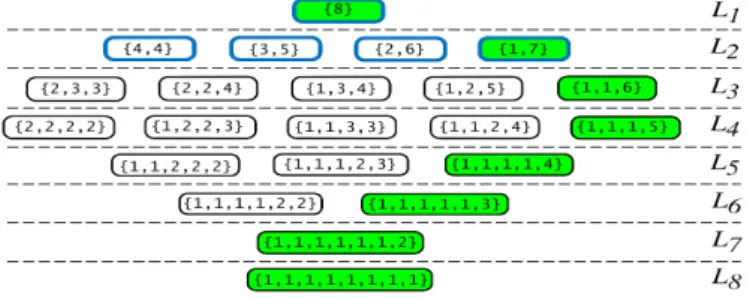
Figure 1. Integer partitions for8agents
ternalities, such as the Shapley value, have to be redefined (or
extended) to allow for existence of externalities. To date, there have been a number of such extensions of the Shapley value in the game-theoretic literature, namely, those proposed by My-erson [21], Bolger [3], Potter [24], Maskin [16], Macho-Stadler et al. [15], Pham Do and Norde [23], Fujinaka [10], Hafalir [12], Hu and Yang [13], Albizuri et al. [1], DeClippel and Serrano [7] and McQuillin [17]. The main reason for this multiplicity of concepts is that the fairness axioms introduced by Shapley for games with no externalities are not sufficient to guaran-tee uniqueness of a division scheme in games with external-ities. To attain this uniqueness, some extra axioms have to be introduced and this leads to a number of different extensions depending on the axioms that are being added. Although the Shapley value is one of the key solution concepts in coalition formation, none of its extensions to games with externalities has been considered in the computer science literature with the exception of the recent paper by Michalak et al. [20] which con-sidered only one of those extensions.
Against this background, in this paper:
• We consider the computational aspects related to three ex-tensions of the Shapley value to games with externalities; namely, those proposed by Myerson, Pham Do and Norde, and McQuillin.
• To facilitate the efficient computation of the three exten-sions under consideration, we propose anovel representa-tion of coalirepresenta-tional games with externalitiesthat is based on weighted logical expressions. We show that our repre-sentation is fully expressive, i.e., it is able to represent any coalitional game with externalities, and is not restricted to any particular subclasses of these games. Furthermore, our representation can be much more concise compared to all available alternatives for games with externalities, namely the conventionalpartition function gamerepresentation, and the representations recently introduced by Michalak et al. [19, 20].4
• We show that, for all three extensions of the Shapley value, using our representation thedivision of payoff is obtained in time linear in the number of logical rulesthat model the coalitional game.
4
In fact, it can be easily shown that the representation in [20], which is also based on logical expression, is only a very special case of our representation.
2
Notation and Basic Definitions
We denote byA ={a1, . . . , a|A|}the set of agents participat-ing in the game. Acharacteristic functionv: 2A →Rassigns to every coalitionC ⊆Aa real number representing the quality of its performance. Acharacteristic function gameis then a tuple
(A, v). However, as common practice in the literature, we will simply denote it byvalone. Acoalition structure, denotedπ, is a disjoint and exhaustive partition of the agents inA. That is, π={C:C⊆A∧S
C∈πC=A∧ ∀C, C 0∈
π, C∩C0=∅}. By
Π(A)we will denote the space of all coalition structures overA. In the spirit of [26], we will divideΠ(A)into sub-spaces such that every sub-space is represented by a unique integer parti-tion of|A|, with the integers corresponding to coalition sizes. Figure 1 shows an example for|A| = 8, where all the pos-sible integer partitions are divided into levelsL1, L2, . . . , L8 such that every levelLicontains the integer partitions of sizei. The integer partition[1,1,6], for example, represents the sub-space containing all the coalition structures within which two coalitions are of size 1, and one coalition is of size 6. For every coalitionC0 ⊆A, we distinguish two coalition structures that contain it, denoted{C0, singletons}and{C0, A\C0}, as these will play an important role in the paper. Specifically:
(i) {C0, singletons}={C:C⊆A∧(C=C0∨ |C|= 1)} (ii) {C0, A\C}={C:C⊆A∧(C=C0∨ |C|=|A| − |C0|)}
In a coalitional game with externalities, given three dis-joint coalitions:C1,C2,C3, and given two coalition structures: CS,CS0such thatC1, C2, C3 ∈CSandC1,(C2∪C3)∈CS0, the value ofC1may be different inCSthan inCS0due to the merge ofC2withC3. Such effects are known asexternalities from
coalition formation. Games with externalities are conventionally modelled using apartition functionthat assigns a real value to any pair(C, π)whereπ ∈ Π(A)andC ∈ π. We will refer to such pairs asembedded coalitions, and the set of them will be de-notedE. Agame in a partition function formis then a tuple(A, w). Again, for ease of notation we will denote such a game by walone. Following [7], we will callw(C,{C, singletons})the
externality-free valueof coalitionC, and denote itvef(C); this is becauseCis not subject to any externalities in{C, singletons} (see [7] for more details).
Now, letω∈Ω(A)denote a permutation of agents inA, and letCω(i)denote the coalition made of all predecessors of agent aiinω. More formally, if we denote byω(j)the location ofaj inω, then:Cω(i) ={aj∈ω:ω(j)< ω(i)}. The Shapley value ofai, denotedSVi(v), is then defined as the average marginal contribution ofaito coalitionCω(i)over allω∈Ω[27]:
SVi(v) = 1 |A|! X ω∈Ω [v(Cω(i)∪ {ai})−v(Cω(i))]. (1)
Shapley provides the following intuition behind this for-mula: imagine that the players are to arrive at a meeting point in a random order, and that every playeraiwho arrives receives the marginal contribution that his arrival would bring to those already at the meeting point. Now if we average these contri-butions over all the possible orders of arrival, we obtainSVi(v), ai’s payoff in the game. The formula in (1) can also be stated in the equivalent but computationally less involved form as:
SVi(v) =
X
C⊆A\{ai}
|C|!(|A| − |C| −1)!
3
Extensions of the Shapley Value
In this section we discuss threeextended Shapley values(ESVs), i.e. extensions of the Shapley value to games with externalities. Each of these is based on a different axiomatic characterization and, thus, accommodates externalities in a different way. To better understand these differences, we show in Figure 1 the coalition structures that play a role in the computation pro-cess of every extension. These differences ultimately determine which extension is most suitable for a given application. Extension of Pham Do and Norde.The axiomatic characteri-zation of this extension is similar to that of the standard Shap-ley value except for the null player and symmetry axioms. Whereas there are many ways of defining these axioms in games with externalities, in their definitions, Pham Do and Norde compute marginal contributions of an agent consider-ing only those coalition structures in which this agent plays as a singleton (see [23] for more details). This uniquely determines the following ESV:
ESVpdn i (w) = X C⊆A\{ai} |C|!(|A| − |C| −1)! |A|! [vef(C∪ {ai})−vef(C)]. (3)
In other words, the axioms proposed by Pham Do and Norde lead to an ESV that focuses solely on theexternality-freevalue of every coalitionC, which can be found in the coalition structure of the form{C, singletons}, i.e., it ignores the other values of C(whenCis embedded in other coalition structures) as visible in Figure 1. This means that players are remunerated based on their performance when it is unaffected by externalities.
The procedural account for theESVP dNis, in principle, sim-ilar to that of the conventional Shapley value, except for the fact that the agents who have not arrived yet at the meeting point, are taken into consideration as singletons.
Extension by McQuillin.This extension is related to the
prob-lem of generalization of the conventional Shapley value. This problem involves defining a fair division of the game’s payoff under the assumption that the game is played not by agents but by coalitions in a certain,a priori known, coalition structure. Whereas the problem of generalization had been considered only in the context of games with no externalities, McQuillin analysed it in the presence of externalities [17]. Specifically, the author showed that the widely accepted solution to the prob-lem of generalization forces a unique solution to the probprob-lem of extension, and he called this solution theExtended, Generalized
Shapley Value(EGSV).
In order to formalize this concept, let us define for any set T ⊆ π the operatorbTc := SC∈TC. For instance, if T = {{a1}{a2}}thenbTc = {a1a2}. Now, given a gamew and
(C, π)∈E, theEGSV is defined as [17]:
EGSV(C,π)(w) = X C∈T⊆π (|T| −1)!(|π| − |T|)! |π|! wπ bTc −wπ bT\{C}c (4) where wπ(C) := w(C,{C, A\C}). In other words, to com-pute theEGSV of a coalitionCembedded in ana priori coali-tion structureπ, a characteristic function game(π, wπ), orwπ for brevity, should be constructed in which the players are the coalitions fromπand the payoffs are given by:wπ(T) := wbTc,
bTc,bπ\Tc for allT ⊆π. Now, by computing the conventional Shapley value of playerC ∈ πin the gamewπ, we obtainEGSV(C,π)(w).
McQuillin shows that apart from efficiency, symmetry, null-player, and linearity, theEGSV meets also weak monotonic-ity, the rule of generalisation, strong linearmonotonic-ity, cohesion, gen-eralised null-player, and recursion axioms (see [17] for more details). The author proves that the extended values proposed by [7, 15, 21, 23, 24] asymptotically converge to theEGSV.
The procedural account for theEGSV is, in principle, simi-lar to that of the conventional Shapley value, but now marginal payoffs are calculated by assuming that agents, who have not arrived yet at the meeting point, form a coalition (which is ex-actly the opposite to the assumption made inESVP dN). Extension of Myerson.The three axioms that uniquely charac-terize Myerson’s extension are linearity, symmetry, and carrier, extended to games with externalities. This last axiom means that the value of the grand coalition should be divided only among the members of the carrier that is defined as:
Definition 3.1
Let(A, w)be a game with externalities. The coalitionC⊆Ais called a carrier ofwif, for any embedded coalition(C0, π)∈E, it holds that
w(C0, π) =w(C∩C0, π∧ {C, A\C}).
This extended carrier axiom implies both the efficiency and the dummy-player concepts much stronger than in the original Shapley value as well as inESVP dNandEGSV (see [15, 17] for more details on this issue). Myerson’s extension is then:
ESViM(w) = X (C,π)∈E (−1)|π|−1(|π| −1)!× (5) × 1 |A|− X e C∈π:C6e=C ai∈/Ce 1 (|π| −1)(|A| − |Ce|) w(C, π)
4
Weighted MC-Nets
We call our representation for games with externalitiesweighted
MC-netsas we derive our inspiration from both:
• the various weighted-formula representations that have been used to represent preferences and valuation functions in other areas of AI [28]; and
• MC-nets — the representation of coalitional games with no externalities proposed by Ieong and Shoham [14].
Although there are a number of alternative representations of games with no externalities in the literature [2, 5, 6, 8, 14, 22], we find MC-nets to be the most suitable starting point of our computational analysis of various extensions of Shapley value for games with externalities. Specifically, in addition to being fully expressive and, for many games, concise, this representa-tion also facilitates a very efficient way of computing the con-ventional Shapley value. In MC-nets, a game with no externali-ties is represented with a set ofsimplerulesR, where each rule is of the form(B, v), withBbeing a Boolean expression over A, andv∈R.5Such a rule is interpreted as follows: the value of any coalitionCis increased byvif that coalitionmeetsthe expressionB, i.e., ifBevaluates totruewhen every Boolean
variable corresponding to an agent inCis set totrue, and ev-ery one corresponding to an agent inA\Cis set tofalse. In
this case, we writeC|=B. Similarly to [14], our computational results are derived for the special case where all expressions are conjunctions of literals. In this context, within any expression, 5
an agent will be called anegative literalif it is preceded with the sign “¬”, and will be called apositive literalotherwise.6We as-sume that any expression contains at least one positive literal. The basic idea behind ourweighted MC-netsrepresentation is to generalize the aforementioned rules such that Boolean ex-pressions are matched against coalition structures rather than just coalitions. Specifically, in our representation, a rule is of the following form:
(B11;v 1 1). . .(B 1 r1;v 1 r1)|. . .|(B s 1;v s 1). . .(B s rs;v s rs) (6) Any rule of this form will be called aweighted rule, and will be denoted asWR∈ WR. A coalition structureπis said tomeet such a rule ifπcan be divided into disjoint non-empty sets of coalitionsπ1, . . . , πssuch thatπ1∪ · · · ∪πs =πand every ex-pressionBklfor a givenl∈ {1, . . . , s}andk∈ {1, . . . , rl}is met by at least one coalition inπl. This, as well as the assumption that every expressionBlkcontains at least one positive literal, imply thatBlkdoes not meet any coalition inπl06=l. In this case, we writeπ |= WR. A coalitional game with externalities is then represented as a tuple(A,WR), where the value of any embedded coalition(C, π)is computed as follows:
w(C, π) = X WR∈WR:π|=WR X (Bl k,vlk)∈WR:C|=Blk vkl
When convenient, an expressionBkl of the form in (6) will be denoted as a conjunction of positive and negative literals. For example, the rule(a1∧a2; 15)(a3∧ ¬a5; 10)|(a7; 20)will be denoted as(p11; 15)(p12∧ ¬n12; 10)|(p21; 20), wherep11 =a1∧ a2,p12 =a3,¬n21 = ¬a5, andp21 = a7. Furthermore, we will denote byPklandN
l
kthe sets containing the agents inp l kand ¬nlk, respectively. For example, in the above rule we haveP
1 1 =
{a1, a2},P21={a3},N21={a5}, andP12={a7}.
Having introduced our representation, we will now evaluate its properties, starting with expressiveness:
Proposition 4.1 (Expressiveness)
Every coalitional game with externalities that is represented with a partition function can be expressed using weighted MC-nets.
Proof: To prove this, it suffices to note that given a coalition structure π = {C1, . . . , C|π|} we can define a “canonical” weighted ruleWRsuch that∀(C, π)∈E, π0|=WR iff π0=π. This rule is(B1;w(C1, π))|. . .|(B|A|;w(C|π|, π)), where the ex-pressionsB1, . . . ,B|π|are composed of positive literals corre-sponding to the agents inC1, . . . , C|π|respectively.
Corollary 4.2 (Conciseness)
Weighted MC-nets are at least as concise as the partition function game representation.
Proposition 4.3 (Conciseness w.r.t. certain games)
Weighted MC-nets are exponentially more concise than the partition function game representation for certain games.
Sketch of Proof: This follows from the well-known result in Boolean algebra that, with a set of Boolean formulas, one can sometimes express the information in an exponentially more concise manner compared to the extensive representation such
as the partition function.
Finally, it is easy to show that weighted MC-nets are at least as concise and sometimes much more concise than the repre-sentations introduced by Michalak et al. in [19, 20].
6
For convenience, with a slight abuse of conventional notation, by¬n, where, for instance,n=a1∧a2, we mean¬a1∧ ¬a2.
5
Computing ESVs with weighted MC-nets
The key role in our algorithms is played by the additivity ax-iom, which is met by all three ESVs and allows for computing these values by considering everyWR ∈ WRas a separate sub-game.7
Lemma 5.1
Letwbe the game represented by(A,WR), and letwzbe the game
represented by(A,{WRz}), whereWRz∈ WR. This meanswzis
represented with a single weighted rule. TheESVP dN,ESVMand EGSV forware equal to the sum of theESVP dNs,ESVMs and
EGSVs, respectively, computed for everywz:WRz∈ WR. We will say that a set of expressions{B1, . . . ,Bm}is
com-patible, which we denote as⊕{B1, . . . ,Bm}, if there exists at least one coalition that meets all these expressions. Formally, ⊕{B1, . . . ,Bm}if∃C⊆A:C|=Bk∀k∈ {1, . . . , m}. This hap-pens if{Smk=1P
k} ∩ {Sm k=1N
k}
=∅. We will denote a set of
incompatibleexpressions as {B1, . . . ,Bm}. In what follows we assume that every weighted ruleWR ∈ WRthat is not cor-rectly defined, i.e.∀π∈Π(A), π 6|=WR, is omitted fromWR (as it does not influence the game at all).
5.1
Computing
ESV
P dNSince ESVP dN is computed in a similar way to the stan-dard Shapley value but using the externality-free values, only the rules influencing these values (i.e., influencing the value of a coalitionC in{C,singletons}) should be taken into ac-count. An algorithm is, therefore, needed to (i) identify those weighted rules and (ii) transform each of them into the corre-sponding simple rule(s). This transformation has to be done very carefully in order to preserve other conditions affecting C that are present in each weighted rule! For example, the weighted rule(a1∧a2,5)(a4∧ ¬a2,6)|(a3,7)is met by some coalition structures of the form{C,singletons}, whereC con-tainsa1anda2. However, this only happens under the condi-tion that botha3anda4do not belong toC.
Theorem 5.2
Let(A,WR)representw. Algorithm 1 transformsWRinto a cor-responding set of simple rulesR(from whichESViP dN(w)can be
computed for allai ∈ Ain time linear in|R|as shown in [14]).
Furthermore, for eachWR∈ WRthe running time of Algorithm 1 isO(|WR|2|). Therefore, it is linear in the size of the representation
|WR|. Finally, it holds that|R| ≤ |A| × |WR|.
Proof: We denote byB∗an interim expression which we use in the process of building a simple rule. For everyWR∈ WR: (i) If for more than one l there exist Bkl : |Pkl| > 1 then
WRcannot be met by any coalition structure of the form {C,singletons}; thus,WRis disregarded;
(ii) If for exactly onelthere existsBlk : |Pk|l >1then we need to ensure that, for thisl, all expressionsBlk : |P
l
k| > 1are compatible as they have to be met by the same coalitionC. Thus:
(a) If {Blk:|Pk|l >1}thenW Ris disregarded; 7
(b) Otherwise,∃C ⊆ A : ({C,singletons} |= WR)∧(C |= B∗
), whereB∗ = Vk:|Pl k|>1B
l
k). Now, what is left is to ensure that the other conditions inWRthat affectCare preserved. As forBl
0
k0 :l06=l, wherel0 ∈ {1, . . . , s} \ {l}
andk0 ∈ {1, . . . , rl0}, the only conditions that these
ex-pressions place onCis thatC∩Pl
0
k0 = ∅. Thus,B∗ ←
B∗∧ ¬
plk00. As forBkl0 : k0 ∈ {1, . . . , rl} ∧ |Pkl0| = 1,
whenever {B∗,Bkl0}it places a condition onCthatC6|=
Bl
k0 sinceC |= B∗. At this point, we have incorporated
inB∗ all the conditions necessary forC to meet; thus,
(B∗,P
k:|Pl k|>1
vl
k) becomes our first simple rule. How-ever, if there existBlk0such that⊕{B∗,Bkl0}then they
con-tribute to the value ofCifC|=B∗∧ Bkl0(see Steps 15-16).
(iii) Otherwise, every Bkl such that l ∈ {1, . . . , s} and k ∈ {1, . . . , rl}has exactly one positive literal. While in (ii,b) we focused onBkl :|Pkl|>1, here the focus is on everyBkl (as coalitionCin{C,singletons}can, in principle, meet any of them). Similar reasoning applies.
It is clear that in both cases(ii)and(iii)the maximum number of simple rules that can be created from a singleWR∈ WRis |A|; thus,|R| ≤ |A| × |WR|. The running time comes from the fact that everyWRcontains at most|A|expressions.
5.2
Computing EGSV
In contrast to theESVP dN, theEGSV is computed for ana
prioricoalitionπ = {C1, . . . , C|π|}using coalition structures that are of the form{C, A\C}and, at the same time, satisfy ∃π1, π2 : (π1∪π2 =π)∧(∪π1 =C)∧(∪π2 = A\C). This latter condition identifies those{C, A\C}that are relevant to the gamewπ. Recall that in this game there are no externalities and every coalition inπis considered to be a single player. We denote these players asAπ={aC1, . . . , aC|π|}. The following
theorem holds: Theorem 5.3
Let(A,WR)representw, and assume that eithers >1or(s= 1)∧
(rs= 1)for everyWR∈ WR. For a given a priori coalition
struc-tureπ, Algorithm 2 transformsWRinto a corresponding set of sim-ple rulesR(from which theEGSV(C,π)(w)can be computed in time
linear in|R|as shown in [14]). Furthermore, for eachWR ∈ WR
the running time of Algorithm 2 isO(max(|WR|+|π|)). Therefore, it is linear in the size of the representation|WR|. Finally, it holds that
|R| ≤2× |WR|.
Proof: As we are only interested in any coalition structure of the form{C, A\C}, all rules for whichs >2should be dis-regarded. Furthermore, for anyWR ∈ WRsuch thats = 2, it may still happen thatWRis not met by any such coalition structure. To ensure that∃C ⊆ A : {C,singletons} |= WR, it is sufficient to ensure that the following two conditions are satisfied: (i) expressions in{B1k : k ∈ {1, ..., r1}}have to be compatible, as well as those in{B2k : k ∈ {1, ..., r2}}; and (ii)
((Sr1 k=1N 1 k)∩( Sr2 k=1N 2
k)). If so then all that is left to check is whether agents inΓ1andΓ2(defined as in Steps 4 and 5) can be replaced with players inAπ. This last issue is important as we are not interested in all structures{C, A\C}but only in those which determine the values of the gamewπwith playersAπ. Finally, Steps 13-14 cover the special case where the weighted rule is actually a simple rule. Finally, it is easy to see from the algorithm that|R| ≤2× |WR|andO(max(|WR|+|π|)).
5.3
Computation of
ESV
MThe starting point of our algorithm is the following property ofESVM [21]:
Proposition 5.4
Letw(C,π)be the partition form game such thatw(C,π)(C,e eπ) = 1 if and only if(C,e e π)≥(C, π), otherwisew(C,π)(C,e e π) = 0.8Then, ESVM
i (w) = |C|1 fori∈Cand0otherwise. Let us define the functionf:Z2→Rby:
f(a, b) = X 0≤j≤b (−1)j b j ! 1 a+j. Theorem 5.5
Let(A,WR)representw, and assume that(s= 1)∧(rs = 1)for
everyWR∈ WR. Algorithm 3 computes theESViMfor allai∈A.
Furthermore, for eachWR∈ WR, the running time of Algorithm 3 isO(|A| × |WR|). Therefore, it is linear in|WR|.
Proof: Following Lemma 5.1, we focus on the case when |WR| = 1 and rewrite the weighted rule ask = 1, . . . , r1 weighted rules of the form:
(B11; 0). . .(B 1 k−1; 0)(B 1 k;v)(B 1 k+1; 0). . .(B 1 r1; 0) (7) 8
Now, the game can be represented by the following rules which consist of only positive literals:
(p11∧n 01 1; 0). . .(p1k∧n 01 k; (−1) |N101|+...+|Nr01 1|·v). . .(p1r1∧n 01 r1; 0) (8)
forNj01 ⊆ Nj1 andj = 1, . . . , r1. This follows from the fol-lowing formulaP0≤l≤r1(−1)
l r1 l
= 0. According to Proposi-tion 5.4, for eachk,ESVMi (w)is:
X (N01 1,...,Nr011):Nj01⊆Nj1 (−1)|N 01 1|+...+|Nr011|· v |P1 k|+|N 01 k| = X N01 k⊆Nk1 (−1)|N101|· v |P1 k|+|Nk01| × X (N01 1,...,Nr011):N 01 j6=k⊆Nj1 (−1)|N 01 16=k|+...+|N 01 r16=k| The sumP(N01 1,...,Nr011):N 01
j6=k⊆Nj1 has non zero value iff∀j 6= k, N1
j =∅. Now, let us assume thatNj1=∅forj6=k. Then, the sumP(N01 1,...,Nr011):N 01 j6=k⊆Nj1(−1) |N01 16=k|+...+|Nr0116=k|= 1 ; thus ESVMi (w) = X N01 k⊆Nk1 (−1)|Nk01|· v |P1 k|+|N 01 k| =f(|Pk1|,|N 1 k|).
From (8) we have thatESVMi (w) = 0forai∈/Pk1. The agents inNk1are equally valued byESV
M
due to symmetry axiom. Since A is always a carrier, we have thatPaiESV
M i (w) = w(A,{A}); thusESVMi (w) =− |P1 k| |N1 k| f(|Pk1|,|N 1 k)forai ∈Nk1. The running time comes from the fact that, in every rule,|WR| expressions have to be checked against everyai∈A.
6
Conclusions
If coalitional games with externalities are modelled using a conventional partition function game representation, the com-putation of the three different extensions of Shapley value con-sidered in this paper requires an exponential number of oper-ations. To tackle this problem, we propose a representation of coalitional games with externalities based on weighted logic formulas. We demonstrate that it is fully expressive and at least as concise as the conventional partition function game repre-sentation. However, it can be exponentially more concise. Fi-nally, we show that all three extensions of the Shapley value considered in this paper can be computed in the time linear in the size of the input (which is the number of weighted rules).
Our work can be extended in several directions. Firstly, the computational aspects of remaining ESVs are still to be anal-ysed. Secondly, more involved Boolean expression can be con-sidered (as it is done in Elkind [9] for basic MC-nets). Finally, it is interesting to consider the properties of the weighted MC-nets with respect to other coalitional games solution concepts such as the core.
REFERENCES
[1] M. J. Albizuri, Javier Arin, and Juan F Rubio-Ramirez, ‘An axiom system for a value for games in partition function form’,
Interna-tional Game Theory Review (IGTR),07(01), 63–72, (2005).
[2] J.M. Bilbao,Cooperative Games on Combinatorial Structures, Kluwer Academinc Publishers, 2000.
[3] E. M. Bolger, ‘A set of axioms for a value for partition function games’,Internat. J. Game Theory,18(1), 37–44, (1989).
[4] E. Catilina and R.Feinberg, ‘Market power and incentives to form research consortia’,Rev. of Industrial Org.,28(2), 129–144, (2006). [5] V. Conitzer and T. Sandholm, ‘Complexity of Determining
Nonemptiness in The Core’, inIJCAI, pp. 219–225, (2004). [6] V. Conitzer and T. Sandholm, ‘Computing shapley values,
manip-ulating value division schemes and checking core membership in multi-issue domains’, inIn Proceedings of AAAI, pp. 42–47, (2004). [7] G. de Clippel and R. Serrano, ‘Marginal contributions and
exter-nalities in the value’,Econometrica,76(6), (2008).
[8] X. Deng and C. Papadimitriou, ‘On the complexity of cooperative solution concepts.’,Mathematical OR, (19), 257–266, (1994). [9] E. Elkind, L.A. Goldberg, P. W. Goldberg, and M. Wooldridge, ‘A
tractable and expressive class of marginal contribution nets and its applications’,Math. Logic Quart.,55(4), 362 – 376, (2009). [10] Y Fujinaka, ‘On the marginality principle in partition function
form games’,Mimeo, Kobe University, Japan, (2004).
[11] G. Greco, E. Malizia, L. Palopoli, and F. Scarcello, ‘On the com-plexity of compact coalitional games’, inIJCAI, pp. 147–152, (2009).
[12] I. E. Hafalir, ‘Efficiency in coalition games with externalities’,
Games and Economic Behavior,61(2), 242–258, (2007).
[13] C.-C. Hu and Y.-Y. Yang, ‘An axiomatic characterization of a value for games in partition function form’,SERIEs: Journal of the
Span-ish Economic Association, (2010).
[14] S. Ieong and Y. Shoham, ‘Marginal contribution nets: A complact representation scheme for coalitional games’,ACM EC-06. [15] I. Macho-Stadler, D. P´erez-Castrillo, and D. Wettstein, ‘Sharing
the surplus: An extension of the shapley value for environments with externalities’,J. of Economic Theory, (135), 339–356, (2007). [16] E. Maskin. Bargaining, production, and monotonicity in
eco-nomic environments. The Econometric Society, 2003.
[17] B. McQuillin, ‘The extended and generalized shapley value: Si-multaneous consideration of coalitional externalities and coali-tional structure’,Journal of Economic Theory, (144), 696–721, (2009). [18] T. Michalak, A. Dowell, P. McBurney, and M. Wooldridge, ‘Opti-mal coalition structure generation in partition function games’, in
ECAI-08, pp. 388–392, (2008).
[19] T. P. Michalak, T. Rahwan, J. Sroka, A. Dowell, M. J. Wooldridge, P. J. McBurney, and N. R. Jennings, ‘On representing coalitional games with externalities’, inACM EC ’09.
[20] T.P. Michalak, D. Marciniak, M. Szamotulski, T. Rahwan, P. McBurney, M. Wooldridge, and N. Jennings, ‘A logic-based rep-resentation for coalitional games with externalities’, in
AAMAS-2010.
[21] R. B. Myerson, ‘Values of games in partition function form’,
Inter-nat. J. Game Theory,6(1), 23–31, (1977).
[22] N. Ohta, A. Iwasaki, M. Yokoo, and K. Maruono, ‘A compact rep-resentation scheme for coalitional games in open anonymous en-vironments’, inAAAI-2006, pp. 509–514.
[23] K.H. Pham Do and H. Norde, ‘The Shapley value for partition function form games’,Int. Game T. Rev.,9(2), 353–360, (2007). [24] A. J. Potter. A value for partition function form games. Working
paper, Hardin–Simons University, Abilene, Texas, 2000. [25] T. Rahwan, T. Michalak, N. R. Jennings, M. Wooldridge, and
P. McBurney, ‘Coalition structure generation in multi-agent sys-tems with positive and negative externalities’, inIJCAI, (2009). [26] T. Rahwan, S. D. Ramchurn, V. D. Dang, and N. R. Jennings,
‘Near-optimal anytime coalition structure generation’, inIn
Pro-ceedings of IJCAI, pp. 2365–2371, (2007).
[27] L. S. Shapley, ‘A value for n-person games’, inIn Contributions to
the Theory of Games, volume II, eds., H.W. Kuhn and A.W. Tucker, 307Ű317, Princeton University Press, (1953).