with open access at Springerlink.com 2016 DOI 10.1007/s00006-016-0692-8
Advances in
Applied Clifford Algebras
Motor Estimation using Heterogeneous Sets
of Objects in Conformal Geometric Algebra
Lars Tingelstad
∗and Olav Egeland
Abstract. In this paper we present a novel method for nonlinear rigid body motion estimation from noisy data using heterogeneous sets of objects of the conformal model in geometric algebra. The rigid body motions are represented by motors. We employ state-of-the-art nonlin-ear optimization tools and compute gradients and Jacobian matrices using forward-mode automatic differentiation based on dual numbers. The use of automatic differentiation enables us to employ a wide range of cost functions in the estimation process. This includes cost func-tions for motor estimation using points, lines and planes. Moreover, we explain how these cost functions make it possible to use other geometric objects in the conformal model in the motor estimation process, e.g., spheres, circles and tangent vectors. Experimental results show that we are able to successfully estimate rigid body motions from synthetic datasets of heterogeneous sets of conformal objects including a combi-nation of points, lines and planes.
Mathematics Subject Classification. Primary 15A66; Secondary 00A00. Keywords. Rigid body motion estimation, Geometric algebra,
Automatic differentiation, Optimization.
1. Introduction
Rigid body motion or pose estimation in geometric algebra has been an active research topic over the last decades, and it has been investigated using the conformal model since its introduction in 2001 by Li, Hestenes and Rock-wood [15]. Lasenby et al. [14] presented attitude estimation using rotors in the 3D Euclidean model. Daniilidis [5] presented a solution to the hand-eye calibration problem in robotics using dual quaternions. This solution was later extended to the motor algebra in [2], and to the conformal model in [18]. Rosenhahn and Sommer [19] presented 2D-3D pose estimation using stratification of spaces. Further, Gebken, Perwass and Sommer [9] presented methods for 2D-3D and 3D-3D rigid body motion estimation from point data *Corresponding author.
in the conformal model using a tensor implementation for the numerical com-putations.
Most estimation techniques based on geometric algebra employ singular value decomposition or other linear least-squares methods. In contrast to this, Valkenburg and Alwesh [25] employed non-linear optimization in a calibration method of multiple stationary 3D points as part of an optical positioning system using the conformal model of geometric algebra. Perwass [17] used non-linear optimization in 3D-reconstruction from multiple view geometry in the projective model of geometric algebra. The methods of [17,25] made use of multivector differentiation in geometric calculus [12] to compute gradients and Jacobian matrices.
In [24] we presented methods and implementation details for automatic differentiation [13,22] of multivector valued functions, which were used for computing gradients and Jacobian matrices in nonlinear optimization. Both matrix and multivector implementations were presented. Further, we pre-sented multiple parameterizations of rotors and motors as well as different cost functions for rotor and motor estimation from noisy point data.
This work is extended in this paper with inspiration from the results of Valkenburg and Dorst [26] on the estimation of motors from sets of hetero-geneous objects in the conformal model. We also expand our work on point sets, as presented in [24], by introducing cost functions for motor estimation from 3D line and plane correspondences. Further, we explain how these cost functions make it possible to use other geometric objects like spheres, circles and tangent vectors in the conformal model in the estimation process.The use of automatic differentiation makes it efficient to implement optimization for a wide range of cost functions.
The paper is organized as follows: Sect.2introduces geometric algebra and the conformal model. Further, Sect.3 presents motor estimation from observations of geometric objects in the conformal model. Section4presents experimental results. Finally, Sect.5concludes the paper.
2. Geometric Algebra and the Conformal Model
Geometric algebra is an approach to geometry based on the work of W. Clif-ford who combined Grassmann’s exterior algebra with Hamilton’s quater-nions, and created what he termed geometric algebra. Hestenes developed geometric algebra further in his books [11,12] and later introduced the con-formal model in [15].
The elements of a geometric algebra are called multivectors. The geo-metric algebra over the 3-dimensional Euclidean spaceR3is denotedR3. The notationRr3refers to ther-grade elements ofR3; e.g.,R23refers to the elements ofR3of grade 2 – the bivectors. The notationR+3 refers to the elements ofR3 of even grade. The conformal model of geometric algebra is denotedR4,1with the null basis{e1, e2, e3, no, n∞}. The basis vector n∞=e−−e+ represents
the point at infinity and the basis vector no = (e−+e+)/2 represents an
n∞·no = −1. The notation eij is shorthand for the outer product ei∧ej of the vectorsei, ej ∈ R13. The highest grade element ofR3, the Euclidean
pseudoscalar, is denoted I3. The conformal pseudoscalar is denoted I. The conformal dual of a multivectorX is denotedX∗=X·I−1. The element of graderof a multivector X is extracted using the grade projection operator
Xr.
Vectorsx∈R13maps to pointsp∈R14,1according top=x+12x2n∞+no.
LinesΛ∈R34,1 are constructed through the outer product of two conformal points and the point at infinity: Λ = p1∧p2∧n∞. Planes Π ∈ R44,1 are
constructed through the outer product of three conformal points and the point at infinityΠ =p1∧p2∧p3∧n∞.Dual planes are denoted π∈R14,1.
Rigid body motions can be represented in the conformal model using motors
M =T R (2.1)
where T = 1− 12tn∞ is a translator with translation vector t ∈ R13, and
R∈R+3 is a rotor. A rotorRcan be written in the form
R= cos θ 2 −sin θ 2 B, (2.2)
whereθ∈Ris the rotation angle andB∈R23is a unit bivector that encodes the rotation plane. It is noted that rotors are isomorphic to the unit quater-nions.
Define M = span{1, e12, e13, e23, e1n∞, e2n∞, e3n∞, I3n∞}. The motor
manifoldMis defined as the set
M={M :M ∈M, MM= 1}. (2.3) The motors can be written as the exponential of a unit bivectorΛ∗
M = exp
−1
2Λ
∗, (2.4)
where Λ∗ ∈ span{e12, e13, e23, e1n∞, e2n∞, e3n∞}. More specifically, Λ∗ =
θB+tn∞whereB ∈R23and t∈R13. It can be shown thatΛ∗ is a dual line
representing the screw axis of the rigid body motion, see [6]. Following [27], the exponential formulation in (2.4) can be written in terms of the constituent elements of different grades as
M0= cos θ 2 (2.5) M2= sin θ 2 B+ cos θ 2 t⊥n∞+ sinc θ 2 tn∞ (2.6) M4= sin θ 2 Bt⊥n∞, (2.7)
where t⊥ = (t∧B)/B is the rejection oft byB and t = (t·B)/B is the
projection oftinB. As described in [7], the rotorRof a motorM =T Rcan be extracted by
The translation vectort∈R3 can then be found using
t=−2(no·M)/R. (2.9) The bivectorB is found as the normalized grade 2 part of the rotorR:
B=R2/R2. (2.10) A geometric object X ∈ R4,1 is displaced by a motor M ∈ M using the sandwich product
X=M XM , (2.11) whereX is the displaced object.
3. Motor Estimation from Observations of Conformal Objects
In this section a new approach to motor estimation is proposed based on non-linear least squares optimization of the form
min
M∈MF(M). (3.1)
whereF :M →Ris the cost function to be minimized andM is a conformal motor on the motor manifoldM. The cost functionF can be written
F(M) = 1 2 N i=1 (fi(M))2= 12 N i=1 p j=1 (rij(M))2, (3.2)
where each observationi corresponds to a vectorfi(M) = (ri1, . . . , rip) of
presidualsrij ∈R. It is seen that the cost functionF hasm=N presiduals whereN is the number of observations. A residual is a scalar measure for the discrepancy between the model and the observed data [16].
It must be ensured that the solution stays on the motor manifold during the optimization. In this paper, this is achieved using the exponential map in (2.5) to (2.7). The use of the exponential map in optimization on manifolds has previously been used in pose estimation onSE(3) [21], and in numerical integration on SO(3) and SE(3) [10]. The motor Mk+1 ∈ M in iteration
k+ 1 is calculated as Mk+1= exp(Λ∗(ak+1))Mk, (3.3) whereak+1∈R6and Λ∗(a) = I aIΛ∗I, Λ∗I ∈ {e12, e13, e23, e1n∞, e2n∞, e3n∞}. (3.4)
Here,ak+1is the step calculated using a nonlinear least-squares method [16], e.g., BFGS, nonlinear conjugate gradients or the Levenberg–Marquardt method. The method used in this work is the Levenberg–Marquardt method. This means thatΛ∗(ak+1) is in the tangent space ofMatMk. Thus,Mk+1is on the motor manifoldMand satisfiesMk+1Mk+1= 1 wheneverMkMk = 1.
3.1. Motor Estimation from Points
Consider a rigid body that is displaced by a motorM ∈ M. Let{pi}, pi∈R14,1
be a set of points on the rigid body in the initial configuration, and let
{qi=M piM} be the set of same points in the displaced configuration. The sets {pi} and {qi} are called point clouds. Motor estimation is to find the motorM given{pi}and{qi}.
One possible formulation of this optimization problem employs the inner product between two conformal points
min M∈M 1 2 N i=1 M piM·qi 2 . (3.5)
In this formulation, the measure that is optimized is the squared distance between each two points, resulting in a 1-dimensional residual vector for each observation. This however, is not a good formulation for the cost function as is shown in the experimental results in [24] where the optimization process converge slowly close to the solution.
An alternative solution is to project the points down to the 3-dimensional Euclidean model after the transformation by the motorM, and then to use the residual errors along each of the coordinate axes, resulting in a 3-dimensional residual vector for each observation
min M∈M 1 2 N i=1 PR1 3(M piM)−PR13(qi) 2 . (3.6)
In [24], we found that this gave a significantly faster rate of convergence in experiments.
3.2. Motor Estimation from 3D Line Correspondences
The next step is to consider motor estimation from two sets of 3D line cor-respondences. Lines have been widely used in tracking, visual servoing and pose estimation [1], however most of this work is based on optimizing 2D-3D line correspondences with error metrics based on image features and not 3D-3D line correspondences. Bartoli and Sturm [1] present two reasons for this. First, there is no global minimal parameterization for lines representing their 4 degrees of freedom with 4 global parameters, and second, there are no universally agreed error metric for comparing lines.
We present three formulations for motor estimation from 3D line corre-spondences. Formally, given a set of direct or dual line correspondences
{(Λ1i, Λ2i)},
the aim is estimate the motorM that transforms the set{Λ1i}onto the set
{Λ2i}, that is,
Λ1i =M Λ2iM . (3.7)
The first formulation is based on the “Lin 3D” method in [1], and is based on direct comparison of line coordinates. The optimization problem can then be formulated as
min M∈M 1 2 N i=1 M Λ2iM−Λ1i 2 , (3.8)
resulting in a 6-dimensional residual vector for each observation.
The other formulation we present is based directly on the geometry of two lines [26]. This formulation is based on the angle and the common normal between two lines. Given two normalized dual linesΛ∗1 andΛ∗2, the common
normal Euclidean vectorw∈R13 can be found by computing the motor
M =T R (3.9)
= 1 2Λ
∗
1/Λ∗2. (3.10)
A measure for the angle between the two lines is found from cos θ 2 = 1 2Λ ∗ 1/Λ∗2. (3.11)
The common normal vector w can then be found as the rejection of the translation vector t∈ R13 of the translator T in the rotation plane bivector
B∈R23of the rotor R.
Given the motorM and the set of normalized dual line correspondences
{(Λ∗1i, Λ∗2i)}the residual common normal vectorw∈R13 for line setican be found from
1 2M Λ
∗
1iM /Λ ∗2i. (3.12)
The optimization problem can then be formulated as min M∈M 1 2 N i=1 (wi+ (1−cos(θ/2))i)2, (3.13) resulting in a 4-dimensional residual vector for each observation.
A 2-dimensional residual vector for each observation can be formed by using the Euclidean norm of the common normal vectorw,w ∈R, and the measure for the angle between the lines.
3.3. Motor Estimation from Plane Correspondences
This section presents a new method for motor estimation from correspon-dences of 3D planes. The proposed method holds for both direct and dual planes. Valkenburg and Dorst [26] employ the inner product between two planes as the similarity measure used in the optimization. For two dual planes
π1, π2∈R14,1, this results in the measure
cos(θ) =π1π2. (3.14)
However, this measure does not include any information regarding the dis-tance from the origin along the respective normal vectors of each plane. The estimated motor based on this measure will only contain the rotor and not the translator.
In this work we present a formulation that is able to estimate not only the rotor components of the motor, but also the components related to the
translator. Similarly to creating a motor through the geometric product of two lines, we form a general rotorG=T RT, which is the rotorRtranslated by the translator T = 1− 12wn∞, through the geometric product of two
planes,
G= 1
2π2/π1. (3.15) Note that a translator is formed if the unit vectors of the two planes are parallel. The distance measure can then be found by decomposing the general rotor and finding the translation vector w ∈ R13 and taking the Euclidean
norm
d=w ∈R. (3.16) The optimization problem can then be formulated with the cost function
min M∈M 1 2 N i=1 (di+ (1−cos(θ/2))i)2, (3.17) resulting in a 2-dimensional residual vector for each observation.
3.4. Motor Estimation using Heterogeneous Conformal Objects
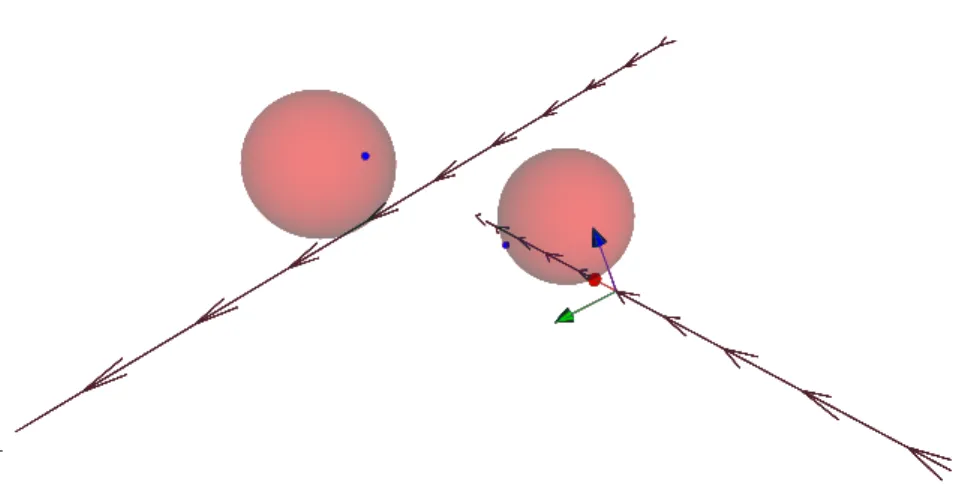
In the preceding sections, only homogeneous sets of conformal objects have been used in the motor estimation. Based on the ideas of Valkenburg and Dorst [26], this is now extended to motor estimation using heterogeneous sets of conformal objects that have all been transformed by the same motor, as shown in Fig.1 for a point, a line and a sphere.
Figure 1. Aline, apoint and aspherebefore and after the
In our formulation, this is done with the optimization problem min M∈M 1 2 N1 i=1 w1i PR1 3(M piM)−PR13(qi) 2 +1 2 N2 j=1 w2j M Λ2jM−Λ1j 2 +1 2 N3 k=1 w3k (dk+ (1−cos(θ/2))k)2, (3.18)
where N1 are the number of point correspondences, N2 are the number
of line correspondences, N3 are the number of plane correspondences and
w1i, w2j, w3k ∈R are weights to adjust the contributions from the different
cost functions to the overall solution based on, e.g., the reliability of the data [26].
This formulation can be used to estimate motors from more complex geometric objects as point pairs, circles and tangent vectors. For circles, this can be performed by using the center point and the carrier plane where the center points c ∈ R14,1 is extracted using c =C/(−n∞·C) and the carrier
dual plane is found byπ= (C∧n∞)∗. This can similarly be done for tangent
vectors by using the origins of the transformed tangent vectors and the carrier lines. Point pairs can be used by either splitting them into the constituent points or by creating the carrier line.
3.5. Convexity
The convexity of motor estimation using non-linear optimization has not been thoroughly investigated in the context of geometric algebra. However, motor estimation is closely related to estimation and control inSE(3), where the analysis can be separated into convergence of translation, and convergence in rotation as given in SO(3). It is known that if deviations in SO(3) are described by the angleθand plane of rotationB, or with associated metrics like 1−η or 1−η2 where η = cos(φ/2), the convergence to zero deviation can be achieved for all initial conditions except for initial conditions where the solution can get stuck at|θ|=π, see [8,28].
The cost functions that we use in the present paper are based on the angle-plane description (2.2) for the deviation in rotation. This is even the case for the cost function in (3.5), which is seen by applying the angle-plane form of the rotor. The step in the Levenberg–Marquart for iteration k is calculated in the tangent space atMk based on the deviation in translation and the deviation in rotation, which is given in terms of the geodesic metric and the plane of rotation in the same tangent space. The update is done with the exponential map and results in a new motorMk+1. In this optimization
process the incremental convergence properties at each step will be similar to stability properties in the control problem onSE(3). This indicates that the optimization problem will be convex except in the case that the solution gets stuck at|θ|=π, which will not be encountered in practice. This agrees with
the extensive numerical testing that was performed on the method proposed in this paper, with initial angular deviations up to ¯θ0=π.
4. Experimental Results
This section presents experimental results on motor estimation using sets of heterogeneous conformal objects. The experiments were implemented using our framework GAME [23] for multivector estimation, which was presented in [24]. The GAME framework is written in C++ and Python, and is based on the Ceres [20] non-linear optimization framework of Google, and the Versor [4] geometric algebra library of Pablo Colapinto.
We employ the Levenberg–Marquardt (LM) [16] method, where the Jacobian matrices are computed using forward mode automatic differen-tiation based on dual numbers [3,13]. Automatic differentiation computes derivatives with machine precision and works by exploiting the fact that all computer implementations of mathematical functions are composed of a set simple differentiable unary or binary operations. Derivatives of more com-plex functions are computed by applying the chain rule at each operation and bookkeeping the results [22]. The Jacobian matrices used in this work are of sizeN×6, whereN is the number of residuals and 6 is the dimension of the tangent space of the motor manifoldMat the motorM.
In the following, the ground truth set of homogeneous conformal objects
{Xi}, X ∈ R4,1, i∈ {1, . . . , N} are transformed by the motor M to form
the set{Xi}where Xi =M XiM. The motorM which is to be estimated is generated by a rotation ofπ/3 around thee2 axis followed by a translation of 1 unit along thee1, e2 and e3 axes resulting in a motor M = T R with
coefficient vector
xM ≈(0.87,0,−0.5,0,−0.68,−0.43,−0.18,−0.25). (4.1) No noise was added in the experiments and the initial motorM0= 1 was used in all experiments, if not explicitly stated otherwise. The performance of the different cost functions were evaluated by comparing the coefficients of the estimated motor with the ground truth motor. Two motors are considered to be equal if their coefficient vectors are equal within some tolerance. Given the coefficient vectors a,b∈R8, coefficient i ofbis considered to be equal to coefficientiofaif the following equation holds
|ai−bi| ≤α+β|bi|, (4.2) where α, β ∈ R. In the following experiments we consider two coefficient vectors to be equal if (4.2) holds for
α= 1×10⁻⁸ and β= 1×10⁻⁵. (4.3) The termination criterion of the LM solver is that the relative function tol-eranceF satisfiesF ≤1×10⁻⁶, or that the relative parameter tolerancex
4.1. Motor Estimation from 3D Point Correspondences
In [24], we presented motor estimation from sets of noisy point correspon-dences. Using the LM method we were able to estimate the motor that trans-formed one set of conformal points to the other set using 1,00,000 observations with a computation time of 0.5040 s.
With no noise added, our method was able to estimate the correct motor from 10 points in 4 iterations within tolerancesα= 1×10⁻⁹andβ= 1×10⁻⁵. 4.2. Motor Estimation from 3D Line Correspondences
Motor estimation using 10 3D line correspondences with three different cost functions was performed. The results are shown in Fig.2. The cost function in (3.8) with 6 residuals converged in 4 iterations and terminated due to the parameter tolerance x, while the cost function in (3.13) with 4 residuals
per observation converged in 7 iterations, with termination due to F. A version of (3.13) using the norm of the common normal between the line correspondences and thus 2 residuals per observation performed slightly worse and converged in 15 iterations, with termination due toF. The optimization problems based on (3.13) converged quickly during the first iteration while it converged slowly close to the solution, that is, when the distance and angle
100 101 102 4-residuals 0 1 2 3 4 5 6 7 Iterationk 10−15 10−13 10−11 10−9 10−7 10−5 10−3 10−1 101 6-residuals C o st
Figure 2. Convergence of the cost function for motor
esti-mation using 3D line correspondences with two different cost functions. The cost function in (3.8) with 6 residuals per observation converged in 4 iterations and terminated due to the parameter tolerancex, while the cost function in (3.13) with 4 residuals per observation converged in 7 iterations, with termination due to the function tolerance F
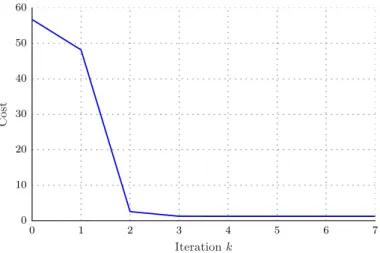
0 1 2 3 4 5 6 7 Iterationk 0 10 20 30 40 50 60 Cost
Figure 3. Convergence of the cost function for motor
esti-mation using 3D plane correspondences. The cost function in (3.17) with 2 residuals per observation converged in 7 itera-tions
between the lines are small. The best cost function was the cost function in (3.8) employing 6 residuals per observation. This gave the smallest number of iterations, and it was the only cost function that was able to satisfy the tolerances in (4.3). The two other cost functions were only able to satisfy the condition in (4.2) withα= 1×10⁻³. By decomposing the estimated motor, we found that there were errors in both the translational and rotational components with an angle error θ ≈ 3×10⁻⁴ rad and distance error d ≈
1.4×10⁻⁴ m.
4.3. Motor Estimation from 3D Plane Correspondences
Motor estimation using 10 plane correspondences was performed and the results are shown in Fig. 3. Optimization with the cost function in (3.17) with 2 residuals per observation converged in 7 iterations and satisfied the condition in (4.2) with α = 1×10⁻³ and β = 1×10⁻⁵. The LM solver terminated due to the function toleranceF.
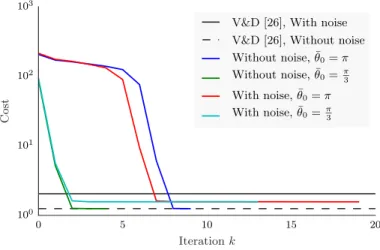
4.4. Motor Estimation from Sets of Heterogeneous Conformal Objects Motor estimation with the cost function in (3.18) using points, lines and planes gave the results shown in Fig.4. Without noise, when all objects were transformed by the same motor, we were able to estimate the motor with
α= 1×10⁻⁵ in 4 iterations with an initial angular error of ¯θ0 = π/3. In
addition, our method was able to estimate the motor with the same precision with an initial angular error of ¯θ0 = π, demonstrating the robustness of
our proposed method. Using the same initial motors and with noise, the optimization converged in 13 and 19 iterations. The noise was applied to the sets {Xi} by applying a motor with a small translation and rotation. Different noise motors were applied to different sets, that is, the point set were
0 5 10 15 20 Iterationk 100 101 102 103 Cost
V&D [26], With noise V&D [26], Without noise Without noise, ¯θ0=π Without noise, ¯θ0=π3 With noise, ¯θ0=π With noise, ¯θ0= π3
Figure 4. Convergence of the cost function for motor
esti-mation using sets of heterogeneous conformal objects – points, lines and planes. Without noise, the motor was esti-mated with α = 1×10⁻⁵ in 4 iterations with an initial angular error of ¯θ0 = π/3, and in 9 iteration with ¯θ0 =π.
With noise, the initial convergence is comparable, but due to noise the optimization terminated after 13 and 19 iterations. Comparison with the method of Valkenburg and Dorst [26] shows that our method converged with the same accuracy in the noise free case and with improved accuracy when there was noise
transformed by another noise motor than the set of lines and planes. In these experiments, the weights w1i = w2j = w3k = 1, in (3.18), were used. Our
method performs equally well as the method by Valkenburg and Dorst [26] when no noise is present. When noise is present our method performs slightly better.
5. Conclusion
In this paper we have presented a novel method for non-linear rigid body motion estimation using point, line and plane correspondences where the rigid body motions were represented using motors in the conformal model of geometric algebra. The presented method makes is possible to estimate motors using both homogeneous and mixed or heterogeneous sets of objects, that is, using observations of points, lines and planes all transformed by the same motor. In addition, these formulations can be used to estimate con-formal motors from correspondences of more complex objects, e.g., spheres, circles and tangent vectors. As opposed to the method of Valkenburg and Dorst [26] our method is able to estimate the translational part of the motor using only lines and planes. This is due to the use of the common normal for line correspondences and the translation in the rotation plane for plane
correspondences. Moreover, our method had slightly better performance than the method of Valkenburg and Dorst in the presence of noise. Our method was very robust in the numerical experiments, and converged consistently with initial angular deviations up toπ.
The Levenberg–Marquardt nonlinear least-squares optimization method was used and Jacobian matrices were computed using automatic differentia-tion based on dual numbers. The presented method ensures that the soludifferentia-tion in each iteration is on the motor manifold by computing the update step in the tangent space and computing the resulting motor using the exponential map.
Open Access. This article is distributed under the terms of the Creative Com-mons Attribution 4.0 International License (http://creativecommons.org/licenses/ by/4.0/), which permits unrestricted use, distribution, and reproduction in any medium, provided you give appropriate credit to the original author(s) and the source, provide a link to the Creative Commons license, and indicate if changes were made.
References
[1] Bartoli, A., Sturm, P.: The 3D line motion matrix and alignment of line recon-structions. Int. J. Comput. Vis.57(3), 159–178 (2004)
[2] Bayro-Corrochano, E., Daniilidis, K., Sommer, G.: Motor algebra for 3D kine-matics: the case of the hand-eye calibration. J. Math. Imaging Vis.13(2), 79– 100 (2000)
[3] Clifford, W.K.: Preliminary Sketch of Biquaternions. Proc. Lond. Math. Soc.4, 361–395 (1873)
[4] Colapinto, P: (2011) Versor: spatial computing with conformal geometric alge-bra. Master’s thesis, University of California at Santa Barbara. Available at:
http://versor.mat.ucsb.edu
[5] Daniilidis, K.: Hand-eye calibration using dual quaternions. Int. J. Robot. Res.18(3), 286–298 (1999)
[6] Dorst, L.: The representation of rigid body motions in the conformal model of geometric algebra. In: Rosenhahn, B., Klette, R., Metaxas, D. (eds) Human motion: understanding, modelling, capture, and animation, vol. 36 of Compu-tational Imaging and Vision, pp. 507–529. Springer, Netherlands (2008) [7] Dorst, L., Fontijne, D., Mann, S.: Geometric algebra for computer science: an
object-oriented approach to geometry. Morgan Kaufmann Publishers Inc., San Francisco (2007)
[8] Egeland, O., Dalsmo, M., Sørdalen, O.J.: Feedback control of a nonholonomic underwater vehicle with a constant desired configuration. Int. J. Rob. Res. 15(1), 24–35 (1996)
[9] Gebken, C., Perwass, C., Sommer, G.: Parameter estimation from uncer-tain data in geometric algebra. Adv. Appl. Clifford Algebras. 18(3-4), 647– 664 (2008)
[10] Hairer, E., Lubich, C., Wanner, G.: Geometric numerical integration : structure-preserving algorithms for ordinary differential equations. Springer series in computational mathematics. Springer, Berlin (2006)
[11] Hestenes, D.: New foundations for classical mechanics, vol. 15 of fundamental theories of physics. Springer, Netherlands (1986)
[12] Hestenes, D., Sobczyk, G.: Clifford algebra to geometric calculus– a unified language for mathematics and physics, vol. 5 of fundamental theories of physics. Springer, Netherlands (1984)
[13] Hoffmann, P.H.W.: A Hitchhiker’s guide to automatic differentiation. Num. Algorithms 1–37 (2015)
[14] Lasenby, J., Fitzgerald, W.J., Lasenby, A.N., Doran, C.J.L.: New geometric methods for computer vision: an application to structure and motion estima-tion. Int. J. Comput. Vis.26(3), 191–213 (1998)
[15] Li, H., Hestenes, D., Rockwood, A.,: Generalized Homogeneous Coordinates for Computational Geometry. In: Sommer, G. (ed) Geometric computing with Clifford Algebras, pp. 27–59. Springer, Berlin (2001)
[16] Nocedal, J., Wright, S.J,: Numerical optimization. 2 edition, Springer, New York, (2006)
[17] Perwass, C.: Applications of geometric algebra in computer vision—the geom-etry of multiple view tensors and 3d-reconstruction. PhD thesis, University of Cambridge (2000)
[18] Rivera-Rovelo, J., Herold-Garc´ıa, S., Bayro-Corrochano, E.: Geometric hand-eye calibration for an endoscopic neurosurgery system. In: ICRA, pp. 1418– 1423. IEEE (2008)
[19] Rosenhahn, B., Sommer, G.: Pose estimation in conformal geometric alge-bra part I: the stratification of mathematical spaces. J. Math. Imaging Vis.22(1), 27–48 (2005)
[20] Sameer, A., Keir, M., et al.: Ceres solver.http://ceres-solver.org
[21] Sarkis, M., Diepold, K.: Camera-pose estimation via projective newton opti-mization on the manifold. IEEE Trans. Image Process.,21(4), 1729–1741 (2012) [22] Sommer, H., Pradalier, C., Furgale, P.: Automatic differentiation on differen-tiable manifolds as a tool for robotics. In: Int. Symp. on Robotics Research (ISRR) (2013)
[23] Tingelstad, L.: GAME—Geometric Algebra Multivector Estimation. Available at:http://github.com/tingelst/game/(2016)
[24] Tingelstad, L., Egeland, O.: Automatic multivector differentiation and opti-mization. Submitted to Advances in Applied Clifford Algebras. Available at:
http://folk.ntnu.no/tingelst/2016 aaca tingelstad egeland.pdf(2016)
[25] Valkenburg, R., Alwesh, N.: Calibration of target positions using conformal geometric algebra. In: Dorst, L., Lasenby, J., (eds.) Guide to geometric algebra in practice, pp. 127–148. Springer, London (2011)
[26] Valkenburg, R., Dorst, L.: Estimating motors from a variety of geometric data in 3D conformal geometric algebra. In: Dorst, L., Lasenby, J., (eds.) Guide to geometric algebra in practice, pp. 25–45. Springer, London (2011)
[27] Wareham, R., Cameron, J., Lasenby, J.: Applications of conformal geometric algebra in computer vision and graphics. In: Li, H., Olver, P.J., Sommer, G. (eds.) Computer algebra and geometric algebra with applications, pp. 329–349. Springer, Berlin (2005)
[28] Wen, J.T.Y., Kreutz-Delgado, K.: The attitude control problem. IEEE Trans. Autom. Control,36(10), 1148–1162 (1991)
Lars Tingelstad, Olav Egeland
Department of Production and Quality Engineering Faculty of Engineering Science and Technology
NTNU, Norwegian University of Science and Technology Trondheim, Norway e-mail:[email protected] Olav Egeland e-mail:[email protected] Received: February 21, 2016. Accepted: May 30, 2016.