19
Forecasting Bill for Cloud Consumers Based on
Previous Resource Usage
Aditi A Irkal, Manoj L Bangare
Information Technology, Shri Kashibai Navale College of Engineering, Pune Email: [email protected] , [email protected]
Abstract- Cloud computing is a type of computing where resources are shared over internet, rather than having
local servers and disks for handling the application. The cloud resources can be hired on demand as per the requirement. Cloud provides pay-as-you-go service, i.e. computing users pay for the resources and the workload they use. Many companies are making use of cloud for processing there data and hence cloud is gaining more popularity in the market.
As the consumers are utilizing many resources in their organization, budget becomes an important factor to control the cost that has to be paid by the organization to the cloud vendors. Most of the users are unaware of the current usage and thus cannot forecast on the next required usage. This is the reason where most of the users fail to plan for the resource utilization and thus budget fires.
In many cases, the consumers are layman who are non expert users , and do not have much knowledge of finding the suitable cloud providers, who are best matching their requirements. This is another reason that is affecting the budget of the organization. For these two reasons, we proposed a system that the accountability of the consumer bills and forecasts on the upcoming bills of the consumer based on the previous usage of the resources. It not only forecasts the bills but also compares the resources that are used by the consumer with other cloud vendors and provides the price.
The proposed system helps to keep the accountability of the resources, forecast the budget and search the suitable cloud providers for cost effective management of the budget.
Index Terms- Bill Accountability, Cloud Resource Prediction, Forecasting cloud resource, Resource Usage,
Cloud Vendor Comparison.
1. INTRODUCTION
Cloud computing environment is a complex system and consists of large number of resources. The resources are available based on two criteria: resources on-demand and pay-per-use. This is why many of the people are trying to make use of cloud computing environment for their businesses and provide easy and effective solutions for their customers.
Many large companies occupy different type of resources. Keeping the accountability of these resources becomes a critical task for the consumer. It is also important that the user must be aware of which resource’s usage is more and required mostly in the future,
For this above issues, we designed a system called “Forecasting Bill for Cloud Consumers”. There are two major modules in the system. One is Bill accountability and the second checks for the resource comparison. The first module keeps the accountability of the resource’s usage and forecasts the upcoming bills based on the number of days or months. It also checks for the budget based on the threshold bill. If the bill for the current month resource usage reaches its maximum threshold value, it indicates the customer for the same.
The second module check for the most frequently used resources by the user and maps with other cloud vendors and provides the comparison of the resources between the vendors and also provides the price of the resources. This helps the consumers to check the same resources with better suitable price, which also plays an important role to control the budget.
Both these modules are helpful in controlling the resource usage accountability, and also find cloud vendors in the market with different schemes, finding the appropriate one suitable to the requirement. The overall system is focused on the resource usage accountability and comparison.
2. BACKGROUND
20
2.1.Weak and Strong Accounting Model
In this model, the author speaks about the strong and weak accounting models[1]. Using this models, consumers can get a clear idea of the discrepancies in the bill. The author explains that a weak entity model is a model where the accountability is done at the vendor side and not by the client side just like the traditional system of electricity bills, water bills etc, where consumer has no other option else than paying the bill provided to them. In strong accounting model, the metering data that has to be calculated is collected independently by the consumer or some trusted third resources. The mechanism is introduced by author [4], is based on reverse auction. The mechanism allows user to select the appropriate cloud vendors and decide price dynamically.
Another approach that can be used for dynamic pricing is using game theory [5]. Using the game theory author tries to solve the problem between the competition of providers and propose dynamic pricing. This is done by Markov Decision Process that produces Markov Perfect Equilibrium.
In [7], Author speaks about different pricing models and new pricing policies for federated cloud. The two pricing models are – fixed and dynamic models, where fixed pricing model fixes the 0070rices for a particular time horizon and where as dynamic pricing scheme allows to charge consumer with different prices for the same product depending on the characteristics of transaction. The pricing policies that the author introduces are On-demand (OD), Spot (S), and Reserved(R).
2.3.Discovering Resources & Agent based modeling
In [2], Author speaks about Cloud service composition, which includes several tasks such as
discovering, compatibility checking, selection and deployment. Most of them find it difficult to select the best one among the hundreds of possible compositions available. Author includes several algorithms for the selection of the required resources, helps to non-expert users with limited or no knowledge to deploy their services faultlessly. Can only perform well when the number of given alternatives is given small and the number of objectives is limited.
Cloud pricing has attracted many researcher attentions. Existing papers discuss how the optimal pricing can be obtained with revenue gain to the bolstering the cloud service discovery, service negotiation and service composition. The advantage of using this is Software tools and testbeds are used for managing cloud resources, Complex cloud negotiation mechanism was deviced to support cloud commerce and a multicriteria search engine that accepts as its inputs functional, technical, and budgetary requirements from consumers.
3. Forecasting Resource Usage
Cloud pricing has become an important topic in research and bringing improvement in it, is a challenge. From the above survey, we have gone through different approaches for cloud accountability and comparison and resource hiring techniques. All these techniques are dealing with one particular issue is resource usage and consumptions only.
21 The cloud consumer has to first register to the system.
For registration the customer has to provide their cloud registered credentials for accessing their bills
from the cloud. On successful registration when user logs in to the system, the system automatically syncs to the customer’s cloud, and fetches the recent bills from the cloud vendor.
3.1 Bill Analysis Module
This module is used to perform bill analytics in which the current bill and previous bill are fetched and the data is refined. This module also performs prediction of the resources. Prediction of the resources is performed based on the previous usage data of the resources and bills. In this module the bill prediction is based on number of days, months and years as per the user requirement. Track Threshold is another module that keeps tracking the resource usage bill, and if the bill of the current month reaches the threshold it indicates it to the customer for the same.
3.2 Comparator
In this module, the current resources that are used by the customers, are fetched and it matches with other provider’s resources and
provides the price for the same. Thus, compares the best schemes with other vendor. For simplicity, we have used only
one cloud vendor in the system for comparison.
4. Algorithm: Resource Bill Forecasting (RBF)
The algorithm performs calculation of the bill from the previous bills for forecasting. Forecasting is done based on number of days, months and years. User can now predict their bill based on their plans and forecast the budget.
RBF Algorithm
Input: Present and past Resource Bill Data Output: Future Resource Bill Amount (FRBA)
RUB: Resource Usage Bill, UP: Usage Prediction, RR: Resource Rate, FB: Forecast Bill, RUA: Required Usage Analysis, CB: Current Bill, TFB: Total Forecast Bill
22 RUA do UsageAnalysis(RUB)
UP predictUsageRequirement(RUA) FB CalculateForecastBillPerMonth(UP) end foreach month data is analyzed and the required data is fetched from the bills. Then the prediction calculation is done on every month usage. These are then combined and calculated for the next forecast bill. Each resource rates are then multiplied with the usage and the sum of all these is the Total Forecast Bill.
5. Mathematical Model
In this system, we have used Exponential Smoothing forecast technique. In exponential smoothing, for making some determination the prior assumptions by the user are used. This technique is considered as more superior than the other forecasting techniques because it places more weight on the recent observations and is slightly more responsive to changes occurring in the recent past.
Let,
sd StartDate, ed EndDate,
PDU Per Day Usage, PHU Per Hour Usage FUR Forecasted Usage per Resource, TCD Total Cost per Day,
As the cloud provides bill on hourly basis, the usage for per day PDU is calculated by summing the usage per hour equation (1). By using per day usage, the exponential smoothing technique is now applied on the per day usage for previous six months data as shown in equation (2) per resource type. The resource rates are then applied to each predicted cost shown in (3). Based on the per day consumption of each resource the forecasting is calculated for number of months and years, equation (4) & (5).
6. Results
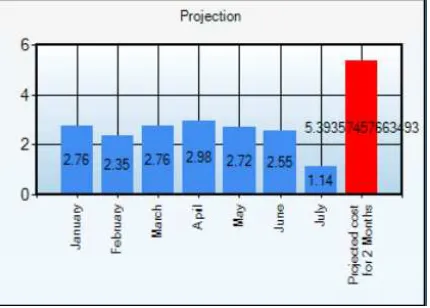
Fig 2: Projected bill for 2months.
The above figure shows the forecasted bill for two months calculated by using the previous bill records. The graph y-axis shows the amount that is billed and the x-axis shows the month.
7. Conclusion
The cloud allows users to “pay-as-you-use” strategy. The survey provides different ways of pricing and comparison methods of cloud resources. By using the proposed system, users can predict their bill and know their budget in advance. The system also provides the resource costs from different providers, according to their requirements. Thus, the users can now check their bills, predict the bills and compare the rates of different providers cloud resources in single platform that helps a layman to find the requirements easily and efficiently, and within their budget.
8. Future Scope
23
Acknowledgments
This work is dedicated for completion of master of Engineering in Information Technology from “Smt. Kashibai Navale College of Engineering, Pune.” In association with “Cloudability Pvt Ltd.”
REFERENCES
[1] Ahmed Mihoob, Carlos Molina-Jimenez and Santosh Shrivastava (2013) Consumer-centric resource accounting in the cloud, Mihoob et al. Journal of Internet Services and Applications 2013, 4:8 2013 Mihoob et al; licensee Springer.(Base Paper)
[2] Amir Vahid Dastjerdi, Member, IEEE and Rajkumar Buyya, Senior Member, IEEE (2014) Compatibility-Aware Cloud Service Composition under Fuzzy Preferences of Users IEEE TRANSACTIONS ON CLOUD COMPUTING, VOL. 2, NO. 1, JANUARY-MARCH 2014
[3] Yuan Feng, Member, IEEE, Baochun Li, Senior Member, IEEE, and Bo Li, Fellow, IEEE(2014) Price Competition in an Oligopoly Market with Multiple IaaS Cloud Providers IEEE TRANSACTIONS ON COMPUTERS, VOL. 63, NO. 1, JANUARY 2014
[4] Abhinandan S. Prasad Member IEEE, Shirsha Rao, Senior Member IEEE,A Mechanism Design Approach to Resource Procurement in Cloud Computing IEEE Transactions on Computer, VOL 63, NO. 1, JANUARY 2014.
[5] Tram Truong-Huu, Member IEEE, Chen-Khong Tham, Member IEEE, A Novel Model for Competition and Cooperation among Cloud Providers, IEEE Transaction on Cloud Computing, VOL 2, NO. 3, JULY-SEPTEMBER 2014.
[6] Kwang Mong Sim, Senior Member, IEEE (2012) Agent-Based Cloud Computing IEEE
TRANSACTIONS ON SERVICES
COMPUTING, VOL. 5, NO. 4, OCTOBER-DECEMBER 2012