The Role of Limitations and SLAs in the API Industry
Antonio Gamez-Diaz
Universidad de Sevilla Seville, Spain [email protected]Pablo Fernandez
Universidad de Sevilla Seville, Spain [email protected]Antonio Ruiz-Cortés
Universidad de Sevilla Seville, Spain [email protected]Pedro J. Molina
Metadev Seville, Spain [email protected]Nikhil Kolekar
PayPalSan Jose, California, USA [email protected]
Prithpal Bhogill
GoogleMountain View, California, USA [email protected]
Madhurranjan Mohaan
Mountain View, California, USA [email protected]
Francisco Méndez
AsyncAPI Initiative Barcelona, Spain [email protected]ABSTRACT
As software architecture design is evolving to a microservice para-digm, RESTful APIs are being established as the preferred choice to build applications. In such a scenario, there is a shift towards a growing market of APIs where providers ofer diferent service levels with tailored limitations typically based on the cost.
In this context, while there are well established standards to describe the functional elements of APIs (such as the OpenAPI Speciication), having a standard model for Service Level Agree-ments (SLAs) for APIs may boost an open ecosystem of tools that would represent an improvement for the industry by automating certain tasks during the development such as: SLA-aware scafold-ing, SLA-aware testscafold-ing, or SLA-aware requesters.
Unfortunately, despite there have been several proposals to de-scribe SLAs for software in general and web services in particular during the past decades, there is an actual lack of a widely used standard due to the complex landscape of concepts surrounding the notion of SLAs and the multiple perspectives that can be addressed. In this paper, we aim to analyze the landscape for SLAs for APIs in two diferent directions: i) Clarifying the SLA-driven API development lifecycle: its activities and participants; 2) Developing a catalog of relevant concepts and an ulterior prioritization based on diferent perspectives from both Industry and Academia. As a main result, we present a scored list of concepts that paves the way to establish a concrete road-map for a standard industry-aligned speciication to describe SLAs in APIs.
CCS CONCEPTS
·Information systems→RESTful web services; ·Software and its engineering→Extra-functional properties;System description languages.
ESEC/FSE ’19, August 26ś30, 2019, Tallinn, Estonia © 2019 Association for Computing Machinery.
This is the author’s version of the work. It is posted here for your personal use. Not for redistribution. The deinitive Version of Record was published inProceedings of the 27th ACM Joint European Software Engineering Conference and Symposium on the Foundations of Software Engineering (ESEC/FSE ’19), August 26ś30, 2019, Tallinn, Estonia, https://doi.org/10.1145/3338906.3340445.
KEYWORDS
RESTful APIs, SLA, OpenAPI Speciication, SLA-driven APIs, API Gateways
ACM Reference Format:
Antonio Gamez-Diaz, Pablo Fernandez, Antonio Ruiz-Cortés, Pedro J. Molina, Nikhil Kolekar, Prithpal Bhogill, Madhurranjan Mohaan, and Francisco Méndez. 2019. The Role of Limitations and SLAs in the API Industry. In
Proceedings of the 27th ACM Joint European Software Engineering Conference and Symposium on the Foundations of Software Engineering (ESEC/FSE ’19), August 26ś30, 2019, Tallinn, Estonia.ACM, New York, NY, USA,9pages. https://doi.org/10.1145/3338906.3340445
1
INTRODUCTION
In the last decade, RESTful APIs are becoming a clear trend as composable elements that can be used to build and integrate soft-ware [6,12]. One of the key beneits this paradigm ofers is a sys-tematic approach to information modeling leveraged by a growing set of standardized tooling stack. In this context, the term ofAPI Economyis being increasingly used to describe the movement of the industries to share their internal business assets as APIs [22] not only across internal organizational units but also to external third parties; in doing so, this trend has the potential of unlocking additional business value through the creation of new assets [4]. In fact, we can ind a number of examples in the industry that are deployed solely as APIs (such as Meaningcloud1, Flightstats2or Twilio3).
In order to be competitive in this such a growing market of APIs, at least two key aspects can be identiied: i)ease of usefor its po-tential developers; ii) a lexible usageplanthat its their customer’s demands.
Regarding theease of useperspective, third-party developers need to understand how to use the exposed APIs so it becomes necessary to provide good training material but, unfortunately, sev-eral API providers do not often write good documentation of their products [7]. Notwithstanding, during the last years, theOpenAPI 1https://www.meaningcloud.com/products/pricing
2https://developer.lightstats.com/getting-started/pricing 3https://www.twilio.com/sms/pricing
Speciication4(OAS), formerly known asSwaggerspeciication, has become thede factostandard to describe RESTful APIs from a func-tional perspective providing an ecosystem that helps the developer in several aspects of the API development lifecycle5.
The beneits are twofold: from the API provider’s perspective, there are tools aimed to automate the server scafolding, an inter-active documentation portal creation or the generation of unit test cases; from API consumer’s perspective, there are tools to auto-mate the creation of API clients, the security coniguration or the endpoints discovery and usage [1,19,21].
Concerning the usageplansperspective, as APIs are deployed and used in real settings, the need for non-functional aspects is becoming crucial. In particular, the adoption of Service Level Agree-ments (SLAs) [17] could be highly valuable to address signiicant challenges that industry is facing, as they provide an explicit place-holder to state the guarantees and limitations that a provider ofers to its consumers. Exemplary, these limitations (such asquotasor
rates) are present in most common industrial APIs [8] and both API providers and consumers need to handle how they monitor, enforce or respect them with the consequent impact in the API deployment/consumption.
However, to the best of our knowledge, there is no widely ac-cepted model to describe usage plans including elements such as cost, functionality restrictions or limits. In this context, a new type of infrastructure, coined as API Gateway [10], has emerged to sup-port API developers in the management of multiple non-functional aspects such as consumer authentication, request throttling or billing. From a deployment perspective, API Gateways are usu-ally implemented as virtual appliances, virtual machine images or reverse proxies that promote a decoupling from the main API artifact. In contrast, the vendor-speciic approach to non-functional concerns typically represents a strong dependence with the API Gateway provider.
In this paper, we aim to analyze the landscape in the SLA and lim-itations for APIs directly from those participants who have shown interest on participating in the deinition of an industrial standard for SLAs in APIs. Speciically, we have started up conversations with members of the OpenAPI Initiative who belong to the SLA interest group aiming to gather information about their industrial perspective of the role of SLAs and limitations in the APIs.
The rest of the paper is structured as follows: in Section2we introduce, briely, the idea of Service Level Agreements (SLA) and its importance in the API ecosystem. Next, in Section3, we describe the related work. Continuing, in Section4we describe the SLA-driven API lifecycle. Further, in Section5we present the industrial insights from diferent participants. Finally, in Section6, we show some inal remarks and conclusions.
2
SLAS IN A NUTSHELL
Service Level Agreements (SLAs) consist of a set of terms that include information about functional features, non-functional guar-antees, compensation, termination terms and any other terms with relevant information to the agreement. An agreement signed by
4The latest version of the OpenAPI Speciication is available athttps://github.com/
OAI/OpenAPI-Speciication
5https://openapi.tools
all interested parties should be redacted carefully because a fail-ure to specify their terms could carry penalties to the initiating or responding party. Therefore, agreement terms should be spec-iied in a consistent way, avoiding contradictions between them. However, depending on the complexity of the agreement, this may become a challenging task. SLAs can, therefore, be used to describe the rights and obligations of parties involved in the transactions (typically the service consumer and the service provider); among other information, SLA could deine guarantees associated with the idea of Service Level Objectives (SLOs) that normally represent key performance indicators of either the consumer or the provider. In case the guarantee is under-fulilled or over-fulilled SLAs could also deine some compensations (i.e. penalties or rewards). In such a context, during the last years, there have been important steps towards the automation of the management of SLAs, however, the formalization in SLAs still remains an important challenge.
ASLAtypically contains these concepts:
Nameidentiies the agreement and can be used for reference.
Context includes information such as the name of the parties and their roles as initiator or responder in the agreement. Additionally, it can include other important information for the agreement.
Terms the two main types of terms are:
Service termsthey provide service information by means of:
Service description terms which includes information to instantiate or identify the services and operations involved in the agreement.
Service properties which includes the measurable prop-erties that are used in expressing guarantee terms. They consist of a set of variables whose values can be estab-lished inside the service description term. These terms play an key role in the deinition of the service level which is actually ofered to clients and the price they pay for. For instance, in APIs, it is common to see quota (e.g., 30K request/month) and rate (e.g., 1 request/second) limitations that deine the service.
Guarantee termsthey describe the service level objectives (SLOs) agreed by a speciic obligated party, using Service Level Indicators (SLIs), a set of carefully deined quantita-tive measures of some aspect of the level of service that is provided. It also includes the scope of the term (e.g. if it applies to a certain operation of a service or the whole service itself) and a qualifying condition that speciies the validity condition under which the term is applied. Guarantee terms often include compensations [17], that is, penalties (or rewards) applied when the SLO is unfulilled or overfulilled.
The concept of SLA is, very frequently, misunderstood: some services claim to have an SLA when they are only deining the service description terms (e.g., limitations). SLAs are agreements, that is, an explicit or implicit contract with your users that includes consequences of the meeting (or missing) the SLOs they contain [3,
20]. In many services, including APIs, there is no SLA: if nothing happens if the SLOs are not being met, it is not an SLA, but a mere description of SLOs and service properties.
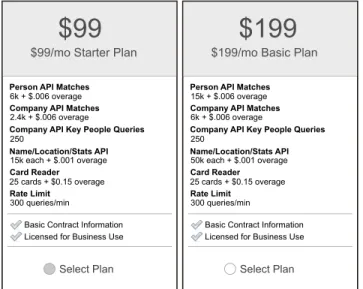
In the industry, the way in which a customer can select and purchase a certain service level is by using pricing plans. In Figure1
it is depicted a real plan extracted fromFullContact6, a product which includes an API for managing and organizing contacts in a collaborative way and it also matches emails addresses looking for publicly available information on the Internet to enrich the proiles.
Person API Matches Company API Matches Company API Key People Queries Name/Location/Stats API Card Reader Rate Limit 6k + $.006 overage 2.4k + $.006 overage 250 15k each + $.001 overage 25 cards + $0.15 overage 300 queries/min
Basic Contract Information Licensed for Business Use
Select Plan
$99
$99/mo Starter PlanPerson API Matches Company API Matches Company API Key People Queries Name/Location/Stats API Card Reader Rate Limit 15k + $.006 overage 6k + $.006 overage 250 50k each + $.001 overage 25 cards + $0.15 overage 300 queries/min
Basic Contract Information Licensed for Business Use
Select Plan
$199
$199/mo Basic PlanFigure 1: Example of an API plan
This example is composed of two paid plans having a ixed price that is monthly billed. Regarding thelimitations, for each resource, aquotais being applied; for instance, in thestarterplan, only 6000 matches over Person are available. Nevertheless, an overage is deined, that is, it is possible to overcome the limit by paying a certain amount of money; in this case, $0.006 per each request. Regardless of the accessed resources, a commonrateof 300 queries per minute is being applied.
In this example, there is neither guarantee term nor SLOs. All these elements belong to the set of service properties, particularly, the limitations, which are, actually, deining the service level (e.g.,
free,starterorbasic)
3
RELATED WORK
The software industry has embraced integration as a key challenge that should be addressed in multiple scenarios. In such a context, the proliferation of APIs is a reality that has been formally analyzed: in [18], authors performed an analysis of more than 500 publicly-available APIs to identify the diferent trends in current industrial landscape with the following key results: in terms of paradigm they conclude that 500 out of 522 analyzed APIs provide an API based on REST; regarding theformat, the authors identiied that nearly two thirds of the APIs support JSON without supporting XML. Concern-ing theaccess control, authors showed that most APIs require some form of service registration for developers to start using the API. Regarding thedocumentation, they showed that generated docu-mentation is being used in about a half of the APIs, with documents
6https://www.fullcontact.com/developer
Table 1: Analysis of SLA Models
Name F1 F2 F3 F4 F5 F6 F7 SLAC[24] DSL ✓ ✓ CSLA[14] XML ✓ ✓ L-USDL Ag.[11] RDF ✓ ✓ ✝ ✓ rSLA[23] Ruby ✓ ✓ ✓ ✓ SLAng[15] XML ✓ WSLA[16] XML ✓ ✓ ✓ SLA*[13] XML ✓ ✓ ✓ WS-Ag.[2] XML ✓ ✓ ✓ ✝
✝Supported with minor enhancements or modiications.
generated by SwaggerUI (from an OpenAPI Speciication) taking the lead, suggesting some tendency to make the API documentation machine-readable and understandable as well. Speciically, from a functional point of view, there is a clear trend with respect to the functional description of the service: during the last years, the OpenAPI Speciication has consolidated as ade-factostandard to deine the diferent functional properties an API provides. One of the reasons behind this success has been a growing ecosystem of tools that leverages from the API development life-cycle based on the information included in OAS: from automated code generators that create an initial scafolding of the API to dynamic documenta-tion portals that allow developers to understand and test the API usage.
In such a consolidated market of APIs, non-functional aspects are also becoming a key element in the current landscape. In [8], authors analyze a set of the 69 real APIs in the industry to charac-terize the variability in its oferings, obtaining a number of valuable conclusions about real-world APIs, such as: (i) Most APIs provide diferent capabilities depending on the tier or plan of the API con-sumer is willing to pay. (ii) Usage limitations are a common aspect all APIs describe in their oferings. (iii) Limitations over API re-quests are the most common including quotas over static periods of times (e.g.,1.000 request each natural day) and rates for dynamic periods of times (3 request per second). (iv) Oferings can include a wide number of metrics over other aspects of the API that can be domain-independent (such as the number of returned results or the size in bytes of the request) or domain-dependent (such as the CPU/RAM consumption during the request processing or the number of diferent resource types). Based on these conclusions, we identify the need for non-functional support in the API devel-opment life-cycle and the high level of expressiveness present in the API oferings.
Furthermore, as monitoring is a key aspect, a number of works have been presented aiming to analyze diferent approaches for runtime monitoring. In [20], authors developed a comparison frame-work for runtime monitoring approaches and validate it by applying it to 32 existing approaches and by comparing 3 selected approaches in the light of diferent monitoring scenarios.
Furthermore, during the last decade, a number of SLA models have been presented. We have analyzed the most prominent aca-demic and industrial proposals aimed to the deinition of SLAs in both traditional web services and cloud scenarios.
Speciically, in Table1, we have considered 7 aspects to analyze in each SLA proposal, namely:F1determines the format in which the document is written syntax;F2shows whether the target domain is web services;F3indicates if it can model more than one ofering (i.e., diferent operations of a web service);F4determines if it allows modeling hierarchical models or overriding properties and metrics;
F5shows whether temporal concerns can be model (e.g., in metrics);
F6indicates if there exists a tool for assisting users to model using this proposal;F7determines if there exists a tool/framework for enacting the SLA.
Based on the comparison of the diferent SLA models (summa-rized in Table1), we highlight the following conclusions: (i) None of the speciications provides any support or alignment with the Ope-nAPI Speciication; (ii) Most of the approaches provide a concrete syntax on XML, RDF (some of them they even lack concrete syntax) and there is no explicit support to YAML or JSON serializations. (iii) An important number of proposals are complete, but others leave some parts open to being implemented by practitioners. (iv) Besides the fact that a number of proposals are aimed to model web services, they are focused on traditional SOAP web services rather than RESTful APIs. In this context, they do not address the modeling standardization of the RESTful approach: i.e., the concept of a resource is well uniied (a URL), and the amount of operations is limited (to the HTTP methods, such as GET, POST, PUT and DELETE). This lack of support of the RESTful modeling prevents the approaches to have a concise and compact binding between functional and non-functional aspects. (v) They do not have enough expressiveness to model limitations such as quotas and rates, for each resource and method and with complete management of tem-porally (static/sliding time windows and periodicity) present in the typical industrial API SLAs. (vi) Most proposals are designed to model a single ofering and they mostly lack support to modeling hierarchical models or overriding properties and metrics (F4); in such a context, they cannot model a set of tiers or plans that yield a complex ofering that maintains the coherence by model and instead they rely on a manual process that is typically error-prone. (vii) inally, the ecosystem of tools proposed in each approach (in the case of its existence) is extremely limited and aimed to be solely as a prototype; moreover, they apparently are not integrated into a developer community nor there is evidence of this usage by practi-tioners in the industry.
4
INTRODUCING SLAS IN THE API
LIFECYCLE
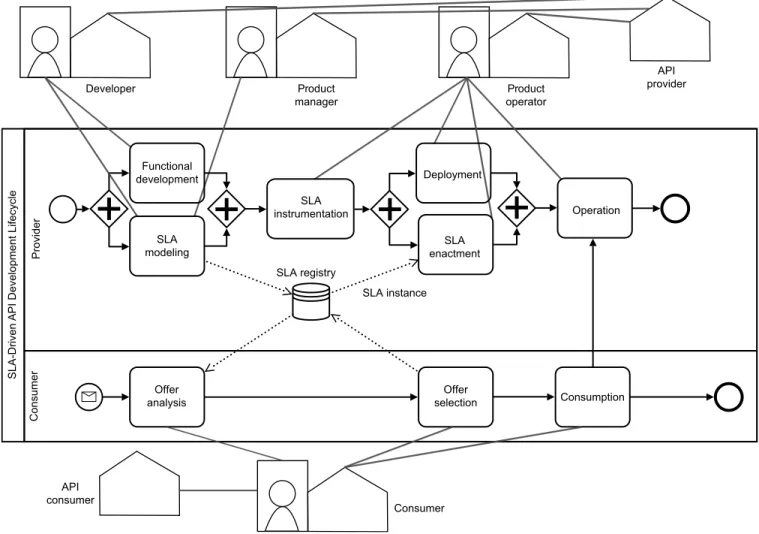
In spite of the fact that each organization could address the API lifecycle with slightly diferent approaches, we identify a minimal set of general stages and activities. The irst activity corresponds with the actualFunctional Developmentof the API implementing and testing the logic; next aDeploymentactivity where the devel-oped artifact is conigured to be executed in a given infrastructure; inally, once the API is up and running, anOperationactivity starts where the requests from consumers can be accepted. This process is a simpliication that can be evolved to add intermediate steps (such as testing) or to include an evolutionary cycle where diferent versions are deployed progressively. In order to incorporate SLAs
in this process, we expand to this basic lifecycle where both API Provider and API Consumer interact (as depicted in Figure2).
Speciically, from the provider’s perspective, theFunctional De-velopmentcan be developed in parallel with aSLA modelingwhere the actual SLA ofering is written and stored in a givenSLA Registry. Once both the functional development and the SLA modeling has concluded, theSLA instrumentationmust be carried out, where the tools and/or developed artifacts are parameterized, so they can adjust their behavior depending on a concrete SLA and provide the appropriate metrics to analyze the SLA status. Next, while the
deploymentof the API takes place, a parallel activity ofSLA enact-mentis developed where the deployment infrastructure should be conigured in order to be able to enforce the SLA before the API reaches theoperationactivity.
Complementary, from consumer’s perspective, once the provider has published the SLA ofering (i.e.,Plans) in theSLA Registry, it starts theofer analysisto select the most appropriate option (ofer selectionactivity) and to create and register its actual SLA; inally, the APIConsumptionis carried out as long as the API is the
Operationactivity and its regulated based on the terms (such as quotas or rates) deined in the SLA.
In order to implement this lifecycle, it is important to highlight that theSLA instrumentation,SLA enactmentandOperation activi-ties should be supported by an SLA enforcement protocol aimed to deine the interactions forcheckingif the consumption of the API for a given consumer is allowed (e.g., it meets the limitations speciied in its SLA) and to gather the actual values of themetrics
from the diferent deployed artifacts that implement the API. From an industrial perspective and regarding the implication across the entire development lifecycle of APIs, diferent roles or stakeholders appear, as discussed below. The mapping role-activity is also depicted in Figure2by using the RALPH notation [5].
Developer This role is composed by the team responsible for the development of a certain API and making it available for other teams. Their use cases are related to the deinition of Service Level Objectives (SLOs) since they are the role most aware of the internal functioning of the API. Namely: •a better understanding of what SLOs can they reasonably
target so that they can ofer an SLO for the API. •a better understanding of the performance of their
down-stream dependencies (e.g., back-ends) so that they can determine their efect on the SLOs.
•a better understanding of the performance of policies in the proxy so that they can determine their efect on the SLOs.
Product manager This role is composed of business people, aligned with the company’s objectives. Their use cases aim to satisfy customer’s needs and be aware of the overall picture of the dependencies between services. Namely, knowing the SLOs of the downstream dependencies so that they can create products which meet the customers’ needs.
Product operator This role is composed of system administration people, who are responsible for monitoring and reporting the service performance in SLOs. Their use cases aim to be notiied of any alert or incident and take remedial actions. Namely:
Developer Product manager Product operator API provider Functional development SLA modeling Operation SLA enactment Deployment SLA registry Offer analysis Offer selection Consumption SLA instance SLA instrumentation Provider SLA-Driven
API Development Lifecycle
Consumer
API consumer
Consumer
Figure 2: SLA-Driven API development lifecycle
• having alerts automatically set based on SLOs to alert them of the risk of missing the objective so that they can take remedial action.
• receiving regular reports detailing API performance against SLOs, so that they can report to the business owners. • watching both the internal and external SLO commitments
for various APIs or Products so that they can quickly cate-gorize and prioritize the operational eforts.
Consumer This role is composed of the set of API clients. Their use cases aim to be informed of the diferent service levels and claim if the SLOs are not being met. Namely:
• knowing what service level is ofered so that they can make an informed decision about adopting the API. • understanding the historical actual performance of an API
so that they can know how reliable they might expect them to be.
• assuring that they are getting the service level that they are paying for so that they can claim remedies if SLOs are not met.
5
INDUSTRIAL DISCUSSION
5.1
The Discussion Process
We opened a call for interest on participating in a research paper open to the OAI members belonging to the SLA4OAI group7, as part of the OpenAPI Initiative. Our main goal is to gather information about their industrial perspective of the role of SLAs in the APIs.
In order to present general vision, we have classiied the partici-pants in diferent groups regarding their role in the API industry, namely: i)API infrastructure manager: are the creator of middleware solutions such as API Gateways or proxies, they do not develop any particular API, but they enhance and enrich third-party ones with other features; ii)API providers: are the developers of one or many APIs and also responsible for setting the proper service level and limitations values; iii)Others: represent a diferent set of participant not included before, for instance, API enthusiasts and people who have been involved in the creation of other speciications.
As for anAPI infrastructure manager, we haveGoogle Apigee. As for anAPI provider, we havePayPal. Finally,otherparticipants includeAsync APIandMetadev.
5.2
Describing some API Concepts
In order to have a common vocabulary prior discussion, some con-siderations about the concepts and terminology took place: 5.2.1 SLA General Concepts.
Context describes aspects such as the version, stakeholders or the validity period.
Metrics are the elements that are being gathered and computed.
Service Level Indicator (SLI) is a particular case of metric which is used to assess one key aspect of the system. They are typ-ically implemented as a time series and may involve some level of sophistication (e.g., sliding windows) in its calcula-tion.
Service Level Objective (SLO)is a precise numerical target (of-ten a ratio) for one or more SLIs, describing the minimum acceptable reliability or performance of a system. A given system may have diferent SLOs for diferent users, e.g., an internal objective and an external one.
Guarantee terms describe the commitments over certain SLI. They also should describe the consequences of not meet-ing this commitment in terms of compensations.
Service Level Agreement (SLA) is, therefore, a contract signed with a user. Notably, SLIs and SLOs are technical constructs whereas SLAs are business constructs.
Service properties (or coniguration) are the attributes constraints that are being used to drive the API behavior.
5.2.2 API Constraints.
Quotasdescribe the limitations of use for a ixed/static period of time. It is an entitlement to API usage over a (usually relatively long) time period, e.g., 100000 calls per month.
Ratesdescribe the limitations of use for a dynamic period of time. It is an entitlement to API usage over a (usually short) time period, e.g., 10 calls per second per consumer.
Time constraintsome APIs can ofer a set of limitations regarding the time in which it is being requested. For instance, some calls could be thought to be cheaper during of-peak hours.
Authentication is the veriication of the credentials of the request. This process is based on sending the credentials from the remote client to the server by using an authentication proto-col. Likewise, the authorization is the process of veriication that the connection attempt is allowed. These mechanisms are required for the API monetization.
5.2.3 API Monetization.
Pricing is the way in which APIs are monetized. Typically, some pricing models are: ixed (with or without overage) and pay-as-you-go. The irst allows a developer to purchase ixed values for a set of metrics (e.g., number of calls) within a period (e.g., per month), but they cannot exceed the estab-lished limitations; when overage is allowed, a small fee is charged if the developer exceeds the values of the metrics (e.g., number of calls).
Plans is an approach to it a wide range of business needs by organizing the pricing in a set of tiers of plans.
Metering is the recording of the API usage in suicient detail to perform rating.
Rating is the conversion of records of API usage into an owed amount of money. This conversion may involve simply a ixed charge per API call, or considerably more complex schemes.
Billing is the presentation to an API user of a report of amounts owed, taking into account any discounts, service credits, taxes, and revenue sharing.
Collection is the way of receiving and recording payments of amounts owed by users of APIs.
Enforcement is preventing a user from using an API once they have exhausted their pre-paid service credit, or reached a credit limit.
5.3
API Provider’s Vision
For some API providers, the inclusion of SLAs is something rela-tively new (less than ive years ago), but the main issue is the SLA ield is the set of activities surrounding the SLOs to improve the customer experience; for instance, the deinitions of metrics and SLIs and the monitoring process.
They believe that, in general, SLOs are drivers for customer experience and digital businesses. As applications and experiences are composed of business capabilities and they are realized as APIs which may use other APIs to achieve their business function, the customer experience is fueled by complex tiered orchestration of APIs and, therefore, performance and availability of experiences is a function of those underlying services.
SLOs for APIs dictate suitability and choice of utilization and, hence, having the ability to accurately measure and monitor SLOs is a fundamental requirement. SLOs, also, dictate performance and availability proiles for the application and provide individual ac-countability for performance and availability across enabling ser-vices. The common thread is the correlation and tracking of the call-chain for service invocation, the identiication of the API sub-scription for applications, monitoring aggregated and apportioned performance proiles for applications and, inally, a common set of performance metrics need to be deined, logged, monitored, ana-lyzed and reported.
As API providers, they use to consider the following set of met-rics/SLIs in their APIs:
• Call volume: number of API operations invocations irre-spective of response.
• Response time: the total amount of time, in milliseconds, it takes the service to respond to an API operation request aggregated as the 95th percentile, 90th, and 50th.
• Availability: percentage of API calls completed without causing aFailed Customer Interaction.
• Business Error Rate: percentage of API calls with business error responses. A business error is an error that is not a system error and could be caused by invalid input, user error, business rules, policy constraints, or lack of authorization. • System Error Rate: percentage of API calls with system
a code defect, timeouts for underlying services, or a frame-work failure, including a hardware netframe-work or environment failure.
Regarding the SLI, these metrics need to be measured at the indi-vidual API operation level. For REST APIs, the URI for the resource and the HTTP method need to be used as identiiers for API opera-tion. The method identiier from the API speciication must be used for correlation. The API operation metrics need to be correlated to the API product and its major and minor version. This correlation will provide insights into capability and ownership attribution form the observed quality of service with respect to published SLAs. The application identity of the originating application, along with that of the immediate application invoking the API operations must be tracked. The identity of Remote Availability Zone (RAZ) for the service application must be tracked to help understand the quality of service across RAZs.
Concerning the monitoring, the published SLOs for API oper-ations must be monitored for compliance. Since there could be variance in API metrics for diverse application use-cases, compli-ance must be computed using 95th, 90th percentiles, and average aggregations initially, before being base-lined for a longer term. As a daily basis, developer and operation teams are responsible for checking the service status and monitoring the key metrics. Speciically, the SLIs are expected to be in an acceptable range, as deined in the SLOs. For instance, the SLIs availability and latency are measured to meet the target metrics in the SLOs.
Regarding the SLAs, they see SLAs as part of a wider contract, which includes other legal aspects. In such a context, the SLA is just a part of the service contract. At some organizational levels, the value of the SLAs is concentrated in the fulillment of the guarantee terms when negotiating contractual agreements and invoicing, that is, the SLA reporting. At this point, the SLA of the API services should be considered to be reportable, that is, showing, at a glance, the overall picture of the SLA state in each moment.
In service-based applications (SBAs) the fruitful composition of diferent services and APIs play a crucial role. There is a strong dependency between diferent components and, therefore, they are expected to be as reliable as possible (and agreed in the SLA). As an SBA provider, it is strictly necessary to know in advance all the values of the limitations and the agreed SLA terms. Otherwise, the provider is not able to set its own SLOs
5.4
API Infrastructure Manager’s Vision
As API infrastructure manager, such as an API Gateway, their plat-forms aim to deine API concerns such as diferent service levels, API limitations (or entitlement) and pricing. They also lay out their position on extending the OpenAPI speciication in this area.
Regarding the pricing, their platform provides support for:ixed fee per API call,ixed fee per time period,volume-based tiers of fees per API call,volume-based bundles of API calls,revenue sharing schemes,charging variable amountsbased on arbitrary runtime attributes (parameters in the request, elements of the response, time, geography, current load on the API, etc).
They consider two diferent types of API limitations: quotas and rate limits: i) Quotas are the business level construct of enforcing how much access does one client have to an API based on their tier.
For instance: agold tiercustomer may have access to invoking a set of APIs 1000 per day, whereas abronze tiercustomer may only able to invoke 100 per day. 2) Rate limiting, on the other hand, has a system-centric connotation. For instance: if the infrastructure is only expected to work for loads under 100 transactions per second, the proper level of rate limiting policy would be irrespective of the kind of customer invoking it.
Regarding the roles, they consider API producers as a team re-sponsible for API development and making the APIs available for every other team. Additionally, they identify the role of an API Product Manager as the one that has business ownership of a port-folio of APIs also known as an API Product. Their main focus is to manage these products and look into ways of monetizing them via partners and external developers. As API infrastructure managers, they use to consider the following set of metrics/SLIs in their APIs: • Availability: percentage of API calls completed without
errors.
• Error rates: percentage of API calls with error responses • Latency: the total amount of time that takes the service to
respond to an API operation request aggregated as a per-centile.
Concerning the modeling issues, their current priority would be to codify SLIs and SLOs for APIs in a formal description language by extending the OpenAPI Speciication. Based on such a codiication their tooling could then ofer richer native support for the user stories. Nevertheless, they recommend focusing irst on deining an extension to describe technical concerns (e.g., SLIs and SLOs) and keep SLAs (as a business contract) out of the scope for a later extension. They believe that SLAs, as well as not being readily amenable to such a codiication, probably don’t belong in OpenAPI Speciication in any case.
They also suggest that monetization and pricing deinition should be part of a separate initiative. In the real world, there is signii-cant complexity in rating API usage, likely deserving of its own OpenAPI extension.
5.5
Discussion’s Results
In this section, we show some inal remarks aiming to be able to deine a roadmap in the standardization of the SLA and limitations in an API context.
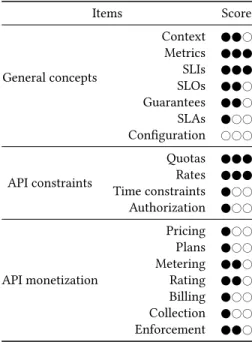
The relevance of each concept described in Section5is difer-ent for each provider. After asking them for scoring each one, we gathered and aggregated the responses, as stated in Table2.
The most important concepts aremetrics/SLIs,quotasandrates. The importance of the deinition of SLOs for both API producers and infrastructure manager is notorious. As also stated by other participants, it is important to keep separate concerns and diferent aspects (i.e., SLOs, plans, metrics); they can be always be referenced externally if needed. The granularity of deinitions when deining an SLA model is a problem: there exists the dichotomy between a ine-grained approach (i.e., a fully comprehensive model description) and a coarse-grained one (i.e., a description the most common elements and paving the way for custom extensions).
Table 2: Relevance of concepts for industrial participants Items Score General concepts Context # Metrics SLIs SLOs # Guarantees # SLAs ## Coniguration ### API constraints Quotas Rates Time constraints ## Authorization ## API monetization Pricing ## Plans ## Metering # Rating # Billing ## Collection ## Enforcement #
Symbol denotes the relevance for the industrial participants.
In general terms, the participants belonging to the SLA4OAI group, as part of the OpenAPI Initiative, tend to agree in a manifesto during the standardization tasks:
Motivation fostering the importance of the SLA inside the API development lifecycle is that SLAs are already present in most commercial APIs. Since OAI is becoming thede facto
standard for the deinition of APIs, natural evolution to de-scribe SLAs into OpenAPI Speciication would expand the OAI beneits.
Goals Three are identiied:
• Be as aligned as possible with the OpenAPI principles. • Describe the most common elements in SLAs (e.g., plans,
metrics, quotas, rates).
• Be integrated with the main OpenAPI Speciication.
Non-goalsThere are two:
• Deine a particular way to enforce SLAs.
• Be fully comprehensive including a wide set of elements found in diferent industrial APIs.
Design principles They are two:
• Pragmatism to spot the most common elements; • Promote tooling to take advantage of the SLA4OAI
Speci-ication.
6
CONCLUSIONS
From the Academia’s point of view, the fact of having a standard model for the deinition of SLAs in APIs could foster the devel-opment of novel techniques aiming to deal with the information contained in the SLAs. There is already a number of works in the SLA ield, as pointed out in Section3, so aligning that with the API ecosystem would pave the way for new challenges.
As an example, this SLA model could enableSLA-aware moni-toring and testingtechniques: including non-functional and QoS requirements into the test cases. Moreover, aformal analysis on the SLA modelcould unveil inconsistencies in the set of API limitations. Furthermore,SLA-aware model-driven developmentwould experi-ence an improvement, since taking into account the SLA could be helpful when deciding among diferent architectures. A irst step in this direction, in [9], we presentedGovernify for APIs, an initial set of tools aimed to settle down our idea of SLA-driven APIs.
Finally, this work is intended to collect the industrial perspective on the challenge of standardizing the modeling of SLAs and limi-tations in the API context, under the umbrella of a well-assented speciication for APIs as it is the OpenAPI Speciication. The con-tribution presented herein just lay the irst stone on the roadmap that is the modeling efort in conjunction with relevant industrial players.
ACKNOWLEDGMENTS
This work is partially supported by the European Commission (FEDER), the Spanish Government under projects BELI (TIN2015-70560-R) and HORATIO (RTI2018-101204-B-C21), and the FPU scholarship program, granted by the Spanish Ministry of Education, Culture and Sports (FPU15/02980).
The authors would also like to thank for their time and their valuable contributions to all the members of the OpenAPI Technical Steering Committee and, specially, to the rest of the Technical Committee behind the SLA4OAI Speciication: Isaac Hepworth (Google), Jefrey ErnstFriedman (The Linux Foundation), Kin Lane (API Evangelist), Mike Ralphson (The Linux Foundation) and Scott Ganyo (Google).
REFERENCES
[1] Mithun Acharya, Tao Xie, Jian Pei, and Jun Xu. 2007. Mining API patterns as partial orders from source code. InProceedings of the the 6th joint meeting of the European software engineering conference and the ACM SIGSOFT symposium on The foundations of software engineering - ESEC-FSE ’07. ACM Press, New York, New York, USA, 25. https://doi.org/10.1145/1287624.1287630
[2] Alain Andrieux, Karl Czajkowski, Kate Keahey, A. Dan, Kate Keahey, H. Ludwig, J. Pruyne, J. Rofrano, S. Tuecke, and M. Xu. 2004. Web Services Agreement Speciication (WS-Agreement). (2004), 80 pages. http://forgc.gridforum.org/Public_Comment_Docs/Documents/Oct-2006/WS-AgreementSpeciicationDraftFinal_sp_tn_jpver_v2.pdf
[3] Betsy Beyer, Chris Jones, Jennifer Petof, and Niall Richard Murphy. 2016.Site Reliability Engineering: How Google Runs Production Systems(1st ed.). O’Reilly Media, Inc., 1005 Gravenstein Highway North, Sebastopol, CA 95472, USA. [4] Michele Bonardi, Maurizio Brioschi, Alfonso Fuggetta, Emiliano Sergio Verga,
and Maurilio Zuccalà. 2016. Fostering Collaboration Through API Economy: The E015 Digital Ecosystem. InProceedings of the 3rd International Workshop on Software Engineering Research and Industrial Practice (SER&IP ’16). ACM, New York, NY, USA, 32ś38.https://doi.org/10.1145/2897022.2897026
[5] Cristina Cabanillas, David Knuplesch, Manuel Resinas, Manfred Reichert, Jan Mendling, and Antonio Ruiz-Cortés. 2015. RALph: A Graphical Notation for Resource Assignments in Business Processes. InAdvanced Information Systems Engineering, Jelena Zdravkovic, Marite Kirikova, and Paul Johannesson (Eds.). Springer International Publishing, Cham, 53ś68.
[6] Roy Thomas Fielding. 2000. Architectural Styles and the Design of Network-based Software Architectures.Building54 (2000), 162.https://doi.org/10.1.1.91.2433 [7] Forrester. 2015.API Management Solutions , Q3 2014. Technical Report. Forrester. [8] Antonio Gamez-Diaz, Pablo Fernandez, and Antonio Ruiz-Cortes. 2017. An
Analysis of RESTful APIs Oferings in the Industry. InService-Oriented Computing, Michael Maximilien, Antonio Vallecillo, Jianmin Wang, and Marc Oriol (Eds.). Springer International Publishing, Cham, 589ś604.
[9] Antonio Gamez-Diaz, Pablo Fernandez, and Antonio Ruiz-Cortes. 2019. Governify for APIs: SLA-Driven ecosystem for API governance. InProceedings of the 27th ACM Joint European Software Engineering Conference and Symposium on the
Foundations of Software Engineering (ESEC/FSE 2019). ACM, Tallin, Estonia.https: //doi.org/10.1145/3338906.3341176
[10] Antonio Gámez-Díaz, Pablo Fernández-Montes, and Antonio Ruiz-Cortés. 2015. Towards SLA-Driven API Gateways. InActas de las XI Jornadas de Ingeniería de Ciencia e Ingeniería de Servicios, Juan Manuel Murillo (Ed.), Vol. 201232273. Sistedes, Santander, 9.https://doi.org/10.13140/RG.2.1.4111.5609
[11] José María García, Pablo Fernández, Carlos Pedrinaci, Manuel Resinas, Jorge Cardoso, and Antonio Ruiz-Cortés. 2017. Modeling Service Level Agreements with Linked USDL Agreement.IEEE Transactions on Services Computing10, 1 (1 2017), 52ś65.https://doi.org/10.1109/TSC.2016.2593925
[12] Holger Harms, Collin Rogowski, and Luigi Lo Iacono. 2017. Guidelines for Adopting Frontend Architectures and Patterns in Microservices-based Systems. InProceedings of the 2017 11th Joint Meeting on Foundations of Software Engineering (ESEC/FSE 2017). ACM, New York, NY, USA, 902ś907.https://doi.org/10.1145/ 3106237.3117775
[13] Keven T. Kearney, Francesco Torelli, and Constantinos Kotsokalis. 2010. SLA * An abstract syntax for Service Level Agreements. In2010 11th IEEE/ACM International Conference on Grid Computing. IEEE, Brussels, Belgium, 217ś224.https://doi.org/ 10.1109/GRID.2010.5697973
[14] Yousri Kouki, Frederico Alvares de Oliveira, Simon Dupont, and Thomas Ledoux. 2014. A language support for cloud elasticity management. InProceedings -14th IEEE/ACM International Symposium on Cluster, Cloud, and Grid Computing, CCGrid 2014. IEEE, Chicago, IL, USA, 206ś215.https://doi.org/10.1109/CCGrid. 2014.17
[15] D. D. Lamanna, J. Skene, and W. Emmerich. 2003. SLAng: A language for deining service level agreements. InFTDCS, Vol. 2003-Janua. IEEE, San Juan, Puerto Rico, USA, USA, 100ś106.https://doi.org/10.1109/FTDCS.2003.1204317
[16] H. Ludwig, A. Keller, A. Dan, and R. King. 2002. A service level agreement language for dynamic electronic services. InWECWIS 2002. IEEE Comput. Soc, Newport Beach, CA, USA, USA, 25ś32.https://doi.org/10.1109/WECWIS.2002. 1021238
[17] C. Muller, A. Gutierrez Fernandez, P. Fernandez, O. Martin-Diaz, M. Resinas, and A. Ruiz-Cortes. 2018. Automated Validation of Compensable SLAs.IEEE
Transactions on Services Computing(jan 2018), 1ś1.https://doi.org/10.1109/TSC. 2018.2885766
[18] Andy Neumann, Nuno Laranjeiro, and Jorge Bernardino. 2018. An Analysis of Public REST Web Service APIs.IEEE Transactions on Services Computing(2018). https://doi.org/10.1109/TSC.2018.2847344
[19] Tien N. Nguyen, Anh Tuan Nguyen, Trong Nguyen, Thanh Nguyen, Hoan Anh Nguyen, Ngoc Tran, Hung Phan, and Linh Truong. 2018. Complementing global and local contexts in representing API descriptions to improve API retrieval tasks. InProceedings of the 2018 26th ACM Joint Meeting on European Software Engineering Conference and Symposium on the Foundations of Software Engineering - ESEC/FSE 2018. ACM Press, New York, New York, USA, 551ś562.https://doi. org/10.1145/3236024.3236036
[20] Rick Rabiser, Sam Guinea, Michael Vierhauser, Luciano Baresi, and Paul Grün-bacher. 2017. A comparison framework for runtime monitoring approaches. Journal of Systems and Software125 (3 2017), 309ś321. https://doi.org/10.1016/j. jss.2016.12.034
[21] Anastasia Reinhardt, Tianyi Zhang, Mihir Mathur, and Miryung Kim. 2018. Aug-menting Stack Overlow with API Usage Patterns Mined from GitHub. In Proceed-ings of the 2018 26th ACM Joint Meeting on European Software Engineering Confer-ence and Symposium on the Foundations of Software Engineering (ESEC/FSE 2018). ACM, New York, NY, USA, 880ś883.https://doi.org/10.1145/3236024.3264585 [22] W. Tan, Y. Fan, A. Ghoneim, M. A. Hossain, and S. Dustdar. 2016. From the
Service-Oriented Architecture to the Web API Economy.IEEE Internet Computing20, 4 (July 2016), 64ś68.https://doi.org/10.1109/MIC.2016.74
[23] S. Tata, M. Mohamed, T. Sakairi, N. Mandagere, O. Anya, and H. Ludwig. 2016. rSLA: A Service Level Agreement Language for Cloud Services. In2016 IEEE 9th International Conference on Cloud Computing (CLOUD). IEEE, San Francisco, CA, USA, 415ś422. https://doi.org/10.1109/CLOUD.2016.0062
[24] Rafael Brundo Uriarte, Francesco Tiezzi, and Rocco De Nicola. 2014. SLAC: A Formal Service-Level-Agreement Language for Cloud Computing. InProceedings of the 2014 IEEE/ACM 7th International Conference on Utility and Cloud Computing (UCC ’14). IEEE Computer Society, Washington, DC, USA, 419ś426.https://doi. org/10.1109/UCC.2014.53