AN EVALUATION OF LOYALTY PROGRAMMES
ANESHREE TERRILLA THAVER
Submitted in partial fulfilment of the requirements for the MASTER’S DEGREE IN BUSINESS ADMINISTRATION
in the
FACULTY OF BUSINESS AND ECONOMIC SCIENCES of the
NELSON MANDELA UNIVERSITY
Supervisor: Professor Margaret Cullen
DECLARATION
NAME: ANESHREE TERRILLA THAVER
STUDENT NUMBER: 218081553
QUALIFICATION: MASTER’S DEGREE IN BUSINESS ADMINISTRATION
TITLE OF PROJECT: AN EVALUATION OF LOYALTY PROGRAMMES
In accordance with Rule G5.6.3, I hereby declare that the above-mentioned thesis is my own work and that it has not previously been submitted for assessment to another University or for another qualification.
………..
SIGNATURE
6 March 2019
ACKNOWLEDGEMENTS
There are innumerable people who have helped me along this journey. A journey which has taken me on an amazing pathway in my pursuit of knowledge. As a medical doctor, the pursuit of expanding my business acumen has been the most interesting and challenging educational experience and I am grateful to each and every person, who helped and supported me the over these past two years. In particular, I would like to thank and acknowledge the following:
Firstly God, for providing me with this opportunity and giving me the support network, I needed to see me through the difficult times. I thank God for giving me abilities far greater than my own and for the strength to complete this journey;
My husband, Gladwin Walsh, my parents, Poobie and Thiru, my sister Berenice and my brother Dayalan – thank you for your encouragement. Thank you all for the sacrifices that you made and for your understanding throughout all the times I had to miss out on family time. To my husband and parents thank you for all the extra efforts you put in to keep our house a home. It would have been impossible to complete this degree and research without your support and assistance;
Professor Margaret Cullen, from the day we met I knew I had found in you an inspirational teacher. You have held my hand through this journey even when I doubted my own abilities. Your patience, assistance and guidance in steering this treatise towards a successful outcome is testimony to the phenomenal teacher that you are. Thank you for being an exceptional mentor and friend to me on this journey;
My MBA-family, Symone, Martin, Jacque, Hein and David thank you for the laughter, support and for making me feel inspired to continue during those dull moments. The lessons learnt, friendships made and combined efforts of hard work made this a truly memorable journey, thank you;
Urvasie Chetty my MBA rock. Thank you for all the conversations, for being my coach and for encouraging me. I could not have asked for a better friend to share this experience with;
Dr Danie Venter and Professor André Caltiz, thank you for your help and patience with the statistical analysis. Thank you for answering my questions with expert insight;
OneStopSolution.co.za for the technical editing and Professor Margaret Cullen for proofreading;
My friends and work colleagues, who remained understanding. Thank you for being willing to work around my study schedule. Your unyielding support, encouragement and understanding is deeply appreciated.
ABSTRACT
A Loyalty Programme, is the term most commonly used to summarise various Customer Relationship Management programmes instituted by companies, to endear and encourage loyalty from customers. In order to better understand the component of loyalty within the context of Loyalty Programmes, a dimensional approach has been suggested. The dimensional approach is based firstly, on behavioural loyalty theories, which focus on purchase patterns to qualify/quantify loyalty. Secondly, it included attitudinal loyalty measures to account for customer’s actions and feelings to aid in both the conceptualisation and measurement of loyalty.
The need to understand and evaluate the effects of programmes specifically designed to promote loyalty from customers has prompted a surge in academic research, which has led to great debate over the effectiveness of these programmes. Previous empirical research has provided divergent findings and many polarised views abound. This is due in part to the lack of consistent research methodologies, concepts and measurements of previous studies, which has made the comparison of Loyalty Programmes increasingly difficult. However, despite these challenges, there remains substantial evidence in support of the overall effectiveness of Loyalty Programmes. The aim of this research has been to focus on developing a model to evaluate the components of Loyalty Programmes based on attitudinal and behavioural loyalty dimensions, with the view of recommending components that should be included in the design of Loyalty Programmes.
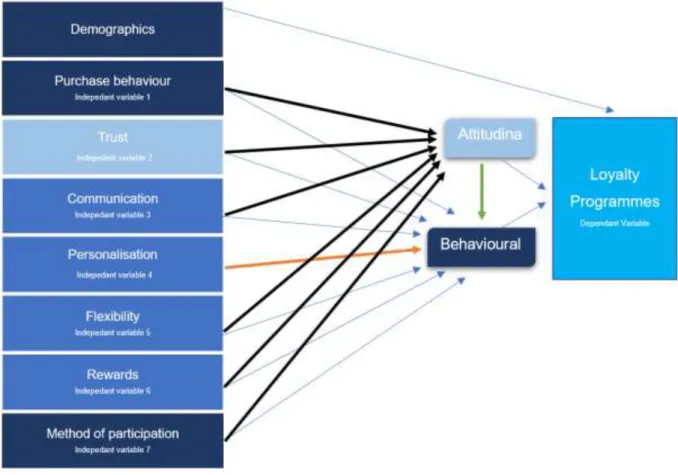
An in-depth literature review was conducted and the two dimensions of loyalty (attitudinal and behavioural) were examined. Additionally, the following Theories were explored Social Exchange Theory, Equity Theory and the Theory of Planned Behaviour, to examine the interchange between participants of Loyalty Programmes. The review of literature further laid the foundation for the conceptual model that proposed purchase behaviour, trust, communication, personalisation, flexibility, rewards and methods of participation as components which influenced Loyalty Programmes.
A multi-method study, with 1090 respondents, was conducted and a proposed conceptual model was compiled. An analysis was conducted through various
descriptive and inferential statistical tests as well as Exploratory Factor Analysis and Confirmatory Factor Analysis. The results of the study identified the following factors
Attitudinal loyalty (Attitudinal – Communication, Attitudinal – Flexibility, Attitudinal –
General, Attitudinal – Rewards (Personal and Monetary) and Attitudinal – Trust) and
Behavioural loyalty (Behavioural – Communication, Behavioural – Flexibility, Behavioural – General, Behavioural – Personalisation, Behavioural – Purchasing Behaviour, Behavioural – Rewards and Behavioural – Trust) to be of influence with regard to the effectiveness of Loyalty Programmes.
The study concludes with managerial recommendations for the improvement in the design of Loyalty Programmes to enhance Attitudinal and Behavioural loyalty from participants. The recommendations from this study are based on the three strongest factor relationships identified through Pearson Product Moment Correlations. They are (a) Attitude – General and Behavioural – General (0.723), (b) Attitude – Communication and Behavioural – Communication (0.691) and (c) Attitude – Trust and Behavioural – Trust (0.595). Hence it is suggested that communication surrounding Loyalty Programmes needs to embrace new technologies and adopt a multichannel and multi-directional strategy to be more responsive to customers. Furthermore, trust was found to be influential in Loyalty Programme participation and how managers used the shared personal data, impacted customer willingness to participate in Loyalty Programmes.
This study found that overall purchasing behaviour is poorly influenced by Loyalty Card/Programmes, as discounts and promotions did not sway shopper purchasing behaviour and that the most preferred rewards were monetary, free shipping and brand partnerships. In summary, consideration should be given to the type, flexibility and expiration of rewards offered. Further, a regular review of personalisation strategies, customer expectations and participation methods are recommended to bridge the mismatch between idle membership and active participation in Loyalty Programmes.
TABLE OF CONTENTS
DECLARATION ... i
ACKNOWLEDGEMENTS ... ii
ABSTRACT ... iv
LIST OF ANNEXURES ... xii
LIST OF FIGURES ... xiv
LIST OF TABLES ... xvi
CHAPTER ONE ... 1
INTRODUCTION AND PROBLEM STATEMENT ... 1
1.1 INTRODUCTION ... 1 1.2 PROBLEM STATEMENT ... 3 1.3 RESEARCH QUESTIONS ... 5 1.4 RESEARCH OBJECTIVES ... 6 1.5 RESEARCH DELIMITATION ... 8 1.6 RESEARCH THEORY ... 8 1.7 RESEARCH SIGNIFICANCE ... 9 1.8 RESEARCH METHODOLOGY ... 11 1.8.1 Research Approach ... 11 1.8.2 Literature Study ... 11
1.8.3 Data Collection and Analysis... 11
1.9 ETHICAL CLEARANCE ... 13
1.10 REPORT STRUCTURE ... 13
1.10.1 Chapter 1: Introduction and Problem Statement ... 13
1.10.2 Chapter 2: Literature Review... 13
1.10.3 Chapter 3: Research Design and Methodology... 14
1.10.5 Chapter 5: Findings, Conclusions and Recommendations ... 14
1.11 SUMMARY ... 15
CHAPTER TWO ... 17
LITERATURE REVIEW... 17
2.1 INTRODUCTION ... 17
2.2 DEFINITION OF LOYALTY PROGRAMMES ... 18
2.2.1 The Nature of Loyalty ... 20
2.2.2 Dimensions of Loyalty ... 20
2.2.2.1 The Progression of the Dimensional Approach ... 21
2.2.3 Theories of Loyalty ... 25
2.2.3.1 Social Exchange Theory... 25
2.2.3.2 Equity Theory ... 26
2.2.3.3 Theory of Planned Behaviour ... 27
2.3 THE IMPORTANCE OF LOYALTY PROGRAMMES... 29
2.3.1 The Need for Further Research on Loyalty Programmes ... 31
2.3.2 Types of Loyalty Programmes ... 32
2.4 INTERNATIONAL TRENDS IN LOYALTY PROGRAMMES ... 34
2.5 LOYALTY PROGRAMMES IN SOUTH AFRICA ... 38
2.6 DETERMINANTS OF LOYALTY PROGRAMMES ... 39
2.6.1 Demographics ... 41 2.6.2 Purchase Behaviour ... 43 2.6.3 Trust ... 45 2.6.4 Communication ... 46 2.6.5 Personalisation ... 48 2.6.6 Flexibility ... 49 2.6.7 Rewards ... 50
2.6.8 Methods of Participation ... 54
2.7 CONCEPTUAL MODEL ... 56
2.8 SUMMARY ... 57
CHAPTER THREE ... 58
RESEARCH DESIGN AND METHODOLOGY ... 58
3.1 INTRODUCTION ... 58
3.2 RESEARCH DEFINITION ... 60
3.2.1 Literature Review ... 61
3.3 RESEARCH DESIGN ... 63
3.3.1 Research Philosophies and Approaches ... 63
3.3.2 Research Methodology and Design. ... 67
3.3.3 Time Horizons ... 71
3.4 UNIT OF ANALYSIS ... 72
3.5 SAMPLING DESIGN... 72
3.5.1 Participants of the study ... 73
3.6 DATA COLLECTION METHOD ... 74
3.6.1 Questionnaire Development ... 75
3.6.2 Data Analysis ... 85
3.6.3 Reliability and Validity ... 90
3.7 ETHICAL REQUIREMENTS ... 93
3.8 SUMMARY ... 94
CHAPTER FOUR ... 95
RESULTS AND ANALYSIS ... 95
4.1 INTRODUCTION ... 95
4.2 REVISION OF THE CONCEPTUAL MODEL ... 96
4.3.1 Geographic Information ... 99
4.3.2 Demographic characteristics ... 101
4.3.3 Employment information ... 104
4.4 MEASUREMENT ITEMS ... 110
4.4.1 Factor 1: Loyalty Programmes - General ... 110
4.4.2 Factor 2: Purchase Behaviour ... 113
4.4.3 Factor 3: Trust ... 115
4.4.4 Factor 4: Communication ... 116
4.4.5 Factor 5: Personalisation ... 118
4.4.6 Factor 6: Flexibility ... 119
4.4.7 Factor 7: Rewards ... 120
4.4.8 Factor 8: Method of Participation ... 122
4.5 ITEM ANALYSIS: EXPLORATORY FACTOR ANALYSIS (EFA) ... 123
4.5.1 Eigenvalues... 124
4.5.2 Factors that did not load or that were reversed ... 144
4.5.3 Cronbach’s Alpha Coefficient Analysis ... 149
4.6 DESCRIPTIVE STATISTICS FOR FACTORS ... 150
4.6.1 Frequency Distributions of Factors ... 150
4.6.2 Central Tendency and Dispersion of Factors ... 151
4.7 INFERENTIAL STATISTICS FOR THE FACTORS ... 153
4.7.1 One Sample T-Tests ... 153
4.7.2 Pearson’s Correlation ... 155
4.8 RELATIONSHIPS BETWEEN DEMOGRAPHIC FACTORS AND THE FACTORS (ANOVAS) ... 160
4.8.1 ANOVA Results and Discussion of Descriptive Statistics for the ANOVA ... 160
4.9.1 Confirmatory Factor Analysis (CFA) ... 168
4.10 CONCLUSIONS ... 169
CHAPTER FIVE ... 173
FINDINGS, CONCLUSIONS AND RECOMMENDATIONS ... 173
5.1 INTRODUCTION ... 173
5.2 SUMMARY OF STUDY ... 174
5.2.1 Chapter 1: Introduction and Problem Statement ... 174
5.2.2 Chapter 2: Literature Review... 174
5.2.3 Chapter 3: Research Design and Methodology... 175
5.2.4 Chapter 4: Empirical Study - Results and Analysis ... 177
5.2.5 Chapter 5: Findings, Conclusions and Recommendations ... 178
5.3 KEY FINDINGS OF THE STUDY ... 179
5.3.1 Proposed Components of Loyalty Programmes ... 179
5.3.2 Factor 1: Loyalty Programmes - General ... 182
5.3.3 Factor 2: Purchase Behaviour ... 183
5.3.4 Factor 3: Trust ... 185
5.3.5 Factor 4: Communication ... 187
5.3.6 Factor 5: Personalisation ... 188
5.3.7 Factor 6: Flexibility ... 189
5.3.8 Factor 7: Rewards ... 191
5.3.9 Factor 8: Method of Participation ... 192
5.3.10 The Tested Model for Measuring Loyalty Programmes ... 193
5.4 MANAGERIAL RECOMMENDATIONS ... 194
5.4.1 Attitudinal – Communication... 194
5.4.2 Attitudinal – Flexibility ... 195
5.4.4 Attitudinal – Rewards (Personal and Monetary) ... 196 5.4.5 Attitudinal – Trust ... 196 5.4.6 Behavioural – Communication ... 196 5.4.7 Behavioural – Flexibility ... 197 5.4.8 Behavioural – General ... 197 5.4.9 Behavioural – Personalisation ... 197
5.4.10 Behavioural – Purchasing Behaviour ... 198
5.4.11 Behavioural – Rewards ... 198
5.4.12 Behavioural – Trust ... 198
5.5 LIMITATIONS AND CALL FOR FUTURE RESEARCH ... 199
5.6 SUMMARY ... 199
LIST OF ANNEXURES
ANNEXURE A – FORM E ETHICS CLEARANCE ... 212
ANNEXURE B – QUESTIONNAIRE ... 214
ANNEXURE C – COPY OF EMAIL SENT TO RESPONDENTS ... 226
ANNEXURE D – CONSENT FOR PARTICIPANTS OF THE SURVEY ... 228
ANNEXURE E – MID-YEAR POPULATION ESTIMATES ... 229
ANNEXURE F – DESCRIPTIVE STATISTICS FOR THE ANOVAS ... 230
Table 4.60 - Descriptive Statistics for factor ATTITUDINAL - GENERAL by ANOVA Factors ... 230
Table 4.61 - Descriptive Statistics for factor Behavioural – General by ANOVA Factors ... 231
Table 4.62 - Descriptive Statistics for factor Attitudinal - Trust by ANOVA Factors ... 232
Table 4.63 - Descriptive Statistics for factor Behavioural - Trust by ANOVA Factors ... 233
Table 4.64 - Descriptive Statistics for factor Attitudinal - Communication by ANOVA Factors ... 234
Table 4.65 - Descriptive Statistics for factor Behavioural - Communication by ANOVA Factors ... 235
Table 4.66 - Descriptive Statistics for factor Behavioural - Personalisation by ANOVA Factors ... 236
Table 4.67 - Descriptive Statistics for factor Attitudinal – Flexibility by ANOVA Factors ... 237
Table 4.68 - Descriptive Statistics for factor Behavioural - Flexibility by ANOVA Factors ... 238
Table 4.69 - Descriptive Statistics for factor Behavioural - Rewards by ANOVA Factors ... 239
Table 4.70 - Descriptive Statistics for factor Attitudinal - Rewards Personal by ANOVA Factors ... 240 Table 4.71 - Descriptive Statistics for factor Attitudinal – Rewards Tangible
by ANOVA Factors ... 241 Table 4.72 - Descriptive Statistics for factor Attitudinal – Rewards Monetary
by ANOVA Factors ... 242 ANNEXURE G - TURNITIN REPORT ... 243
LIST OF FIGURES
Figure 1.1: Chapter One Outline ... 3
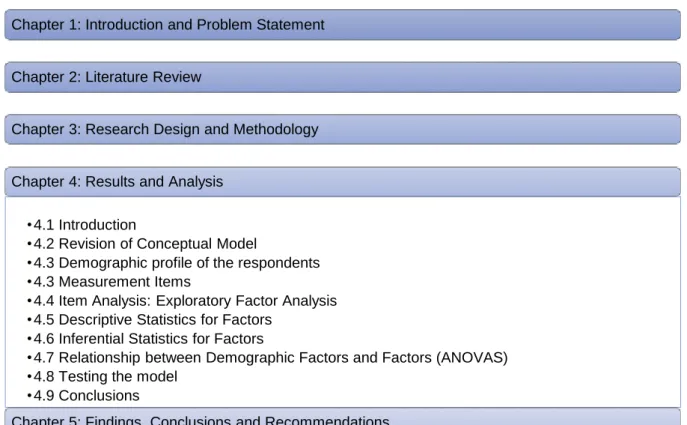
Figure 1.2: Chapter outline for this treatise. ... 15
Figure 2.1: Chapter Two Outline ... 18
Figure 2.2: Four-Dimensional Loyalty Algorithm ... 21
Figure 2.3: Types of Rewards Offered by Loyalty Programmes ... 52
Figure 2.4: Proposed Conceptual Model of Determinants of Loyalty Programmes ... 56
Figure 3.1: Chapter Three Outline ... 59
Figure 3.2: The Research Onion ... 62
Figure 3.3: Research Methodology for this Treatise ... 72
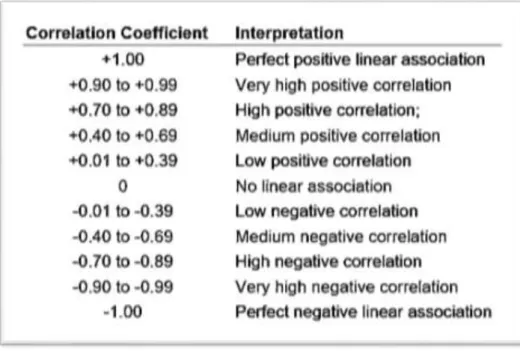
Figure 3.4: Strengths of Correlation (Collis and Hussey, 2014) ... 88
Figure 4.1: Chapter Four Outline ... 96
Figure 4.2: Revised Conceptual Model of Factors Influencing Loyalty Programme Participation. ... 99
Figure 4.3: Frequency Distribution of Participants per Province ... 101
Figure 4.4: Frequency Distribution: Gender (n=1090) ... 102
Figure 4.5: Frequency Distribution: Household Size (n=1090) ... 105
Figure 4.6: Frequency Distribution: Responsible for Day-to-Day Household Purchases (n=1090) ... 106
Figure 4.7: Frequency Distribution: Loyalty Programme/card Participants (n=1090) ... 108
Figure 4.8: Frequency Distribution: Loyalty Programme/card, Best Description of Brand Connection (n=740) ... 110
Figure 4.9: Scree Plot - Factor 1: Loyalty Programmes as Related to Attitudinal Factors - Attitudinal General. (n=740) ... 125
Figure 4.10: Scree Plot – Factor 1: Loyalty Programmes as Related to Behavioural factors – Behaviour General. (n=656) ... 127 Figure 4.11: Scree Plot – Factor 2 - Purchase Behaviour and Behavioural Factors (n=656) ... 129 Figure 4.12: Scree Plot - Factor 3 - Trust and Attitudinal Factors (n=740) ... 131 Figure 4.13: Scree Plot - Factor 4 – Communication and Attitudinal Factors (n=740) ... 134 Figure 4.14: Scree Plot -Factor 4 - Communication and Behavioural Factors (n=656) ... 135 Figure 4.15: Scree Plot – Factor 5 - Personalisation and Behavioural Factors (n=656) ... 137 Figure 4.16: Scree Plot –Factor 7 - Rewards and Attitudinal Factors (n=740) ... 141 Figure 4.17: Scree Plot – Factor 7 - Rewards and Behavioural Factors (n=656) .... 143 Figure 4.18: Illustrates the Pearson Product Moment Correlations – Attitudinal
Factors to all ... 157 Figure 4.19: Illustrates the Pearson Product Moment Correlations – Behavioural Factors to all Factors ... 159 Figure 4.20: Model 3 Attitudinal Factors Influencing Loyalty Programme Participation ... 170 Figure 4.21: Model 4 Behavioural Factors Influencing Loyalty Programme
Participation ... 171
Source: Authors own construction Figure 5.1: Chapter Five Outline ... 174
LIST OF TABLES
Table 1.1: Research Alignment Plan ... 7
Table 2.1: Brand Audit Table Based on Tri-Dimensional Loyalty ... 23
Table 2.2: Four-Dimensional Loyalty, Stages of Attitudinal Loyalty ... 24
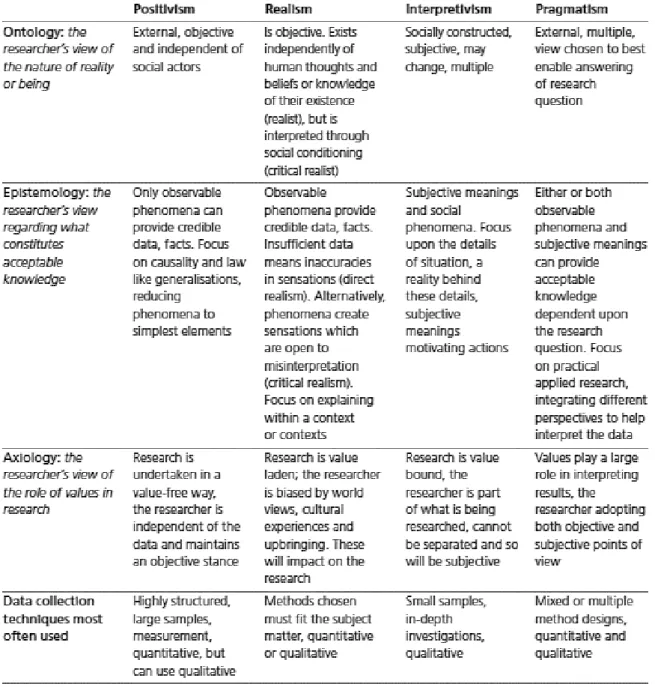
Table 3.1: A Comparison of the Four Research Philosophies ... 65
Table 3.2: Operationalisation of Factors and Demographic Variables ... 78
Table 3.3: Interpretation Intervals for Cohen's d ... 86
Table 3.4: Interpretation Intervals for Cramer's V ... 87
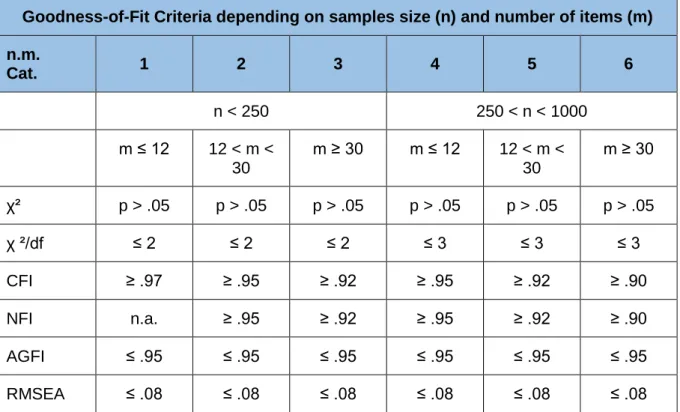
Table 3.5: "Goodness of Fit" for Confirmatory Factor Analysis ... 90
Table 3.6: Interpretation Intervals for Cronbach’s alphas ... 91
Table 4.1: Frequency Distribution – Country ... 100
Table 4.2: Frequency Distribution - Demographic Characteristics of Participants ... 103
Table 4.3: Frequency Distribution: Employment and Monthly Household Income... 104
Table 4.4: Frequency Distribution: Decision Making in Households. ... 107
Table 4.5: Frequency Distribution: Loyalty Programme/Card Participation. ... 108
Table 4.6: Number of Loyalty Programmes/Cards per Category ... 109
Table 4.7: Frequency Distributions: Loyalty Cards/Programmes Items (n=740) ... 111
Table 4.8: Frequency Distributions: Purchase Behaviour Items (n=740)... 113
Table 4.9: Frequency Distributions: Trust Items (n=740)... 115
Table 4.10: Frequency Distributions: Communication Items (n=740) ... 117
Table 4.11: Frequency Distributions: Personalisation Items (n=740) ... 118
Table 4.12: Frequency Distributions: Flexibility Items (n=740) ... 119
Table 4.13: Frequency Distributions: Rewards Items (n=740) ... 121
Table4.14: Frequency Distributions: Method of Participation Items (n=740) ... 123
Table 4.15: Eigenvalues of Factors and Variances Explained for Factor 1: Loyalty Programmes as Related to Attitudinal Factors - Attitudinal General. (n = 740) ... 125
Table 4.16: Exploratory Factor Analysis (EFA) Loadings (1 Factor Model) – Factor 1: Loyalty Programmes as Related to Attitudinal Factors - Attitudinal General (n=740) ... 126 Table 4.17: Eigenvalues of Factors and Variances Explained for Factor 1: Loyalty Programmes as Related to Behavioural Factors – Behaviour General. (n=656) ... 127 Table 4.18: Exploratory Factor Analysis (EFA) Loadings (1 Factor Model) – Factor 1: Loyalty Programmes as Related to Behavioural Factors – Behaviour General (n=656) ... 128 Table 4.19: Eigenvalues of Factors and Variances Explained for Factor 2 - Purchase Behaviour and Behavioural Factors. (n=656) ... 129 Table 4.20: Exploratory Factor Analysis (EFA) Loadings (1 Factor Model) – Factor 2 - Purchase Behaviour and Behavioural Factors (n=656) ... 130 Table 4.21: Eigenvalues of Factors and Variances Explained for Factor 3 - Trust and Attitudinal Factors ... 131 Table 4.22: Exploratory Factor Analysis (EFA) Loadings (1 Factor Model) – Factor 3 - Trust and Attitudinal Factors (n=740) ... 132 Table 4.23: Eigenvalues of Factors and Variances Explained for Factor 3 – Trust and Behavioural Factors ... 132 Table 4.24: Exploratory Factor Analysis (EFA) Loadings (1 Factor Model) - Factor 3 - Trust and Behavioural Factors (n=656) ... 133 Table 4.25: Eigenvalues of Factors and Variances Explained for Factor 4 –
Communication and Attitudinal Factors. (n=740) ... 133 Table 4.26: Exploratory Factor Analysis (EFA) Loadings (1 Factor Model) – Factor 4 - Communication and Attitudinal Factors (n=740) ... 134 Table 4.27: Eigenvalues of Factors and Variances Explained for Factor 4 –
Communication and Behavioural Factors ... 135 Table 4.28: Exploratory Factor Analysis (EFA) Loadings (1 Factor Model) – Factor 4 - Communication and Behavioural Factors (n=656) ... 136 Table 4.29: Eigenvalues of Factors and Variances Explained for Factor 5 –
Table 4.30: Exploratory Factor Analysis (EFA) Loadings (1 Factor Model) - Factor 5 -
Personalisation and Behavioural Factors (n=656) ... 138
Table 4.31: Eigenvalues of Factors and Variances Explained for Factor 6 – Flexibility and Attitudinal Factors ... 138
Table 4.32: Exploratory Factor Analysis (EFA) Loadings (1 Factor Model) – Factor 6 - Flexibility and Attitudinal Factors (n=740) ... 139
Table 4.33: Eigenvalues of Factors and Variances Explained for Factor 6 – Flexibility and Behavioural Factors ... 139
Table 4.34: Exploratory Factor Analysis (EFA) Loadings (1 Factor Model) – Factor 6 - Flexibility and Behavioural Factors (n=656) ... 140
Table 4.35: Eigenvalues of Factors and Variances Explained for Factor 7 – Rewards and Attitudinal Factors ... 141
Table 4.36: Exploratory Factor Analysis (EFA) Loadings (3 Factor Model) – Factor 7 - Rewards and Attitudinal Factors (n=740) ... 142
Table 4.37: Eigenvalues of Factors and Variances Explained for Factor 7 – Rewards and Behavioural Factors ... 143
Table 4.38: Exploratory Factor Analysis (EFA) Loadings (1 Factor Model) – Factor 7 - Rewards and Behavioural Factors. (n=656) ... 144
Table 4.39: Revised Survey Questions with Factor Loadings ... 145
Table 4.40: Cronbach's Alpha Coefficients for the Factors – All Measurement Items. ... 149
Table 4.41: Frequency Distributions: Factors ... 150
Table 4.42: Central Tendency and Dispersion: Factors ... 152
Table 4.43: One-Sample T-Tests: Factors ... 154
Table 4.44: Pearson Product Moment Correlations – Attitudinal Factors to All Factors ... 156
Table 4.45: Pearson Product Moment Correlations – Behavioural Factors to All Factors ... 158
Table 4.47: Univariate ANOVA Results – Attitudinal – Trust ... 161
Table 4.48: Post-Hoc Results - Attitudinal – Trust ... 162
Table 4.49: Univariate ANOVA Results – Behavioural – Trust. ... 162
Table 4.50: Post-Hoc Results - Behavioural – Trust. ... 163
Table 4.51: Univariate ANOVA Results - Behavioural – Communication ... 163
Table 4.52: Post-Hoc Results - Behavioural – Communication ... 164
Table 4.53: Univariate ANOVA Results - Behavioural – Personalisation ... 164
Table 4.54: Post-hoc Results - Behavioural – Personalisation ... 165
Table 4.55: Univariate ANOVA Results - Attitudinal – Rewards Personal ... 165
Table 4.56: Post-hoc Results - Attitudinal – Rewards Personal ... 166
Table 4.57: Univariate ANOVA Results - Attitudinal – Rewards Tangible ... 166
Table 4.58: Post-hoc Results - Attitudinal – Rewards Tangible ... 167
Table 4.59: Observed CFA goodness of Fit Statistics (figures indicated red in denote an acceptable fit) ... 168
CHAPTER ONE
INTRODUCTION AND PROBLEM STATEMENT
1.1 INTRODUCTION
A Loyalty Programme is the term most commonly used to summarise various customer relationship management programmes that have emerged as companies move toward a more customer centred focus (Bijmolt, Dorotic and Verhorf, 2010; Cromhout, Netto, Hamilton and Rootman, 2017; Dorotic, Bijmoltand Verhoef, 2012). Catapulted by technology, more specifically advances in information technology (Estrella-Ramon, Sanchez-Perez, Swinnen and VanHoof, 2013; Melzer and Olivier, 2015), Loyalty Programmes have gained centre stage in any company’s arsenal for encouraging customer loyalty (Breugelmans et al., 2015; Dorotic et al., 2012). This has prompted a surge in academic research into understanding the effects of Loyalty Programmes and has led to great debate over the effectiveness of these programmes (Brashear-Alejandro, Kang and Groza, 2016; Dorotic et al., 2012; Leenheer, Bijmolt, van Heerde and Smidts, 2003; Rese, Hundertmark, Schimmelpfennig and Schons, 2013).
The resultant empirical research has provided divergent findings (Bijmolt et al., 2010; Dorotic et al., 2012; Liu and Yang, 2009) and many polarised views abound. The lack of consistent research methodologies, concepts and measurements used in previous studies has made comparisons increasingly difficult and while no unified opinion can be demonstrated, there is substantial evidence in support of Loyalty Programmes (Breugelmans et al., 2015; Dorotic et al., 2012).
Loyalty Programmes have been in existence since the 18th century (McCall, Voorheesand Calantone, 2010). The modern format of Loyalty Programmes began in the airline industry 28 years ago (Xie and Chen, 2013). Throughout the history of Loyalty Programmes, the popularity of these offerings has not waned among consumers but rather has rapidly grown over recent years (Liu and Yang, 2009), with Reuters (April, 2017) valuing the Global Loyalty Management Market at 1.94 billion US dollars (USD) in 2016. Global trends have confirmed that successful Loyalty Programmes promoted higher frequency of patronage and higher spends per visit, with seventy-two percent of global participants favouring retailers with Loyalty Programmes
and two thirds of participants admitting to participation in more than one Loyalty Programme (Nielson Report, 2016; Rese et al., 2013).
The understanding of the component of loyalty in the context of Loyalty Programmes is best achieved through a dimensional approach (Day,1969; Dick and Basu, 1994; Oliver, 1999; Khan, 2009; Worthington, Russell-Bennett and Hartel, 2009). This concept is based firstly on behavioural loyalty theories that focused on the patterns of purchase, more especially frequency, pattern, probability and share of total purchase, which are applied to qualify/quantify loyalty. Secondly, it included attitudinal loyalty measures, which incorporated customer’s actions and feelings to aid the loyalty construct development in two ways (a) conceptualisation and (b) measurement. The Nielsen Global Loyalty-Sentiment Survey (2016) reported Loyalty Programme participation at a rate of fifty percent across Africa and the Middle East, with the highest levels of participation found in the United Arab Emirates and South Africa. The lowest levels were found in Egypt and Pakistan. The high participation rates in South Africa attest to the long history of Loyalty Programmes in the country (Cromhout et al., 2017; Nielson report, 2016).
Literature has established the popularity of Loyalty Programmes and that they are widely accepted by both consumers and companies. However, consumers and companies are evolving and the relevance of the components that led to a successful Loyalty Programme 28 years ago in the airline industry may no longer be relevant today. Questions are being raised over the components needed in an evolving market for the design of Loyalty Programmes that will ensure future-flexibility (McCall, Voorhees and Calantone, 2010; Rese, Hundertmark, Schimmelpfennig and Schons, 2013; Wyman, 2015).
Additionally, Dorotic et al. (2012) identified that the effects Loyalty Programmes had on customer attitudes and behaviour was poorly understood and should also be the subject of further research. Thus, with this in mind this treatise aims to evaluate Loyalty Programmes by investigating the components of Loyalty Programmes. The aim of this evaluation is to assist companies to improve the performance of current or planned Loyalty Programmes and to avoid the pitfalls that maybe present in the design of loyalty offerings.
The effects of components will be evaluated against several variables and include demographic factors such as age, income, gender, etc. as well as components relating to the attitude and behaviour of participants. Other factors also proposed for evaluation are factors that influence the reward, trust and communication components of Loyalty Programmes. Once these have been established, the study aims to propose practical managerial improvement strategies for current and future design components of Loyalty Programmes. The Chapter outline for Chapter One is illustrated in Figure 1.1. below.
Source: Chapter One Outline (Author’s own construct) Figure 1.1: Chapter One Outline
1.2 PROBLEM STATEMENT
Ever since the introduction of the concept of Loyalty Programmes, researchers have questioned and debated the practicality and effectiveness of implementing Loyalty Programmes (Breugelmans et al., 2015; Dorotic et al., 2012). The resultant contradicting views from the debate of researchers, have left managers lacking a coherent understanding of which components to focus on when designing a Loyalty Programme to suit their company needs and the needs of their consumers
(Brashear-Alejandro et al., 2016; Liu, Guo and Lee, 2011; Martínez and Rodríguez del Bosque, 2013; Mimouni-Chaabane and Volle, 2010; Xie and Chen, 2013).
Poorly executed Loyalty Programmes can damage the brand and more seriously the relationship with the customer (Dick and Basu, 1994). This is especially evident when the expectations from participation in a programme are not met, as the consumer feels cheated by the company offering (Bazargan, Karray and Zolfaghari, 2017; Dorotic, Verhoef, Fok and Bijmolt, 2014; Winters and Ha, 2012). This may occur as a result of gaps in communication regarding methods of participation, reward distance or as a result of other factors (Breugelmans et al., 2015; Gommans et al., 2001; Winters and Ha, 2012; Xie and Chen, 2013). Additionally, the consumer becomes distrusting of the company and may abandon the relationship altogether. An even more damaging consequence may result from the negative word-of mouth effects to the brand and the company from unsatisfied participants (van Doorn et al., 2010; Mimouni-Chaabane and Volle, 2010; Xie and Chen, 2013).
The financial implications of Loyalty Programmes that miss their mark are thus threefold, firstly the investment loss from the company. Secondly, there is a loss of current revenue and finally the loss of future revenue streams (Mimouni-Chaabane and Volle, 2010; Winters and Ha, 2012; Collins and Lau, 2017; Bazargan et al., 2018). The aim of any Loyalty Programme in the short term, is to increase sales but the long term focus is long-term commitment from consumers ( Dorotic, Bijmolt and Verhoef, 2012 ; Xie and Chen, 2013; Dorotic, Verhoef, Fok and Bijmolt, 2014). Successfully executed Loyalty Programmes offer far more than financial gains to the company and the time and effort invested in designing Loyalty Programmes yields long term dividends as customers become consumers and brand loyalty is converted to company loyalty (Bazargan et al., 2018; Estrella-Ramon et al., 2013; Liu and Yang, 2009; Sarwar, Abbasi and Pervaiz, 2012).
A central design component for this is customer database development, which focuses on personalisation (Melzer and Olivier, 2015) and provides the framework for tailored offerings used by modern Loyalty Programmes (Liu and Yang, 2009; Xie and Chen, 2013; Estrella-Ramon et al., 2013; Dorotic, Bijmolt and Verhoef, 2012; Jennings et al., 2014; Breugelmans et al., 2015). Loyalty Programmes need flexibility (Liu and Yang,
2009) and variety (Jennings et al., 2014) to be attractive and improve participation (McCall et al., 2010; Breugelmans and Liu-Thompkins, 2017).
The concern of managers is then how to successfully design and incorporate components that improve participation and avoid those that have pitfalls (Breugelmans et al., 2015; Dorotic et al., 2012). Future concerns regarding Loyalty Programme design include trust and privacy issues (Xie and Chen, 2013), reward desirability and distance (Bagchi and Li, 2011; Bazargan et al., 2018; Dorotic et al., 2014) and flexibility. Consumers want an authentic experience but are reluctant to share personal information (Gomez, Arranz and Cillan, 2012) and discerning consumers consider far more than the offer at hand but consider the company as a whole before forming an association with the company ( Breugelmans et al., 2015).
Based on these considerations, the research problem is thus formulated as follows:
Research Problem: The components that Loyalty Programmes should include have not been sufficiently examined, nor have the implications been adequately explored.
1.3 RESEARCH QUESTIONS
Based on an examination of the Research Problem discussed in Section 1.2 above, the Main Research Question (RQM) was formulated and is stated as follows below:
RQM: What are the components that Loyalty Programmes should include? In support of the RQM the following research questions (RQ) below were then developed to assist in answering the RQM. They are as follows:
RQ1: What are the components of Loyalty Programmes?
RQ2: What components do Loyalty Programmes offer globally (internationally) and nationally?
RQ3: What components do Loyalty Programmes offer in different industries?
RQ5: What recommendations can be made to improve the design of Loyalty Programmes in terms of the components that should be included in Loyalty Programmes
1.4 RESEARCH OBJECTIVES
To explore, examine and address the research questions outlined above, the main Research Objective (ROM) is determined to be:
ROM: To determine the components that Loyalty Programmes should include. Thus, the following secondary objectives are proposed to achieve the above stated main research objective:
RO1: To investigate the general components of Loyalty Programmes through a review of terms, theories and literature;
RO2: To investigate the components present in Loyalty Programmes globally (internationally) and nationally;
RO3: To determine and propose the components that Loyalty Programmes should include across various industries;
RO4: To establish the appropriate research design and methodology which will be used so that the study can be reproduced in the future;
RO5: To formulate recommendations that can be implemented by organisations who employ Loyalty Programmes.
A summary of Sections 1.2, 1.3 and 1.4 together with the title of the study are illustrated in the research alignment plan in Table 1.1:
Table 1.1: Research Alignment Plan Title: An evaluation of Loyalty Programmes
Problem statement: The components that Loyalty Programmes should include have not been sufficiently examined, nor have the implications been adequately explored.
Main Research Question (RQM): RQM: What are the components that Loyalty Programmes
should include?
Main Research Objective (ROM): ROM: To determine the components that Loyalty
Programmes should include.
Chapter Research Questions Research Objectives Chapter 2
Literature Review
RQ1: What are the
components of Loyalty Programmes?
RQ2: What components do
Loyalty Programmes offer globally (internationally) and nationally?
RQ3: What components do
Loyalty Programmes offer in different industries?
RO1: To investigate the general
components of Loyalty
Programmes through a review of terms, theories and literature RO2: To investigate the
components present in Loyalty Programmes globally
(internationally) and nationally. RO3: To determine and propose
the components that Loyalty Programmes should include across various industries. Chapter 3
Research Design and Methodology
RQ4: What research design
will be used in this study?
RO4: To establish the appropriate
research design and
methodology which will be used so that the study can be
reproduced in the future. Chapter 4
Empirical Study
RQM: What are the
components that Loyalty Programmes should include?
ROM: To determine the
components that Loyalty Programmes should include. Chapter 5
Findings, conclusions and recommendations
RQ5: What recommendations
can be formed to improve the design of Loyalty
Programmes in terms of the components that should be included in Loyalty
Programmes
RO5: To formulate
recommendations that can be implemented by organisations who employ Loyalty Programmes
1.5 RESEARCH DELIMITATION
In this treatise, the components of Loyalty Programmes are explored. The population targeted in this study was all adult South African customers. There are no e-mail directories for the general population, therefore no sampling frame exists. To closely approximate the population of adult customers in South Africa, all South African customers were targeted through online survey invitations distributed using e-mail. A non-probability sampling method was employed thus, sample members were not randomly selected. Hence, data quality is impacted by coverage and frame challenges and will be taken into consideration during reporting of research results. Sample members were identified through a combination of convenience sampling and snowball sampling (Wegner, 2016). Although the response rate of consumers was high, 1090 participants of which 1078 were South African participants, participants were mainly from three provinces, Eastern Cape (54%, n=587), Gauteng (23%, n=247) and the Western Cape (12%, n=127).
Additionally, 88% (n=964) of respondents were between the ages of 26 and 55 years old. Hence, the population groups under 26 years old and over 55 years old are poorly represented. To obtain a more holistic view, further research will need to be conducted to better assess these groups. In light of the demographic distribution above, the findings of this study will only reflect South Africa consumers, as the response rate of participants from other countries was extremely low (less than 1%). The design of this study allows for it to be replicated and thus, to assess the components of Loyalty Programmes globally.
1.6 RESEARCH THEORY
The components of Loyalty Programmes were initially explored through an examination of the dimensions of loyalty, namely behavioural and attitudinal loyalty. The basis for this study is formed from Social Exchange Theory, Equity Theory and the Theory of Planned Behaviour, which have been used to examine the interchange between parties associated by Loyalty Programme membership. The convergence of Social Exchange Theory and economic anthropology was drawn by Emerson in1976 (p. 337) and highlighted two main concerns: (a) who is rewarded and (b) how the
proposition is made, as two integral features of Social Exchange Theory (Redmond, 2015). In the context of Loyalty Programmes, Equity Theory is used to express factors associated with injustice and the associated repercussions and focuses on feelings pertaining to cost and reward (Adams and Freedman, 1976; Redmond, 2015).
1.7 RESEARCH SIGNIFICANCE
The impact of understanding the components of Loyalty Programmes comes from the benefits it will provide for future participants and providers of Loyalty Programmes. Reuters (April, 2017) projected the Global Loyalty Management Market growth to reach 7.305 billion US Dollars at the end of 2022. Wyman (2016) described the future of Loyalty Programmes as hinged on the company’s ability to engage in retailer-controlled third-party ecosystems (Breugelmans et al., 2015) and the ability of Loyalty Programmes to embrace adaptability. Additionally, future-flexibility has become a key differentiator in the competitive loyalty landscape (Wyman, 2016; Dorotic et al., 2012). Modern Loyalty Programmes started 28 years ago in the airline industry (Xie and Chen, 2013) and todays’ leaders in innovative Loyalty Programmes are arguable companies such as Starbucks, Walgreens and Amazon Prime (McCall, Voorhees and Calantone, 2010; Crowd Twist report, 2016). Loyalty Programmes are about more than just points, with the customers’ overall experience becoming pivotal (Gomez, Arranz and Cillan, 2012; Mosavi and Ghaedi, 2012; Collins and Lau, 2017). Questions are being raised over the components needed to design a Loyalty Programme that will be competitive in the evolving customer market place (McCall, Voorhees and Calantone, 2010; Rese, Hundertmark, Schimmelpfennig and Schons, 2013; Wyman, 2015).
Dorotic et al. (2012) proposed that the effects of Loyalty Programmes on customer attitudes and behaviour required further research as previous research had generally neglected this aspect. To this end, Dorotic et al. (2012) suggested studies whereby longitudinal data are collected specifically to examine these aspects of Loyalty Programme membership, customer attitudes and behaviour. A further aspect highlighted was the development of loyalty and the separation of loyalty in respect of Loyalty Programme incentives versus the company offering the Loyalty Programme. (Dorotic et al., 2012).
According to Breugelmans et al. (2015) further research was needed to understand the interaction among the design aspects of Loyalty Programmes and three research areas were identified. They are firstly, Loyalty Programme design, secondly, the evaluation of the performance of Loyalty Programmes and finally, the impact of new technologies on Loyalty Programmes. (Breugelmans et al., 2015) This treatise aims to offer insights into the aspects of Loyalty Programmes highlighted above.
The four dimensions of loyalty are summarised as Cognitive Loyalty (Belief), Affective Loyalty (Emotions), Conative Loyalty (Intention), Action Loyalty (Behaviour) in Figure 2.4, which highlights the significance of both situational influencers as well as social norms in modulating the actions of purchasers’ behaviour (TaghiPourian and Bakhsh, 2015; Worthington, Russell-Bennett and Hartel, 2009; Oliver, 1999; Dick and Basu, 1994). For the purposes of this study, the focus of two dimensional loyalty has been considered. According to Dorotic et al. (2012) and Breugelmans et al. (2015) the following anchoring components and design elements are integral to Loyalty Programmes (a) Foster loyalty, (b) Membership based, (c) Long-term commitment, (d) Reward for loyalty, (e) Review design regularly (Dorotic, Bijmolt and Verhoef, 2012; Jennings et al., 2014; Breugelmans et al., 2015).
The opportunity from addressing these elements includes, firstly, a greater understanding of the motivations of Loyalty Programme users, in terms of drivers of behaviour and attitudes (Dorotic et al. ,2012; Liu and Yang, 2009). Secondly, it affords the opportunity to understand the relevance of the components of Loyalty Programmes and the future value these components may offer ( Breugelmans et al., 2015). Thirdly, it provides the opportunity to refine and redesign Loyalty Programmes so that they may become future-flexible (Bijmolt et al., 2010; Leenheer, van Heerde, Bijmolt and Smidts, 2007; Wyman, 2015). Finally, in addressing these areas, managers will be afforded greater insight to convert consumers into long term, loyal customers (Evanschitzky et al., 2012).
1.8 RESEARCH METHODOLOGY 1.8.1 Research Approach
This treatise adopts a positivistic, deductive approach, using a multi-method research methodology, survey data collection method and cross-sectional time horizon, with quantitative data proposed to be collected from respondents. Quantitative data has been chosen for its objectivity, as it allows for the study of relationships between variables, by employing numerical data analysis (Yilmaz, 2013; Zikmund et al., 2013) and it allows for the findings to be inferred onto the population (Yilmaz, 2013; Collis and Hussey, 2013). A further discussion of the research approach is done in Section 3.2 and is summarised in Figure 3.3.
1.8.2 Literature Study
The review of literature identifies previously unapparent perspectives and approaches to the researcher beforehand (Kumar, 2011). Through critical review of available literature, researchers are afforded insight into gaps and deficiencies in knowledge that inform the design and research methodology of the proposed study (Collis and Hussey, 2014). The review of literature commenced with the process of compiling a list of relevant academic journals in the fields of business and management, to address the research topic and questions discussed in Section 1.3.
Using keywords, search engines such as Google Scholar, Ebscohost, ResearchGate as well as the Nelson Mandela University online library were searched to access relevant academic journal articles, books, publications and reports. Most sources found were directly applicable to this study. There are however, some indirectly relevant sources also used. All sources used in this study are cited in-text with the full reference found in the reference list.
1.8.3 Data Collection and Analysis
This study conducted both primary and secondary research. Chapters Two and Three reviewed existing sources (secondary research) as described in Section 1.7. This informed the development of a questionnaire, which formed the mechanism for the collection of primary research, which took the form of a survey. The Survey was
developed on the Nelson Mandela University Online Survey Tool (QuestionPro) and the link was distributed to Post graduate students on the PDBA and MBA programmes at NMU, who then distributed the survey link to their networks. Table 3.1 illustrates the operationalisation of each item from the literature that was perceived to be relevant in determining the component that Loyalty Programmes should include.
The questionnaire itself was comprised of a cover letter that detailed the aim of the study, this included a consent section to ensure participants were older than 18 years old. A section of the consent outlined to participants that they could withdraw from the survey at any time and that their partaking in the survey was voluntary. The remainder of the questionnaire was divided into two sections.
Demographic information pertaining to Loyalty Programme participants was collected in the first section through twelve closed-ended or multiple-choice questions. The second section of the questionnaire addressed the dependant variable and the seven independent variables identified as integral to the review of components of Loyalty Programmes and was comprised of seventy-two questions based on a five-point Likert scale. The scale range used in this questionnaire included the options “Strongly disagree” (1), “Disagree” (2), “Neutral” (3), “Agree” (4) and “Strongly Agree” (5). The population of this study consisted of all adult customers in South Africa, targeted though online survey invitations distributed using e-mail. As no sampling frame exists for the general population, the sampling method employed in this treatise was non-probability sampling. A combination of convenience sampling and snowball sampling was used to identify participants (Wegner, 2016). At the close of the study, 974 complete responses had been received. Section 3.5 and Section 3.6 discuss this aspect further.
The link to the online questionnaire was distributed via email to the NMU Post graduate PDBA and MBA students. The use of QuestionPro for the survey facilitated data capturing and simplified data exporting to Microsoft Excel 2016. Thereafter data was edited and cleaned to allow for statistical analysis for this study, which was conducted by Dr Danie Venter from the Nelson Mandela University. The following analyses were performed and are further described in Section 3.6.2, descriptive statistics, inferential statistics, Exploratory Factor Analysis (EFA), Cronbach Alpha, Pearson’s correlation
and Confirmatory Factor Analysis (CFA). The results of these analyses are discussed in Chapter Four.
1.9 ETHICAL CLEARANCE
Nelson Mandela University has clearly outlined criteria to assess the type of ethical clearance required for any proposed research. These criteria determine if the requirement of full ethical clearance must be met. This treatise did not meet the criteria for full ethical clearance. Therefore, for the purposes of this treatise the Ethical Clearance Form E provided by the NMU Business School was sufficient. The signed Form E is attached in ANNEXURE A: Form E, Ethical Clearance.
1.10 REPORT STRUCTURE
1.10.1 Chapter 1: Introduction and Problem Statement
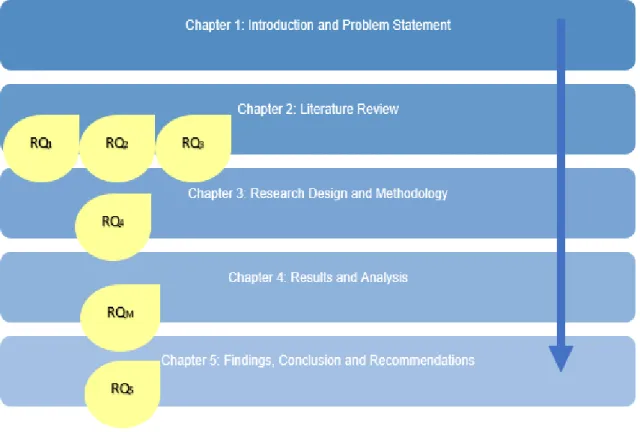
Chapter One, provides an introduction for the study and outlines the Research Problem, Research Questions and Research Objectives. Additionally, an overview of the study, together with its purpose, delimitation and significance are specified. This chapter includes the research alignment plan and the chapter outline for this treatise, which outlines the structure of the document and these are illustrated in Table 1.1 and Figure 1.2 respectively.
1.10.2 Chapter 2: Literature Review
In this chapter, numerous academic resources are explored to address the first three research questions together with the corresponding research objectives. Firstly, RQ1: What are the components of Loyalty Programmes? Which correlates to RO1: To investigate the general components of Loyalty Programmes through a review of terms and theories. Thereafter, RQ2: What components do Loyalty Programmes offer globally (internationally) and nationally? Which correlates to RO2: To investigate the components present in Loyalty Programmes globally (internationally) and nationally. Finally, RQ3: What components do Loyalty Programmes offer in different industries? Which correlates to RO3: To determine and propose the components that Loyalty Programmes should include across various industries. A conceptual model which
seeks to examine the determinants of Loyalty Programmes is proposed to conclude this chapter.
1.10.3 Chapter 3: Research Design and Methodology
In Chapter Three, various research philosophies and approaches are examined to develop an outline for this study to follow in terms of research design and methodology. Additionally, this chapter elaborates on the unit of analysis and participants of this study as well as discussing the data analysis methods that will be employed. In so doing, Chapter Three addresses RQ4: What research design will be used in this study? Which correlates to RO4: To establish the appropriate research design and methodology which will be used so that the study can be reproduced in the future.
1.10.4 Chapter 4: Results and Analysis
Chapter Four, presents, analyses and discusses the results of the empirical study. Data analyses was conducted using descriptive and inferential statistics, factor analysis and structural equation modelling. The results of these analyses are illustrated using various tables and charts, which present the data and findings. Hence, Chapter Four addresses the main research question: RQM: What are the components that Loyalty Programmes should include? which correlates to the main research objective: ROM: To determine the components that Loyalty Programmes should include. Thus, this chapter forms the foundation for Chapter Five.
1.10.5 Chapter 5: Findings, Conclusions and Recommendations
In Chapter Five begins with the findings of the study being presented. These findings are based on the results presented in Chapter Four. Thereafter, Chapter Five continues to make managerial recommendations based on the study findings and identifies the limitations present in this study. Additionally, any call for future research is outlined and finally, conclusions regarding the research problem identified in this chapter are drawn. Thus, Chapter five seeks to address RQ5:What recommendations can be formed to improve the design of Loyalty Programmes? Which correlates to RO5: To formulate recommendations that can be implemented by organisations who employ Loyalty Programmes.
Figure 1.2 below outlines the structure and layout of this treatise.
Figure 1.2: Chapter outline for this treatise.
1.11 SUMMARY
In this chapter, the topic of the study is introduced together with a definition and clarification of the main research problem as well as the research questions and research objectives that this study will seek to address. The section that follows highlights the research methodology that will be used in this study as well as a brief discussion of the delimitation and significance of the research. An introductory discussion of the methods of data collection and analysis proposed to be conducted in this study are then discussed together with a brief overview of the ethical requirements that were adhered to as a requirement to conduct this study, as is stipulated by the Nelson Mandela University.
In the latter half of this chapter, a report structure is found as well as the research alignment plan. This research alignment plan will be used and illustrated in all subsequent chapters to highlight the research question/s and research objective/s that are addressed in these chapters. The chapter that follows, Chapter Two, will discuss the first three research questions together with their corresponding research
objectives. This discussion will be achieved through an exploration and review of relevant literature.
CHAPTER TWO
LITERATURE REVIEW 2.1 INTRODUCTION
The purpose of this study, together with the main research objectives and research questions were outlined in the preceding chapter, Chapter One. In Chapter Two, the main focus is the review of literature pertaining to Loyalty Programmes. The primary objective of this study is to make recommendations on how to improve customer Loyalty Programmes by investigating the main components of such programmes and proposing how the design of Loyalty Programmes could be improved. To this end, this chapter sets out to, amongst other things, define and discuss the constructs of Loyalty Programmes, examine the theories associated with Loyalty Programmes and examine the determinants of Loyalty Programmes. In addition, global, continental, regional and local trends are discussed with the view of framing Loyalty Programmes and thus advance a proposed conceptual model to be used in this study. Hence, Chapter Two expands on the first three research questions as outlined in Chapter one.
Chapter two addresses RQ1, RQ2, RQ3 and their corresponding objectives RO1, RO2,
RO3thus this chapter addresses:
RQ1: What are the components of Loyalty Programmes? To correspond with RO1: To investigate the general components of Loyalty Programmes through a review of terms and theories.
RQ2: What components do Loyalty Programmes offer globally (internationally) and nationally? To respond to RO2: To investigate the components present in Loyalty Programmes globally (internationally) and nationally.
RQ3: What components do Loyalty Programmes offer in different industries? To address RO3: To determine and propose the components that Loyalty Programmes should include across various industries.
Source: Chapter Two Outline (Author’s own construct) Figure 2.1: Chapter Two Outline
2.2 DEFINITION OF LOYALTY PROGRAMMES
Loyalty Programmes have been in existence since the 18th century, in the form of copper tokens and thereafter the Sperry and Hutchinson Green Stamp programme (McCall, Voorhees and Calantone, 2010), which was extremely popular. Many other similar programmes based on a loyalty redemption strategy developed in the years that followed. Modern Loyalty Programmes started in the airline industry 28 years ago (Xie and Chen, 2013) and today the leaders in innovative Loyalty Programmes are arguable companies such as Starbucks, Walgreens and Amazon Prime (McCall, Voorhees and Calantone, 2010; Crowd Twist report, 2016).
Globally these companies lead the race among Loyalty Programmes (Brashear-Alejandro, Kang and Groza, 2016). Today Loyalty Programmes are about more than just points. The customers overall experience drives acceptance of any proposed
Loyalty Programme (Gomez, Arranz and Cillan, 2012; Mosavi and Ghaedi, 2012; Collins and Lau, 2017). This raises questions over the components needed to design a Loyalty Programme that will be competitive in the evolving customer market place (McCall, Voorhees and Calantone, 2010; Rese, Hundertmark, Schimmelpfennig and Schons, 2013; Wyman, 2015).
The vast array of loyalty building offerings classified as Loyalty Programmes makes any attempt at a unifying singular definition problematic. The defining characteristic of any Loyalty Programme is to reward and thereby promote an attitude and behaviour of loyalty from a buyer to a seller (Sharp and Sharp 1997, pp. 473 – 474; McCall, Voorhees and Calantone, 2010). Expanding or defining characteristics for Loyalty Programmes raises many challenges, hence a set of characteristics is proposed for offerings aimed at building loyalty. These should form the core in the design of a Loyalty Programme. The core features are:
The main focus should be to foster loyalty through the reward of members behavioural and or attitudinal loyalty to encourage repeat patronage (McCall, Voorhees and Calantone, 2010, pp.7-8; Dorotic, Bijmolt and Verhoef, 2012, p. 218; Jennings, Giorgio, Murali and Goggin, 2014, p. 9);
It should be a formal, structured arrangement with the customer, who must formally join the programme to obtain benefits, that is, it must be membership based (Dorotic, Bijmolt and Verhoef, 2012, p. 218; Estrella-Ramon, Sanchez-Perez, Swinnen and VanHoof, 2013, p. 55);
Membership is a long-term commitment from both engaging parties( Dorotic, Bijmolt and Verhoef, 2012, p. 218 ; Xie and Chen, 2013, p. 469; Dorotic, Verhoef, Fok and Bijmolt, 2014, p. 9);
There should be reward for loyalty for members, which is based in the current or future value of the buyer to the seller. The reward format can be variable but must be desirable and personalised to the buyer (Rese et al., 2013; Breugelmans et al., 2015; Breugelmans and Liu-Thompkins, 2017).
It must evolve tailoring marketing offers and efforts to match buyer preferences and may have various formats (redesign elements) (Dorotic, Bijmolt and Verhoef, 2012, p. 218; Jennings et al., 2014, p. 9; Breugelmans et al., 2015, p. 13).
2.2.1 The Nature of Loyalty
The Stanford Encyclopaedia of Philosophy (Kleinig, 2017) described the following characteristics to be the underpinning qualities of “loyalty”. Firstly, it is the practical temperament to persevere in a fundamentally valued associational attachment, however this is not a requisite. Secondly, there is an associated potential cost of commitment, where the aim of securing or at the very least protecting the interests or well-being of the object of loyalty has bearing. Finally, the association comes to be
valued for its own sake as well as for the sake of evoking a sense of identifying with the object as being part of you or yours.
Other affiliated characteristics of the leitmotif of loyalty identified by The Stanford Encyclopaedia of Philosophy (Kleinig, 2017), were that colloquially the term “loyalties” is often usedto express our “loyalty”. Loyalty is described as not just an affiliation but as a deeper associational relation based on groupings such as friends, family professions, country, etc. This deeper association promotes a willingness within the loyalist to expose themselves to additional risks or tolerate special burdens for the sake of these affiliates who are deemed socially valued. It must be noted, however that any association can become inherently important, regardless of its social value. The value of the association stems from the individual’s perception of the value, which leads to allocation of loyalty by the individual (2017).
The objective of any Loyalty Programme is to evoke loyalty from members toward their offerings. This objective is supported through customer relationship management (Sarwar, Abbasi and Pervaiz, 2012, pp. 30-32; Xie and Chen, 2013, p. 466). Members are drawn to join programmes through incentives in the form of rewards for participation (Ailawadi et al., 2010, p.281) and the offering of greater customer utility resulting from the interaction (Leenheer, van Heerde, Bijmolt and Smidts, 2003, Leenheer, van Heerde, Bijmolt and Smidts, 2007; Bazargan, Karray and Zolfaghari, 2017).
2.2.2 Dimensions of Loyalty
The understanding of the concept of Loyalty is best approached through an analysis of the scope of loyalty through a dimensional approach. This approach was initially
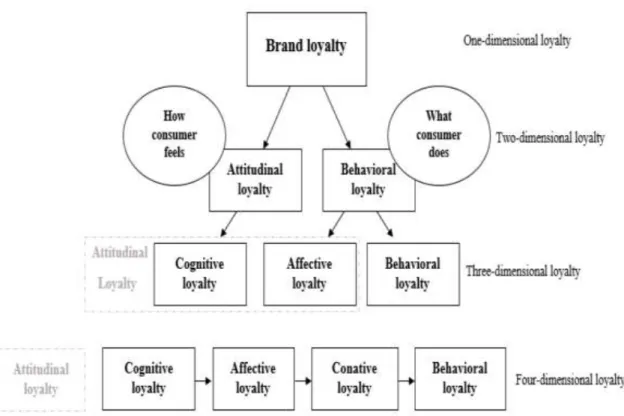
described by Day (1969) and then broadened by Dick and Basu (1994), Oliver, (1999), Khan (2009) and Worthington, Russell-Bennett and Hartel (2009). Consolidating these dimensions TaghiPourian and Bakhsh (2015, pp. 48-51) identified four dimensions to Loyalty illustrated in Figure 2.2 below.
Source: Loyalty: From Single-Stage Loyalty to Four-Stage Loyalty Mohammad TaghiPourian and Bakhsh (2015, p. 50)
Figure 2.2: Four-Dimensional Loyalty Algorithm
2.2.2.1 The Progression of the Dimensional Approach
The concept of One-dimensional loyalty (1970’s) is based on behavioural loyalty
theories that dominated this period and focused on the purchase patterns of (a) frequency, (b) pattern, (c) probability and (d) share of total purchase, to qualify/quantify loyalty to the brand and did not consider the role of reasoning.
The concept of Two-dimensional loyalty included attitudinal measures in the assessment of loyalty, incorporating customer’s actions and feelings. This aided the loyalty construct development in two ways (a) conceptualisation and (b) measurement (Day, 1969).
The concept of Three or Tri dimensional loyalty (1994 - 2009) Dick and Basu (1994) developed Three-dimensional loyalty to describe the customer loyalty relationship, which appeared to be mediated through both situational factors as well as social norms. The relationship further had a cognitive, affective and conative background in addition to the motivational, perceptual and behavioural consequences. Dick and Basu (1994) proposed attitude and shopping behaviour of customers could be categorised into four (4) groups, which are described as follows:
1. True Loyalists - this group exhibited both a high attitudinal loyalty as well as strong behavioural loyalty;
2. Latent Loyalists - this group exhibited high attitudinal loyalty however had low behavioural loyalty;
3. Ingenuine Loyalists - this group exhibited low attitudinal loyalty but were characterised by having high behavioural loyalty; and
4. Non-Loyalists - this group exhibited both low attitudinal and low behavioural loyalty.
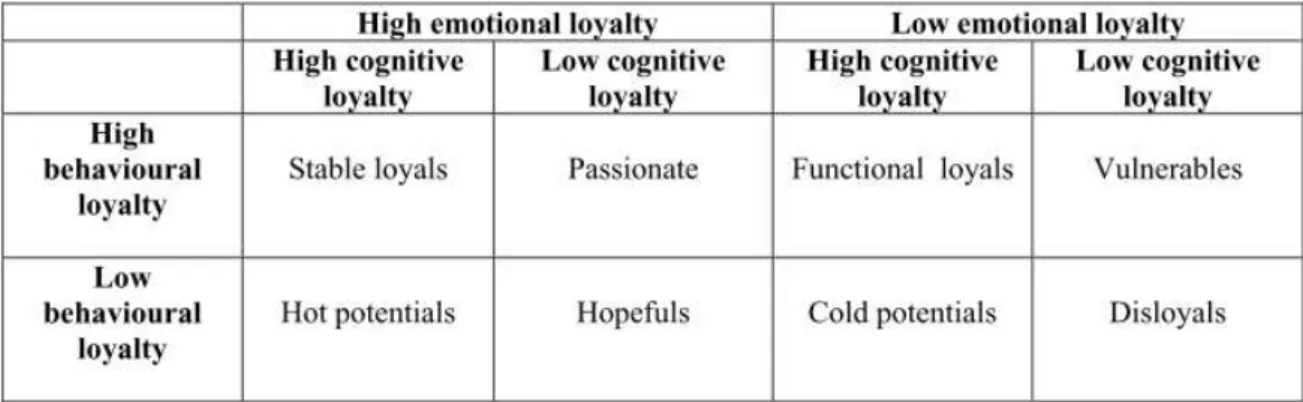
Tri dimensional Loyalty proposed by Worthington, Russell-Bennett and Hartel (2009) included two other components under attitudinal loyalty in addition to behavioural loyalty. These components are (a) emotional loyalty and (b) cognitive loyalty and in so doing introduced the concept of intensity to the dimensional view of loyalty. Worthington et al. (2009, p. 6, p. 22) tabulated combinations based on the three dimensions of brand loyalty and proposed this table as a tool for auditing brand loyalty illustrated in Table 2.1. Worthington, Russell-Bennett and Hartel (2009) proposed that the sequential implementation of each dimension was not necessary however, if the response to a particular hierarchical sequence was proven, it would be prudent to follow suit from both a cost and efficiency perspective.
Table 2.1: Brand Audit Table Based on Tri-Dimensional Loyalty
Source: Worthington et al. (2009, p. 6, p. 22)
The concept of Four-dimensional loyalty, which expanded the previous models proposed by Oliver (1999) derived that customer loyalty is formed in a successive manner initiated by attitudinal loyalty, progressing to behavioural loyalty. In this progressive manner cognitive loyalty progresses to affective loyalty to conative loyalty and ends with the act of loyalty (Oliver, 1999; Khan, 2009).
The dimensional frameworks in Table 2.2 summarise the contributions of TaghiPourian and Bakhsh, (2015); Worthington, Russell-Bennett and Hartel, (2009); Oliver (1999) and Dick and Basu, (1994) and highlight the significance of both situational influencers as well as social norms and the modulating effect it has on the actions of purchasers’ behaviour. The managerial implication from this is the role it should play when structuring and designing offerings to appeal positively to these emotional motivators of customers. Table 2.2 below expands on how appealing to the various attitudinal aspects build customer loyalty.
Table 2.2: Four-Dimensional Loyalty, Stages of Attitudinal Loyalty Stages of Attitudinal Loyalty Cognitive Loyalty (Belief) Affective Loyalty (Emotions) Conative Loyalty (Intention) Action Loyalty (Behaviour) Motivator Information based brand loyalty Pleasantness associated with using the brand
Repeated formation of positive feelings
Intentions built up through the earlier stages translates into a greater willingness to act Depth of loyalty Superficial-performance based Emotional attachment Based Commitment intention to purchase further Intention converted to action despite possible obstacles Progression Resultant form Attraction to commitment Deep commitment to brand Action
Source: Adapted from Oliver(1999) and TaghiPourian and Bakhsh (2015)
Through an application of loyalty dimensional frameworks, Steyn, Pitt, Strasheim, Boshoff and Abratts (2010) studied Asian customers, to evaluate the impact of the perceptions of benefits on the participants’ feelings towards a Loyalty Programme and the resultant attitude towards the provider of that Loyalty Programme. This study revealed concurrent structural relations between the following items (a) perceived benefit, (b) emotional feelings and (c) loyalty behaviours. The significant findings of the study by Dorotic et al. (2014) were that Loyalty Programmes had a small overall positive effect on customer behaviour. Loyalty Programmes did improve loyalty but only significantly changed the behaviour of a minority of customers. The sustainability of Loyalty Programmes emanated from reinforcement of attitudinal attachment together with behavioural loyalty (Dorotic et al., 2014).
In a study of casino reward club members, Tanford and Baloglu (2013) demonstrated that loyal customers express high attitudinal and behavioural loyalty. Inactive but loyal patrons exhibited favourable attitudes, however this translated to low patronage perhaps due in part to income limitations (Tanford and Baloglu, 2013). The group who were not genuinely loyal demonstrated high behavioural loyalty but showed very low attitudinal loyalty, rather placing emphasis on the attainment of the reward programme