The Auditor-General ANAO Report No.18 2014–15
Performance Audit
The Ethanol Production Grants Program
Department of Industry and Science
ANAO Report No.18 2014–15
The Ethanol Production Grants Program 2
© Commonwealth of Australia 2015
ISSN 1036–7632 (Print) ISSN 2203–0352 (Online) ISBN 0 642 81540 2 (Print) ISBN 0 642 81541 0 (Online) Except for the content in this document supplied by third parties, the Australian National Audit Office logo, the Commonwealth Coat of Arms, and any material protected by a trade mark, this document is licensed by the Australian National Audit Office for use under the terms of a Creative Commons Attribution‐NonCommercial‐ NoDerivatives 3.0 Australia licence. To view a copy of this licence, visit http://creativecommons.org/licenses/by‐nc‐nd/3.0/au/. You are free to copy and communicate the document in its current form for non‐commercial purposes, as long as you attribute the document to the Australian National Audit Office and abide by the other licence terms. You may not alter or adapt the work in any way. Permission to use material for which the copyright is owned by a third party must be sought from the relevant copyright owner. As far as practicable, such material will be clearly labelled. For terms of use of the Commonwealth Coat of Arms, visit the It’s an Honour website at http://www.itsanhonour.gov.au/. Requests and inquiries concerning reproduction and rights should be addressed to: Executive Director Corporate Management Branch Australian National Audit Office 19 National Circuit BARTON ACT 2600 Or via email: [email protected].ANAO Report No.18 2014–15
The Ethanol Production Grants Program
© Commonwealth of Australia 2015
ISSN 1036–7632 (Print) ISSN 2203–0352 (Online) ISBN 0 642 81540 2 (Print) ISBN 0 642 81541 0 (Online) Except for the content in this document supplied by third parties, the Australian National Audit Office logo, the Commonwealth Coat of Arms, and any material protected by a trade mark, this document is licensed by the Australian National Audit Office for use under the terms of a Creative Commons Attribution‐NonCommercial‐ NoDerivatives 3.0 Australia licence. To view a copy of this licence, visit http://creativecommons.org/licenses/by‐nc‐nd/3.0/au/. You are free to copy and communicate the document in its current form for non‐commercial purposes, as long as you attribute the document to the Australian National Audit Office and abide by the other licence terms. You may not alter or adapt the work in any way. Permission to use material for which the copyright is owned by a third party must be sought from the relevant copyright owner. As far as practicable, such material will be clearly labelled. For terms of use of the Commonwealth Coat of Arms, visit the It’s an Honour website at http://www.itsanhonour.gov.au/. Requests and inquiries concerning reproduction and rights should be addressed to: Executive Director Corporate Management Branch Australian National Audit Office 19 National Circuit BARTON ACT 2600 Or via email: [email protected].ANAO Report No.18 2014–15 The Ethanol Production Grants Program
Canberra ACT
28 January 2015
Dear Mr President
Dear Madam Speaker
The Australian National Audit Office has undertaken an independent
performance audit in the Department of Industry and Science titled
The
Ethanol Production Grants Program.
The audit was conducted in
accordance with the authority contained in the
Auditor-General Act
1997
. Pursuant to Senate Standing Order 166 relating to the
presentation of documents when the Senate is not sitting, I present the
report of this audit to the Parliament.
Following its presentation and receipt, the report will be placed on the
Australian National Audit Office’s website—http://www.anao.gov.au.
Yours sincerely
Ian McPhee
Auditor-General
The Honourable the President of the Senate
The Honourable the Speaker of the House of Representatives
Parliament House
Canberra ACT
ANAO Report No.18 2014–15
The Ethanol Production Grants Program 4 AUDITING FOR AUSTRALIA The Auditor‐General is head of the Australian National Audit Office (ANAO). The ANAO assists the Auditor‐General to carry out his duties under the Auditor‐General Act 1997 to undertake performance audits, financial statement audits and assurance reviews of Commonwealth public sector bodies and to provide independent reports and advice for the Parliament, the Australian Government and the community. The aim is to improve Commonwealth public sector administration and accountability. For further information contact: The Publications Manager Australian National Audit Office GPO Box 707 Canberra ACT 2601 Phone: (02) 6203 7505 Fax: (02) 6203 7519 Email: [email protected] ANAO audit reports and information about the ANAO are available on our website: http://www.anao.gov.au
Audit Team Julian Mallett Chris Preston Debbie Moore Donna Burton
ANAO Report No.18 2014–15 The Ethanol Production Grants Program
Contents
Abbreviations ... 7 Glossary ... 8 Summary ... 9 Summary ... 11 Introduction ... 11The Ethanol Production Grants Program ... 11
Audit approach ... 15
Overall conclusion ... 16
Key findings by chapter ... 18
Summary of entity responses ... 22
Audit Findings ... 23
1. Introduction ... 25
Background ... 25
Australian Government support for ethanol production ... 26
Overview of the Ethanol Production Grants Program (EPGP) ... 27
The Australian Government’s grants administration framework ... 32
Audit objective, criteria, methodology and scope ... 33
2. Program Objectives ... 36
Introduction ... 36
Phase 1 – Establishment (2002–2003) ... 37
Phase 2 - First extension ... 39
Phase 3 - Second extension (2008-June 2011) ... 41
Phase 4 - Third extension (July 2011- June 2021) ... 43
Phase 5 – Closure (2014-June 2015) ... 44
Progress towards achieving EPGP program objectives ... 44
Conclusion ... 47
3. Program Administration... 49
Introduction ... 49
Program planning and design ... 50
Program guidelines and procedures ... 51
Application and assessment ... 54
Funding arrangements ... 56
Claims for payment and monitoring compliance ... 57
Program reporting ... 60
Conclusion ... 63
ANAO Report No.18 2014–15
The Ethanol Production Grants Program
AUDITING FOR AUSTRALIA The Auditor‐General is head of the Australian National Audit Office (ANAO). The ANAO assists the Auditor‐General to carry out his duties under the Auditor‐General Act 1997 to undertake performance audits, financial statement audits and assurance reviews of Commonwealth public sector bodies and to provide independent reports and advice for the Parliament, the Australian Government and the community. The aim is to improve Commonwealth public sector administration and accountability. For further information contact: The Publications Manager Australian National Audit Office GPO Box 707 Canberra ACT 2601 Phone: (02) 6203 7505 Fax: (02) 6203 7519 Email: [email protected] ANAO audit reports and information about the ANAO are available on our website: http://www.anao.gov.au
Audit Team Julian Mallett Chris Preston Debbie Moore Donna Burton
ANAO Report No.18 2014–15
The Ethanol Production Grants Program 6
Appendices ... 67
Appendix 1: Entity Response ... 69
Appendix 2: International Support For Ethanol Production ... 70
Appendix 3: Ethanol Production Grants Program Key Performance Indicators ... 72
Index ... 76
Series Titles ... 77
Better Practice Guides ... 80
Tables Table 1.1: EPGP grant recipients and amounts, 2002–03 to 2013–14 ... 30
Table 1.2: Report structure ... 35
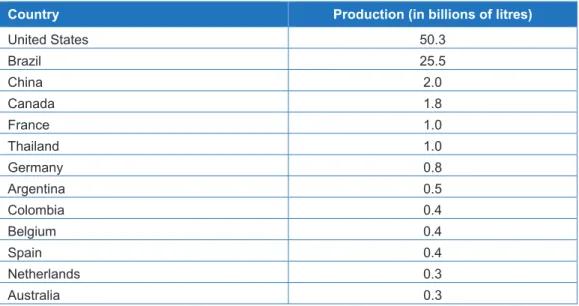
Table A.1: Ethanol global production, 2013 ... 70
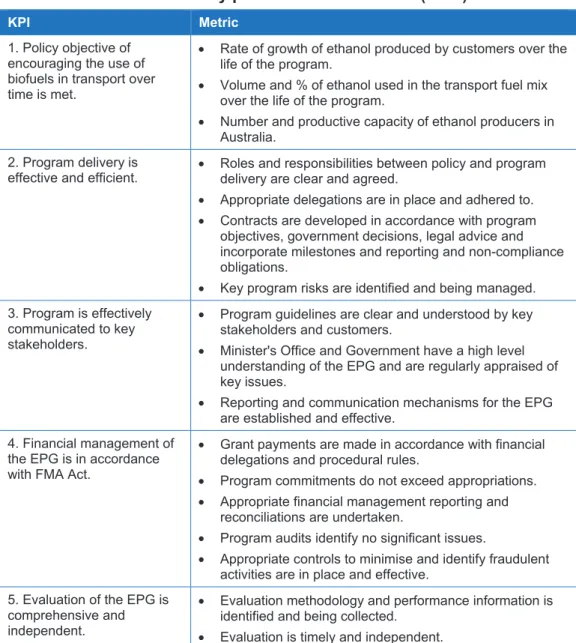
Table A.2: 2009 EPGP Key performance indicators (KPIs)... 72
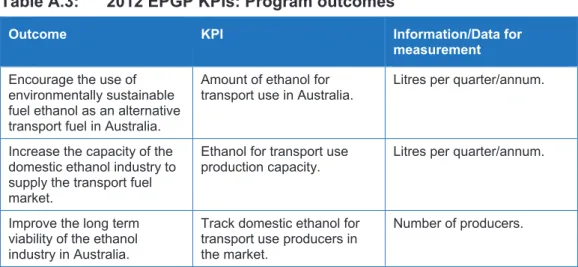
Table A.3: 2012 EPGP KPIs: Program outcomes ... 73
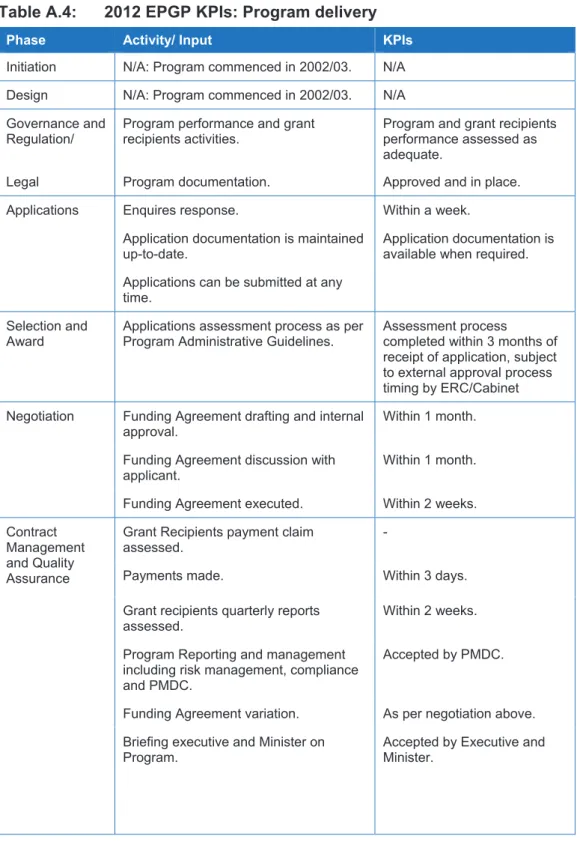
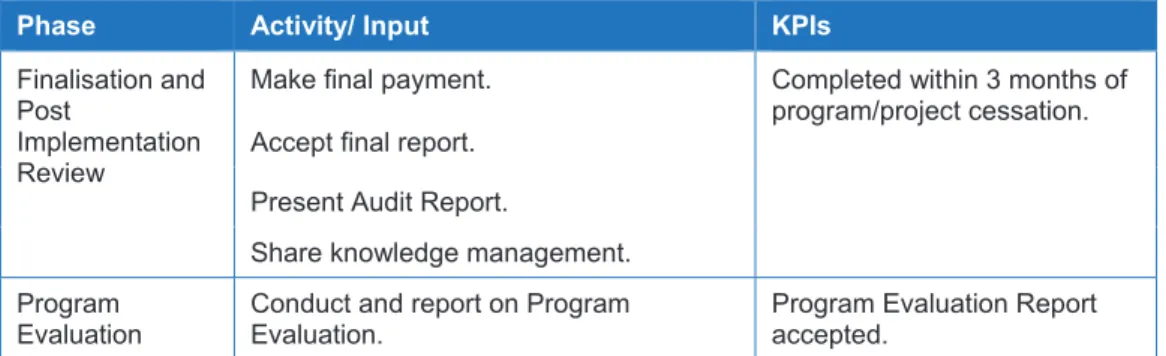
Table A.4: 2012 EPGP KPIs: Program delivery ... 74
Figures Figure S.1: EPGP key decision points and administering departments ... 14
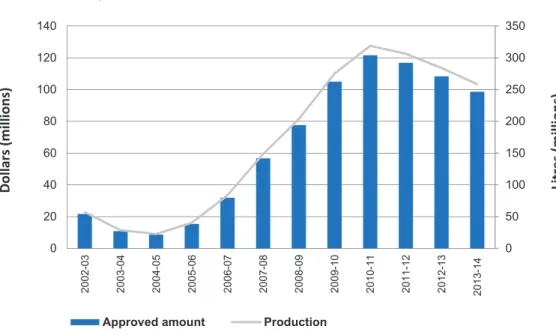
Figure 1.1: Ethanol Production Grants Program: grant payments and production, 2002–03 to 2013–14 ... 29
Figure 1.2: EPGP key decision points and administering departments ... 31
ANAO Report No.18 2014–15
The Ethanol Production Grants Program
Appendices ... 67
Appendix 1: Entity Response ... 69
Appendix 2: International Support For Ethanol Production ... 70
Appendix 3: Ethanol Production Grants Program Key Performance Indicators ... 72
Index ... 76
Series Titles ... 77
Better Practice Guides ... 80
Tables Table 1.1: EPGP grant recipients and amounts, 2002–03 to 2013–14 ... 30
Table 1.2: Report structure ... 35
Table A.1: Ethanol global production, 2013 ... 70
Table A.2: 2009 EPGP Key performance indicators (KPIs)... 72
Table A.3: 2012 EPGP KPIs: Program outcomes ... 73
Table A.4: 2012 EPGP KPIs: Program delivery ... 74
Figures Figure S.1: EPGP key decision points and administering departments ... 14
Figure 1.1: Ethanol Production Grants Program: grant payments and production, 2002–03 to 2013–14 ... 29
Figure 1.2: EPGP key decision points and administering departments ... 31
ANAO Report No.18 2014–15 The Ethanol Production Grants Program
Abbreviations
ABARE Australian Bureau of Agricultural and Resource Economics (now The Australian Bureau of Agricultural and Resource Economics and Sciences) ATO Australian Taxation Office BCGP Biofuels Capital Grants Program BREE Bureau of Resources and Energy Economics BTRE Bureau of Transport and Regional Economics CGGs Commonwealth Grant Guidelines CNG Compressed Natural Gas CSIRO Commonwealth Scientific and Industrial Research Organisation DITR Department of Industry, Tourism and Resources EDP Ethanol Distribution Program EPGP Ethanol Production Grants Program KPI Key Performance Indicator LNG Liquefied Natural Gas LPG Liquefied Petroleum Gas PM&C Department of the Prime Minister and Cabinet RET Department of Resources, Energy and TourismANAO Report No.18 2014–15
The Ethanol Production Grants Program 8
Glossary
Biofuel Liquid fuel derived from biological material such as waste plant and animal matter. The two main types of biofuels are biodiesel and ethanol. E10 A blend of 10 per cent ethanol and 90 per cent petrol E100 Pure ethanol fuelANAO Report No.18 2014–15 The Ethanol Production Grants Program 9
ANAO Report No.18 2014–15 The Ethanol Production Grants Program
ANAO Report No.18 2014–15 The Ethanol Production Grants Program
Summary
Introduction
1. Ethanol or ethyl alcohol (molecular formula C2H5OH) is a colourless liquid and is the principal form (and intoxicating agent) of alcohol found in alcoholic beverages. It can also be used as a solvent, an antiseptic and as a fuel. When used as a fuel, it can either be used ‘neat’ (known as E100) or blended with petrol. In Australia, ethanol is typically blended with petrol at a concentration of 10 per cent ethanol and 90 per cent petrol—known as E10. Most modern vehicles available in Australia can operate successfully on E10; at concentrations higher than this, engines may require modification.
2. Since 1980, successive Australian governments have introduced initiatives aimed at assisting the development of an Australian ethanol industry1, including the Ethanol Bounty which operated from 1994—1996 and the Ethanol Production Grants Program from 2002 to the present. In addition to industry development, other indirect outcomes—such as regional development, environmental and health benefits—were also advanced in support of domestically‐produced ethanol as a fuel.
The Ethanol Production Grants Program
3. In September 2002, the then Prime Minister, the Hon. John Howard MP, announced that as part of a strategy to encourage the use of biofuels in transport, the Australian Government would abolish the exemption from fuel excise for ethanol and impose an excise at the same rate as for petrol (38.143 cents per litre). At the same time, the Government introduced a ‘production subsidy’ to be paid to producers of ethanol in Australia (but not to importers of ethanol). For existing Australian producers of ethanol, the effect of this government decision was that while they would be required to pay the excise to the Australian Taxation Office (ATO), they would then be reimbursed in full through the Ethanol Production Grants Program (EPGP). 4. When the EPGP was first established, program documentation did not include explicit objectives or outcomes, but referred to the terms of the Prime
1 These have included exemption of ethanol from excise (1980); introduction of an ethanol bounty (1994); the Biofuels Capital Grants Program (BCGP) (2003); the Ethanol Distribution Program (EDP) (2006); and the Ethanol Production Grants Program (EPGP) (2002).
ANAO Report No.18 2014–15
The Ethanol Production Grants Program 12
Minister’s media release when announcing the program. A specific Program objective and outcomes were introduced in July 2012 in the following terms:
Program objective
The objective of the Program is to support production and deployment of ethanol as a sustainable transport fuel in Australia. The Program will provide fuel excise reimbursement of 38.143 cents per litre for ethanol produced and supplied for transport use in Australia from locally derived feedstocks. Program outcome The intended outcome of the Program is to: (a) Encourage the use of environmentally sustainable fuel ethanol as an alternative transport fuel in Australia; (b) Increase the capacity of the ethanol industry to supply the transport fuel market; and (c) Improve the long term viability of the ethanol industry in Australia. 5. The EPGP is a demand‐driven grants program. Eligible producers that have a funding agreement with the Commonwealth are reimbursed for excise paid to the ATO, usually on a weekly basis. To be eligible for grants under the EPGP, applicants must: be an Australian entity incorporated under the Corporations Act 2001; produce and supply ‘eligible ethanol’2; and not have been named as an entity that has not complied with the Equal Opportunity for Women in the Workplace Act 1999.3 6. Applications for funding can be submitted for assessment at any time. Under all EPGP program guidelines, approved by the relevant Minister at certain times, authority for making decisions on program eligibility and funding has been delegated to departmental officials. The EPGP program
2 ‘Eligible ethanol’ is defined in the EPGP’s administrative guidelines as ethanol produced in Australia from biomass feedstock or urban waste on which excise has been paid to the Australian Taxation Office and does not include any ethanol that has been imported into Australia.
3 This Act imposes certain obligations on employers in order to improve gender equality outcomes within their workplaces. Employers which fail to meet their obligations may be named in Parliament and, consistent with the Australian Government’s Procurement Rules, will not be permitted to enter into contracts with the Australian Government.
Summary
ANAO Report No.18 2014–15 The Ethanol Production Grants Program 13
guidelines provide that the program must be administered in accordance with the Australian Government’s financial management and accountability framework, including the Commonwealth Grant Guidelines.4
7. When first introduced, the EPGP was administered by the then Department of Industry, Tourism and Resources, and later by the then Department of Resources, Energy and Tourism (RET). At the time of this audit, the program was administered by the Department of Industry and Science (Industry).5 For simplicity, the title ‘Industry’ will be used throughout this report to refer to the present administering department as well as its predecessors, unless otherwise specified.
8. Since its introduction in 2002, originally as a short‐term subsidy ‘while longer term arrangements are considered by the government’, the EPGP has been extended three times: in 2003, 2004 and 2011. Figure S.1 shows a timeline of the EPGP, key decision points for each phase and the administering departments over time.
4 EPGP Program Administrative Guidelines, paragraph 8.2, 12 June 2014; EPGP Program Administrative Guidelines, paragraph 8.2, July 2012. The November 2011 program guidelines also noted that the program would be administered ‘in accordance with Commonwealth grants requirements’, p. 5.
5 There have been a range of entities involved in both the administration and policy aspects of the EPGP. When the EPGP was established, the Prime Minister announced that it would be administered by the then Department of Industry, Tourism and Resources (DITR), with delivery of the program carried out by AusIndustry (a division of DITR). Following the November 2007 election and
consequent Machinery of Government changes, the newly-created Department of Resources, Energy and Tourism (RET) assumed policy responsibility for the EPGP, with AusIndustry continuing to perform the program delivery role. From December 2011, RET assumed both policy and program delivery responsibilities for the EPGP. After the September 2013 election, RET was abolished and its resources and energy functions, including the EPGP, were transferred to the Department of Industry. In December 2014, the department was renamed the Department of Industry and Science.
ANAO Report No.18 2014–15
The Ethanol Production Grants Program
Minister’s media release when announcing the program. A specific Program objective and outcomes were introduced in July 2012 in the following terms:
Program objective
The objective of the Program is to support production and deployment of ethanol as a sustainable transport fuel in Australia. The Program will provide fuel excise reimbursement of 38.143 cents per litre for ethanol produced and supplied for transport use in Australia from locally derived feedstocks. Program outcome The intended outcome of the Program is to: (a) Encourage the use of environmentally sustainable fuel ethanol as an alternative transport fuel in Australia; (b) Increase the capacity of the ethanol industry to supply the transport fuel market; and (c) Improve the long term viability of the ethanol industry in Australia. 5. The EPGP is a demand‐driven grants program. Eligible producers that have a funding agreement with the Commonwealth are reimbursed for excise paid to the ATO, usually on a weekly basis. To be eligible for grants under the EPGP, applicants must: be an Australian entity incorporated under the Corporations Act 2001; produce and supply ‘eligible ethanol’2; and not have been named as an entity that has not complied with the Equal Opportunity for Women in the Workplace Act 1999.3 6. Applications for funding can be submitted for assessment at any time. Under all EPGP program guidelines, approved by the relevant Minister at certain times, authority for making decisions on program eligibility and funding has been delegated to departmental officials. The EPGP program
2 ‘Eligible ethanol’ is defined in the EPGP’s administrative guidelines as ethanol produced in Australia from biomass feedstock or urban waste on which excise has been paid to the Australian Taxation Office and does not include any ethanol that has been imported into Australia.
3 This Act imposes certain obligations on employers in order to improve gender equality outcomes within their workplaces. Employers which fail to meet their obligations may be named in Parliament and, consistent with the Australian Government’s Procurement Rules, will not be permitted to enter into contracts with the Australian Government.
Summary
ANAO Report No.18 2014–15 The Ethanol Production Grants Program 13
guidelines provide that the program must be administered in accordance with the Australian Government’s financial management and accountability framework, including the Commonwealth Grant Guidelines.4
7. When first introduced, the EPGP was administered by the then Department of Industry, Tourism and Resources, and later by the then Department of Resources, Energy and Tourism (RET). At the time of this audit, the program was administered by the Department of Industry and Science (Industry).5 For simplicity, the title ‘Industry’ will be used throughout this report to refer to the present administering department as well as its predecessors, unless otherwise specified.
8. Since its introduction in 2002, originally as a short‐term subsidy ‘while longer term arrangements are considered by the government’, the EPGP has been extended three times: in 2003, 2004 and 2011. Figure S.1 shows a timeline of the EPGP, key decision points for each phase and the administering departments over time.
4 EPGP Program Administrative Guidelines, paragraph 8.2, 12 June 2014; EPGP Program Administrative Guidelines, paragraph 8.2, July 2012. The November 2011 program guidelines also noted that the program would be administered ‘in accordance with Commonwealth grants requirements’, p. 5.
5 There have been a range of entities involved in both the administration and policy aspects of the EPGP. When the EPGP was established, the Prime Minister announced that it would be administered by the then Department of Industry, Tourism and Resources (DITR), with delivery of the program carried out by AusIndustry (a division of DITR). Following the November 2007 election and
consequent Machinery of Government changes, the newly-created Department of Resources, Energy and Tourism (RET) assumed policy responsibility for the EPGP, with AusIndustry continuing to perform the program delivery role. From December 2011, RET assumed both policy and program delivery responsibilities for the EPGP. After the September 2013 election, RET was abolished and its resources and energy functions, including the EPGP, were transferred to the Department of Industry. In December 2014, the department was renamed the Department of Industry and Science.
ANAO Report No.18 2014–15
The Ethanol Production Grants Program 14
Figure S.1: EPGP key decision points and administering departments
Source: ANAO.
9. The EPGP has had five participants. When the program commenced, it had two initial participants, increasing to five participants for a single year (2008–09), then declining and remaining at three participants since. Between 2002–03 and 2013–14, one participant (Honan Holdings Pty Ltd) received $543.4 million (70.2 per cent of all program funding).
10. At a number of key program phases, reviews of the EPGP have been commissioned. In February 2014, an assessment by the Bureau of Resources and Energy Economics (BREE)6, a unit within Industry, found that:
while the annual cost of the program had been significant, regional employment and greenhouse gas abatement benefits had been modest;
the health benefits that accrue from reduced air pollution are also modest and declining;
there would appear to be no net benefit for agricultural producers;
while the program supported an additional lower priced fuel product, the benefits to motorists were less than they should have been; and
there was no evidence that provision of support for the Australian ethanol industry provided downward pressure on petrol prices.
6 BREE, An assessment of key costs and benefits associated with the Ethanol Production Grants program, February 2014.
ANAO Report No.18 2014–15
The Ethanol Production Grants Program
Figure S.1: EPGP key decision points and administering departments
Source: ANAO.
9. The EPGP has had five participants. When the program commenced, it had two initial participants, increasing to five participants for a single year (2008–09), then declining and remaining at three participants since. Between 2002–03 and 2013–14, one participant (Honan Holdings Pty Ltd) received $543.4 million (70.2 per cent of all program funding).
10. At a number of key program phases, reviews of the EPGP have been commissioned. In February 2014, an assessment by the Bureau of Resources and Energy Economics (BREE)6, a unit within Industry, found that:
while the annual cost of the program had been significant, regional employment and greenhouse gas abatement benefits had been modest;
the health benefits that accrue from reduced air pollution are also modest and declining;
there would appear to be no net benefit for agricultural producers;
while the program supported an additional lower priced fuel product, the benefits to motorists were less than they should have been; and
there was no evidence that provision of support for the Australian ethanol industry provided downward pressure on petrol prices.
6 BREE, An assessment of key costs and benefits associated with the Ethanol Production Grants program, February 2014.
Summary
ANAO Report No.18 2014–15 The Ethanol Production Grants Program
11. In the 2014–15 Budget, the Government announced the closure of the EPGP, and program payments will cease with effect from 1 July 2015. In parallel, the fuel excise on domestically produced ethanol will be reduced to zero from 1 July 2015 and then increase by 2.5 cents per litre per year for five years from 1 July 2016 until it reaches 12.5 cents per litre.
12. The Australian Government’s total expenditure on the EPGP program since 2002–03, including estimated costs in 2014‐15, is expected to be some $895 million.7
Audit approach
Objective, criteria and scope
13. The objective of the audit was to examine the effectiveness of Industry’s administration of the EPGP, including relevant advice on policy development. 14. To form a conclusion against the objective, the following high level audit criteria were used:
the grant application process was accessible and attracted high quality applications;
the assessment process adopted was consistent, transparent and cost effective;
advice to the delegate was complete and robust and funding decisions were sound;
funding distribution is consistent with the program’s objectives and appropriate arrangements are in place to manage successful projects;
appropriate monitoring and reporting arrangements are in place; and
relevant government entities provided sound advice to assist with policy development and government decision making.
15. The ANAO examined program administration since 2007–08, given the difficulty in identifying and locating detailed records relating to the program’s early administration. However, the ANAO’s examination of the policy development process and decisions by government covers the period from the
7 This includes actual expenditure of $773.1 million between 2002 and 2013–14 and $122.1 million in estimated expenditure in 2014–15.
ANAO Report No.18 2014–15
The Ethanol Production Grants Program 16
EPGP’s establishment in 2002. The ANAO does not have a role in commenting on the merits of government policy.
16. This audit does not involve an assessment of the administration of other (non‐EPGP) government initiatives to support the Australian ethanol industry, except to the extent necessary for an understanding of the history of the EPGP.
Methodology
17. In conducting the audit, the ANAO reviewed: documents of the departments of Industry and Science, the Prime Minister and Cabinet, the Treasury and Finance, including policy documents, ministerial correspondence, reports, guidelines and operational documents; examined relevant Cabinet submissions, memoranda and decisions; interviewed departmental staff; and examined the grants administration process. The ANAO also invited EPGP recipients (see Table 1.1) to provide representations about their experience as grant recipients and, in particular, Industry’s administration of the program; however, no submissions were received.
Overall conclusion
18. Originally introduced in 2002‐03 as a short term (12 month) subsidy payable to eligible domestic ethanol producers, the Ethanol Production Grants Program (EPGP) was extended by successive Australian Governments and will end on 30 June 2015 at a cost to the Commonwealth of some $895 million over the program’s life. The key program objective was to support the production and deployment of ethanol produced from locally derived feedstocks as a sustainable transport fuel in Australia. Intended outcomes were to: improve the long term viability of the ethanol industry in Australia; increase the capacity of the ethanol industry to supply the transport fuel market; and encourage the use of environmentally sustainable fuel ethanol as an alternative transport fuel in Australia. Five program participants have received financial assistance under the EPGP, which is a grants program currently administered by Industry.
19. Overall, Industryʹs administration of the EPGP since 2007‐08, the period examined in this performance audit, has been generally effective. EPGP program arrangements were generally fit for purpose and largely consistent with the Australian Governmentʹs grants administration framework. The department also implemented a sound arrangement for monitoring grant recipientsʹ compliance with key program requirements. Had the program
ANAO Report No.18 2014–15
The Ethanol Production Grants Program
EPGP’s establishment in 2002. The ANAO does not have a role in commenting on the merits of government policy.
16. This audit does not involve an assessment of the administration of other (non‐EPGP) government initiatives to support the Australian ethanol industry, except to the extent necessary for an understanding of the history of the EPGP.
Methodology
17. In conducting the audit, the ANAO reviewed: documents of the departments of Industry and Science, the Prime Minister and Cabinet, the Treasury and Finance, including policy documents, ministerial correspondence, reports, guidelines and operational documents; examined relevant Cabinet submissions, memoranda and decisions; interviewed departmental staff; and examined the grants administration process. The ANAO also invited EPGP recipients (see Table 1.1) to provide representations about their experience as grant recipients and, in particular, Industry’s administration of the program; however, no submissions were received.
Overall conclusion
18. Originally introduced in 2002‐03 as a short term (12 month) subsidy payable to eligible domestic ethanol producers, the Ethanol Production Grants Program (EPGP) was extended by successive Australian Governments and will end on 30 June 2015 at a cost to the Commonwealth of some $895 million over the program’s life. The key program objective was to support the production and deployment of ethanol produced from locally derived feedstocks as a sustainable transport fuel in Australia. Intended outcomes were to: improve the long term viability of the ethanol industry in Australia; increase the capacity of the ethanol industry to supply the transport fuel market; and encourage the use of environmentally sustainable fuel ethanol as an alternative transport fuel in Australia. Five program participants have received financial assistance under the EPGP, which is a grants program currently administered by Industry.
19. Overall, Industryʹs administration of the EPGP since 2007‐08, the period examined in this performance audit, has been generally effective. EPGP program arrangements were generally fit for purpose and largely consistent with the Australian Governmentʹs grants administration framework. The department also implemented a sound arrangement for monitoring grant recipientsʹ compliance with key program requirements. Had the program
Summary
ANAO Report No.18 2014–15 The Ethanol Production Grants Program
continued beyond its planned closure in 2014‐15, there would have been opportunities for the department to improve its public performance reporting on achievement against the program’s objectives and outcomes, which is currently limited to reporting on the number of companies that receive payments under the program.
20. The Australian Governmentʹs recent decision to close the EPGP was informed by a consistent body of analysis and advice—provided to successive governments since the programʹs earliest days—drawing attention to shortcomings in the overall policy approach and the likelihood that program costs would exceed benefits. Prior to the EPGPʹs establishment and at key decision points, the administering department and central co‐ordinating agencies8 offered candid advice on value for money, drawing on past Australian and international experience and the findings of two key reviews (in 2008 and 2014) which had concluded that the benefits of the program were modest and had come at a high cost. These assessments of value for money are underlined by the programʹs limited success in achieving key objectives and outcomes. After 12 years of operation and some $895 million in government support directed towards improving the long‐term viability of the domestic ethanol industry, in 2014 only three domestic producers (up from two in 2002) were operating,9 and an expanded Australian ethanol industry based on market priced feedstock was considered unlikely to be commercially viable in the absence of the EPG rebate.10
21. The ANAO has not made recommendations in this audit, as the EPGP is scheduled to close from 30 June 2015. While there was scope for the administering departments to develop a more effective performance reporting framework as a basis for assessing outcomes, Industry and the central agencies did provide candid advice to government on the modest performance of the program against its objectives, drawing on Australian and international experience and two reviews of the program; with decisions to continue the program until 2014–15 made by successive governments.
8 The Department of the Prime Minister and Cabinet, the Treasury and the Department of Finance. 9 In 2002–03, it was suggested that up to a further 15 domestic ethanol plants might be established
across Australia.
10 BREE, An assessment of key costs and benefits associated with the Ethanol Production Grants program, February 2014, p. 4.
ANAO Report No.18 2014–15
The Ethanol Production Grants Program 18
Key findings by chapter
Achievement of program objectives (Chapter 2)
22. The Australian Government announced the closure of the Ethanol Production Grants Program (EPGP) in the context of the 2014‐15 Budget. While originally established as a one year assistance measure, the EPGP operated for 12 years at a cost of some $895 million, with successive governments extending the program on three occasions.
23. The EPGP is a grants program currently administered by the Department of Industry and Science (Industry). The 2012 program objective was to support the production and deployment of ethanol produced from locally derived feedstocks as a sustainable transport fuel in Australia. The intended program outcomes were to: improve the long term viability of the ethanol industry in Australia; increase the capacity of the ethanol industry to supply the transport fuel market; and encourage the use of environmentally sustainable fuel ethanol as an alternative transport fuel in Australia.
24. At the outset of the program and at key phases in the program’s life, the administering department and central co‐ordinating agencies consistently highlighted shortcomings in the overall policy approach and drew attention to the EPGP’s limited success in achieving its program objectives. In their advice, entities drew on international experience and available Australian evidence, including experience with the earlier Ethanol Bounty Scheme on which the EPGP was largely modelled. A 1996 program evaluation of the Ethanol Bounty Scheme had observed that it would not achieve its objective and should be discontinued.
25. At a number of key program phases, external and internal reviews were commissioned to inform government decisions on the EPGP. In particular, a 2014 report by Industry’s Bureau of Resources and Energy Economics (BREE) provided a concise high level assessment of the program’s costs and benefits11, leading soon after to the Australian Government’s decision to close the program.12
11 BREE, An assessment of key costs and benefits associated with the Ethanol Production Grants program, February 2014.
ANAO Report No.18 2014–15
The Ethanol Production Grants Program
Key findings by chapter
Achievement of program objectives (Chapter 2)
22. The Australian Government announced the closure of the Ethanol Production Grants Program (EPGP) in the context of the 2014‐15 Budget. While originally established as a one year assistance measure, the EPGP operated for 12 years at a cost of some $895 million, with successive governments extending the program on three occasions.
23. The EPGP is a grants program currently administered by the Department of Industry and Science (Industry). The 2012 program objective was to support the production and deployment of ethanol produced from locally derived feedstocks as a sustainable transport fuel in Australia. The intended program outcomes were to: improve the long term viability of the ethanol industry in Australia; increase the capacity of the ethanol industry to supply the transport fuel market; and encourage the use of environmentally sustainable fuel ethanol as an alternative transport fuel in Australia.
24. At the outset of the program and at key phases in the program’s life, the administering department and central co‐ordinating agencies consistently highlighted shortcomings in the overall policy approach and drew attention to the EPGP’s limited success in achieving its program objectives. In their advice, entities drew on international experience and available Australian evidence, including experience with the earlier Ethanol Bounty Scheme on which the EPGP was largely modelled. A 1996 program evaluation of the Ethanol Bounty Scheme had observed that it would not achieve its objective and should be discontinued.
25. At a number of key program phases, external and internal reviews were commissioned to inform government decisions on the EPGP. In particular, a 2014 report by Industry’s Bureau of Resources and Energy Economics (BREE) provided a concise high level assessment of the program’s costs and benefits11, leading soon after to the Australian Government’s decision to close the program.12
11 BREE, An assessment of key costs and benefits associated with the Ethanol Production Grants program, February 2014.
12 The 2014 National Commission of Audit also recommended that the government end the program.
Summary
ANAO Report No.18 2014–15 The Ethanol Production Grants Program
26. In 2013‐14, only three ethanol producers were in receipt of EPGP support. When the program was introduced in 2002‐03, it was suggested that up to a further 15 domestic ethanol plants might be established across Australia. While the program has directly supported a small number of grant recipients13, in some cases for an extended period14, the program has had limited success in achieving the program outcome of improving the long‐term viability of Australia’s domestic ethanol industry. In 2014, the BREE considered that an expanded Australian ethanol industry based on market priced feedstock was considered unlikely to be commercially viable in the absence of the EPG rebate.15 The BREE further concluded that realisation of expected indirect benefits— including regional development, environmental and health benefits—has been modest at best, and/or at a much higher cost than could be achieved using more direct forms of government support.
Administration of the EPGP (Chapter 3)
27. In September 2002, the then Prime Minister, the Hon. John Howard MP, announced publicly that the EPGP would commence within a week, providing the administering department16 with very limited opportunity to plan for program implementation. The department focussed initially on establishing funding arrangements with existing producers, consistent with the core program parameters set by Ministers. When the program was subsequently extended, the department formalised several of the program’s key administrative supports, such as application forms and program guidelines, placing its grants administration on a sounder footing. The program guidelines examined by the ANAO were clear and generally reflected the requirements of the grants administration framework. While the program guidelines referred to the Prime Minister’s 2002 statement about the program, an explicit program objective and set of program outcomes were only developed in the course of preparing the July 2012 guidelines.
13 In all, five producers have received assistance at various times under the program. 14 Two recipients have participated for the duration of the program.
15 The BREE noted that since the inception of the EPGP, ethanol production for transport fuel in Australia had grown from 56.8 million litres to a peak of 319 million litres in 2010–11. Since then, production and consumption had fallen to 284 million litres in 2012–13. The decline in market sales of E10 over the last two years, despite its discounted bowser price, suggested that a sustainable (i.e. non subsidised) market for ethanol blended fuels would be smaller than the current EPGP supported market, particularly as the majority of motorists appeared to display a preference for unblended petrol for performance or other reasons. BREE, ibid., (pp. 3–4).
ANAO Report No.18 2014–15
The Ethanol Production Grants Program 20
28. The EPGP is a demand‐driven grants program which allows for applications to be submitted at any time. Since its establishment, only two formal applications have been submitted to the administering department—in 2006 and 2008—as the three companies initially contacted in 2002 were directly invited to enter into a funding agreement.
29. As part of its assessment process for the 2008 application, the administering department did not document its assessment of the applicant’s claims against all of the program’s mandatory criteria. In particular, the department did not advise the program delegate whether the applicant met or was likely to meet the ‘eligible ethanol’ criterion17—a key consideration in assessing whether the application would represent a ‘proper use’ of Commonwealth resources.18 In this case, as the applicant advised that it had not yet commenced production of ethanol, it would have been appropriate for the delegate to consider approving EPGP funding on a conditional basis, subject to further inquiries in due course regarding the production of ‘eligible ethanol’. In the event, the department adopted a comparable course of action when, 18 months later in March 2010, it conducted a compliance audit of the then grant recipient to satisfy itself that all EPGP payments had been for ‘eligible ethanol’. The department’s approach could usefully have been documented as part of the approval process for the grant, to help the department demonstrate its consideration of ‘proper use’ before payments were made.19
30. The ANAO examined all 20 of the EPGP funding agreements, including variations, executed since 2007‐08 and found that the key financial framework approval requirements had been observed in 13 of these agreements. Where required, Regulation 10 approvals had also been obtained.20 However, departmental records could not demonstrate that the relevant expenditure
17 See footnote 2.
18 The assessment of ‘proper use’ was a key feature of the Australian Government’s financial framework applying at the time. FMA Regulation 9 provided that: an approver must not approve a spending proposal unless the approver is satisfied, after making reasonable inquiries, that giving effect to the spending proposal would be a proper use of Commonwealth resources. Proper use meant efficient, effective, economical and ethical use not inconsistent with Commonwealth policies.
19 The financial framework applying at the time required an agency approver to consider proper use and provide a financial approval before commitments of public money were entered into and any payments were made.
20 Regulation 10 of the former financial management framework required the Finance Minister or a delegate to provide written agreement before an agency entered into an arrangement where there was insufficient available appropriation to cover expenditure that might become payable under the arrangement.
ANAO Report No.18 2014–15
The Ethanol Production Grants Program
28. The EPGP is a demand‐driven grants program which allows for applications to be submitted at any time. Since its establishment, only two formal applications have been submitted to the administering department—in 2006 and 2008—as the three companies initially contacted in 2002 were directly invited to enter into a funding agreement.
29. As part of its assessment process for the 2008 application, the administering department did not document its assessment of the applicant’s claims against all of the program’s mandatory criteria. In particular, the department did not advise the program delegate whether the applicant met or was likely to meet the ‘eligible ethanol’ criterion17—a key consideration in assessing whether the application would represent a ‘proper use’ of Commonwealth resources.18 In this case, as the applicant advised that it had not yet commenced production of ethanol, it would have been appropriate for the delegate to consider approving EPGP funding on a conditional basis, subject to further inquiries in due course regarding the production of ‘eligible ethanol’. In the event, the department adopted a comparable course of action when, 18 months later in March 2010, it conducted a compliance audit of the then grant recipient to satisfy itself that all EPGP payments had been for ‘eligible ethanol’. The department’s approach could usefully have been documented as part of the approval process for the grant, to help the department demonstrate its consideration of ‘proper use’ before payments were made.19
30. The ANAO examined all 20 of the EPGP funding agreements, including variations, executed since 2007‐08 and found that the key financial framework approval requirements had been observed in 13 of these agreements. Where required, Regulation 10 approvals had also been obtained.20 However, departmental records could not demonstrate that the relevant expenditure
17 See footnote 2.
18 The assessment of ‘proper use’ was a key feature of the Australian Government’s financial framework applying at the time. FMA Regulation 9 provided that: an approver must not approve a spending proposal unless the approver is satisfied, after making reasonable inquiries, that giving effect to the spending proposal would be a proper use of Commonwealth resources. Proper use meant efficient, effective, economical and ethical use not inconsistent with Commonwealth policies.
19 The financial framework applying at the time required an agency approver to consider proper use and provide a financial approval before commitments of public money were entered into and any payments were made.
20 Regulation 10 of the former financial management framework required the Finance Minister or a delegate to provide written agreement before an agency entered into an arrangement where there was insufficient available appropriation to cover expenditure that might become payable under the arrangement.
Summary
ANAO Report No.18 2014–15 The Ethanol Production Grants Program
approvals had been prepared for seven of these 20 funding agreements prior to their execution.
31. Departmental processes for accepting, verifying and paying EPGP claims by grant recipients have been assessed by the ANAO as part of its financial assurance audit process over each of the last six years, providing reasonable assurance that payments have been correctly and accurately made and reconciled each quarter with the ATO’s records. In addition, a sound arrangement was established for ongoing monitoring of recipients’ compliance with the key program requirements, including through a program of external and internal compliance reviews.
32. Departmental reporting on the EPGP has been mixed. Reporting requirements set out in participants’ funding agreements facilitated ongoing monitoring of program administration. However, the reporting requirements contained in the funding agreements were not designed to assist the administering department monitor achievements against the program’s intended outcomes and claimed benefits (such as the impact of the program on regional employment).
33. Further, for the first seven years of the program’s operation, there were no program‐level key performance indicators (KPIs) established for the purposes of internal or external reporting. In 2009 (with revisions made in 2012) internal KPIs were developed but there was no indication that they were used to report to senior departmental management or the Minister to assist with an assessment of whether the EPGP was achieving its objectives. Until 2014–15, public reporting related to ‘Delivery of the Ethanol Production Grants Program’, a broad activity measure which offered no insight into program performance. A revised KPI was published in Industry’s 2014–15 Portfolio Budget Statements, relating to the number of companies that received payments under the program. This KPI offered some improvement over the previous measure but nonetheless provided a very limited basis for assessing achievement of the program’s objectives and outcomes released in 2012.
34. The Government announced the closure of the EPGP in the 2014‐15 Budget, effective from 30 June 2015. Internal advice to the program delegate in May 2014 indicated that the department planned a thorough end of program evaluation, incorporating a final compliance audit, be undertaken in the final quarter of 2014–15.
ANAO Report No.18 2014–15
The Ethanol Production Grants Program 22
Summary of entity responses
35. The proposed audit report issued under section 19 of the Auditor‐General
Act 1997 was provided to Industry. In addition, relevant extracts of the proposed
report were provided to the departments of the Prime Minister and Cabinet, the Treasury and Finance.
36. A summary of Industry’s response to the proposed audit report is below, with the full response at Appendix 1.
The Ethanol Production Grants Program commenced in September 2002 as a measure to further assist the development of an Australian ethanol industry. The Government announced the closure of the Program from 1 July 2015. The Department notes the ANAO has concluded the department’s administration of the Program has been effective. The report also notes the department’s intent to conduct an end‐of‐program evaluation, incorporating a final compliance audit of grant recipients.
ANAO Report No.18 2014–15
The Ethanol Production Grants Program
Summary of entity responses
35. The proposed audit report issued under section 19 of the Auditor‐General
Act 1997 was provided to Industry. In addition, relevant extracts of the proposed
report were provided to the departments of the Prime Minister and Cabinet, the Treasury and Finance.
36. A summary of Industry’s response to the proposed audit report is below, with the full response at Appendix 1.
The Ethanol Production Grants Program commenced in September 2002 as a measure to further assist the development of an Australian ethanol industry. The Government announced the closure of the Program from 1 July 2015. The Department notes the ANAO has concluded the department’s administration of the Program has been effective. The report also notes the department’s intent to conduct an end‐of‐program evaluation, incorporating a final compliance audit of grant recipients.
ANAO Report No.18 2014–15 The Ethanol Production Grants Program
ANAO Report No.18 2014–15 The Ethanol Production Grants Program
1. Introduction
This chapter provides background information on the use of ethanol as a transport fuel in Australia and summarises government support for ethanol production in Australia, including the Ethanol Production Grants Program. It also outlines the audit approach including its objective, scope and methodology.Background
1.1 Ethanol or ethyl alcohol (molecular formula C2H5OH) is a colourless liquid. It is the principal type (and intoxicating agent) of alcohol found in alcoholic beverages. It can also be used as a solvent, an antiseptic and as a fuel.21 1.2 Ethanol’s use as a fuel for internal combustion engines dates back to the early nineteenth century. In 1908, when the Model T Ford was introduced, early models ran on ethanol, with adjustable carburettors allowing them to be run on petrol as an alternative.22
1.3 Ethanol can be used as a fuel for motor vehicles, either ‘neat’ (known as E100) or when blended with petrol. Most modern vehicles available in Australia will operate satisfactorily on a blend of 10 per cent ethanol and 90 per cent petrol (E10). At blends higher than this, engines may need modification or damage may occur.
1.4 In Australia, fuel for use in motor vehicles (especially petrol) has been subject to excise23 since 1929. Between 1929 and 1959, excise on fuel was hypothecated (earmarked) for road funding but in 1959, hypothecation was abolished and the revenue became a source of general revenue..
1.5 Since 1980, successive Australian governments have introduced initiatives in various forms aimed at assisting the development of an Australian ethanol industry.24
21 Wikipedia, Ethanol, http://en.wikipedia.org/wiki/Ethanol [accessed 13 August 2014].
22 Wikipedia, Timeline of alcohol fuel, <http://en.wikipedia.org/wiki/Timeline_of_alcohol_fuel> [accessed 14 August 2014]
23 Excise is a tax imposed on certain goods which are produced domestically as opposed to duty which is a tax imposed on imported goods.
24 Many other governments internationally have provided support for ethanol production, as discussed in Appendix 1.
ANAO Report No.18 2014–15
The Ethanol Production Grants Program 26
Australian Government support for ethanol production
Early government initiatives
Excise exemption
1.6 In February 1980, the then (Fraser) Government abolished the $19.25 per litre excise on ethanol when used as a fuel, to ‘encourage research into the production of ethanol as a fuel in internal combustion engines’.25
Ethanol bounty
1.7 In 1994, the then (Keating) Government introduced a bounty26 ‘on the production of certain fuel ethanol in Australia to assist in the development of a competitive, robust and ecologically sustainable fuel ethanol industry’.27 The bounty scheme provided 18 cents per litre payable to registered companies or persons which produced fuel ethanol for use in Australia’s transport industry. Although $25 million was allocated to the three year scheme, only $3.1 million in total claims had been paid by the end of its second year. In 1996, the then Department of Primary Industries and Energy undertook an evaluation of the bounty, which concluded that: evidence concerning the greenhouse gas and pollution impacts of fuel ethanol is ambiguous, and the appropriateness of encouraging its production and use, as implemented until now through the Ethanol Bounty Scheme, is questionable;
current production and use of fuel ethanol is not cost effective in reducing emissions of greenhouse gas and environmental pollutants; and
the Ethanol Bounty Scheme has not as yet met the objective of the Act28 and is unlikely to significantly achieve this if continued in the future.
25 Commonwealth, Speeches, House of Representatives, V. Garland, 28 February 1980 and P. Keating, 19 March 1980.
26 The Macquarie dictionary defines a bounty as ‘an amount paid by a government to a person or company in the private sector to encourage them to produce goods that they would otherwise not produce’.
27 Commonwealth, Second reading speech for the Bounty (Fuel Ethanol) Bill 1994, House of Representatives, 8 June 1994, J. Lindsay, Parliamentary Secretary to the Minister for Industry, Science and Technology.
28 ANAO comment: the objective, as stated in the Bounty (Fuel Ethanol) Act 1994, was ‘to provide for the payment of bounty on the production in Australia of certain fuel ethanol to assist the development of a competitive, robust and ecologically sustainable fuel ethanol industry’.
ANAO Report No.18 2014–15
The Ethanol Production Grants Program
Australian Government support for ethanol production
Early government initiatives
Excise exemption
1.6 In February 1980, the then (Fraser) Government abolished the $19.25 per litre excise on ethanol when used as a fuel, to ‘encourage research into the production of ethanol as a fuel in internal combustion engines’.25
Ethanol bounty
1.7 In 1994, the then (Keating) Government introduced a bounty26 ‘on the production of certain fuel ethanol in Australia to assist in the development of a competitive, robust and ecologically sustainable fuel ethanol industry’.27 The bounty scheme provided 18 cents per litre payable to registered companies or persons which produced fuel ethanol for use in Australia’s transport industry. Although $25 million was allocated to the three year scheme, only $3.1 million in total claims had been paid by the end of its second year. In 1996, the then Department of Primary Industries and Energy undertook an evaluation of the bounty, which concluded that: evidence concerning the greenhouse gas and pollution impacts of fuel ethanol is ambiguous, and the appropriateness of encouraging its production and use, as implemented until now through the Ethanol Bounty Scheme, is questionable;
current production and use of fuel ethanol is not cost effective in reducing emissions of greenhouse gas and environmental pollutants; and
the Ethanol Bounty Scheme has not as yet met the objective of the Act28 and is unlikely to significantly achieve this if continued in the future.
25 Commonwealth, Speeches, House of Representatives, V. Garland, 28 February 1980 and P. Keating, 19 March 1980.
26 The Macquarie dictionary defines a bounty as ‘an amount paid by a government to a person or company in the private sector to encourage them to produce goods that they would otherwise not produce’.
27 Commonwealth, Second reading speech for the Bounty (Fuel Ethanol) Bill 1994, House of Representatives, 8 June 1994, J. Lindsay, Parliamentary Secretary to the Minister for Industry, Science and Technology.
28 ANAO comment: the objective, as stated in the Bounty (Fuel Ethanol) Act 1994, was ‘to provide for the payment of bounty on the production in Australia of certain fuel ethanol to assist the development of a competitive, robust and ecologically sustainable fuel ethanol industry’.
Introduction
ANAO Report No.18 2014–15 The Ethanol Production Grants Program
1.8 The evaluation recommended:
In light of the conclusions of the evaluation, the Ethanol Bounty Scheme, in its current form, will not achieve its objective and should be discontinued at the current time.
1.9 The bounty scheme was terminated in August 1996.29
Overview of the Ethanol Production Grants Program
(EPGP)
1.10 On 12 September 2002, the then Prime Minister (the Hon. John Howard MP) announced that as part of the Government’s strategy to encourage the use of biofuels in transport, the Government would abolish the previous excise exemption and impose an excise to apply at the same rate as for petrol (38.143 cents per litre). In parallel, the Government also introduced a ‘production subsidy’ at the same rate to be paid to producers of ethanol in Australia (but not to importers of ethanol). For existing Australian ethanol producers at the time, the effect of this decision was that while they would be required to pay excise to the Australian Taxation Office (ATO), they would be reimbursed in full by the EPGP payment. The Prime Minister’s announcement stated that the subsidy would be provided for 12 months ‘while longer term arrangements are considered by the government regarding the future of the emerging renewable energy industry’.
1.11 When the EPGP was established, program documentation did not include explicit objectives or outcomes, but referred to the terms of the Prime Minister’s 12 September 2002 media release. A specific program objective and outcomes were introduced in July 2012 in the following terms:
Program objective
The objective of the Program is to support production and deployment of ethanol as a sustainable transport fuel in Australia.
The Program will provide fuel excise reimbursement of 38.143 cents per litre for ethanol produced and supplied for transport use in Australia from locally derived feedstocks.
29 Senator W. Parer, (Minister for Resources and Energy), ‘Ethanol Bounty Scheme Ended’, media release, Parliament House, Canberra, 21 August 1996.