2014
WWW.G8.ARMY.MIL
2014
WWW.G8.ARMY.MIL
Army EquipmEnt
modErnizAtion plAn
U.S. ARMY
13 May 2013
The estimated cost of report or study for the Department of Defense is approximately $31,000 in Fiscal Years 2012 - 2013. This includes $6,780 in expenses and $25,000
in DoD labor.
U.S. ARMY
13 May 2013
Table of Contents
Foreword ... 3
Executive Summary ... 7
Linking Resource Decisions to Army Strategy ... 9
Army Fiscal Year 2014 Budget Objectives and Priorities ... 17
Equipment Portfolio Overviews ... 23
Soldier and Squad ... 25
Mission Command ... 28
Intelligence ... 31
Ground and Maneuver ... 35
Aviation ... 37
Indirect Fires ... 43
Air and Missile Defense Protection ... 46
Force Protection... 50
Sustainment (Transport) ... 54
Sustainment ... 57
Science and Technology Program ... 61
Capability Fielding and Distribution ... 69
Conclusion ... 73
7 www.g8.army.mil
The Army Equipment Modernization Plan 2014 describes the Army Research, Development, and Acquisition (RDA) for ten capability portfolio areas and the Science and Technology portion of Fiscal Year 2014 (FY 14) President’s Budget Request. The plan breaks down the RDA investments into ten capability portfolio areas, highlights the portfolio accomplishments over the last two years and provides intent for FY 14 investments as well as the way ahead. Dollars and quantities in this document do not reflect sequestration impacts.
In addition to capability portfolio investment strategies, the plan links RDA investments to Army Strategy and discusses specific modernization priorities and objectives, priority materiel programs, the Army’s Science and Technology program, equipment fielding and distribution.
The Soldier and Squad are the foundation of our Army. Army equipment modernization builds from the Soldier out, equipping our Squads for tactical overmatch in all situations, connected to an integrated network, and operating in vehicles that improve mobility and lethality while preserving survivability.
The objective of Army equipment modernization is to develop and field versatile and tailorable equipment that is affordable, sustainable, cost-effective, enables our Soldiers to fight and win across the entire range of conflict. To achieve this objective the Army uses portfolio management to help ensure efficiencies and eliminate redundancies, evolutionary acquisition to ensure program risk is reduced by emphasizing mature technologies, and the Army readiness model to ensure the timely fielding of equipment.
The Army will continue to pursue mission command capabilities by enhancing our network; remain prepared for decisive action by improving or transforming our combat platforms; and enable Soldiers and squads with improved lethality, protection and situational awareness. These enhancements also enable our Soldiers and squads to leverage Joint capabilities.
As the Army transitions from Afghanistan and reinforces its commitment in the Asia-pacific region, the Army will continue to make cost-effective, sustainable and affordable choices. Overall, our modernization efforts will prepare the total force for a complex and uncertain battlefield by putting squads, with precise information and overmatch capability, in the right place at the right time to accomplish their mission. This plan enhances our advantages leader development, mobility, logistics at the tactical, operational, and strategic levels of our Army, and C4I.
E
xEcutivES
ummAryDetails on major Army acquisition programs can be found in the
2013 Army Weapon Systems handbook at:
Linking Resource Decisions
to Army Strategy
11 www.g8.army.mil
We face a complex and interconnected global operational environment with a range of threats, challenges and opportunities. This makes it likely that U.S. forces will be called on to conduct operations in any of a broad range of conditions. At the same time, innovation in technology and changes across the political landscape are reshaping the strategic environment, multiplying and improving the capabilities actors are able to obtain. Additionally, the fiscal environment is a key factor that will impact our national defense for decades to come.
The Army has a key role in the shaping of the strategic environment and in the execution of the majority of operations the armed forces will be required to conduct. Among the capabilities provided to the combatant commanders, the Army builds and operates the space and terrestrial communication networks that connect our own units, the Joint community, and interagency and multinational partners. Soldiers provide essential logistics infrastructure, delivering food, fuel, ammunition, materiel and medical support that sustain Joint operations ranging from combat to humanitarian assistance. In addition, the Army collects and analyzes the intelligence that informs our actions and measures our progress, and provides the majority of the forces in U.S. Special Operations Command.
The 2014 Army Equipment Modernization Plan addresses the strategic, technological and fiscal environments as the Army adjusts following a decade of intense conflict and moves to a broader Joint mission focus and our priorities and investments to equip the Army.
Entering into our 12th consecutive year of war, Afghanistan remains our top priority. We continue to ensure that our Soldiers deployed are fully trained, equipped, and ready. As we equip the Force to carry out current operations and continue to reset our returning forces, we also prepare for future operations. Our goal is to ensure we are prepared even in an uncertain future. To do this, we must widen our aperture for broad Joint mission sets, across varied geographies, and during a time of declining budgets. This Army Equipment Modernization Plan is the stepping off point that addresses current needs and supports the Army Equipment Modernization Strategy that will help us determine which systems to procure, which technologies to invest in, and which applications to integrate during the yearly budgeting process.
In an increasingly interconnected world, the Army plays a critical role in shaping the strategic environment. Our Total Force has honed its tremendous skills not only in battle, but also quelling civil unrest, countering terrorism, demilitarizing former combat zones, protecting vulnerable populations, and providing disaster relief. They include building partnerships through standing organizations such as Joint Task Force Bravo in Central America since 1984 and Combined Joint Task Force-Horn of Africa since 2002.
The Army is an indispensable provider to the Joint Force, and we will continue that role with a smaller, more agile Army. Army Commanders lead Joint Task Forces, plan operations, and command and control units across the range of military operations. Army
The Strategic Environment
Linking Resource Decisions
to Army Strategy
12 www.g8.army.mil
Linking Resource Decisions to Army Strategy
units build and operate the networks connecting our own units, the Joint community, interagency, and multinational partners on austere battlefields.
Soldiers deliver food, fuel, ammunition, and medical support necessary to sustain joint operations from combat to humanitarian assistance. The Army collects and analyzes the intelligence that informs our actions and measures our progress. It delivers vital supplies to communities, at home and abroad, impacted by natural disasters. And finally, the Army provides 75 percent of the operators in U.S. Special Operations Command, who are essential to our national counter-terrorism and security force assistance operations.
The strategic environment will remain complex. The interaction of many variables within the environment, including human behavior, assures both fog and friction as adversaries continue to search for, find, and exploit vulnerabilities through increasingly sophisticated technologies. The current strategic environment is more ambiguous than past decades, presenting multiple layers of complexity and challenging the Army with threats beyond traditional warfighting skills and training. This complexity extends beyond the battlefield and throughout all levels of the Army’s supply chain as resource; energy and water scarcity will increasingly constrain our options, create exploitable vulnerabilities, and reduce access to key commodities and affordable materiel solutions. As we remain committed to responsibly ending the current fight in Afghanistan, we will reinforce our posture to respond to contingencies in the Pacific, Middle East, and other regions around the world.
To truly become a force capable of engaging around the world and to provide credible deterrence requires an equipment modernization plan that is centered on our Soldiers and squad. We must empower them with unmatched lethality, protection, and situational awareness to achieve
tactical dominance. It entails an overarching network architecture that connects all echelons –from the squad through the Joint Task Force to the Enterprise and home station - to ensure leaders have the most complete information possible at the right time to make the best possible decisions. It includes network-ready combat and tactical wheeled vehicles designed to maneuver our formations with increased lethality and mobility, while optimizing for force protection, sustainability and survivability. Our modernization efforts will prepare the Total Force for the complex and uncertain battlefield by putting squads with access to necessary information, with overmatch capability at the decisive time and place to dominate in the operational environment. At the same time, we must preserve the ability to reassemble our Forces rapidly, building the mass necessary to decisively defeat a determined enemy. In pursuing these goals, we ensure that we remain an Army capable of many missions, at many speeds, under many conditions.
To build and maintain these fundamental capabilities, we must make affordable, sustainable, and cost-effective decisions which simultaneously accomplish several key tasks: 1) provide joint commanders versatile and tailorable capabilities; 2) maintain the capacity to deter and defeat future adversaries; and 3) integrate rapidly evolving technologies to avoid block obsolescence of our platforms and systems, while searching for future disruptive technologies. Our approach is to integrate mature technologies and incremental improvements while investing in military-unique technologies for the future.
To do this, the Army is expanding its planning horizon to encompass the near-term (out to six years) to the far-term (beyond 30 years). This long range planning will facilitate knowledge points, enabling decision points for considering equipment age, degradation of overmatch abilities, industrial base viability (economic, political, environmental, and
13 www.g8.army.mil
Linking Resource Decisions to Army Strategy
resource considerations), and closure of capability gaps in a near, mid, and far-term timeframes, while also allowing for cost-informed decisions. Although we do not have a specific threat or location to focus on, we do know that the future environment will require versatile and tailorable formations with fundamental capabilities that are ready for rapid and scalable global employment to meet combatant commander’s needs for land forces in support of the National Defense Strategy.
The reality is that capability gaps will emerge and disappear rapidly -- military requirements will not remain constant so our Requirement, Resource, Acquisition and Sustainment processes must adjust to remain agile.
• Our equipment and acquisition must be versatile: Just as our forces are regionally aligned and mission tailored, our equipment must be adaptable to geographic requirements. Given the diversity of the 11 defense missions, our equipment must work safely in various terrains, in cold and hot weather, and in energy and water constrained environments. We must retain the capability to quickly procure equipment based on changing mission needs, which is an Army priority, but make tough decisions on when it is cost-effective to do so.
• Our equipment modernization efforts must consider Joint, Interagency, Intergovernmental and Multinational (JIIM) and Coalition interoperability: Interoperability and interdependence will become increasingly important with reductions in U.S. force structure; globally integrated operations will leverage unique capabilities of each military Service and Coalition partner.
• Our equipment must support tailorable formations: Combatant commanders
will utilize Army formations from the individual Soldier through Corps; therefore, our equipment and systems have to be scalable to different sized formations and retain capacity to surge quantities to meet mobilization needs.
• We must retain the ability to deter and defeat adversaries: Modernization preserves the Army’s core capability to prepare for future challenges.
• Our combat enablers will remain in high demand: Army capabilities such as engineers, military intelligence, air defense, aviation, communication, logistics and military police will maintain a high operational deployment tempo; keeping them resilient and equipped with up-to-date technologies is a priority.
• We must reduce the training, maintaining, safety and health issues, energy, and water burdens to use equipment: Since we cannot anticipate which formations will deploy where, equipment that is “intuitive” in use, energy and water efficient/flexible, will greatly increase our versatility; human factors engineering and virtual simulation-based training are highly desired attributes. This also supports the Army’s goal to improve energy efficiency and reflects our changing culture that makes power and energy a consideration in everything we do.
The Technological Environment
In the past, we were able to anticipate capability gaps based upon a relatively static threat, but that model has disintegrated over the past two decades. Today, non-state actors and other nations are capable of acquiring advanced communications, cyber, unmanned aviation, and weapons that provide them sophisticated capabilities. Additionally, the
14 www.g8.army.mil
Linking Resource Decisions to Army Strategy
commercial sector in many industries has grown much larger than the traditional defense sector causing a disconnect in the rate of innovation between commercial-technologies and military-technologies. The effect of this disconnect is that we must change how we think about our traditional weapon systems and disaggregate them into three pieces to take advantage of commercial advances and mitigate potential vulnerabilities:
• Components: These are items for which technologies rapidly change (three to five year cycles) such as sensors, software, and communication equipment; we want them to be adaptable and reconfigurable across multiple platforms, expansible (readily updated in response to changing circumstances) and linked together to close multiple capability gaps; innovation is primarily driven by commercially available technologies requiring the Army to maintain and improve a core ability to integrate components across multiple systems and sub-systems; these components must be built with the understanding that size, weight and power must be minimized.
• Sub-Systems: These are the devices that link components to our platforms, for which technology changes more slowly (once a decade) such as engines, gun tubes, radios, and cockpits; they enable our platforms to shoot, move, and communicate; innovation is shared between the commercial and defense sectors, requiring careful integration of investments in areas such as encryption, robotics, unmanned systems, networking/ energy efficiency, energetic materials and mobility.
• Systems: Systems host our component and sub-systems, for which technology
changes very slowly (several decades) such as tanks, helicopters, watercraft, and facilities; there are generally fewer commercial innovations, forcing us to rely on government funded research efforts in areas such as protection, survivability and lethality; replacing systems is often expensive and takes a generation; some of our systems need to be replaced in the near-term as the threat has made them obsolete, while others will be with us for many decades.
The Fiscal Environment
As a Nation, we are living in the midst of both a global and national fiscal crisis. The near-term is forcing crucial decisions relating to structure, readiness, and equipment modernization. Decisions made in the next few years, driven by near-term fiscal challenges, will impact our national defense for decades to come. During the periods after protracted wars, the defense budget has historically declined and we have taken a “procurement holiday,” which resulted in greater risk for the first battles of the next war. The impact takes into account the reality of defense spending – it rises and falls over time and is never constant. We will continue to refine our program investments under the following points:
• Smaller procurement objectives: As immediate operational and reset requirements decrease, the Army is refining the level of equipment we purchase annually as the Army cannot afford to equip and sustain the entire force with the most advanced equipment. The balance we struggle creating is to maintain operational readiness and fiscal responsibilities while also maintaining the industrial capacity to increase procurement when necessary.
15 www.g8.army.mil
Linking Resource Decisions to Army Strategy
• The Army will employ experiments and demonstration, such as the Network Integration Evaluations (NIE), to inform capabilities developed through Army research and development (R&D) processes. The NIE is a series of evaluations designed to put new technologies in the hands of Soldiers in a field environment early in the development process. The Army executes NIEs to evaluate emerging technologies from industry and government R&D, incorporating Soldier feedback into the acquisition process which results in more cost effective capability development. • Align threshold requirements with
mature/non-developmental technologies: Many capability gaps can be closed with equipment or technologies that already exist; commodity-like procurements will capitalize on industry practice to incrementally improve equipment as we unbundle our systems and requirements into components, sub-systems, and systems; this will also shorten acquisition timelines, enabling us to buy more often and divesting rather than sustaining some items.
• Cost-effectiveness is different than affordable: For the foreseeable future, every equipment decision has to be both affordable within the overall budget to include life cycle logistics costs, but also cost-effective in addressing the known capability gap that is being addressed; the opportunity cost of “over-spending” to close a specific gap is that we will not be able to afford closing other gaps; we will make cost-informed trades to manage risk. • Setting requirements to be affordable: In
the past, we spent large sums to develop programs that we later could not afford or the capability gap changed; we seek to
minimize development times to preclude a forced “procurement holiday” while also assessing standing requirements that we have decided not to fund to determine if those requirements should be cancelled. • Divest to reduce costs: To generate
additional resources for modernization, we will accept risk by divesting older systems or niche capabilities to decrease sustainment costs; when planning platform replacements and upgrades, assess the economically sustainable life of the current platforms to determine cost and risk of continuing to sustain, upgrade or replace the platform. • Invest for sustainability: When acquiring
or upgrading capabilities, consider alternatives to reduce energy and water demands and develop operationally viable alternatives to reduce the tactical and operational risk to Soldiers.
Summary
Our top priority remains ensuring our Soldiers are fully trained, equipped and ready to support current operations. Virtually all equipment coming out of Iraq and Afghanistan will require reset. Even after the drawdown from Afghanistan is complete, the Army will require funding for three years to reset our equipment from the harsh demands of war.
As we look to defense guidance and the future, the Army is a key Joint Force asset and the world’s decisive land force. Soldiers and squads must be equipped, enabled, and prepared to operate in complex and uncertain battlefields supported by needed information and overmatch capabilities delivered to the right place, at the right time, to accomplish their mission. The Army can prevent conflict by maintaining credibility based on: dominant capabilities, readiness, environments shaped by sustained strong relationships with other
16 www.g8.army.mil
Linking Resource Decisions to Army Strategy
Armies, building their capacity, and facilitating strategic access. If necessary, the Army rapidly applies its combined arms capabilities in a “discriminately lethal” fashion to deter and defeat any adversary. In pursuing this equipment strategy, we must equip the Army for many missions, under many conditions, in varied geographies, against evolving threats, in an uncertain fiscal environment. Overall, our modernization efforts will prepare the Total Force for complex and uncertain battlefield by putting a squad with precise
information and overmatch capability in the right place at the right time to accomplish their mission. As current budget realities challenge steady funding for programs and limit our investment resources, we must make decisions on cost effective and affordable solutions with investments in key capabilities to provide the Force needed to meet combatant commanders’ requirements and provide necessary alternatives for our Nation. We believe the President’s Budget request for the Army does that.
Army Fiscal Year 2014 Budget
Objectives and Priorities
19 www.g8.army.mil
The Soldier and Squad are the foundation of our Army. The American Soldier remains the most discriminately lethal force on the battlefield. Army equipment modernization builds from the Soldier out, equipping our squads for tactical overmatch in all situations, connected to an integrated network, and operating in vehicles that improve mobility and lethality while preserving survivability. Our plan provides our small units over time with a range of equipment to provide him with an advantage including individual and crew-served weapons, next generation optics and night vision devices, body armor and advanced individual protection equipment, providing lethality and force protection to the Soldier on the ground. For the Squad, tactical overmatch will be facilitated by a suite of small-unit systems including unmanned aerial vehicles, ground based robots, counter-IED devices, and the latest surveillance systems.
The Army Network and Mission Command connect Soldiers across the Joint Force linking them to the right information from a range of sensors and data sources at the right time to make the best possible decisions. It provides the squad
connectivity with Joint assets, allowing access to Joint firepower systems in the most complex physical and human terrain.
Our combat and tactical wheeled vehicles and aviation improvements enable our forces with greater lethality, mobility and responsiveness. Overall, our modernization efforts will prepare the entire force for the complex and uncertain battlefield by putting a squad with precise information and overmatch capability in the right place at the right time to accomplish their mission.
The Army’s FY 14 budget request supports the Defense strategy, provides a variety of capabilities to ensure the combatant commanders get what they need to shape their environment and reflects the equipment needed to deter and defeat current and future threats. Below are the priorities and specific objectives that guide FY 14 equipment modernization investments.
Priorities
Objectives
Enhance the Soldier for Broad Joint Mission Support Empower and enable squads with improved lethality, protection and situational awareness
Enable Mission Command
Facilitate Command and Control and decision-making with networked real-time data and connectivity with the Joint force
Remain Prepared for Decisive Action Increase lethality and mobility while optimizing survivability for vehicle fleets
Army Fiscal Year 2014
20 www.g8.army.mil
Army Fiscal Year 2014 Budget Objectives and Priorities
The priority Army programs for FY 14 are:
The Network
• Warfighter Information Network-Tactical (WIN-T) $1.3B ($272M Research, Development, Test and Evaluation (RDTE)/$1.0B Other Procurement, Army (OPA) provides the broadband backbone communications necessary for the tactical Army. It extends an Internet Protocol (IP) based satellite and line-of-sight communications network through the tactical force supporting telephone, data and video. FY 12 began the fielding of the second increment of WIN-T providing an initial on-the-move capability as well as a robust line-of-sight transmission network and greater satellite throughput down to company level for maneuver brigades and division headquarters. FY 18 begins fielding the third increment of WIN-T, providing full on-the-move capabilities as well as exponential improvements in throughput on the line of sight transmission network and enabling an aerial layer to thicken the network.
• Family of Networked Tactical Radios
$402.1M (OPA) is the Army’s future deployable mobile communications family of radio systems providing advanced joint tactical end-to-end networking data and voice communications to dismounted troops and aircraft platforms. Formally known as the Joint Tactical Radio Systems (JTRS), these multi-band/multi-mode radio capabilities leverage IP based technologies and provide network routing, embedded information assurance and simultaneous exchange of voice, data and video.
• Joint Battle Command-Platform (JBC-P)
$110.6M ($7.4M RDTE/$103.2M OPA) is the next generation of Force XXI Battle Command
Brigade and Below / Blue Force Tracking and is the foundation for achieving affordable information interoperability and superiority on current and future battlefields and is the principal command and control/situation awareness (C2/SA) system for the Army and Marine Corps at the brigade level and-below.
• Distributed Common Ground System-Army (DCGS-A) $295M ($28M RDTE/ $267M OPA) provides integrated Intelligence, Surveillance, Reconnaissance (ISR) Processing, Exploitation and Dissemination (PED) of airborne and ground sensor platforms providing commanders, at all levels, access to the Defense Intelligence Information Enterprise and leverages the entire national, joint, tactical and coalition ISR community. Modernizes and procures components for the DCGS-A program, DCGS-A fixed sites and data centers setting conditions for the Army’s ISR component of the Common Operating Environment (COE). DCGS-A hardware and software will be integrated into select ISR current force Programs of Record (POR) systems to network enable and provide enhanced PED capabilities.
• Nett Warrior$122.6M ($41M RDTE / $81.6M OPA). Squads are the foundation of the decisive force and Soldiers are the centerpiece of the Army’s formation. Nett Warrior (NW) is a dismounted Soldier worn mission command system providing unprecedented C2/SA capabilities supporting the dismounted combat leader. The design incorporates operational unit mission needs and leverages operational lessons learned, while maintaining power requirements in austere environments.
Combat Vehicles
• Ground Combat Vehicle (GCV) $592M (RDTE) is the Army’s replacement program
21 www.g8.army.mil
Army Fiscal Year 2014 Budget Objectives and Priorities
for the Infantry Fighting Vehicle (IFV) in Armored Brigade Combat Teams (ABCTs) and is the centerpiece of the Army’s overall Combat Vehicle Modernization Strategy. The GCV accommodates a nine-man infantry squad, balances mobility and survivability, and provides improved lethality on the battlefield. Key GCV attributes include, required network integration, modular armor allowing commander adjustments based on operational threats as well as a design which allows incorporation of future size, weight, power, and cooling technologies (SWAP-C). The Army expects to award Engineering and Manufacturing Development (EMD) contracts in FY 14.
• Armored Multi-Purpose Vehicle (AMPV)
$116M (RDTE) replaces the M113 family of vehicles and provides required protection, mobility and networking for the Army’s critical enablers including mission command, mortars, medical evacuation and medical treatment as well as general purpose vehicles. Following the February 2012 Materiel Development Decision, an Analysis of Alternatives has been completed. The Army expects to award an Engineering and Manufacturing Development contract following Milestone B scheduled in third quarter FY 14.
• Paladin Integrated Management (PIM)
$340.8M ($80.6M RDTE/$260.2M Weapons and Tracked Combat Vehicles (WTCV) is an important part of the Army’s Ground Combat Vehicle Modernization Strategy and provides readily available, low risk upgrades enhancing the responsiveness, force protection, survivability and mobility of the self-propelled howitzer fleet. The PIM replaces the current M109A6 Paladin and M992A2 Field Artillery Ammunition Supply Vehicle with a more robust platform incorporating Bradley common drive train and suspension components in a newly designed hull. The program completed the
initial Developmental Testing phase and was designated as an Acquisition Category I Major Defense Acquisition Program in FY 11.
Light Tactical Vehicles
• Joint Light Tactical Vehicle (JLTV) $84.2M (RDTE) is the centerpiece of the Army’s Tactical Wheeled Vehicle modernization strategy replacing approximately one third of the light wheeled vehicle fleet by 2041. The JLTV family of vehicles is being designed to provide the necessary leap in protection, performance, and payload to fill the capability gap remaining between the High Mobility Multipurpose Wheeled Vehicle (HMMWV) and the Mine Resistant Ambush Protected (MRAP) family of vehicles. This multi-mission vehicle will provide protected, sustained and networked mobility for personnel and payloads across the full range of military operations whether traditional or irregular. The Army anticipates a down select to one specific manufacture prior to Milestone (MS) C decision in 3rd Quarter FY 15 to determine the manufacturer to produce the first line of JLTVs.
Aviation
• Kiowa Warrior (KW) $257.8M ($69.8M RDTE/$184.0M Aviation Procurement, Army (ACFT)/$4M Operations & Maintenance, Army (OMA)). The Army recognizes a continuing requirement for a light, armed helicopter for manned armed aerial reconnaissance, surveillance and light attack operations missions. In addition to OH-58D Wartime Replacement Aircraft, this funding modernizes the Kiowa Warrior to the OH-58F model by providing enhanced cockpit and sensor capabilities through the Cockpit and Sensor Upgrade Program (CASUP).
25 www.g8.army.mil
Equipment Portfolio Overviews—Soldier and Squad
Soldier and Squad
Section 1— Overview
The squad is the foundation of the decisive force and the cornerstone of all units. Ensuring our squads have overmatch in the future, this portfolio focuses on equipping for squad success. Squad equipment and weapons include: small arms, crew-served weapons, shoulder-fired and vehicle-mounted missiles, mortars, Soldier sensors and lasers, night vision devices, body armor, Soldier clothing, individual equipment, parachutes, and limited tactical communications equipment (see figure 1). Collectively, these systems enable lethality, protection, situational awareness and mobility for the individual Soldier and squad.
FIGURE 1. Soldier and Squad Portfolio (see Acronym Glossary)
26 www.g8.army.mil
Equipment Portfolio Overviews—Soldier and Squad
To meet the readiness and the modernization objectives of the Army Campaign Plan the Soldier and Squad portfolio focus for FY 14 is:
• Supporting the Engineering and Manufacturing Development phase of the XM-25, Counter Defilade Target Engagement (CDTE) system is the next step in employing this revolutionary Soldier-level, precision weapon system.
• Continuing the fielding of Enhanced Night Vision Devices to deploying Special Operation Forces and Brigade Combat Teams.
• Executing small arms procurement, as informed by the results of a full and open carbine competition, while simultaneously improving the current carbine capability for deployed forces.
• Continuing replacement of the conventional force parachute inventory with the Advanced Tactical Parachute System.
• Continuing Soldier load reduction efforts through research and development in body armor, weapons and selected energy solutions to extend dismounted Soldiers’ range and endurance.
• Providing the Fire Resistant Environmental Ensemble to aircrews improving their protection and comfort.
• Continue fielding of Operation Enduring Freedom Camouflage Pattern Fire Resistant Army Combat Uniforms and organizational and individual equipment to forces deploying to Afghanistan which will help inform future Army uniform camouflage strategy.
Section II — Key Soldier and Squad
Portfolio Accomplishments (FY 12/13):
• Reduced Soldier load in Afghanistan by replacing 501 M240B Medium Machine Guns with Lightweight Medium Machine Guns (10 pounds) and 44,000 Outer Tactical Vests with plate carriers (3.2 pounds). In addition, reduced the weight of the 81mm Mortar by 20 pounds and the 60mm Mortar by 8.8 pounds. • Provided the American Soldier with the best
possible carbine by procuring improved M4A1s (rather than M4 Carbines) and converting existing M4 Carbines into improved M4A1s. Capability improvements include a heavier barrel for greater barrel life, fully automatic trigger and selector switch, ambidextrous controls, improved sustained rate of fire, a consistent trigger pull and improved ergonomics and handling characteristics.
• Continued procuring the following small arms weapon initiatives with:
>> 12,000 M4A1 Carbines from new production to support the industrial base, while procuring the parts to convert even more M4s to M4A1s.
>> 5,402 kits to convert .50 cal Machine guns to Quick-Change Barrel (QCB) Variants to eliminate the need to set Head Space & Timing.
• Limited procurement and increased research and development of Soldier night vision equipment for current and future contingencies enhancing Soldier lethality and situational awareness across the full range of missions:
>> 2,195 Sniper Night Sights for Special Operations Forces (SOF), Brigade
27 www.g8.army.mil
Equipment Portfolio Overviews—Soldier and Squad
Combat Teams (BCTs) and Battlefield Surveillance Brigades.
>> 27,765 Thermal Weapon Sights for deploying BCTs, Combat Support (CS) and SOF units.
>> 1,301 Laser Target Locators for BCTs. >> 372 Small Tactical Optical Rifle-Mounted
(STORM) (micro laser range finders) for dismounted infantry and scouts in BCTs. >> 1,059 Enhanced Night Vision Goggles for
deploying BCTs and SOF units.
Section III — Key FY 14 Soldier and
Squad Portfolio Investments:
The FY 14 Soldier investments total $1.1B ($115M RDTE/$295M WTCV/$377M OPA/$200M Missile Procurement, Army (MSLS)/$109M OMA) and include small arms (individual and crew-served weapons), night vision, Soldier sensors, body armor, individual networked command and control (C2), Soldier clothing and individual equipment, and parachutes. Specific investments in this portfolio include:
• $167M (OPA) procures Enhanced Night Vision Goggles for deploying SOF and 6,147 systems per deploying BCT.
• $31.6M (WTCV) continues small arms investment consisting of M4A1 procurement which supports the industrial base; converting M4s to M4A1s; and procuring carbine accessories (Close Combat Optics, M4 Rails, Close Quarters Battle Kits, Cleaning Kits and Magazines). The M4A1 provides Soldiers with close quarters capability at extended ranges with accurate lethal fire.
• Full spectrum dominance Soldier sensors and lasers for deploying BCTs and SOF:
>> $30.9M (OPA) procures 658 Laser Target Locators.
>> $22.3M (OPA) procures 1,491 STORM (micro laser range finders).
• $46M (OPA) fields new parachutes and accessories for three BCTs.
• $24.0M (WTCV) for 5,061 M320A1 40MM Grenade Launchers.
• $56.6M (WTCV) for 242 Common Remotely Operated Weapon Station (CROWS).
• $49.6M (WTCV) for 29,987 Individual Carbines.
• $33.7M (WTCV) for 3,238 QCB Kits to convert M2 (.50 Cal) Machine Guns to M2A1s. • Begin upgrading all Improved Target Acquisition System (ITAS) systems with Network Lethality and Image Enhancement to increase overall Tube-Launched, Optically-Tracked, Wire-Guided (TOW) lethality.
28 www.g8.army.mil
Equipment Portfolio Overviews—Mission Command
Mission Command
Section 1 — Overview
LandWarNet (LWN) 2020 And Beyond is the Army’s End-to-End Network that simultaneously supports all Army Mission Areas. The Mission Command portfolio is the Operational segment of this network which supports Service, Joint, Coalition, and Interagency operations (see figure 2). This portfolio consists of four distinct capability areas: Transport, Applications, Enablers and Integration. Warfighter Information Network – Tactical (WIN-T) and the Family of Networked Tactical Radios are the primary Transport programs; Tactical Battle Command (TBC), Joint Battle Command – Platform (JBC-P) and Global Combat Support System – Army (GCSS-A) are the key Application programs; Communication Security (COMSEC) with Key Management Infrastructure and Power Generation are the key Network Enabler programs; and
FIGURE 2. Mission Command Portfolio (see Acronym Glossary)
29 www.g8.army.mil
Equipment Portfolio Overviews—Mission Command
NIE is the principal integration program. The Army integrates these elements into a coherent, intuitive network of sensors, Soldiers, platforms, and command posts linked by a robust transport network with an enabling suite of C2 applications, plus the necessary Network Operations (NetOps) tools providing our Soldiers greater access to varied and defendable network capabilities.
The network supports both the operating and generating force, shares information across levels of classification and enables rapid application development and deployment. The network is the combat multiplier for a flexible Army and every Soldier has enabled access.
Section II — Key Mission Command
Portfolio Accomplishments (FY 12/13):
• Fielding of Capability Set 13 (CS13) to five Brigade Combat Teams and two Division headquarters. CS13 provides the first fully integrated Networking on-the-move capability through networking radios, satellite systems, software applications, and smartphone like devices developed as a result of Soldier-driven evaluations during the NIE process.
• Completed the fielding of WIN-T Increment (Inc) 1 and Inc 1a initial capabilities to 210 units. In an effort that began in FY 12, all Inc 1 and 1a units will be upgraded to Inc 1b providing Enhanced Networking at the Halt capabilities by introducing the Net Centric Waveform modem and the “colorless core” for interoperability.
• Conducted the Initial Operational Test and Evaluation (IOTE) for WIN-T Inc 2 providing an initial on-the-move capability and extending the network to the company level. Fielded initial Inc 2 to support CS13 Units.
• Completed the reshaping of the former JTRS programs. Conducted the IOTE for the Handheld, Manpack, and Small Form Fit (HMS) ManPack (MP) and Rifleman Radio (RR) resulting in direction to procure and field the initial Rifleman Radio capabilities and direction to procure the initial HMS MP capability. Fielded initial RR and HMS MP capabilities to support CS13 units.
• Began the fielding of an Advanced Medium Mobile Power Source (AMMPS), designed to integrate with distributed renewable power generation, power storage and power management solutions, in support of Security Forces Assistance Advisory Teams (SFAATs), Village Stability Platforms (VSPs) and austere combat outposts. AMMPS generators replace the Tactical Quiet Generators, are Environmental Protection Agency (EPA) compliant and provide a 21 percent improvement fleet-wide in fuel efficiency. Further fuel reductions are being obtained at selected forward operating bases where we have integrated mini-grids with AMMPS.
• Completed development of Command Post of the Future (CPOF) 7.0, culminating a four year effort to engineer the system to support continuous operations in all network environments. With this delivery in FY 12, CPOF gives the Soldier the ability to operate in disconnected, intermittent, and latent network environments and automatically re-synchronizing offline data changes when the network becomes available.
• Began development of Mission Command collapse, which provides a significantly enhanced Common Operating Picture (COP) and collaboration experience through an automated interface on the Mission Command workstation for intelligence, fires, logistics management and airspace management. This frees the Soldier by
30 www.g8.army.mil
Equipment Portfolio Overviews—Mission Command
eliminating countless hours and effort of having to swivel chair or manually input specific war fighting function data into the COP.
• Implemented the Command Post Computing Environment (CP CE) under the Common Operating Environment (COE), which provides a significantly enhanced COP and collaboration through an interface on a consolidated Mission Command workstation for intelligence, fires, logistics management and airspace management tools and applications in a more intuitive and cost effective manner. Formalized the COE effort by assigning responsibility for leading the various Computing Environments, including Command Posts, Mounted, and Mobile/ Hand Held.
• Implemented the series of NIE events to ensure integrated network capabilities are delivered to units rather than separate systems which require integration. NIE also provides the Army with a mechanism to rapidly and cost-effectively evaluate and assess commercial upgrades and capabilities for Army use.
Section III — Key FY 14 Mission
Command Investments:
FY 14 Mission Command investments total $3.6B ($844M RDTE/$2.4B OPA / $369M OMA) and include communications transport, applications and network services capabilities. Specific investments in this portfolio include:
• $293M (OPA) procures WIN-T Increment 1b upgrading 77 Brigades.
• $712M (OPA) procures WIN-T Increment 2 equipping four BCTs and two Divisions and spares.
• $272M (RDTE) continues the development of WIN-T Increment 3 to include an integrated
NetOps, Aerial Layer and the convergence of the intelligence network into the WIN-T network. • $402.1M (OPA) procures Mid-Tier Networking
Vehicular Radio (MNVR) systems, HMS ManPack radios and Rifleman Radios for BCTs. • $103.2M (OPA) procures Joint Battle
Command-Platform (JBC-P) for BCTs and BDEs.
• $7.4M (RDTE) supports implementation of Mounted Computing Environment (MCE) as part of COE.
• $36.5M (RDTE) resources development efforts for Command Post COE server infrastructure/ common software, interoperability, COE mission command application modifications, operations/intelligence convergence and the rich web client/command web capability. • $101.4M (OPA) provides continued
procurement of AMMPS.
• $194M (RDTE) and $20M (OPA) resources two NIEs per fiscal year and enables the procurement of limited new technology as a result of the new approach to agile acquisition in the NIE process.
• $41.2M (RDTE) and $83.9M (OPA), achieves the GCSS-A Full Deployment Decision (FDD), begins training and fielding of Wave 1 to all Supply Support Activities Army wide, continues development of Wave 2 consisting of unit supply, ground maintenance and property book.
31 www.g8.army.mil
Equipment Portfolio Overviews—Intelligence
Intelligence
Section 1— Overview
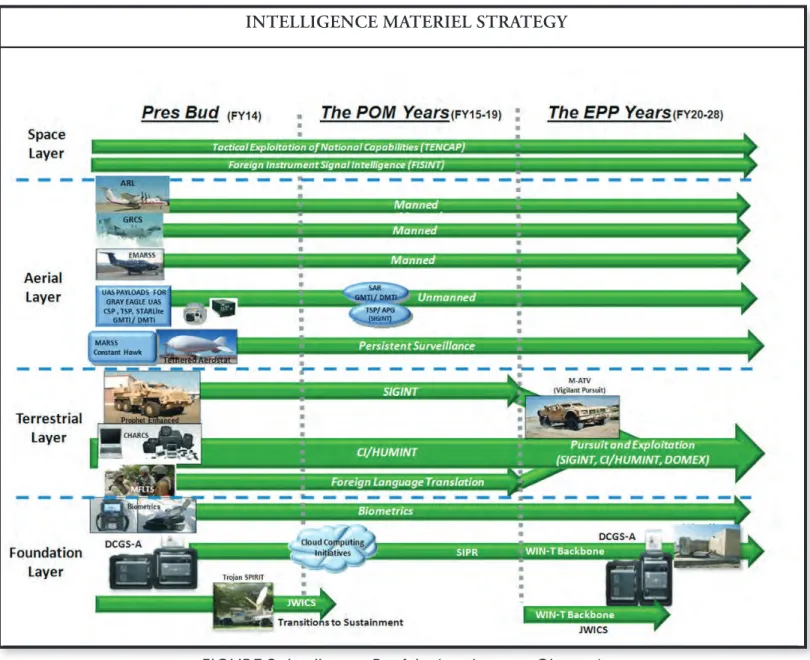
The Intelligence Portfolio incorporates key components of intelligence collection, exploitation, and analysis across four primary layers: Foundational, Terrestrial, Aerial and Space. The goal of the portfolio is to fully integration the core intelligence capabilities, including Signals Intelligence (SIGINT) collection, Counterintelligence (CI)/Human Intelligence (HUMINT) interrogation and source operations, and Geospatial Intelligence (GEOINT), including Full Motion Video (FMV). The portfolio also includes secure intelligence communications architecture, synchronized and integrated with the Army’s network initiatives. This architecture supports all aspects of exploitation, analysis, and dissemination to meet the readiness and modernization objectives of the Army Campaign Plan.
FIGURE 3. Intelligence Portfolio (see Acronym Glossary)
32 www.g8.army.mil
Equipment Portfolio Overviews—Intelligence
As depicted in figure 3 (pg. 31), the Intelligence portfolio provides essential modernization to keep pace with the evolving threat and rapid technological advancements.
• Fully funds the Distributed Common Ground System – Army (DCGS-A)
• Fully funds the Enhanced Medium Altitude Reconnaissance and Surveillance System (EMARSS)
• Fully funds the Prophet Ground SIGINT capability
Section II – Key Intelligence
Portfolio Accomplishments (FY 12/13):
• Continued the transition of DCGS-A Operation Enduring Freedom (OEF) capabilities to “cloud computing” architecture, with user gateways from Company Intelligence Support Team (CoIST) to the International Security Assistance Force Headquarters.
>> Began training the cloud software baseline. • Completed a formal Initial Operational Test and
Evaluation (IOT&E) of DCGS-A in FY 12. The Defense Acquisition Executive published a Full Deployment Decision (FDD) Memorandum in December 2012.
• Achieved EMARSS Milestone (MS) B and entered the EMD phase with contract award for four to six EMD EMARSS aircraft to the Boeing Corporation. Began development and initial testing of these EMD aircraft in preparation for MS C in FY 14.
• Procured and integrated Enhanced Situational Awareness (ESA) and High Band Communications Intelligence (COMINT) (HBC) on the remaining seven RC-12X GUARDRAIL Common Sensor (GRCS) systems for fielding in FY 12. Retrofits the
first seven modernized GRCS with improvements to COMINT ESA, Communications High Accuracy Location System, and HBC in FY 13. • Continued Airborne Reconnaissance – Low
(ARL) upgrades of system payloads with improvements to interface software and radar in FY 12 remaining a relevant ISR collection asset against a dynamic range of targets. of targets. Provided interoperable data links and workstation architecture software in FY 13 to improve workstation performance.
• Equipped and fielded the Gray Eagle Unmanned Aircraft System (UAS) in FY 12 and FY 13 with the Common Sensor Payload (CSP), which includes Full Motion Video (Electro-Optical/Infrared/Laser Designator). Also equipped the Gray Eagle UAS with the Small Tactical Radar Lightweight (STARLite) sensor, a Synthetic Aperture Radar (SAR) that provides imagery through weather and detects moving target indicators. RDTE efforts initiated engineering development of High Definition (HD) video improvements for CSP, enhancements to STARLite range, and resolution and initiation of EMD of the Tactical SIGINT Payload (TSP). TSP testing will be delayed by six months, delaying the completion of TSP EMD Block 1 Increment 1 from July 2013 to July 2014.
• Fielded Prophet Enhanced Ground SIGINT, a more modular and vehicle-agnostic version of Prophet Signals Intelligence collection capability, to BCTs and Battlefield Surveillance Brigades (BfSBs) operating in combat theaters.
>> Fielded 12 of the Prophet Enhanced sensors to next deployers as Theater Provided Equipment (TPE) in FY 12. Provided RDTE for software and hardware upgrades to the Prophet Enhanced sensors in order to maintain operational relevance.
33 www.g8.army.mil
Equipment Portfolio Overviews—Intelligence
>> Fielded five Prophet Enhanced sensors to next deployers as TPE in FY 13. Provided RDTE for continued software and hardware upgrades to the Prophet Enhanced sensors.
Section III –Key FY 14 Intelligence
Portfolio Investments:
The FY 14 Intelligence portfolio investments total $766M ($154M RDTE / $349M OPA / $263M ACFT) and include the key components of ISR collection, exploitation, and analysis. Specific investments in this portfolio include:
• $295M ($267M OPA/$28M RDTE) funds DCGS-A development and procurement to modernize and procure components for the DCGS-A Program, DCGS-A fixed sites, and Data Centers, setting conditions for the Army’s ISR component of the COE. DCGS-A hardware and software will be integrated into select ISR current force platforms to network enable and provide enhanced ISR PED capabilities.
>> Provides development and testing of DCGS-A multi-intelligence capable software baselines as well as the continued development and testing of the Command Post Computing Environment as it fits into the Army’s overarching COE construct. >> Procures 2,303 DCGS-A Portable Multi-
Function Workstations, 88 Fixed – Multi Functional Workstations, 94 GEOINT Workstations, three DCGS-A ISR Process Center V1s, 15 DCGS-A ISR Process Center V2s, one Operational ISR Ground Station, one DCGS-A Global Unified Data Environment Node, and 18 Cross Domain Systems and 194 Intelligence Fusion Servers. These systems will support one corps, three divisions, 12 BCTs, three special operations units,
three maneuver enhancement brigades, three combat aviation brigades, three fires brigades, Army Materiel Command (AMC) Intelligence Directorate, and other combat support (CS) and combat service support (CSS) units entering the Army Force Generation (ARFORGEN) available pool.
• $152.5M ($142.1M ACFT; $10.4M RDTE) funds development and procurement for EMARSS to provide a real-time, networked multi-sensor intelligence collection capability throughout the joint battlespace, with focus on support to BCT operations.
>> Completes EMD phase, including all test and evaluation activities.
>> Procures four Low Rate Initial Production (LRIP) systems.
• $10.3M (ACFT) completes SIGINT Payload modernization and begins FMV integration for Guardrail Common Sensor.
• $12.5M (ACFT) supports procurement of a mission equipment package to install sensors that support a plug-and-play mounting system to allow rapid integration of sensors for ARL. >> Procures workstation architecture for one
system, workstation, servers, monitors, and communications equipment. • $128.1M ($97.8M ACFT/$30.3M RDTE) for
UAS ISR Payloads, providing the Gray Eagle platform with day and night capability to collect and display FMV continuous imagery, wide-area all-weather search capability, persistent stare, Ground Moving Target Indicator (GMTI), and SAR capabilities.
>> Provides development of UAS payloads and procurement of eight CSP Electro-Optical/
34 www.g8.army.mil
Equipment Portfolio Overviews—Intelligence
Infrared/Laser Designator (EO/IR/LD) equipped with HD sensors, 23 CSP HD Retrofits, and eight STARLite SAR/GMTI sensors and 16 TSP sensors for integration and fielding support to the ARFORGEN schedule. RDTE facilitates continued improvements to CSP and STARLite and baseline development of TSP.
• $65.3M ($59.2M OPA/$6.1M RDTE) for Prophet Ground SIGINT.
>> Procures nine Prophet Enhanced sensors mounted on Panther Medium Mine Protected Vehicles for training and fielding to BCTs and BfSBs operating in combat theaters.
>> Funding will also procure three next-generation antennas and hardware/ software improvements to keep pace with rapidly changing threat technology, tactics, techniques, and procedures. >> Funds RDTE product upgrades for next-
generation signals and multi-path/co-site mitigation for pre-planned product improvement requirements for Prophet Enhanced sensors.
35 www.g8.army.mil
Equipment Portfolio Overviews—Ground Movement and Maneuver
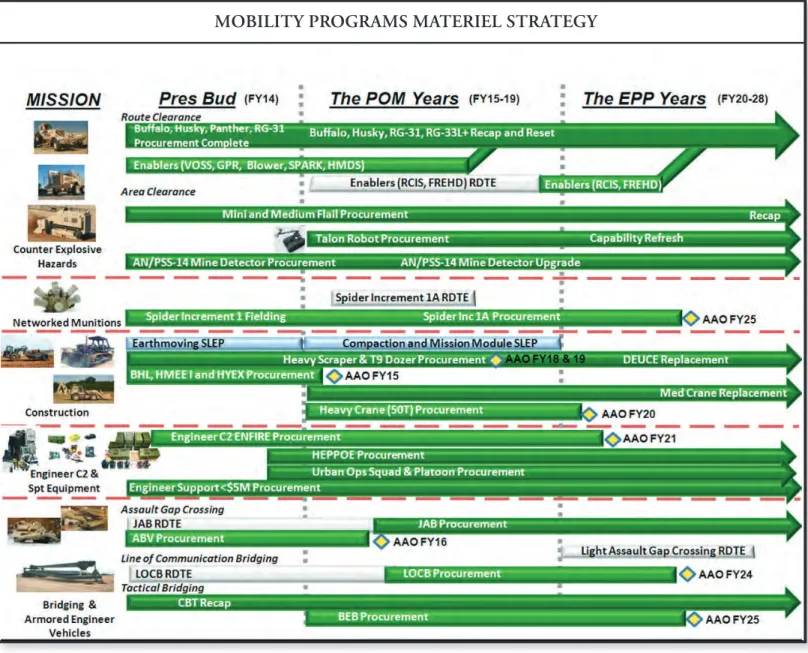
FIGURE 4. Ground Movement and Maneuver Portfolio (see Acronym Glossary)
GROUND MOVEMENT AND MANEUVER MATERIEL STRATEGY
Ground Movement and Maneuver
Section 1— Overview
The Ground Movement and Maneuver Portfolio’s goal is to develop and field an integrated combined team, linked by the network, and capable of dominating across the range of missions today and into the future. Key to this effort is our Combat Vehicle Modernization Strategy which transforms the capability of the Brigade Combat Team by acquiring the Ground Combat Vehicle (GCV) and replacing the M113 Family of Vehicles with an Armored-Multi Purpose Vehicle AMPV). The strategy also improves the Abrams tank; the Bradley Cavalry, Fire Support, and Engineer Vehicles; and the Stryker by increasing protection, ensuring required mobility, and allowing integration of the network.
36 www.g8.army.mil
Equipment Portfolio Overviews—Ground Movement and Maneuver
Section II – Key Ground Movement and
Maneuver Portfolio Accomplishments
(FY 12/13)
• Modernizes 1st Infantry Division (Fort Riley) and the 116th ABCT (Idaho Army National Guard) with the most modern versions of the Abrams tank (M1A2 System Enhancement Program (SEP) v2) and the Bradley Fighting Vehicle (M2A3). The 155th ABCT (Mississippi Army National Guard) will also field the M1A2 SEP v2 to complement the M2A3 Bradley Fighting Vehicles that were fielded in 2012. • Continue our focus on achieving standardization
of two variants of our dominant combat maneuver platforms (M1 Abrams Tank and M2 Bradley Fighting Vehicle (BFV)) combined with expansion of the versatile and lethal Stryker Combat Vehicle.
>> Upgraded kits made the M2A3 Operation Desert Storm (ODS) and M3A2 ODS Bradleys compatible with the M1A1 SA Abrams, providing greater lethality, survivability, and sustainability.
S
ection III –Key FY 14 Ground Movement
and Maneuver Portfolio Investments:
The FY 14 Ground Movement and Maneuver investments total $1.8B ($870M WTCV/ $943M RDTE) and include the Army’s combat vehicles such as Abrams, Bradley, Stryker, and the development of the GCV. Specific investments in this portfolio include:
• $592M (RDTE) develops GCV technologies which continue through 3rd quarter FY 14. • $374M ($168M RDTE / $206M OPA) begins
M109A6 PIM procurement by purchasing the Paladin Digital Fire Control System-Replacement. RDTE funds the development
and integration of common components into prototype vehicles.
• $116M (RDTE) funds AMPV Pre-Milestone B development activities with a Milestone B Defense Acquisition Board (DAB) planned for 3rd quarter, FY 14.
• $49.9M (RDTE) funds Stryker Engineering Change Proposal (ECP) that addresses future network integration, mobility, and SWaP-C. The Stryker ECP provides growth in electrical, mechanical, and engine power.
• $394M (WTCV) funds a third Double-V-Hull (DVH) brigade through the Stryker Exchange Program in FY 14-16 and fielding of Nuclear Biological Chemical Reconnaissance Vehicles (NBCRV).
• $279M ($178M WTCV/$101M RDTE) completes the fielding of M1A2 SEP v2 Abrams and achieves Modular Two Variant Fleet Configuration which is 1,593 M1A2 SEP v2s and 791 M1A1 AIM SA. RDTE funds the technology development phase for Abrams ECP improvements.
• $234M ($158M WTCV/$76M RDTE) completes the fielding of Bradley ODS- Situational Awareness (SA) vehicles to the Army National Guard (ARNG) and continues production of ECP1 capability that restores lost ground clearance due to increased combat weight. RDTE focuses on ECP improvements for the Bradley Cavalry, Fire Support, and Engineer Vehicles focused on mobility and SWaP-C improvements.
37 www.g8.army.mil
Equipment Portfolio Overviews—Aviation
Aviation
Section 1— Overview
The Aviation portfolio consists of core aviation programs, including utility and cargo, fixed wing mission profiles, reconnaissance/attack, Intelligence, Surveillance and Reconnaissance (ISR), and Unmanned Aircraft Systems (UAS) which meet the readiness and modernization objectives of the Army Campaign Plan.
As depicted within figures five through seven, key objectives and decision points in the Aviation portfolio are:
• Fully fund the Kiowa Warrior OH-58F program.
• Fully fund the Apache AH-64E (Apache Block III) program.
• Fully fund Gray Eagle UAS production.
FIGURE 5. Aviation Portfolio (Core Programs) (see Acronym Glossary)
38 www.g8.army.mil
Equipment Portfolio Overviews—Aviation
• Fully fund UH-60 production, meeting 4th ID Combat Aviation Brigade (CAB) growth and the increased aircraft requirement for Special Operations.
• Complete procurement of the Lakota Light Utility Helicopter program at 315 aircraft, 31 short of the Army Acquisition Objective. • Fully fund the 13th CAB and Special Operations
CH-47 aircraft requirements.
Section II—Key Aviation
Accomplishments (FY 12/13):
• Continued induction of Apache AH-64D Block I helicopters for remanufacture to AH-64E (Apache Block III).
• Continued equipping of the Advanced Threat Infrared Countermeasures (ATIRCM) on the CH-47D/F helicopters.
• Continued upgrading the Raven UAS to Digital
FIGURE 6. Aviation Portfolio (Utility/Cargo/Fixed Wing) (see Acronym Glossary)
39 www.g8.army.mil
Equipment Portfolio Overviews—Aviation
Data Link (DDL) with 84 DDL systems fielded in FY 12, 377 new systems procured, and 332 analog systems converted to DDL. DDL increases the amount of channels Raven aircraft use within a single geographic area, providing the supported unit more FMV coverage across the area of operations.
• Fielded the 1-135th Attack Reconnaissance Battalion (ARB) (Missouri ARNG) with AH-64D Apache Block II helicopters; also continued
fielding the 1-183rd (ARB) (Idaho ARNG) and 1-149th ARB (Texas/Mississippi ARNG) with AH-64D Apache Block II helicopters.
• In FY 12, procured and fielded components of the Air Warrior System (to include the new Operation Enduring Freedom Camouflage Pattern flight uniform) to deploying CAB’s aircrew members. In FY 13 complete procurement of the Air Warrior System, with fielding completed to the Army in FY 14.
FIGURE 7. Aviation Portfolio (RECON/ATTACK/UAS) (see Acronym Glossary)
40 www.g8.army.mil
Equipment Portfolio Overviews—Aviation
• Fielded Medical Evacuation (MEDEVAC) helicopters (HH-60M) to four General Support Aviation Battalions, supporting Army and Department of Defense leadership emphasis on increased MEDEVAC Capability.
• Procured 19 MQ-1C Gray Eagle Unmanned Aircraft and the associated ground support equipment ($518.1M). Gray Eagle missions include Reconnaissance, Surveillance, Target Acquisition, Armed Reconnaissance, Signals Intelligence, Communications Relay, and Battle Damage Assessment.
>> Fielded two Gray Eagle Quick Reaction Capability platoons equipped with four aircraft each, both of which were deployed in support of OEF.
>> Completed fielding the first MQ-1C Gray Eagle Company to the 1st Cavalry Division CAB and the unit which deployed in FY 12.
>> Fielded the second MQ-1C Gray Eagle Company to the 1st Infantry Division CAB in the 3rd quarter of FY 12. The unit conducted Initial Operational Test and Evaluation in August 2012 and subsequently deployed.
>> Upon completion of the fielding plan, the Army will have fielded 13 Gray Eagle Companies with two assigned to the Special Operations Command, one to each active component division headquarters (ten total), and one to the National Training Center.
• Procured Shadow modifications including seven Tactical Common Data Link (TCDL) Retrofit Kits, seven launchers, nine Universal Mission Simulators, 80 New Mission Computers, and 14 SIGINT payloads. New Equipment Training for TCDL Retrofits continues through FY 14.
• Focused rotary wing aircraft modernization on the UH-60 (Black Hawk), CH-47 (Chinook), and AH-64 (Apache) helicopters:
>> Procured 49 UH-60M (utility mission) and 24 HH-60M (MEDEVAC mission) helicopters. The M model provides a digitized cockpit, a new engine for improved lift, and range and wide-chord rotor blades. By the end of FY 12, the Army equipped four Assault Helicopter Battalions (AHBs) with the UH-60M. >> Procured 50 CH-47F and eight
MH-47G (Chinook) aircraft while providing modifications including a loading system, enabling more rapid reconfiguration from cargo to passenger support missions. Continued fielding the CH-47F to the Active and ARNG components, with USAR fielding to begin in FY 14.
>> Procured 67 Apache AH-64E (Apache Block III) aircraft and provided the existing Block II fleet with modifications that address operationally driven improvements and obsolescence. Improvements: Manned-Unmanned Teaming and Sensors upgrades.
• Funded $48M for RDTE and $35M OPA for Hostile Fire Quick Reaction Capability development, testing, and fielding of the capability in September 2013.
• Funded $26M for the KW helicopter, addressing obsolescence and weight reduction efforts for the aging KW fleet. Also funded the continued research and development of the Cockpit and Sensor Upgrade Program and procurement of long lead items for the first lot of LRIP of OH-58F helicopters.
• Funded $15M in FY 12 the Armed Aerial Scout (AAS) supporting program RDTE.
41 www.g8.army.mil
Equipment Portfolio Overviews—Aviation
• Funded $2.9B in FY 12-13 for the Blackhawk helicopter Multi-Year Procurement, procuring 92 UH-60M and 48 HH-60M aircraft. The first year of Multi-Year/Multi-Service VIII contract was FY 12.
• Funded $18.1M in RDTE to support the continued development of the Improved Turbine Engine Program, which is scheduled for a MS A decision in 2013.
• Funded $250M for Lakota in FY 12, of which $244M remains allocated for the Army National Guard. Procured 39 aircraft in FY 12.
• Funded fixed wing aircraft modifications to include Global Air Traffic Management (GATM) upgrades, cockpit upgrades, and mandatory safety upgrades.
• Fielded three new Twin Otters to replace legacy aircraft for the Golden Knights.
• Funded two aircraft for the Army Test and Evaluation Command to replace retiring T-34 aircraft.
• Funded $666M in FY 12 for AH-64E (Apache Block III). The Army remains on schedule to equip the first unit with the AH-64E (Apache Block III) in FY 13.
• Funded $104M in FY 13 for the RQ-7B Shadow, supporting the acquisition of seven TCDL Retrofit Kits and 400 One System Remote Video Terminal (OSRVT) modification kits. • Funded $25.8M in FY 13 for RQ-11B Raven,
procuring 78 gimbaled systems (234 Air Vehicles) and other hardware costs, including ground control stations, remote video terminal, and an initial deployment spares package. The gimbaled payload combines the Electro-optical/ Infrared cameras into one payload ball and is a major improvement over the current payloads.
In addition, funding meets unit requests for a virtual training device for system operators. • Funded $518.1M in FY 13, maximizing the
production rate of the MQ-1C Gray Eagle program, procuring 19 MQ-1C aircraft and associated ground support equipment.
• Funded $127M in FY 12 for the Joint Air to Ground Missile (JAGM) which supports the transition of the Army Hellfire missile to a joint missile system. This system replaces the Marine Corps air launched version of the TOW missile and the Navy’s Maverick missiles. In addition, funds were applied to the JAGM program restructure which extended the technology development phase.
• Funded $163M in FY 12 for 350 of the Gen3 Electronic Control Units for Common Missile Warning System.
Section III –Key FY 14 Aviation
Portfolio Investments:
Fiscal Year 14 Aviation investments total $5.5B ($640M RDTE/$108.5M Procurement of Ammunition, Army (AMMO)/$4.4M MSLS/$4.8B ACFT) and include required capabilities in the reconnaissance, attack, unmanned, utility and cargo, and fixed wing mission profiles. Specific investments in this portfolio include:
• $121M (RDTE) for the Technology Development phase of the Common Infrared Countermeasure (CIRCM) system for Army aviation platforms. CIRCM is a lightweight, low cost, highly reliable laser-based countermeasure system which works in conjunction with Service missile warning systems (i.e. Common Missile Warning System). The program’s Full Rate Production decision is scheduled for FY 19.
42 www.g8.army.mil
Equipment Portfolio Overviews—Aviation
• $13.1M ($2.3M RDTE/$10.8M ACFT) for RQ-11B Raven, procuring 103 gimbaled payload retrofits and new equipment training (NET).
• $133.9M ($12M RDTE/$121.9M ACFT) for RQ-7B Shadow supporting the acquisition of seven Shadow TCDL Retrofit kits (and associated spare parts), seven launchers, 94 New Mission Computers, six Universal Mission Simulators, and 70 Mobile Directional Antenna System extended range antennas.
• $529.4M ($10.9M RDTE/$518.5M ACFT) procures 15 MQ-1C aircraft and associated ground support equipment.
• $1.3B ($80M RDT&E/$1.2B ACFT) procures 41 UH-60M, 24 HH-60M, funds Improved Turbine Engine Program and UH-60 digital L RDTE efforts, and purchases mission equipment packages.
• $884.2M ($124.8M RDTE/$759.4M ACFT) procures 42 Remanufactured AH-64E (Apache Block III) aircraft and associated modifications to existing AH-64D fleet.