Concretely Annotated Corpora
Francis Ferraro Max Thomas Matthew R. Gormley Travis Wolfe Craig Harman Benjamin Van Durme
Human Language Technology Center of Excellence Johns Hopkins University
1
Introduction
Richly annotated documents are a part of many knowledge extraction efforts. Such efforts may include knowledge base population (KBP), a task where it is important to recognize certain rela-tionships between entities in text in order to add those facts to an entity-centric database. Document annotations might also serve asgristfor training various distributional models of meaning.
In either setting, it is common for a research group to generate bulk annotations over a preferred corpus internally, using their own tools, programming languages and formats, but then reporting on this as merely an engineering pre-processing step not worth describing in significant detail. Worse, these annotated collections are often not available to the rest of the community, making it difficult to perform apples-to-apples comparison of the “real research”.
We previously sought to address these issues with the creation and release of the Annotated Giga-word corpus [1], a resource comprising 4.5 billion tokens of English newswire text, processed with a collection of then state-of-the-art tools from the community. The LDC distributed this collection [2] along with a Java utility library to easily work with the data in a variety of popular formats.1 Here we describe a new effort that follows this same idea, with various extensions and improve-ments. Under the headingConcretely Annotated, we are processing a variety of standard corpora with multiple popular NLP tool-chains, collected together under a single data schema we have cre-ated that we refer to as CONCRETE. We envision amultimodalworkflow, where, e.g., knowledge can be extracted from both text and audio. We developed CONCRETEto record and share annotations on structured human language data – both text and speech. Backed by Apache Thrift, this schema allows for direct programmatic access to the annotations across a variety of popular languages. In this new data set, we include multiple tool outputs producing the same types of annotations; these annotations are represented together under a shared tokenization as different annotation theories. For example, these new resources include ACE ontology relations [3] – produced automatically by both BBN’s SERIFsystem [4] and an in-house JHU toolchain competitive to state-of-the-art (in prep) – as well as semantic frame analyses – produced by SEMAFOR[5] and an in-house semantic frame parser (in prep). As we demonstrate in this paper, CONCRETE’s common storage and annotation format allow multiple, independently-developed systems to be pipelined together. We also believe that developers will be able to leverage complementary aspects of repeated annotation types.
2
Facilitating Knowledge Extraction from Text
Many, including Chuch & Hanks (1990) [6] and DIRT [7], have considered the connections be-tween shallower linguistic analyses and deeper semantic understanding ([8, 9, 10, 11, 12]). Multiple recent efforts, e.g., script learning [13], relation discovery [14], and information extraction [15], have utilized richer linguistic annotations on large corpora to improve knowledge extraction. As
1
For example, all syntactic parse trees can be printed to a console as a phrase structure parse, whereas all NER labels are output in a CoNLL style.
recent efforts in knowledge base population have shown [16], huge, highly annotated corpora can be leveraged to improve inference.
Multiple previous efforts have attempted to ensure the community has easy access to large and suf-ficiently annotated data. Annotated Gigaword [1] ran state-of-the-art tools on a single, large dataset of ten million documents in order to create a standard reference. ILLINOISCLOUDNLP [17] devel-oped a framework in which users could annotate individual large datasets on a remote, distributed compute grid, allowing annotated data to be created “on demand.” Goldberg and Orwant (2013) [18] released counts of “syntacticn-grams” – dependency paths spanningnwords – from three million books, to facilitate PMI-inspired efforts. While these approaches, among others, all have their mer-its, our focus is on creating larger and richer common corpora that promote collaboration and have the potential to facilitate multimodal research.
In addition to adding semantic annotations, this work corrects some of the losses that arose from the Annotated Gigaword pipeline (AG). In AG there was a 2% loss in sentences arising to a bug in Splitta, which AG used to split sentences [19]. Second, coreference resolution only included non-singleton entities (those that have at least two mentions). Borrowing terminology from GAF [20], we make a distinction between (conceptual) instances of a situation or an entity, and the individual mentionsof those instances in text. In NLP terms, this means we reify a coreference chain to stand for an entity, with the items in that coreference set the representative entity mentions. Therefore, we need to record singletons, even though suppressing singleton mentions is consistent with coreference evaluation [21]. To quantify the impact of these missing mentions, we employed a simple heuristic that matches NER spans with existing entities2. We found that more than 1.6 million documents (16% of AG) would have had ten or more additional PER, LOC or ORG entities. This does not consider non-location or organization entities, which can be of interest in open-domain IE efforts.
3
Concrete
CONCRETE is an extensible data schema aimed at capturing a wide variety of natural language annotations over both structured and unstructured data. We sought acommon formatthat reduces the complexity associated with both using different corpora (unique file formats or markup) as well as interfacing with or creating different annotation tools and analytics (programming languages and APIs). Some data types can be required to be present, providing some guarantees about what will be present in any given annotation layer and helping to prevent the accidental omission of critical information. These guarantees extend to thetypesof individual annotations, limiting a potential source of bugs. For instance CONCRETEannotation creators cannot accidentally populate a field with the wrong type of object, while CONCRETEreaders do not need to manually cast values. We further sought a representation amenable tomultimodaldata. While most of our current ef-forts have been focused on text processing, CONCRETEalso supports audio data. We envision a multimodal workflow wherein automatic knowledge extraction is not limited to text corpora. The simultaneous interest that multiple fields share for grounded language tasks suggests that researchers will be looking for easy-to-use multimodal corpora and/or data exchange formats.
ImplementationThe CONCRETEschema is a set of Apache Thrift [22] schema files specifying 51 interworkingstructs. Structs contain instances of other structs, “primitive” types (e.g., strings and ints), and lists or maps of structs or primitives. Thrift generates schema-specific classes for many popular and widely used programming languages, including Java, Python, C++ and Javascript.3 The array of supported languages allows data to be shared easily across projects, lessening barriers to-ward collaborative efforts. Thrift also provides backto-wards compatibility: additions to the schema do not invalidate previously generated data, making previously annotated data compatible with future changes. (CONCRETEwas initially based on Google’s Protocol Buffer technology; we switched to Thrift to better align with related community standards such as the StreamCorpus format employed in NIST’s TREC KBA, or the ADEPT schema used in the ongoing DARPA DEFT program.4)
2
We compare a document’s maximal NER spans to every entity mention officially recorded in [1]. We report as “missing mentions” only those NER spans that do not overlap with a recorded mention.
3In object-oriented languages, a struct becomes a class. 4
See https://github.com/google/protobuf/, https://github.com/trec-kba/streamcorpus and http://www.darpa.mil/opencatalog/DEFT.html
Document Representation CONCRETE defines a structure-preserving wrapper (called a
Communication) around tokenized data. The tokenized data are realized by either a list or lattice of Tokens. In many text applications, the collection will be aTokenList, a flat sequence of
Tokens; when capturing output from speech systems or machine translation, the collection may be better represented as aTokenLattice. All annotations are defined on theseTokens.
ACommunicationsegments the observed data into differentSections, each of which main-tains a list of Sentences. Every Sentence contains the collection of Tokens – either a
TokenListorTokenLattice, encapsulated as a union record in a containingTokenization
struct. As explained shortly,Tokenizations allow us to succinctly keep related annotations to-gether. As in [23], CONCRETEusesglobal byte offsetsto index into the data: when representing text, we use character offset spans, and when representing audio, we use start and end time spans.
Sections,Sentences andTokens maintain these spans.
Annotation RepresentationsCONCRETEallows both intrasentential and intersententialannotation theories. The former includes standard tagging tasks (e.g., part-of-speech, named entity recogni-tion, lemmatizarecogni-tion, cached out intoTokenTaggings) and syntactic analyses (constituency or dependency parse). Because we store intrasentential annotations within every Tokenization, we keep, e.g., individual token labels close to the tokens themselves. By manipulating a single
Tokenization, a developer has easy access to its different token taggings. We are not restricted in the types ofTokenTaggings we can add: a tagging is agnostic to its actualmeaning. We can just as easily store language ID for code-switched tweets as we can per-token sentiment.
Intersentential annotations revolve around mention identification and coreference, in a manner akin to [20], with the latter recording equivalent groupings in the former. CONCRETEimplements men-tions and coreference sets for both entities and situamen-tions – a term derived from the event semantics literature [8, 24, 12] that broadly covers events, relations, facts, sentiments, and beliefs. Mentions point into a specific tokenization, recording both byte offsets and token indices. Although individ-uals are constrained to a specificTokenization, coreference spans multipleTokenizations. As a result, we store all mention and coreference theories as members of aCommunication. Crucially, aCommunicationmay have the same type of annotation multiple times. For instance, each Tokenizationmay have multiple, competing NER or dependency parse theories, and a
Communicationmay have any number of parallel or competing, e.g., entity coref theories. Open-Source ReleaseOur primary development languages are Java, Python and C++: as such, we have written utility libraries in these three languages. These libraries are in active development; they, along with the CONCRETEschema definition files, will be released as open source projects.5
4
Corpora
We process four different corpora, covering formal newswire, casual internet media and Wikipedia. We mapped each corpus to CONCRETE, maintaining paragraph or section structure when possible. English Gigaword v5The Gigaword corpus [25] contains 4.5 billion words from 10 million English newswire articles, from 1994 - 2010. The data are sectioned into paragraphs. We maintain this structure and record the minimal metadata, such as dateline, within our CONCRETEschema. Annotated NYTThe New York Times Annotated Corpus [26] is a collection of 1.8 million New York Times articles from 1987 - 2007. These articles have been heavily enriched with nearly fifty types of metadata by NYT staff. These metadata include a hierarchical taxonomic classification into different types of documents (e.g., Opinionvs. News/U.S./Rockies), an originating newsdesk (e.g.,Businessdesk vs.Classifiedsdesk) and a list of prominent people, locations and organizations mentioned in the article.
ColdStartThe 2014 ColdStart KBP track of NIST’s Text Analysis Conference (TAC) is based on a corpus of roughly 50,000 documents, with ∼70% derived from the Gigaword corpus and the remainder a collection of more informal blog and discussion forum posts [27]. This collection was preprocessed by the ColdStart organizers with BBN’s Serif tool and then released in order that participants would have equal access to the output of a competitive information extraction toolchain.
Table 1:Tools and types of annotations produced, with some producing multiple versions of a type.
Tokens Syntax Entities Situations
POS Lemma NER CP DP Mention Id. Coref
JHU X X X XXX
BBN SERIF X X X X X X
CMU SEMAFOR X X X
STANFORDCORENLP X X X X XXX X X
WikipediaPrevious work has shown that Wikipedia is a useful resource for knowledge base con-struction [28, 29, 30]. We process Wikipedia in order to make available a text that is both encyclo-pedic and open access, akin to WaCkypedia EN, which followed from ukWaC [31].
5
Annotations
We process all corpora (§4) with four different suites: Stanford’s CORENLP [23], BBN’s SERIF[4], CMU’s SEMAFOR[5] and an in-house JHU pipeline.We modified or developed each of these tools to read in and operate on the mapped CONCRETEdata from above. See Table 1 for an overview of the different types of annotations each tool adds; note that a tool may add more multiple theories for each type of annotation, while multiple tools may add the same type of annotation.
In order for all annotations to exist in parallel, we force all tools to operate on a single (PTB-style) tokenization and sentence segmentation, obtained from the CORENLP pipeline.6 We label individ-ual tokens with two part-of-speech theories and three named entity theories (CORENLP, SERIFand JHU [32]), and a lemmatization theory (CORENLP). We further use CORENLP and SERIFto add constituency parses. These CORENLP parses are converted to chunks using the same method as the CoNLL-2000 shared task [33]. In total, three different tools produce five dependency parses: CORENLP applies human-written rules to deterministically convert the Stanford constituency parse into the three types of Stanford dependencies [34], while CMU’s Stacked MST Parser [35] (a vari-ant of [36]’s minimum spanning tree parser) and a fast, first-order dependency parser from JHU [37] each provide a statistically determined dependency parse.
We record three types of situation mentions: frame analyses based on FrameNet [9, 38, 39], Propbank-style semantic role labeling [40] and ACE relation extraction [3]. We include frame analyses from both SEMAFOR[5, 41] and an in-house log-linear staged FrameNet parser (article in prep), where we tune the latter for high recall annotation. Semantic role labeling is done via a competitive system [37, JHU]. We extract and record dual ACE relations using both SERIFand an in-house project that leverages word embeddings to be competitive with state-of-the-art (article in prep.). As a result of how “situations” are defined in the linguistics literature and in CONCRETE, most arguments ofSituationMentions point to anEntityMention. All suites contribute to the parallel entity mention identification theories, but only SERIFand CORENLP provide entity coreference atop their own mention identifications (singleton mentions included). The JHU entity mentions are ACE-style named entities from an in-house variant of prior work [32].
6
Utilities and Open-Source Release
We are releasing CONCRETEand utility libraries, including interfaces for Java, Python and C++, as open-source projects athttps://hltcoe.github.io/. The Java and Python utility libraries can be easily downloaded or installed with Maven and PyPI, respectively. The above URL also has the data and annotations that can be freely-released (e.g., Wikipedia).
The language-specific interfaces and utilities are in active development, though they currently pro-vide only basic annotation retrieval, e.g., providingTokenizations for anEntityMentionin
6
We allow a destructive tokenizer; CORENLP “Americanizes” words, e.g., replacing an “-our” suffix with “-or” in “colour”, for example. Certain non-content word normalizations help to alleviate token sparsity.
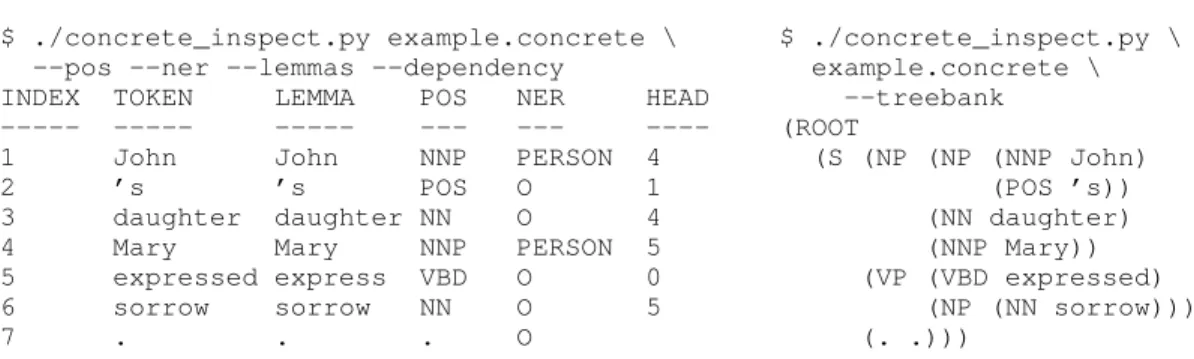
Figure 1: Example output from a command-line utility providing easy access to plain-text versions of CONCRETEannotations. 1a demonstratesTokenannotations, plus a dependency parse, while 1b shows a constituency parses.
(a) CoNLL-style output.
$ ./concrete_inspect.py example.concrete \ --pos --ner --lemmas --dependency
INDEX TOKEN LEMMA POS NER HEAD --- --- --- --- --- ----1 John John NNP PERSON 4
2 ’s ’s POS O 1
3 daughter daughter NN O 4 4 Mary Mary NNP PERSON 5 5 expressed express VBD O 0 6 sorrow sorrow NN O 5
7 . . . O
(b) Constituency parse output. $ ./concrete_inspect.py \ example.concrete \ --treebank (ROOT (S (NP (NP (NNP John) (POS ’s)) (NN daughter) (NNP Mary)) (VP (VBD expressed) (NP (NN sorrow))) (. .)))
which it appears. Due to their open-source nature, they can be extended to handle more complex tasks, such as intersecting multiple annotations.7
Since the Thrift format is not viewable as plain-text, we have developed tools that allow researchers to quickly inspect aCommunicationat the command line. This utility also provides researchers with easy access to plain-text versions of CONCRETEannotations. See Figure 1 for an example. For instance,Token-level annotations can be output in a CoNLL-like format (1a), while constituency parses can be returned as standard S-expressions (1b). With this utility, existing systems can use the annotations provided in this paper without modifying code.
7
Conclusion
Our final data set contains more than approximately 400 million sentences. While at time of print the full annotation processing is in progress, approximately 1 TB of (non-compressed) annotations have been produced from initial corpora sizes of approximately 40 GB of uncompressed text. Fully processing the corpora through CORENLP took approximately 900 CPU-hours, or three days with 300 cores (∼115 tokens/second). The other tools we use range from 150 to 1,000 tokens/second. Efforts such as DeepDive [16] exemplify the community’s interest in large scale knowledge base creation fostered by equally large text corpora processed with state-of-the-art NLP tools. Further, efforts such as [13, 42] in event and distributional semantics require a similar sort of processed input. As an effort to democratize such large scale efforts, we provide several different theories of token taggings, entity mentions, entities, and situations; researchers can investigate what particular tools are optimal for their use case, or more easily conduct systems combination research. Researchers can access the data by using the libraries mentioned earlier, or creating their own Thrift bindings for the programming language of their choice.
Acknowledgements Thank you to the three reviewers for helpful feedback, and to Johns Hopkins HLTCOE for providing support. We also thank Ed Loper, Mark Dredze and the participants of SCALE 2013 for feedback. Any opinions expressed in this work are those of the authors.
References
[1] Courtney Napoles, Matthew Gormley, and Benjamin Van Durme. Annotated gigaword. InAKBC, 2012. [2] Courtney Napoles, Matthew Gormely, and Benjamin Van Durme. Annotated English Gigaword
LDC2012T21. Web Download, Philadelphia: Linguistic Data Consortium, 2012.
[3] Christopher Walker, Stephanie Strassel, Julie Medero, and Kazuaki Maeda. ACE 2005 multilingual train-ing corpus. Ltrain-inguistic Data Consortium, Philadelphia, 2006.
[4] Elizabeth Boschee, Ralph Weischedel, and Alex Zamanian. Automatic information extraction. In Con-ference on Intelligence Analysis, 2005.
7
[5] Dipanjan Das, Nathan Schneider, Desai Chen, and Noah A Smith. Probabilistic frame-semantic parsing. InNAACL, pages 948–956, 2010.
[6] Kenneth Ward Church and Patrick Hanks. Word association norms, mutual information, and lexicography. Computational linguistics, 16(1):22–29, 1990.
[7] Dekang Lin and Patrick Pantel. DIRT: Discovery of inference rules from text. InKDD, pages 323–328, 2001.
[8] Donald Davidson. The logical form of action sentences. 1967.
[9] Charles J Fillmore. Frame semantics and the nature of language. Annals of the New York Academy of Sciences, 280(1):20–32, 1976.
[10] Roger C Shank and RP Abelson. Scripts. Plans, Goals, and Understanding. Lawrence, Erlbaum, Hills-dale, 1977.
[11] Jerry R Hobbs. Ontological promiscuity. InACL, pages 60–69, 1985.
[12] Lenhart K Schubert. The situations we talk about. InLogic-based artificial intelligence. Springer, 2000. [13] Nathanael Chambers and Daniel Jurafsky. Unsupervised learning of narrative event chains. InACL, pages
789–797, 2008.
[14] Harr Chen, Edward Benson, Tahira Naseem, and Regina Barzilay. In-domain relation discovery with meta-constraints via posterior regularization. InACL. Association for Computing Machinery, 2011. [15] Mstislav Maslennikov and Tat-Seng Chua. A multi-resolution framework for information extraction from
free text. InACL, volume 45, page 592, 2007.
[16] Ce Zhang, Christopher R´e, Amir Abbas Sadeghian, Zifei Shan, Jaeho Shin, Feiran Wang, and Sen Wu. Feature engineering for knowledge base construction.CoRR, abs/1407.6439, 2014.
[17] Hao Wu, Zhiye Fei, Aaron Dai, Stephen Mayhew, Mark Sammons, and Dan Roth. ILLINOIS-CLOUDNLP: Text analytics services in the cloud. InLREC, 2014.
[18] Yoav Goldberg and Jon Orwant. A dataset of syntactic-ngrams over time from a very large corpus of english books. In*SEM, pages 241–247, 2013.
[19] Dan Gillick. Sentence boundary detection and the problem with the US. InNAACL, 2009.
[20] Antske Fokkens, Marieke van Erp, Piek Vossen, Sara Tonelli, Willem Robert van Hage, Luciano Serafini, Rachele Sprugnoli, and Jesper Hoeksema. GAF: A grounded annotation framework for events. In Work-shop on Events: Definition, Detection, Coreference, and Representation, pages 11–20, Atlanta, Georgia, 2013.
[21] Sameer Pradhan, Lance Ramshaw, Mitchell Marcus, Martha Palmer, Ralph Weischedel, and Nianwen Xue. Conll-2011 shared task: Modeling unrestricted coreference in ontonotes. InCoNLL: Shared Task, pages 1–27, 2011.
[22] Mark Slee, Aditya Agarwal, and Marc Kwiatkowski. Thrift: Scalable cross-language services implemen-tation. Facebook White Paper, 2007.
[23] Christopher D. Manning, Mihai Surdeanu, John Bauer, Jenny Finkel, Steven J. Bethard, and David Mc-Closky. The Stanford CoreNLP natural language processing toolkit. InACL Demos, pages 55–60, 2014. [24] Reinhard Muskens.Meaning and Partiality. CSLI Books, Stanford, CA, 1995.
[25] Parker and Robert et al. English Gigaword Fifth Edition LDC2011T07. Web Download, Philadelphia: Linguistic Data Consortium, 2011.
[26] Evan Sandhaus. The New York Times Annotated Corpus LDC2008T19. Web Download, Philadelphia: Linguistic Data Consortium, 2008.
[27] Jim Mayfield. TAC Cold Start Knowledge Base Population task description, vers. 1.3. NIST, August 2014.
[28] Fei Wu and Daniel S Weld. Open information extraction using wikipedia. InACL, pages 118–127, 2010. [29] Fabian M Suchanek, Gjergji Kasneci, and Gerhard Weikum. Yago: a core of semantic knowledge. In
WWW, pages 697–706. ACM, 2007.
[30] Simone Paolo Ponzetto and Michael Strube. Deriving a large scale taxonomy from wikipedia. InAAAI, volume 7, pages 1440–1445, 2007.
[31] M. Baroni, S. Bernardini, A. Ferraresi, and E. Zanchetta. The Wacky Wide Web: A Collection of Very Large Linguistically Processed Web-Crawled Corpora. InLREC, 2009.
[32] Mo Yu, Tiejun Zhao, Daxiang Dong, Hao Tian, and Dianhai Yu. Compound embedding features for semi-supervised learning. InProceedings of the 2013 Conference of the North American Chapter of the Association for Computational Linguistics: Human Language Technologies, 2013.
[33] Erik F. Tjong Kim Sang and Sabine Buchholz. Introduction to the CoNLL-2000 shared task: Chunking. InProceedings of the Fourth Conference on Computational Natural Language Learning and the Second Learning Language in Logic Workshop, 2000.
[34] Marie-Catherine De Marneffe and Christopher D Manning. The stanford typed dependencies represen-tation. InColing 2008: Proceedings of the workshop on Cross-Framework and Cross-Domain Parser Evaluation, pages 1–8. Association for Computational Linguistics, 2008.
[35] Andr´e FT Martins, Dipanjan Das, Noah A Smith, and Eric P Xing. Stacking dependency parsers. In EMNLP, pages 157–166, 2008.
[36] Ryan McDonald, Fernando Pereira, Kiril Ribarov, and Jan Hajiˇc. Non-projective dependency parsing using spanning tree algorithms. InEMNLP, pages 523–530, 2005.
[37] Matthew R. Gormley, Margaret Mitchell, Benjamin Van Durme, and Mark Dredze. Low-resource seman-tic role labeling. InACL, pages 1177–1187, Baltimore, Maryland, June 2014. Association for Computa-tional Linguistics.
[38] Charles Fillmore. Frame semantics.Linguistics in the morning calm, pages 111–137, 1982.
[39] Collin F Baker, Charles J Fillmore, and John B Lowe. The Berkeley Framenet Project. InACL, pages 86–90. Association for Computational Linguistics, 1998.
[40] Martha Palmer, Daniel Gildea, and Paul Kingsbury. The proposition bank: An annotated corpus of semantic roles.Computational Linguistics, 31(1):71–106, 2005.
[41] Dipanjan Das, Andr´e FT Martins, and Noah A Smith. An exact dual decomposition algorithm for shallow semantic parsing with constraints. In*SEM, pages 209–217, 2012.
[42] Jackie Chi Kit Cheung and Gerald Penn. Probabilistic domain modelling with contextualized distribu-tional semantic vectors. InACL, pages 392–401, 2013.