Ecosystem Biodiversity of India
Vivek Khandekar and Anita Srivastava
Additional information is available at the end of the chapter http://dx.doi.org/10.5772/584311. Introduction
Forests are amongst the most biologically-rich terrestrial systems. Tropical, temperate and boreal forests together offer diverse sets of habitats for plants, animals and micro-organisms, and harbour the vast majority of the world’s terrestrial species. In the past, timber production was regarded as the dominant function of forests. However, in recent years these perception has changed towards recognizing and acknowledging the diverse ecological services and functions offered by forests. Today, it is understood that forest biodiversity underpins a wide range of goods and services for over all human well-being. Ecologically intact forests store and purify drinking water, mitigate natural disasters such as droughts and floods, help store carbon and regulate the climate, provide food and produce rainfall and provide a vast array of goods and services for medicinal, cultural and spiritual purposes. The health of forests and the provision of forest ecosystem services depend on the diversity between species, the genetic diversity within species, and the diversity of forest types.
Vegetative biodiversity, heretofore referred to forest biodiversity of the country is under severe threat due to various factors such as increasing population, environmental degrada‐ tion, indiscriminate resource utilization etc. Social, economic and spatial constraints have made the value of biodiversity irredeemable. The alarming rate of loss of biodiversity particularly in terms of ecological, genetic, economic and evolutionary consequences became a matter of universal concern when the eventful Earth Summit work place at Rio de Janiero in 1992. This later culminated in 1993 in the ratification of a global agenda on biodiversi‐ ty, now referred as the UN Convention on Biodiversity. India being signatory to the Convention on Biological Diversity (CBD), is committed not only to the conservation of its biodiversity but also to sustainable and equitable utilization of its genetic resources. With long history of conservation in India, the conservation of forest biodiversity becomes an integral part of the development process. Over the years, India has developed a strong legal and policy framework along with a number of programmes promoting biodiversity © 2014 The Author(s). Licensee InTech. This chapter is distributed under the terms of the Creative Commons Attribution License (http://creativecommons.org/licenses/by/3.0), which permits unrestricted use, distribution, and reproduction in any medium, provided the original work is properly cited.
conservation in the country. In this paper the intrinsic nature of biodiversity and multi‐ ple nature of its stakeholder are explored in order to explore the inextricable link be‐ tween human welfare and conservation biodiversity. The paper is a compendium of practice, a synthesis of insights into biodiversity conservation related research and technology in the country, and a source of ideas for way forward.
2. Literature review
Biological diversity refers to variety within the living world, and is commonly used to describe the number, variety and variability of living organisms. Thus, biodiversity is the variation of taxonomic life forms within a given ecosystem, biome or for the entire Earth. It is often used as a measure of the health of biological systems.
The term ‘Biodiversity’, a contraction of the term ‘biological diversity’ was first coined by Walter Rosen in the 1986 Forum on Biodiversity (Wilson 1988). The term biodiversity entails more than just the accumulation of species. The 1992 United Nations Earth Summit in Rio de Janeiro defined ‘biodiversity’ as "the variability among living organisms from all sources, including, 'inter alia', terrestrial, marine, and other aquatic ecosystems, and the ecological complexes of which they are part: this includes diversity within species, between species and of ecosystems" (UNEP 1992). This comes closest thing to a single legally accepted definition of biodiversity and also the definition adopted by the United Nations Convention on Biological Diversity (CBD). The concept of biodiversity involves an “understanding that all organisms interact, like a web of life, with every other element in their local environment” (SCBD 2010). An estimated 1.7 million species have been described to date although estimates for the total number of species existing on earth at present vary from five million to nearly 100 million. However, biodiversity is not distributed evenly on Earth. It is consistently richer in the tropics and in other localized regions. Forests are more biologically diverse than any other land-based ecosystem, and contain more than two-thirds of the world’s terrestrial species (ibid).
2.1. India – A megadiverse country with diverse landscape
India is situated north of the equator between 66°E to 98°E and 8°N to 36°N. The varied edaphic, climatic and topographic conditions have resulted in a wide range of ecosystems and habitats such as forests, grasslands, wetlands, coastal and marine ecosystems, and deserts. The mountainous region covers an area close to 100 mha, arid and semi-arid zones are spread over 30 mha and the coastline is about 8000 km long (MoEF 2009). India represents: (i) Two ‘Realms’-the Himalayan region represented by Palearctic Realm and ‘Realms’-the rest of ‘Realms’-the sub-continent represented by Malayan Realm; (ii) Five Biomes e.g. Tropical Humid Forests; Tropical Dry Deciduous Forests (including Monsoon Forests); Warm Deserts and Semi-deserts; Coniferous Forests; Alpine Meadows; and (iii) Ten biogeographic zones and Twenty-seven biogeographic provinces(ibid).
(Source: Rodgers and Panwar, 1988)
Figure 1. Biogeographic zones in India
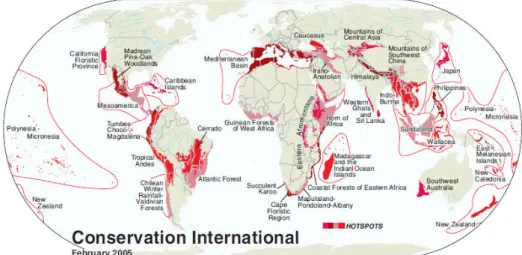
Indian region has over 130,000 species of plants and animals which have been scientifically documented. The country has been referred to as one of the top mega diversity region of the globe with only 2.5% of the global land area. Of the 34 globally identified biodiversity hotspots, India harbours four hotspots, i.e., Himalaya, Indo-Burma, Western Ghats and Sri Lanka, Sundaland. The richness of the biodiversity of the region is largely due to the occurrence of rich diversity of species, genetic and ecological variabilities in different biogeographically and bioclimatically defined zones.
In terms of plant diversity, India ranks tenth in the world and fourth in Asia. India represents nearly 11% of the world’s known floral diversity with over 45,500 plant species. The richness of Indian plant species as compared to the world is shown in Table 1.
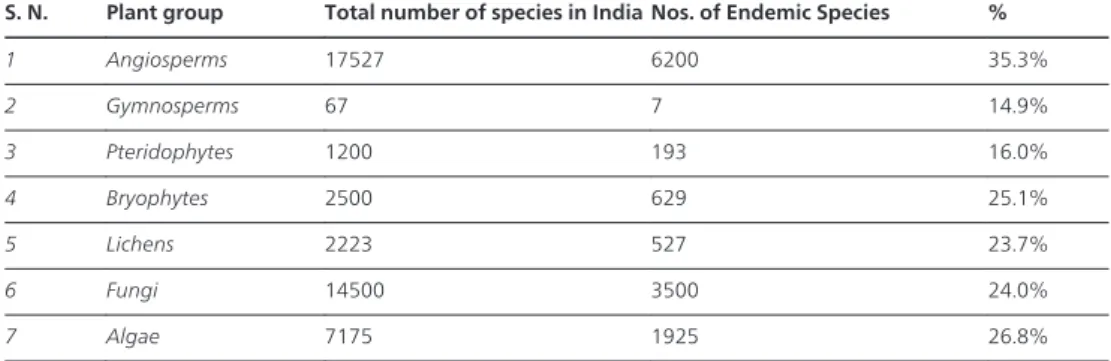
Endemism pertains to the restricted distribution of the flora and fauna. The probable causes for same are geographical isolation, land degradation, close and distinct ecosystem like mountain and oceanic systems etc. About 11,058 species are endemic to Indian region, 6,200 of which belong to flowering plants alone. Eastern Himalaya and north-eastern region (about 2,500 species), peninsular India including western and Eastern Ghats (about 2,600 species), north-western Himalaya (about 800 species) and Andaman & Nicobar Islands (about 250
species) are the areas rich in endemic plants. Endemism in different plant groups of India is given in Table 2.
(Source: http://www.conservation.org)
Figure 2. Global biodiversity hotspots
Plant groups No. of species % of India to the world
India World Virus/Bacteria 850 8,050 10.6 Algae 7175 40,000 17.9 Fungi 14,500 72,000 20.1 Lichens 2223 13,500 16.4 Bryophytes 2500 14,500 17.2 Pteridophytes 1,200 10,000 12.0 Gymnosperms 67 650 10.3 Angiosperms 17,527 2,50,000 7.0 (Source: BSI, 2009)
Table 1. Number of species in major groups of plants and microorganisms in relation to same at international level showing extent of diversity
S. N. Plant group Total number of species in India Nos. of Endemic Species % 1 Angiosperms 17527 6200 35.3% 2 Gymnosperms 67 7 14.9% 3 Pteridophytes 1200 193 16.0% 4 Bryophytes 2500 629 25.1% 5 Lichens 2223 527 23.7% 6 Fungi 14500 3500 24.0% 7 Algae 7175 1925 26.8%
(Source: Botanical Survey of India, 2009)
Table 2. Endemism in different plant groups of India showing high % of endemism to emphasize need of conservation
As per the IUCN Red List (2008), India has 246 globally threatened floral species, which constitute approximately 2.9% of the world’s total number of threatened floral species (8457). Distribution of various IUCN threat categories of Indian plants as compared to global trends is given in Figure 3 and 4.
Figure 3. Indian plants – representation in IUCN threat categories
2.2. Forest biodiversity
India is endowed with vast forest resources. Forests play a vital role in social, cultural, economic and industrial development of the country and in maintaining its ecological balance. The forest resources are storehouse of biodiversity. Other land use practices are benefitted by forests. Realizing the crucial role of forests in maintaining the ecological balance and socio-economic development, the National Forest Policy, 1988 aims at maintaining a minimum of
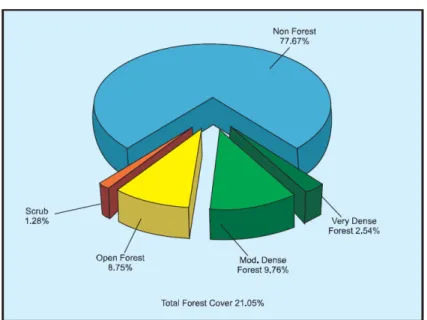
33% of country’s geographical area under forest and tree cover. Currently, total forest cover of India is 692,027 km2 which forms 21.05% of the geographical area of the country (FSI 2011). The state of Madhya Pradesh has the largest forest cover (77,700 km2) in the country followed by Arunachal Pradesh (67,410 km2), Chhattisgarh (55,674 km2), Maharashtra (50,646 km2) and Orissa (48,903 km2) in terms of percentage of forest cover with respect to total geographical area.
Figure 5. Forest cover of India
(Source: FSI 2001)
Figure 6. Forest cover map of India
The forests in the country have been classified into 16 major types and 251 subtypes by Champion and Seth (1968) on the basis of climatic and edaphic features. Forest Survey of India has mapped forest types of India, based on Champion and Seth classification on 1:50,000 scale. Distribution of diverse forest types across the country is presented in Table 3.
Sl.No Group % of Forest Cover
1. Group1- Tropical Wet Evergreen Forest 2.92
2. Group2- Tropical Semi –Evergreen Forest 13.79 3. Group3- Tropical Moist Deciduous Forest 19.73
4. Group 4-Littoral and Swamp Forest 0.69
5. Group5- Tropical Dry Deciduous 41.87
6. Group 6-Tropical Thron Forest 2.25
7. Group 7- Tropical Dry Evergreen Forest 0.13
8. Group 8- Subtropical Broadleaved Hill Forest 2.69
9. Group 9 Subtropical Pine Forest 2.63
10 Group 10- Subtropical Dry Evergreen Forest 0.03
11 Group 11- Montane Wet Temperate Forest 0.69
12 Group 12- Himalayan Moist Temperate Forest 4.12 13 Group13- Himalayan Dry Temperate Forest 0.84 14 Group 14,15 ,16- Sub Alpine and Alpine Forest 2.55
15 Plantation/TOF 5.07
(Source: FSI 2011)
Table 3. Percentage of total forest cover in different forest type groups supporting harbouring diverse life forms Forests are one of the most biologically rich terrestrial systems with diversity in their forest types. These types provide habitats for plants, animals and micro-organisms, and harbour the vast majority of the world’s terrestrial species. Furthermore, forest biodiversity is interlinked to a web of other socio-economic factors, providing an array of goods and services that range from timber and non-timber forest resources to mitigating climate change and genetic resources. At the same time, forests provide livelihoods for people worldwide and play important economic, social, and cultural roles in the lives of many indigenous communities. Therefore, forests and forest biological diversity are innately linked to ecosystem and human well-being.
2.3. Salient features of India’s forest phytodiversity i. The Himalayas
Himalayas-one of the largest and youngest mountain chains in the world-cover roughly 10% of India total land surface. Variations in terms of its size, climate and altitudinal ranges have created environments unique and characteristic to this region only. The diverse climate and the varied environmental conditions of Himalayas support diverse habitat and ecosystems with equally diverse life forms.
The Indian Himalayan flora represents 71 endemic genera and 32% endemic species. The families such as Tetracentraceae, Hamamelidaceae, Circaeasteraceae, Butomaceae, and Stachyuraceae are endemic families of flowering plants. Over 90% of the species in the family Berberidaceae and Saxifragaceae are endemic to the Himalaya, several of the species are disjunct elements of phytogeographical significance. A large number of orchids, many representing neoendemic taxa occur in Sikkim and Arunachal Pradesh.
Except perhaps in the higher elevations of Himalayas and in the more arid parts of Tahr Desert, the natural vegetation of India is essentially arboreal. It is conifers in the Himalayas, which generally resemble that from the north. The most conspicuous trees here are Shorea robusta,
Dipterocarpus tuberculatus, Dalbergia sissoo, Acacia catechu and Acacia nilotica, ssp Indigenous
palms like Corypha, Phoenix sylvestris and Borassus flabellifer as well as Bamboos are common here. Tree ferns are abundant in the forests of Eastern Himalays. The occurrence of Rhododen‐
dron, an Ericaceae member of high altitude, both in the Himalayas and in the Western Ghats
is phytogeographically interesting. The tropical humid elements in the Western Himalays is represented by the Malesian-Deccanian-Pre Himalayan forms such as Terminalia bellirica,
Bombax ceiba, Toona cilitata, Syzygium cumini, Lagerstroemia spp., Daphniphyllum spp. and Shorea robusta. The tropical semi-arid elements are represented by Woodfordia spp., Dalbergia sissoo
and Lannea coromandelica.
The evergreen forests in the Eastern Himalays consist of tree species such as Aesculus panduana,
Artocarpus chamba (A. chaplasha), Michelia chmapaca, Cinnamomum spp., Schima wallichii and Dillenia indica. The common Bamboo seen here is Dendrocalamus hamiltonii. The Savannas in
this part of the Himalays are usually moist and consist of trees like Albizia procera, Bischofia
javanica and Bombax. The vegetation in the lower region is dominated by broad leaved species
of Oaks such as Quercus lamellosa, Q. lineate, Michelia daltsopa (M. excelsa), Pyrus spp., Symplo‐
cos spp., Eurya spp., Meliosma spp., and Castanopsis spp. ii. Desert region
In Indo-Pacific region Thar desert ecoregion is considered the world’s seventh largest desert. The eco-region lies to the west of Aravalli Range and characterized by extreme climate with temperature touching subzero in winters and nearly 50oC during the summer. Rainfall in such region ranges between 100-150 mm.
Flora of Indian desert consists of approximately 700 species (352 genera and 87 families including solitary gymnosperm family). 37 genera and 63 species are exotic to the region. A large number of plants species found in the Thar Desert are known to be endemic (Khan and Frost 2001). High endemism and the occurrence of a large number of sub-species provide evidence of high phylogenetic plasticity and intense speculation on account of extreme dynamics of the ecological conditions, and the recent geological, physiographic, topographical those of the Sahara (Quezel 1965). The plant taxa endemic to the Thar Desert include 23 species and 14 sub-species, forming 6.4 percent of the recorded total. High endemism and the occurrence of a large number of subspecies provide evidence of high phylogenetic plasticity. A complex of extreme environmental factors, the dynamics of the ecological conditions, recent geological, physiographic and topographical changes, can induce speciation. The proportion
of endemic plant species in the Indian desert is higher (6.4 percent) than that of the Sahara which has only 3 to 5 percent of endemic species (Gupta 1998). The Indian desert endemic flora includes: Calligonum polygonoides (Polygonaceae), Prosopis cineraria (Mimosaceae), Acacia
nilotica (Mimosaceae), Lasiurus sindicus (Poaceae), Cenchrus biflorus (Poaceae), Tecomella undulata (Bignoniaceae), Citrullus colocynthis (Cucurbitaceae), Anogeissuspendula (Combreta‐
ceae), Tamarix aphylla (Tamaricaceae), Salvadora oleoides (Salvadoraceae),Commiphora weightii (Burseraceae), Haloxylon salicornicum (Chenopodiaceae), Capparis decidua (Capparaceae), Sueda
fructicosa (Chenopodiaceae), Aerva pseudotomentosa (Amaranthaceae) Crotolaria burhia (Faba‐
ceae), Leptadenia pyrotechnica (Ascelpiadaceae).
The once glorious forests in this region stand, however degraded because of the biotic interference and comprise mostly of bushy, thorny plants. The common trees found are Acacia
nilotica, ssp. indica, Prosopis cineraria, Acacia senegal, Anogeissus latifolia, Syzygium cumini, Dalbergia sissoo, Albizia lebbeck, Boswellia serrata, Balanites aegyptiaca (B. roxburghii), Sterculia urens, Commiphora mukul and Acacia leucophloea. Prosopis chilensis (P. juliflora) is extensively
planted all over the plains.
Pandey et al. (1983) reported 41 and Sharma (1983) reported 106 rare, endangered and threatened (RET) taxa from Rajasthan. Pandey and Shetty (1985) listed RET taxa, whereas Singh (1985) dealt with threatened taxa and their scope of conservation. The present flora of Rajasthan has 2090 species belonging to 819 genera under 159 families of vascular plants (Shetty and Singh, 1987-1993). This included 63 RET taxa, reasons for their depletion and strategies for conservation as well as 45 species of crop and other cultivated plants having 66 species of their wild relatives. However, various researchers are working on under explored areas in search of new species and re-defining the status of RET species. According to Khan et al. (2003), Thar Desert has its own importance and specific characteristics with respect to endemic and medicinal plants. In this study forty-five plant species were considered to be rare and/or endangered and a large number of plants have been categorized as of economic importance and medicinal use. The high population of the region exerts pressure on the biological resources of the Thar Desert causing lack of sustainability and necessitates conser‐ vation of biodiversity actions.
iii. Gangetic Plain
The forests of Gangetic Plain have largely been destroyed and in some tracts Sal forests are left. The Sal forests have species like Terminalia elliptica (T. alata), Terminalia bellirica, Bauhinia spp., Syzygium cumini, Phyllanthus emblica and Woodfordia sp. The mangrove forests of Sun‐ derbans have species like Aechmanthera gossypina (Aegiceras majus), Cynometra iripa (C. mimo‐
soides) and Ceriops tagal (C. candolleana). iv. North-east India
In the north-east region, the tree flora is luxuriant, consisting of species like Artocarpus chamba,
Michelia champaca, Ficus elastica, Mesua ferrea, Alstonia scholaris, Pterygota alata, Morus macro‐ ura (M. laevigata) and Stereospermum chelonoides. The common Bamboo available here is Dendrocalamus hamiltonii. The hill forests are dominated by Alnus nepalensis, Rhododendron arboreum, Michelia champaca and Prunus sp. The Pine forests are composed of Pinus kesiya.
Samati and Gogoi (2007) carried out a study for the documentation of the ethnobotanical wealth of Jaintia hills. Population expulsion and unemployment also compel people to exploit these SGs, leading to a rapid dwindling of many rare and threatened taxa of both plants and animals from the region. In this context he mentions that an extensive awareness programme is needed to educate the locals about SGs. The State Forest Department and MoEF can join hands with the local NGOs to create a network of all the SGs and bring them under state-sponsored conservation programmes. The Tourism Department also should come forward to focus on SGs as a destination for tourists. The local community should be provided with adequate funds and the responsibility to manage the SGs. This will help in the protection of the SGs. Eco-restoration and afforestation programmes of the government conservation agencies should also include these degraded SGs.
Deb et al (2008) stated that the areca-nut based traditional agroforests and the natural tropical rainforests have multi-layered vegetal structures with comparable tree density, but showed significant differences in soil nutrients and microbial biomass that recorded lower values in traditional agroforests as compared to the tropical forests. Nonetheless, the percentage contribution of soil microbial biomass, litter and fine roots to soil C was similar and competitive in traditional agroforests, but substantially lower than that in the tropical forests. Litter had a major role to play in soil nutrient turnover in tropical forests followed by soil microbes and fine roots. The traditional agroforesty systems studied are, however not well-managed, but when subjected to scientific management might prove to be a sustainable food production land use system in the hills and flood plains and consequently can potentially promote conservation and sustainability of the tropical forests.
Deb and Sundriyal (2007) stated that small and medium size gaps had limited impacts on the species composition. Such gaps however are crucial for regeneration of top canopy as well as pioneer species and hence the important for maintaining species diversity in Namdapha National Park. As the gaps showed difference in species composition, it clearly illustrated that the plant species behavior in low-land tropical forest is independent of gap size and is mainly governed by availability of seeds at the time of creation of gaps. The information on the tree species gap performance has implications for the management of the forest stand.
Mishra et al 2005 conducted a study in a subtropical humid forest (sacred grove) at Mawnai, West Khasi hills district of Meghalaya. Citrus medica (Rutaceae), the dominant species, was the only species exhibiting random distribution. All other species showed contagious distribution.
Cryptocarya amygdalina, family Lauraceae, was the co-dominant species. Lauraceae (17 species)
was the species rich family in the grove and exhibited maximum tree density and basal area. However, generic composition was highest (9 genera) in the case of Euphorbiaceae, which is the co-dominant family in the grove. Majority of the families were represented by single genus and single species. Log-normal dominance-distribution curves at the levels of species and family, and wide girth structure signify the complexity and stability of the community.
v. The Western Ghats
The Western Ghats are the main peninsular hill range extending over 1400 Km, starting in the north from near the Tapti River and ending in the south near Kanyakumari. Undoubtedly it
is the most important topographic feature of peninsular India. It is more or less homogenous but biologically distinctive geographical zone with total area of about 1,60,000 sq. Km of which about one third is forests. It is known that 90% of the country’s medicinal flora occurs in these forests.
The Western Ghats region is considered as one of the most important biogeographic zones of India as well as one of the 34 ‘Hot Spots’ of biodiversity recognized in the world. About 1500 endemic species of dicotyledonous plants have been reported from the Western Ghats. It is one of the richest centers of endemism. Due to varied topography and micro-climatic regimes, some areas within the region are considered to be active zones of speciation. The region has 490 arborescent taxa, of which as many as 308 are endemics. 56 genera and 1500 species of flowering plants and 63% of India’s evergreen forest plants are endemic to the Western Ghats. The Western Ghats forests are characterized by conditions of high humidity and temperature, favouring vigorous growth of trees that often attains a height of 60 m or more. The tropical wet evergreen and semi-evergreen forests are typically rain forests. Luxuriant vegetation in more or less virgin condition is a characteristic feature of the Malabar region of the Western Ghats. The region has tropical evergreen rain forests, mixed deciduous or monsoon forests and subtropical or temperate forests. Majority of the tree species in this region belong to the families like Dipterocarpaceae, Guttiferae, Myristicaceae, Tiliaceae, Euphorbiaceae, Annona‐ ceae, Anacardiaceae, Fabacae, Caesalpiniaceae, Mimosaceae, Meliaceae, Myrtaceae, Rutaceae, Rubiaceae, Sapotaceae, Urticaceae and Palmaceae. The tropical evergreen forests consists of tree species such as Toona ciliata, Dysoxylum malabaricum, Vateria indica, Dipterocarpus indicus,
Hopea parviflora, Hopea ponga, Cullenia exarillata, Artocarpus hirsuta, Vitex altissima, Hydnocarpus laurifolia, Humboldtia spp., Haldinia cordifolia and Garcicina spp.
The mixed deciduous or monsoon forests consist of dominant tree species like Terminalia
elliptica (T. alata), T. paniculata, T. bellirica, T. chebula, Lagerstroemia spp., Dalbergia latifolia, Xylia xylocarpa, Pterospermum spp., Sterculia urens, S. guttata and Stereospermum spp. The bamboos
occurring commonly in this forests are Bambusa bambos and Dendrocalamus strictus.
The subtropical or temperate evergreen forests are commonly known as “Sholas” and they usually exist above an altitude of 1800 m. They are composed mainly of Gordonia obtusa,
Michelia nilagirica, Ternstroemia japonica, Syzgium mudagam, Eugenia spp., Meliosma simplicifolia, Symplocos cochinchinensis, Litsea coriacea, Litsea floribunda and Actinodaphne spp. The flora of the
Nilgiri hills are interesting, as it shows affinities with Assam flora and with that of the southern slopes of Himalayas. Shola forests in the mountain slopes with trees of Rhododendron arbor‐
eum, ssp. nilagiricum, Turpinia nepalensis, Elaeocarpus serrtus, E. recurvatus and Viburnum spp.
are unique in composition.
Fresh water swamps with characteristic vegetation occur in the Malabar region of the Western Ghats, dominated by different species of Myristica. Therefore, they are also called as “Myristica Swamps”. The Myristica species in the swampy areas produce “Knee roots” which are very unique. The Myristica swamps consist of species such as Myristica fatua var. magnifica (M.
The vegetation of the Western Ghats of the Malabar region is very rich and phytogeographi‐ cally interesting. The species occurring here show affinities with that of Sri Lanka and Malaysia. The region is also rich in endemic species. The conifer, Nageia wallichiana (Podocarpus
wallichianus), confined to the hills of Tirunelveli and Southern Kerala is known only from
Burma and South East Asia.
vi. Deccan Plataeu
The deciduous forests of Deccan have species like Sterculia urens, Boswellia serrata and
Cochlospermum religiosum. The dry slopes have Anogeissus latifolia, Ougenia oojeinensis, Lannea coromadelica, Cleistanthus collinus, Zizyphus xylopyrus, Buchanania spp., Terminalia spp., Bauhinia
spp., Shorea spp., Dalbergia spp., Maduca longifolia, var. latifolia (Bassia latifolia), Diospyros spp.,
Pterocarpus marsupium, Pterocarpus santalinus, Eugenia spp. and Wendlandia thyrsoidea. The areas
of having black cotton soil are covered by Capparis divaricata, Acacia nilotica, ssp. indica, Prosopis
cineraria, Parkinsonia aculeata and Zizyphus mauritiana.
Except the more arid margins, the whole of Peninsular India was formerly densely forested, but at present only Acacia shrubs occur here. The thorn forests in the west, the closed monsoon forests of Shorea in Chota-Nagpur and the open deciduous forests in between are only relics.
vii. Andaman Islands
The vegetation of Andaman Islands consist of Mangrove forests, Littoral forests, Evergreen forests, Deciduous forests and the hill forests on shallow soiled slopes of hills. The major tree species of the island are Pterocarpus dalbergioides (Andaman Padauk), Thespesia populnea,
Pongamia pinnata, Barringtonia sp., Erythrina indica, Calophyllum inophyllum, Gyrocarpus ameri‐ canus, Terminalia catappa, Rhizophora mucronata, Brugueira gymnorrhiza and Ceiops tagal
(Parkinson, 1923). The Andamans and the Nicobar Islands possess the best quality of mangrove forests. The total area estimated under mangrove vegetation in India is 4827 km2 and out of this, 966 km2 area of mangroves occurs in Andaman and Nicobar Islands (i.e. 20 per cent of the total mangrove area of the Indian territory) (Ramakrishana et al. 2010). There are 45 species of mangroves, coming under 27 genera, represented in the island zone.
viii. Coastal zone and Lakshadweep
The distribution of different mangrove genera shows that the greatest number of genera and species occur along the shores of the Indian and Western Pacific oceans. The Indian mangorves comprise approximately 59 species of 41 genera, belonging to 29 families. Of these, 32 species belonging to 24 genera and 20 families are present along the west coast. There are about 21 mangrove species reported from Gujarat coast, 28 from Maharashtra, 20 from Goa, 21 from Karnataka, 14 from Kerala and 4 from Lakshadweep. The Arabian Sea coast is characterised by the typical funnel shaped estuaries of the major rivers like Narmada and Tapti and numerous small rivers. The entire west coast is thus dominated by estuarine backwater type of mangroves, unlike the deltaic mangroves of the east coast. Mangrove forests of the west coast are evergreen or deciduous, characterized by the presence of Avicennia marina, Rhizophora
mucronata, Kandelia candel, Brugueira gymnorrhiza and Carallia brachiata. Sonneratia caseolaris
only along the Maharashra coast. Species like Ceriops decandra, Xylocarpus spp., Lumnitzera
littoralis, Nypa fruticans, Phoenix paludosa and Cerbera manghas are limited along the east coast.
The species, which commonly occur and uniformly distributed along the east and west coast of India are Rhizophora mucronata, R. apiculata, Ceriops tagal, Brugueira gymnorrhiza, Lumnitzera
racemosa, Sonneratia apetala, Acanthus ilicifolius, Avicennia marina, A. officinalis, Excoecaria agallocha and Acrostichum aureum. The east coast of India has deltaic type of mangroves and it
covers about 70 percent of the total mangrove forested area in India (Deshmukh, 1991).
2.4. Value of forest biodiversity
Life has value and meaning beyond monetary measure, and so does biodiversity. While it is not really possible to put a monetary figure on the value of forests, it is now widely recognized that we need to improve the way our societies and economies account for ecosystem services. We often take these services for granted, such as the ability of the forest to filter water or produce oxygen. Human well-being depends on the goods and services provided by nature —Earth’s “natural capital”. Recent initiatives, such as the global study on ‘The Economics of Ecosystems and Biodiversity’ (TEEB) have resulted in a better understanding of the economic value of forests and other ecosystems for societies.
Sl.No Ecosystem services
Value of Ecosystem Services (US$/ha/year-2007 values) Average Maximum Provisioning services 1. Food 75 552 2. Water 143 411 3. Genetic resources 483 1756 4. Medicinal resources 181 562 Regulating services
1. Influence on air quality 230 449
2. Climate regulation 1965 3281
3. Water flow regulation 1360 5235
4. Waste treatment/ water purification 177 506
5. Erosion prevention 694 1084
Cultural services
1. Recreation and tourism
opportunities 381 1171
Total 6120 16362
(Source: TEEB Climate Issues Update 2009)
Table 4. Values of ecosystem services in tropical forests for influencing economic decisions about the future of forests for Societies
The TEEB study estimates that, on average, one hectare of tropical forest provides US$ 6,120 per year in ecosystem services, such as watershed protection, climate regulation; soil stabili‐ zation, coastal protection, nutrient cycling, and carbon storage (Table 4). This also includes the numerous products from tropical forests, such as timber, wild food and non-timber forest products—rubber, oils and fibres that are economically important both locally and nationally in many tropical forest countries. Yet, only a fraction of this value is currently accounted for when we make economic decisions about the future of forests. The Green Economy Initiative of the United Nations Environment Programme (UNEP) and other efforts are now underway to improve the way we value and account for nature in our economic decision-making.
2.5. Support for people’s livelihoods
Forests, with their rich biodiversity are essential for human livelihoods and for sustainable development. For example, fuel wood is the primary source of energy for heating and cooking for an estimated 2.6 billion people. The World Bank estimates that forests directly contribute to the livelihoods of some 90 per cent of the 1.2 billion people living in extreme poverty. The Millennium Ecosystem Assessment also found that as many as 300 million people, many of them very poor, depend substantially on forest ecosystem services for their subsistence and survival. Many non timber forest products derived from forest biodiversity, such as wild cocoa, honey, gums, nuts, fruits, flowers, seeds, rattan, fungi and wild meat and berries are essential for the food, medicine and confectionary building material used by indigenous and local communities to sustain their way of life, including their cultural and religious traditions. India has a huge population living close to the forest with their livelihoods critically linked to the forest ecosystem. There are around 1.73 lakh villages located in and around forests (MoEF, 2006). Though there is no official census figures for the forest dependent population in the country, different estimates put the figures from 275 million (World Bank, 2006) to 350-400 million (MoEF, 2009). People living in these forest fringe villages depend upon forest for a variety of goods and services which includes collection of edible fruits, flowers, tubers, roots and leaves for food and medicines; firewood for cooking (some also sale in the market); materials for agricultural implements, house construction and fencing; fodder (grass and leave) for livestock and grazing of livestock in forest; and collection of a range of marketable non-timber forest products. Therefore, with such a huge population and extensive dependence pattern, any over exploitation and unsustainable harvest practice can potentially degrade forest. Moreover, a significant percentage of the country’s underprivileged population happened to be living in its forested regions (Saha and Guru, 2003). It has been estimated that more than 40 per cent of the poor of the country are living in these forest fringe villages (MoEF, 2006). Apart from this, a significant percentage of India’s tribal population lives in these regions. Several field based studies have documented the adverse impact of such dependence pattern on the forest quality. The forest fringe communities not just collect these forest products for their own consumption but also for commercial sale, which fetch them some income. The income from sale of the forest products for households living in and around forest constitutes 40 to 60 per cent of their total income (Bharath Kumar et al, 2011; Sadashivappa et al, 2006; Mahapatra and Kant, 2005; Sills et al, 2003; Bahuguna, 2000). A study (Saha and Sundriyal,
2012) on the extent of NTFP use in north east India suggest that the tribal communities use 343 NTFPs for diverse purposes like medicinal (163 species), edible fruits (75 species) and vege‐ tables (65 species). The dependence for firewood and house construction material is 100% and NTFPs contributed 19–32% of total household income for the communities under study (Saha and Sundriyal, 2012). Forests are not only a source of subsistence income for millions of poor households but also provide employment to poor in these hinterlands. This makes forests an important contributor to the rural economy in the forested landscapes in the country. The widespread poverty and lack of other income generating opportunities often make these people resort to over-exploitation of forest resources. The collection of firewood for sale in the market, though it is illegal, is also extensive in many parts of the forested regions in the country and constitutes the source of livelihood for 11 per cent of the population (IPCC, 2007). However, many other forest products have been sustainably harvested by local communities for many years, and are a constant source of household income.
2.6. Threats to the biodiversity
Threats to species are principally due to decline in the extent of their habitat, fragmentation of habitat, decline in habitats quality, shrinking genetic diversity; invasive alien species; declining forest resource base; climate change and desertification; over exploitation of resources; impact of development projects and impact of pollution. For terrestrial species decline habitat quality and quantity arise from conversion of forest and grasslands to agriculture, of natural forests into monoculture plantations and from grazing and firewood collection. In some areas, invasion of exotic species also results in habitat degradation. For aquatic and semi aquatic species, decline in habitat quality are due to diversion of ground and surface water resulting in drying of streams and other water bodies apart from siltation and pollution from pesticides. In this century, the Indian cheetah, Lesser Indian rhino, Pink-headed duck, and the Himalayan mountain quail are reported to have become extinct and several other species (39 mammals, 72 birds and 1,336 plants) are identified vulnerable or endangered.
The constraints and challenges to biodiversity conservation which flow inter alia from these threats include: biodiversity information base; implementation of Biological Diversity Act and safeguarding traditional knowledge; new and emerging biotechnologies; economic valuation and natural resource accounting; policy, legal and administrative measures; and institutional support. Taking clue from the preceding lines, the Cold Desert areas lie in the Trans-Himalayan zone and some species in the region those are endemic to Tibetan plateau and also include oasitic elements that comprises a variety of exotic as well as indigenous species. The area represents common herbaceous, shrubby and woody elements of temperate vegetation and alpine species also dot the region. The region is also a house of species growing in glacial moraines and also harbours threatened medicinal plants. Talking of faunal diversity this area harbours rare and endangered fauna pointed out earlier and avifauna endemic to the region or migrating adds to its uniqueness. Livestock rearing, agricultural & horticultural practices and mode of agro-forestry are entirely different and the people living here have succeeded in developing their own distinguish culture.
The above explanation reveals that the area is unique to the region and hence requires special attention especially with respect of ecology of India. Hence laxity on our part in conserving the cultural and natural resources will put the area under severe thereat thereby exposing the region to all sorts of ecological disasters.
2.7. Habitat fragmentation, degradation and loss, and shrinking genetic diversity
Habitat destruction is identified as the main threat to biodiversity. Under diverse natural conditions, over a billion people in rural and urban areas live in harmony under a democratic system in India. Their pressing needs for food, fiber, shelter, fuel and fodder combined with compelling need for economic development exert enormous pressure on natural resources. With half the total land under agriculture, and approximately 23 or 20% per cent under forests, the protection of diverse habitats poses a formidable challenge. The loss and fragmentation of natural habitats affects all animal and plant species. We need to not only stop any further habitat loss immediately but also to restore a substantial fraction of the wilderness that has been depleted in the past. Various species of plants and animals are on the decline due to habitat fragmentation and over-exploitation, e.g. habitats of Great Indian Bustard in Madhya Pradesh, Gujarat and Rajasthan and of the Lion-tailed Macaque in Western Ghats. The major impact of developmental activities involves diversion of forest land. Since the enactment of Forest (Conservation) Act in 1980, about 14,997 development projects involving diversion of 11.40 lakh hectare forest area for non forestry uses, have been granted clearance. Against this diversion, Compensatory Afforestation has been stipulated over 12.10 lakh hectare.
Habitat fragmentation is also one of the primary reasons leading to cases of man animal conflict. Common property resources like pastures and village forests, which served as a buffer between wildlife habitat and agriculture, have been gradually encroached upon and converted into agricultural fields and habitation. Due to this, the villagers are brought into a direct conflict with wild animals.
Sacred groves (India has over 19,000 sacred groves) are also getting eroded or getting converted to plantations. Because there are several medicinal plants and wild relatives of crop plants occurring naturally in these areas, the sacred groves need to be conserved. Traditional norms and practices for conservation of neighborhood forest and common land are also diminishing, although certain rural and tribal communities continue to safeguard their biological resource base even at the cost of their livelihood and sustenance. Himalayan Forest Research Institute (HFRI), Shimla is in the process of documenting the sacred groves of Kullu Valley and it is proposed that such efforts are required to be replicated elsewhere in this part of the country. It is pertinent to add here that strengthening the database of sacred groves will usher in development of strong bonds between ecological and social ethos relevant to the society at last ultimately reflecting upon the conservation of biodiversity. The point gains significance here, because the areas under sacred groves, otherwise the property of local deity, are being encroached upon by the local population thereby creating loss of biodiversity (Horticulture is now being tried in these areas) on one hand and threatening the social ethos of the area on the other.
2.7.1. Invasive alien species
Among the major threats faced by native plant and animal species (and their habitats), the one posed by the invasive alien species is truly scaring since it is considered second only to that of the habitat loss. The major plant Forest Invasive Species (FIS) include Lantana camara, Eupato‐
rium glandulosum, Parthenium species, Mimosa species, Eichhornia crassipes, Mikania micrantha, Ulex europaeus, Prosopis juliflora, Cytisus scoparius, Euphorbia royleana etc. Alien aquatic weeds
like water hyacinth and water lettuce are increasingly choking waterways and degrading freshwater ecosystems. Lantana and carrot grass cause major economic losses in many parts of India. Highly invasive climbers like Chromolaena and Mikania species have over-run the native vegetation in North-East Himalayan region and Western Ghats. Numerous pests and pathogens such as coffee berry borer, turnip stripe virus, banana bunchy top virus, potato wart and golden nematode have invaded agro-ecosystems becoming serious menace. HFRI, Shimla has identified some of the plant and insect species which though invasive have naturalized itself in the region thereby, posing a serious threat to the ecology. No particular attention to these invasive species have been paid over a period of time which had then resulted into the present alarming situation and all the countries have now converged over a single platform for fighting the menace caused by the same. Accordingly special efforts towards assessment of these invasive species are required to be made and if we fail in this direction it will lead to loss of endemic biodiversity on one hand and will expose the area to the exotic species on the other.
2.7.2. Impact of development projects
India, with its large population, is poised for rapid economic growth. Large infrastructural and industrial projects, including highways, rural road network and the special economic zones (SEZs), are coming up. With cities and townships expanding often at the cost of agriculture, and agriculture expanding at the cost of tree cover, fresh threats to biodiversity are emerging. In addition, changing lifestyles of the people with rising incomes, in both rural and urban areas, are placing increasing demands on biodiversity.
No doubt that infrastructural development is essential for the welfare of human beings inhabiting the planet since; it brings more comfort to the society. However, it may specifically be mentioned over here that over utilization of the resources for substantial increase in the comforts is directly impinging upon the environmental health. Developmental activities no doubt, are essentially required for the larger interest of the human kind yet, over utilization of natural resources in the process certainly require a relook into some of the criterion otherwise required to be fitted in the process for sustainable development. The government machinery should therefore, be not averse to the development but should ask the implementers and managers to devise suitable strategies for paying required attention towards the development of issue based parameters for ultimate protection of the environment.
Many river valley projects are being implemented for the last 100 years or so all across the world. These projects besides providing safeguards against floods also provide electricity for increasing overall productivity of the region or of the country. Though efforts in the direction are still continuing, yet it is estimated that approximately 99 per cent of precipitation in the
form of rain, snow etc. directly merges with the oceans without being utilized properly on their way. This certainly requires sincere thoughts/ efforts to harness it for the ultimate benefit of the mankind.
In order to harmonize developmental activities with protection of environment, environmen‐ tal impact assessment (EIA) was made mandatory by the EIA Notification issued in 1994 for notified categories of developmental projects in the sectors of industry, thermal and nuclear power, mining, river valley and infrastructure projects. This Notification has been revised and notified on 14 September 2006 to make the EIA process more efficient, decentralized and transparent. What is required now is the effective implementation of these legislations by making it site and species specific. So that such plans become more relevant to the Environ‐ mentalists, implementers and managers. The issue gains significance in the state of Himachal Pradesh. Since large reservoirs are repeatedly coming over on the same river within a short distance and hence, are damaging the fragile ecology of Himalayas and directly impinging upon the loss of biodiversity. Large tunnel projects are also affecting the aquatic fauna-due to diversion of water through these tunnels especially during the winters when the water flow in the rivers gets reduced considerably.
2.7.3. Pollution
Biodiversity in India is facing threat from various sources of pollution, both point and non-point, sources. The major threats are from improper disposal of municipal solid waste, inadequate sewerage, excessive use of chemical pesticides and continuous use of hazardous chemicals even where non-hazardous alternatives are available. New industrial processes are generating a variety of toxic wastes, which cannot be dealt with by currently available technology in the country. Besides, economic constraints and problems related to the indige‐ nization makes the substitution of these technologies difficult.
3. Major findings and management status
India has a long history of conservation and sustainable use of natural resources and over a period of time has developed a stable organizational structure for environment protection. Conservation and sustainable use of biodiversity has been integrated into national decision making through:
1. Policy statements (e.g. National Forest Policy, National Conservation Strategy, National
Wildlife Action Plan, Draft National Environment Policy.)
2. Legislative measures (e.g. Environment (Protection) Act, Wildlife (Protection) Act,
Biological Diversity Act, Environment Impact Assessment Notification, Coastal Regula‐ tion Zone Notification, Notifications on ecologically fragile areas)
India’s strategies for conservation and sustainable utilization of biodiversity in the past have comprised providing special status and protection to biodiversity – rich areas by declaring them as National Parks, Wildlife Sanctuaries, Biosphere Reserves, ecologically fragile and
sensitive areas, off loading pressure from reserve forests adopting by alternative measures for fuel wood and fodder by afforestation of degraded areas and wastelands, creation of ex-situ conservation facilities such as gene banks etc.
Although there were several Acts existed in India for ensuring conservation of biodiversity, the International Convention on Biological Diversity that came in to effect in 1993 and the Biodiversity Act, 2002 enacted by the Indian Parliament subsequently gave impetus to the conservation efforts in the country.
3.1. The Convention on Biological Diversity
The Convention on Biological Diversity (CBD) is a landmark in the environment and devel‐ opment field, as it envisages for the first time a comprehensive rather than a sectoral approach to the conservation of Earth's biodiversity and sustainable use of biological resources. It was in the year 1984 that the need to have in place a global convention on biological diversity started gaining momentum. In response to it, the United Nations Environment Programme (UNEP) in the year 1987 recognized the need to streamline international efforts to protect biodiversity. The Convention on Biological Diversity (CBD) was negotiated and signed by nations at the UNCED Earth Summit at Rio de Janeiro in Brazil in June 1992. The Convention came into force on December 29, 1993. India became a Party to the Convention in 1994. At present, there are 175 Parties to this Convention (NBA, 2004).
The main objectives of the Convention are:
• Conservation of biological diversity
• Sustainable use of the components of biodiversity and
• Fair and equitable sharing of benefits arising out of the utilisation of genetic resources. 3.2. Biological Diversity Act, 2002
The Central Government has brought Biological Diversity Act, 2002 with the following salient
features:-1. To regulate access to biological resources of the country with the purpose of securing
equitable share in benefits arising out of the use of biological resources and associated knowledge relating to biological resources.
2. Conservation and sustainable use of biological diversity.
3. To respect and protect knowledge of local communities related to biodiversity;
4. To secure sharing of benefits with local people as conservers of biological resources and
holders of knowledge and information relating to the use of biological resources.
5. Conservation and development of areas of importance from the standpoint of biological
diversity by declaring them as biological diversity heritage sites.
7. Involvement of institutions of State governments in the broad scheme of the implemen‐
tation of the Biological Diversity Act through constitution of committees (NBA, 2004).
3.3. Conservation of forest biodiversity in protected areas
In order to conserve variability within and among different species in its authority Protected Areas (PAs) have been established for coordinated conservation of ecological units and corridors with multilateral cooperation of the neighbouring nations. There are different types of PAs like Biosphere Reserve (BR), National Parks (NPs), Wildlife Sanctuaries (WLS), Conservation Reserves (CR) and Community Reserves (Com.R).
Different workers have carried out isolated work on evaluation of genetic conservation of forest trees and woody species in the country. Nageswara Rao et al. (2001) assessed the genetic diversity parameters of Sandal (Santalum album) populations of peninsular India and suggest‐ ed that in-situ conservation of Sandal genetic resources to be focused at populations and sites in the Deccan plateau. Similarly, Ravikanth et al. (2001) mapped the genetic diversity of rattans in central Western Ghats and suggested to have conservation stands at three sites in southern Western Ghats. Anandarao (2003) and Tikader et al. (2001) studied the germplassm of different species of Morus and identified diverse populations in different locations in Andamans, North-East India. Padmini et al. (2001) analysed Genetic diversity of Phyllanthus emblica in forests of South India and identified different locations with high diversity for in-situ conservation. However, these findings couldn’t be utilized fully as certain identified sites fall outside the already established PAs. Vasudeva et al (2002) studied the available population of Semecarpus
kathalekanensis, an Endangered tree and its diversity in Myristica swamp in Karnataka and
suggested the requirement of special in-situ conservation measures.
3.4. Biosphere Reserves, National Parks and Wildlife Sanctuaries
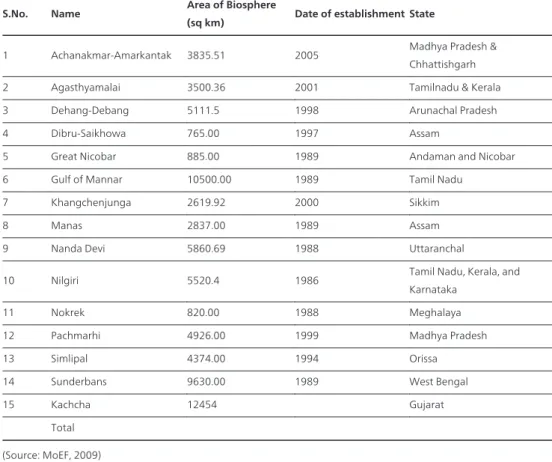
Biosphere Reserve is an international conservation designation given by UNESCO under its Programme on Man and the Biosphere (MAB). According to “The Statutory Framework of the World Network of Biosphere Reserves,” biosphere reserves are created to promote and demonstrate a balanced relationship between humans and the biosphere. Under article 4, biosphere reserves must “encompass a mosaic of ecological systems,” and thus consist of combinations of terrestrial, coastal, or marine ecosystems. In India there are 15 biosphere reserves with total area of 58,645 sq.km (MoEF, 2009) (Table 5). They encompass one or more protected areas like National Parks, sanctuaries or conservation reserves.
A network of 667 PAs has been established, extending over 157826.773 sq. kms. (4.80 % of total geographic area of the country), comprising 102 National Parks, 514 Wildlife Sanctuaries, 47 Conservation Reserves and 4 Community Reserves. The State / Union Territory wise details of PAs in the country with extent are given in (Table 5.). The protected areas in India are mainly meant for large mammals, birds and some specific conservation dependant flagship species. However, when the whole habitat or ecosystems are protected, whole forest biodiversity also enjoys the protection. Some protected areas have also been designated recently for the conservation of certain plant species, considering their importance. They are Kurinjimala
National Park, in Idukki district, Kerala for Strobilanthes; the Rhododendron Sanctuary at Singba in Sikkim, the Nepenthes Sanctuary at Jarain in Meghalaya and the Orchid Sanctuary at Sessa in Arunachal Pradesh.
3.5. Conservation of forest biodiversity outside protected areas
In addition to the PAs, there are several other means of in-situ conservation like Sacred Groves (SG), Gene Pool Conservation Areas (GPCA), Seed Production Areas (SPAs) Medicinal Plant Conservation Areas (MPCA) and Permanent Preservation Plots (PPP).
3.6. Sacred groves
Conservation of habitats and individual species has been practiced in India since time immemorial. Concern for nature conservation is deeply embedded in the multiracial Indian
S.No. Name Area of Biosphere
(sq km) Date of establishment State
1 Achanakmar-Amarkantak 3835.51 2005 Madhya Pradesh &
Chhattishgarh
2 Agasthyamalai 3500.36 2001 Tamilnadu & Kerala
3 Dehang-Debang 5111.5 1998 Arunachal Pradesh
4 Dibru-Saikhowa 765.00 1997 Assam
5 Great Nicobar 885.00 1989 Andaman and Nicobar
6 Gulf of Mannar 10500.00 1989 Tamil Nadu
7 Khangchenjunga 2619.92 2000 Sikkim
8 Manas 2837.00 1989 Assam
9 Nanda Devi 5860.69 1988 Uttaranchal
10 Nilgiri 5520.4 1986 Tamil Nadu, Kerala, and
Karnataka
11 Nokrek 820.00 1988 Meghalaya
12 Pachmarhi 4926.00 1999 Madhya Pradesh
13 Simlipal 4374.00 1994 Orissa
14 Sunderbans 9630.00 1989 West Bengal
15 Kachcha 12454 Gujarat
Total (Source: MoEF, 2009)
Table 5. Biosphere Reserves in India encompass a mosaic of ecological systems consist of combinations of terrestrial, coastal, or marine ecosystems
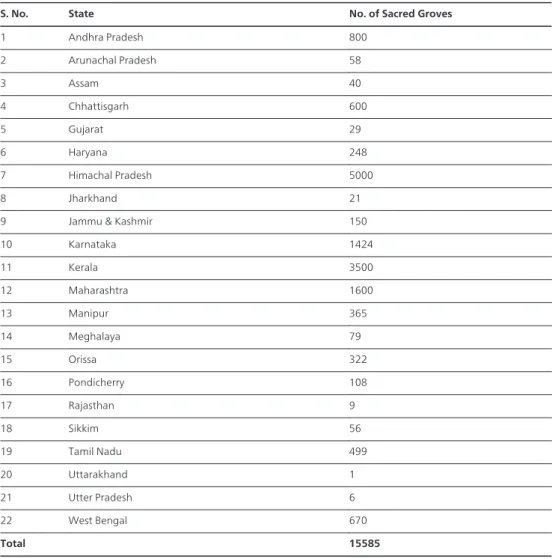
society. The Sacred groves are patches of natural vegetation, which are protected through some religious faiths and they exist throughout India. They shelter many economically important, medicinal, endemic, rare and endangered species. The extent of sacred groves varies from 1m2 to 1000000 m2. Although, there has been no comprehensive study on the Sacred groves of the entire country, experts estimate the total number of sacred groves in India could be in the range of 100,000 – 150,000. As per some reports, India is having 13270 sacred groves (Malhotra
et al. 2001; Kunhikannan and Gurudev Singh, 2005; Warrier et al. 2008) (Table 6).
State/Union Territories National Parks (NP) Wildlife Sanctuaries (WS) Conser. Reserves (CR) Community reserve (Com.R) Area of state (sq km) Total Area covered (sq km) % of protected area in State Andhra Pradesh 6 21 0 0 275068 13006.514 4.73 Arunachal Pradesh 2 10 0 0 83743 9778.57 11.68 Assam 5 18 0 0 78438 3909.80 4.98 Bihar 1 12 0 0 94163 3187.33 3.39 Chhattisgarh 3 11 0 0 135194 6382.27 4.79 Goa 1 6 0 0 3702 754.91 20.39 Gujarat 4 23 1 0 196024 17323.48 8.83 Haryana 2 8 2 0 44212 348.84 0.75 Himachal Pradesh 5 32 0 0 55673 10016.85 17.99
Jammu & Kashmir 4 15 34 0 222235 11688.36 5.26
Jharkhand 1 11 0 0 79714 2182.14 2.74 Karnataka 5 22 2 1 191791 6482.52 3.38 Kerala 6 16 0 1 38863 2382.52 6.13 Madhya Pradesh 9 25 0 0 308252 10814.76 3.51 Maharashtra 6 35 1 0 307690 15429.75 5.02 Manipur 1 1 0 0 22327 224.4 1.01 Meghalaya 2 3 0 0 22429 301.68 1.35 Mizoram 2 8 0 0 21081 1240.75 5.89 Nagaland 1 3 0 0 16579 222.35 1.34 Orissa 2 18 0 0 155707 7959.85 5.11 Punjab 0 12 1 2 50362 344.72 0.68 Rajasthan 5 25 3 0 342239 9548.60 2.79 Sikkim 1 7 0 0 7096 2183.10 30.76 Tamil Nadu 5 21 1 0 130058 3829.82 2.95
State/Union Territories National Parks (NP) Wildlife Sanctuaries (WS) Conser. Reserves (CR) Community reserve (Com.R) Area of state (sq km) Total Area covered (sq km) % of protected area in State Tripura 2 4 0 0 10486 603.62 5.76 Uttar Pradesh 1 23 0 0 240926 5711.00 2.37 Uttaranchal 6 6 2 0 53485 7376.33 13.79 West Bengal 5 15 0 0 88752 2896.53 3.26 Andaman & Nicobar 9 96 0 0 8249 1543.33 18.71 Chandigarh 0 2 0 0 114 26.009 22.81
Dadra & Nagar
Haveli 0 1 0 0 491 92.16 18.77
Daman & Diu 0 1 0 0 112 2.18 1.95
Delhi 0 1 0 0 1483 27.82 1.88
Lakshadweep 0 1 0 0 32 0.01 0.031
Pondicherry 0 1 0 0 493 3.90 0.79
Total 47 4 4.80
(Source: MoEF, 2012)
Table 6. State-wise details of the Protected Area Network of the country for conservation of certain plant species, mammals and birds
A recent study conducted by (Sambandan and Dhatchanamoorthy, 2012) on the floristic composition of angiosperms occurring in a sacred grove of 0.2 ha area, located in Karaikal area of the UT of Puducherry brought out presence of 59 plants species of flowering plants coming under 55 genera and 30 families. They also found that, many rural people in the district were using the plants from the sacred groves to cure many common diseases. They suggested that, this kind of degraded sacred groves should be immediately restored or regenerated using appropriate technologies and by creating awareness among the rural people regarding the importance of sacred grove and its conservation.
3.7. Gene Pool Conservation Areas
Gene pool conservation is necessary for human welfare. Several species have become extinct and some others are already threatened and may become extinct if appropriate measures for their conservation are not taken. Some State Forest Departments like Kerala, Tamilna‐ du and West Bengal have initiated establishment of Gene Pool Conservation Areas (GPCA) for providing specific protection to certain areas through participatory approaches, involving local people. The Govt. of Kerala has identified some of the areas to be protect‐
ed as GPCAs and issued guidelines for identification and mapping of GPCAs in the State (KFD, 2005) (Table 7).
S. No. State No. of Sacred Groves
1 Andhra Pradesh 800 2 Arunachal Pradesh 58 3 Assam 40 4 Chhattisgarh 600 5 Gujarat 29 6 Haryana 248 7 Himachal Pradesh 5000 8 Jharkhand 21
9 Jammu & Kashmir 150
10 Karnataka 1424 11 Kerala 3500 12 Maharashtra 1600 13 Manipur 365 14 Meghalaya 79 15 Orissa 322 16 Pondicherry 108 17 Rajasthan 9 18 Sikkim 56 19 Tamil Nadu 499 20 Uttarakhand 1 21 Utter Pradesh 6 22 West Bengal 670 Total 15585
Table 7. Status of Sacred Groves in India harbouring original and pristine vegetation and biodiversity of area
3.8. Seed Production Areas (SPAs)
With an aim to improve the productivity and profitability of planting forest species and offering an attractive land use option, many SFDs have established Seed Production Areas, in collaboration with various research organizations, for different forest species. Such SPAs act as means of conservation of Forest Genetic Resources, especially of forest plantation species of high commercial value. Species wise list and total area under SPAs are given in Table 8.
Species (scientific name) Purpose for establishing conservation unit
Number of populations
or stands conserved Total Area (Ha)
Abies pindrow Seed production 1 13.25
Acacia catechu Seed production 14 230.00
Acacia nilotica Seed production 7 87.00
Acrocarpus fraxinifolius Seed production 1 2.00
Haldinia cordifolia Seed production 1 255.00
Aegle marmelos Seed production 1 0.5
Ailanthus excelsa Seed production 1 10.00
Ailanthus triphysa Seed production 1 7.00
Albizia amara Seed production 1 2.00
Amoora wallichii Seed production 1 11.00
Anogeissus latifolia Seed production 5 57.00
Artocarpus chaplasha Seed production 1 2.00
Artocarpus heterophyllus Seed production 2 5.00
Bombax cieba Seed production 7 51.50
Borassus flabellifer Seed production 1 30.00
Buchnania lanzan Seed production 1 20.00
Calophyllum inophyllum Seed production 1 315.00
Cedrus deodara Seed production 6 86.8
Chloroxylon swietenia Seed production 1 10.00
Chukrasia tabularis Seed production 4 29.00
Cupressus torulosa Seed production 1 5.00
Dalbergia latifolia Seed production 5 37.30
Dalbergia sissoo Seed production 19 197.00
Diospyros melanoxylon Seed production 1 5.00
Dipterocarpus macrocarpus Seed production 5 39.00
Dipterocarpus turbinatus Seed production 1 2.00
Ficus spp. Seed production 2 8.00
Garcinia indica Seed production 1 78.00
Gmelina arborea Seed production 7 59.50
Hardwickia binata Seed production 7 80.40
Hopea parviflora Seed production 4 50.70
Lagerstroemia lanceolata Seed production 2 8.30
Limonia acidissima Seed production 2 3.50
Madhuca longifolia var. latifolia Seed production 1 10.00
Michelia champaca Seed production 1 1.00
Mitragyna parvifolia Seed production 1 5.00
Morinda tinctoria Seed production 1 10.00
Species (scientific name) Purpose for establishing conservation unit
Number of populations
or stands conserved Total Area (Ha)
Pinus caribaea Seed production 2 6.00
Pinus kesiya Seed production 1 15.00
Pinus patula Seed production 1 1.50
Pinus roxburghii Seed production 17 215.00
Pinus wallichiana Seed production 5 87.00
Prosopis cineraria Seed production 1 10.00
Pterocarpus dalbergioides Seed production 1 29.11
Pterocarpus marsupium Seed production 5 57.00
Pterocarpus santalinus Seed production 2 32.40
Rhododendron arboreum Seed production 1 0.50
Santalum album Seed production 6 32.60
Schleichera oleosa Seed production 1 5.00
Semicarpus anacardium Seed production 1 186.00
Shorea robusta Seed production 9 501.80
Sterculia villosa Seed production 1 4.00
Swietenia mahogany Seed production 1 10.00
Tamarindus indica Seed production 1 5.00
Tectona grandis Seed production 223 6014.34
Terminalia alata Seed production 6 51.74
Terminalia bellirica Seed production 1 67.00
Terminalia chebula Seed production 1 5.00
Vateria indica Seed production 1 4.00
Xylia xylocarpa Seed production 1 33.00
Ziziphus mauritiana Seed production 2 14.50
Taxus baccata Conservation of threatened
species 16 89
Tachycarpus takil Conservation of rare palm
species endemic to Kumaon hills1 10
Shorea robusta To preserve high quality sal crop.6 75
Haldinia cordifolia, Albizzia procera, Shorea robusta, Diospyros embroptria, Terminalia belerica
To preserve an area of primeval
fresh water swamp forest. 4 57
Dalbergia sissoo To study natural succession. 2 2
Pterospermum acerifolium
To maintain this interesting group of kanakchampa trees in perpetuity and study the natural succession in this type of forest.
1 3.7
3.9. Preservation plots
The Silvicultural conference held in 1929 recommended laying out of preservation plots in India, by selecting representative areas of major forest types and exceptional trees to be selected for permanent protection. Subsequently, 309 preservation plots were laid out throughout the country, 187 in natural forests and 122 in plantations covering a total area of about 8, 500 ha (Table 9.) In addition to this, 537 trees in various States were protected (Khullar, 1992).
State Number of preservation plots
Natural Forests Plantations Total
Andhra Pradesh 11 - 11 Arunachal Pradesh 1 - 1 Assam 9 1 10 Bihar 9 - 9 Gujarat 18 - 18 Haryana - - 0 Himachal Pradesh 6 6 12
Jammu & Kashmir 3 - 3
Karnataka 11 - 11 Kerala 8 43 51 Madhya Pradesh 28 - 28 Maharashtra 11 - 11 Manipur - - 0 Meghalaya 2 - 2 Nagaland - - 0 Orissa 6 - 6 Punjab - - 0 Rajasthan 3 - 3 Tamil Nadu 2 67 69 Union Territories - - 0 Uttar Pradesh 32 - 32 West Bengal 27 5 32 Total 187 122 309
Table 9. In-situ conservation and Status of preservation plots in India (1991) for observing and preserving the original vegetation and natural animals
Rodgers (1991) opined that, a network of forest preservation plots within a larger extent of natural forests, which covers the entire range of forest types in India could play a major role in national efforts to protect biodiversity. He pointed out the virtual lack of co-ordination of management efforts in maintaining the network of plots. He therefore advocated that there is need for extending the network of preservation plots to ensure that, it covers (a) the “Vegeta‐ tion Series” of vegetation mapping studies carried out by the French Institute, Puducherry (b)
biogeographic classification of India prepared for conservation and planning purposes and (c) Project Tiger areas, established in different parts of India. He concluded that such a network would complement the conservation zone of Biosphere Reserves and their conservation capability into a much wider variety of forest types.
3.10. Plus trees
Plus tree selection is one of the methods to conserve diversity at species level. Plus tree is a phenotypically superior tree. Most of the tropical forest trees are out crossers and therefore, there is wide variability among individual trees of a particular species in terms of growth, form and wood characters. In some cases much of the variations may be genetic and in others environmental. It is the utilization part of gene conservation where individual selection and breeding within locally adapted provenance will provide additional improvement in selected characteristics. A list of superior phenotypes of different species (Emmanual et al. 1990) selected in different States is given in Table 10.
State Species with number of trees
Andhra Pradesh Tectona grandis-75.
Arunachal pradesh
Acrocarpus fraxinifolius-16, Ailanthus grandis-18, Altangia excelsa 27, Neolamarkia cadamba-08, Bombax ceiba-21, Canarium resiniferum-7, Cinnamomum
cecidodaphne-4, Chukrasia tabularis-5, Dipterocarpus macrocarpus-39, Mesua ferrea-8, Michelia champaca-30, Phoebe goalparensis-21, Shorea assamica-27, Terminalia myriocarpa-28, Tectona grandis-2, Pinus roxburghii-4, Gmelina arborea-20.
Himachal Pradesh Pinus roxburghii-47 high resin yielder and 59 for timber production.
Karnataka Tectona grandis-50, Artocarpus heterophyllus-31, Phyllanthus emblica -11, Limonia
acidissima-40, Ziziphus mauritiana-3, Syzygium cumini-1
Kerala Tectona grandis-29, Bombax ceiba-11, Santalum album-3, Azadirachta indica-300 Madhya Pradesh Tectona grandis-360, Albizia procera-55, Azadirachta indica-200
Maharashtra Tectona grandis-33, Dalbergia sissoo-12, Bombax ceiba-1, Acacia catechu-23.
Manipur Tectona grandis-25.
Tamil Nadu Tectona grandis-24.
Tripura Gmelina arborea-50, Shorea robusta-50, Tectona grandis-50.
Uttar Pradesh & Uttarakhand Pinus roxburghii- 54 for tree form and 39 for high resin yield, D. sissoo 302,
Rajasthan Dalbergia sissoo-50, Azadirachta indica –350
Gujrat Tectona grandis -63
North eastern states Gmelina arborea-119,Tectona grandis-46,Dipterocarps-93