Vol. 7, No.1| June 2015| ISSN 2229-8932 Journal of Technical Education and Training (JTET) | 50
EXPLORING THE RELATIONSHIP BETWEEN FREQUENCY USE OF
WEB 2.0 AND MEANINGFUL LEARNING ATTRIBUTES
Hamdan, A., Din, R., Abdul Manaf, S.Z., Mat Salleh, N.S., Kamsin, I.F. and Ismail, N.M.
Faculty of Education
Universiti Kebangsaan Malaysia
[email protected]
ABSTRACT
The education system around the world emphasises the importance of pedagogical innovation using the latest technological advances in order to create effective and meaningful learning. Nevertheless, the studies related to the relationship between Web 2.0 technologies and meaningful learning attributes are inadequate. The objective of the study was to identify the relationship between frequency of Web 2.0 tools and five meaningful learning attributes. Based on a survey with 70 respondents, frequencies of five types of Web 2.0 applications (Facebook, YouTube, WordPress, Twitter and Prezi) that were used as hybrid e-learning tools were identified. Data was collected using a set of instruments. Results show that the instrument is highly reliable and validated. On the other hand, the Web 2.0 technologies had affected positively towards cooperative learning followed by authentic, intentional, and constructive learning. There was no relationship between Web 2.0 and active learning; however, Web 2.0 has been identified to promote active learning. Thus, Web 2.0 tools were found to be able to support teaching and learning process in order to achieve meaningful learning. The use of Web 2.0 will produce high implications in education in order to make sure students achieve meaningful learning at the end of the learning session. Thus, the teaching quality of academicians would be improved and students’ learning achievement would increase. Therefore, advanced research on several types of Web 2.0 applications applied in teaching and learning should be done to achieve meaningful learning.
Vol. 7, No.1| June 2015| ISSN 2229-8932 Journal of Technical Education and Training (JTET) | 51
1
INTRODUCTION
Education is the most important sector in every nation to sustain in this world. Furthermore, various education systems including the Technical and Vocational Education (TVET) System across the globe have been competing and changing rapidly to become better than before. Based on a Pearson website, South Korea has been one of the top ten countries in the world to have the best education system for the year 2014 followed by Japan and leading European countries (The Learning Curve, 2014). South Korea has been investing a huge amount of money for their education system, especially on private tuition. However, Japan has the second best education system due to the strong emphasis on quashing original thoughts among students in favour of rote learning and focusing on theory rather than practical skills (McCurry, 2013). Furthermore, Japan uses technology as well as implements meaningful learning in their education system (Jackson, 2012; Thornton & Houser, 2005). However, they only make use of one characteristic of meaningful learning, which is collaborative learning (Thornton & Houser, 2005).
For instance, the Malaysian education system has been constantly changing in the view of the current technology. According to the Higher Education Minister, the Honourable Dato’ Seri Mohamed Khaled Nordin, innovation and creativity are the main focus of the government in moving towards a developed country by the year 2020 (Ministry of Higher Education, 2011). In addition, The Malaysia Education Blueprint has set the goal for Malaysia to be in the top third of countries participating in PISA and Timms by 2025 (The Star Online, 2013). In line with the progress and development of Information and Communication Technology (ICT), the Ministry of Higher Education encourages innovation at every institution of higher learning (IHL), polytechnics and community colleges. Thus, a policy was made in order to provide learners with appropriate and effective pedagogical practices that are capable of creating meaningful learning. Pedagogical innovations are found to help improve teaching and learning processes that involve the use of instructional media and strategies (Sharples et al., 2012).
Pedagogical innovation can be easily and effectively done with the use of Web 2.0 technologies. Web 2.0 technologies are made available for free, easy to use and interactive in nature to attract students. Moreover, Web 2.0 can be accessed via the Internet by using computers and mobile devices such as the smart phone, iPad and Tablet PC (O’Reilly, 2007). Besides that, the Ministry of Higher Education encourages teachers to make pedagogical innovation with the latest technologies such as Web 2.0 to increase students’ motivation and achievements. However, the research on pedagogical innovation supported by the use of Web 2.0 technologies is limited (Nachmias et al., 2004).
Vol. 7, No.1| June 2015| ISSN 2229-8932 Journal of Technical Education and Training (JTET) | 52 learning attributes. Therefore, there is a need for a study that is able to provide detailed information on the usage of Web 2.0 technologies in class and meaningful learning attributes. The relationship between the technology usage and five meaningful learning attributes would be studied and the finding would be used to improve lesson plan and pedagogy planning. Hence, the objective of the study is to identify the relationship between Web 2.0 usage and meaningful learning attributes.
2
LITERATURE REVIEW
2.1
Web 2.0Web 2.0 is a terminology that is highly related to the education sector. Web 2.0 has so many definitions and interpretations from different individuals. According to Alexander (2008), Web 2.0 is defined as a way to create a web page that concentrates on micro content and social relationship among humans. Web 2.0 can be considered as the second stage of e-learning which emphasizes on active, collaborative, constructive learning and integrated interactions. According to Munoz and Towner (2009), students enjoy surfing Facebook and hundreds of Web 2.0 applications. With the presence of Web 2.0 technologies, learning can be implemented better. Examples of Web 2.0 applications that have high impact on e-learning are Wikipedia, WordPress, Twitter, YouTube, Prezi and Facebook (Bower, 2015; Teclehaimanot & Hickman, 2010; Hamdan et al., 2012; Hamdan et al., 2013a).
However, the use of Web 2.0 technologies has its own advantages and disadvantages. According to Hamdan et al. (2013b), the potential for students to understand and master a topic increased when using Web 2.0. In addition, students tend to provide immediate feedback confidently using Facebook. Besides, the interaction in the forum and Facebook post among introvert students has increased. This is due to the fact that introvert students have highly internal and external motivations to communicate with teachers and students.
In an interview with 13 respondents, studies found that there was an increased reliance on Web 2.0 by the students (Hamdan et al., 2013b). This is because students tend to look for the easiest way to complete a given task by using technologies. For example, students will find a topic and solution about a certain task given by teachers through Google search without generating their own ideas and views when making reflections. Moreover, the elements of plagiarism and the incidence of cyber bully among students are increased (Hamdan et al., 2013b). Therefore, teachers need to control the use of Web 2.0 by imposing regulations to avoid such conduct to occur.
Vol. 7, No.1| June 2015| ISSN 2229-8932 Journal of Technical Education and Training (JTET) | 53
2.2 Meaningful Learning
Meaningful learning theory is a learning process that combines several teaching and learning activities such as collaborative and constructive. For instance, meaningful learning consists of active and constructive processes, which allow students to develop knowledge, reflects on the activities and articulates the information that are gained in a project (Yusof et al., 2012; Din, 2010; Din et al., 2012; Jonassen, 2002). It is also intentional and authentic by whom students are motivated towards a goal. Meanwhile, educators should plan their lessons and specify the outcomes that the students need to achieve. Any pedagogical use of technology should allow students to engage in meaningful learning (Jonassen, 2002). According to Meyers (2014), there are three strategies for creating meaningful learning experiences such as (i) assessing early and often, (ii) letting the students get their feet wet, and (iii) welcoming student input in assignment and content. It means that the teacher needs to observe or facilitate the learning by doing assessment frequently towards the students’ progress where students will go through their learning by doing problem-based learning project. On the other hand, teachers should receive comments or feedback from the students in order to enhance the quality of teaching and learning. There are five attributes of meaningful learning which are (i) cooperative learning, (ii) active learning, (iii) constructive learning, (iv) authentic learning and (v) intentional learning.
2.2.1 Cooperative Learning
In real world situations, although people mainly have to be cooperative, students are mostly taught to work by themselves in class. Students have the ability to share ideas with others and come up with better solutions and answers when they work in groups. Several researches have shown that the usage of Web 2.0 supports cooperative learning (Mostmans et al., 2012; Brodahl et al., 2011). With the implementation of Web 2.0 technologies in the classroom, students will start to engage themselves and be able to cooperate in doing their tasks and activities with their friends. According to Mallon and Bernsten (2015), technologies used in cooperative learning settings will promote an active and constructive learning by implementing online communication using YouTube and Facebook. Besides, by using online group work tools such as WordPress blog, students can write their group reflections and archive their work assignments. Research conducted by Kwok and Neo (2015) shows that Web 2.0 tools influence cooperative learning and help engage students’ learning by strengthening their problem solving skills. In conclusion, Web 2.0 tools promote students’ engagement and influence the cooperative learning in face-to-face class and also online learning.
2.2.2 Active Learning
Vol. 7, No.1| June 2015| ISSN 2229-8932 Journal of Technical Education and Training (JTET) | 54
2.2.3 Authentic Learning
Authentic learning is related to the real world activities and complex problems. This type of learning is meaningful as it tends to engage and immerse students’ participation in learning activities. Within the confines of space and budget of a classroom, teachers tend to make the learning session more theoretical than practical. Information and Communication Technology (ICT) tools have been identified to promote authentic learning and have been used extensively in learning. According to Lombardi (2007), technology has become a catalyst and an enabler of authentic learning. Technology can perhaps be used to virtualise the real-world scenarios. Based on previous research, Web 2.0 has been noticed to promote authentic learning (Oldfield & Herrington, 2012; Kingsley & Brinkerhoff, 2011). Abdullah and Mtsweni (2014) emphasized that Web 2.0 tools have been used to foster and enhance authentic learning by suggesting e-tutor. Blogs and podcasts have been used during teaching and learning session where students do their reflections, thus it was claimed that the tools supported the authentic learning.
2.2.4 Constructive Learning
Constructive learning theory is an approach or a philosophy to enhance students’ learning and growth. According to Taber (2009; 2011), in order to achieve meaningful learning, students’ activities should be something that can be created, designed and produced from the scratch. Students must show as well as reflect what they have done or accomplished in their work. In terms of Bloom’s Taxonomy, students should synthesise new and old information to create a different understanding. Moreover, students can do their reflections for each topic that they have learned with the help of the technologies. Previous researches have also proven that Web 2.0 helps to promote constructive learning among students (Toland, 2013; Sharma & Monteiro, 2012). According to Enonbun (2010), constructivism suggested that the students actively participate in the learning process. Page and Ali (2009) claimed that Web 2.0 tools are fit for constructive learning. Therefore, we can conclude that if the frequency of using Web 2.0 tools is high, the level of constructive learning will be increased.
2.2.5 Intentional Learning
Generally, the objective of each thing that we do is to achieve a goal. It means that the students are more motivated to learn when the goal is internalised. For instance, technology should be used to help learners to develop and express personal goals. Learning objectives should also be given to students so that they know what to achieve by the end of a lesson. Previous researches indicate that intentional learning is affected by the use of Web 2.0 tools (Dunlap & Lowenthal, 2013; Väljataga & Fiedler, 2009; Jokisalo & Riu, 2009). Väljataga and Fiedler (2009) emphasized that the use of social media such as WordPress, YouTube and Delicious has influenced students’ intentional learning projects. Therefore, we can conclude that if the frequency of using Web 2.0 tools is high, the level of intentional learning will be increased.
2.3 Research Questions and Hypothesis
Based on reviewed literature, there are two research questions to be addressed:
(i) What is the level of Web 2.0 technologies’ usage from this study?
(ii) How are the identified meaningful learning attributes structurally related to Web 2.0 technologies? a) Is there a relationship between Web 2.0 tools and cooperative learning?
Vol. 7, No.1| June 2015| ISSN 2229-8932 Journal of Technical Education and Training (JTET) | 55 c) Is there a relationship between Web 2.0 tools and authentic learning?
d) Is there a relationship between Web 2.0 tools and constructive learning? e) Is there a relationship between Web 2.0 tools and intentional learning?
For research question 1, mean frequency of Web 2.0 technologies’ usage will be identified. For research question 2, the structural model of Web 2.0 technologies’ usage with five attributes of meaningful learning will be set up. Therefore, the hypothesis statements in this study are as below.
H1: Web 2.0 tools would positively affect active learning H2: Web 2.0 tools would positively affect active learning H3: Web 2.0 tools would positively affect authentic learning H4: Web 2.0 tools would positively affect constructive learning H5: Web 2.0 tools would positively affect intentional learning
3
METHODOLOGY
The number of respondents who took part in the survey was 70. Respondents were the second-year students pursuing Bachelor of Education (TESL) having basic knowledge on the use of the computer after taking a course which is Computer in Education and undertaking Educational Technology. Respondents were found to have the exposure on Web 2.0 technologies and meaningful learning attributes. All respondents owned mobile technology devices such as laptop, iPad, smart phone or tablet PC and Wi-Fi connection allowing them to access Web 2.0 tools anytime and anywhere on campus.
Besides that, the respondents were selected based on a voluntary basis and they categorised themselves as generation Y. Generation Y is the generation that was born between the years from 1976 to 1999. Furthermore, the people from this group grow up with technology and use it at school and at home. In addition, they are more comfortable with the technologies (Hughes et al., 2009). In this study, the respondents were students aged 18-24 years (ADSHEL, 2012). Meaningful e-Training (MeT) instruments were given to respondents directly via online. They were requested to answer all questions related to meaningful learning and Web 2.0 technologies in teaching and learning. The percentage of the survey form returned back to the researcher was 100%. Data were analysed by using SmartPLS 3 (Ringle et al.,
2015).
4
FINDINGS
Vol. 7, No.1| June 2015| ISSN 2229-8932 Journal of Technical Education and Training (JTET) | 56
4.1 Frequency of Web 2.0 tools
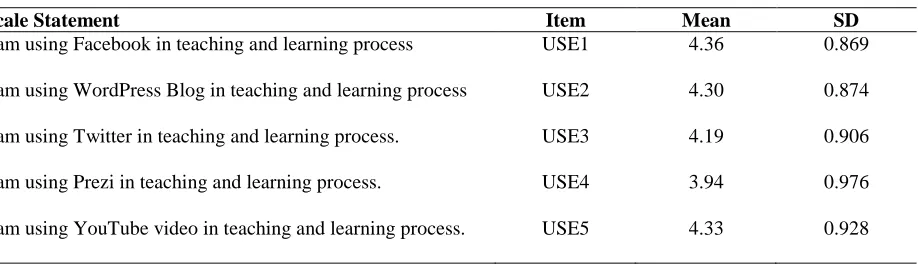
Table 1 shows the frequency of Web 2.0 tools used during teaching and learning process. Most of the students used Facebook, WordPress, Twitter and YouTube at least once per day. However, the students used Prezi almost several times per week. The finding is in line with Junco (2012) research that most of the students participate in a variety of Facebook activities such as checking notifications, viewing videos and photos, and commenting on content.
Table 1: Frequency of Web 2.0 Tools
Scale Statement Item Mean SD
I am using Facebook in teaching and learning process USE1 4.36 0.869
I am using WordPress Blog in teaching and learning process USE2 4.30 0.874
I am using Twitter in teaching and learning process. USE3 4.19 0.906
I am using Prezi in teaching and learning process. USE4 3.94 0.976
I am using YouTube video in teaching and learning process. USE5 4.33 0.928
4.2 Validity and Reliability of Instrument
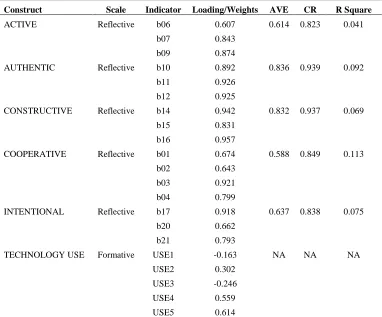
According to Hulland (1999), reliability and validity of latent variables have to be examined based on (1) individual item reliability, (2) convergent validity, and (3) discriminant validity. For individual item reliability, any measurable factor loading < 0.5 should be deleted except for formative scale. Table 2 shows that the factor loading for each item after deletion has been made. As for convergent validity, Composite Reliability (CR) and Average Variance Extracted (AVE) are the main indicators to be evaluated. According to Fornell and Larcker (1981), CR representing internal consistency should be higher than 0.7. In this research, the range of CR was between 0.823 and 0.939. Another study by Fornell and Larcker (1981) suggested that an AVE should be more than 0.50. Based on the result in Table 2, the latent variables possessed a good convergent validity.
In order to examine the discriminant validity, the square root of AVE of each latent variable and the correlation coefficient among latent variables was calculated. The existence of discriminant validity was acknowledged when the square root of AVE was greater than the correlation coefficient among other latent variables. Table 2 shows that the square root of AVE was greater than the correlation coefficient among other latent variables. Based on the analysis, the latent variables possessed good reliability and validity.
Vol. 7, No.1| June 2015| ISSN 2229-8932 Journal of Technical Education and Training (JTET) | 57 Table 2: Reliability and validity of measurement model
Construct Scale Indicator Loading/Weights AVE CR R Square
ACTIVE Reflective b06 0.607 0.614 0.823 0.041
b07 0.843
b09 0.874
AUTHENTIC Reflective b10 0.892 0.836 0.939 0.092
b11 0.926
b12 0.925
CONSTRUCTIVE Reflective b14 0.942 0.832 0.937 0.069
b15 0.831
b16 0.957
COOPERATIVE Reflective b01 0.674 0.588 0.849 0.113
b02 0.643
b03 0.921
b04 0.799
INTENTIONAL Reflective b17 0.918 0.637 0.838 0.075
b20 0.662
b21 0.793
TECHNOLOGY USE Formative USE1 -0.163 NA NA NA
USE2 0.302
USE3 -0.246
USE4 0.559
USE5 0.614
a Composite reliability (CR) = (square of the summation of the factor loadings)/{(square of the summation of the factor loadings) + (square of the summation of the error variances)}
b Average variance extracted (AVE) = (summation of the square of the factor loadings)/{(summation of the square of the factor loadings) + (summation of the error variances)}
NA = Not Applicable
Table 3: Discriminant validity of latent variables
Active Authentic Constructive Cooperative Intentional Usage
Active 0.783
Authentic 0.174 0.915
Constructive 0.200 0.225 0.912
Cooperative 0.226 0.227 0.398 0.767
Intentional 0.405 0.179 0.313 0.308 0.798
Technology Use 0.203 0.304 0.263 0.336 0.274 NA
Note: The diagonals in bold represent the square root of the average variance extracted (AVE) while other entries represent correlations
NA = Not Applicable
Vol. 7, No.1| June 2015| ISSN 2229-8932 Journal of Technical Education and Training (JTET) | 58 path model that are sufficiently referred to in prior research should be strong and significant (Henseler et al., 2011). Moreover, the external validity could finally be calculated as 1 – Var(v). The suggested value of 0.8 was considered the minimum for external validity and this means that the formative index carried about 80 percent of the intended meaning.
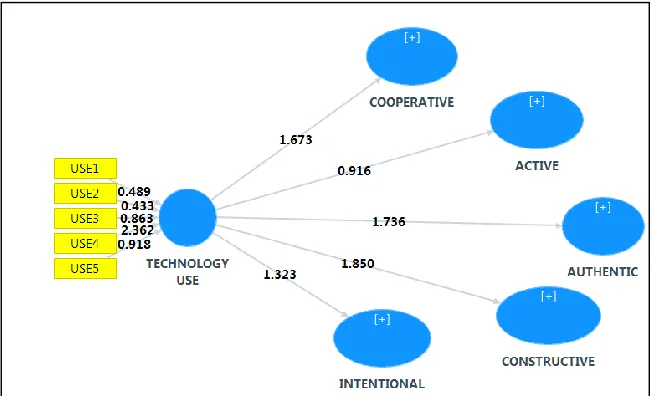
The next procedure aimed to check whether each indicator delivered a contribution to the formative index by carrying the intended meaning. The first step was to run bootstrapping and this process was done to determine the significance of the estimated indicator weights. As shown in Figure 1, all formative indicators were not significant except USE4.
Figure 1: Research model (after bootstrapping)
The second step was to assess the degree of multicollinearity among the formative indicators by calculating variance inflation factor (VIF) or the tolerance values. By using SPSS, VIF and tolerance values were calculated. According to Hair et al., (2011), a VIF value of 5 and above and a tolerance value of 0.2 and lower could indicate a potential collinearity problem, thus a corresponding indicator should be removed or deleted. Table 3 shows that all indicators owned VIF < 5 and tolerance values > 0.2. Hence, all indicators were retained and should not be deleted.
Table 4: Multicollinearity assessment
Model
Collinearity Statistics
Tolerance VIF
1 (Constant)
USE1 0.627 1.594
USE2 0.406 2.464
USE3 0.987 1.103
USE4 0.991 1.009
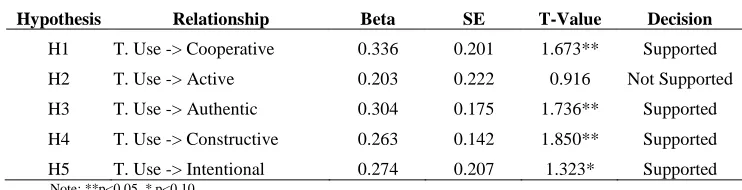
Vol. 7, No.1| June 2015| ISSN 2229-8932 Journal of Technical Education and Training (JTET) | 59 In assessing structural measurement, path coefficients and R2, among latent variables, will be examined (Hair et al., 2013). Better known as hypothesis testing, it is conducted to see if the usage of Web 2.0 tools affects all five components of meaningful learning positively. In this research, Table 5 shows that all hypotheses were significant, except active construct in which the usage of Web 2.0 technologies affected positively towards cooperative, authentic, constructive, and intentional attributes. The coefficients for five hypotheses were 0.444, 0.599, 0.221, 0.228 and 0.459, respectively.
Table 5: Path coefficients and results of the hypothesis tests
Hypothesis Relationship Beta SE T-Value Decision
H1 T. Use -> Cooperative 0.336 0.201 1.673** Supported
H2 T. Use -> Active 0.203 0.222 0.916 Not Supported
H3 T. Use -> Authentic 0.304 0.175 1.736** Supported
H4 T. Use -> Constructive 0.263 0.142 1.850** Supported
H5 T. Use -> Intentional 0.274 0.207 1.323* Supported
Note: **p<0.05, * p<0.10
As shown in Table 2, R2 for endogenous latent variables, including cooperative, active, authentic, constructive and intentional were 0.113, 0.041, 0.092, 0.069, and 0.075. Moreover, the usage of Web 2.0 technologies explained 11.3% of the total variance in cooperative, 9.2% in authentic, 7.5% in intentional, 6.9% in constructive and 4% in active. Thus, all meaningful learning characteristics were positively influenced by the use of Web 2.0 technology except for active construct.
5
DISCUSSIONS
Research question 1: What is the frequency of Web 2.0 tools’ used in this study?
Based on the frequency of five Web 2.0 tools, results show that Web 2.0 tools have been extensively used by the students in their learning process. Almost 86 percent of students use Facebook at least once a day for learning purpose, which means it can be more than once per day as they used the Facebook for other non-study related purposes. According to Frison and Eggermont (2015), there are two types of Facebook usages, which are passive Facebook use and active Facebook use. Passive Facebook use indicates careful watching of other people’s lives by looking at the content of others’ profiles. Active Facebook use consists of interactions between the user and other Facebook friends in a private or public setting. Thus, in this research, most of the students were active Facebook users who used Facebook Group to communicate, share resources and discuss among students in the group.
Vol. 7, No.1| June 2015| ISSN 2229-8932 Journal of Technical Education and Training (JTET) | 60 Twitter is a micro blogging tool that has been used in teaching and learning process. In this research, 78.6% of students used Twitter for educational purpose for at least once a day. However, according to Gooding et al. (2014), Twitter has been used less frequently for academic purpose. It is because they are interested to comment on a class event with other students rather than discussing an idea or issue. Prestridge (2014) suggested that student-initiated interaction supported by instructor use of participatory pedagogies enables substantive dialogue through Twitter. Therefore, we can promote the use of Twitter for academic purpose by giving them an issue to be discussed in a certain period of time with the fast feedback and good moderators.
Prezi is an online slide presentation that has been used for academic purposes. Among all students, 70 percent of students use Prezi for at least once a day. Prezi has been used for presentation in Preston et al., (2014) research besides other Web 2.0 tools. According to Chess and Booth (2014), Prezi has been used to illustrate animation to the students. Therefore, teachers should make use of Prezi, or other Web 2.0 presentation tools in their teaching to promote students’ interest and engagement.
Last but not least, YouTube has been used by the students as a video platform to share their online videos and to help in their studies. YouTube is a place for viewing, sharing, hosting, and basic editing of online video (Snelson, 2013). In this research, 77.8 percent of students used YouTube videos once per day for their learning purpose. They need to upload and share their videos via the platform as well as commenting videos made by other students. By doing this, it promotes active learning and sharing ideas among students. In conclusion, all Web 2.0 tools that have been used in this research have been promoted to an active learning among students.
Research question 2: How are these identified meaningful learning attributes structurally related to Web 2.0 technologies?
Question 2 (a): Is there a relationship between Web 2.0 tools and cooperative learning? Question 2 (b): Is there a relationship between Web 2.0 tools and active learning? Question 2 (c): Is there a relationship between Web 2.0 tools and authentic learning? Question 2 (d): Is there a relationship between Web 2.0 tools and constructive learning? Question 2 (e): Is there a relationship between Web 2.0 tools and intentional learning?
In this research, Web 2.0 tools have been used to achieve five attributes of meaningful learning. Findings show that there are relationships between Web 2.0 tools and cooperative learning, authentic learning, constructive learning and intentional learning. However, there is no relationship between Web 2.0 tools and active learning. It is due to the fact that every Web 2.0 tools used by the students would require active engagement and participation (An et al., 2009). If the frequencies of Web 2.0 tools are high, it does not mean that a high level of active learning should take place. However, if the frequencies are low, it does not mean that there is no active learning. Therefore, based on several researches from Williams and Chinn (2009) and Smirnova (2008), we can consider that Web 2.0 tools have successfully affected meaningful learning attributes in teaching and learning process.
Vol. 7, No.1| June 2015| ISSN 2229-8932 Journal of Technical Education and Training (JTET) | 61 successfully encouraged students to work together in writing their reflections and expressing their ideas. In addition, Web 2.0 tools have established an authentic learning environment by introducing tools that support real life learning. It allows students to create a tangible and useful product to be shared. The tools that allow the authentic learning to be implemented were YouTube, WordPress and Prezi. Thus, to enhance the quality of teaching and learning, one can use as many tools that they need as long as the tools are suitable for the lesson.
Even though Web 2.0 tools have been considered as good tools to be used in teaching and learning process, therefore there are distractions while the students benefit the tools. The distraction of using Web 2.0 tools for the purposes of learning might be caused by the effect of advertisements. In line with Fewkes and McCabe (2012) research, they suggested that Facebook should be used differently by teachers and students to lessen the distraction. Not only Facebook, but other tools should be used carefully such as using the checklist, managing news feed, setting a designated social time, blocking the games request, and using scheduling software (Sprout Social or Post Planner). Although there are distractions taking place while using the technologies, the input from the students would be considered. Therefore, we strongly agree that Web 2.0 technologies support teaching and learning, especially in achieving meaningful learning.
6
IMPLICATIONS
This study is aim to provide advantages to both teachers and students to deliver and learn the dynamic Web 2.0 tools for academic used. The usage of Web 2.0 tools have been identified to support meaningful learning attributes. The findings demonstrated that Web 2.0 tools (Facebook, WordPress, Twitter, and YouTube & Prezi) have been used extensively among students. By using any Web 2.0 tools, it is expected that active learning will take place as the students are keep operating the tools. The empirical research phase of the paper addressed some of the issues arising around Web 2.0 tools. This study is also intent to produce high implications in education in order to make sure students achieved meaningful learning in the end of learning session. Thus, teaching quality of academicians would be improved and students’ learning achievement would be increased. Web 2.0 technologies, active learning, cooperative learning, authentic learning, intentional learning and constructive learning can expand and support a comprehensible pedagogical and instructional design for pre-service teachers in future. Thus, this study would help the teachers to adopt Web 2.0 for new pedagogical dimension. For educational implementers, this study would help them to consider new instructional design with the combination of variety suitable Web 2.0 tools, content and pedagogy that would end up in achieving meaningful learning. In this precise respect, educational policy should address the objectives of the curriculum to a new comprehensive method offered by Web 2.0 tools and combine with meaningful learning attributes in face-to-face classroom settings.
7
CONCLUSIONS
Vol. 7, No.1| June 2015| ISSN 2229-8932 Journal of Technical Education and Training (JTET) | 62 to support teaching and learning as well as promoting students’ engagement and participation in order to achieve meaningful learning in TVET.
Reference
Abdullah, H., & Mtsweni, J. (2014). The role of e-tutors in promoting e-learning using Web 2.0 technologies. African Cyber Citizenship Conference 2014.
ADSHEL. (2009). Research & Insights: The Essential Guide to Gen Y 16-24, 1-7.
Alexander. B. 2008. Web 2.0 and emergent multi-literacies. Theory Into Practice 47(2): 150-160.
An, Y. J., Aworuwa, B., Ballard, G., & Williams, K. (2009). Teaching with Web 2.0 Technologies: Benefits, Barriers and Best Practices. 32ndannual, 1.
Anderson, J., C. & Gerbing, D., W. (1991). Predicting the performance of measures in a confirmatory factor analysis with a pretest assessment of their substantive validities. Journal of Applied Psychology, 76(5), 732-740.
Bower (2015). A Typology of Web 2.0 Learning Technologies. Retrieves from http://net.educause.edu/ir/library/pdf/csd6280.pdf
Brodahl, C., Hadjerrouit, S., & Hansen, N. K. (2011). Collaborative writing with Web 2.0 technologies: education students' perceptions.
Chess, S., & Booth, P. (2013). Lessons down a rabbit hole: Alternate reality gaming in the classroom. new media & society, 1461444813497554.
Cowan, J., & Astall, C. (2010). Exploring collaborative learning: Experiences of a web 2.0 tool within a pre-service teacher education environment. Technology, 22, 3.
Din, R. (2010). Development And Validation Of An Integrated Meaningful Hybrid E-Training (I-Met) For Computer Science: Theoretical Empirical Based Design And Development Approach. PhD Thesis. Bangi: UKM.
Din, R., Nordin, M.S., Abu Kassim, N., Tunku Ahmad, T.B., Jusoff, K., Johar, N.A., Kamarul Zaman, M.F., Zakaria, M.S., Ahmad, M., Abdul Karim, A. & Mastor, K.A. (2010). Development and Validation of Meaningful Hybrid e-Training Model for Computer Education. International Journal of Computer Science and Information Technologies, 1(3), 179-184.
Din, R., Norman, H., Kamarulzaman, M. F., Shah, P. M., Karim, A., Salleh, N. S. M., Zakaria, M. S. & Mastor, K. A. (2012). Creation of a Knowledge Society via the Use of Mobile Blog: A Model of Integrated Meaningful Hybrid E-training. Asian Social Science, 8(16), p45.
Din, R., Zakaria, M.S., Mastor, K.A., Abdul Razak, N., Embi, M.A. & Arifin, S.A. (2009). Meaningful Hybrid e-Training Model via POPEYE Orientation. International Journal Of Education And Information Technologies, 1(3), 56-66
Duarte, P. (2015). The use of a group blog to actively support learning activities. Active Learning in Higher Education, 1469787415574051.
Vol. 7, No.1| June 2015| ISSN 2229-8932 Journal of Technical Education and Training (JTET) | 63 Enonbun, O. (2010). Constructivism and web 2.0 in the emerging learning era: A global perspective. Journal of
Strategic Innovation and Sustainability, 6(4), 16-25.
Fewkes, A. M., & McCabe, M. (2012). Facebook: Learning tool or distraction?.Journal of Digital Learning in Teacher Education, 28(3), 92-98.
Fornell, C., & Larcker, D. F. (1981). Evaluating structural equation models with unobservable variables and measurement error. Journal of marketing research, 39-50.
Frison, E., & Eggermont, S. (2015). The impact of daily stress on adolescents’ depressed mood: The role of social support seeking through Facebook.Computers in Human Behavior, 44, 315-325.
Gooding, L. F., Yinger, O. S., & Gregory, D. (2014). # Music Students College Music Students’ Twitter Use and Perceptions. Update: Applications of Research in Music Education, 8755123314552458.
Hair Jr, J. F., Hult, G. T. M., Ringle, C., & Sarstedt, M. (2013). A primer on partial least squares structural equation modeling (PLS-SEM). Sage Publications.
Hair, J. F., Ringle, C. M., & Sarstedt, M. (2011). PLS-SEM: Indeed a silver bullet. The Journal of Marketing Theory and Practice, 19(2), 139-152.
Hamdan, A., Din, R., Abdul Manaf, S. Z., Mat Salleh, N. S., Kamarul Zaman, M. F. & Ab Khalid, R. (2012). Penerimaan Pelajar Terhadap Penggunaan Teknologi Web 2.0 Di Malaysia. Proceeding of International Seminar Educational Comparative in Competency Based Curriculum Between Indonesia and Malaysia. Hlm. 380-387.
Hamdan, A., Din, R., Abdul Manaf, S. Z., Mat Salleh, N. S., Kamsin, I. F., Norman, H., Ismail, N. M., & Mohamad Zaid, A. S. (2013b). Kelebihan Dan Kekurangan Teknologi Web 2.0 Dalam Model Integrasi E-Latihan Bermakna (I-MeT) Dalam Kalangan Pelajar, 4th International Conference of Asean Studies on Integrated Education and Islamic Civilization UKM-UNIMED 9 – 10 December 2013.
Hamdan, A., Din, R., Adnan, A., Abdul Manaf, S. Z., Ismail, N. I., Mat Salleh, N. S. & Shafiin, H. (2013a). Penggunaan Teknologi Web 2.0 Dalam Pembelajaran Hibrid. Tempawan Jurnal Penyelidikan 87-103.
Henseler, J., Ringle, C. M., & Sinkovics, R. R. (2009). The Use Of Partial Least Squares Path Modeling In International Marketing.
Henseler, J., Wilson, B., & Westberg, K. (2011). Managers' perceptions of the impact of sport sponsorship on brand equity.
Howland, J. L., Jonassen, D., & Marra, R. M. (2012). Community Building and Collaborating with Technologies. In Meaningful Learning with Technology (4th ed.). Boston: Pearson Education, Inc.
Hughes, B., Joshi, I., Lemonde, H., & Wareham, J. (2009). Junior physician's use of Web 2.0 for information seeking and medical education: a qualitative study. International journal of medical informatics, 78(10), 645-655.
Hulland, J. (1999). Use of partial least squares (PLS) in strategic management research: A review of four recent studies. Strategic management journal, 20(2), 195-204.
Vol. 7, No.1| June 2015| ISSN 2229-8932 Journal of Technical Education and Training (JTET) | 64 Jokisalo, E., & Riu, A. (2009). Informal learning in the era of Web 2.0. ICT and lifelong learning for a creative and
innovative Europe Findings, reflections and proposals from the Learnovation project.
Jonassen, D. H. (2002). Engaging and supporting problem solving in online learning. Quarterly Review of Distance Education, 3(1), 1-13.
Kassens-Noor, E. (2012). Twitter as a teaching practice to enhance active and informal learning in higher education: The case of sustainable tweets. Active Learning in Higher Education, 13(1), 9-21.
Kingsley, K. V., & Brinkerhoff, J. (2011). Web 2.0 tools for authentic instruction, learning, and assessment. Social Studies and the Young Learner, 23(3), 9-13.
Kwok, Wai-Jing & Neo, Tse-Kian. (2015). Utilizing Web 2.0 Tools in a Group Based Learning Environment: A Malaysian Classroom Perspective, International Journal of Social Science and Humanity, 5(3): 311-315.
Lombardi, M. M. (2007). Authentic learning for the 21st century: An overview.Educause learning initiative, 1(2007), 1-12.
Mallon, M. & Bernstein, S. (2015). Collaborative Learning Technologies. Retrieved from http://www.ala.org/acrl/sites/ala.org.acrl/files/content/aboutacrl/directoryofleadership/sections/is/iswebsite/pr ojpubs/tipsandtrends/winter2015.pdf
McCurry, J. (2013). Why do Japanese children lead the world in numeracy and literacy? http://www.theguardian.com/world/2013/oct/08/why-do-japanese-children-lead-world-numeracy-literacy [17 October 2013]
Meyers, S. A. (2014). Three Strategies for Creating Meaningful Learning Experiences, Retreived from http://www.facultyfocus.com/articles/effective-teaching-strategies/three-strategies-creating-meaningful-learning-experiences/
Ministry of Higher Education. 2011. Speech Innovation Day.
Mostmans, L., Vleugels, C., & Bannier, S. (2012). Raise Your Hands or Hands-on? The Role of Computer-Supported Collaborative Learning in Stimulating Intercreativity in Education. Educational Technology & Society, 15 (4), 104–113.
Munoz, C. L. & Towner, T. L. 2009. Opening Facebook: How to Use Facebook in the College Classroom. Society for Information Technology and Teacher Education conference. hlm. 1-13.
Nachmias, R., Mioduser, D., Cohen, A., Tubin, D., & Forkosh-Baruch, A. (2004). Factors involved in the implementation of pedagogical innovations using technology. Education and Information Technologies, 9(3), 291-308.
Oldfield, J., & Herrington, J. (2012). Mobilising authentic learning: Understanding the educational affordances of the iPad.
O'reilly, T. (2007). What is Web 2.0: Design patterns and business models for the next generation of software. Communications & strategies, (1), 17.
Vol. 7, No.1| June 2015| ISSN 2229-8932 Journal of Technical Education and Training (JTET) | 65 Preston, J. P., Moffatt, L., Wiebe, S., McAuley, A., Campbell, B., & Gabriel, M. (2014). The use of technology in
Prince Edward Island (Canada) high schools Perceptions of school leaders. Educational Management Administration & Leadership, 1741143214535747.
Prestridge, S. (2014). A focus on students’ use of Twitter–their interactions with each other, content and interface. Active Learning in Higher Education, 1469787414527394.
Ringle, Christian M., Wende, Sven, & Becker, Jan-Michael. (2015). SmartPLS 3. Hamburg: SmartPLS. Retrieved from http://www.smartpls.com
Sharma, R., & Monteiro, S. (2012). Reflective Blogging: Education in a Social Constructivist Environment–A Case Study. International Journal of e-Education, e-Business, e-Management and e-Learning, 2(2), 93-96.
Sharples , M., McAndrew, P., Weller, M., Ferguson, R., FitzGerald, E., Hirst, T., Mor, Y., Gaved, M. & Whitelock, D. (2012). Innovating pedagogy 2012: Exploring new forms of teaching, learning and assessment, to guide educators and policy makers.
Sherer, P., & Shea, T. (2011). Using online video to support student learning and engagement. College Teaching, 59(2), 56-59.
Smirnova, L. (2008). Technology Enhanced Teaching and Learning for Student (and Teacher) Success. In Defining and Promoting Student Success. Faculty Resource Network: A National Symposium.
Snelson, C. (2013). Vlogging about school on YouTube: An exploratory study. New Media & Society, 1461444813504271.
Taber, K. S. (2009). Learning from experience and teaching by example: reflecting upon personal learning experience to inform teaching practice. Learning, 4(1).
Taber, K. S. (2011). Constructivism as educational theory: Contingency in learning, and optimally guided instruction. In J. Hassaskhah (Ed.), Educational Theory. New York: Nova, 39-61.
Teclehaimanot, B. & Hickman, T. 2010. Student-Teacher Interaction on Facebook: What Teachers Find Appropriate. Dlm. Proceedings of World Conference on Educational Multimedia, Hypermedia and Telecommunications 2010. hlm. 2157-2162). Chesapeake, VA: AACE.
The Learning Curve. (2014). Retrieved from http://thelearningcurve.pearson.com/
The Star Online. (2013). Poor show in Pisa rankings. Retrieved from http://www.thestar.com.my/News/Education/2013/12/08/Poor-show-in-Pisa-rankings/
Thornton, P., & Houser, C. (2005). Using mobile phones in English education in Japan. Journal of computer assisted learning, 21(3), 217-228.
Toland, R. (2013). Facebook as a Learning Tool. Perspectives in Learning, 40.
Väljataga, T., & Fiedler, S. (2009). Supporting Students to self-direct Intentional Learning Projects with Social Media. Educational Technology & Society, 12(3), 58-69.
Venkatesh, V., Thong, J. Y., & Xu, X. (2012). Consumer acceptance and use of information technology: extending the unified theory of acceptance and use of technology. MIS quarterly, 36(1), 157-178.
Vol. 7, No.1| June 2015| ISSN 2229-8932 Journal of Technical Education and Training (JTET) | 66 Yusof, N., Othman, M., Yunianta, A., & Octaviani, D. (2012). Analysis and categorization of e-learning activities