Sustainable Machining Processes through Optimization of Process
Parameters
OGEDENGBE Temitayo Samson
Received: 05 November 2018 Accepted: 24 December 2018 Published: 01 March 2019 Publisher: Deer Hill Publications © 2019 The Author(s)
Creative Commons: CC BY 4.0
ABSTRACT
Machining processes are a vital part of manufacturing activities in major industries that contributes to the growth of the economy. They mostly require high amount of electrical energy to power the various support modules installed on machine tools. Carrying out machining activities with a view to reducing energy consumption will therefore result in a lowered cost of production for manufactured products. Previous studies on some energy-saving methods adopted by researchers and the limitations faced in the reduction of energy consumption have been discussed. In this work, the effect of process parameters in the conservation of energy during machining processes was experimented. Minitab 16 was used to design the experiment and a 9-run orthogonal array was generated. The machining parameters were cutting speed (80 – 120 m/min), feed (0.05 – 0.07 mm/rev) and depth of cut (0.1 – 0.3 mm). A high carbon steel bar was machined using high speed steel tool and the energy consumed during the machining process was measured. Energy (28.67 kw/hr) was consumed during machining at 0.005 mm/rev and 0.3 m. Energy (12.83 kw/hr) was consumed while machining at 0.07 mm/rev and 0.1 m. The energy consumed changed with machining parameters. These results showed that much energy could be saved by optimizing parameters before machining.
Keywords: Energy consumption, Machine tools, Machining processes, Parameters
1 INTRODUCTION
on energy conservation during machining are hereafter discussed. A study on automated monitoring of machine tools specifically analysing the energy consumption of the machines has been done [11]. It was reported that process control was a key factor for energy consumption. A study on the possible improvements in energy efficiency of machine tools with Diamond-Like Carbon (DLC) deposited tools has been carried out [12]. Results showed that the method was able to reduce the cutting power consumption of the machine by 36%. The optimization of machining processes from the perspective of energy consumption has also been attempted [13]. It was opined that machining parameters, cutting tools and workpiece materials influence the rate of energy consumption during machining processes. There is a need to further consider the possibility of a conservation of energy through the optimization of process parameters. This work is therefore an attempt to conserve energy by reduction of the energy consumed during machining processes.
2 METHODOLOGY 2.1 Machine and Tools
The experiment was carried out on a Colchester Triumph model 2000 conventional lathe machine with a 3-jaw chuck as shown in Figure 1. The workpiece material was a high carbon steel bar and the tool used for the experiment was High Speed Steel (HSS). The choice of high carbon steel was informed by the higher difficulty in machining the steel as compared to other materials (e.g. mild steel) used in fabrication of parts. HSS was selected because it was cheaper and easily accessible compared to other tools. The surface roughness was measured with a profilometer while the power consumed was measured using multimeters.
2.2 Experimental Procedure
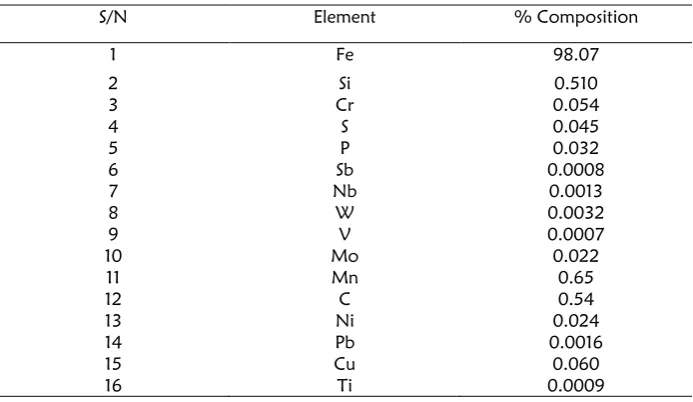
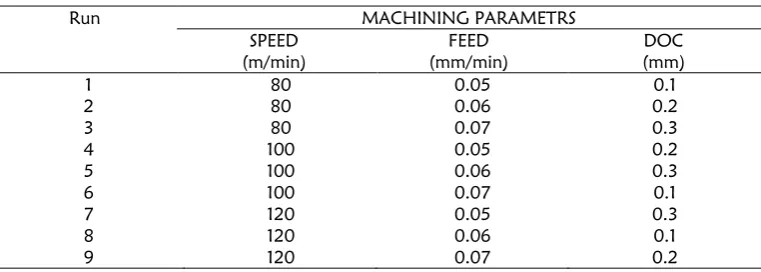
The workpiece used for this experiment was a high carbon steel material. Table 1 shows the result of the compositional analysis for the workpiece material. Figure 2 shows the set up for the experimental process carried out on the lathe machine. The process parameters used for the experiment as given in Table 2 were cutting speed, feed rate and depth of cut. The process parameters were selected based on literature and machine constraints. A low feed was used to ensure a longer period of machining to sufficiently measure energy consumed. Taguchi orthogonal array from Minitab 16 software was used to design the experiment resulting in a 9–experimental run mix with the three factors. The smaller-is-better design option was adopted in the analysis of Signal-to-Noise (SN) ratio for the energy consumed during machining process as recommended by [14]. The energy consumed during the machining process was measured with the use of multi-meters connected in series and parallel to capture the current and voltage respectively. The resulting values where thereafter used to compute the energy consumed using equations 1 and 2.
𝑃𝑜𝑤𝑒𝑟 = √3 𝑉𝑙 (1)
𝐸𝑛𝑒𝑟𝑔𝑦 𝐶𝑜𝑛𝑠𝑢𝑚𝑒𝑑 = 𝑃𝑜𝑤𝑒𝑟 𝑥 𝑇𝑖𝑚𝑒 (2)
Table 1: Chemical composition of High Carbon Steel Sample
S/N Element % Composition
1 Fe 98.07
2 Si 0.510
3 Cr 0.054
4 S 0.045
5 P 0.032
6 Sb 0.0008
7 Nb 0.0013
8 W 0.0032
9 V 0.0007
10 Mo 0.022
11 Mn 0.65
12 C 0.54
13 Ni 0.024
14 Pb 0.0016
15 Cu 0.060
Figure 1: Colchester Lathe machine and HSS tool
Figure 2: Experimental Set-up
Table 2: Machining Parameters for Experiments
Factor Level
1 2 3
Speed (m/min) 80 100 120
Feed rate(mm/rev) 0.05 0.06 0.07
Depth of cut (mm) 0.1 0.2 0.3
Table 3: Orthogonal array for machining experiment
Run MACHINING PARAMETRS
SPEED
(m/min) (mm/min) FEED (mm) DOC
1 80 0.05 0.1
2 80 0.06 0.2
3 80 0.07 0.3
4 100 0.05 0.2
3 RESULTS AND DISCUSSIONS
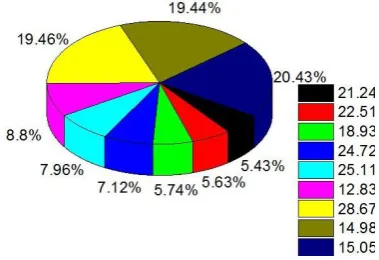
The result gotten after the machining is as shown in Figure 4. The highest amount of energy was consumed (28.67kw/Hr) during run 7 at a low feed rate of 0.05mm/min and a high depth of cut of 0.3m. The lowest energy consumption (12.83kw/Hr) was also recorded at run 6 with feed rate and depth of cut of 0.07mm/min and 0.1mm respectively. Also, as shown in Figure 6, at values of highest speed of 120m/min and highest feed rate of 0.07mm/min obtained at run 9 with a MRR of 488,850.82mm3/min, a very low amount of energy was consumed. These results
agree with [15]. The analysis of the S/N ratio as shown in Figure 5 indicates that at higher values of cutting speed, the average S/N ratio is higher which is preferable. The analysis also indicates that a higher cutting speed resulted in a higher energy consumption. However, depth of cut and feed rate did not contribute significantly to the consumption of energy.
Figure 4: Energy consumed during Runs
Figure 5: Signal-to-Noise analysis for parameters.
4 CONCLUSIONS
The aim of this study was to optimize process parameters for conservation of energy. The following conclusions have been reached from the results and findings after the study.
• At highest machining speed (120m/min), lowest energy is consumed.
• Depth of cut has no significant effect on rate of consumption of energy during machining. • Energy can be conserved by the optimization of process parameters during machining.
ACKNOWLEDGEMENT
The authors are grateful for generous support from the Central Engineering Workshop, University of Ilorin, Kwara State, Nigeria and Central Engineering Laboratory/Workshop, Elizade University, Ilara-Mokin, Ondo State, Nigeria where this research was been conducted.
REFERENCES
1. Moradnazhad M. and Unver H.O. (2016), Energy efficiency of machining operations: A review, Proceedings of Institution of Mechanical Engineers, Part B Journal of Engineering Manufacture 231(11). DOI: 10.1177/0954405415619345
2. Zhou LR, Li JF and Li FY (2016), Energy consumption model and energy efficiency of machine tools: a comprehensive literature review. J Clean Prod; 112: 3721–3734.
3. Arif M., Ian A. S. and Olcay A. (2014), A model to determine the optimal parameters in a machining process for the most profitable utilization of machining energy, Proceedings of the Institution of Mechanical Engineers, Part B: Journal of Engineering Manufacture, DOI: 10.1177/0954405414527960
4. Diaz N, Helu M, Jarvis A (2009), Strategies for minimum energy operation for precision machining. In: Proceedings of the Machine Tool Technologies Research Foundation (MTTRF) annual meeting, Shanghai, China. 5. Fang K., Uhan N., Zhao F. (2011), A new shop scheduling approach in support of sustainable manufacturing. In: Proceedings of the 18th CIRP international conference on life cycle engineering, Technische Universita¨ t Braunschweig, Braunschweig, Germany, pp. 305–310.
6. Duflou J.R, Sutherland J.W, Dornfeld D (2012), Towards energy and resource efficient manufacturing: a processes and systems approach. CIRP Ann: Manufacturing Technology; 61: 587–609.
7. Ogedengbe T. S., Abdulkareem S., Aweda J. O. (2018), Effect of Coolant Temperature on Machining
Characteristics of High Carbon Steel, Covenant Journal of Engineering Technology (Special Edition), Vol 1, No 1, Available at https://journals.covenantuniversity.edu.ng/index.php/cjetse/article/view/812
8. Abdulkareem S., Ogedengbe T.S., Aweda J.O, Khan A.A (2017), Comparative Analysis of AISI 1050 Steel Using N5-Soluble Oil and Arachis Oil in Metal Cutting Operation, Proceedings of the 30th AGM and International Conference of the Nigerian Institution for Mechanical Engineers.
9. Kalpakjian, S. and Schmid, S. Manufacturing engineering and technology, (1999) (Addison-Wesley Publishing Company, Boston, Massachusetts).
10. He Y., Liu F., Wu T., Zhong F-P, and Peng B. (2010), Analysis and estimation of energy consumption for numerical control machining, Proceedings of NIMechE Vol. 226 Part B: J. Engineering Manufacture. DOI: 10.1177/0954405411417673
11. Vijayaraghavan, A., Dornfeld, D., (2010). Automated energy monitoring of machine tools. CIRP Annals - Manufacturing Technology 59, pp. 21-24.
12. Zolgharni, M., Jones, B.J., Bulpett, R., Anson, A.W. and Franks, J., (2008), Energy Efficiency Improvements in Dry Drilling with Optimised Diamond-Like Carbon Coatings, Diamond & Related Materials, 17:1733–1737. 13. Bi Z. M. and Wang L. (2012), Optimization of machining Processes from perspective of energy consumption: A
case study, Journal of Manufacturing Systems 31, 420– 428, dx.doi.org/10.1016/j.jmsy.2012.07.002. 14. Xin Q. (2011), Diesel Engine System Design. Cambridge: Woodhead Publishing, pp.212–217.
15. Shokrani A., Dhokia V., Newman S.T. (2016), Energy conscious cryogenic machining of Ti-6Al-4V titanium alloy, Proc IMechE Part B: J Engineering Manufacture 1–17, IMechE, DOI: 10.1177/0954405416668923.