© 2016 IJSRSET | Volume 2 | Issue 4 | Print ISSN : 2395-1990 | Online ISSN : 2394-4099 Themed Section: Engineering and Technology
Process Parameter Optimization of Surface Grinding for AISI
321 by Using Taguchi Method
Avinash S. Jejurkar, Vijay L. Kadlag
Department of Mechanical Engineering, SVIT, Chincholi, Nashik, Maharashtra, India
ABSTRACT
Recently Austenitic stainless steel AISI-321 finding many applications like Automotive, Aerospace, Nuclear, Chemical and Cryogenics. The proposed work takes the following input processes parameters namely Work speed, feed rate and depth of cut. The main objective of this work is to predict the grinding behavior and achieve optimal operating processes parameters. A software package may be utilized which integrates these various models to simulate what happens during surface grinding processes. Predictions from this work will be further analyzed by calibration with actual data. It involves many variables such as depth of cut, work speed, feed rate, chemical composition of work piece, etc. The main aim of any machining process is to maximize the Metal Removal Rate (MRR) and to minimize the surface roughness (Ra). In order to optimize these values Taguchi method, ANOVA is used.
Keywords: Austenitic stainless steel, surface grinding, Taguchi, S/N ratio ANOVA, Optimization
I.
INTRODUCTION
The manufacturing method of surface grinding has been established in the production of slim and flat symmetrical components. Due to the complex set-up, which results from the big sensitivity of this grinding method to a multiplicity of geometrical, kinematical and dynamical influence parameters, surface grinding is rarely applied inside limited-lot production. The substantial characteristics of this grinding process square measure the synchronic steering and machining of the work piece on its edge. Surface grinding is an essential method for final machining of elements requiring sleek surfaces and precise tolerances. As compared with other machining processes, grinding is costly operation that ought to be used underneath optimum conditions. Although wide used in business, grinding remains perhaps the least understood of all machining processes. The major operating input parameters that influence the output responses, metal removal rate, surface roughness, surface damage, and tool wear etc., are: (i) wheel parameters: abrasives, grain size, grade, structure, binder, shape and dimension, etc., (ii) Work piece parameters: fracture mode, mechanical properties and chemical
composition, etc., (iii) Process parameters: work speed, depth of cut, feed rate, dressing condition, etc., (iv) machine parameters: static and dynamic Characteristics, spindle system, and table system, etc. The proposed work takes the following input processes parameters specifically Work speed, feed rate and depth of cut.
1. Literature Review
Kamaldeep Singh, Dr. Beant Singh, Mandeep Kumar (2015) states that, Grinding is a very important technique in which material is removed at a high rate with high level of surface finish. In their research work Taguchi method is applied to find optimum process parameters for abrasive assisted surface grinding of AISI D3 tool steel. Experiments are conducted on horizontal spindle reciprocating table surface grinding machine with L18 orthogonal array with input machining variables as type of wheel, depth of cut, table speed, grain size and slurry concentration. After conducting the experiments, MRR is calculated and surface roughness is measured using surface roughness tester. Results are optimized by S/N ratio and analyzed by ANOVA. This study demonstrates that c-BN grinding wheel is preferred for higher MRR and Al2 O3 grinding wheel for better surface finish. Depth of cut is the most significant factor for both MRR and surface roughness.
Gaurav upadhyay, Ramprasad, Kamal Hassan (2015) proposed that, metal removal rate and surface finish are the important output responses in the production with respect to quantity and quality respectively. The objective of this paper is to arrive at the optimal grinding conditions that will maximize metal removal rate when grinding IS 319 brass. Empirical models were developed using design of experiments by Taguchi L9 Orthogonal Array and the adequacy of the developed model is tested with ANOVA. For Metal Remove Rate (MRR), the depth of cut (μm) was the most influencing factor for IS 319 Brass work material followed by grinding wheel speed and work speed.
K Mekala, J Chandradas (2014) sates that the surface grinding parameters on Austenitic stainless steel are conducted using Taguchi design of experiments of L9 orthogonal array was selected with 3 levels with 3 factors and output parameters of Metal removal rate are measured. After conducting experiment optimized by S/N ratio and analyzed by ANOVA and predicts Cutting speed is a dominating parameter of surface grinding. The influence parameter of surface roughness is cutting speed and metal removal rate is influenced by Depth of cut. The optimum parameters of surface grinding overcome problem of poor chip breaking and machining distortion.
M. S. Sukumar, P. Venkata Ramaiah, A. Nagarjuna (2014) worked on Al 6061 material, according to Taguchi orthogonal array (L16) for various combinations of controllable parameters viz. speed, feed and depth of cut. The surface roughness (Ra) is measured and recorded for each experimental run and analyzed using Taguchi S/N ratios and the optimum controllable parameter combination is identified. An Artificial neural network (ANN) model has been developed and trained with full factorial design experimental data and a combination of control parameters have been found from ANN for the surface roughness (Ra) value, obtained from confirmation test, for the optimum control parameters which are obtained from Taguchi S/N ratios analysis. Taguchi method and ANN found different sets of optimal combinations but the confirmation test revealed that both got almost same Ra values. Among the consider parameters, speed has the most influence on the surface finish of the work-piece. The trained ANN is able to predict the Ra values with reasonable accuracy. Taguchi S/N ratio analysis and ANN are useful to find the optimum combination of parameters for getting a good surface finish.
Pawan Kumar, Anish Kumar, Balinder Singh (2013) states that, surface quality and metal removal rate are the two important performance characteristics to be considered in the grinding process. The main purpose of this work is to study the effects of abrasive tools on EN24 steel surface by using three parameters (Grinding wheel speed, table speed & Depth of cut). This study was conducted by using surface grinding machine. In this work, empirical models were developed for surface roughness and metal removal rate by considering wheel speed, table speed and depth of cut as control factors using response surface methodology. In this Response surface methodology (RSM) was applied to determine the optimum machining parameters leading to minimum surface roughness and maximum metal removal rate in Surface grinding process. Surface roughness and material removal rate is strongly dependent on wheel speed, table speed and depth of cut.
Reddy Sreenivasulu (2013) worked on, the influence of cutting speed, feed rate and depth of cut on the delamination damage and surface roughness on Glass Fiber Reinforced Polymeric composite material (GFRP) during end milling. Taguchi design method is employed to investigate the machining characteristics of GFRP. From the results of ANOVA, it is concluded that cutting speed and depth of cut are the most significant factors affecting the responses, their contribution in an order of 26.84% and 40.44% respectively. Confirmatory experiments show that 5.052μm for surface roughness and 1.682 delamination damage to validate the used approach after conducting with optimal setting of process parameters. Finally, artificial neural network has been applied to compare the predicted values with the experimental values, the deviations are found in the range of 3.7%, it shows good agreement between the predictive model results and the experimental measurements.
Mustafa Kemal Kulekcy (2013) states that, the Taguchi method that is a powerful tool to design optimization for quality can be used to find the optimum surface roughness in grinding operations. An orthogonal array, a signal-to-noise (S/N) ratio, and an analysis of variance (ANOVA) are employed to investigate the surface-roughness characteristics of AISI 1040 steel plates using EKR46K grinding wheels. Through this study, not only the optimum surface roughness for grinding operations be obtained, but the main grinding parameters affecting the performance of grinding operations can also be
found. Experimental results are provided to confirm the effectiveness of this approach. The results of this study showed that the depth of cut and the wheel speed have significant effects on the surface roughness, while the rate of feed has a lower effect on it. This study showed that the depth of cut and the wheel speed have significant effects on the surface roughness. The rate of feed has a lower effect on the surface roughness.
2. Problem Identification
Alloy 321 is commonly used to handle sulfur, pulp liquor, acid dyestuffs, acetylating and nitrating mixtures, bleaching solutions, severe oil and coal, and most of the chemical compounds. Some core applications that use alloy 321 include:
Rigid Flanges Pipes
Butt weld fittings Fasteners
Chemical and petrochemical processing equipment Condensers in fossil and nuclear fueled power generation plants Food processing equipment Textile equipment.
The identification of machining and grinding difficulties for Austenitic stainless steel (AISI 321) which cannot be tackled using conventional technique because of following problems occur in Grinding.
• Poor Chip Breaking. • High Work hardened. • Tendency to sticky.
• Transformation Induced plasticity. • Passive surface is affected.
• Machining distortion
The above problems are to overcome during surface grinding and achieve good surface finish and close dimensional accuracy.
II.
METHODS AND MATERIAL
(variables) and the number of levels. This is further explained later in this article. Analysis of variance on the collected information from the Taguchi design of experiments can be used to select new parameter values to optimize the performance characteristic. Data from the arrays can be analyzed by plotting the data and performing a visual analysis, ANOVA.
A.Taguchi Method of Orthogonal Arrays Parameters-3
1. Rotational speed- e.g. A, B, C 2. Feed (Table speed) - e.g. P, Q, R 3. Depth of cut- e.g. L, M, N
Here there are total three levels for each parameter. Therefore refer Taguchi table of orthogonal arrays L9.
Table 2. Layout of experimental design according to L9 array
Table 3. Process Parameters with their values at corresponding levels.
Sr. No
Process
Parameters Range
Level 1
Level 2
Level 3
1
Rotational speed
400-1100
m/min 400 750 1100
2 Feed
3-15
m/min 3 9 15
3 Depth of cut
3-18
µm 3 10.5 18
III.
RESULTS AND DISCUSSION
Table 4. Result table for surface roughness (Ra)
Sr. No.
Speed
(rpm) Feed(m/min) DOC(µm) Ra(µm)
1 400 3 3 0.871
2 400 9 10.5 1.108
3 400 15 18 1.343
4 750 3 10.5 1.428
5 750 9 18 1.469
6 750 15 3 1.384
7 1100 3 18 1.666
8 1100 9 3 1.77
9 1100 15 10.5 1.586
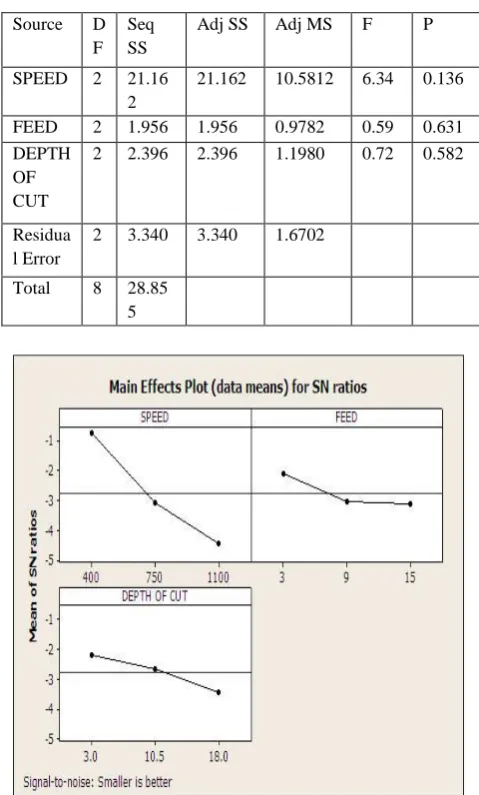
Table 5. Analysis of Variance for SN ratio
Experime nt
Rotational speed
Feed Depth of
cut
1 A P L
2 A Q M
3 A R N
4 B P L
5 B Q M
6 B R N
7 C P L
8 C Q M
9 C R N
Source D F
Seq SS
Adj SS Adj MS F P
SPEED 2 21.16 2
21.162 10.5812 6.34 0.136
FEED 2 1.956 1.956 0.9782 0.59 0.631 DEPTH
OF CUT
2 2.396 2.396 1.1980 0.72 0.582
Residua l Error
2 3.340 3.340 1.6702
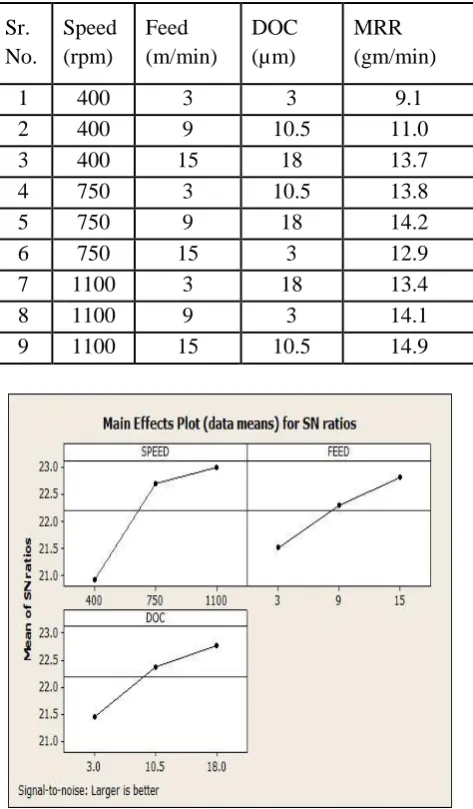
Table 6. Result table for material removal rate (MRR)
After conducting the experiment on surface grinding of austenitic stainless (AISI 321) surface finish are given below.
• Speed is a dominating parameter of Surface grinding. • The optimum parameter for Surface finish for
surface grinding of Austenitic stainless steel AISI 321is 400 rpm of speed, 3 m/min of Feed and 3 µm depth of cut are shown in Table 5.
• However Austenitic stainless steel (AISI 321) is having good machinabilty characteristic and Produce excellent surface finish.
• Austenitic stainless steel produce good surface finish and get minimum crack tendency.
IV.
CONCLUSION
After conducting experiments on surface grinding, I conclude the following:
• Austenitic stainless steel produces good surface finish during surface grinding process in optimum grinding parameters.
• Close tolerance can be achieved during surface grinding.
• Speed play an important role in surface grinding and produce good surface roughness in AISI 321 austenitic stainless steel were 400 rpm of cutting speed 3 m/min and 3 µm of depth of cut.
• Austenitic stainless (AISI 321) Provide good machinability property.
• The influence parameter of surface roughness and material removal rate is speed.
• The optimum parameters of surface grinding overcome problem of poor chip breaking and machining distortion
V.
REFERENCES
[1] Mustafa Kemal Külekcý., Analysis of process parameters
for a surface-grinding process based on the taguchi method,2013.,SSN 1580-2949 MTAEC9, 47(1)105
[2] Gaurav Upadhyay, Ramprasad, Kamal Hassan.,
Optimization of Metal Removal Rateon Surface Grinding For Is 319 Brass Using Taguchi Method,Vol. 5, Issue 6, ( Part -3) June 2015, pp.63-67.
[3] K Mekala1,J Chandradas. “Optimization of Surface
Grinding Parameters Of Austenitic Stainless Steel Rods (Aisi 316) By Taguchi Method”. IJMERR 2014.
[4] M.S. Sukumar,P.Venkata Ramaiah. A. Nagarjuna,
Optimization and Prediction of Parameters in Face
Milling of Al-6061 Using Taguchi and ANN
Approach,GCMM 2014.
[5] M.Aravind, Dr.S.Periyasamy. Optimization of Surface
Grinding Process Parameters By Taguchi Method And Response Surface Methodology, IJERT Vol. 3 Issue 5, May – 2014.
[6] Pawan Kumar,Anish Kumar,Balinder Singh.,
Optimization of Process Parameters in Surface Grinding Using Response Surface Methodology.,2013 IJRMET Vol. 3.
[7] Reddy Sreenivasulu.,Optimization of Surface Roughness
and Delamination Damage of GFRP Composite Material in End Milling using Taguchi Design Method and Artificial Neural Network., 2013,IConDM.
[8] Kamaldeep Singh,Dr. Beant Singh,“Experimental
Investigation of Machining Characteristics of AISI D3
Steel with Abrasive Assisted Surface
Grinding”.IRJET,2015 Volume: 02 Issue: 04.
Sr. No.
Speed (rpm)
Feed (m/min)
DOC (µm)
MRR (gm/min)
1 400 3 3 9.1
2 400 9 10.5 11.0
3 400 15 18 13.7
4 750 3 10.5 13.8
5 750 9 18 14.2
6 750 15 3 12.9
7 1100 3 18 13.4
8 1100 9 3 14.1