Bitmap Index: a Processing-in-Memory
reconfigurable implementation
M. Andrighetti1, G. Turvani1, G. Santoro1, M. Vacca1, M. Ruo Roch1, M. Graziano1, and M. Zamboni1
Politecnico di Torino, Department of Electronics and Telecommunications [email protected]
Abstract. During the years, microprocessors went through impressive performance improvement thanks to technology development. CPUs be-came able to process great quantities of data. Memories also faced growth especially in density, but as far as speed is concerned the improvement did not proceed as the same rate. Processing-in-Memory (PIM) consists in enhancing the storage unit of a system, adding computing capabili-ties to memory cells, partially eliminating the need to transfer data from memory to execution unit. In this paper, a PIM architecture is presented for bulk bitwise operation mapped on the Bitmap Index application. The architecture is a memory array with logical computing abilities inside the cells. The array is a configurable modular architecture distributed in dif-ferent banks, each bank is able to perform a difdif-ferent operation at the same time. This architecture has remarkable performance being faster than other solutions available in literature.
Keywords: Processing-in-memory, Bitmap Index, Reconfigurable ar-chitecture
1
Introduction
Nowadays, data-intensive applications, such as image processing and databases ones, must process big amounts of data. This is a consequence of the speed im-provement obtained throughout the years thanks to technology scaling. However, memory development did not follow the same path, resulting in a much slower performance increase. This disparity reduces the overall computing capability of the system, as memory is not able to provide data as fast as CPU demands them. This issue is known asmemory wall or Von Neumann bottleneck. A pos-sible solution to this problem is to nullify the distance between processor and memory, removing the cost of data transfer and creating a unit which is capable of storing information and performing operations at the same time. This concept is called Processing-in-Memory (PIM). There are many different approaches in literature to the Processing-in-Memory idea.
Thanks to their storage and logic properties, MTJs can be used to implement hybrid logic circuits with CMOS technology ideal for a PIM architecture [7]. Another widely explored technology is Resistive RAM, a non-volatile memory that exploits a resistive component (metal-insulator-metal structure) to store information. ReRAM arrays are usually found in crossbar structures that enable the implementation of matrix-vector multiplication, commonly used in neural networks applications. One example of such implementation is PRIME [4], an architecture aimed at accelerating Artificial Neural Networks, which are based on operations that perfectly fit the crossbar structure. While the previous proposals shaped their approach on a particular technology, others worked on an architec-tural perspective, independently from the technology itself. Some tried to narrow the physical distance between memory and computation unit by stacking them on a 3-Dimensional structure, enhancing the available bandwidth by connecting the layers through True Silicon Vias [5]. Anyhow, it should be noticed that in this case even if the two units (memory and logic) are moved very close to each other, they are still distinct components. Another possible approach is to cre-ates a system composed of an host processor surrounded by several HMC-based (Hybrid Memory Cube) units, composed of multiple memory layers stacked on a logic layer [10]. A different solution is to slightly modify the circuits controlling the memory to implement simple logic operations inside the memory array, such as Ambit[9], an in-memory accelerator which exploits DRAM technology. The DRAM array is slightly modified to perform AND, OR and NOT operations. Other examples are presented in [6, 2, 1]. Among the many proposals provided by literature, one of the best fitting representative of the PIM concept is pre-sented in [8]. In this work the proposed architecture is a memory array where the cell itself is capable of performing several logical operations on the stored value.
In this paper, we propose a different solution of Processing-in-Memory, pre-senting an architecture shaped around the application of Bitmap Indexing, thus suitable for bulk bitwise operations. The proposed architecture is a memory ar-ray in which each cell is able to both store information and to be configured to execute simple logical operations such as AND, OR and XOR. The array is also distributed into banks and each bank is able to work both independently and with other banks, solving different queries, achieving flexibility and an high degree of parallelism. Since the structure is modular it can be built with as many banks as needed. The architecture synthesized is an array of 8,512 KB, distributed on 16 banks. The technologies used are CMOS 45nm and 28nm. The results obtained highlight great potential as the synthesized structure can reach a maximum throughput of 2.45Gop/s and 9.2Gop/s for 45nm and 28nm respec-tively and it is noticeably faster than other solutions presented in literature.
2
The Architecture
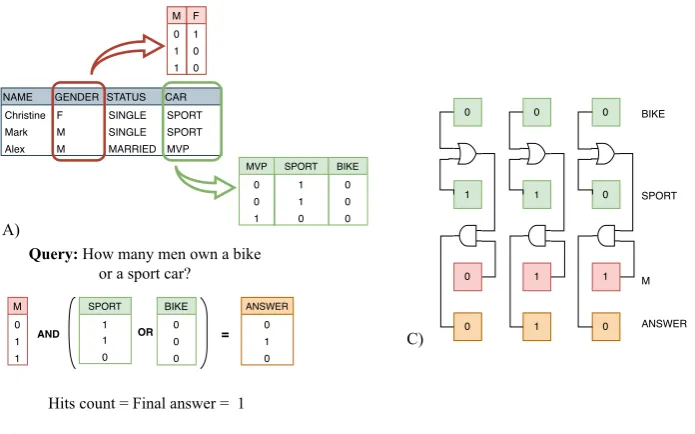
algo-rithms that need to perform huge amount of simple operations on data stored. To demonstrate the advantages that the PIM approach can provide, we choose to implement an architecture able to solve the Bitmap indexing problem. The Bitmap indexing is an important algorithm often used in database management systems. C) B) NAME Christine Mark Alex GENDER F M M STATUS SINGLE SINGLE MARRIED CAR SPORT SPORT MVP M 0 1 1 F 1 0 0 MVP 0 0 1 SPORT 1 1 0 BIKE 0 0 0 SPORT 1 1 0 BIKE 0 0 0 M 0 1 1 ANSWER 0 1 0
AND OR =
A)
Query: How many men own a bike or a sport car?
Hits count = Final answer = 1
0 1 0 0 0 1 1 1 0 0 1 0 BIKE SPORT M ANSWER
Fig. 1.A) Given a table, bitmap indexing transforms each column in as many bitmap as the number of possible key-values for that column B) In order to answer a query logic, bitwise operations are to be performed C) Practical scheme of the execution of the query.
The Bitmax Indexing is an algorithm used to identify, inside a database, entries that have specific characteristics. For example, inside the database of Fig. 1.A the query consist in the identification of how many man own a motorbike or a sport car. To reach this goal each feature is indexed using a binary representation. The gender column, for example, is divided in two sub-columns, one representing the male gender and one representing the female gender. Then each sub-column is represented using single bits. For example the first entry of the database is a female, so the M column contains ’0’, while the F column contains ’1’ (see Fig. 1.A). Searching for a specific query inside such database means performing simple logic operations between each sub-column, as depicted in Fig. 1.B.
OPERATION DECODER
GHOST ROW
LIM ROW
ADDRESS DEC.
LIM CELL BANK
BREAKER B)
DATA IN
BANK
BANK
1s COUNTER
ROQ CONTROL
UNIT
BREAKER
LIM ARRAY
ADDR. RF INSTR. MEM.
OP
. DISP
A
TCHER
0 1 0
1
QUERIES DATA_IN
Result of Query
DELAY A)
CELL
MEM CONFIG LOGIC
data_in
data_out
from_mem
from_ext logic_result
C)
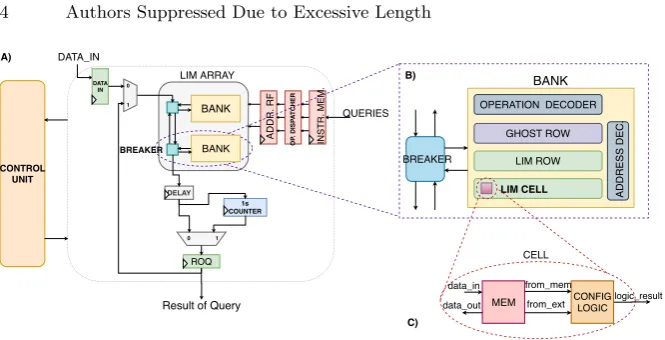
Fig. 2.A) Overview of the complete architecture. B) Structure of the duo Bank-Breaker C) Insight of the PIM cell
to search for a specific query in the database it is necessary to execute logic operations between subsequent rows of the memory (Fig. 1.C). To reach this goal we have designed a memory cell that consists of a memory element and a configurable logic block (Fig. 2.C, more details on the implementation will be given in Section 3).
bank and select between PIM and standard memory mode. The breaker block is used to enable the communication among different banks. This structure is flexible and can be easily reconfigured to implement other algorithms.
3
Results and conclusions
To evaluate the performance of the structure, a circuit composed by a 8,512 KB PIM array, distributed on 16 banks with 16 bit data size, was implemented. Then, the architecture, implemented in VHDL (VHSIC Hardware Description Language), was tested with Modelsim and later synthesized with Synopsys De-sign Compiler using 45 nm BULK and 28 nm FDSOI CMOS technologies (table 1). In this first implementation the storage elements were synthesized as latches, instead of designing a custom memory cell. As a consequence the results here presented can be greatly improved by designing a custom memory-logic cell.
Parameter 45nm 28nm Total area [mm2] 2.33 1.058
fCLK [M Hz] 153.4 574.7 Total Power [mW] 49.7 14.07 Table 1.Synthesis results for 45nm and 28 nm CMOS technologies
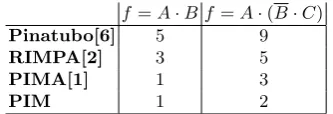
f=A·B f=A·(B·C)
Pinatubo[6] 5 9
RIMPA[2] 3 5
PIMA[1] 1 3
PIM 1 2
Table 2.Clock cycles comparison for a sin-gle query execution
Table 1 highlights the synthesis results. As it can be noticed the architecture is very efficient, it is capable of high clock speed but at the same time has a low power consumption.
One of the main goal this paper aimed to fulfill is the high level of concur-rency. This was accomplished thanks to the internal organization of the array, that is distributed on banks which are capable of working both independently and with each other, providing flexibility in the position of the operands that are called to act in the query. To execute a simple query only one cycle is required (Table 2).
The maximum throughput achievable isthroughputmax=fCLK·Nops.
As-suming to execute a different query in each of the 16 available banks, a maximum throughput of 2.45Gop/s and 9.2Gop/s for 45nm and 28nm can be reached. Ta-ble 2 highlights the comparison of the proposed architecture with the state of the art in terms of clock cycles required for an operation. Our architecture is always faster than the other solution proposed in literature.
with as many banks as needed. It could also be possible to develop a 3D struc-ture in order to increase performance. The architecstruc-ture could be easily modified to implement other types of operations. In conclusion, this architecture demon-strates that a Processing-in-Memory approach leads to a great improvement of performance. The architecture here proposed achieve very good performance and has enough flexibility to be adapted to several different algorithms.
References
1. Angizi, S., He, Z., Fan, D.: Pima-logic: A novel processing-in-memory archi-tecture for highly flexible and energy-efficient logic computation. In: 2018 55th ACM/ESDA/IEEE Design Automation Conference (DAC). pp. 1–6 (June 2018) 2. Angizi, S., He, Z., Parveen, F., Fan, D.: Rimpa: A new reconfigurable dual-mode
in-memory processing architecture with spin hall effect-driven domain wall motion device. In: 2017 IEEE Computer Society Annual Symposium on VLSI (ISVLSI). pp. 45–50 (July 2017)
3. Causapruno, G., Riente, F., Turvani, G., Vacca, M., Roch, M.R., Zamboni, M., Graziano, M.: Reconfigurable systolic array: From architecture to physical de-sign for nml. IEEE Transactions on Very Large Scale Integration (VLSI) Systems PP(99), 1–10 (2016)
4. Chi, P., Li, S., Xu, C., Zhang, T., Zhao, J., Liu, Y., Wang, Y., Xie, Y.: Prime: A novel processing-in-memory architecture for neural network computation in reram-based main memory. In: 2016 ACM/IEEE 43rd Annual International Symposium on Computer Architecture (ISCA). pp. 27–39 (June 2016)
5. Kim, D.H., Athikulwongse, K., Healy, M.B., Hossain, M.M., Jung, M., Khorosh, I., Kumar, G., Lee, Y.J., Lewis, D.L., Lin, T.W., Liu, C., Panth, S., Pathak, M., Ren, M., Shen, G., Song, T., Woo, D.H., Zhao, X., Kim, J., Choi, H., Loh, G.H., Lee, H.H.S., Lim, S.K.: Design and analysis of 3d-maps (3d massively parallel processor with stacked memory). IEEE Transactions on Computers 64(1), 112– 125 (Jan 2015)
6. Li, S., Xu, C., Zou, Q., Zhao, J., Lu, Y., Xie, Y.: Pinatubo: A processing-in-memory architecture for bulk bitwise operations in emerging non-volatile memories. In: 2016 53nd ACM/EDAC/IEEE Design Automation Conference (DAC). pp. 1–6 (June 2016)
7. Matsunaga, S., Hayakawa, J., Ikeda, S., Miura, K., Endoh, T., Ohno, H., Hanyu, T.: Mtj-based nonvolatile logic-in-memory circuit, future prospects and issues. In: 2009 Design, Automation Test in Europe Conference Exhibition. pp. 433–435 (April 2009)
8. Santoro, G., Turvani, G., Graziano, M.: New logic-in-memory paradigms: An ar-chitectural and technological perspective. Micromachines 10(6) (2019), https: //www.mdpi.com/2072-666X/10/6/368