1
Title: From the classroom into the fire: Learning the reality of nursing
through rotation programmes for newly qualified nurses
(Working Paper)
ABSTRACT
The nature of nurse education has changed considerably since the inception of nursing as a profession in the mid-nineteenth century. The challenge for modern student nurses is bridging the conceptual gap between formal (classroom) learning and practical (on the ward) competence. The nature of post-registration transition into nursing practice is challenging for many nurses. The Capital Nurse Foundation Programme (CNFP) provides support for newly qualified nurses who begin their practice with National Health Service (NHS) Trusts within the UK capital. Crossing this boundary from academia to practice can be daunting for new nurses. This programme uses rotation to provide supported educational experiences for new nurses crossing this boundary aiming to support retention and prevent high turnover.
This paper is a qualitative evaluation of newly qualified nurses and programme managers experiences of the CNFP across 9 different London Healthcare Trusts. The findings revealed five primary themes including Recruitment and Retention; Programme Support; Challenges; Rotation and new experiences; and Career development.
2
Title: From the classroom into the fire: Learning the reality of nursing
through rotation programmes for newly qualified nurses
INTRODUCTION
The World Health Organisation (WHO) (2014) has observed that there is a labour market supply deficit in healthcare of around 12 million doctors, nurses and support workers. Patient outcomes, job performance and care quality indicators are diminished by a shortage of nursing staff globally (ICN, 2013). The picture across European settings is similar (Taylor & Siegel, 2017). This shortfall proposed to be linked to the mid- to high prevalence of stress and burnout amongst working nurses and health professionals in the UK who report low levels of job satisfaction (Mark and Smith, 2012; Farquharson et al., 2013; Ruotsalainen et al., 2015). The literature has noted that nurses are at high risk of stress-related mental health issues, this may be due to regular subjection to patient suffering (Clegg, 2001) and the fast-paced intense nature of their work (Kirkcaldy & Martin, 2000). As a consequence of this high-stress working reality staff turnover is often turbulent, particularly in urban settings where other employment opportunities are plentiful.
Nursing education
3
20th Century there were significant changes to the role of the nurse and to nurse education. Not least the establishment of a professional register together with a more formal approach to their education meant the realisation of nursing as a profession (Davies 1996).
Further changes came with Project 2000, which when introduced placed more emphasis on the education of nurses being ‘based’ in Universities (Clark, Maben and Jones 1997). Ultimately this led to nursing becoming an ‘all graduate’ profession (Nursing and Midwifery Council 2015). There is recognition of current financial pressure of healthcare delivery, where healthcare professionals are expected to do more for less (Edwards et al. 2014). Taylor & Siegel in a report on the healthcare workforce across Europe, cite a telling quote from a medical director “We are training our workforce in a strait-jacket educational system, fit for a model of the 1960s” (Taylor & Siegel, 2017, p.19).
Innovation is needed within the system, one form of innovation has come in the form of funding. Form September 2017 pre-registration student nurses no longer receive a bursary and instead need a student loan to fund their studies. This new system may reduce the costs to Health Education England of educating nurses, yet it is anticipated to have a significant and long-term impact on nursing students’ recruitment (The 2015 spending review changes to Nursing, Midwifery and AHP education). There has been the introduction of the associate nurse, potentially seen as a ‘cheaper’ alternative to the registered nurse, primarily responsible for direct care-giving to the patient (Leary 2016).
With these changes, and the identified shortage of registered nurses in the UK (Longhurst 2016), research is needed to examine the impact on both recruitment and retention of newly qualified nurses.
4
In London there is a higher density of teaching hospitals in comparison with the remainder of the UK (London’s NHS Infrastructure, 2017). This density reflects a diverse range of healthcare providers (acute, community, etc.) and so increases the likelihood of diversity in the nursing population. It can also lead to a rapid turnover of nurses who have a range of jobs available to apply for within easy reach of their home base. Nurses are able to cross organisations with relative ease, and temporary agency staff use is widespread.
The retention of urban nurses has been studied using the anticipated turnover model (Lucas et al 1993; Leveck & Jones, 1996). Group cohesion and job satisfaction predicted anticipated turnover, whilst job satisfaction effectively buffered job stress. Evidence suggests that job satisfaction strategies need to be targeted specifically to the types of clinical services. Such turnover has been challenging within London hospitals, with a number of organisations struggling to keep a stable work base. In order to address this challenge, healthcare organisations, Universities and the UK government have begun to rethink how nurses experience the initial transition from academia into practice.
A new approach to nursing education in practice
5 Preceptorship
The nature of post registration transition into nursing practice is challenging for many nurses. Classroom based clinical education in undergraduate nursing has been noted to inadequately prepare graduates for entry onto the ward. Preceptorship programmes have become increasingly prevalent in nursing education as a way to support newly qualified nurses to make the transition from classroom to employment. However, few empirical studies have been undertaken to support or refute its benefits. Udlis (2008) in a review of sixteen research studies found a positive evaluation in the majority (56%) of cases, or no significant differences (44%) in students after the preceptorship. A range of different models have been used in preceptorship, including one to one support via mentoring; group preceptorship within the organisation; and rotation programmes which can allow new employees access to a range of frontline experiences, mentors (on each ward) and preceptorship during their first year.
Rotation programmes, where students spend short periods (4-12 weeks) in one clinical setting and then move to another clinical setting for a period, have been used extensively throughout medical education programmes (Kern, 1998) and indeed a range of associated healthcare professions (Occupational Therapists, Pharmacists etc.). However, rotation programmes in nursing are a relatively new phenomena in the UK. Role modelling by other nurses on the ward can be a key part of a nurses’ practical education (Baldwin et al, 2017), whether that impact is negative or positive. Rotation can provide a range of role modelling experiences which can support a nurse in their development.
The Capital Nurse Foundation Programme (CNFP) outlined here is an example of a
6
nursing. It is hypothesised that enabling newly qualified nurses to experience a range of nursing environments (some very busy and taxing, some not so stressful) will help to address the stress/burnout and retention issues currently faced by London hospitals.
Local Context
The Capital Nurse Foundation Programme (CNFP) was funded by Health Education England as part of a long-term plan to build a sustainable new workforce of nurses within the London health sector. The overriding objective of the programme is to provide a skilled, stable workforce within the capital as opposed to the frequent turnover seen currently. This pilot evaluation was funded by Health Education England, Northwest London (HEENWL) to examine the development of career pathways of nurses taking up CNFP posts in a sample of Trusts that have recently commenced the programme. The findings below outline the common themes that emerged from the six participating Trusts and two multi-Trust focus groups, where the CNFP (education leads) group reflected on and considered issues seen across nine Trusts.
The aim of the research was to evaluate the challenges and benefits of running and participating in CNFP. The main objectives were to support shared learning among the existing and new/starting sites running the CNFP; and to uncover any obstacles or facilitators to establishing an effective CNFP in North West London.
METHODS
7
groups consisted of the CNFP staff and Newly Qualified Nurses (NQNs) on the programme. The profile of Trusts included a cross section of Acute, Community and Mental Health Trusts delivering care across northwest London.
Data collection
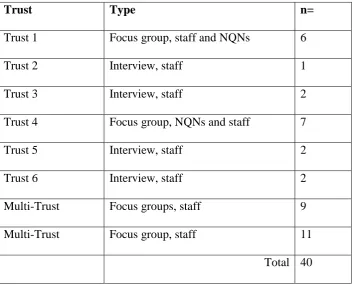
Primary data were collected from focus groups and individual interviews in each participating Trust. Focus groups with NQNs on the CNFP and staff involved in setting up the programme were conducted in two trusts. Individual interviews were conducted with set up staff at four trusts. A further two focus groups were conducted with Trust Education Leads attending a HEENWL Capital Nurse support day from nine Trusts.
Table 1: Participants and type of data collection
Trust Type n=
Trust 1 Focus group, staff and NQNs 6
Trust 2 Interview, staff 1
Trust 3 Interview, staff 2
Trust 4 Focus group, NQNs and staff 7
Trust 5 Interview, staff 2
Trust 6 Interview, staff 2
Multi-Trust Focus groups, staff 9 Multi-Trust Focus group, staff 11
8 Data analysis
The audio files from the focus groups and interviews were transcribed. The transcriptions were then analysed using an open-coding inductive approach in NVivo 11. Themes and patterns became apparent within the data and were reviewed and second coded by two other members of the research team.
Ethics
Each Trust was contacted via the CNFP education lead. Local research governance was sought at each participating Trust. The majority of Trusts categorised the evaluation work as audit and approved the work. Ethical approval from the University of West London was sought and awarded by the College of Nursing Midwifery and Healthcare Ethics Committee.
RESULTS
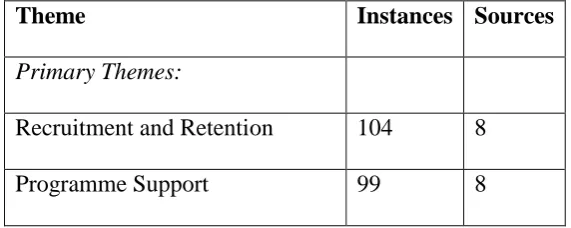
The findings from this evaluation revealed five major themes or patterns in the data across the nine regional Trusts. Five primary themes emerged from all sources (six Trust interview transcripts and the 2 multi-Trust focus groups transcripts) and five secondary themes revealed issues which were identified in more than one source but not all.
Table 2: Themes breakdown, with instances and sources
Theme Instances Sources
Primary Themes:
9
Challenges 73 8
Rotation and new experiences 62 8 Career development 54 8
Secondary Themes:
Benefits of being a Capital Nurse 51 7
Future 46 5
Getting the programme going 34 7 Resistance to change 21 5
Shared Learning 17 5
We will present the themes by topic area integrating both secondary and primary themes as appropriate to the area.
Recruitment and Retention
A strong pattern in the data which emerged from all sources was that of the challenges of recruitment and retention. There were a range of challenges identified, first to the timing of the programme, this led to challenges to getting people to start, particularly the initial timing being out of step with student nurses graduating.
‘it’s about the timing as well, so it wasn't the right time I think to be starting employment as newly qualified nurses’(Programme Manager)
10
‘I think that's why we're getting a different quality of nurses going on to Capital Nurse, who are eager and want to learn and keep going and there's a slight difference you can see in who is stepping on to the Programme’(Programme Manager)
‘so that people feel like they're more special, … has been certainly something that I have used to start to recruit on to the next cohort’ (Programme Manager)
There was attention paid to new strategies of recruitment, going to institutions or areas that have not traditionally been visited before (out of patch, e.g. Dundee, Birmingham) to bring nurses into the Capital.
‘We used to do RCN fairs but we found it was a lot of students and [they] were saying ‘why don't you[r Trust] come to our university?’’(Programme Manager)
A secondary theme in this topic area was ‘getting the programme going’: Some sites described the challenges of starting the programme. Three sites mentioned the timing of the academic year, that they had delayed intake to ensure they were recruiting the best candidates as they completed their university studies (i.e. in the summer or early autumn). For others the challenges was just as much internal stakeholder engagement, gaining buy in, and the
logistics of setting up the programme in a short space of time.
Programme Support
11
Some organisations have used the technique of a drop in clinic, where NQNs know they can find help at a certain time:
‘currently our rotational nurses have an individual mentor, so what we've said is, because there's going to be so many, that we are going to do a day a month where there will be a drop-in clinic,’ (Programme Manager)
‘so they'll drop in and they can have a one-to-one with a group of us, and actually have that one-to-one chat, and that will probably be you know like a kind of an hour, then they're going to have a group mentorship like so ‘ (Programme Manager)
Other organisations have a project manager or identified person who leads the CNFP within the Trust. Many of the NQNs found this person to be a key important contact.
‘if you have any concerns, like she comes pretty much straight away to us to resolve any issues that we have.’ (NQN)
More formal mentorship schemes were used by two organisations; all organisations referred to the availability of existing mentors as they are usually available on a ward. However one organisation had created an extra Capital Nurse mentor scheme to support NQNs in their career development.
‘so that that will be facilitated by Super Mentors, so they were able to make informed choices about what suits them, where they would like to work [so] we can actually place them somewhere that they will enjoy, which means that that will help with retention.’ (Programme Manager)
The use of social media to keep in contact with each other was identified, with some using a Facebook group, others a What’sApp group.
12
‘I think we're definitely …. Not doing What'sApp but tapping in to some sort of social media thing with our [lot] social networking for the group and having the drop-in clinic, because everybody wants to come and chat.’ (Programme Manager)
A secondary theme in this topic was ‘Shared Learning’ which centred on both programme managers and NQNs appreciating the shared learning the programme provided. This was taking place at two levels. First, within the programme, shared learning across a cohort of NQNs within a Trust, appreciating the rotation and support provided by others on the programme. Secondly, the programme managers appreciating the opportunities provided by the programme to come together and share learning across the larger capital nurse
programme – to learn from others mistakes, to pick up problem solving hints to try in their own programmes.
Challenges
There were challenges for both staff setting up the programme and also for NQNs on the programme. Communication was a key challenge for both groups, with programme managers having to do engagement work with ward managers to negotiate release of time for Capital Nurses (to attend support sessions) and what to expect when a nurse arrived on their ward.
‘there was a lack of understanding of what is Capital Nurse and once the message, you know we did quite a lot of groups in terms of what is Capital Nursing’ (Programme Manager)
13
For programme managers there were challenges related to logistics - who to rotate, to where and when. Some NQNs had expectations of particular rotations they wished to join and this sometimes presented challenges in meeting expectations whilst balancing needs in staffing areas. For some organisations this centred on acute vs community placements, for others it was about particular wards or specialist areas of interest.
‘That's certainly one of the challenges is trying to plot them on maps … and that's been one of the challenges.’(Programme Manager)
‘I actually had one student say to me – ‘what in the community? Do you really think that's a really good idea? oh no, I wouldn't do that’ I wouldn't go near that at all!’
(Programme Manager)
For the NQNs a theme that came out in all organisations was the challenge of rotating through different experiences and of being ‘new’ again.
‘I'd have appreciated someone telling me like it's like starting a new job every six months, good as it might be’ (NQN)
A secondary theme in this topic area was ‘Resistance to change’ which was an issue that came up for five of the sites. There were a number of sites who spoke of feedback from ward staff who didn’t know what the programme was and were not keen to trust new NQNs. However the picture was not all negative and in fact one site noted
14
Three sites mentioned equality as an issue, regarding the existing Band 5s working in the Trust questioning the extra resources allocated to the new CNFP nurses, wishing to avoid a ‘what about me?’ dissatisfaction from existing staff.
Rotation and new experiences
The advantages and aspects of rotation to facilitate nurse training were identified by both staff and NQNs as an important theme. Rotation lengths across the organisations varied from four months as a minimum, with the majority being the longer six months. There was also variation in the breadth of the rotation programme, some organisations rotating just within one directorate, others rotating across directorates, across the organisation, and across both acute and community settings.
One of the main aspects of rotation that was liked by all was the ‘taster’ aspect, which enabled the NQN to experience a range of different specialties to find what suits them.
‘I think it's about … people finding themselves really, finding what interests them, something they can experience, if we don't sample it, we don't know what it's like’
(Programme Manager)
‘so they’ve got that good mixture, which hopefully builds, you know, synergy that's going to work well and to have a good understanding’ (Programme Manager)
‘it's trying to match what they want with the rotations that we've got, hoping they fit’ (Programme Manager)
15
‘I've found because I started with … newly qualifieds and I found I've been pushed a bit more to get things done because I'm on [Capital Nurse] I'm going to ITU, so they pushed me a bit more to do my IV's and everything, so I think that's good, I feel more confident than some of the other newly qualifieds, which is good.’ (NQN)
‘Yes, and I think it's building your skills as well, as a qualified nurse, how you build relationships with different teams, how you become much more confident in your approach’ (Programme Manager)
There were other aspects noted, where rotation might be considered to benefit an organisation as well as the individual.
‘that since the rotation, having fresh faces coming and going so often from the wards, is almost like improving the team work and everything on the wards’(Programme Manager)
A secondary theme in this topic area was ‘Benefits of being on a Capital Nurse’. This theme came mainly from the NQNs with some comments from programme managers. The main issues were nurses having more confidence individually, the realisation that one way of doing something isn’t the only way (e.g. formulating antibiotics, variations in practice 100 ml bag vs 50ml syringe). This was highlighted as important for new nurses as a part of their
formation of how to be a nurse; understanding the nuances of preference of practice on different wards. Being pushed to be better quicker was seen as a benefit of the programme:
‘I found I've been pushed a bit more to get things done because I'm on [the programme]’ (NQN)
16 Career Development
A range of perspectives emerged on how the rotation programme can facilitate and improve nurse’s career plans and opportunities. All sites spoke of rotation and its advantages, often in the context of long-term career development.
‘yes, different opportunities, doors get opened that you know might not have been if they're you know kind of hidden away in a ward,’ (Programme Manager)
‘It (rotation) can introduce you to an area that you want to go, at the same time, it can like broaden your horizon to think I might do this for a few years but this is the place I want to end up my career.’ (NQN)
Another aspect that linked with this was the ‘push’ or the stretch that nurses experienced in the programme.
‘I think as you are coming to the end of it you present yourself different, … so you go in with a different perspective and you are sit better when you go in and you can do stuff other than hiding’(NQN)
‘It's very good for signing your competencies because you get a lot of … the working with another nurse’ (NQN)
This theme linked back into the recruitment and retention challenges, including rotation allowing nurses to see more, have a better experience, so they were possibly more likely to stay.
17
five years... It helps them also to make up a decision as to where they want to specialise’. (Programme Manager)
Also mentioned was the opportunity to recruit in hard to fill areas, for example
‘We can't get Tissue Viability Nurses for love nor money … they don't exist. We propose growing our own … and then we did the interviews and the Tissue Viability Nurse said, I don't care if this rotation doesn't go ahead, I want this [NQN] and that was a real light bulb moment, actually, you can grow your own.’ (Programme Manager)
A secondary theme in this topic area was that of ‘Future‘. This theme had three sub themes. Firstly, clarity of purpose, understanding the purpose of CNFP, its future, and the sustainable development of good nurses within the Trust. Secondly, expansion – this being the idea of expanding the programme to include other existing Band 5 nurses with potential to develop and sustain their career within the Trust. Finally, sustainability, which came up in reference to the CNFP surviving beyond the funding provided by HEENWL.
DISCUSSION
18
Overall NQNs found the programme experience a positive one and felt their career plans were enhanced by participating. This supports the recently developing literature that preceptorship can be a useful way to help nurses transition from academia to practice (Udis, 2008; Kern, 1998). The exposure to a range of role models was also seen as valuable, supporting recent literature in this area (Baldwin et al, 2017). There was a strong sense that the programme increased, and in some cases accelerated the acquisition of skills, providing a varied and worthwhile experience. Of the themes identified, many linked back to the perceived value of the programme in enabling trusts to retain and recruit good nurses and to rotate NQNs through specialities that they would not normally have considered, this could be proposed would mitigate burnout and turnover risks (Clegg, 2001; Kirkcaldy & Martin 2000). NQNs did not refer to stress or burnout issues which suggests that rotation may mitigate against initial negative impacts some new nurses can experience when first entering a busy workplace (Mark & Smith, 2012; Ruotsalainen et al, 2015).
There is some indication that the CNFP could be developed further to support nurses during the first few years (rather than just the first year). Developing the programme to support nurses to cross the initial academia to practice boundary, but then continuing to support working nurses (band 5s) already struggling with a fast past work environment and possible burnout (Kirkcaldy & Martin, 2000) with a supportive system within the organisation.
19
adaptive to respond rapidly to the challenges facing the healthcare workforce in a pressured environment.
In future research, it would be valuable to understand if the early benefits articulated by NQNs are sustained and how career trajectories develop, including the intention to remain in the capital. It may be useful to consider strategies to facilitate further personal and professional development with a view to planned progression. As the CNFP has not completed a full 18 month cycle it is not possible to support the perceived benefits with hard outcome data related to retention or the sustainability of the programme. Further evaluation to understand the impact of the CNFP on capability and capacity, recruitment and retention and job satisfaction within participating trusts is required.
Limitations
20
REFERENCES
Baldwin, A., J. Mills, M. Birks, L. Budden. (2017) Reconciling professional identity: A grounded theory of nurse academics' role modelling for undergraduate students. Nurse Education Today, Volume 59 , 1 - 5
Clark, Jill Macleod, Maben, Jill and Jones, Karen (1997) Project 2000. Perceptions of the philosophy and practice of nursing: preparation for practice Journal of Advanced Nursing, 1997, 26, 246–256
Clegg, Andrew., 2001. Occupational stress in nursing: a review of the literature. Journal of Nursing Management, 9(2), pp.101-106.
Davies, Celia (1996) Gender and the professional predicament in nursing. Buckingham, United Kingdom: Open University Press.
Edwards, Mark. Penlington,C. Kalidasan, V. Kelly, T. (2014) ‘Culture change, leadership and the grass-roots workforce’. Clinical Medicine, Vol 14, No 4: 342–4.
Farquharson, Barbara., Bell, C., Johnston, D., Jones, M., Schofield, P., Allan, J., Ricketts, I., Morrison, K. and Johnston, M., (2013). Nursing stress and patient care: real‐time investigation of the effect of nursing tasks and demands on psychological stress, physiological stress, and job performance: study protocol. Journal of Advanced Nursing, 69(10), pp.2327-2335.
21
International Council of Nurses [ICN] (2013) The Global Shortage of Registered Nurses: An Overview of Issues and Actions. http://www.icn.ch/publications/the-global-shortage-of-registered-nurses-an-overview-of-issues-and-actions/ accessed Nov 2017
Kirkcaldy, Bruce .D. and Martin, T., 2000. Job stress and satisfaction among nurses: individual differences. Stress and Health, 16(2), pp.77-89.
Kern, David. E. (1998). Curriculum development for medical education: a six-step approach.
JHU Press.
Leary, A. (2016) ‘New Role will lead to underclass of nurses’, Nursing Times.112(5):8-8, 2nd March.
Leveck, M. L. and Jones, C. B. (1996), The nursing practice environment, staff retention, and
quality of care. Res. Nurs. Health, 19: 331–343.
doi:10.1002/(SICI)1098-240X(199608)19:4<331::AID-NUR7>3.0.CO;2-J
London's NHS Infrastructure - London Medicine (2017) website: London Medicine,
accessed 21st November 2017 url:
https://www.londonmedicine.ac.uk/londons-landscape/national-health-service/london-s-nhs-infrastructure/
Longhurst, C. (2016) 'UK is 'unprepared' for predicted nurse shortages', Nursing Standard; 30(46): 7-7.
Lucas, M. D., Atwood, J.R. Hagaman, R. (1993) Replication and Validation of Anticipated Turnover Model for Urban Registered Nurses. Nursing Research: January/February 1993
22
Nursing and Midwifery Council (2015) Read raising concerns online. Available at:
https://www.nmc.org.uk/standards/guidance/raising-concerns-guidance-for-nurses-and-midwives/read-raising-concerns-online/ (Accessed: 18 July 2016).
Orsolini-Hain, Liana, PhD, RN; Waters, Verle, MA, RN (2009) Education Evolution: A Historical Perspective of Associate Degree Nursing. Journal of Nursing Education; Vol. 48, Iss. 5: 266-71.
Ruotsalainen, J.H., Verbeek, J.H., Mariné, A. and Serra, C., 2015. Preventing occupational stress in healthcare workers. The Cochrane Library.
Taylor, Karen, & Siegel, Sara (2017) Time to Care: Securing a future for the hospital workforce in Europe. Website accessed Dec 6th 2017 pdf available:
https://www2.deloitte.com/content/dam/Deloitte/uk/Documents/life-sciences-health-care/deloitte-uk-time-to-care-health-care-workforce.pdf
Udlis, K A (2008) Preceptorship in Undergraduate Nursing Education: an Integrative Review. Journal of Nursing Education. 47 (1):
20-29HTTPS://DOI.ORG/10.3928/01484834-20080101-09
World Health Organisation (2014) World Health Statistics: online at:
http://www.who.int/gho/publications/world_health_statistics/2014/en/ accessed Nov