© 2018 IJSRST | Volume 4 | Issue 2 | Print ISSN: 2395-6011 | Online ISSN: 2395-602X Themed Section: Science and Technology
Video Scene Segmentation : A Novel Method to Determine Objects
A. Syed Kalith
*1, D. Mohanapriya
2, Dr. K. Mahesh
3*1M. Phil Scholar, Department of Computer Applications ,Alagappa University, Karaikudi, Tamil Nadu, India 2
Ph.DScholar, Department of Computer Applications, Alagappa University, Karaikudi, Tamil Nadu, India
3Professor ,Department of Computer Applications , Alagappa University, Karaikudi, Tamil Nadu, India
ABSTRACT
Video segmentation plays an important role in the MPEG-4 standard for multimedia applications. Segmentation of videos into their respective foreground and background articulate its importance in Video compression, human-computer interaction, video editing and manipulation etc. Video sequences are converted into frames and processing is done. The key perspective consider in this paper is the moving object detection with noise reduction. The video segmentation is done by detecting the moving objects on each frames and then labeling on it. A hybrid algorithm is proposed that quickly and efficiently extract the moving objects from the video sequence. Background difference is involved so as to acquire the initial object masking and to solve the uncovered background problem in the frames. The combination of noise reduction and background difference will yield the moving object within the video sequences with accuracy. The proposed algorithm is evaluated with varying input video sequences and results are produced. The experimental results show the method defers low computational complexity and better results in real time applications.
Keywords : MPEG-4 Standard, Video Segmentation, Filtering, Noise Removal, Background Difference, Object Detection.
I.
INTRODUCTION
One of the main challenges in computer vision is automatic comprehension of complex dynamic content of videos, such as detection, localization, and segmentation of objects and people, and understanding their interactions. Image and video segmentation is very beneficial in several applications for finding the regions of interest in a panorama or annotating the data.MPEG-4 is a promising standard for multimedia communications. MPEG-4 provides standardized ways to encode the video and audio objects, and the scene description, which represents how the objects are structured in a scene Due to the sudden growth in digital video content, an efficient way to access and manipulate the information in a huge video database has become a difficult and timely issue.Therefore, the need for developing tools and systems that can effectively search and retrieve the desired video content has gained enormous popularity among researchers. Recent development of range-camera technology has the potential to capture the range video in an applicable frame rate and frame resolution. The video segmentation
is an imperative technique used for the improvement of video quality on the basis of segmentation The function of video segmentation is to segment the moving objects in video sequences .Video segmentation is entirely different from single image segmentation.The bad quality segments such as very blurred or shaking clips should be eliminated or recovered, because these clips often irritate the viewer's . Video object segmentation is an important issue in video analysis, and it has several applications namely post-production, special effects, object detection, object tracking,and video compression .
video segmentation, image segmentation based video segmentation and change detection based video segmentation . The segmentation of each frame of a video into homogeneous regions is an important issue for many video applications such as region-based motion estimation, image enhancement (since different processing may be applied on different regions), and 2D to 3D conversion .Scene segmentation has many applications in various domains. For example, in the feature films, scene segmentation provides the chapters that correspond to the different sub themes of the movies . In television videos, segmentation can be used to separate the commercials from the regular programs. In news broadcast programs, segmentation can be used to identify different news stories and videoconferencing application. In home videos, scene segmentation may help the consumers to logically organize the videos related to the different events (e.g., birthday, graduation, weddings, or vacation) [8].
II.
BASIC CONCEPTS OF VIDEO
SEGMENTATION
Segmentation can be specified that it is a process of partitioning data into groups of potential subsets that share almost identical characteristics. It has become a technique for semantic content extraction and plays an essential role in pattern recognition ,digital multimedia processing and computer vision.
A. Image Segmentation
Image segmentation is an important but challenging problem. It is a necessary first step in image analysis. Because it is use d in high-level image interpretation and understanding such as robot vision, object recognition, geographical imaging and medical imaging. In general, image segmentation is a process of partitioning an image into non-overlapped, consistent regions that are uniform with respect to some characteristics like intensity, color, tone or texture, and more. There are different techniques for image segmentation e.g. thresholding, clustering, classifications, artificial neural networks (ANNs), region growing, edge detection etc.
B. Clustering
Clustering is defined as the classification of similar objects into different groups, or more accurately, the
dividing of a data set into subsets (clusters), so that in each subset (ideally) the data are some common trait – often proximity according to some defined distance measure. Many schemes of clustering are categorized based on their special characteristic, such as the hard clustering scheme and the soft (fuzzy) clustering scheme. The conventional hard clustering scheme restricts each point of the data set to entirely just one cluster. As a consequence, with this approach the result of segmentation is often very crisp, i.e., each pixel of the image belongs to just one class exactly. However, in many real situations, for images, issues such as poor contrast, limited spatial resolution ,overlapping intensities, intensity in -homogeneities variation and noise make this hard (crisp) segmentation a difficult job .In fuzzy (soft) clustering, data elements can belong to more than one cluster. The fuzzy set th eory described by a membership function. [2] The most popular method among the fuzzy clustering methods is fuzzy c-means (FCM) algorithm. Because it gives much more information than the hard segmentation methods and has robust characteristics for ambiguity.
C. Motion Detection
Motion detection is essential in many fields, such as pattern recognition, object tracking, traffic surveillance. At present the concerned approaches of moving target detection are background difference, time difference (frame difference) and optical flow. Motion detection algorithm operates in a specific area to observe the change of image for detecting the moving object. However, the change in the environment disturbs the motion detection seriously: illumination, noise, shadow and so on. Lots of current motion detection algorithm fails to be effective and fast at the same time. Thus our task is to detect the motion detection algorithm which finds the balance between effectiveness and complexity.
D. Object Tracking
challenging problem. Due to abrupt motion of object, changing appearance patterns of the object and the scene, non-rigid object structures, object-to-scene and object Object occlusions, and camera motion, there are many difficulties arise in tracking of objects.
E. Video Segmentation
The term video segmentation refers to decaying a video data into meaningful elementary parts that have strong correlation with the real world contained in the video data. The result of video segmentation is a set of segments that collectively cover the actual entire video data. The major difference between image signal and video signal is that a video signal consists of temporal information, which includes camera motion and introduces the concept of object motion, therefore Video has temporal nature as well as spatial (static) nature. Segmentation of video can thus be temporal, spatial or spatio-temporal. Segmenting a frame of a video in spatial domain is just like a static image. Segmenting a sequence of video frames in temporal domain is called temporal segmentation or shot detection.
III.
RELATED WORKS
The algorithm proposed by Tripty Singh et.al[10] a
method for moving object detection, in high
secured arenas, which is deployed both in the static
position and in the dynamic position is provided.
Author’s main objective is to increase the efficiency
of the moving object detection both at the online
and offline processing of video sequences. Their
implementation is carried out by reducing the noise
at background, calculating frame difference and
producing snapshots for every sequence. In the
method
proposed
by
Yasira
Beevi
and
S.Natarajan[5] a video segmentation algorithm for
MPEG-4 camera system by means of change
detection, background registration methods and real
time adaptive threshold techniques are analyzed.
Their algorithm provides better segmentation
results with low computation complexity. It uses a
shadow cancellation mode, that can able to handles
both light changing effect and shadow effect.
Moreover, the algorithm has also applied real time
IV.
PROPOSED WORK
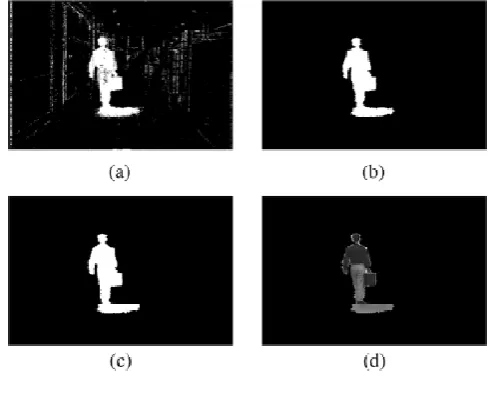
This section illustrates the proposed work, and model for the extraction of the segments from the video frame are described in detail In this research work, a new novel video segmentation method is devised to perform dynamic and static foreground segmentation. This novel approach segments both the dynamic and static foreground objects without considering the global motion constraints. The segmentation process is carried out by both frame differencing algorithm and frame intersection method. Subsequently the most common and accurate segmented objects are retrieved from both the segmented results. The step by step segmentation process is as follows :
Cluster segmentation (grouping of similar Objects)
Video frame object identification and extraction using FFBA
Track frame assortment
Frame Change detection using frame intersection algorithm
Foreground segmentation using frame difference algorithm
segmented results
A. Analysis Parameters
This proposed work can be compare with the existing and proposed techniques. The superiority of the proposed framework results are analyzed and evaluated in terms using the metrics such as sensitivity, specificity and accuracy.
.
Figure 1. Overall Flow of Proposed work
Psuedo Code
B. Steps
1. Video as an input is either taken from online mode or offline mode.
2. Video is converted to number of frames.
3. In order to detect moving object frame difference algorithm is applied. Here for detecting slow moving object kth frame is subtracted from (k-3)th frame.
4. Cluster segmentation (grouping of similar Objects) 5. Video frame object identification and extraction
using FFBA
6. Track frame assortment
7. Frame Change detection using frame intersection algorithm
8. Foreground segmentation using frame difference algorithm
9. segmented results.
C. Expected Results
In our proposed video segmentation approach to be validated by experimenting with variety of video sequences. The proposed system has been implemented in Matlab (Matlab 13). The performance of the proposed approach is compared.
V.
CONCLUSION
successful use of many video sequences is video object segmentation that accentuates partitioning the video frames to semantically meaningful video objects and backgrounds. Video object segmentation is a vital operation for content-based video coding, multimedia content description, intelligent signal processing and more. Various techniques are being used by the developers in reviewed. In background subtraction slow moving objects and poor image qualities of videos are handled perfectly. It eliminates shadow much more effectively than other technique. CNAFCM calculate the cluster number with minimal time cost. Histogram Based FCM Algorithm and Spatial probability improve the segmentation accuracy for noisy images. Optimizing Motion Detection algorithm suppress the noise effect. Color Histogram Bins and Fuzzy C- Means Clustering is effective for motion detection system. It increases the performance and decrease the computational complexity
VI. REFERENCES
[1] Li Junshan, Yang Wei, Zhang Xiongmei, “Infrared image processing, analysis and integration Beijing”, Science Press. 2009.
[2] K.Mahesh, K.Kuppusamy, "A New Hybrid Algorithm for video segmentation" ,Springerlink, Advances in Computer Science, Engineering & Applications, Advances in Intelligent and Soft Computing Volume 166, 2012, pp 587-595.
[3] K.Mahesh, K.Kuppusamy, "Video Segmentation using Hybrid Segmentation Method" , European Journal of Scientific Research ISSN 1450-216X Vol.71 No.3 (2012), pp. 312-326.
[4] Agarwal L, Lakhwani K, Optimization of frame rate in real time object detection and tracking, International Journal of Scientific & Technology Research, Volume 2, Issue 7, July 2013, pp:132-134.
[5] Beevi C.P.Y., Natarajan S. (2009) A Novel Video Segmentation Algorithm with Shadow Cancellation and Adaptive Threshold Techniques. In: Ślęzak D., Pal S.K., Kang BH., Gu J., Kuroda H., Kim T. (eds) Signal Processing, Image Processing and Pattern Recognition. Communications in Computer and Information Science, vol 61. Springer, Berlin, Heidelberg
[6] B. Deori, D. M. Thounaojam, "A survey on moving object tracking in video", International Journal on Information Theory (IJIT), vol. 3, no. 3, July 2014.
[7] Mengxin Li, Jingjing Fan, Ying Zhang, RuiZhang, Weijing Xu and Dingding Hou,“Moving Object Detection and TrackingAlgorithm”, in
TELKOMNIKA, Vol. 11,No. 10, October 2013, pp. 5539 – 5544
[8] Sudhanshu Sinha, Manohar Mareboyana, “Video Segmentation into Background and Foreground Using Simplified Mean Shift Filter and K-Means
[9] Saad A. Yaseen and Sreela Sasi, "Robust Algorithm for Object Detection and Tracking in a Dynamic Scene," Journal of Image and Graphics, Vol. 2, No. 1, pp. 41-45, June 2014. doi: 10.12720/joig.2.1.41-45.
[10] Tripty Singh, Sanju S and Bichu Vijay, “ANew Algorithm Designing for Detection ofMoving Objects in Video”, in InternationalJournal of Computer Applications (0975 –8887) Volume 96– No.2, June 2014.
[11] Mada Amarnadh, S. Asif Hussain, M. Janardhana Raju, “A Review of Video Segmentation Techniques”, Global Journal of Advanced Engineering Technologies, Special Issue (CTCNSF-2014).
[12] D. Mohanapriya and Dr. K. Mahesh., Robust Video Tracking System with Shadow Suppression Based on Feature Extraction. Aust. J. Basic & Appl. Sci., 10 (12): 307-311, 2016
[13] N. S. Nagaraja, F. Schmidt, and T. Brox. Video segmentation with just a few strokes. In ICCV, 2015
[14] C. Ma, J.-B. Huang, X. Yang, and M.-H. Yang. Hierarchical convolutional features for visual tracking. In ICCV, 2015
[15] L. Xu, J. Chen, and J. Jia. A segmentation based variational model for accurate optical flow estimation. In ECCV, 2008
[16] D. Zhang, O. Javed, and M. Shah. Video object segmentation through spatially accurate and temporally dense extraction of primary object regions 2013.
[17] D. Mohanapriya, Dr. K. Mahesh “A Comparative Analysis of Video Tracking Techniques” International Journal for Modern Trends in Science and Technology, Volume: 03, Issue No: 05, May 2017.
[18] Mohanapriya D. & Mahesh K. Multimed Tools Appl (2017) 76: 25731. https://doi.org/10.1007/s11042-017-4409-3.
[19] Mohanapriya, D., and K. Mahesh. “A video target tracking using shadow suppression and feature extraction.” 2017 International Conference on Information Communication and Embedded Systems (ICICES), 2017, doi:10.1109/icices.2017.8070734.