Nat. Hazards Earth Syst. Sci., 12, 379–390, 2012 www.nat-hazards-earth-syst-sci.net/12/379/2012/ doi:10.5194/nhess-12-379-2012
© Author(s) 2012. CC Attribution 3.0 License.
Natural Hazards
and Earth
System Sciences
Development of an operational coastal flooding early
warning system
D.-J. Doong1, L. Z.-H. Chuang2, L.-C. Wu3, Y.-M. Fan3, C. C. Kao3, and J.-H. Wang4
1Department of Marine Environmental Informatics and Center of Excellence for Marine Bioenvironment and Biotechnology,
National Taiwan Ocean University, Keelung, Taiwan
2Institute of Ocean Technology and Marine Affairs, National Cheng Kung University, Tainan, Taiwan 3Coastal Ocean Monitoring Center, National Cheng Kung University, Tainan, Taiwan
4Water Resources Agency, Taipei, Taiwan
Correspondence to: D.-J. Doong ([email protected])
Received: 3 October 2011 – Revised: 12 December 2011 – Accepted: 20 December 2011 – Published: 17 February 2012
Abstract. Coastal floods are a consistent threat to ocean-front countries, causing major human suffering and substan-tial economic losses. Climate change is exacerbating the problem. An early warning system is essential to mitigate the loss of life and property from coastal flooding. The pur-pose of this study is to develop a coastal flooding early warn-ing system (CoFEWs) by integratwarn-ing existwarn-ing sea-state mon-itoring technology, numerical ocean forecasting models, his-torical database and experiences, as well as computer sci-ence. The proposed system has capability of offering data for the past, information for the present and future. The sys-tem was developed for the Taiwanese coast due to its fre-quent threat by typhoons. An operational system without any manual work is the basic requirement of the system. Integra-tion of various data sources is the system kernel. Numeri-cal ocean models play an important role within the system because they provide data for assessment of possible flood-ing. The regional wave model (SWAN) that nested with the large domain wave model (NWW III) is operationally set up for coastal wave forecasting, in addition to the storm surge predicted by a POM model. Data assimilation technology is incorporated for enhanced accuracy. A warning signal is presented when the storm water level that accumulated from astronomical tide, storm surge, and wave-induced run-up ex-ceeds the alarm sea level. This warning system has been in practical use for coastal flooding damage mitigation in Tai-wan for years. An example of the system operation during the Typhoon Haitung which struck Taiwan in 2005 is illus-trated in this study.
1 Introduction
The northwestern part of the Pacific Ocean globally features numerous and intense tropical cyclones (typhoons). With strong wind entering the coast, the direct force by huge waves and rising sea levels caused by storm surges resulting from typhoons destruct the coastal defense, accelerate the coastal erosion, and cause coastal flooding directly or indirectly. Coastal inhabitants are exposed to such hazards. Taiwan’s location is on the major moving track of typhoons in the NW Pacific. Coastal flooding is frequent during typhoon season in Taiwan. Every year the property damage costs due to ty-phoons are estimated in the hundreds of millions of dollars. Development of a system for early warning on coastal flood-ing is therefore necessary for loss reduction. Nowadays, the technologies of sea state monitoring and numerical predic-tion models are well developed. Informapredic-tion and communi-cation technologies are also sufficient. Applicommuni-cation of such scientific principle to establish a coastal flooding warning system is possible and is the task of this study.
380 D.-J. Doong et al.: Development of an operational coastal flooding early warning system
Warning systems for river flooding are numerous (Parker and Fordham, 1996; Wang and Du, 2003; Plessis, 2002; Kaya et al., 2005; Basha and Rus, 2007). For coastal areas, substantial efforts have been invested into the different man-agement systems (Solomon and Forbes, 1999; Doornkamp, 1998; Thumerer et al., 2000). In the aftermath of the 2004 Indian Ocean tsunami, the warning system was developed (Nayak and Kumar, 2008; Taubenb¨ock et al., 2009). Most of the presented warning have a rigid theoretical base, but some of them lack an operational interface. A correct, direct, and simple warning system is useful for the decision marker to receive valuable information. Currently, such a system can be implemented by applying latest computer technolo-gies. Holz et al. (2006) presented an application of infor-mation and communication technology to provide improved flood detection capabilities for citizens. Katuk et al. (2009) presented the development of a web-based support system for flood response operations in Malaysia to provide prompt and effective response to victims. Wang and Du (2003) de-veloped a flood warning system with an internet-based in-terface by integrating Internet technology, a Geographic In-formation System (GIS), and a hydrologic model. Taramelli et al. (2010) modeled the risk hurricane elements in poten-tially affected areas by a GIS system. Accurate estimation on the potential flooding area in a typhoon is critical for damage or loss mitigation. Basher (2006) and Twigg (2003) suggested that insufficient communication and lack of pre-paredness are always the cause of warning system failure. They both emphasized that an early warning system should be people-centered.
The purpose of this study is to assemble several existing technologies to develop a coastal flooding warning system. For warning purposes, future sea state scenarios are required. Wave and storm surge models are therefore essential in the system. In addition, field data are required for model calibra-tion and assimilacalibra-tion. Experiences from historical records are also valuable as a reference. Furthermore, computer sci-ence was used to link the components. In this paper, the early warning system developed and applied for the Taiwanese coast is studied. In Sect. 2, the coastal damage caused by typhoons is presented. The components of the warning sys-tem are introduced theoretically in Sect. 3. In Sect. 4, the system is illustrated and the conclusion is given in the final Sect. 5.
2 Coastal disasters caused by typhoons in Taiwan
The IPCC AR4 report shows that the number of strong ty-phoons could increase in the northwestern part of the Pacific Ocean. Taiwan is an island located on the western edge of the Pacific Ocean in the center of the East-Asian island arc. Its location is a major typhoon site in the northwestern area of the Pacific Ocean, rendering Taiwan vulnerable to frequent disasters caused by typhoons. Overall, approximately 30
ty-23
Figure 1 Category of tracks of typhoons attack Taiwan
Figure 2 Statistics of the damaged sea dyke from 1981 to 2010 Fig. 1. Category of tracks of typhoons attack Taiwan.
phoons originate in the western part of the Pacific Ocean each year, of which an average of four to six pass through or in-fluence Taiwan. In the past 100 yr, more than 400 typhoons have landed in or directly influenced Taiwan (Fig. 1). In cer-tain years, Taiwan was subjected to a surge in the number of typhoons, such as in 2010, with 10 typhoons. The areas most affected by typhoons are low coastal regions, where more than half the population resides, with extensive infrastruc-ture, buildings and businesses. Losses from typhoon-related disasters in Taiwan are substantial.
Most exposed populations in the world are protected from coastal flooding by various structural measures. The coast-line of Taiwan’s main island is approximately 1100 km long. Since the 1950s, concrete diking has been the commonly used protection technique in Taiwan. Currently, nearly 370 km of the Taiwanese coastline have been covered with sea dikes. Although improvements in the aesthetics of sea defenses have been actively pursued in recent years, sea dikes remain the most important structural measure for coastal flood mitigation and damage control against typhoons. Sea dikes will remain essential and indispensable to protect life and ensure continued agricultural production. Figure 2 shows the length of damaged sea dikes during typhoons in the past 30 yr corresponding to the number of typhoons. In total, 150 km sea dikes have been damaged and repaired, that is, 5 km damaged per year. According to statistics by the Wa-ter Resources Agency in Taiwan, 22.3 million dollars have been invested for sea dike restoration in the past 10 yr.
D.-J. Doong et al.: Development of an operational coastal flooding early warning system 381
23
Figure 1 Category of tracks of typhoons attack Taiwan
Figure 2 Statistics of the damaged sea dyke from 1981 to 2010
Fig. 2. Statistics of the damaged sea dyke from 1981 to 2010.3 Composition of the warning system
3.1 System framework
Nations worldwide have increased their focus on establishing a warning system for the mitigation of and preparedness for coastal flooding hazards and their catastrophic impacts, for use by emergency managers, coastal zone managers, plan-ners, and other decision makers. ISDR (2004) defined an early warning system as a system that provides timely and ef-fective information through related institutions, which allows individuals exposed to a hazard to take action, to avoid or re-duce risk and prepare for an effective response. Early warn-ing systems exist for preparation against natural geophysical and biological hazards, complex sociopolitical emergencies, industrial hazards, personal health risks, and numerous other related risks. This study focuses on early warning systems for coastal flooding hazards.
An entire early warning system for natural hazards must comprise four factors including risk knowledge, a monitor-ing and warnmonitor-ing service, dissemination and communication, and response capability. Because of the vulnerabilities of so-ciety to natural hazards, providing knowledge to people on the risks of relevant hazards is essential. The second factor, a monitoring and warning service, is a technical capacity to monitor hazard precursors for hazard progression forecasting and to issue warnings. The dissemination of understandable warnings and information on preventive measures is neces-sary. The last factor of the warning system is to provide infor-mation, plans, and capacity data to enable relevant authorities and those affected to take timely and appropriate action. This study focuses on the technical development of a monitoring and warning service. The coastal flooding early warning
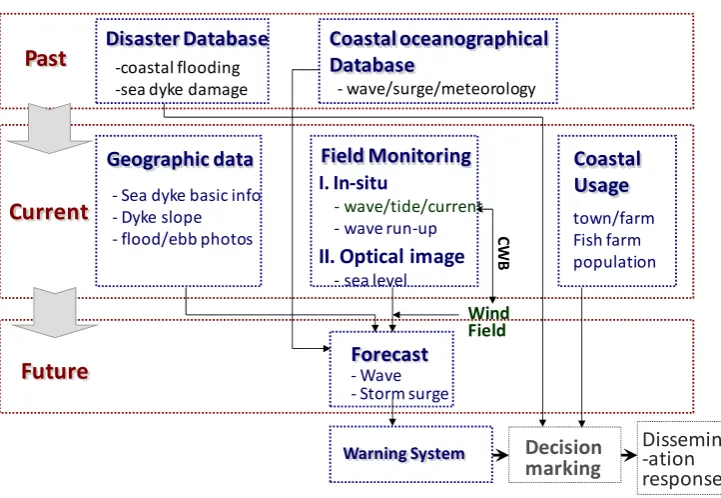
sys-tem developed in this study aims to provide past, current and future information as shown in Fig. 3. It is comprised of the following three parts: a real-time monitoring unit, an opera-tional numerical modeling unit, and an information interface, as detailed below.
3.2 Real-time monitoring network
382 D.-J. Doong et al.: Development of an operational coastal flooding early warning system
24
Past
Current
Future
Field
Monitoring
Disaster
Database
Coastal
oceanographical
Database
Forecast
‐Wave ‐Storm surge
Warning System
Decision
marking
Dissemin
‐
ation
response
I. In‐situ
‐wave/tide/current
‐wave run‐up
II.
Optical
image
‐sea level
‐wave/surge/meteorology ‐coastal flooding
‐sea dyke damage
Coastal
Usage
town/farm Fish farm population
Geographic
data
‐Sea dyke basic info ‐Dyke slope ‐flood/ebb photos
Wind
Field
CWB
Figure 3 Framework and internal link of the coastal flooding warning system
Data buoy
Tide station
Coastal weather station
Radar station
Optical station
Figure 4 Coastal and ocean monitoring network in Taiwan Waters
Fig. 3. Framework and internal link of the coastal flooding warning system.Table 1. Composition of the monitoring network.
Station type Quantity Observations Location Function
Data buoy 15 Waves, Wind, current,
Temperatures, Pressure
Coastal ocean (<100 m) and offshore (>2000 m)
– Model calibration and verification. – Understand of real-time sea states
Tide station 11 Sea water level Along the coastline – Monitoring sea level in real-time
– Storm surge model verification Coastal weather
station
10 Meteorological elements Intertidal zone, coastline – Monitoring coastal weather – Data for typhoon tracking model assimilation
Radar station 2 Spatial wave condition Coast high building – Monitoring waves in spatial domain
Optical camera station
5 Sea surface movement,
overtopping
Coast high building – Visual coverage for lack professional knowledge decision makers
Data buoys are the most commonly used instrument for marine measurements in coastal oceans and at sea. They are developed and manufactured locally in Taiwan (Kao et al., 1999). Discus-shaped buoys with 2.5 m diameter were de-signed. Two anemometers are mounted on the mast of the buoy at approximately 3 m above the sea surface, equipped with sea and air temperature sensors and a barometer. The buoy payloads and light are typically powered by secondary batteries with solar charging and primary battery backup. For wave monitoring by data buoys, both inertia gyros and GPS systems are integrated to provide six degrees of freedom for
acceleration, velocity, and inclination on three axes. GPS is used as a wave measurement auxiliary device (Doong et al., 2011). The recorded buoy movements of ocean surface waves are used to yield a wave directional spectrum using cross-spectrum analysis, detailing the characteristics of wave energy distribution on frequency and the direction of propa-gation. The directional spectra provide superior precision for building a wave forecast model and for application of data assimilation technology.
Since the coastal waters are a highly non-homogeneous area, X-Band microwave radar systems that have 5 km radius
D.-J. Doong et al.: Development of an operational coastal flooding early warning system 383
24
Past
Current
Future
Field Monitoring Disaster Database Coastal oceanographical
Database
Forecast
‐Wave
‐Storm surge
Warning System Decision marking
Dissemin ‐ation response I. In‐situ
‐wave/tide/current
‐wave run‐up
II. Optical image
‐sea level
‐wave/surge/meteorology
‐coastal flooding
‐sea dyke damage
Coastal
Usage
town/farm Fish farm population
Geographic data
‐Sea dyke basic info ‐Dyke slope ‐flood/ebb photos
Wind
Field
CWB
Figure 3 Framework and internal link of the coastal flooding warning system
Data buoy Tide station
Coastal weather station Radar station Optical station
Figure 4 Coastal and ocean monitoring network in Taiwan Waters Fig. 4. Coastal and ocean monitoring network in Taiwan Waters.
coverage capability are installed in the monitoring network in order to provide spatial wave pattern (Wu et al., 2011), in ad-ditional to the point measurement by data buoys. The coastal weather stations that are equipped with automatic wind, pres-sure, temperature sensors and rainfall gauge are set up at the sea-land interface. The sampling rate is 2 Hz and the mea-surement interval is one hour. Further, the optical cameras are installed at the coast in order to monitor the overtopping of sea water. The images are transmitted to the system to provide live sea images for the decision markers in real-time. In addition to data buoys, all other stations in the moni-toring network are also equipped with a real-time data trans-mission system. For near-shore stations, field data are auto-matically transmitted to a quality check center by a cost-free radio telemetry or low-cost GSM (Global system for mobile communications) or GPRS (General packet radio service) cellular communication technology. However, because ra-dio telemetry, GSM and GPRS signals reach only a limited distance, the telecommunication link with satellite is used for far offshore stations. Data transmission cost is one of the most important issues for long-term observation systems. A comparison, as displayed in Fig. 5, shows that GPRS is the best data transmission choice because of its low cost and re-liability.
Data correctness is another crucial requirement for early warning systems. Quality control procedures are performed on automated data when the central control computer re-ceives them. Automated data quality is assessed according
25
0 10 20 30 40 50 60 Quantity of data transmitted (KB)
5.0
4.0
3.0
2.0
1.0 30.0
20.0
10.0
Co
st
of
Da
ta
tr
an
sm
issi
o
n
(N
TD
1000/
m
o
nth) Satellite(Iridium)
GSM
GPRS Condition: data transmission once per
hour. 24 times per day.
Figure 5 Comparison of various data transmission costs
Figure 6 Comparison of modeled wind field (left) and atmospheric model derived (AMD) wind field (right). AMD wind field reasonably simulates the wind distortion
when typhoon passes through high mountain in central Taiwan.
Fig. 5. Comparison of various data transmission costs.
to sensor limitation, time continuity, and internal consistency (Doong et al., 2007). After experienced data analysts con-duct manual data verification, data are processed, formatted, and imported to the early warning system in less than 30 min after measurements.
3.3 Operational numerical modeling
Field observations provide actual sea conditions; however, numerical models are necessary to forecast the tendency of coastal sea conditions and which is necessary in an early warning system. Numerical ocean models have been widely studied in the research field. However an early warning sys-tem needs operational models. Performance of a numerical model from research use into an automatic, efficient, and non-breaking operation system is actually a complex pro-cedure, for example the input of wind field. A typhoon wind field modelled after the Rankin-Vortex model (Holland, 1980) is adopted for research purposes. Although the mod-eled wind field was revised and applied recently (Holland, 2008; Taramelli et al., 2010), we suggest importing an analy-sis of a wind field from atmospheric models provided by the weather authority, regarding its suitability for mountainous area in Taiwan. Figure 6 shows the reasonable wind field de-rived by the atmospheric model. Another issue of developing an operational model in a warning system is the time con-sumption. Unlike the model execution time, which may not be a serious concern for the esearch stage, time is an essential consideration in a state of warning; therefore, fully opera-tional and efficient models are necessary in an early warning system.
384 D.-J. Doong et al.: Development of an operational coastal flooding early warning system
25
0 10 20 30 40 50 60
Quantity of data transmitted (KB)
5.0
4.0
3.0
2.0
1.0 30.0
20.0
10.0
Co
st
of
Da
ta
tr
an
sm
issi
o
n
(N
TD
1000/
m
o
nth) Satellite(Iridium)
GSM
GPRS
Condition: data transmission once per
hour. 24 times per day.
Figure 5 Comparison of various data transmission costs
Figure 6 Comparison of modeled wind field (left) and atmospheric model derived
(AMD) wind field (right). AMD wind field reasonably simulates the wind distortion
when typhoon passes through high mountain in central Taiwan.
Fig. 6. Comparison of modeled wind field (left) and atmospheric model derived (AMD) wind field (right). The AMD wind field reasonably simulates the wind distortion when a typhoon passes through the high mountains in central Taiwan.
Current numerical wind-wave prediction models for oceans and shelf seas are based on the spectral energy bal-ance equation, which describes the space-time evolution of a two-dimensional spectrum with source terms that account for wind-wave interaction, nonlinear wave-wave interaction, wave-current interaction, and dissipation. A wind-wave propagation model for coastal areas differs essentially from a model that can be applied to deeper waters because the small depths cause different processes to be dominant, more specifically, depth-induced breaking. Therefore, the wave model within the warning system consists of large-scale, regional, nested grids. In this study, the NOAA WAVE-WATCH III (NWWIII) model (Tolman, 1991) is used for simulating waves in the East Asia domain, and the SWAN model (Booij et al., 1999) is used for simulating coastal waves because it has high spatial resolution and uses superior physics calculations for shallow water areas. Ou et al. (2002) has demonstrated the capability of typhoon wave simulation using SWAN. The Princeton Ocean Model (POM) (Blum-berg and Mellor, 1987) is used for storm surge forecasting in the proposed warning system.
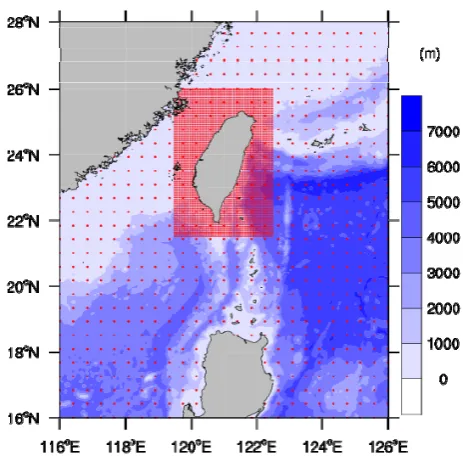
For the early coastal flooding warning system developed in Taiwan, wind fields are imported twice per day, at 00:00 UTC and 14:00 UTC, by the Central Weather Bureau (CWB). The temporal resolution of wind fields is 1 h, and the spatial reso-lution is 45 km for the East Asian domain, but 15 km for the near-Taiwan domain. After the central control computer of the warning system receives the wind field data, NWWIII is triggered to provide the two-dimensional wave spectra on boundaries for the regional SWAN model. NWWIII is run operationally with a grid spacing of 45 km, followed by SWAN to obtain a coastal wave forecast model 72 h ahead. The spatial resolution of the bathymetry used in SWAN is
26
Figure 7 Nested grids used for numerical wave models. Whole domain – NWWIII model, grid size is 45 km. Central regional domain – SWAN, grid size is 0.5km. Fig. 7. Nested grids used for numerical wave models. Whole do-main – NWWIII model, grid size is 45 km. Central regional dodo-main – SWAN, grid size is 0.5 km.
5 km for the coastal ocean, though occasionally condensed to 500 m for certain small coastal areas for wave run-up compu-tation. Figure 7 shows the grid distribution for wave models. When wave models run on one computer, the POM model runs on a separate computer to provide the storm surge height during typhoons. An empirical formula that correlates the storm surge height and the distance between station locations to the typhoon is calibrated and used as a backup demand in
D.-J. Doong et al.: Development of an operational coastal flooding early warning system 385
27
Receiving wind field data
from CWB at UTC 00:00
and UTC 14:00
Large scale wave
model ‐NWW III
Storm surge model
‐POM
Regional wave model
‐SWAN
Statistical
storm surge
model
Astronomy
tide
Forecast of total coastal sea
water level for next 72 hrs
Real‐time
in‐situ data
Apply data assimilation tech.
for modeling improvement
Coastal Flooding Early
Warning System (CoFEWs)
Historical events Fieldcamera images
Integration of storm
surge forecasting
results
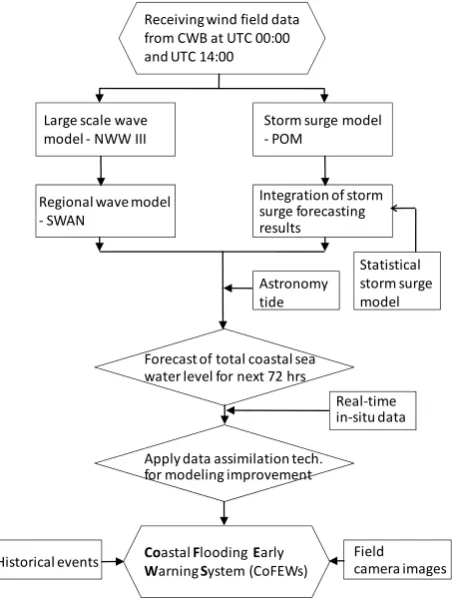
Figure 8 Flowchart of the operational models Fig. 8. Flowchart of the operational models.
the warning system. The models used in this warning system are listed in Table 2. The flowchart of the operational models and system elements and their interlinks is shown in Fig. 8.
Waves and storm surges simulated by the numerical mod-els have been extensively verified before the operation of the proposed warning system. Figure 9 shows the signifi-cant wave height simulation at Longdong in the northeastern coastal ocean of Taiwan for the typhoon season of 2006. The correction coefficient between the simulated wave heights with the measurements is 0.66. Results of verification from other stations range from 0.55 to 0.76. This outcome is not wholly satisfying. Figure 10 shows another example of the wave height verification during typhoon Songda (2011) at Longdong. It is found that the regular simulation of waves yields a reasonable result for the wave growth stage, but the maxima wave height is always underestimated, and simula-tion of the decaying sea state is inadequate. The data as-similation was performed to improve the accuracy of model simulation by using the univariate optimal interpolation (OI) procedure on constant depth surfaces by interpolating appro-priate model variables from the σ-levels to the depth lev-els. The new values were interpolated back to the original σ-coordinates (Daley, 1991). Real-time data from buoys are used for assimilation. An example of the comparative results is shown in Fig. 11. The model with simulated wave heights
that uses the assimilation technique has stronger agreement with actual measurements than the direct model does. Other verifications are shown in Fan (2008). Data assimilation technology improves the simulation, and is employed in the warning system.
4 The Coastal Flooding Early Warning System (CoFEWs)
4.1 Nationwide system
In this study, we developed a coastal flooding early warning system to provide timely and correct information for immi-nent and dangerous circumstances, with which appropriate action could be taken in advance to reduce potentially af-fected risks. The warning system may be applied on the na-tional scale or even on local scales. The WRA is responsi-ble for making decisions and RB is distributing hazard re-lief items in Taiwan. The Coastal Flooding Early Warn-ing System (CoFEWs) is for use by the WRA and RB, but is not open to the public. Considerations for constructing the proposed warning system were as follows: accurate in-formation, simplicity in operation, user-friendly interface, and web-based. The system was developed using Microsoft ASP.NET technology with an MS SQL-Server. Four desk-top computers are used for the system. One for wave mod-ling, the second one for storm surge modemod-ling, the third is the central control computer including the information sys-tem and historical database, and the fourth computer is for system backup. The web-based system is designed for its easiness to maintain, and technical support can be provided by teams located in different cities or countries.
386 D.-J. Doong et al.: Development of an operational coastal flooding early warning system
Table 2. Models used in the warning system.
Model Purpose Domain
NWWIII Boundary wave field for inputting to coastal model East Asia: 116◦E 126◦E; 16◦N 28◦N
SWAN Forecast coastal waves Taiwan nearshore: 119.5◦E 122.5◦E; 21.5◦N 26◦N POM Forecast storm surge heights Taiwan nearshore: 119.5◦E 122.5◦E; 21.5◦N 26◦N
28
6/1/06 6/11/06 6/21/06 7/1/06 7/11/06 7/21/06 7/31/06 8/10/06 8/20/06 8/30/06
Date 0 1 2 3 4 5 6 S igni fi c a n t w a v e hei gh t (m ) measurement NWWIII+SWAN Longdong Buoy (Summer 2006)
Figure 9 Verification of long-term wave simulation (summer in 2006)
21-May 22-May 23-May 24-May 25-May 26-May 27-May 28-May 29-May 30-May 31-May 1-Jun
Date 0 1 2 3 4 5 6 S ig n if ic a n t w a v e heigh t (m) measurement NWWIII+SWAN Longdong Buoy
Figure 10 Verification of wave simulation for the period of typhoon Songda in 2011
12-Sep 13-Sep 14-Sep 15-Sep 16-Sep 17-Sep 18-Sep 19-Sep 20-Sep 21-Sep
Date (2006) 0 2 4 6 8 10 Si g n if ic a n t wa v e h e ig h t (m) Longdong Buoy measurement
NWWIII+SWAN with assimilation NWWIII+SWAN
Figure 11 Improvement of wave forecast by data assimilation technique
Fig. 9. Verification of long-term wave simulation (summer in 2006).
28
6/1/06 6/11/06 6/21/06 7/1/06 7/11/06 7/21/06 7/31/06 8/10/06 8/20/06 8/30/06
Date 0 1 2 3 4 5 6 S igni fi c a n t w a v e hei gh t (m ) measurement NWWIII+SWAN Longdong Buoy (Summer 2006)
Figure 9 Verification of long-term wave simulation (summer in 2006)
21-May 22-May 23-May 24-May 25-May 26-May 27-May 28-May 29-May 30-May 31-May 1-Jun Date 0 1 2 3 4 5 6 S ig n if ic a n t w a v e heigh t (m) measurement NWWIII+SWAN Longdong Buoy
Figure 10 Verification of wave simulation for the period of typhoon Songda in 2011
12-Sep 13-Sep 14-Sep 15-Sep 16-Sep 17-Sep 18-Sep 19-Sep 20-Sep 21-Sep Date (2006) 0 2 4 6 8 10 Si g n if ic a n t wa v e h e ig h t (m) Longdong Buoy measurement
NWWIII+SWAN with assimilation NWWIII+SWAN
Figure 11 Improvement of wave forecast by data assimilation technique
Fig. 10. Verification of wave simulation for the period of typhoon Songda in 2011.
28
6/1/06 6/11/06 6/21/06 7/1/06 7/11/06 7/21/06 7/31/06 8/10/06 8/20/06 8/30/06
Date 0 1 2 3 4 5 6 S igni fi c a n t w a v e hei gh t (m ) measurement NWWIII+SWAN Longdong Buoy (Summer 2006)
Figure 9 Verification of long-term wave simulation (summer in 2006)
21-May 22-May 23-May 24-May 25-May 26-May 27-May 28-May 29-May 30-May 31-May 1-Jun Date 0 1 2 3 4 5 6 S ig n if ic a n t w a v e heigh t (m) measurement NWWIII+SWAN Longdong Buoy
Figure 10 Verification of wave simulation for the period of typhoon Songda in 2011
12-Sep 13-Sep 14-Sep 15-Sep 16-Sep 17-Sep 18-Sep 19-Sep 20-Sep 21-Sep Date (2006) 0 2 4 6 8 10 Si g n if ic a n t wa v e h e ig h t (m) Longdong Buoy measurement
NWWIII+SWAN with assimilation NWWIII+SWAN
Figure 11 Improvement of wave forecast by data assimilation technique
Fig. 11. Improvement of wave forecast by data assimilation tech-nique.
the possibility of overtopping. The WRA defines alarm lev-els, which are normally set at a certain distance to the top of the sea dykes, depending on the protected interests situated on the other side of the dyke. The overhead function scroll of the table entitled Forecast Time enables forecast time se-lection. TSWLs change according to the sese-lection. CoFEWs is designed to show forecasting results 6 h ahead which is enough for decision-marking. When the overtopping condi-tion is met, the status column in the table displays a warning notification in red. The information located at the bottom of the main page details past damages caused by typhoons that share a similar track with one in the present. Occasionally, historical experiences have an even higher referential value than those provided by the model using complex computa-tions.
4.2 The regional system
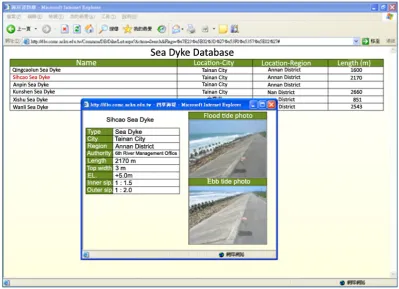
The main page of CoFEWs is mainly used by the WRA in the central government. It helps the WRA study coastal con-ditions nationwide. The local RB uses a regional subsys-tem, as displayed in Fig. 13, which shows one coastal zone in the central map of RSS of CoFEWs. The regional warning system was developed using a similar framework, but with more detailed data. The database on sea dykes including the length, slope, elevation, and photos are collected and im-ported to the subsystem, as shown in Fig. 14 when one clicks the sea dyke name at bottom-right window of Fig. 13. Ten regional subsystems are currently used to observe the entire Taiwanese coastline. Some are equipped with a wave run-up monitoring camera. The regional subsystem of CoFEWs
D.-J. Doong et al.: Development of an operational coastal flooding early warning system 387
Figure 12 Main page of CoFEWs. Four parts are presented in this page. They are
Real-time Sea States (RSS);
Forecast Storm Level (FSL);
Live Video Image
(LVI); and
Historical Typhoon Events (THE)
Figure 13 Regional system of CoFEWs – Page for the 6
thRiver Bureau
Fig. 12. Main page of CoFEWs. Four parts are presented in this page. They are
29
Figure 12 Main page of CoFEWs. Four parts are presented in this page. They are
Real-time Sea States (RSS); Forecast Storm Level (FSL); Live Video Image
(LVI); andHistorical Typhoon Events (THE)
Figure 13 Regional system of CoFEWs – Page for the 6th River Bureau
Real-time Sea States (RSS);
29
Figure 12 Main page of CoFEWs. Four parts are presented in this page. They are
Real-time Sea States (RSS); Forecast Storm Level (FSL); Live Video Image
(LVI); andHistorical Typhoon Events (THE)
Figure 13 Regional system of CoFEWs – Page for the 6th River Bureau
Forecast Storm Level (FSL);
29
Figure 12 Main page of CoFEWs. Four parts are presented in this page. They are
Real-time Sea States (RSS); Forecast Storm Level (FSL); Live Video Image
(LVI); andHistorical Typhoon Events (THE)
Figure 13 Regional system of CoFEWs – Page for the 6th River Bureau
Live Video Image (LVI); and
29
Figure 12 Main page of CoFEWs. Four parts are presented in this page. They are
Real-time Sea States (RSS); Forecast Storm Level (FSL); Live Video Image
(LVI); andHistorical Typhoon Events (THE)
Figure 13 Regional system of CoFEWs – Page for the 6th River Bureau
Historical Typhoon Events (THE).
29
Figure 12 Main page of CoFEWs. Four parts are presented in this page. They are
Real-time Sea States (RSS);
Forecast Storm Level (FSL);
Live Video Image
(LVI); and
Historical Typhoon Events (THE)
Figure 13 Regional system of CoFEWs – Page for the 6
thRiver Bureau
Fig. 13. Regional system of CoFEWs – Page for the 6th River Bureau.
is an action system that is used during typhoons. Both the CoFEWs and its subsystem were originally designed using the native language, and they are in operation daily.
4.3 Case study: Typhoon Haitang
Typhoon Haitang was a category 5 super typhoon in 2005, which struck the northwestern part of the Pacific Ocean. It moved westward and created a landfall in Hualien, Taiwan, on 18 July, as shown in Fig. 15. Operational models were
388 D.-J. Doong et al.: Development of an operational coastal flooding early warning system
Fig. 14. Window of detail data of queried sea dyke.
30
Figure 14 Window of detail data of queried sea dyke
Figure 15 Track of typhoon Haitang in 2005
Fig. 15. Track of typhoon Haitang in 2005.
D.-J. Doong et al.: Development of an operational coastal flooding early warning system 389
31
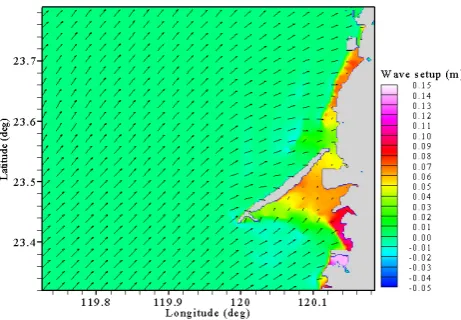
Figure 16 Wave height and runup presented by the operational models Fig. 16.models. Wave height and runup presented by the operational
5 Conclusions
The frequency of natural disasters may be increasing because of growing global change. The magnitude of a disaster de-pends on the intensity of a natural hazard, in addition to the effectiveness of prevention mitigation actions. Natural haz-ard events cannot be prevented from occurring, but their im-pacts on people and property can be reduced if accurate in-formation can be provided to people in a timely manner. An early warning system is therefore essential.
Taiwan, located at the major site of typhoons in the NW Pacific, is frequently threatened by typhoons. A large amount of coastal defense has failed, life and property has been lost in the past thirty years in Taiwan. Global climate change is increasing the frequency and strength of typhoons. The threat from typhoons and disasters is increasing. In this study, we have developed the warning system CoFEWs to mitigate coastal flooding in Taiwan. First, the users of the system must be defined clearly. The warning system functions ac-cording to the background of a user and to the purpose of using the system. Because users of the CoFEWs are admin-istrators without professional academic backgrounds, a user-friendly interface with a single page of information, with-out requiring numerous clicks and video and movie presenta-tions for measurements and model results has been designed. Second, the functionality of the system must be clearly de-fined. CoFEWs monitor sea conditions and forecast over-topping possibilities on sea dykes. To achieve this objective, a real-time coastal watch network and numerical modeling are the basis of the system. We constructed the CoFEWs by integrating an operational East Asian scale NWWIII model and the regional SWAN model for coastal wave forecasting, in addition to the POM model for storm surge prediction. Accurate forecasting was verified in the wave growth stage, but poor results were obtained for the wave subsiding period in a typhoon. The maximal significant wave heights dur-ing typhoons are occasionally not forecasted properly. We
improved this problem by applying data assimilation tech-nology in CoFEWs. The operational model should not only pursue the accuracy of the simulation, but balance it with computational efficiency. Decision makers cannot wait for 5% simulation improvements, but require reasonable model results immediately. Real-time data are very necessary to import into the system for assimilation purposes, except for their direct function of monitoring the coastal sea conditions. The web-based warning system presented contains the main nationwide information page and a regional subsystem. Ap-plying the system during Typhoon Haitang in 2005 and for numerous other typhoons thereafter has verified its accuracy and applicability.
Acknowledgements. This study is the partial outcome of the
THESEUS (Innovative technologies for safer European coasts in a changing climate) project supported by the EC seventh framework programme (FP7) under the Grant agreement no.: 244104. Financial support is provided by the National Science Council of Taiwan (NSC 98-2923-I-006-001-MY4). Thanks to Mr. Tzu-Lien Cheng for his great help on the development of ther warning system through his excellent information technology. The authors also thank the Water Resources Agency for long-term support of the development of the early warning system and using it. In addition, the authors would like to give great thanks to the colleagues of COMC at NCKU for their efforts on the deployment and maintenance of the monitoring instruments. Finally, we greatly appreciate Fernando Mendez for his invitation to publish this paper.
Edited by: F. J. Mendez
Reviewed by: A. Taramelli and M. Gomez
References
Basha, E. and Rus, D.: Design of early warning flood detection sys-tems for developing countries, in: Proceedings of the Conference on Information and Communication Technologies and Develop-ment, Bangalore, India, 11–20, 15–16 December 2007. Basher, R.: Global early warning systems for natural hazards:
sys-tematic and people-centred, Philos. T. R. Soc. A, 364, 2167– 2182, 2006.
Blumberg, A. F. and Mellor, G. L.: A description of a three-dimensional coastal ocean circulation model, in: Three-Dimensional Coastal Ocean Models, edited by: Heaps, N. S., American Geophysical Union, Washington, DC, 1–16, 1987. Booij, N., Ris, R., and Holthuijsen, L.: A third-generation wave
model for coastal regions I. Model description and validation, J. Geophys. Res., 104, 7649–7666, 1999.
Daley, R.: Atmospheric Data Analysis, Cambridge Univ. Press, New York, USA, 1991.
Doong, D. J., Chen, S. H., Kao, C. C., and Lee, B. C.: Data qual-ity check procedures of an operational coastal ocean monitoring network, Ocean Eng., 34, 234–246, 2007.
Doong, D. J., Lee, B. C., and Kao, C. C.: Wave measurement using GPS velocity signal, Sensors, 11, 1043–1058, 2011.
390 D.-J. Doong et al.: Development of an operational coastal flooding early warning system
Fan, Y. M.: Spectral wave data assimilation in SWAN wave model, PhD thesis of National Cheng Kung University, Tainan, Taiwan, 2008.
Holland, G. J.: An analytical model of the wind and pressure pro-files in hurricanes, Mon. Wea. Rev., 108, 1212–1218, 1980. Holland, G. J.: A revised hurricane pressure-wind model, Mon.
Wea. Rev., 136, 3432–3445, 2008.
Holz, K. P., Hildebrandt, G., and Weber, L.:, Concept for a web-bases information system for flood management, Nat. Hazards, 38, 121–140, 2006.
ISDR: Terminology: basic terms of disaster risk reduction, Inter-national Strategy for Disaster Reduction Press, Geneva, Switzer-land, 2004.
Kao, C. C., Chuang, L. Z. H., Lin, Y. P., and Lee, B. C.: An intro-duction to the operational data buoy system in Taiwan, in: Pro-ceedings of the International MEDCOAST Conference on Wind and Wave Climate of the Mediterranean & the Black Sea, An-talya, Turkey, 33–39, 9–13 November 1999.
Katuk, N., Ku-Mahamud, K. R., Norwawi, N., and Deris, S.: Web-based support system for flood response operation in Malaysia, Disaster Prevention and Management, 18, 327–337, 2009. Kaya, Y., Stewart, M., and Becker, M.: Flood forecasting and flood
warning in the firth of Clyde, UK, Nat. Hazards, 36, 257–271, 2005.
Nayak, S. and Kumar, T. S.: Indian tsunami warning system, In: Proceedings of the International Archives of the Photogramme-try, Remote Sensing and Spatial Information Sciences, 37, Bei-jing, China, 1501–1506, 3–11 July 2008.
Nieto Borge, J. C., Reichert, K., and Dittmer, J.: Use of nautical radar as a wave monitoring instrument, Coast. Eng., 37, 331– 342, 1999.
Ou, S. H., Liau, J. M., Hsu, T. W., and Tzang, S. Y.: Simulating ty-phoon waves by SWAN wave model in coastal waters of Taiwan, Ocean Eng., 29, 947–971, 2002.
Parker, D. and Fordham, M.: An evaluation of flood forecasting, warning and response systems in the European Union, Water Re-sour. Manag., 10, 279–302, 1996.
Plessis, L. A.: A review of effective flood forecasting, warning and response system for application in South Africa, Water SA, 28, 129–137, 2002.
Solomon, S. M. and Forbes, D. L.: Coastal hazards and associ-ated management issues on South Pacific Islands, Ocean Coast. Manag., 42, 523–554, 1999.
Taramelli, A., Melelli, L., Pasqui, M., and Sorichetta, A.: Modelling risk hurricane elements in potentially affected areas by a GIS system, Geomatics, Natural Hazards and Risk, 1, 349–373, 2010. Taubenb¨ock, H., Goseberg, N., Setiadi, N., L¨ammel, G., Moder, F., Oczipka, M., Kl¨upfel, H., Wahl, R., Schlurmann, T., Strunz, G., Birkmann, J., Nagel, K., Siegert, F., Lehmann, F., Dech, S., Gress, A., and Klein, R.: “Last-Mile” preparation for a poten-tial disaster – Interdisciplinary approach towards tsunami early warning and an evacuation information system for the coastal city of Padang, Indonesia, Nat. Hazards Earth Syst. Sci., 9, 1509– 1528, doi:10.5194/nhess-9-1509-2009, 2009.
Thumerer, T., Jones, A. P., and Brown, D.: A GIS based coastal management system for climate change associated flood risk as-sessment on the east coast of England, Int. J. Geogr. Inf. Sci., 14, 265–281, 2000.
Tolman, H. L.: A third-generation model for wind waves on slowly varying, unsteady and inhomogeneous depths and currents, J. Phys. Oceanogr., 21, 782–797, 1991.
Twigg, J.: The human factor in early warnings: risk perception and appropriate communications, in: Early Warning Systems for Natural Disaster Reduction, edited by: Zschau, J. and K¨uppers, A. N., Springer Verlag, Heidelberg, 2003.
Wang, X. H. and Du, C. M.: An Internet based flood warning sys-tem, J. Environ. Informatics, 2, 48–56, 2003.
Wu, L. C., Chuang, L. Z. H., Doong, D. J., and Kao, C. C.: Quan-tification of non-homogeneity from ocean remote sensing image using two-dimensional continuous Wavelet transform, Int. J. Re-mote Sens., 32, 1303–1318, 2011.