179
Model Management Intergovernmental Relations
(Case Study Program Free Education In South
Sulawesi)
Suhardiman Syamsu, Sangkala, Armin, Hasniati
Abstract: Looking for intergovernmental relations management model is a consequence of the decentralization of government from local to central government (provincial and district / city). Delivery of affairs to the position of actors in the region more involved than ever before. The actor was instrumental in determining the center of attention, authority patterns and methods of conflict resolution when to initiate and conduct a free educational program cooperation. Intergovernmental relations management effectiveness is determined by the role of actors in determining the center of attention, establish a pattern of authority, and choose a method of conflict resolution. Affairs of primary and secondary education is the authority of the district / city. If the provincial government to initiate treatment in the free education program, the pattern of intergovernmental relations management authority selected cooperation may, or may be of assistance (subsidy). For matters of primary and secondary education, the choice of co-administration is not appropriate. Choices made during this cooperation needs to be reviewed with due regard to equality, work together, mutual benefit of all parties cooperate. When cooperation to lead to conflicts, preferably selected pattern of relationships is the only province to provide subsidies allow the district / city alone is conducting the affairs of a free education. Options cooperation dominated by actors and actors governor regent / mayor refused to put forward its own program is an option for power from the owner of the sovereignty of the people as a constituent in the local elections in both provinces and districts / cities.
Keywords: Intergovernmental Relations Management
————————————————————
1 INTRODUCTION
All countries no matter how big and its influence is definitely one of the fundamental problems facing the government, how to solve the competition between central and local authorities. In the constitution, the issue governed by the law: which level legally have the authority and what level of discretion or autonomy? (Bulpitt 1983; Davis 1978; King 1982; Riker 1964). Administratively Fasler asking fundamental theoretical questions, how to connect region with a function? Some have questioned the fundamental questions at the level where the power of the state: at the central, provincial or district / city. Centralized authority at the national level when viewed from the provincial level and district / city known as centralization, while moving away from the center of power called decentralization. Burki, Shahid J., Perry and Dillinger explained that conceptually, there are two types of decentralization of education, namely: first, decentralization of authority in the education sector in terms of education policy and funding aspects of the central government to local governments (provincial and district), and the second , decentralization of education with a focus on providing greater authority at the school level.
The first concept of decentralization of education is primarily concerned with local autonomy and decentralization of governance from the center to the regions, while the concept of decentralization of education that focuses on providing greater authority at the school level is done with the motivation to improve the quality of education. Organizational design and management of intergovernmental relations in Indonesia as stipulated in Article 18 UUD 1945 that, the Republic of Indonesia is divided into regions provinces and regions of the province is divided into districts and cities, which each province, county, and city governments have area, which is regulated by law. The law in question is Law No. 32 of 2004 on Local Government which regulates, among others:
- The regional government in conducting the affairs of government has a relationship with the government and with other local governments. Relationship shall include authority relations, finance, public services, utilization of natural resources, and other resources that are causing the relationship between the administration and regional government levels. Government affairs organized based on the principle of autonomy and assistance. The principle of autonomy, the Government held its own or may delegate part of government affairs for the Government or a Government representative in the area or can be assigned to the local government and / or village government.
- In the government affairs under the joint authority, the government can organize it by itself part of government affairs, delegate part of government affairs to the governor as government representatives, or assigns to local government affairs and / or village government based on the principle of co-administration. Implementation of government affairs is an implementation of the authority relationship between the government and the provincial government, city or inter-district and inter-related areas, dependent, and synergistic as a system of government.
- Relations in the financial field between government and local government include the provision of financial resources to conduct government affairs under the _________________________
Suhardiman Syamsu : Graduate School, Science of Public Administration. Hasanuddin University, Makassar, Indonesia.
Email: [email protected]
Sangkala : Faculty Of Social Sciences and Political Sciences. Hasanuddin University, Makassar, 90245 Armin : Faculty Of Social Sciences and Political
Sciences. Hasanuddin University, Makassar, 90245 Hasniati . Faculty Of Social Sciences and Political
180 authority of local governments, the allocation of funds to
the local government and the balance of loans and / or grants to local governments.
- Relations in the field of inter-regional finance, among others, include the funding of government affairs is a shared responsibility, co-financing the cooperation between the regions, and loans and / or grants an inter-region.
One of the common goals that must be achieved of the reasons the establishment of the Republic of Indonesia is "to the intellectual life of the nation" (opening 1945). Educational affairs organized by the Government, Provincial and Regency / City in stages in accordance with their respective authorities. Authority and government budget is provided at each level of government, while the target using the same funds that citizens / people, especially students. Therefore, if the two are not regulated and well coordinated, there will be overlapping authority and use of the education budget is not efficient and effective. For that reason, the government issued Government Regulation (PP) No. 38 of 2007 on Government Affairs Division of the Government, Provincial Government, and the Government of Regency / City. In it set 33 government affairs administered together at each level of government and one of the set is a matter of education. With regard to the financing of education, South Sulawesi Provincial Government has issued a policy of free education through the implementation of the Regional Regulation No. 4 of 2009. In the set a few things about the relationship between levels of government are free education, the scope of financing, financing targets, sources of financing and governance are then implemented in the form of cooperation. Noting the relationship between levels of government, and free education financing scheme for primary and secondary education are addressed jointly by the Provincial Government and Regency / City in South Sulawesi, it is a fundamental problem that needs to be explored further is, "How does management model of intergovernmental relations in education programs free in South Sulawesi Province ". The main questions were translated into four research questions: (1) How is the role of actors in the implementation of free education program in the province of South Sulawesi? (2) How is the center of attention (goals / objectives and measurement) in the implementation of free education program in the province of South Sulawesi? (3) What is the pattern of authority in the implementation of free education program in the province of South Sulawesi? and (4) What methods of conflict resolution in the implementation of free education program in the province of South Sulawesi?
RESEARCH METHODS
This study used a qualitative appr ach to the type of case study, conducted in the city of Makassar, Gowa, Pangkep, District of Bone and Sinjai. The fifth district is determined by using purposive. This study focuses on (1) Management of intergovernmental relations in managing the free education program between the provincial and district / city in South Sulawesi in 2008 - 2013. The program management views on the role of actors in receiving and making cooperation, determine the focus of the collaboration is done with patterns of authority possessed by each party and methods of conflict resolution in the event of a conflict in co-operation; (2) The
role of the actor refers to the willingness of the regent / mayor and / or other competent authority which is being held in the year 2008 to 2013 to accept or reject the invitation of the Governor of South Sulawesi cooperation in the implementation of free education; (3) Center of attention refers to the target, the item mutually agreed activities in cooperation free education program. Agreement on the goals, objectives and activities as a basis for financing items free education program. The main target also with regard to the agreement targets jointly agreed priorities to be achieved in cooperation and also as a measure of the success of cooperation; (4) The pattern of authority refers to the competencies of the provincial and district/city to build a relationship of cooperation in the implementation of free education; (5) The method of conflict resolution with regard to the manner agreed upon by the parties to resolve the conflict between them, if the conflict was really happening. Data sourced from people (informants) and documents collected by the in-depth interview techniques and recaps document. Data were analyzed through three phases: data reduction, data presentation stage, the stage of deduction and verification of the results.
RESULTS AND DISCUSSION
181 Matrix 1: Use of Free Education funds accordance Purpose
For Level SD / MI / SDLB / PPS ULA : For Level SMP / MTs / SMPLB / PPS ULA:
1. Financing all activities within the framework of new admissions; registration fee, procurement forms, administrative registration and re-registration, as well as other activities that are directly related to these activities.
1. Financing all activities within the framework of new admissions; registration fee, procurement forms, administrative registration and re-registration, as well as other activities that are directly related to these activities.
2. The purchase of textbooks (outside of books that have been purchased from BOS and BOS book) and reference books for the library collection;
2. The purchase of textbooks (outside of books that have been purchased from BOS and BOS book) and reference books for the library collection;
3. Financing learning activities, remedial, enrichment learning, sports, arts, scouts, youth red cross, and the like.
3. Financing learning activities, remedial, enrichment
learning, sports, arts, scouts, youth red cross, and the like.
4. The procurement report card and student photo 4. Procurement student report cards and photos
5. The costs of daily tests, general tests, tests, and report student learning outcomes,
5. The costs of daily tests, general tests, tests, and report student learning outcomes,
6. Purchase of consumable materials, books, chalk, pencils, lab materials, books parent student, the book inventory, newspaper subscriptions, sugar. Coffee, and tea for everyday needs at school.
6. Purchase of consumable materials, books, chalk, pencils, lab materials, student registration books, book 7. Purchase of consumable materials, books, chalk, pencils, lab materials, student registration books, inventory books, newspaper subscriptions, sugar. Coffee, and tea for everyday needs at school.
7. Paying bills: electricity, water, telephone, including new installations if existing tissue around the school.
7.Paying bills: electricity, water, telephone, including new installations if existing tissue around the school.
8. Financing school care: checking, repairing leaky roofs, repairing doors and windows, repair the furniture, school sanitation and other facilities that care be slightly damaged,
8 Financing of school care: checking, repairing leaky roofs, repairing doors and windows, repair the furniture, school sanitation and other facilities that care be slightly damaged,
9. Incentives educators and other education personnel. 9 Incentive principals, educators and educators.
10. The development of the teaching profession: training, KKG / MGMP and PSC / MKKS
10 Professional development of teachers: training, KKG / MGMP and PSC / MKKS
11 The provision of transportation costs for poor students who face the problem of the cost of transportation to and from school.
11. The provision of transportation costs for poor students who face the problem of the cost of transportation to and from school.
12 Help the purchase of books, pens, clothes se-wide, sports clothes, shoes, bags, etc. for the carrying out the learning process in schools for poor students
12. Help the purchase of uniforms, tracksuits, shoes, and bags (which are not suitable to be used) for poor students.
13 Financing free education management: stationery (ATK), multiplication, correspondence and reporting. Especially for salafiyah and religious schools and non-Islamic, free education funds can be used to charge the hostel / dormitory and buy equipment worship.
13. Financing free education management: stationery (ATK), multiplication, correspondence and reporting.
14. Especially for salafiyah and religious schools and non-Muslims, free education funds can be used to charge boarding / boarding and buy equipment worship.
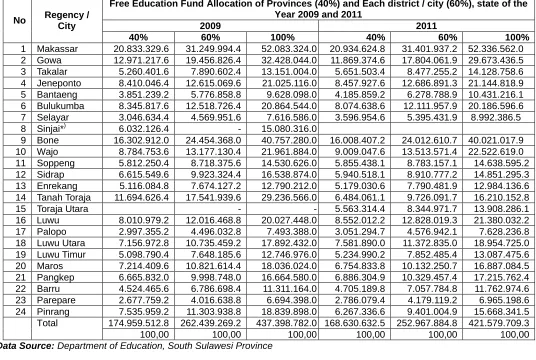
182 Table 1: Allocation of Free Education Fund of the Province (40%) and Regency / City (60%) for 2009 and 2011 (in
millions = 0,000)
No Regency /
City
Free Education Fund Allocation of Provinces (40%) and Each district / city (60%), state of the Year 2009 and 2011
2009 2011
40% 60% 100% 40% 60% 100%
1 Makassar 20.833.329.6 31.249.994.4 52.083.324.0 20.934.624.8 31.401.937.2 52.336.562.0 2 Gowa 12.971.217.6 19.456.826.4 32.428.044.0 11.869.374.6 17.804.061.9 29.673.436.5 3 Takalar 5.260.401.6 7.890.602.4 13.151.004.0 5.651.503.4 8.477.255.2 14.128.758.6 4 Jeneponto 8.410.046.4 12.615.069.6 21.025.116.0 8.457.927.6 12.686.891.3 21.144.818.9 5 Bantaeng 3.851.239.2 5.776.858.8 9.628.098.0 4.185.859.2 6.278.788.9 10.431.216.1 6 Bulukumba 8.345.817.6 12.518.726.4 20.864.544.0 8.074.638.6 12.111.957.9 20.186.596.6 7 Selayar 3.046.634.4 4.569.951.6 7.616.586.0 3.596.954.6 5.395.431.9 8.992.386.5 8 Sinjai*) 6.032.126.4 - 15.080.316.0
9 Bone 16.302.912.0 24.454.368.0 40.757.280.0 16.008.407.2 24.012.610.7 40.021.017.9 10 Wajo 8.784.753.6 13.177.130.4 21.961.884.0 9.009.047.6 13.513.571.4 22.522.619.0 11 Soppeng 5.812.250.4 8.718.375.6 14.530.626.0 5.855.438.1 8.783.157.1 14.638.595.2 12 Sidrap 6.615.549.6 9.923.324.4 16.538.874.0 5.940.518.1 8.910.777.2 14.851.295.3 13 Enrekang 5.116.084.8 7.674.127.2 12.790.212.0 5.179.030.6 7.790.481.9 12.984.136.6 14 Tanah Toraja 11.694.626.4 17.541.939.6 29.236.566.0 6.484.061.1 9.726.091.7 16.210.152.8 15 Toraja Utara - - 5.563.314.4 8.344.971.7 13.908.286.1 16 Luwu 8.010.979.2 12.016.468.8 20.027.448.0 8.552.012.2 12.828.019.3 21.380.032.2 17 Palopo 2.997.355.2 4.496.032.8 7.493.388.0 3.051.294.7 4.576.942.1 7.628.236.8 18 Luwu Utara 7.156.972.8 10.735.459.2 17.892.432.0 7.581.890.0 11.372.835.0 18.954.725.0 19 Luwu Timur 5.098.790.4 7.648.185.6 12.746.976.0 5.234.990.2 7.852.485.4 13.087.475.6 20 Maros 7.214.409.6 10.821.614.4 18.036.024.0 6.754.833.8 10.132.250.7 16.887.084.5 21 Pangkep 6.665.832.0 9.998.748.0 16.664.580.0 6.886.304.9 10.329.457.4 17.215.762.4 22 Barru 4.524.465.6 6.786.698.4 11.311.164.0 4.705.189.8 7.057.784.8 11.762.974.6 23 Parepare 2.677.759.2 4.016.638.8 6.694.398.0 2.786.079.4 4.179.119.2 6.965.198.6 24 Pinrang 7.535.959.2 11.303.938.8 18.839.898.0 6.267.336.6 9.401.004.9 15.668.341.5 Total 174.959.512.8 262.439.269.2 437.398.782.0 168.630.632.5 252.967.884.8 421.579.709.3
100,00 100,00 100,00 100,00 100,00 100,00
Data Source: Department of Education, South Sulawesi Province
183 IGM Dimension in Education Program Implementation
Guide
1. Role of Actors In Intergovernmental Relations Management
Free Education Program in South Sulawesi is a form of cooperation between the provincial government and the government district / city. The principle of cooperation refers to Government Regulation No. 50 Year 2007 on the Implementation of the Regional Cooperation among other synergies, mutual benefit, mutual agreement, and equality.
The results showed that the free education program in South Sulawesi is not the result of a collective agreement but launched the program itself by the Governor and invite districts / cities in collaboration a success. Items were assigned their own financing in Regulation actors Governor and district / city only requested funding of 60%, so that in practice many activities that are not financed in accordance with the real needs of the school. These conditions create a range of attitudes actor districts / cities in receiving the program as described in the following matrix.
Matrix 2. Level of Acceptance of Bids Free Education Program in South Sulawesi and Their Reasons
Regency / City Bid Acceptance Level Education Program Guide and Their Reasons
Sinjai
Explicitly reject free education program with reason: 1. It is the first to implement free education program. 2. To avoid overlapping management program 3. To clarify the budget accountability.
Makassar
Receive halfheartedly.
1. If rejected, worry judged not support the program,
2. Accept, many items are not in accordance with the financing of the state of the city of Makassar. 3. The middle ground is taken, issued fully subsidized education programs.
Gowa
No thank wholeheartedly with reason:
1. Accept as financial support in the provision of education in the district free of charge (without refund).
2. Do not accept fully, because the items specified financing done by the province, while what is determined not according to the real needs in school.
3. No thanks, why the authorities take care of basic education in the district / city with its budget support, but in the case of a free education program is precisely regulated by the Governor under Governor Regulation and the district / city as requested budget support 60% to completion. Why the provincial government does not provide financial support of 40% to each region in the form of subsidies only.
Pangkep
Accept the record (not wholeheartedly) by reason of:
1. Accept as a form of financial support to meet the unmet needs of the district budget.
2. No receipt for items that are not in accordance with the financing needs of the region that has been awarded funding segingga terpaksan returned because it can not be used and accounted for.
Bone
Receive halfheartedly.
1. Accept as a form of financial support to meet the educational needs in areas that have not been met by the district budget.
2. Do not accept because the funds provided only pay for the items specified activities, while the set does not always correspond to the real needs in schools.
3. Accept with half a heart, as long as the fund is 60% of the amount specified for the district never provided the funds. Only specified only that the district provide funds 60% of the funds are set but the real money was not there. The proof every year proposal by the education department has never served from 60% of the fund.
Source: Primary Data Processed
2. Attention Center in IGM
For the purposes of cooperation in the implementation of free education program, the Governor has made an agreement with Regent / Mayor of South Sulawesi, except Sinjai. One referred to in the explanation of this is the Cooperation Agreement between the Government of South Sulawesi with Bone County Government on the Implementation of Free
184 Matriks 3: Obligations of the First Party and Second Party (the Parties) in Cooperation:
First Party Liability (Provincial) Second Party Liability (District / City)
1. Implement the program with the
consequences estab-financing; 1. Implement the program at the district / city
2. Establish Control Team Provincial
Program 2.Establish a Program Control Team at Regency / City
3. Perform coordination / consultation with the parties in the implementation of the program
3.Allocate funding programs for education unit in the post budget aid in the district / city;
4. Allocate funds to the second program in the mail help the provincial budget,
4.Open a special account at the Bank or the Regional Development Bank on behalf of the Government Control Team Education Program Guide Regency / City
5. Prepare implementation guidelines (guidelines) / technical guidelines (guidelines), and to socialize program
5.To evaluate the proposed Budget Plan School (budgets);
6. Establish educational unit that will receive funding program established by decision of the regent / mayor;
7. Having funds financing the educational unit to a predetermined;
8. Implement programs to sataun educational socialization and education stakeholders;
9. Make the basic data report for basic education unit calculation / determination of program funding allocation;
10. Receive reports on the results of the program of education units;
11. supervision, monitoring and evaluation of program activities at the unit level of education.
Source: Cooperation Agreement between the Government of South Sulawesi with Bone County Government on the Implementation of Free Education Program in Bone County, No. 04.B / VI / Ministry of Education / 2008) and No. 410/2513 / DP / VI / 2008).
This agreement is valid for five (5) years from the year 2008 to 2013, beginning at the time of the school year 2008/2009 (July 1, 2008), with provisions to be evaluated every year and can be extended if the parties agree and / or policy of the parties to extend cooperation.
3. Pattern Management Authority in Intergovernmental Relations
Management of intergovernmental relations is based pattern authority possessed by the central government, provincial government and district / city governments. The authorization is based on the division of government affairs between the government, provincial governments, and local government district / city as stipulated in Government Regulation No. 38 of 2007.
Matrix 3: Division of Education at policy level; Policies and Standards
Affair became focus of study
The pattern of inter-Level Government Authorities
center Province Regency / City
Policies and Standards Determination of national education policy.
Determination of operational education policy in the province in accordance with national policy.
Determination of operational education policy in districts / cities in accordance with national policy- and provincial late.
Coordination and sinkronitation operational policies and program education.
against the province Of the district and the City -
strategic planning With regard to national education
With regard to early childhood education, elementary education, secondary
185 education and non-formal
education in accordance with the strategic planning of national education
educator early elementary, junior high schools-ah education and non-formal educators late accordance with planning strategis prov level. and national.
early childhood education, elementary education, secondary education, higher
education and non-formal education.
Determination pe knowlman- guidelines and implementation
Coordination for the management and implementation of early educators, developers early education personnel and the provision of education facilities across the district / city, for primary and secondary education levels.
Management and delivery of early childhood education, elementary education, secondary education and non-formal education.
Source: Appendix A, Education, Government Regulation Number. 38 of 2007
Based on the authority, in fact in the implementation of free education program the province (governor) establish financing items that are not too technical, so that the district /city which establishes financing items are more technical result "fund free education program has been enjoyed by teachers. Though teachers have been certified and salaries of civil servants. Another problem of such cooperation is when the determination financing item, we are not involved. Provincial parties set their own items in the financing of the governor rule. "(Mayor of Makassar, June 2012). More or less the same thing also expressed by the Head of Education Pangkep, Head of District Education Office Bone that, and the Head of Education Department Gowa. A third explanation informants reinforces concerns presented by some informants Sinjai alarming overlapping funding in education. There are differences of authority in matters of education and secondary education. The authority of the provincial government will be in the area for the management and coordination of the provision of education, development of educational personnel and the provision of education facilities across the district / city. While the district / city has the full authority to take care of the management and organization of primary and secondary education. With the authority of the provincial government's real position onlysupportive and coordinate its implementation, not take over so as if the district / city is only asked to implement them, as in the case of a free education program in the province of South Sulawesi. Practice in this free educational program is a practice patterns in the management authority of intergovernmental relations are not good and needs to be reorganized in accordance with the division of affairs / authority in the Indonesian Government Regulation No. 38 of 2007. Otherwise, the country is only just able to set management intergovernmental relations at the normative level while the behavior of the government to implement the norms of intergovernmental relations still follow the old habits or behavior in accordance with the previous policy even if it has been changed. Point of tangency authority both at providing financial assistance for the implementation of early childhood education, elementary education, secondary education and non-formal education with international standards. This point is actually in need of coordination and cooperation in programs and financing. While the authorities do not enter the area of the point of tangency that needs to be done by the provincial government is providing support in the form of funds, whereas its use submitted to the district / city according to the real needs of
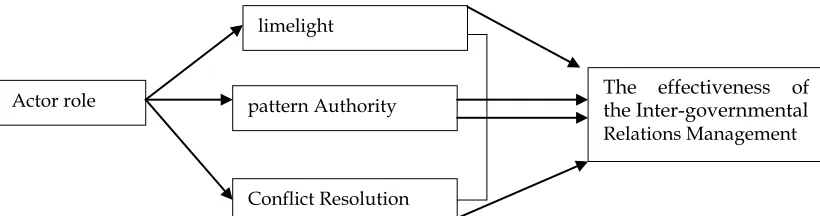
186 on the above proposition, can be modeled in the model
relationship management effectiveness of intergovernmental
relations as follows:
Figure 2: Effective Management of Intergovernmental Relations in South Sulawesi
However, there needs to be an additional explanation as a correction to the IGM models adopted from other countries. Some additional explanation as revised application IGM models in Indonesia, as presented below:
a. The role of the actor. The role of the actor is not controlled by the interests of the organization, but more is still controlled by the interests of individuals or groups / classes. Hence the need for effective control of the public and also from other institutions authorized in order to interest countries / regions who put forward, not the interests of individuals / groups. Conditional effective public control the transparency of government. In addition, the public should also be strengthened to conduct ethical control. Indeed, in South Sulawesi has been a lot of public control is done on the behavior of actors who tend individualist / group, but that needs to be addressed is the ethics of public control.
b. Determination of the center of attention of cooperation needs to be discussed / discussed together at the planning stage so that the implementation will have strong support from all parties who have been involved from the beginning. Determination limelight cooperation in free educational programs set unilaterally by the provincial government actors has led to the participation of the actors districts / cities in doing so is not so optimal. Determination suggested that the focus of cooperation identified through a bottom-up models planning. Choice of this model is expected to identify the real needs are funded with the free education program. Model topdown planning as the translation of the vision and mission officials are not wrong, but it should be applied flexibly so as to have enough space to accommodate the aspirations of the public / people who are identified through a bottom-up planning models. Public and government level below must have the courage deliver real needs and capable of providing proportional pressure to win the public interest when consulted in determining the center of attention. c. Patterns of authority should be regulated more firmly so
that it can overcome the problem of overlapping authority in resolving overlapping educational affairs at all levels of government. Government Regulation No. 38 of 2007 has been trying to resolve matters overlap between the central government, provincial government and district / city governments have not followed the pattern of behavior of actors and bureaucratic administrators. To ensure the consistency of the behavior of actors and bureaucrats bullet made adequate and proportional control of various
source control both the control hierarchy, professional control, the control law, political control and public control. Suggested proportional control with regard to the level of control of a variety of different control sources. Control level is adjusted to the level of integrity / consistency of the actors. Actor and low consistency level bureaucrats will require a high level of control. Instead of actors and bureaucrats who have a high level of consistency in implementing various provisions of the level of control should be low.
In a unitary state the necessary unity of direction, harmony and harmony in government. Therefore, it is necessary coordination vertically, horizontally and diagonally in educational affairs. This is necessary because Indonesia is not the Federal State Unitary State. This coordination line can also be used to address the willingness of actors that are controlled by an individual or group interests rather than the interests of the nation and the state. The degree of coordination line like a pendulum that at any time can be shifted toward a lower degree and also can be moved to a higher degree of deviation depends on the behavior of actors and bureaucratic policies that lead to the process of educating the nation. This recommendation was submitted relating to the various negative effects arising from efforts to accommodate the management model of intergovernmental relations in the federal state into a model of intergovernmental relations management within a unitary state. Solicitation intergovernmental cooperation needs to position each party (provincial and district / city) are invited to cooperate must feel to have equality, equality and mutual not intervene in each other so that the deliberations / negotiations that do not have a moral burden due to the different status. This recommendation is not with regard to legislation but rather with regard to the behavior of officials who still tend to position themselves as superior and subordinate. After verification field data with the legislation in force and the model of intergovernmental relations management intergovernmental management = IGM) are presented in the theoretical review, the management model of intergovernmental relations proposed as a theoretical recommendation can be seen in the following figure:
The effectiveness of the Inter-governmental Relations Management limelight
pattern Authority
187 Picture above model provides several options depending
affairs management of intergovernmental relations are examined. Affairs of basic education (SD / MI and SMP / MTs) are educational affairs has been decentralized to the district / city into matters required to be maintained by the district / city. The affairs of the above models are in the green circle that became autonomous district / city. Although it has been a matter for the district / city, but the center of the province and also have the same interest in the nation (green circles become part of the circle of brown and blue). Therefore the central and provincial governments were also responsible for educating the affairs of the nation. For this purpose, there are several models of the selected management of intergovernmental relations:
Option I: Model cooperative relationships can be selected in a free educational program with the understanding that the success (performance) can be explained by the performance of the province of the district / city, the provincial governments have the same interests. Cooperation should be established by mutual agreement of the items of financing, the amount of the budget, the proportion of the budget for each of the parties, the pattern of authority and the relationship between the parties in cooperation with regard to the principle of efficiency, effectiveness, synergy, each advantage, collective agreement, in good faith, priority to national interests and territorial integrity of the Republic of Indonesia, equality, transparency, fairness, and the rule of law. What was done by the government of South Sulawesi province with the District / Town in South Sulawesi is not cooperative, because it ignores most of the principles of cooperation.
Option II: Model assistance (subsidy). The provincial government subsidizes education on a regular basis to the district / city to implement free education program that has been implemented in their respective regions. The provincial government only performs the function of coordination and supervision so that the assistance provided can be used properly.
Option III: Model co-administration relationship, when the matter to be resolved is the provincial or central affairs. This model requires the choice of the central or provincial governments must submit a budget and requested the assistance of (officials) district / city government to help solve them. Finance free education program can not be resolved through this model (co-) because affairs SD / MI and SMP / MTs of no concern to the provincial government, but the government's business district / city. d. In the end the conflict in the implementation of free education program in South Sulawesi, there are some steps that can be selected include (1) the withdrawal of co-operation, (2) solving the problem. The first tactic is already done by Sinjai to refuse cooperation.
The same tactics should be used by the city of Makassar when not approve pattern of cooperation offered. Withdrawal is also potential for Pangkep district, or other districts that have a common case when the distryc not heed proposals that have been submitted repeatedly. This study was completed with a choice of the type of qualitative methods case study method. A number of advantages and disadvantages in this study can be identified. The surplus can reveal the empirical facts that are natural, followed by an explanation of researchers in the area of interpretation (meaning). The debate should take place within the territory of meaning (interpretation) but does not change the fact that nature. Some of the perceived weakness in this study were interviews with actors officials such as governors and regents / mayors. The difficulty is what makes the study completion time becomes longer. Another drawback is that because there are a number of informants structural position reluctant to provide data according to the actual facts. This research has also produced a model that is still hypothetical theory. The model needs to be verified by other research methods such as surveys to determine the magnitude of the effect of an actor on the determination of the limelight, the arrangement and selection pattern of authority relations, and conflict resolution methods, as well as the influence of the limelight, the pattern of authority and conflict resolution methods to the management effectiveness of intergovernmental relations. To the provincial government, when choosing a model of cooperation, should pay attention to the principles of cooperation, especially the efficiency, effectiveness, synergy, mutual benefit, mutual agreement, in good faith, equality, transparency, fairness, and the rule of law. Ineffectiveness is due to the cooperation during the regency / city feel ignores the principle of mutual agreement of cooperation, mutual benefit, equality, transparency, fairness and legal certainty. When cooperation is maintained, repair some drawbacks presented here. District / city government should have the courage, candor in conveying field issues that cooperation lasted until now needs to be revisited. When beneficial for both parties, the cooperation can be resumed. But when certain adverse parties, the agreement should be terminated with a choice of conflict resolution method agreed.
CLOSING
188
REFERENCES
[1] Agranoff, R., 1986, Intergovernmental Management: Human Services Problem Solving in Six Metropolitan Areas, State University of New York, Albany, NY.
[2] Agranoff, R. and Lindsay, V. A., 1983.Intergovernmental management: perspectives from human services problem solving at the local level, Public Administration Review, 43, 227–237.
[3] Anderson, W., 1960. Intergovernmental Relations in Review, University of Minnesota Press, Minneapolis, MN.
[4] Anderson, W., 1968.The myths of tax sharing, Public Administration Review, 28, 10–14.
[5] Beer, S. H., 1993.To Make a Nation: The Rediscovery of American Federalism, Harvard University Press, Cambridge, MA.
[6] Bevir, Mark (editor), 2007. Encyclopedia of Governance, SAGE Publication, Thousand Oaks – London – New Delhi.
[7] Burke, B. F. and Wright, D. S., 2002.Reassessing and reconciling reinvention in the American states: exploring state administrative performance, State and Local Government Review, 34, 7–19.
[8] Clayton, R., Conklin, P., and Shapek R. Eds., 1975.Policy management assistance—a developing dialogue, Public Administration Review, 35, 693–818.
[9] Conlan, T. J., 1988. New Federalism: Intergovernmental Reform from Nixon to Reagan, Brookings Institution, Washington, DC.
[10] Davis, S. R., 1978. The Federal Principle: A Journey Through Time in Quest of Meaning, University of California Press, Berkeley, CA.
[11] Dodge, W., 1996. Regional Excellence: Governing Together to Compete Globally and Flourish Locally, National League of Cities, Washington, DC.
[12] Elazar, D. J., 1981. Is federalism compatible with prefectoral administration?, Publius, 11, 3–22,
[13] Farber, S. B., 1982.The new federalism negotiations: a view from the states, Publius, 13, 33–38.
[14] Gage, R. W. and Mandell, M. P., Eds., 1990.Strategies for Managing Intergovernmental Policies and Networks, Praeger, New York,
[15] Gordon, G. J., 1980. Managing leviathan: the intergovernmental management agenda for 1980, Publius, 10, 137–144.
[16] Gore, A., 1993. Creating a Government that Works Better and Costs Less: Report of the National Performance Review, US Government Printing
Office, Washington, DC.
[17] Grosenick, L. E., Ed., 1973.The Administration of the New Federalism: Objectives and Issues, American Society for Public Administration, Washington, DC.
[18] Hendratno, Edi, 2009. Negara Kesatuan, Desentralisasi dan Federalisme, Graha Ilmu, Yogyakarta.
[19] King, P., 1982. Federalism and Federation, Johns Hopkins University Press, Baltimore, MD.
[20] Kreitner dan Kinicki, 2005. Perilaku Organisasi, Buku 2 Edisi 5, Salemba Empat, Jakarta.
[21] Lienesch, M., 1983b. Interpreting experience: history, philosophy, and science in the American constitutional debates, Am Politics Q, 11, 379–401.
[22] Marando, V. L. and Florestano, P. S., 1990.Intergovernmental management: the state of the discipline, In The State of the Discipline, Lynn, N. B. and Wildavsky, A., Eds., Chatham House, Chatham, NJ, pp. 287–317.
[23] Osborne, D. and Gaebler, T., 1992.Reinventing Government: How the Entrepreneurial Spirit is Transforming the Public Sector, Addison-Wesley, Reading, MA.
[24] Osborne, D. and Plastrik, P., 1997.Banishing Bureaucracy: The Five Strategies for Reinventing Government, Addison-Wesley, Reading, MA.
[25] O’Toole, L. J., Jr., Ed., 2000.American Intergovernmental Relations: Foundations, Perspectives, and Issues, 1st ed., 1985, 2nd ed., 1993, 3rd ed., Congressional Quarterly Press, Washington, DC.
[26] Peterson, G. E. and Lewis, C. W., Eds., 1986.Reagan and the Cities, Urban Institute Press, Washington, DC.
[27] Riker, W. H.,1964. Federalism: Origin Operation Significance, Little, Brown, Boston.
[28] Robbins Stephen, P. 1995. Teori Organisasi: Struktur, Desain, dan Aplikasi, Edisi 3, Penerbit Arcan, Jakarta.
[29] Rose, R., 1982. The Territorial Dimension in Government, Chatham House, Chatham, NJ.
[30] Stever, J. A., Intergovernmental management in a revolutionary era, J Public Admin Res Theory, 2, 347–350, 1992.
[31] Stolz, O. G., 1974.Revenue Sharing: A Legal and Policy Analysis, Praeger, New York.
189 for, University of Chicago Press, Chicago, IL.
[33] Truman, D. B., 1940. Administrative Decentralization, Public Administration Service, Chicago, IL.
[34] Walker, D. B., 2000.The Rebirth of Federalism: Slouching Toward Washington, Chatham House, Chatham, NJ.
[35] Weissert, C. S., Ed., 2000. Learning from Leaders: Welfare Reform Politics and Policy in Five Midwestern States, Rockefeller Institute Press, Albany, NY.
[36] Wheare, K. C., 1964. Federal Government, 4th ed., Oxford University Press, New York.
[37] Williamson, R. S., 1990.Reagan’s Federalism: His Efforts to Decentralize Government, University Press of America, Lanham, MD.
[38] Wright, D. S., 1968.Federal Grants-in-aid: Perspectives and Alternatives, American Enterprise Institute, Washington, DC.
[39] Wright, D. S., 1975. Intergovernmental relations and policy choice, Publius, 5, 1–24.
[40] Wright, Deil S. 1982. Understanding Intergovernmental Relations. Brooks/Cole, Monterey, CA
[41] Wright, D. S., 1988.Understanding Intergovernmental Relations, 3rd ed., Brooks/Cole, Monterey, CA.
[42] Wright, D. S., 1990a.Federalism, intergovernmental relations, and intergovernmental management: historical reflections and conceptual comparisons, Public Administration Review, 50, 168–178.
[43] Wright, D. S. and Cho, C. L., 2000.State administration and intergovernmental interdependency: do national impacts on state agencies contribute to organizational turbulence?, In Handbook of State Government Administration, Gargin, J. J., Ed., Marcel Dekker, New York, pp. 33– 66.
[44] Wright, D. S. and Krane, D., 1998.Intergovernmental Management, In International Encyclopedia of Public Policy and Administration, Shafritz, J., Ed., Vol. 2, Westview Press, Boulder, CO, pp. 1162–1168.
[45] Wright, D. S., 1988.Understanding Intergovernmental Relations, 3rd ed., Brooks/Cole, Monterey, CA.
[46] Wright, Deil S. and Stenberg, Carl W. 2007.Federalism, Intergovernmental Relations, and Intergovernmental Management: The Origins, Emergence, and Maturity of Three Concepts across Two Centuries of Organizing Power by Area and by Function; Rabin Jack, Hildreth, W. Bartley and Miller Gerald J.,. Handbook of Public Administration, Third
Edition, Taylor & Francis Group.