Image Annotation
CHEN XIANGYU
A THESIS SUBMITTED
FOR THE DEGREE OF DOCTOR OF PHILOSOPHY NUS GRADUATE SCHOOL FOR INTEGRATIVE
SCIENCES AND ENGINEERING
NATIONAL UNIVERSITY OF SINGAPORE
CHEN XIANGYU All Rights Reserved
I hereby declare that this thesis is my original work and it has been written by me in its entirety. I have duly acknowledged all the sources of information which have been used in the thesis.
This thesis has also not been submitted for any degree in any university previously.
Name: CHEN XIANGYU Date: July 07, 2013
This thesis is the result of four years of work. It would have not been possible, or at least not what it looks like now, without the guidance and help of many people. It is now my great pleasure to take this opportunity to thank them. Foremost, I would like to show my sincere gratitude to my advisor, Prof. Tat-Seng Chua, who has been instrumental in ensuring my academic, professional, financial, and moral well being ever since. He has supported me throughout my research with his patience and knowledge. For the past four years, I have appreciated Prof. Chua’s seemingly limitless supply of creative ideas, insight and ground-breaking visions on research problems. He has offered me with invaluable and insightful guidance that directed my research and shaped this dissertation without constraining it. As an exemplary teacher and mentor, his influence has been truly beyond the research aspect of my life.
I also thank my co-advisor, Prof. Shuicheng Yan. I thank him for his patience, encouragement and constructive feedback on my research work, and for his insights and suggestions that helped to shape my research skills. His visionary thoughts and energetic working style have influenced me greatly. During my Ph.D pursuit, Prof. Yan has always been providing insightful suggestion and discerning comments to my research work and paper drafts. His suggestion and guidance have helped to improve my research work.
During my Ph.D pursuit, many lab mates and colleagues have helped me. I like to thank Yantao Zheng, Guangda Li, Bingbing Ni, Richang Hong, Jinhui Tang, Yadong Mu and Xiaotong Yuan for the inspiring brainstorming, valuable suggestion and enlightening feedbacks on my work.
my wife Yue Du. For their selfless care, endless love and unconditional support, my gratitude to them is truly beyond words.
Finally, I would like to thank everybody who was important to the success-ful realization of thesis, as well as expressing my apology that I could not mention personally one by one. Thank you.
Contents
List of Figures viii
List of Tables xi
Chapter 1 Introduction 1
1.1 Background . . . 1
1.1.1 Semantic Image Annotation . . . 1
1.1.2 Single-Label Learning for Semantic Image Annotation . . . 3
1.2 Multi-Label Learning for Semantic Image Annotation . . . 4
1.2.1 Multi-Label Learning with Label Exclusive Context . . . . 6
1.2.2 Multi-Label Learning on Multi-Semantic Space . . . 7
1.2.3 Multi-Label Learning in Large-Scale Dataset . . . 8
1.3 Thesis Focus and Main Contributions . . . 9
1.4 Organization of the Thesis . . . 11
Chapter 2 Literature Review 13 2.1 Single-Label Learning for Semantic Image Annotation . . . 13
2.1.1 Support Vector Machines . . . 14
2.1.2 Artificial Neural Network . . . 15
2.2 Multi-Label Learning for Semantic Image Annotation . . . 18
2.2.1 Multi-Label Learning on Cognitive Semantic Space . . . . 18
2.2.1.1 Problem Transformation Methods . . . 19
2.2.1.2 Algorithm Adaptation Methods . . . 23
2.2.2 Multi-Label Learning on Emotive Semantic Space . . . 31
2.2.3 Summary . . . 34
2.3 Semi-Supervised Learning in Large-Scale Dataset . . . 34
Chapter 3 Multi-Label Learning with Label Exclusive Context 39 3.1 Introduction . . . 39
3.1.1 Scheme Overview . . . 41
3.1.2 Related Work . . . 42
3.1.2.1 Sparse Linear Representation for Classification . 43 3.1.2.2 Group Sparse Inducing Regularization . . . 43
3.1.2.3 Exclusive Lasso . . . 44
3.2 Label Exclusive Linear Representation and Classification . . . 45
3.2.1 Label Exclusive Linear Representation . . . 45
3.2.2 Learn the Exclusive Label Sets . . . 46
3.3 Optimization . . . 47
3.3.1 Smoothing Approximation . . . 47
3.3.2 Smooth Minimization via APG . . . 51
3.4 A Kernel-view Extension . . . 52
3.5 Experiments . . . 53
3.5.1 Datasets and Features . . . 53
3.5.3 Results on PASCAL VOC 2007&2010 . . . 54
3.5.4 Results on NUS-WIDE-LITE . . . 56
3.6 Conclusion . . . 58
Chapter 4 Multi-Label Learning on Multi-Semantic Space 60 4.1 Introduction . . . 60
4.1.1 Major Contributions . . . 64
4.1.2 Related Work . . . 64
4.1.2.1 Multi-task Learning . . . 64
4.1.2.2 Group Sparse Inducing Regularization . . . 65
4.2 Image Annotation with Multi-Semantic Labeling . . . 66
4.2.1 Problem Statement . . . 66
4.2.2 An Exclusive Group Lasso Regularizer . . . 68
4.2.3 A Graph Laplacian Regularizer . . . 69
4.2.4 Graph Regularized Exclusive Group Lasso . . . 71
4.3 Optimization . . . 72
4.3.1 Smoothing Approximation . . . 72
4.3.2 Smooth Minimization via APG . . . 75
4.4 Experiments . . . 77
4.4.1 Datasets . . . 77
4.4.2 Baselines and Evaluation Criteria . . . 78
4.4.3 Experiment-I: NUS-WIDE-Emotive . . . 80
4.4.4 Experiment-II: NUS-WIDE-Object &Scene . . . 84
Chapter 5 Multi-Label Learning in Large-Scale Dataset 87
5.1 Introduction . . . 87
5.2 Motivation . . . 89
5.3 Large-Scale Multi-Label Propagation . . . 91
5.3.1 Scheme Overview . . . 91
5.3.2 Hashing-based `1-Graph Construction . . . 91
5.3.2.1 Neighborhood Selection . . . 91
5.3.2.2 Weight Computation . . . 93
5.3.3 Problem Formulation . . . 95
5.3.4 Part I: Optimize pi with qi Fixed . . . 99
5.3.5 Part II: Optimize qi with pi Fixed . . . 100
5.4 Algorithmic Analysis . . . 102
5.4.1 Computational Complexity . . . 102
5.4.2 Algorithmic Convergence . . . 103
5.5 Experiments . . . 104
5.5.1 Datasets . . . 105
5.5.2 Baselines and Evaluation Criteria . . . 107
5.5.3 Experiment-I: NUS-WIDE-LITE (56k) . . . 108
5.5.4 Experiment-II: NUS-WIDE (270k) . . . 110
5.6 Conclusion . . . 113
Chapter 6 Conclusions and Future Work 115 6.1 Conclusions . . . 115
6.1.1 Multi-Label Learning with Label Exclusive Context . . . . 116 iv
6.1.3 Multi-Label Learning in Large-Scale Dataset . . . 117 6.2 Future Work . . . 118
With the popularity of photo sharing websites, new web images on a wide variety of topics have been growing at an exponential rate. At the same time, the contents of images are also enriched and more diverse than ever before. This brings about two main challenging problems in semantic image annotation: 1) the semantic space of image dataset is enlarged and may contain two or more semantic spaces; 2) the trend of image corpus is towards large-scale or web-scale setting, which is generally unaffordable for traditional annotation approaches.
To address the first challenging problem, this thesis proposes multi-label learning algorithms for semantic image annotation from two paradigms: multi-label learning on single-semantic space and multi-multi-label learning on multi-semantic space. For the first paradigm, different from most existing works that motivated from label co-occurrence, we propose a novel Label Exclusive Linear Represen-tation (LELR) model for image annoRepresen-tation, which incorporates a new type of context–label exclusive context. In the setting of multi-label learning problems, when the number of categories is large, we may expect negative correlations among categories. Given a set of exclusive label groups that describe the negative rela-tionship among class labels, our proposed method enforces exclusive assignment of the labels from each group to a query image. For the second paradigm, we propose a multi-task linear discriminative model for harmoniously integrating multiple se-mantics, and investigating the problem of learning to annotate images with train-ing images labeled in two or more correlated semantic spaces, such as fascinating nighttime, orexciting cat. Image semantics can be viewed at two levels: Cognitive level and Affective level. The two spaces of image semantics are inter-related and
concept detection and in particular, to detect complex concepts involving both types of basic concepts.
To address the second challenging problem, this thesis proposes an efficient sparse graph based multi-label learning scheme for large-scale image annotation, whereby both the efficacy and accuracy are further enhanced. In order to anno-tating large-scale image corpus, we perform the multi-label learning on the so-called hashing-based `1-graph, which is efficiently derived with Locality Sensitive
Hashing approach followed by sparse `1-graph construction within the
individ-ual hashing buckets. Unlike previous large-scale approaches that propagate over individual label independently, our proposed large-scale multi-label propagation (LSMP) scheme encodes the tag information of an image as a unit label con-fidence vector, which naturally imposes inter-label constraints and manipulates labels interactively. It then utilizes the probabilistic Kullback-Leibler divergence for problem formulation on multi-label propagation.
To demonstrate the advantages and utility of our algorithms, extensive experiments on the challenging real-world benchmarks are provided for each pro-posed multi-label learning method. We compare each propro-posed approach to the state-of-the-art methods, as well as offer insights into individual result. The promising performance well validate the effectiveness of the proposed approaches. In the end, some limitations and broad vision for multi-label learning are also discussed.
List of Figures
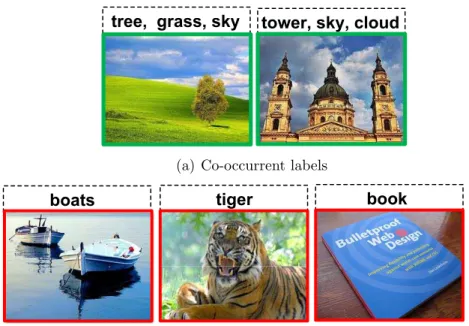
3.1 Two types of label context in real-scene images. The label co-occurrent context as in (a) describes thepositive correlation among labels. The label exclusive context as in (b) describes the negative correlation among labels. In this chapter, we will novelly incorpo-rate the label exclusive context with linear representation for visual classification. . . 40 3.2 Flowchart of linear representation with exclusive label context. . 41 3.3 The MAP results of our LELR algorithm and the four baselines
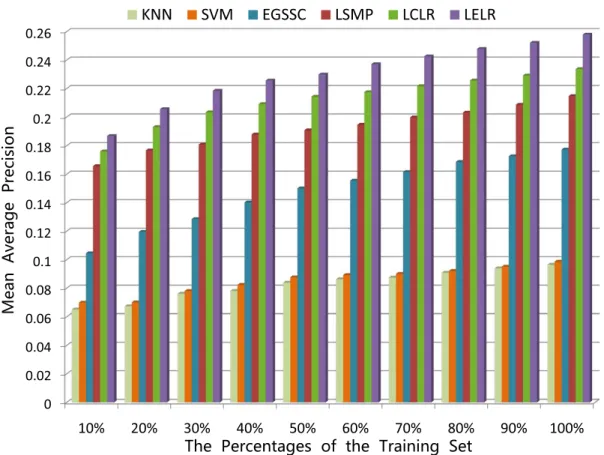
with varying reference image set sizes (in percentage) on NUS-WIDE-Lite dataset. . . 58 3.4 The comparison of APs for the 81 concepts using five methods with
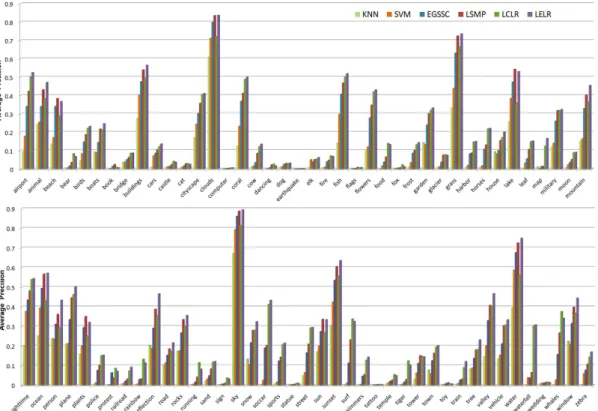
the whole training set as reference set on NUS-WIDE-LITE. . . . 59 4.1 System overview of our proposed Multi-Task Learning scheme for
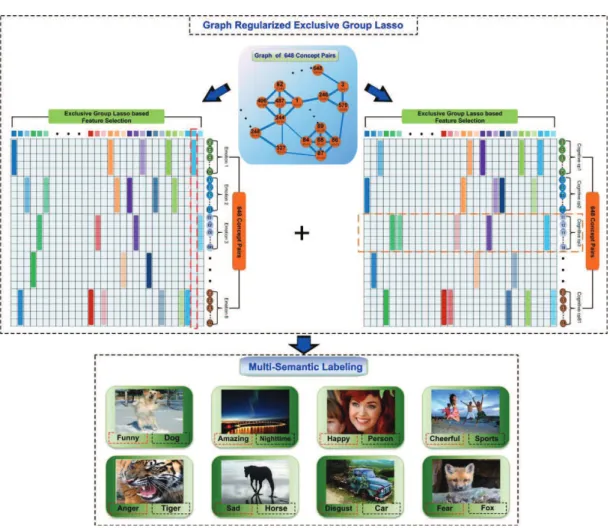
Image Annotation with Multi-Semantic Labeling (IA-MSL). . . . 61
4.2 Convergence curve of IA-MSL on NUS-WIDE-EMOTIVE dataset. 83
row), NMTL (middle row) and SVM (bottom row) on NUS-WIDE-Emotive with the query: “Amusement Dog”. The red border indi-cates correct result while the green one incorrect. . . 84 5.1 Flowchart of our proposed scheme for multi-label propagation.
Step-0 and step-1 are the proposed hashing-based l1-graph construction
scheme, which perform neighborhood selection and weight compu-tation respectively; Step-2 is the probabilistic multi-label propaga-tion based Kullback-Leibler divergence. . . 88 5.2 The distribution of the number of nearest neighbors (denote as k)
in our proposed LSMP. . . 102 5.3 The performance of three baseline algorithms with respect to the
number of nearest neighbors (denote ask). . . . 104 5.4 Convergence curve of our proposed Algorithm on NUS-WIDE dataset.
105
5.5 The distribution of 81 concepts in the training data of NUS-WIDE and NUS-WIDE-Lite when τ = 100%. . . 106 5.6 The results of the comparison of LSMP and the five baselines with
varying parameter τ on NUS-WIDE-Lite dataset. . . 109 5.7 The comparison of APs for the 81 concepts using six methods with
τ = 1. . . 110 5.8 The tags ranking results of LSMP in NUS-WIDE-LITE. . . 111 5.9 The results of the comparison of LSMP and the four baselines with
varying parameter τ on NUS-WIDE. . . 112
WIDE. . . 113
List of Tables
2.1 A list of the representative works in multi-label learning on emotive semantic space. . . 33 2.2 A list of the representative works of semi-supervised learning in
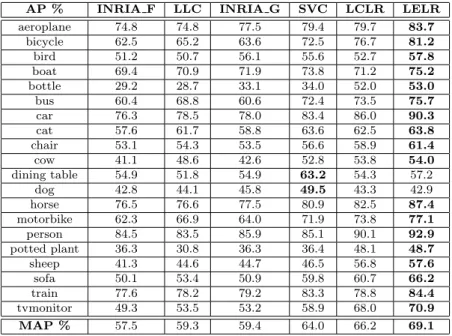
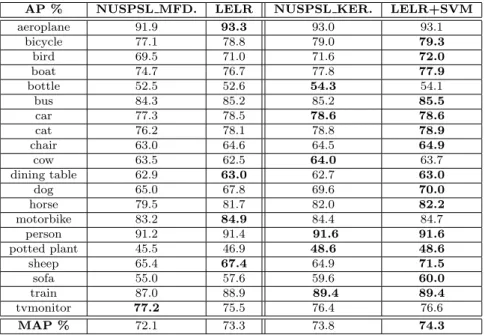
large-scale dataset. . . 37 3.1 The APs and MAPs of different image classification algorithms on
the PASCAL VOC 2007 dataset. The INRIA F and INRIA G
stand for INRIA Flat and INRIA Genetic, respectively. . . 56 3.2 Performance comparison of different image classification algorithms
on the PASCAL VOC 2010 dataset. . . 57 4.1 The baseline algorithms. . . 79 4.2 The baseline algorithms for comparison in individual semantic spaces
of NUS-WIDE-Emotive. . . 80 4.3 The MAUCs of different image annotation algorithms on the
NUS-WIDE-Emotive for 648 Concepts. . . 81 4.4 The AUCs and MAUC of different image annotation algorithms on
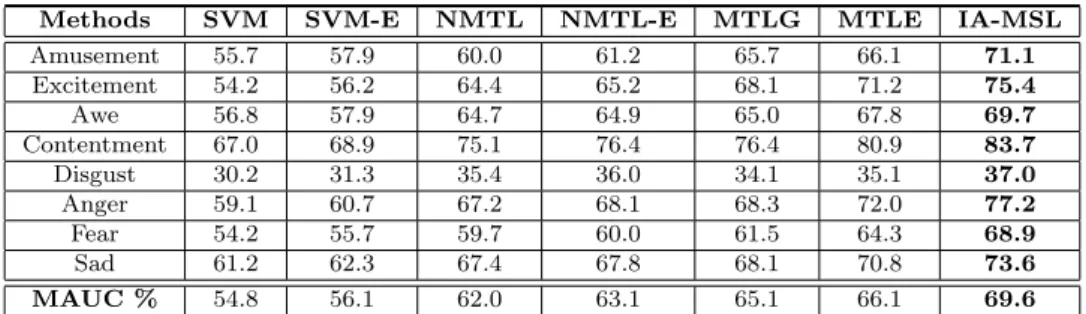
the NUS-WIDE-Emotive for 8 Emotive Categories. . . 82
WIDE-Emotive for 81 object concepts. . . 82 4.6 The unitary semantic annotation results on NUS-WIDE-LITE. . 83 4.7 The MAUCs of different image annotation algorithms on the
NUS-WIDE-Object&Scene for 1023 Concepts. . . 85 4.8 The MAUCs of different image annotation algorithms on the
NUS-WIDE-Object&Scene for 31 object concepts. . . 85 4.9 The MAUCs of different image annotation algorithms on the
NUS-WIDE-Object&Scene for 33 scene concepts. . . 86 5.1 The Baseline Algorithms. . . 108 5.2 Executing time (unit: hours) comparison of different algorithmson
the NUS-WIDE dataset. . . 111
• Xiangyu Chen, Xiaotong Yuan, Shuicheng Yan, Yong Rui and Tat-Seng Chua. 2011. Towards Multi-Semantic Image Annotation with Graph Regu-larized Exclusive Group Lasso. In ACM International Conference on Mul-timedia. (Full Paper)
• Xiangyu Chen, Xiaotong Yuan, Shuicheng Yan, and Tat-Seng Chua. 2011. Multi-label Visual Classification with Label Exclusive Context. In Interna-tional Conference on Computer Vision. (Full Paper)
• Xiangyu Chen, Yadong Mu, Shuicheng Yan, and Tat-Seng Chua. 2010. Ef-ficient Large-Scale Image Annotation by Probabilistic Collaborative Multi-Label Propagation. InACM International Conference on Multimedia. (Full Paper)
• Xiangyu Chen, Yadong Mu, Hairong Liu, Yong Rui, Shuicheng Yan and Tat-Seng Chua. 2013. Efficient Large-Scale Image Annotation based on Sparse Induced Graph Construction. Minor Revision on ACM Transactions on Multimedia Computing, Communications and Applications.
• Xiangyu Chen, Jin Yuan, Liqiang Nie, Zheng-Jun Zha, Shuicheng Yan and Tat-Seng Chua. 2010. TRECVID 2010 Known-item Search by NUS.TREC Video Retrieval Evaluation Online Proceedings.
• Jian Dong, Xiangyu Chen, Tat-Seng Chua and Shuicheng Yan. 2012. Ro-bust Image Annotation via Simultaneous Feature and Sample Outlier
nications and Applications.
• Yadong Mu, Xiangyu Chen, Shuicheng Yan, and Tat-Seng Chua. 2011. Learning Reconfigurable Hashing for Diverse Semantics. In ACM Interna-tional Conference on Multimedia Retrieval. (Oral Paper)
• Yadong Mu, Xiangyu Chen, Xianglong Liu, Tat-Seng Chua, Shuicheng Yan. 2011. Multimedia Semantics-Aware Query-Adaptive Hashing with Bits Re-configurability,International Journal of Multimedia Information Retrieval.
• Yantao Zheng, Shi-Yong Neo, Xiangyu Chen and Tat-Seng Chua. 2009. VisionGo: towards true interactivity. In ACM International Conference on Image and Video Retrieval.
Chapter 1
Introduction
1.1
Background
1.1.1
Semantic Image Annotation
For image annotation, the main task is to assign semantic keywords to an image in order to reflect its semantic content. Due to the rapid development of digital photography and the popularity of photo sharing websites, the digital images are increasing in an explosive way. Robust browsing and retrieval of these huge amount of images via semantic keywords is becoming a critical requirement. In the real world, most Internet image search engines efficiently utilize text-based search to satisfy the queries of users, while not exploiting the visual content of images. Utilizing visual content to annotate images with a richer and more relevant set of semantic keywords would allow one to further exploit the fast indexing and retrieval architecture of these search engines, which boosts the search performance at the same time. This makes the problem of annotating images with relevant semantic keywords increasingly important.
In the field of semantic image annotation, one of the main challenges is the well-known “semantic gap” problem, which points to the fact that it is hard to bridge the gap between low level feature and high-level human perception. Humans tend to use high-level semantic concepts (e.g., keywords, text descriptors) to interpret image content and measure their similarity. While the visual features extracted utilizing computer vision techniques are mostly low-level features, such as color, shape, texture, etc. Though a large amount of research has been carried out on designing algorithms to extract effective visual features in the past two decades, these algorithms cannot adequately model image semantics and have many limitations when dealing with broad content image databases [Mojsilovic and Rogowitz, 2001]. Therefore, to satisfy user’s expectations and support query by high-level concepts, a large number of machine learning techniques for bridging the “semantic gap” have been applied along with a great deal of research efforts. Given the set of semantically labelled training images that are represented with low level features, a machine learning algorithm can be trained to utilize the visual feature to perform semantic label matching. Once trained, the algorithm can be used to label new images. There are generally two types of semantic image annotation approaches: single-label learning and multi-label learning for image annotation. In a single-label setting [Shotton et al., 2006], each image will be categorized into one semantic label and only one of the predefined label categories. In other words, only one label will be assigned on each image in this setting. In a multi-label setting [Boutell et al., 2004; Kang, Jin, and Sukthankar, 2006], which is more challenging but much closer to real world applications, each image will be assigned with one or multiple labels from a predefined label set. This thesis focuses on multi-label learning (MLL) for image annotation.
1.1.2
Single-Label Learning for Semantic Image
Annota-tion
For single-label learning algorithms, firstly, low level visual features are extracted from image, and then the features are considered as input to a conventional binary classifier which indicates which concept category it belongs to. Finally, the output of the classifier is the semantic concept which is assigned for image annotation. In a single-label learning setting, once the images are classified into different cate-gories, each image is only annotated with one category concept such as bus, tree, building etc. The common algorithms for single-label learning annotation basi-cally include three types: support vector machines(SVM) [Vapnik, 1995], artificial neural network(ANN) [Frate et al., 2007],and decision tree(DT) [Quinlan, 1986a]. Based on this single-label learning annotation, retrieval of images in the search engine is straightforward by just typing in keywords related to the concept labels . The main advantage of this type of approach is that searching of images is efficient because the search engine needs not to do usual image indexing and expensive on-line matching. However, this type of approach ignores the fact that many images may contain multiple semantic concepts. As a result, many relevant images may be missed from the retrieval list if a user does not search using the exact keyword. One effective way to alleviate this problem is to annotate each image with multiple keywords in order to reflect different semantics contained in the image. This motivates semantic image annotation focusing on multi-label learning for improving the search performance.
1.2
Multi-Label Learning for Semantic Image
An-notation
Conventional single-label learning methods for image annotation usually consider an image as an entity associated with only one label in model learning stage. These single-label learning algorithms may sound attractive and straightforward, but they overlook the fact that a real-world image usually contains multiple semantic concepts rather than a single one. In most real-world problems, multiple labels can be assigned to an image. In many online image sharing websites (e.g. Picasa, Flickr, and Yahoo! Gallery), most of the images have more than one tags. For example, an image can be annotated as “road” as well as “car”, where the terms “road” and “car” are in different categories. Furthermore, the traditional methods lack a mechanism to rank images according to their similarity to the annotated label. Owing to the great potential of automatically tagging images with related labels, multi-label image annotation is becoming increasingly important and is a more reasonable approach for real-world image annotation, because it assigns an image to several categories and assigns an image to a category with a confidence value which assists in image ranking. This dissertation mainly investigates multi-label learning for semantic image annotation.
The most commonly-used approach for multi-label learning is to divide it into multiple binary classification problems [Chang, K. Goh, and CBSA, 2003; Yan, Tesic, and Smith, 2007], and determine the labels for each test sample by aggregating the classification results from all the classifiers. However, there are three main disadvantages of this type of approach: 1) It assumes each class label independently so that it is not able to utilize the correlation information of labels
to boost the performance; 2) It is cannot be employed for annotating images with a large number of classes because each class requires a binary classifier for training; 3) Most binary classification approaches toward multi-label learning suffer severely from the unbalanced data problem [Weiss and Provost, 2003], particularly when the number of classes is large. Given image dataset, once the number of classes is large, the number of negative samples is overwhelmingly larger than the number of positive samples for every class. As a result, most of trained binary classifiers will assign the negative labels to test images. This motivates many researchers to exploit machine learning algorithms for multi-label learning. The detailed related works of multi-label learning will be reviewed in Chapter 2.
Due to the explosive growth of digital technologies, new images on a large variety of topics have been growing at an exponential rate. And the contents in images are enriched and more diverse than ever before. This brings about two main challenges in multi-label learning: (a) the semantic space of image data is enlarged and contains one or more semantic spaces, where there may been multi-ple semantic spaces included in an image dataset (e.g. cognitive semantic space and emotive semantic space); and (b) the image corpus for annotation is towards to large-scale or web-scale setting, which is generally infeasible for traditional annotation approaches. According to the above mentioned two challenging prob-lems, this thesis focuses on exploiting the semantic multi-label learning from three aspects: (a) label learning on traditional single-semantic space, (b) multi-label learning on multi-semantic space, and (c) multi-multi-label learning in large-scale dataset. For the first challenge, multi-label learning with label exclusive context in single semantic space is first proposed and explored in Chapter 3, then an ex-tension version towards multi-semantic space for multi-label image annotation is
proposed and discussed in Chapter 4. For the second challenge, a graph-based semi-supervised multi-label learning approach for large-scale image annotation is exploited in Chapter 5, which is founded on hashing-based l1 graph construction
and Kullback-Leibler divergence based label similarity measurement.
1.2.1
Multi-Label Learning with Label Exclusive Context
Since many words are semantically related, labels in image dataset are usually correlated. This correlation among labels are helpful for predicting labels of test images. For example, the concepts “lake” and “boat” usually appear in the same image. When assigning a label “boat” to a test image, this image may contain the label “lake”. so they are correlated concepts. It is reasonable to make use of such a correlated context of labels for predicting class labels of the query image sample. In the past, many researcher have explored the co-occurrent label context in multi-label learning for image annotation [Zhu et al., 2005; Yu et al., 2005; McCallum, 1999].
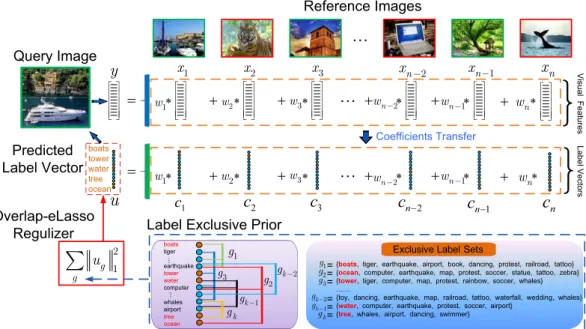
In order to further improve the performance of image annotation, we pro-pose a novel Label Exclusive Linear Representation (LELR) method for multi-label image annotation. Unlike the past research efforts based on co-occurrent information of labels, we incorporate a new type of label context named label ex-clusive context into the LELR scheme, which describes the negative relationship among class labels. Given a set of exclusive label groups that describe the negative relationship among class labels, the proposed LELR enforces repulsive assignment of the labels from each group to a test image. Extensive experiments on the chal-lenging real-world benchmarks demonstrate the effectiveness of embedding this new context into multi-label learning scheme.
1.2.2
Multi-Label Learning on Multi-Semantic Space
In order to manege the huge amount and variety of images, there is a basic shift from content-based image retrieval to concept-based retrieval techniques. This shift has motivated research on image annotation which offers a series of chal-lenges in media content processing techniques. The semantic gap [Lew et al., 2006] between high-level semantics and low-level image features is still one of the main challenging problems for image classification and retrieval. Moreover, image semantics can be viewed at two levels: Cognitive level and Affective level [Han-jalic, 2006]. The two spaces of image semantics are inter-related and should be used together to reinforce each other in order to improve the accuracy of concept detection and in particular, to detect the complex concepts involving both types of basic concepts.
However, existing studies on image semantic annotation mainly aim at the assignment of either the cognitive concepts or affective concepts to a new item separately. Moreover, they fail to take into consideration the correlation between concepts from different spaces. For example, certain cognitive concepts (such as snake and tiger) are usually attached with negative emotion, while other con-cepts (such as beach and sunset) are associated with positive emotions. As a result, the complex concepts consisting of concepts from different spaces cannot be inferred easily. For detecting these complex concepts, the current learning process requires a huge amount of efforts in extracting different types of cogni-tive and emocogni-tive features and is thus generally unaffordable for large-scale image dataset. Moreover, it is hard to generate concepts from different semantic spaces simultaneously because they require the use of different techniques to be applied to different semantic spaces, and the aggregation of results of individual concepts
from different spaces is usually unable to model the meanings of complex query in the real-world search task. This motivates us to harmoniously embed these two or more semantic spaces into one general framework for annotating the deeper and multi-semantic labels to images. In this thesis, we are particularly interested in explicit multi-semantic 1 image annotation under the unified generic visual
fea-tures. This framework not only works well on cognitive and affective spaces but can also be applied to other multi-space semantics such as object and scene.
1.2.3
Multi-Label Learning in Large-Scale Dataset
The last decade has witnessed a growing interest in image annotation. In many real world scenario cases, we often face the challenging situation that there is no sufficient labeled data whereas large numbers of unlabeled image data may could be far easier to be crawled on the web. And annotating this large-scale unlabeled data often requires the employment of a huge number of experienced human annotators and consuming much time, which directly motivates recent development of large-scale semi-supervised learning (SSL) methods [Zhu, 2006; Subramanya and Bilmes, 2009]. With the small amount of labeled image data, SSL makes itself as an effective annotation technique through working together with other unlabeled data for learning and inference.
For image annotation, a graph is often employed as an effective represen-tation for label propagation in large-scale setting, wherein all images of the entire dataset are expressed as vertices and edges reflecting similarity between the
im-1Themulti-semantic (or polysemy) retrieval has been explored in [Kesorn, 2010] for
multi-modality (visual and textual) based image retrieval, in which a visual object or text word may belong to several concepts. For example, a “horizontal bar” object can belong to high jump or pole vault event. Differently, the term multi-semantic used in this chapter emphasizes that an image can be labeled in multiple semantic spaces.
ages. For generative modeling methods, the priori probabilistic assumptions usu-ally play an import role for propagation. Different from this body of generative modeling work, graph-based modelings are especially interested in non-parametric and discriminative local structure discovery with the assumption that the larger the weight of edge connecting vertices, the higher the possibility of sharing the sim-ilar labels between the images. And it is also demonstrated that graph-based ap-proaches are usually able to achieve the state-of-the-art performance as compared to other SSL algorithms [Zhu, 2006]. In this thesis, we propose an efficient semi-supervised large-scale multi-label learning approach based on hashing-accelerated `1-graph construction.
1.3
Thesis Focus and Main Contributions
The overall objective of this thesis is to develop methodologies for multi-label learning image annotation from three aspects: 1) exploiting label exclusive con-text for multi-label learning on traditional single semantic space; 2) developing multi-task linear discriminative model for multi-label learning on multi-semantic space; and 3) utilizing hashing based sparse`1-graph construction to exploit
multi-label learning annotation in large-scale image dataset. Three major contributions are made in this dissertation.
1) Multi-Label Learning with Label Exclusive Context: We introduce in this thesis a novel approach to multi-label image annotation which incorporates a new type of context — label exclusive context — with linear representation and classification. Given a set of exclusive label groups that describe the negative
rela-tionship among class labels, our method, namely LELR for Label Exclusive Linear Representation, enforces repulsive assignment of the labels from each group to a query image. The problem can be formulated as an exclusive Lasso (eLasso) model with group overlaps and affine transformation. Since existing eLasso solvers are not directly applicable to solving such an variant of eLasso in our setting, we pro-pose a Nesterov’s smoothing approximation algorithm for efficient optimization. Extensive comparing experiments on the challenging real-world visual classifica-tion benchmarks demonstrate the effectiveness of incorporating label exclusive context into visual classification.
2) Multi-Label Learning on Multi-Semantic Space: To exploit the com-prehensive semantic of images, we propose a general framework for harmoniously integrating the above multiple semantics, and investigating the problem of learn-ing to annotate images with trainlearn-ing images labeled in two or more correlated semantic spaces. This kind of semantic annotation is more oriented to real world search scenario. Our proposed approach outperforms the baseline algorithms by making the following contributions. 1) Unlike previous methods that annotate images within only one semantic space, our proposed multi-semantic annotation associates each image with labels from multiple semantic spaces. 2) We develop a multi-task linear discriminative model to learn a linear mapping from features to labels. The tasks are correlated by imposing the exclusive group lasso regulariza-tion for competitive feature selecregulariza-tion, and the graph Laplacian regularizaregulariza-tion to deal with insufficient training sample issue. 3) A Nesterov-type smoothing approx-imation algorithm is presented for efficient optimization of our model. Extensive experiments on NUS-WIDE-Emotive dataset (56k images) with 8×81 emotive
cognitive concepts and Object&Scene datasets from NUS-WIDE well validate the effectiveness of the proposed approach.
3) Multi-Label Learning in Large-Scale Image Dataset: Motivated by re-cent development of semi-supervised or active annotation methods, we develop a novel large-scale multi-label learning scheme, whereby both the efficacy and accuracy of large-scale image annotation are further enhanced. Our proposed scheme outperforms the state-of-the-art algorithms by making the following con-tributions. 1) Unlike previous approaches that propagate over individual label independently, our proposed large-scale multi-label propagation (LSMP) scheme encodes the tag information of an image as a unit label confidence vector, which naturally imposes inter-label constraints and manipulates labels interactively. It then utilizes the probabilistic Kullback-Leibler divergence for problem formulation on multi-label propagation. 2) We perform the multi-label propagation on the so-called hashing-based `1-graph, which is efficiently derived with Locality Sensitive
Hashing approach followed by sparse `1-graph construction within the individual
hashing buckets. 3) An efficient and convergency provable iterative procedure is presented for problem optimization. Extensive experiments on NUS-WIDE dataset (both lite version with 56kimages and full version with 270k images) well validate the effectiveness and scalability of the proposed approach.
1.4
Organization of the Thesis
The detailed organization of this dissertation is as follows.
label learning image annotation, multi-label learning image annotation on single-semantic space, and semi-supervised learning on large-scale dataset.
Chapter 3 presents a label exclusive context based multi-label learning framework for semantic image annotation, which is formulated as an exclusive Lasso (eLasso) model. Extensive evaluations of the framework on the challenging real-world visual classification benchmarks are given.
Chapter 4 further introduces a label learning framework on multi-semantic space, which is a multi-task linear discriminative model to learn a linear mapping from features to labels. Extensive evaluations of the framework on NUS-WIDE-Emotive dataset (56k images) with 8×81 emotive cognitive concepts and Object&Scene datasets from NUS-WIDE are given.
Chapter 5 introduces hashing-based `1-graph construction for large-scale
multi-label image annotation, which utilizes the probabilistic Kullback-Leibler divergence for problem formulation on multi-label learning. Extensive evaluations of the framework on NUS-WIDE dataset (both lite version with 56k images and full version with 270k images) are given.
Chapter 6 concludes the thesis with highlight of contributions of this thesis, and discusses future research directions.
Chapter 2
Literature Review
With the proliferation of digital photography, semantic image annotation becomes increasingly important. Image Annotation is typically formulated as a single-label or multi-single-label learning problem. This chapter serves to introduce the neces-sary background knowledge and related works of single-label learning, multi-label learning and semi-supervised learning before delving deep into the proposed mod-els of multi-label learning for semantic image annotation.
2.1
Single-Label Learning for Semantic Image
Annotation
In semantic image annotation, single-label learning methods usually consider an image as an entity associated with only one label in model learning stage. The common algorithms for single-label learning annotation basically include three types: support vector machines(SVM), artificial neural network(ANN), and deci-sion tree(DT). In the following, we introduce representative works and necessary
background knowledge of each of these techniques.
2.1.1
Support Vector Machines
The SVM method comes from the application of statistical learning theory to sep-arating hyperplanes for binary classification problems [Cortes and Vapnik, 1995]. The central idea of SVM is to adjust a discriminating function and find a hy-perplane from a training set of image samples to separate the training dataset. In SVM methods, each training sample is represented with a feature vector and a class label. Training a SVM classifier consists in searching for the hyperplane that leaves the largest number of image samples of the same class on the same side, while maximizing the distance of both classes from the hyperplane. SVM is a supervised classifier. And it has been shown with high effectiveness in high dimen-sional data classifications,especially when the training dataset is small [Vapnik, 1995]. The advantage of SVM over other classifiers is that it can achieve optimal class boundaries by finding the maximum distance between classes. It has been widely employed to solve the classification problems, such as text classification, object detection and image annotation.
Although SVMs are mainly designed for the discrimination of two classes, they can be adapted to class (single-label learning) problems. A multi-class SVM multi-classifier can be obtained by training several multi-classifiers and combining their results. In the training phase, a separate SVM classifier for each concept is trained and each SVM will generate a probability value for a input sample. During the testing phase, the decisions from all classifiers are combined and fused to assign the final class label to a test image. In the past two decades, SVM is successfully applied to image annotation. For example, Chapelle et al.[Chapelle,
Haffner, and Vapnik, 1999] utilize the above combined SVM framework to train SVM classifiers for 14 semantic concepts. In their work, images are represented with HSV histogram. Each trained classifier is regarded as “one vs. all” classifier. In the testing stage, each SVM classifier generates a probabilistic value. The class with maximum probability is finally considered as the label of the test image. In the work of [Shi et al., 2004a], the authors use SVM to learn the semantic concepts for image regions, where the images are first segmented usingk-means algorithms, and 23 SVM classifiers are trained to learn the 23 region level concepts.
2.1.2
Artificial Neural Network
Artificial Neural Networks (ANN) started playing a important role in the field of remote sensing. Since the early nineties, several studies focused on evaluating the performance of ANNs by comparing with traditional statistical methods in remote sensing applications, and in particular in image classification. ANN is a learning network, which learns from training samples and makes decision for a test sample. It consists of multiple layers of interconnected nodes, which are also called perceptrons. Generally, an ANN is also known as multilayer perceptron (MLP).
For image annotation, the first layer of ANN is the input layer which has perceptrons equal to the dimension of input image sample. The number of percep-trons in the output layer is equal to the number of concept classes. The important and open issues are the choice of the number of hidden layers and the number of perceptrons at each hidden layer [Frate et al., 2007]. The numbers of hidden layers and perceptrons are usually selected empirically depending on the practical prob-lems. In an ANN, the connecting edges between perceptrons of different layers
are associated with weights. Each perceptron works as a processing element and is governed by an activation function. The activation function generates output based on the weights and the outputs of the perceptrons at the previous layers. For annotating a test image, ANN first learns the edge weights in the process of training, which minimizes the overall learning error. Then each output percep-tron generates a confidence measure and the class associated with the maximum measure indicates the decision about the test image.
The main advantage of ANN is that the outputs of output layer perceptrons are determined by the previous layers and the connecting edges. Training ANN is not dependent on any other parameter tuning or any assumption about the feature distribution. Many researchers have applied the ANN to image annotation. Frate et al. [Frate et al., 2007] use the ANN for satellite image annotation. They utilized a 4-layer ANN to classify pixels of images into four categories: vegetation, asphalt, building, and bare soil. In their experiment, a network of two hidden layers is employed, where each layer consists of 20 neurons. Kim et al. [Shi et al., 2004b] utilize the ANN technique to classify images into object and non-object images by 3-layer ANN. They assume that the center 25% of the image significantly characterizes the content of the entire image and use this center part to represent the image. However, the performance of classification will be degraded if the object appears in the other part of the image.
2.1.3
Decision Tree
Decision Tree (DT) learning is a special type of machine learning technique. Many researchers have utilized decision tree (DT) learning to perform image classifica-tion. Given a set of training images described by a fixed set of input attributes
and a known outcome for each image, a DT is built by recursively dividing the training images into non-overlapping sets, and every time the images are divided, the attribute used for the division is discarded. The procedure continues until all images of a group belonging to the same class or the tree reaches its maximum depth when no attribute remains to separate them [Quinlan, 1986b]. Finally, the above learning process produces a DT which can classify the outcome value based on the given attributes of new images. For annotating a new image, the tree is traversed from the root node to a leaf node using the attribute value of the new image. The decision of the new image is the outcome of the leaf node where the image reaches.
Unlike other classification model whose input-output relationships are diffi-cult to describe, a DT expresses the input-output relationship using human under-standable rules (e.g., if-then rules). There are mainly three types of DT algorithms in the literature: ID3 [Quinlan, 1986a], C4.5 [Quinlan, 1993], and CART [Breiman et al., 1993]. Sethi et al. [Sethi and Coman, 2001] utilize CART to annotate out-door images with four classes. They partition each component of HSL colour space into eight intervals and consider each of the 24 intervals as an attribute. As a result, each image in the experiment is represented with 24 attributes. In the work of [Wong and Leung, 2008], acquisition parameters (aperture, exposure time, and focal length, etc.) are used as attributes. Since the attributes are continuous values, they adopt the C4.5 method to classify scenery images into ten semantic concepts. Different from the above mentioned algorithms which can only anno-tate images globally, Liu et al.[Liu, Zhang, and Lu, 2008] utilize DT to annotate regions of segmented images. In order to training a DT, they use weighted average of color and texture features, and develop pre-pruning and post-pruning scheme.
2.2
Multi-Label Learning for Semantic Image
An-notation
Generally, image semantics are recognized at two levels: cognitive level and affec-tive level [Hanjalic, 2006]. Many multi-label annotation algorithms are proposed and well studied to assign labels to each image for a fixed image collection crawled from websites such as Flickr. For this fixed data set, images are assigned with either cognitive concepts or emotive concepts. In this section, we will introduce the related works of multi-label learning on single-semantic space from two as-pects: multi-label learning on cognitive semantic space and multi-label learning on emotive semantic space.
2.2.1
Multi-Label Learning on Cognitive Semantic Space
Multi-label learning is a hot and promising research direction, especially on cogni-tive semantic space. In the following of this subsection, multi-label learning means multi-label learning on cognitive semantic space(unless specified otherwise). At the early stage of research on multi-label learning, its literature is primarily geared to text classification or bioinformatics. Therefore, besides giving review on the related works of multi-label learning for semantic image annotation, we also in-troduce several representative works about text classification methods based on multi-label learning scheme.
Multi-label learning methods can be mainly categorized into two differ-ent groups [Tsoumakas and Katakis, 2007]: 1) problem transformation methods, and 2) algorithm adaptation methods. The first group includes methods that are algorithm independent. They transform the multi-label learning task into
multiple, independent single-label learning problems and determine the labels for each sample point by aggregating the classification results from all the classifiers. The second group includes methods that employs specific learning algorithms to handle multi-label data directly.
2.2.1.1 Problem Transformation Methods
In this section, we briefly introduce three main problem transformation methods: Binary Relevance Method, Pairwise Classification Method and Label Powerset Method.
1) Binary Relevance Method
In the problem transformation methods, the most well-known method is the binary relevance method (BR) [Godbole and Sarawagi, 2004]. BR converts the multi-label problem into multiple binary problems. Each binary classifier is then utilized to predict the association of a single label. For the classification of a new instance, BR outputs the union of the labels that are positively predicted by the classifiers.
Yan et al.[Yan, Tesic, and Smith, 2007] present a BR-based boosting algo-rithm for multi-label learning. Different from other methods, the binary classifiers are trained on subsets of the samples and attribute spaces. In the learning pro-cess, their proposed algorithm reduces the information redundancy in the label space by jointly optimizing the loss functions over all the labels. Ji et al. [Ji et al., 2008] introduce a general framework for extracting shared structures in a BR approach. In this framework, a common subspace is assumed to be shared among multiple labels. Although they use an approximation algorithm for the solution to
the proposed formulation, the resulting method is computationally expensive. In the work of [Raez, Lopez, and Steinberger, 2004], the authors propose a BR model for solving the class-label imbalance problem. They solve the text categorisation problem by overweighting positive examples in the BR models. In a real-time environment and on large collections, they observe that classification speed can be improved with marginal effect on predictive performance by ignoring rare class labels in text dataset.
For image annotation, Changet al. [Chang, K. Goh, and CBSA, 2003] pro-pose a BR-based soft annotation procedure for providing images with semantical multiple labels. They choose Support Vector Machines (SVMs) and Bayes Point Machines for training binary classifiers. Each classifier assumes the task of de-termining the confidence score for a semantic label. The annotation starts with labeling a small set of training images, each with one single semantical label. An ensemble of binary classifiers is then trained for predicting label membership for test images. The trained ensemble is applied to each test image to give the image multiple soft labels, and each label is associated with a label membership factor. Although BR method is conceptually simple and relatively fast, it con-structs a decision boundary individually for each label so that this method can not explicitly model label correlations [Yan, Tesic, and Smith, 2007; Godbole and Sarawagi, 2004]. Moreover, due to the typical sparsity of labels in multi-label dataset, each binary classifier is likely to have far more negative examples than positive. The performance of BR is also be affected by class-imbalance [Raez, Lopez, and Steinberger, 2004],
2) Pairwise Classification Method
Another popular transformation method is pairwise classification (PW). The above mentioned BR method is a one-vs-rest paradigm, in which each classi-fier corresponds to each label in the image dataset. PW is a one-vs-one paradigm where each classifier is associated with each pair of labels [Hullermeier et al., 2008]. As a results, instead of N binary problems for BR (N is the number of labels in the dataset), M =N(N −1)/2 binary problems are formed in PW.
Different from BR methods, the classification in PW results in a set of pair-wise preferences (which give rise more naturally to a ranking) rather than a label set prediction. PW methods are widely used in ranking schemes. Hullermeier et al. [Hullermeier et al., 2008] developed a ranking by pairwise comparison scheme (RPC). The proposed scheme obtains a ranking by counting the votes received by each label. Furnkranz et al. [Furnkranz et al., 2008] extend RPC with calibrated label ranking to create a bipartition of relevant and irrelevant labels for multi-label learning. In their proposed scheme, a virtual multi-label partitions a ranking into relevant and irrelevant labels to form a concrete label-set prediction for any test instance.
In order to deal with the large number of classifiers in a PW scheme (quadratic with respect to N), many PW approaches utilize single-label base classifiers to improve scalability. The multi-label pairwise perceptron (MLPP) proposed in [Mencia and Furnkranz, 2008a] trains one perceptron for each pos-sible class-label pair. Although its performance is better than related BR-based perceptron algorithm, it scales quadratically with N rather than linearly. In the work of [Mencia and Furnkranz, 2008b], the authors introduce a modified version of above MLPP which can scale to large label space by using simple perceptrons.
This modified version contains a special adaptation: rather than having to main-tain the (N(N −1))/2 models normally associated with PW, it instead keeps all examples in memory and builds models dynamically for each prediction.
3) Label Powerset Method
Another fundamental problem transformation method is the label powerset (LP). LP considers each unique set of labels that exists in a multi-label training set as one of the classes of a new single-label classification task. For a new test image, the single-label classifier of LP outputs the most probable class, which is a set of labels.
Boutellet al.[Boutell et al., 2004] presented a LP-based multi-label learning scheme for scene classification, which uses multi-label training model and specific testing criteria. They use a Support Vector Machine (SVM) as a classifier. A new training strategy named cross training is utilized to build SVM classifiers. In the last they extend the SVM classifier to multi-label scene classification. However, the above proposed scheme may lead to data sets with a large number of classes and few examples per class.
Due to the fact that the scalability of LP is quite poor (quadratically with the number of distinct label sets), LP can not be widely used as an off-the-shelf method. Tsoumakas et al. [Tsoumakas and Katakis, 2007] develop an efficient approach RAkEL (RAndom K-labEL subsets), which constructs an ensemble of LP classifiers. In the proposed RAkEL scheme, each LP classifier is trained based on a different small random subset of the set of labels. A ranking of the labels is produced by averaging the zero-one predictions of each model per considered label. In addition, a thresholding scheme is also exploited to produce a classification.
This method has become one of the most well known in the multi-label literature. In the above mentioned LP methods, label correlations is directly utilized in the process of learning. However, different from the binary models of BR and PW, LP model only classify new samples with label sets it has already seen in the training set. The computation and implementation of LP is also complex because it requires as many class labels in the single-label transformation as there are distinct label sets in the training data (usually, these labels are likely to be very sparse with respect to training samples.).
2.2.1.2 Algorithm Adaptation Methods
The algorithm adaptation methods utilize specific learning algorithms to solve multi-label learning problem. Many research works in recent belong to the second group such as Label Ranking, Co-occurrent Context, Label Propagation. In the following, we introduce several representative multi-label learning methods of the second group.
1) Label Ranking
Another group of algorithm adaptation approaches toward multi-label learn-ing is label ranklearn-ing. These algorithms first learn a ranklearn-ing function of class labels from the labeled samples in training dataset, and then utilize the function to sort the class labels for test samples.
In the area of Bioinformatics and Text Mining, Elisseeffet al.[Elisseeff and Weston, 2002] present a label ranking scheme based on a large margin ranking system that shares a lot of common properties with SVMs. They develop a linear model that minimizes the Ranking Loss while having a large margin. In the
work of [Schapire and Singer, 2000], Adaboost.MH and Adaboost.MR are two extensions of AdaBoost [Freund and Schapire, 1997] for multi-label learning. In the first extension, the goal of the learning algorithm is to predict all and only all of the correct labels. Thus, the learned classifier is evaluated in terms of its ability to predict a good approximation of the set of labels associated with a given document. In the second extension, the goal is to design a classifier that ranks the labels so that the correct labels will receive the highest ranks.
For image annotation, In [Liu et al., 2009], Liu et al. propose to rank the image tags according to their relevance with respect to the associated images by tag similarity and image similarity in a random walk model. To estimate the tag relevance to the images, they first get the initial tag relevance scores based on probability density estimation, and then apply a random walk on a tag similarity graph to refine the scores. Since all the tags have been ranked according to their relevance to the image, for each uploaded image, they find the K nearest neighbors based on low-level visual features. Finally, the top ranked tags of the K neighboring images are collected and recommended to the user.
Motivated by the fact that the existing user-provided image tags in pub-lic photo sharing websites are imprecise and incomplete, Zhu et al. [Zhu, Yan, and Ma, 2010] propose a tag ranking and refinement scheme in form of convex optimization which comprehensively considers the tag characteristics from the points of view of low-rank, error sparsity, content consistency and tag correla-tion. They use a matrix to represent the image-tag relationship. In their work, the tag refinement problem is formulated as a decomposition of the user-provided tag matrix D into a low-rank refined matrix A and a sparse error matrix E, namely D=A+E. Compared with existing works, the low-rank and error
spar-sity are firstly integrated into the optimization procedure for multi-label learning. With the assistance of constraints of content consistency and tag correlation, the proposed approach is capable of correcting imprecise tags and enriching the in-complete ones.
Compared to single-label learning approaches, one advantage of label rank-ing approaches is that they are superior at dealrank-ing with large numbers of classes since only a ranking function is learned to compare the relevance of individual class labels with respect to the test samples. Another advantage is that these approaches do not have the issue of unbalanced data because no binary decision has to be made regarding class labels. However, these label ranking approaches do not explicitly explore the correlated information of labels, which is similar to the single-label learning approaches.
2) Label Co-occurrent Context
The essential difference between single-label learning and multi-label learn-ing is that labels in slearn-ingle-label learnlearn-ing are assumed to be mutually exclusive while labels in multi-label learning are often assumed to be correlated. In the context of multi-label learning, there has been many works focusing on exploiting label correlation (label co-occurrent context) for semantic image annotation.
Zhu et al. [Zhu et al., 2005] suggest a maximum entropy model for multi-label learning classification. They explore correlations among categories with maximum entropy method and derive a classification algorithm for multi-labelled documents. The experimental results validate that multi-labelled classification is beneficial and helpful in the model considering the correlation between labels, especially when the correlation is relatively strong.
In the work of [Ueda and Saito, 2002], a probabilistic generative model for multi-label learning is proposed to explicitly incorporates the pairwise correlation between any two class labels. They assume that multi-labeled text has a mix-ture of characteristic words appearing in single-labeled text that belong to each category of the multi-categories. By employing SVM and Bag-of-Word (BOW) representation, two types of probabilistic generative models for multi-labeled text called parametric mixture models (PMM1, PMM2) are presented in this work.
Yu et al. [Yu et al., 2005] introduce a multi-label informed latent semantic indexing (MLSI) algorithm which preserves the information of inputs and mean-while captures the correlations between the multiple outputs. They assume a linear model between the input features and the output class labels, and a regres-sion model is proposed to find the appropriate linear combination weights. The label correlation is explored by imposing a common prior for the combination weights on different classes. They use this method as a preprocessing step and achieve encouraging results on the multi-label text classification problems.
Griffithset al.[Griffiths and Ghahramani, 2005] propose a Bayesian model to assign labels through underlying latent representations. They define priors over infinite combinatorial structures from nonparametric Bayesian statistics, and use it to develop methods for unsupervised learning in which each object is represented by a sparse subset of an unbounded number of features. And these features can be binary, take on multiple discrete values, or have continuous weights. In addition, they assume a probability distribution over equivalence classes of binary matrices with a finite number of rows and an unbounded number of columns, which is suitable for use as a prior in probabilistic models that represent objects using a potentially infinite array of features.
Despite above mentioned efforts in exploiting the co-occurrent information of labels, most of the research is limited to pairwise correlation between class labels. In order to improving the performance, there are several algorithms for multi-label learning that assume a particular structure among the class labels.
Cai et al. [Cai and Hofmann, 2004] present a hierarchical classification method that generalizes Support Vector Machine learning, which directly incor-porates prior knowledge about class relationships. They assume a hierarchical structure among the class labels, and the introduced method is based on discrim-inant functions that are structured in a way that mirrors the class hierarchy. The method can work with arbitrary, not necessarily singly connected taxonomies and can deal with task-specific loss functions.
Rousu et al. [Rousu et al., 2004] also proposed a hierarchical structure among the class labels to explore multi-label learning problem. They present a variation of the maximum margin multi-label learning framework, which is suited to the hierarchical classification task and allows efficient implementation via gradient-based methods. And the classification hierarchy is represented as a Markov network equipped with an exponential family defined on the edges.
McCallum [McCallum, 1999] assumes that class labels can be divided into a small number of disjoint clusters. They describes a probabilistic generative model that can represents the correlations between class labels, in which the multiple classes that comprise a document are represented by a mixture model. Since the labeled training data indicates which classes were responsible for generating a document, and it does not indicate which class was responsible for generating each word. The authors use EM to fill in this missing value by learning both the distribution over mixture weights and the word distribution in each class’s
mixture component.
Kang et al. [Kang, Jin, and Sukthankar, 2006] proposed a correlated label propagation framework for multi-label learning, which explicitly exploits high-order correlation between labels. Different from previous approaches to multi-label learning that either treat class multi-label independently or only take into count the pairwise correlations, the proposed algorithm exploits label correlations of any order. Most existing approaches only consider the propagation of a single class label between training examples and test examples. Motivated by this, the proposed framework takes into account the simultaneous propagation of multiple labels. They formulate the proposed framework as a linear programming problem with an exponential number of constraints, which cannot be practically solved using standard techniques. To solve this problem exactly and efficiently, an algo-rithm based on properties of submodular functions is introduced.
Different from this body of work motivated from Co-occurrent Label Con-text, we exploit in Chapter 3 a novel type of context namedlabel exclusive context for multi-label learning, which describes the negative relationship among class la-bels.
3) Label Propagation
As a graph-based approach, Label Propagation belongs to the semi-supervised learning and has been proved to be an effective for both text categorization and image annotation [Kang, Jin, and Sukthankar, 2006; Cao, Luo, and Huang, 2008; Wang and Zhang, 2006; Zhou, Scholkopf, and Hofmann, 2005]. The central idea of label propagation is to first construct a graph in which each node represents a data point and each edge is assigned a weight (e.g. the similarity between
data points), then propagate the class labels of labeled data to unlabeled data based on the constructed graph in order to make predictions. A number of ma-chine learning algorithms have been exploited for label propagation, including the approaches based on Green functions [Zhou, Scholkopf, and Hofmann, 2005], har-monic functions [Zhu, Ghahramani, and Lafferty, 2003], Gaussian processes [Chu and Ghahramani, 2005]
Based on Green functions, Zhou et al. [Zhou, Scholkopf, and Hofmann, 2005] propose a general regularization framework on directed graphs for label propagation. Given a directed graph in which some of the nodes are labeled, the authors exploits the link structure of the graph to infer the labels of the remaining unlabeled nodes. For the regularization framework, the objective functions are defined over nodes of a directed graph that forces the classification function to change slowly on densely linked subgraphs.
Gaussian fields and harmonic functions-based methods are motivated by assuming that the label assignments should be smooth over the entire graph. The work in [Zhu, Ghahramani, and Lafferty, 2003] is one of most popular approaches in label propagation. Zhu et al.develop an label propagation approach to semi-supervised learning based on a Gaussian random field and harmonic functions, where the propagation is performed on a weighted graph representing labeled and unlabeled data. In their proposed scheme, firstly, labeled and unlabeled data are represented as vertices in a weighted graph with edge weights encoding the similarity between instances. Then the learning problem is formulated in terms of a Gaussian random field on this graph. This work concentrates on the use of only the mean of the field, which is characterized in terms of harmonic functions and spectral graph theory. The fully probabilistic framework is closely related to
Gaussian process classification
In [Chu and Ghahramani, 2005], the authors propose a probabilistic kernel approach to label propagation for preference learning over instances or labels. The formulation of learning label preference is based on Gaussian processes. A new likelihood function is proposed to capture the preference relations in the Bayesian framework. In addition, this approach remains linear with the size of the training instances, rather than growing quadratically, which provides a general Bayesian framework for model adaptation and probabilistic prediction.
Based on a linear neighborhood model, Wanget al.[Wang and Zhang, 2006] present a semi-supervised learning approach called Linear Neighborhood Propa-gation(LNP), which assumes that each data point can be linearly reconstructed from its neighborhood. The authors exploit the structure of the whole dataset through synthesizing the linear neighborhood around each data object. The LNP algorithm first approximates the whole graph by a series of overlapped linear neighborhood patches. The edge weights in each patch is solved by a standard quadratic programming procedure. Then all the edge weights will be aggregated together to form the weight matrix of the whole graph for annotating. Finally, LNP propagates the labels from the labeled points to the whole dataset using these linear neighborhoods with sufficient smoothness.
Label propagation is an important technique in machine learning. It has shown the promising performance in label learning problem. Despite the various motivations behind the above mentioned approaches utilizing label propagation, most of them are based on the prior assumption of consistency: nearby data points or data points on the same structure are likely to have the same class label. Based on the same assumption, we develop a multi-label propagation scheme for
large-scale image annotation in Chapter 5, which based on efficient sparse graph construction.
2.2.2
Multi-Label Learning on Emotive Semantic Space
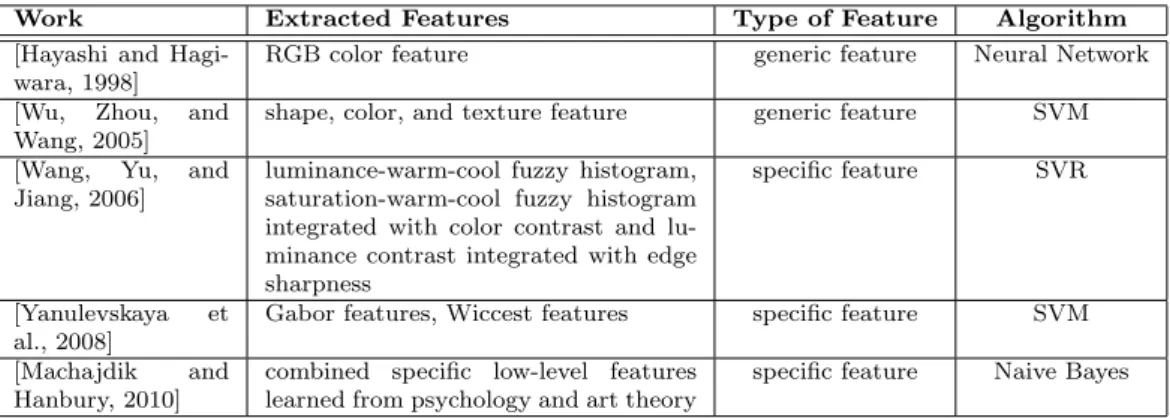
Unlike research in cognitive semantic space, most researchers in the field of emo-tive semantic image classification focus on effecemo-tive and special visual feature extraction in order to explore the emotion contained in images. The popularly adopted methods for emotive semantic annotation include Support Vector Ma-chines (SVMs), Neural Network, Random Forest, the C4.5 tree classifier and Naive Bayes classifier method. A summary of below introduced representative works in multi-label learning on emotive semantic space is provided in Table 2.1
Wang et al. [Wang, Yu, and Jiang, 2006] extract special integrated his-togram features and utilize support vector regression for automatically emotional image annotation. The authors analyze the emotional space and propose a scheme to annotate the image emotion semantic automatically and realize emotional im-age retrieval. Based on psychological experiments measuring evoked feelings by art paintings, they first identify an orthogonal three-dimension emotional factor space of image through 12 pairs of emotional words. Then, the following three specific image features are designed for each emotional factor to predict it. They are luminance-warm-cool fuzzy histogram, saturation-warm-cool fuzzy histogram integrated with color contrast and luminance contrast integrated with edge sharp-ness. The values of emotional factors can be predicted from the image features automatically by using support vector machine of regression (SVR). Finally, an emotion-based image retrieval system is designed and implemented, in which the users can perform retrieval using semantic words.
In the work of [Yanulevskaya et al., 2008], an SVM framework for supervised learning of emotion categories is first adopted with extracting the holistic image features. Then, the authors develop an emotion categorization system trained by ground truth from psychology studies. The training data contains emotional valences scored by human subjects on the International Affective Picture System (IAPS). The extracted specific features (Gabor features, the Wiccest features, or both) for each ground truth image are used to train a classifier to distinguish between the various emotional valences. For test the performance, the emotion classification system is applied to a collection of masterpieces. Although the re-sults are preliminary, they demonstrate the potential of machines to elicit realistic emotions as can be derived from visual scenes.
Machajdik et al. [Machajdik and Hanbury, 2010] investigate methods to extract and combine low-level features that represent the emotional content of an image from psychology and art theory views. Firstly, the authors exploit theo-retical and empirical concepts from psychology and art theory to extract image features that are specific to the domain of artworks with emotional expression. Then, they concentrate on determining the affect of still images and studying the extracted specific feature for the task of affective image classification. For classi-fication, they adopte the Naive Bayes classifier to annotate images with emotive concepts.
Besides focusing on extracting specific features for affective image anno-tation, many other works also employ the generic features to classify emotional images.
Hayashi et al. [Hayashi and Hagiwara, 1998] adopt the RGB color feature and classified the affective images through neural network. They developed a
im-Table 2.1: A list of the representative works in multi-label learning on emotive semantic space.
Work Extracted Features Type of Feature Algorithm
[Hayashi and Hagi-wara, 1998]
RGB color feature generic feature Neural Network [Wu, Zhou, and
Wang, 2005]
shape, color, and texture feature generic feature SVM [Wang, Yu, and
Jiang, 2006]
luminance-warm-cool fuzzy histogram, saturation-warm-cool fuzzy histogram integrated with color contrast and lu-minance contrast integrated with edge sharpness
specific feature SVR
[Yanulevskaya et al., 2008]
Gabor features, Wiccest features specific feature SVM [Machajdik and
Hanbury, 2010]
combined specific low-level features learned from psychology and art theory
sp