
H igh R ey n o ld s N u m b er V ortex Flow s:
V o r te x /R a y le ig h W ave In tera ctio n A n d
T h e C o m p ressib le L ead ing-E dge V o rtex
P h D T h esis
P h ilip p a G a il B r o w n
D e p a r tm e n t o f M a th e m a tic s
U n iv e r s ity C o lle g e L o n d o n
U n iv e r s ity o f L o n d o n
ProQ uest Number: 1 0 0 5 5 8 6 9
All rights reserved
INFORMATION TO ALL U SE R S
The quality of this reproduction is d ep en d en t upon the quality of the copy subm itted. In the unlikely even t that the author did not sen d a com plete manuscript
and there are m issing p a g e s, th e se will be noted. Also, if material had to be rem oved, a note will indicate the deletion.
uest.
ProQ uest 1 0 0 5 5 8 6 9
Published by ProQ uest LLC(2016). Copyright of the Dissertation is held by the Author. All rights reserved.
This work is protected against unauthorized copying under Title 17, United S ta tes C ode. Microform Edition © ProQ uest LLC.
ProQ uest LLC
789 East E isenhow er Parkway P.O. Box 1346
A c k n o w le d g e m e n ts
I am deeply indebted to my supervisor Professor Susan Brown, for her constant time, patience and guidance throughout the past four years. Her encouragement has always been invaluable and ensured th a t I completed this study.
A b s tr a c t
T he work undertaken in this thesis falls into two parts. The term ‘vortex’ is applicable to each, although rather in a different context. In P art I we discuss the stability of a lam inar boundary layer to inviscid Rayleigh p e rtu r bations of such an am plitude and on such a streamwise length scale th a t the m ean flow (the vortex) develops along with the perturbations (the wave). This phenomenon is term ed vortex/w ave interaction and the relevant equa tions (Hall and Smith 1991) have already appeared in the literature. In C hapter 1 of P a rt I we present a solution valid in the neighbourhood of the neutral point where the non-linear interaction is initiated. This the ory is illustrated by a representative boundary-layer profile and confirms the viability of the proposed structure. In C hapter 2 the same physical situation is examined but on a streamwise length scale th a t is, in term s of the Reynolds num ber R th a t is asymptotically large, even shorter. On this new length scale the Hall-Smith interaction equations do not apply, and the resulting am plitude satisfies an integro-differential equation. This is solved completely and is shown to possess solutions in addition to the one th a t m atches downstream onto the algebraic solution of C hapter 1. It is expected th a t the periodic self-persisting solutions found here may have relevance to lam inar turbulent transition.
C o n te n ts
P a g e
A ck n o w led g em en ts ii
A b str a c t iii
C o n ten ts iv
L ist o f F ig u res vi
P A R T I V o r te x /R a y le ig h W ave In te r a c tio n 1
In tr o d u c tio n 2
C h a p ter 1
Introduction 10
1.1- The Hall and Smith v o rtex /wave interaction equations 14 1.2- The core-flow solution for the vortex 20
1.3- The core-flow solution for the wave 23
1.4- The bufler-layer solution for the vortex 29 1.5- The buffer-layer solution for the wave 36
1.6- The equation satisfled by |7To|^ 41
1.7- The numerical solution of |7fo|^ for a representative basic flow 42 A ppendix A Analysis of the critical layer 60
P a g e
C h a p ter 2
Introduction 71
1.1- The equations of motion 74
1.2- The core-flow solutions for the vortex and wave 79 1.3- The vortex solution in the buffer layer 88
1.4- The wave solution in the buffer layer 95
1.5- The m atching and the final solution 104
1.6- The fundam ental equation 106
Appendix A Analysis of the critical layer 117
Appendix B The wall layer 131
C o n clu sio n s 135
R eferen ces 142
P A R T II T h e C o m p ressib le L ea d in g -E d g e V o rtex 146
C h a p ter 3
Introduction 147
1.1- The equations of motion 150
1.2- The outer solution 152
1.3- The inviscid outer solution as a suitable m atch 157
1.4- The inner solution 164
1.5- The numerical solution 174
C o n clu sio n s 184
L ist o f F ig u r e s
F ig u res P a g e
P A R T I Vortex/W ave Interaction
F ig u re 1 .1 ... 9
A sketch of the short scale and Hall and Smith vortex/R ayleigh wave in teraction regions
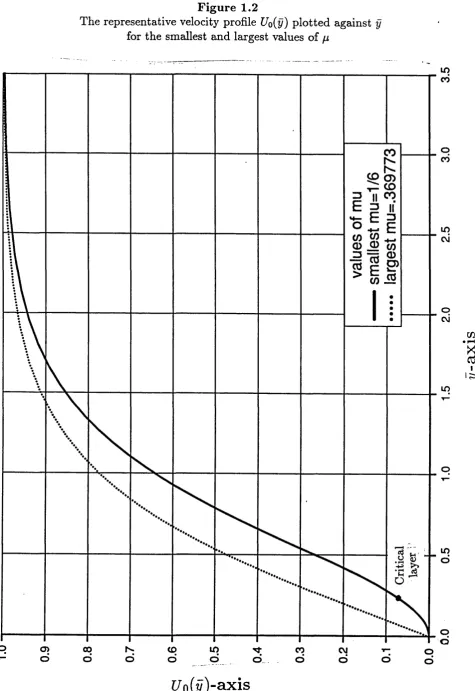
F ig u re 1.2. .55
The representative velocity profile Uo{y) plotted against y for the small est and largest values of y,
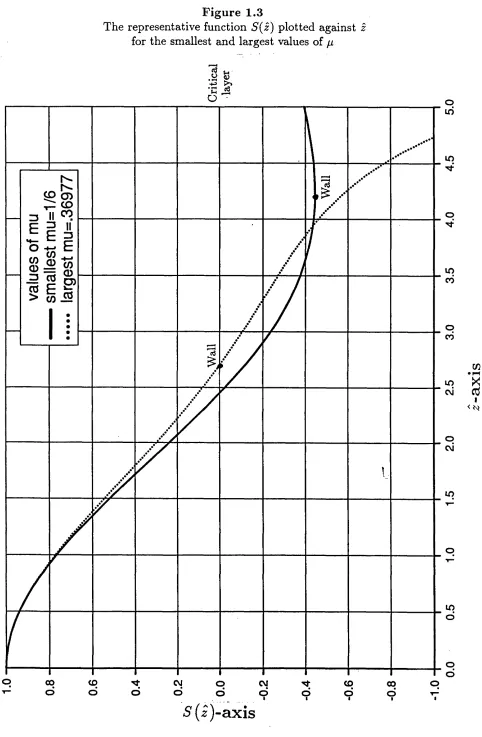
F ig u re 1.3. .56
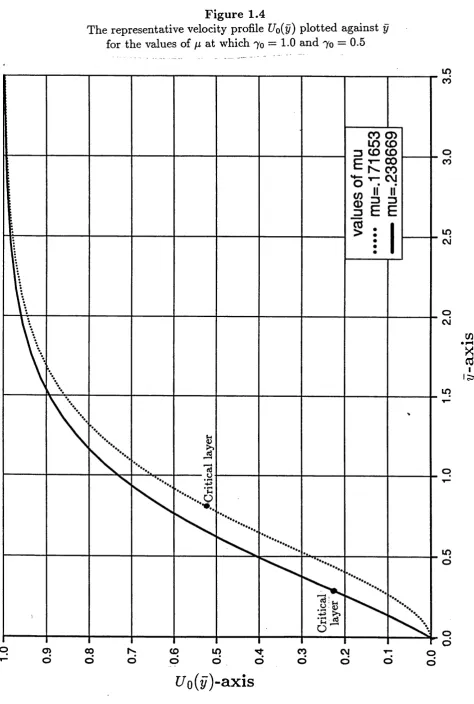
F ig u re 1 .4 ... 57
The representative velocity profile Uo{y) plotted against ÿ for the values of // at which 70 = 1.0 and 70 = 0.5
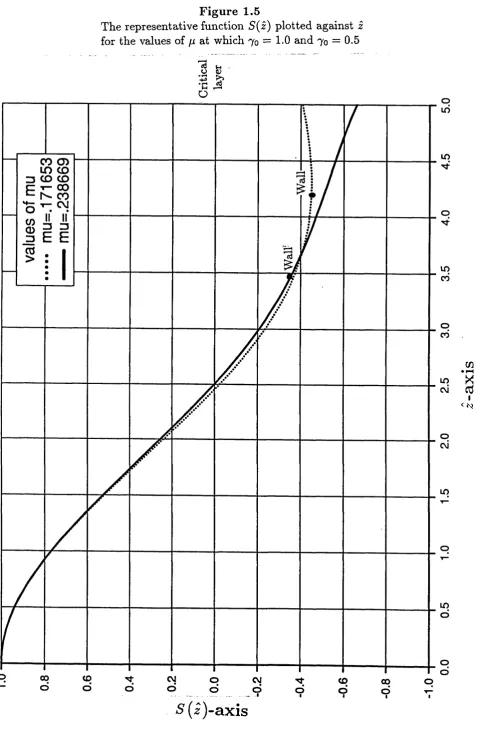
F ig u re 1 .5 ... 58
The representative function S{z) plotted against z for the values of // at which 7o = 1.0 and 70 = 0.5
F ig u re 1 .6 ... 113
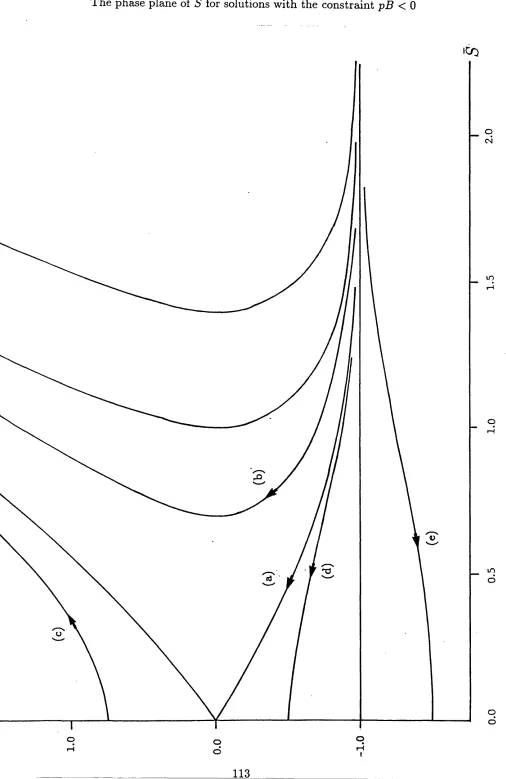
The phase plane of S for solutions w ith the constraint p B < 0
F ig u re 1 .7 ... 114
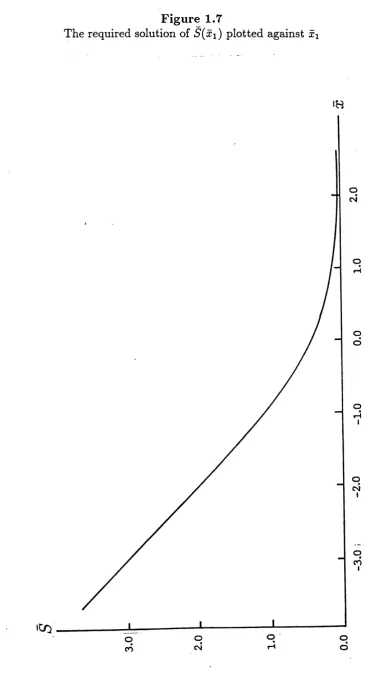
The required solution of 5 (^ i) plotted against Xi
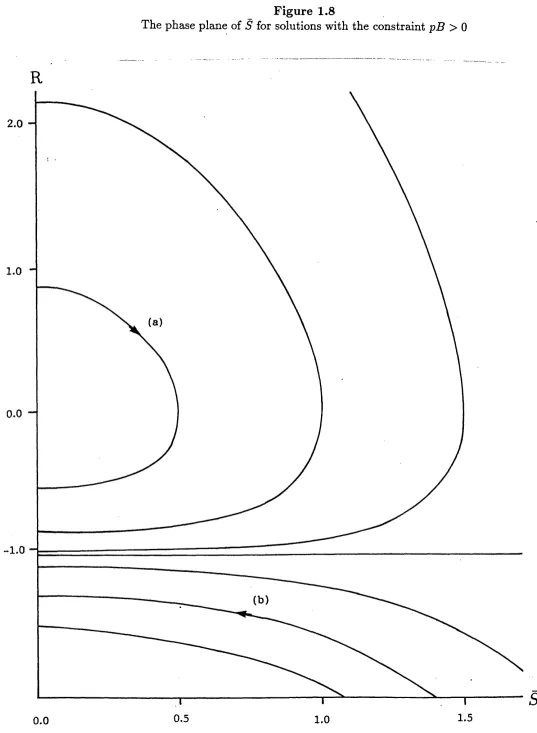
F ig u re 1 .8... 115
P A R T II T h e C o m p ressib le L ead in g-E d ge V o rtex
F ig u re 2 .1 ... 181
P A R T I
I n tr o d u c tio n
The value of descriptions of interactive boundary layer flows has been evi dent since the development of the triple-deck theory for steady flows some twenty or so years ago in, for example, the trailing-edge studies of Stewart- son (1969) and Messiter (1970). The development of the triple-deck theory was followed by the dem onstration of its possible applications to linear and non-linear stability theory as seen in Smith (1979a,b) and thereafter. The studies undertaken in this piece of work concern the concept of vortex-wave interaction. This type of interaction is a relatively new concept and con cerns the spatial development of a steady three-dim ensional vortex. The crucial p art of this wave-vortex interaction theory is th a t the development of this 3-D steady vortex is shaped by the coupling of this vortex and a short wavelength wave component with a prescribed frequency. It is pos sible th a t we could consider this type of vortex-wave interaction theory to be a rational description of the early stages of the mechanism of transition to turbulence in a boundary layer. This mechanism could also apply to transition to turbulence of flows in pipes or channels although these two particular problems are not actually considered here in this study.
non-linear solutions are split at present into two classes dependent on the behaviour of the wave, either the viscous Tollmein-Schlichting waves or the inviscid Rayleigh waves. Examples of the strongly non-linear vortex-wave interaction solutions are presented in studies by Hall and Sm ith (1991), Sm ith and W alton (1989,1992) and W alton (1991). The papers m entioned for both the weakly and strongly non-linear interaction cases cover a variety of flows and situations both for compressible and incompressible flows.
In this particular study we concentrate on the strongly non-linear interac tive vortex-wave theory where the wave m otion is of the inviscid Rayleigh type. The structure of this problem consists of a two-dimensional vortex in a boundary layer which is disturbed at some initiation point by a pair of equally inclined Rayleigh waves with equal am plitude. In flow schemes where the input disturbance is in the form of Tollmein Schlichting waves the initial velocity profile is three-dimensional. Although the case consid ered here is flow past a smooth wall the theory can be extended to include effects of roughness on the wall. The structure of the vortex/R ayleigh wave problem was first proposed by Hall and Smith (1991) for an interactive classical P ran d tl boundary layer. The Hall and Sm ith paper forms the basis of the studies presented in P art I and in particular of the solutions determ ined in C hapter 1. The problem proposed by Hall and Smith is for a compressible boundary layer flow; however, in the situation considered here the flow is taken to be incompressible and the theory has been extended to include other types of boundary layers such as the triple-deck interactive layer. In C hapter 2 we consider vortex/R ayleigh wave interaction, based upon the solutions obtained in C hapter 1, on a much shorter streamwise length scale. Although it seems th a t the shorter length scale vortex/w ave interaction leads to downstream structures th a t are more likely to occur in practice th an the Hall and Sm ith interaction, the studies in C hapter 1 are presented because they form the basis of the solutions determ ined in C hapter 2.
veloc-ity profile with an infiection point. In the Hall and Smith (1991) studies the boundary layer was restricted to the interactive classical P ran d tl type. However, in the studies presented here a more generalised boundary layer albeit with some restrictions is considered where this boundary layer could be of the triple-deck, the classical P ran d tl type or possibly a related form. The condition of the boundary layer with this particular infiection point profile represents a neutral point for the corresponding 2-D Rayleigh equa tion which possesses a non-trivial solution. It is at this neutral point th a t the 3-D non-linear interaction is deemed to begin. At the point of interac tion a critical layer is initiated and the vortex fiow develops d o w n stream ^ The 2-D infiection point condition is eroded as the three-dim ensionality of the vortex flow gradually develops downstream b ut the neutrality of the Rayleigh wave is preserved because the wave num ber remains real. The three-dim ensionality of the vortex evolves as the cross-flow derivative of the streamwise vortex component becomes non-zero. However, in this study we are concerned with the behaviour of the fiow in the neighbourhood of the initiation of the interaction. Therefore, although in C hapter 1 we see the erosion of the inflection point condition, we are sufficiently far enough up stream for this not to have a great effect on the solution obtained. In C hapter 2 however, where the region under consideration is much nearer to the neighbourhood of the initiation of the critical layer, the a:-scale is suf ficiently small th a t the inflection point condition and also the neutrality of the Rayleigh wave is preserved. We have m ade some assum ptions about the form of the wave such th a t for convenience we have defined the transverse component of the wave to consist of a single harm onic at the initial station. Therefore, the ^-dependency of the wave is taken as cos ^qz where z is a dimensional length scale to be defined later. The physical interpretation of this type of dependency is th a t the disturbance is in the form of two waves equally inclined to the streamwise direction of input w ith equal am plitude. There are higher harmonics such as cos also present in the transverse component of the wave but these harmonics are not considered here in this particular study.
This study is split into two distinct parts each described in C hapter 1 and Chapter 2. In C hapter 1 we consider the vortex-Rayleigh wave interac tion first proposed by Hall and Smith (1991). Although the solutions are considered in the neighbourhood of the initiation of the critical layer the instigation of the interaction is rather abrupt suggesting the need for ex am ination of solutions even nearer to the initial station. In fact the initial
station neighbourhood solutions are examined in C hapter 2 where the so lutions in C hapter 1 are considered to form the basis of the downstream behaviour of C hapter 2. In each of the chapters the flow solution is con sidered in four different regions; the core-flow region, the buffer layers, the critical layer and the viscous wall layer. These regions are m arked on the sketch Figure (1.1) at the end of this introduction. In this study R is defined as the global Reynolds num ber and is taken to be large throughout.
In C hapter 1 the areas under consideration are those m arked A,B and C on the sketch Figure (1.1) enclosed at the end of this introduction. The non-dimensional streamwise length scale in this region is considered to be
its derivation is deferred until Appendix A where we study the analysis of the critical layer. The presence of a viscous layer on the wall is also re quired so th a t there is no flow present on the wall. The wall in this study is assumed to be smooth but the theory can be extended to include effects of roughness and the implication of this is discussed in the conclusion of P a rt I. The solutions from this wall layer make no contribution to the algebraic equation describing the constant wave am plitude ttq. The wave am plitude equation is considered in detail and a representative streamwise velocity profile is considered in order to dem onstrate th a t actual solutions for ttq exist for a suitable range of wave number. These num erical examples also go to verify th a t starting solutions are possible for the strongly non-linear interaction under consideration.
be considered to be a constant and is in fact a function of the shorter length scale. The chief result obtained from the studies set out in C hapter 2 is an integro-differential equation describing the complex wave pressure ampli- tude where Xi is the scaled streamwise length employed throughout C hapter 2. The earlier sections of C hapter 2 are devoted to describing the solutions of the wave and vortex components in the outer core-flow solution where y ~ 0{R~^) and the inner viscous buffer layers sandwiched between the core-flow regions. As in C hapter 1 this thinner layer acts like a Blasius layer and so y ~ in this area. The analysis of the critical layer and the viscous wall layers is deferred until Appendices A and B respectively. The results obtained in these appendices are conjectured and quoted through out C hapter 2 and the function of the appendices is merely to provide the reader with details of the proofs of these conjectures. We obtain, from the analysis of the critical layer in Appendix A, the actual value of the jum p in the transverse shear stresses and, from the analysis of the viscous wall layer in Appendix B, th a t the no-slip condition implies th a t the wave pres sure derivative is non-zero on the wall. The last two sections of C hapter
2 address the wave am plitude integro-differential equation in a reasonable am ount of detail. In particular the penultim ate section of this chapter is devoted to the construction of the r(xi) equation and in the concluding section we analyze in detail possible solutions of a slightly more general form of this integro-differential equation.
initial flow structure as described in C hapter 2 and indeed alternative flow behavioui^other th an th a t described by Hall and Sm ith seem more likely.
We conclude P a rt I with a short section discussing the practical applications of th e studies carried out in C hapter 1 and 2. In particular we are interested in a more general form of the integro-differential equation describing the wave am plitude function generated in C hapter 2, w ith regard to alternative dow nstream solutions other th an the Hall and Smith flow scheme set out in C hapter 1. We also discuss additional work carried out on this topic since the w riting of this thesis and the repercussions resulting from new results.
F ig u ré 1.1
A sketch of the short scale and Hall and Smith vortex/Rayleigh wave interaction regions
S - i
<L>
5-, <U
CO
C O
c_>
5-«
<X> C O
V-4
C D
CO
CO
o II
ct;
I
iH
C O
C O
=)
O
CJ
C O
C hapter 1
T h e H a ll an d S m ith v o r t e x /R a y le ig h
w ave in te r a c tio n
In tr o d u c tio n
The structure of the problem and the motivations behind it have already been discussed in the joint introduction of Chapters 1 and 2. The present introduction covers the contents of Chapter 1 only and the structure and aims of each section. Initially we must define the dimensional variables. These dimensional variables are lengths (x*, y*, z*), time C, cartesian veloc ity components and the pressure/density ratio p*/p*. It is con venient to non-dimensionalise the lengths, time, velocity components and pressure/ density ratio with a representative length L* and a representative
speed U*. Thus we define {x, y, z) = (z*, y*, z*)/L*,t = t*U*IL*, (u, v, tc)=rJL_Ct'bu' , O ^
and p = p*/ p*(U*y. The Reynolds number, R, is taken to be large ancW is defined as R = z/* where v* is the kinematic velocity of the fluid. The region under consideration for the work undertaken in Chapter 1 is the region of x = 0 (1), where x is a variable to be introduced in Section 1 but essentially x = R~^x where there are certain restrictions on the value that
b may take.
con-ditions applicable to any boundary layer problem of this type and those with special conditions th a t are peculiar to a particular set of scalings. F i nally, the im portant jum p condition across the critical layer in the shear stresses is defined. The derivation of this discontinuity condition is deferred to Appendix A.
In Sections 2 and 3 we examine the vortex and wave component solutions respectively in the core-fiow region. This area is m arked A on the sketch Figure (1.1). It is not necessary to specify the w idth of this area other th an (Ij. ÿ = 0( i) and, as w ith the whole of this chapter, x = 0 (1).
^ The concerns of Section 2 are mainly with the basic streamwise velocity profile. Expansions about æ = 0 are set for the velocity and pressure components and solutions are determ ined for each coefficient. The leading and correction orders of the streamwise and norm al velocity components are then considered in the neighbourhood of the critical layer, which is defined to leading order as the point ÿ = do where do is a constant. Therefore, Taylor expansions are found for the leading order and correction terms.
In Section 3 we are concerned with the exam ination of the wave in the core-fiow region, namely with the wave pressure. The wave pressure is expressed as an expansion about x = 0 and the leading order term Po(ÿ)
and the correction term Pi(ÿ) are found to satisfy the Rayleigh equation and a forced Rayleigh equation respectively. Again the behaviour of these term s is examined in the neighbourhood of the critical layer where Po{ÿ)
is considered as a Taylor expansion and Pi{ÿ) is considered above and below the critical layer. It is the jum p in the value of the (ÿ — do)^ term in Pi as the critical layer is crossed th a t is the m ain point of interest; since this term is instrum ental in the construction of the wave am plitude equation discussed in Section 6. Finally, we conclude this section w ith a brief discussion concerning the constants th a t have arisen and their possible values.
O ur attention now focuses towards the buffer layer. This layer is sand wiched between the regions of the two previous sections. The area under discussion is th a t marked B on the sketch Figure (1.1). As w ith all the sections x = 0 (1 ) for this region but the buffer is a Blasius type layer so th a t we now have ÿ = 0{x^P).
In Section 4 we are concerned with the vortex solution in this Blasius type
layer. Firstly, for the sake of convenience the ÿ-variable is redefined accord ing to a P ran d tl shift. The Hall and Smith interaction equations are then rew ritten to incorporate this shift. We additionally define a new variable
77, for ease of calculation, so th a t in this Blasius type layer rj oc The solutions of the vortex are expressed as expansions of x whose coefficients are functions of rj only. It is sufficient to consider solutions as far as the
0 { x ‘^) coefficient of the streamwise velocity expansion since discontinuities across the critical layer first appear in this term.
The work in Section 5 is really a continuation of Section 4 w ith the same P ra n d tl shift and variable rj applying to the wave pressure equation. The wave pressure, like the vortex solution is expressed as an expansion of pow ers of X whose coefficients are unknown functions of rj. Successive differen tial equations are solved in order to determ ine these coefficients w ith the first discontinuous term across the critical layer appearing first at
The final derivation of the constants in this term arises from the jum p condition in the shear stresses across the critical layer.
Despite the fact th a t Section 6 is so short it is in fact the most im por ta n t section in this chapter. The discontinuous O( xY^ ) wave pressure term found in Section 5 is m atched to the appropriate O(xy^) wave term de term ined in Section 3 for the core-flow region. The aim of this m atch is to derive an equation for the constant wave pressure am plitude ttq. An algebraic equation for |7To|^ is obtained in section 6 and this equation is the main result of the work studied in this chapter.
The studies in Section 7 concern the exam ination of the |7fo|^ equation previously obtained w ith a view to obtaining num erical values of ttq. The aim of this numerical work is to investigate if reasonable solutions for |7fo|^ exist for a very simple representative profile. This basic flow profile is defined so th a t the wave pressure and the relevant boundary conditions are derived and applied accordingly. The structure of the basic profile w ith the two param eters /i and h invites the definition of a new variable z =
w ith graphs of the profiles relating to the four cases of fi^h considered.
Finally we arrive at the Appendices A and B concerning analysis of the critical layer and of the viscous wall layer respectively. The result of ap pendix A is the derivation of the jum p condition in the shear stresses. The secondary reason for the working of this analysis is th a t the critical layer behaviour determines the order of the perturbations of the wave d istu r bance in the core-flow regions. The critical layer analysis is long winded b u t basically it consists of expansions for the velocity and pressure compo nents and the successive differential equations to determ ine the coefficients of these expansions. The coefficients are determ ined as far as necessary in order to derive the jum p condition in the shear stresses. Although the working for this condition is set out in the Appendix A, throughout the rest of the chapter this result is merely quoted. Finally, in Appendix A is an argum ent as to the correct orders of the wave perturbation.
In Appendix B we are concerned with the viscous layer on the wall. The purpose of this layer is to smooth the cross-flow velocity component in the core-fiow region so th a t it is zero on the wall and to confirm the assum ption th a t the core-flow streamwise velocity correction term is zero as the wall is approached.
The results obtained in both the appendices are quoted throughout C hapter
1.1
T h e H a ll a n d S m ith v o r te x -w a v e in te r
a c tio n e q u a tio n s
The vortex-wave interaction equations derived by Hall and Sm ith in their 1941 paper are set out in this section. Initially dimensions,variables and the scalings required are defined. We then quote the velocity and pressure components w ritten by Hall and Smith followed by the vortex-wave inter action equations. The equations obtained by Hall and Sm ith were actually for the compressible case. However, in this study we are considering the incompressible case only and so the Hall and Sm ith vortex-wave interac tion equations quoted here are for the incompressible case. Then follows a discussion on the various boundary conditions which may occur; some of these boundary conditions are independent of the values of the x and
y-scales adopted. The Hall and Smith interactive equations are derived from the three-dimensional, unsteady Navier-Stokes equations.
The fiow th a t approaches the region in which the vortex-wave interaction is to take place is taken to be a steady two-dimensional z-independent boundary-layer fiow in the æ-direction over a boundary at y = 0. This condition can be generalised to include the situation of upstream fiow over a boundary at y = g(x) ie. fiow over a hump. However, this study examines only the simpler situation of a boundary at y = 0. The order of thickness of the boundary layer does not need to be prescribed in term s of inverse powers of the Reynolds number. This essentially means th a t the scale set for the y-coordinate does not need to be specified except for a few restrictions. The streamwise scale on which this boundary layer varies does not need to be prescribed either. However, some constraints as regards scaling m ust be satisfied and these restrictions are discussed below. Therefore, we write
y = R~^ÿ, (1.1a)
X = R~^x, (1.1b)
where we will require for the consistency of approxim ations to be m ade th a t ^ > 0 and 6 > b. The second of these requirem ents which arises from the condition <c 1, implies th a t the variations across the boundary layer are more rapid th an those along it. Examples of possible types of boundary layers th a t are appropriate to the scaling restrictions on 8 and b
The vortex-wave interaction equations are obtained by the imposition of a wave-like component on the boundary-layer flow^ T h is is chosen in such a way th at the previously steady two-dimensional^ow is substantially al tered to become three-dimensional unsteady flow. It emerges th at for this to take place the original 2-D flow must develop an inflection point and be come unstable to inviscid, Rayleigh-type 3-D perturbations. This wave-like component is characterised by a rapid oscillation on an z-scale comparable to the boundary-layer thickness and a corresponding time-scale. This re sults in disturbances that travel with a speed th at is to leading order th at of the streamwise flow in the boundary layer. The z-scale is also comparable to the boundary-layer thickness. We deflne
E = exp(i{aoX — ÇtT)), (1.2)
where Q. is a prescribed real frequency and oq is a real wave number yet to be determined. The scalings for T and X are
T = ( 1 . 3 a )
aoX
= 7 7 * - * 'j a(x)dx,
( 1 . 3 b )where a{x) is also real and yet to be determined. The scaling of the z-component is such th at the z-variation is of the same order as th at in the direction normal to the boundary layer so we write
z = R ^z. (1.4)
The Hall and Smith components of velocity and pressure are written as follows,
u = i î- '- ''+ “ {j/(Æ,ÿ,2)
+ n - ’’^^-'‘'^ l \ ü { x , ÿ ,z )E ^ c.c.)}, (1.5a)
v = R - ^^^ {v{ x, ÿ,z )
(1.5b)
W = R-^+‘{iü{x,ÿ, z)
+ 7?'(*“‘)/®(ùi(5, ÿ ,2)E + c.c.)}, (1.5c)
p = R-^-^<’+^‘{p{x) + R-^^‘-^^q(x, ÿ, 2)
+ 77-'('-4/G(p(æ, ÿ, z)E + c.c. )}. (1.5d)
w and p term s are the leading-order contributions to the vortex and the
Û, V, w and p term s are the leading-order contributions to the wave. The complex conjugates are also present for the wave in (1.5) and these term s are denoted ‘c.c’. The order of the disturbance, namely ^-i+(5f+b)/6^ ig determ ined by the solution in the critical layer and this point is discussed at the end of Appendix A. The wave p erturbation m ust never be greater th an the vortex flow itself and so consequently the restriction S > b m ust be imposed. We can describe various classical and boundary-layer problems by assigning particular values to 6 and h. However, details of these examples will be discussed later on in this section.
The Hall and Smith vortex-wave interaction equations are given for the compressible case in their 1991 paper. However, here we quote the in teraction equations for the incompressible case. For the vortex we obtain
ü x V ÿ + We = 0, (1.6a)
Ü Ü x + V Üÿ + W Ü z = —p \ x ) + Ü ÿ ÿ -I- Üez, (1.6b)
ü v x + v Vÿ - f w v e = — qÿ - f Vÿÿ -t- Ve z, ( 1 .6 c )
Ü W x + V W ÿ - f i VWE = — Qz + W ÿ ÿ - f WZE- (1.6d)
For the wave we obtain
i a û V ÿ ± ^ O (1.7a)
ia(ü — c)û + vü^-\-wüz = —iap, (1.7b)
ia(ü — c)v = —pÿ, (1.7c)
ia(ü — c)w = —pz, (1.7d)
where
(1-8)
and c{x) is real function.
The four equations w ritten in (1.7) are rearranged to elim inate u , v and
w. Thus, we obtain a single equation for the wave pressure term p. This equation in fact turns out to be the Rayleigh equation and it is w ritten as
We now consider the boundary conditions for our problem. These con ditions can be separated into those th a t apply generally for any scaling within the appropriate range and those th a t are particular to a specific set of scalings. We consider the general boundary conditions first where these conditions apply for all values of 6 and b so long as ^ > 6 and 6 > 0. The boundary conditions at ÿ = 0 are
u = V = w = 0 at ÿ = 0, (1.10a)
Pÿ = 0 at ^ = 0, (1.10b)
and the general condition as ÿ becomes large
p 0 as ÿ ^ CO . (1.10c)
Now we consider the particular boundary conditions appropriate to a spe cific set of scalings. These conditions concern the behaviour as p —> oo and depend on the problem under consideration. The type of problem deter mines the type of boundary layer th at is developing the unstable infiection point. Three examples of these types of problems and their associated boundary conditions as ÿ oo follow below.
1. The classical P ran d tl boundary layer: This boundary layer has the values 8 = 1/2 and 6 = 0 in (1.1a) and (1.1b) respectively. The pressure gradient p \ x ) is prescribed and the boundary conditions as ÿ GO are ^ p ' Cvl'i
ÜÜ5 - p \ x ) , (1.11a)
w ^ 0. (1.11b)
2. Triple-Deck boundary layer: For an interactive boundary layer of stan d ard triple-deck type, we have ^ = 5/8 and b = 3/8 in (1.1a) and (1.1b) respectively. The boundary conditions as ÿ oo are
ü - ^ ÿ - Â ( x ) , (1.12a)
w ^ O , (1.12b)
3. Hydraulic jum p: The hydraulic jum p situation of G ajjar and Sm ith (1983) can be described by taking 6 = 2/5 and 6 = 0 in (1.1a) and (1.1b) respectively. The boundary conditions as ÿ ^ oo are
ü ^ ÿ - \ - p ( x ) , (1.13a)
w 0. (1.13b)
The velocity and pressure component expansions in the Hall and Sm ith paper were actually w ritten for the classical P ran d tl boundary-layer case,
8 — \ j2 and 6 = 0; however these expansions have been extended here in (1.5) to include the general case of any b and 6 as long as 6 > 6 and 6 > 0.
T he work undertaken in this study mainly concentrates on the development of the flow in and around the region of the critical layer. The critical layer is defined as the curve
y = f { x , z ) where ü(x^ÿ^z) = c{x). (1.14)
There is a further linking condition between the vortex equations (1.6) and the Rayleigh wave equation (1.9). This linking condition, as shown by Hall and Sm ith (1991), is crucial and it is also independent of the particular values chosen for 6
and 6 such th a t the linking condition is the same regardless of which of the previously mentioned, or any other, example is chosen.
F urther requirem ents at this critical layer are th a t ü, Ug, üÿÿ, v, w and (v — fzw)g are continuous across ÿ = f ( x , z ) . The inflection point condition th a t
The jum p condition for the shear stresses is, as shown in Appendix A,
'dw' + 1 'dv' +
[ d y \ i m
where
«6/3^5
The
A
and the function a are defined asA = 1 + /I,
Ao " A ’
= J(T ,Z ), (1.15a)
a =
(1.15b)
(1.16a)
(1.16b)
and the A term is defined as the stream wise shear stress at the critical layer such th a t we write
at (1.16c)
It can be seen from (1.15) th at this jum p condition is the linking equation between the vortex and wave flows. The vortex and the wave are linked by the cross-flow derivatives of the wave pressure in the square brackets of (1.15b) to the cross flow shear stress in (1.15a). The analysis of the critical layer and thus also the derivation of the jum p condition in (1.15) is discussed in Appendix A for the more general case of S and b and also in greater detail th an by Hall and Smith.
1.2
T h e co re-flo w s o lu tio n for t h e v o r te x
In this section we describe the solution obtained for the vortex in the core- flow region. The area under question in this and the next section is th a t marked A on the sketch Figure (1.1). Here in the core-flow region, where
0 < ^ <C 1, we also have ÿ — f ( x , z ) = 0 (1 ). At Æ = 0 the flow is z- independent with a streamwise velocity profile Uo{y) and we know th a t at the initiation of the critical layer this profile has an inflection point. Therefore, near ÿ = do we can consider the profile Uo(y) to have the form
°° b
Uo{ÿ) = Co + bi{y — do) -f ^ ~^{y — oq)” , (2.1a) n=3
where the are constants and
do = / ( 0 ,z ) , (2.1b)
Cq = c(0). (2.1c)
Here do and cq are both constants and c(x) is as defined in (1.8).
The leading-order correction to the basic profile Uo{ÿ) is 0{x). Thus, we find th a t the core-flow solution expansions, when 0 < Æ <C 1, have the form
Ü = U o { y ) x ü i { ÿ , z ) , (2.2a)
= %(ÿ) + z) + . . . , (2.2b)
w = x w i { ÿ, z) + . . . , (2.2c)
Px = Po + Xp2 , (2.2d)
P = Q o { ÿ , z ) , (2.2e)
where po,p2 • • • are constants.
The above vortex expansions are substituted into the vortex equations (1.6) and to leading order we obtain
-\- Voÿ = 0, (2.3a)
^0^1 + vo^o ~ ~Po "b Uq, (2.3b)
T h e l e a d i n g - o r d e r e q u a t i o n s a r e s o l v e d t o g i v e
(£
+
5
)
’w h e r e
'
d e n o t e s t h e d e r i v a t i v e w i t h r e s p e c t t oÿ
a n d V q i s a c o n s t a n t t h a ti s t h e v a l u e o f t h e n o r m a l v e l o c i t y a t t h e i n i t i a t i o n o f t h e c r i t i c a l l a y e r . I t
i s e a s y t o o b t a i n
ui
f r o m ( 2 . 3 a ) a n d ( 2 . 4 ) a n d s o w e h a v e(“ I
F i n a l l y , f r o m ( 2 . 3 c ) w e h a v e
w i = (2.6)
I/O
It is convenient at this point to m ention the behaviour of the flow near the wall. This is discussed in much more detail in Appendix B where the viscous wall layer is examined. Essentially, the purpose of this viscous wall layer is to sm ooth the core-flow vortex so th a t ü = v = w = 0 on the wall. There are two m ain results obtained from from Appendix B. The first is to show th a t the core-flow correction term üi m ust be zero as ÿ —> 0. Further on in the chapter in Section 7 we will require the numerical value of the constant Vq and this constant is calculated from the condition th a t üi = 0 at ÿ = 0. The second result of the wall layer studied in Appendix B is th a t we obtain a solution th a t is zero on the wall and matches to the core-flow cross-flow component Wi. This term is necessary since it is easy to see th a t for a non-zero qoz the solution Wi would have singularities at ÿ = 0 because of the Î7o(0) term if this wall layer were not present.
It is noted th a t the early term s of the core-flow vortex expansions are z-independent and continuous through the critical layer ÿ = clq. The con tinuity of Vq is determ ined by the buffer layer as discussed later in Section 4 . To effect a m atch with the buffer layer we shall need the result th a t
has the form near ÿ = clq
'Wi(ÿ) = do-\- di{y — do) -f ^— h . • ., (2.7a)
where
do = —{po + biVo)/co, (2.7b)
di = bs/co, (2.7c)
1.3
T h e core-flow s o lu tio n for th e w a v e
We now address the solution for the wave in the core-flow area. This region is marked A on the sketch Figure (1.1). The wave solution is described in term s of the wave pressure term p and the equation of m otion for this term is the Rayleigh equation (1.9). The neutral eigensolution for this equation does not exist upstream of the start of the critical layer and so we are interested in the value of the eigensolution at the initiation of the critical layer at Æ = 0. It is assumed th at this eigensolution has a periodic
2-dependence of cosj^QZ. The term we shall require is the 0 { x ) correction term to the leading harmonic. Therefore, we w rite p the wave pressure term in (1.5d) as
p { x , y , z ) = TTo{Po{y) -f xPx(ÿ)) cos (3qz 0{x). (3.1) The 0 { x ) includes higher harmonics such as cos3^o^ forced by the buffer layer but we will not be considering these harmonics in this section. The wave am plitude term ttq is a constant. The flnal aim of this chapter is to present an algebraic equation for ttq. This equation is presented in Section
6 and possible numerical solutions for tto are examined in Section 7.
The wave expansion (3.1) is substituted into the Rayleigh equation (1.9). The boundary conditions applicable to this equation are (1.10b) and (1.10c). Thus we obtain an equation for Pq and it is
(Cfo - co)(f^' - 7gfo) = (3.2a)
with
fo(0) = 0, (3.2b)
< j ,
A
- f o ( c o ) = 0 , ( 3 . 2 c )C o v p « A h b o i o o W . where 7q is denned as
7o “ ^0 /^05 (3-3)
and this value is determ ined by the particular eigenvalue problem.
We are able to express Po(y) as an expansion of powers of (ÿ — do) near to the point ÿ = do. We normalise Pq on the critical layer, for the sahe of convenience, so th at Po{do) = 1. Therefore, near ÿ = do we have
7 1= 2
where to m atch with the buffer layer we will need the first few coefficients of Çn. These values are
Ç2 = ~7o, ( 3 . 5 a )
=
n o t c o m p l e t e l y d e t e r m i n e d b y t h e c r i t i c a l l a y e r , ( 3 . 5 b )Ç4 — ~ 7 o ( ^ 7 o + 4 6 3 / 6 1 ) , ( 3 . 5 c )
Ç5 = 9 3 ( 2 7 0 + 4 6 3 / 6 1 ) — 3 7 0 6 4 / 6 1 . ( 3 . 5 d )
The Ç3 term , although undeterm ined at this stage, is not actually arbitrary.
It is determ ined by numerically solving the Rayleigh equation for Po (3.2a) with the associated boundary conditions. An example of this solution is discussed later in Section 7 where a particular profile is studied to solve the wave equation (3.2a) numerically.
Now, we wish to find the solution for the correction term Pi(ÿ) from the wave pressure expansion (3.1). As before, the wave expansion (3.1) is substituted into the Rayleigh equation (1.9) and the correction term s of
0 { x ) are collected. Thus, we obtain the equation for P i (Po - Co)(P" - 7oPi) - 2U'Pi = 2u[P'
— { u i — C2 ) { P q — 7o-Po)
+ 2ooCK2(Po — co)Pq, (3.6)
where C2 and 02 are the 0 { x ) correction term s of c{x) and a{x) such th a t
c{x) = Co + C2X + 0{x^), (3.7a)
a{x) = a o Œ2X O(x^). (3.7b)
The definition given in (1.8) between c(x) and ce(^), since O is a real prescribed constant, gives the relation between C2 and a2 as
C2CK0 CqO!2 — 0* (3.8)
The solution to the homogeneous equation of (3.6) is already known and it is Pq. Therefore it seems sensible to rewrite Pi in term s of a factor of Pq and another function of ÿ. Thus, we write
Pi(ÿ) = Po{ÿ)Qi{ÿy (3.9)
The above expression is substituted into (3.6). The resulting expression is rearranged to obtain
d ( Q \ P l \ ( P P 5 ) P o
where ( R H S ) denotes the terms on the right hand side of equation (3.6) and they are
(^RH S) — 2u-^Pq — (îii — C2){Pq — 'JqPo) + 2cKoa2{Uo — C2)Pq. (3.10b)
The expression for Q[ is integrated with respect to ÿ above and below the critical layer. Thus, for ÿ > do we have
Q[P^ fÿ (RHS)Po (Uq— CqY Joo {Uq— C o)
and for ÿ < do we have
Q[P^ fÿ (RHS)Po
- f a » . .
( U o — C q ) ^ J o ( U o — C q )"
with the boundary conditions
Pi(oo) = P/(0) = 0. (3.12)
We m ust now examine Pi with the view th a t it m ust be m atched to the wave solution in the buffer layers above and below the critical layer. Since the expression for P% is derived from the two integrals (3.11a) and (3.11b) we therefore require the behaviour of the integrands involved in these two expressions as ÿ d o . It can easily be obtained from (2.1a), (2.7a) and
(3.4) th a t near ÿ = do
where
a_3 = 2q2{c2 — do)/6i, (3.13b)
ct-2 = (93(^2 — do) — 2ao^iC2/co)/6i, (3.13c)
= I ( i t ■ ^
It is shown in the next section from the m atch between the vortex solutions in the buffer layers and the core-flow regions 'VhCtt tW (tx/\^ûi/VK
Wl3c \KlWP o t d 'l %v\ is to be
zero. This means th a t Pi is regular at d o where it takes the form as ÿ ^ Uo
where are constants th at take different values above and below the critical layer. It is the difference between and G~ th a t will be required later. In fact
r + = n ( _ q-3________q-2 \
Joo \((7o — (ÿ — doY (ÿ — d o y J
^ (T o + ^3/61), (3.15a)
and
r ~ = r ° ( _ Q -3__________a - 2 \
Jo \((7o — (ÿ — doy (ÿ — doy J
Thus, the value th at we shall require later is
A brief discussion concerning the constants and their values th a t have ap peared in this and the previous sections is appropriate at this point. The properties of the boundary layer th a t reaches the inflection point at 5 = 0
are assumed to be known for the upstream flow at æ < 0. Therefore, the streamwise velocity profile Uo{y) is known and hence the constants in the expansion (2.1a). The values do and Cq are also known and they are defined as follows. The value of ÿ when U^Ky) = 0 is do and Cq is the value of Uo at the same point. Thus
^0 (do) = 0, (3.17a)
Uo{do) = Co. (3.17b)
The constants po and Vo from (2.4) are determ ined by the boundary con ditions at ÿ ^ 00 and a m atch with a viscous layer on the wall. Essentially, Po = Uq{0) and "Vo is determ ined by üi(0) = 0. Therefore, the dn in (2.7a) may all be regarded as known.
that, with the exception of ^3, the rest of the displayed in (3.4) are now known. The unknown constant is determined by actually numerically integrating (3.2a) with a known basic profile Uo[y) and the application of the associated boundary conditions (3.2b) and (3.2c).
In the following two sections the vortex and wave solutions are investigated in the buffer layers where we still have 0 < Æ <C 1 but the buffer layers are of Blasius type and we now have ÿ = 0(.t^/^). The solutions obtained in the successive two sections must match to the core-flow solutions already obtained here and in the previous section. The final result of this m atch will be the derivation of an algebraic equation for the constant wave amplitude pressure ttq. This result is described in Section 6. However, on the way to this result the match between the buffer layers and the core-flow layers will also determine the 0 { x ) perturbation of the position of the critical layer. We have for the critical-layer curve and c(x)
/(Æ, z) = db + Tdg + :r^d4( z ) . . . , (3.18a) c(x) = Co + XC2 + Æ^C4 + ... , (3.18b)
where the match between the buffer and core-flow regions will determine the values of and cg, and hence og. It turns out th at d^ is independent of z.
. The deduction that d] is a constant is made in Section 5 where the ^ wave solution is examined. It turns out that for the*wave pressure solution to be regular in the buffer layer that, in general, «2 is a constant. Two examples of values of d] are the flat critical layer and the non-flat critical layer discussed below.
If the basic flow happens to be such that the critical layer is flat then
02 is zero. It emerges then that the coefficients in (2.7a) are such that
do = C2 and d2 = 0. Hence, æüi(do) at the inner edge of the core regions
is also the value of { Uq — Cq) at the critical layer ÿ = do. Thus, to leading
order the xui{do) term is C2X. The flat critical layer implies th at c?2 = 0
which determines th at ÿ = do remains an inflection point of ü in the core to 0 ( x ) . On the other hand for a non-zero dij, which denotes a non-flat critical layer, the relations do = C2 and d2 = 0 are modifled by the non-zero
02 term. The statem ents regarding the value of (Uo — Cq) on the critical layer are still correct, with the equation for the critical layer now w ritten as
ÿ = do d2X. The critical layer is initially the inflection point level of the
from the üz term , this inflection point is eroded. It is easy to show th a t the values do = C2 and dg = 0 given for the flat critical layer will determ ine
th a t a_i in (3.13d) is zero as required. This result also holds for a non-flat critical layer where do and dg are modifled.
1 .4
T h e b u ffer-la y er s o lu tio n for t h e v o r te x
The buffer layer is sandwiched by the core-flows of the previous two sec tions. The critical layer is contained within the buffer layers as a surface of discontinuity. These layers are Blasius type layers so th a t although we still have 0 < Æ <C 1 we now have ÿ = The continuity conditions dis cussed above (1.15) are still valid across this surface. The jum p condition (1.15) is also applied across the critical layer.
It is convenient to redefine the ^-variable and ?;-component so th a t the
y-variable is zero at the critical layer. Therefore, the new y-variables Ÿ and V
are defined according to the P ran d tl shift
ÿ = ÿ - / ( ^ , ^ ) , (4.1a)
V = V - f ^ü - fzW, (4.1b)
so th a t the critical layer is now at the level ÿ = 0. Under consideration of the above transform ations the x and z-derivatives are rew ritten as
The above Prandtl-shifted variables and the transform ed derivatives are substituted into the vortex equations of m otion set out in (1.6). Thus, the rew ritten vortex equations are
'^x T “h — 0) (4.3a)
üüx T ÜV.Ÿ + wüz = ~Px + (1 + / f )^yF T üzz
— fzzÜŸ — ^fzüÿz, (4.3b)
ÜVx -\-Vv ÿ-\- WVz = —ÿÿ + (1 + fV)^ŸŸ T ^ZZ
— fzz^Ÿ ~ ^fz^Ÿz-i (4.3c)
üiVx -\-Vw ÿ + wWz = - ÿ z -f fzÿŸ
+ (1 + Ie)'^ŸŸ +
~ f z z ^ Ÿ — ^fz'i^Ÿz- (4.3d)
T h e i n f l e c t i o n p o i n t c o n d i t i o n i s e r o d e d b y t h r e e - d i m e n s i o n a l e f f e c t s a s t h e
f l o w c o n t i n u e s d o w n s t r e a m s o t h a t w e c a n o n l y s a y t h a t ü y y i s c o n t i n u o u s
a c r o s s t h e c r i t i c a l l a y e r . I n f a c t i t t u r n s o u t t h a t
üÿÿ
= 0 t o 0{x^).
T h e d i s c o n t i n u i t y c o n d i t i o n ( 1 . 1 5 ) i n t h e s h e a r s t r e s s e s i s n o w w r i t t e n a sdw
a y
w h e r e
J{x^z)
i s a s i n ( 1 . 1 5 b ) ,The solution of this buffer layer is sought, as in the previous sections, in the region 0 < Æ <C 1. The y-variable is however different from the previous sections since Ÿ = 0(æ^/^), The m otivation for Ÿ = 0(æ^/^) is th a t to balance viscous and inertial term s in the æ-momentum equation of m otion (1,6b) we require
_du
ü-qZ ~ ÜŸŸ' (4.5)
The behaviour of ü to leading order is the constant Cq. The above expression is balanced to give Ÿ = /cq^^). The solution m ust also m atch the core-flow solutions found in Sections 2 and 3. Thus, the m atch condition is th a t as Ÿ ^ ±oo the buffer layer solutions m ust m atch the vortex and wave core-flow solutions as ÿ —> f ( x , z ) .
W ith regard to the order of Ÿ we deflne the new variable r] such th a t
- I d ) " ’
. Therefore, we attem p t a solution of the formÜ = Co + biŸ + xÜ2(r]) + -\- x ‘^ü^{r], z) 4 - . . , , (4,7a)
V = 4 n z) + . . , (4.7b)
^0
W = x^^^w i{t],z) - \ - . . . , (4,7c)
Px = P o + p2X + . . . , (4.7d)
q = q o { r ] , z ) - \ - (4,7e)
and we also take
f { x , z) = âo + d2X + 0{x^). (4,7f)
appear until 0{x^) and for V does not appear until 0{x) . Essentially ü
and V rem ain independent of z until they are affected by the cross flow
w. The 61, Po and p2 are all constants which have previously appeared in
(2.1a) and (2.2d). The constant «q in (4.7f) is the inflection point of the profile î7o(ÿ) expressed in (2.1a) and this constant is defined in (2.1b). It will emerge th a t «2 is also independent of z from calculations in the next section. It emerges th a t if «2 is not a constant then the wave solution in the buffer layer is irregular. Therefore, the z-dependency in f { x , z ) is deferred at least until the 0{x^) terms.
The solutions (4.7) and the new variable 77 are substituted into the P randtl- shifted equations for the vortex (4.3). Successive powers of x are collected to form a set of differential equations dependent on rj and z. It is the coefficients of ü th a t we are interested in since these will be th e factors th a t drive the Rayleigh equation expressed in (1.9). It is necessary to determ ine the streamwise coefficients up to and including {^4(77, z). Thus, the equations necessary to determ ine the required coefficients in (4.7a) are as follows. From the continuity equation we have
vot, = 0, / (4.8a) «2- ^ + ^ = 0, - (4.8b)
+ ÿ + = , (4.8c)
Equating powers of x, from the æ-mom entum equation, we obtain
4
U2riT} + “2,r)U2n ~ 4u2 = —(po T /^i%), (4.9a) Cq
Üzrm + 277Ü3^ - 6Ü3 = — ( m ^ l + 7 7 o ^
Cq Z
-f- 2p4p%2 - fJ>ir)^Ü2r,), (4.9b)
Ü4r}rt + 277Ü4;; — 87/4 = —(p2 + fJ-lV2 +
Cq Z
+ V o ~ + Ü 2 ( û i - J } û i j 2 )
+ - W 3r,)), (4.9c)
where we have w ritten for convenience
hi
d/2 -
0
S u c c e s s i v e p o w e r s o f
x
a r e a l s o e q u a t e d f r o m t h e F - m o m e n t u m e q u a t i o n ;h o w e v e r n o t h i n g n e w o f i n t e r e s t i s g a i n e d . T h e l e a d i n g a p p r o x i m a t i o n i s i n
f a c t
V
o
tj
=
0 w h i c h w e h a v e a l r e a d y o b t a i n e d f r o m t h e c o n t i n u i t y e q u a t i o na p p r o x i m a t i o n s . T h e s e c o n d a p p r o x i m a t i o n o f t h e F - m o m e n t u m e q u a t i o n
d e t e r m i n e s t h e l e a d i n g t e r m o f
q
a n d i sqon =
0 . T h e i n i t i a l a p p e a r a n c eo f ^ - d e p e n d e n c y o c c u r s i n t h e l e a d i n g a p p r o x i m a t i o n o f t h e ^ - m o m e n t u m
e q u a t i o n . T h u s , w e o b t a i n f r o m t h e ^ - m o m e n t u m e q u a t i o n
W
irjr,
+ 2r]W
irf ~
2wi =
0 . ( 4 . 1 0 )T h e a b o v e e q u a t i o n f o r
W
i
i s i m p o r t a n t b e c a u s e i t i s t h e z - d e p e n d e n c yi n t h i s t e r m w h i c h f o r c e s t h e
O(x^)
t e r m o f t h e s t r e a m w i s e f l o w t o b ez-d e p e n z-d e n t a n z-d h e n c e a l s o z-d i s c o n t i n u o u s a c r o s s t h e c r i t i c a l l a y e r .
T h e f i r s t f e w c o e f f i c i e n t s o f t h e v e l o c i t y c o m p o n e n t s i n ( 4 . 7 a ) a n d ( 4 . 7 b )
a r e e a s i l y f o u n d . T h e e q u a t i o n s ( 4 . 8 a ) , ( 4 . 9 a ) , ( 4 . 8 b ) a n d ( 4 . 9 b ) a r e s o l v e d
t o o b t a i n
V
q
,
Ü 2 , f i i a n d Ü 3 r e s p e c t i v e l y . T h e s e s o l u t i o n s , a s d i s c u s s e d b e l o w( 4 . 3 ) , m u s t b e c o n t i n u o u s a c r o s s t h e c r i t i c a l l a y e r 77 = 0 a n d t h e s o l u t i o n s
m u s t a l s o m a t c h t h e c o r e - f l o w s o l u t i o n s i n t h e n e i g h b o u r h o o d o f ÿ = d o -
T h e m a t c h o c c u r s a s 77 ^ 0 0 i n t h e b u f f e r l a y e r a n d t h e c o r e - f l o w s o l u t i o n
i s e x p r e s s e d i n t e r m s o f 77. T h u s , t h e s o l u t i o n s a r e f o u n d t o b e
V o =
c^^iVo
-CL2C0),
( 4 . 1 1 a )Ü2 =
— ( 6 1 ( F ) “ G 2 C 0 ) 4 - P o ) , ( 4 . 1 1 b ) CoVi =
— ( 6 1 ( F ) — d g C o ) + P o ) , ( 4 . 1 1 c ) Co^ 3 = ^ ( ^ + ^ ) , ( 4 . 1 1 d )
Co
^
w h e r e
V
q
i s t h e c o n s t a n t i n t r o d u c e d i n ( 2 . 4 ) . T h e c o n s t a n t v a l u e o fV
q
w a s c h o s e n s o t h a t i t m a t c h e s t o t h e o u t s i d e s o l u t i o n . T h e f a c t o r
a r i s e s f r o m t h e d e f i n i t i o n o f
Ÿ
a n d t h e e x t r a 0 2 c o t e r m i s f r o m t a k i n g i n t oa c c o u n t t h e P r a n d t l - s h i f t d e f i n e d a t t h e b e g i n n i n g o f t h i s s e c t i o n . T h e
Ü 2 ,
Vi
a n dÜ3
s o l u t i o n s f o l l o w f r o m t h e i r r e s p e c t i v e e q u a t i o n s w h e r e t h ec o n s t a n t i n Ü 3 i s d e t e r m i n e d b y a g a i n m a t c h i n g t o t h e c o r e - f l o w s o l u t i o n i n
t h e n e i g h b o u r h o o d o f ÿ = d b ; t h i s c o n s t a n t i s f o u n d t o b e 6 3 . T h u s , w e c a n
a l s o d e t e r m i n e t h e v a l u e o f t h e c o e f f i c i e n t C2 i n t r o d u c e d i n t h e e x p r e s s i o n
77 = 0 . T h e r e f o r e , f r o m ( 4 . 1 1 b ) w e o b t a i n
- 1
C2 = ( ^ l ( ^ — C t2C o) +
Po)-
( 4 . 1 2 ) CoW e n o w t u r n o u r a t t e n t i o n t o t h e e q u a t i o n f o r
W
i
a s s e t o u t i n ( 4 . 1 0 ) .T h e l e a d i n g t e r m o f t h e
w
c o r e - f l o w s o l u t i o n d i s c u s s e d i n ( 2 . 2 c ) i s o f 0(x);
t h e r e f o r e t h e l e a d i n g t e r m o f t h e b u f f e r - l a y e r s o l u t i o n f o rw
m u s t v a n i s ha s 77 — > ± 0 0 s o t h a t a c o r r e c t m a t c h o c c u r s i n t h e c r o s s - f l o w c o m p o n e n t s
b e t w e e n t h e t w o l a y e r s . A s d i s c u s s e d i n a n d a b o v e ( 4 . 4 )
w
i s c o n t i n u o u sa c r o s s t h e c r i t i c a l l a y e r 77 = 0 b u t t h e d e r i v a t i v e o f
w
w i t h r e s p e c t t o 77 i sd i s c o n t i n u o u s a t 77 = 0 w i t h a z - d e p e n d e n t j u m p a c r o s s 77 = 0 . T h u s , s o l v i n g
t h e
wi
e q u a t i o n ( 4 . 1 0 ) t o g e t h e r w i t h t h e b o u n d a r y c o n d i t i o n s d e s c r i b e da b o v e w e o b t a i n
wi = Ei{z)
^77erf(r])
^ ^ , ( 4 . 1 3 )a c c o r d i n g a s 77 > 0 o r 77 < 0 . T h e a s y e t u n k n o w n f u n c t i o n
Ei{z)
w i l lb e r e l a t e d t o t h e z - d e p e n d e n t j u m p c o n d i t i o n a c r o s s t h e ^ r j t i c a l l a y e r s o
t h a t f u r t h e r o n i n t h i s c h a p t e r w e w i l l b e a b l e t o s t a t e a r e l a t i o n b e t w e e n
Ei{z)
a n dJ(x^z).
T h e c o e f f i c i e n t sV2
a n d Ü 4 i n ( 4 . 7 ) a r e f o r c e d b ywi.
T h e s e t w o v a l u e s c a n n o w b e d e t e r m i n e d f r o m e q u a t i o n ( 4 . 8 c ) a n d ( 4 . 9 c )r e s p e c t i v e l y . H e n c e , s o l v i n g t h e e q u a t i o n f o r
V2
t o g e t h e r w i t h c o n t i n u i t yc o n d i t i o n s t h a t
v
a n dVrj
a r e c o n t i n u o u s t h r o u g h 77 = 0 , w e t h e r e f o r e o b t a i n2 6 3 2 , 1 / 2 , ^ 2 — 3 / 2 ^ T
^0
^ 2^0
- E[(z)
^77^erf(r])
+
^ 6 7 ^ ( 7 7 ) ! , ( 4 . 1 4 )a c c o r d i n g a s 77 > 0 o r 77 < 0 . H e r e
A2
i s a n a r b i t r a r y _ c o n s t a n tw h o s e v a l u e i s o f n o s i g n i f i c a n c e a t t h i s s t a g e .
F i n a l l y w e t u r n o u r a t t e n t i o n t o t h e e q u a t i o n f o r 7 /4 . A s d i s c u s s e d a b o v e
( 4 . 4 ) w e k n o w t h a t W4 a n d 7/4^, a r e c o n t i n u o u s t h r o u g h 77 = 0 . T h e s o
l u t i o n f o r Ü 4 a s 1771 - 4 - 0 0 m u s t m a t c h w i t h t h e c o r e - f l o w s o l u t i o n i n t h e
biEUz)
t h e e q u a t i o n f o r U 4 c a n b e s o l v e d t o o b t a i n
. . 2ri^ { 6163 . _ A
-
fc^ + &1^2+P2 + — (Vb -
% C o ) - — + ^ +Co Cq Cq y
(ï; ^ - | ) e r /( r /) + ( î j ^ - | ) ^ q = ) ? d , (4.15)
according as 77 > 0 or ?y < 0. It is noted th a t the üg term tu rn s out to be zero and the derivation of this is discussed in the paragraph below and later in Section 5.
In C hapter 2 where we are considering very much smaller values of x we are perm itted to impose the condition th at ü/^ÿÿ = 0 on the critical layer. Unfortunately, due to the erosion of the inflection point condition from three-dimensional effects we can no longer insist on this condition. How ever, we insist th a t the of the wave pressure in the buffer layer remains regular so th at there are no logarithmic term s in this particular wave component. The upshot of the regularity of the wave pressure in the buffer layer is th a t in fact = 0 at 77 = 0. A nother outcome of this insistence th a t the buffer wave pressure is regular is it tu rn s out th a t 02 is a constant. The 7/4^^ = 0 at 77 = 0 condition is applied to (4.15) the result of which is th a t we obtain a relation th a t allows us to determ ine the slope of the critical layer. This relation for 02 in term s of the given profile Uo(y)
and the norm al velocity at the initiation of the critical layer is given as
(%2 = (Vo -f bi/co — 64/^3) / CQ. (4.16)
It is assumed here th a t is a constant and this assum ption will be verified in the next section. The consequences of cl2 taking a constant value is th at
Vo from above and A2 from (4.15) both take constant values as well. A
direct consequence of the above relation for 02 is th a t the a_i coefficient in (3.13d) is zero. This is im portant because it means the solution of the wave p in the core-flow region as examined in (3.1) contains no logarithm ic term s and so continues to be regular. In addition to the above constant relation we can also determine the value of C4 which is the x^ coefficient of
c{x). Thus, from the value of Ü4 at 77 = 0 we obtain
This expression also incidentally confirms th a t the arbitrary constant A2 is
not a function of z since c is a function of x only and the other components of (4.17) are known to be constant.
1.5
T h e b u ffer-la y er s o lu tio n for t h e w a v e
In this section the wave pressure solution p in the Rayleigh equation (1.9) is obtained for the buffer layer. The buffer layer is the region in which the variable F , defined in (4.1a), is Therefore, the new variable 77, also defined in the previous section, is such th a t 77 = 0 (1 ). The Rayleigh wave equation (1.9) is rew ritten in term s of F . Thus, the new Rayleigh equation is
(ü - c) ((1 + îDp ÿ ÿ + Pzz - ^fzPŸz - fzzPŸ - Oi^p)
= 2 {ü ÿPÿ + (Pz - fzP?){^z - IzÜÿ)) . (5.1)
The coefficients involved in the vortex term s have already been obtained in the previous section. The term s we will need are Ü2, Ü3 and Ü4 as stated in (4.11b), (4.l i d ) and (4.15) respectively. The required coefficients of c
are C2 and C4 as in (4.12) and (4.17) respectively. The coefficients of ü are functions of 77 and z and so it follows th a t the solution of p is taken to be an expansion of the following form
p = 7To(f ) + ^7T2(77, z) + z)
+ ^^7T4(77, z) + æ®/^7T5(77, z) + o(^®/^). (5.2)
This expansion is substituted into the p equation (5.1) and successive powers of x are equated. The expressions for f ( x ^ z ) is defined in (3.18a) where we only need to know the value of 02 which is actually determ ined from calculations carried out in this section b ut is in fact quoted earlier in (4.16). The first three approximations yield a set of differential equations which can be solved to give 7T2, TTg and 7T4. Thus, from the first three approxim ations we obtain
7^27,7} - 27T2^77 = - 4(7To - Oo7To)/co, (5.3a)
7^3r,r, ~ 27T3^77 = _ (5.3b)
7^4r]Tj ~ 27T4^77 = 4 ^2o;o0^2^0 ~ 7T2zz + <^0^2^
(co7T2„r,/2 + TTq ~
+ (5.3c)

![SIFT (Søking I Fri Tekst) – Et generelt informasjonssøkesystem (SIFT (Search in Free Text) – A general information retrieval system) [In Norwegian]](data:image/gif;base64,R0lGODlhAQABAIAAAP///wAAACH5BAEAAAAALAAAAAABAAEAAAICRAEAOw==)