
2
Previous Studies
Previous studies related to this paper can be divided into two types. The first group is related to syllable structures, and the other group is on computational phonology in the typed feature structure formalism.
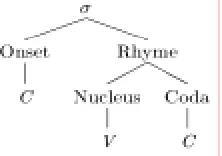
According to Fromkin et al. (2010) and Kenstowicz (1994), English syllable structures are constructed as in Figure 1.
Figure 1: English Syllable Structure
As you can observe in Figure 1, nucleus and coda form a rhyme, and onset and rhyme form a syllable. Several pieces of empirical evidence show that nucleus and coda form a unit in English.
It has been known that the syllable structures in Korean are different from those in English. There have been two types of analyses on Korean syllable structures, which are graphically illustrated in Figure 2. Here, C and V refer to consonant and vowel respectively, and G refers to glide. Because glides are also consonants, the symbol C in this paper refers to all the other consonants except glides.
Figure 2: Korean Syllable Structure (Ternary Branching (Left) and Binary Branching (Right))
The ternary branching analyses, which were included in Lee (1982), Ahn (1985), and Park (1993), said that there is no internal structure within the syllable and that a syllable is composed
of just three components onset, nucleus, and coda. The binary branching analyses, which were
included in Kim (1987), Park (1985), Jun (1980), Ahn (1988), and Kim (1989), claimed that
onset and nucleus form a unit which is called core, and that core and coda form a syllable.
Many previous studies including Kang (2003) showed that the second type of analyses is suitable for Korean syllable structures, and this paper also adopted the binary branching analysis in the computational implementation.1 In the above analyses, note that the template for Korean syllabification is CGVC, whether the syllable has binary branching or ternary branching.
There have been many trials to implement phonological processes within the typed feature structure formalism. Bird and Klein (1994) was virtually the first paper which tried to implement phonological analyses in typed feature systems. Following this paper, Orgum (1996) developed sign-based morphology and phonology, which can easily be implemented in the
1 As one of the evidences of Binary Branching syllable structures in Korean, Kang (2003) and many other scholars
HPSG framework. Recently, Tseng (2008) tried to implement the syllable structures in western languages such as English, and Skwarski (2009) included underlying and surface forms in the analyses.
3
Korean Syllable Structures in Typed Feature Formalism
3.1
Type Hierarchy and AVMs
The first step to provide computational implementations of Korean syllable structures in the LKB system starts from the type hierarchies in which major concepts of syllable structures are organized. Figure 1 illustrates the type hierarchies for segment and suprasegment.
Figure 3: Type Hierarchy for segment and suprasegment
As you can find in Figure 1, sign is divided into segment and suprasegment, which are the types
for segmental and suprasegmental elements respectively. The type segment contains the type phoneme, and it is subdivided into two sub-types consonant and vowel.2 The type suprasegment
contains syll-struct, and all the types which are related to syllable structures are contained here.
Also, note that phon-word (phonological word) is included under the type suprasegment.
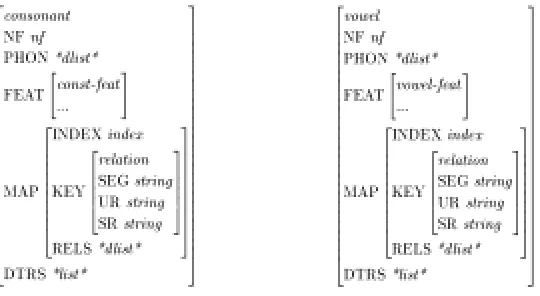
The type phoneme contains two sub-types consonant and vowel, and their attribute-value
matrixes (AVM) are shown in Figure 4. Since both consonant and vowel are subtypes of phoneme, they inherit the properties of phoneme.
Figure 4: AVMs for consonant and vowel
2 It does not mean that the type segment contains only phoneme. It also contains a few more types such as allophone,
NF is the attribute for normal form, and its main contribution to the system is to reduce the
ambiguity during the parsing processes.3 PHON is the attribute for phonetic forms of each segment, and difference lists (*dlist*) are used here. FEAT contains consonant features ( const-feat) and vowel features (vowel-feat). MAP is used to map the underlying representations (UR)
to the surface representations (SR).4 DTRS is the attribute for daughters.
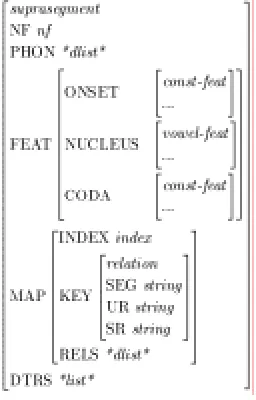
The type suprasegment also has the AVM, and Figure 5 shows us the structure of the AVM.
Figure 5: AVM for suprasegment
As you can observe, the AVM for suprasegment is similar to that for consonant and vowel. The
only difference is that the attribute FEAT is further sub-divided into three attributes ONSET, NUCLEUS, and CODA. Because onset and coda must be a consonant, the AVMs for ONSET
and CODA contain const-feat. On the other hand, since nucleus must contain a vowel, the AVM
for NUCLEUS contains vowel-feat. Everything else is identical with the AVMs for consonant
and vowel.
3.2
Rules for Syllable Structures
Now that we have the type hierarchies and AVMs for consonant, vowel, and suprasegment, it is
the time to implement the rules for syllable structures. As mentioned in Section 2, this paper adopts the binary branching analysis in the computational implementations. That is, onset and nucleus form a core and that this core combines with coda in order to form a syllable in our
implementations. Therefore, the rules for these types are necessary.
The first kind of rule is those for onset, nucleus, and coda. The function of these rules is to
connect each segment (consonant and vowel) to the types for syllable structure (syll-struc). The
rules are schematically illustrated in Figure 6. 5,6,7
3 Section 3.3 includes more detailed explanations about this attribute.
4 The ideas which are enumerated in Skwarski (2009) are partially implemented in the AVMs for MAP.
5 You may find that one more onset rule is necessary. In the right part of Figure 2, note that glide can go between
consonant and vowel. In these cases, the following three values of onset are constructed by concatenating the corresponding values of the two constituents consonant and glide: (i) the PHON value, (ii) the FEAT|ONSET value, and (iii) the MAP|RELS value. As in footnote 1, consonant refers to all the other consonants except glides. The concatenating operation can be represented by ⊕ as in Figure 7 and Figure 8.
6 As pointed out in the footnote 9, this paper used Romanization system for the orthographies of the Korean
Figure 6: Onset Rule (Left), Nucleus Rule (Middle), and Coda Rule (Right)
As you can see in these rules, consonant can be either an onset or a coda, and the FEAT value
of consonant is percolated up into the FEAT|ONSET value and/or the FEAT|CODA value.
Likewise, since vowel can be a nucleus, the FEAT value of vowel is reflected in the FEAT|
NUCLEUS value.
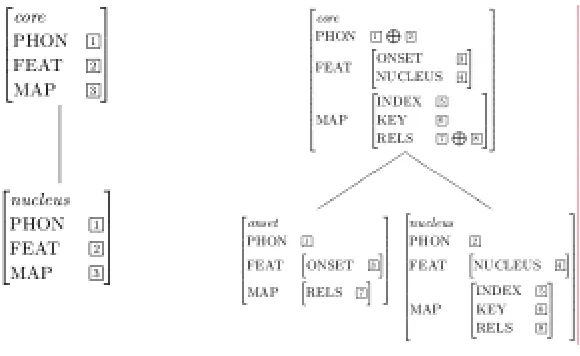
Now, it is time to provide a rule for core. As you can observe in Figure 2, the main function
of core is to combine two constituents, onset and nucleus. There are two sorts of core structure.
One is the structure where core includes only one type nucleus, and the other is the one which is
composed of two constituents, onset and nucleus. Therefore, two kinds of rules have to be
provided separately for the type core. Figure 7 illustrates these two rules.
Figure 7: Core Rules
When a core includes only nucleus, what we have to do is to percolate up the values of each
attribute. The left core rule is for this case. When a core is composed of onset and nucleus, the
features of onset and nucleus are unified. The PHON values of onset and nucleus are
concatenated. The FEAT|ONSET value of onset is percolated up into the FEAT|ONSET value
of core, and the FEAT|NUCLEUS value of nucleus is percolated up into the FEAT|NUCLEUS
value of core. When onset and nucleus combine to form a core, since nucleus is the most
important (head) of the syllable, the MAP|INDEX value and the MAP|KEY value of nucleus are
7 A reviewer pointed out that the rules for onset and coda potentially introduce ambiguity and asked how this
percolated up into the corresponding values of core. The right core rule represents these
mechanisms.
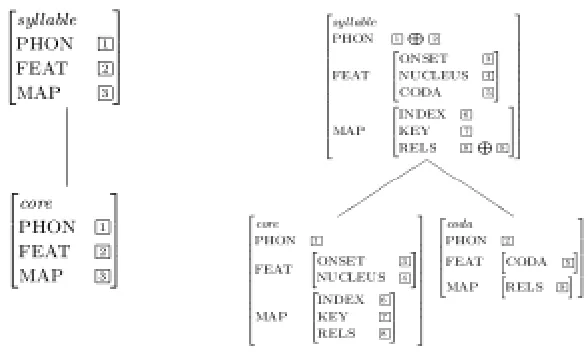
Finally, we are ready to provide a rule for syllable. As you can observe the binary branching
analysis in Figure 2, a syllable is composed of two constituents, core and coda. As in the type core, there are two kinds of syllable structure. One is the structure where syllable includes only core (the case where syllable contains no coda), and the other is the structure which is
composed of two constituents, core and coda. Therefore, two different types of rules have to be
made separately for the type syllable. Figure 8 illustrates these two rules.
Figure 8: Syllable Rules
When a syllable includes only core, what we have to do is to percolate up the values of each
attribute. The left syllable rule is used for this end. When a syllable is composed of two
components, core and coda, the features of core and coda have to be unified. The PHON values
of core and coda are concatenated. The FEAT|ONSET value and the FEAT|NUCLEUS value of core are percolated up into the corresponding values of syllable, and the FEAT|CODA value of coda is percolated up into the FEAT|CODA value of syllable.8 When core and coda combine to
form a syllable, since core contains the features for nucleus (the head of a syllable), the MAP|
INDEX value and the MAP|KEY value of the type core are percolated up into the
corresponding values of syllable. The right syllable rule is for these cases.
Though this paper does not include the rules for phon-word, there are also rules for phon-word. The main function of these rules is to combine the syllables to form a (phonological)
word.
3.3
Resolving Ambiguity Problems
The last part of this section is devoted to the ambiguity problems, i.e. how to handle the ambiguity problems during the parsing processes.
When two consonants go between the vowels, we have no problem. For example, if we have a word ‘kwukmin [kukmin]’ whose meaning is ‘the people of a nation’, two consonants ‘k’ and
‘m’ go between the vowels ‘u’ and ‘i’.9 In this case, the first consonant ‘k’ is syllabified into the
8 Although how the FEAT values are used is not explained in detail here, these attributes are made for the purpose of
modeling many phonological phenomena. For example, when we try to implement assimilation rules, the rules have to confer the phonological features of each segment. The FEAT values are used in those kinds of cases. Since this paper is implementing only syllable structures, the usages and detailed explanations for these values are not included here. However, they play crucial roles in the system, when we model the phonological phenomena such as assimilation.
9 Here, Yale Romanization system is used for the orthography, and IPA symbols are used for the pronunciation. IPA
coda position of the first syllable, and the second consonant ‘m’ is syllabified into the onset position of the second syllable. Problems occur when only one consonant goes between two syllables. For example, in case of a word ‘nala [nala]’ whose meaning is ‘a nation’, two
possible structures in Figure 9 are generated to this word.
Figure 9: Two Possible Syllable Structures
In the first syllable structure, the second consonant ‘l’ is syllabified into the onset position of the second syllable. In the second syllable structure, however, it is syllabified into the coda position of the first syllable. Since a consonant can be syllabified either into an onset position or a coda position, this kind of ambiguity may occur during the parsing processes. In the actual syllabification, however, the left syllable structure is correct for the word ‘nala’. Therefore, it is
necessary to make the right syllable structure not generated during the parsing processes.
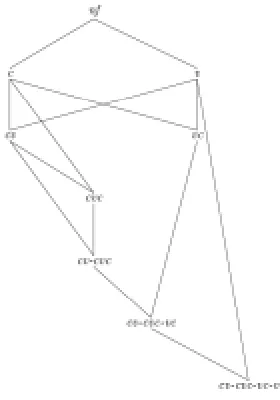
In order to resolve this problem, we employed the type nf (Normal Form), and its type
hierarchy is shown in Figure 10.
Figure 10: Type Hierarchy for nf
Beavers (2002, 2004) also used the type nf in his Type-inherited Combinatory Categorial
Grammar (TCCG). The purpose of using the type nf in the TCCG system is identical with that
of this paper: to reduce the syntactic ambiguity during the parsing processes. Accordingly, we also adopted this type to solve the ambiguity problems.
At the bottom of the type hierarchy in Figure 10, you may find the type cv-cvc-vc-v. It
the CV structure is the most preferable one, and CVC follows the CV structure. Then VC follows CVC, and V is the least preferable one in Korean.
As you can observe in Figure 4 and Figure 5, these preference rankings are encoded in the NF value of segment and suprasegment. Since consonant and vowel are sub-types of segment
and syll-struct is a subtype of suprasegment, all the consonants and vowels and all the types
under syll-struct have the value for nf.
Here, note that the CV structure is more preferable than the CVC one. Now, compare the two syllable structures in Figure 9, those for ‘nala’. The left syllable structure has a form ‘CV+CV’,
whereas the right syllable one has a form ‘CVC+V’. Because the CV structure is more preferable than the CVC one, the left syllable structure is preferred to the right syllable one. Therefore, the parser correctly selects the left syllable structure for the word ‘nala’.
4
The LKB Implementation Examples
In this section, some actual implementation examples are shown. Three words are selected for the illustration. The first one is ‘a.i [ai]’ whose meaning is ‘a child or children’, the second one
is ‘nala [nala]’ whose meaning is ‘a nation’, and the last one is ‘kwukmin [kukmin]’ whose
meaning is ‘the people of a nation’.
Figure 11 illustrates the analysis result of the first word ‘a.i [ai]’.
Figure 11: Implemented Example 1
Since this word contains only vowels, the first rules for core and syllable are applied. That is, core contains only nucleus, and syllable contains only core. Therefore, the syllable structure for
this word is as shown in Figure 11.
Figure 12 illustrates the analysis result of the second word ‘nala [nala]’.
Figure 12: Implemented Example 2
Since this word has a syllable structure ‘CV+CV’, the second core rule and the first syllable rule
are applied. Accordingly, a core contains both onset and nucleus, but syllable contains only core.
Figure 13 illustrates the analysis result of the third word ‘kwukmin [kukmin]’.
Figure 13: Implemented Example 3
Since this word has a syllable structure ‘CVC+CVC’, the second rules are applied for core and syllable. That is, core contains both onset and nucleus, and syllable contains only both core and coda. Therefore, the syllable structure for this word is as shown in Figure 13.
Through the computational implementations, we could find that the system developed in this paper correctly analyzed the syllable structures in Korean.10
5
Conclusion
In this paper, we tried to provide computational implementations for Korean syllable structures within the typed feature structure formalism. For the computational implementation, we adopted the LKB system. In this system, we first implemented the type hierarchies for segment and suprasegment. The type segment contains consonant and vowel, and various types for syllable
structures were included under the type suprasegment. Then, we provided various rules for
syllable structures. Unlike English syllabification, onset and nucleus form a core, and core and coda form a syllable in Korean. We provided the implementational rules for onset, nucleus, and coda; then, we provided rules for core and syllable. Finally, we provided the rules for phon-word in which syllables were combined. Finally, we also employed the type nf in order to solve
the ambiguity problems during the parsing processes.
The system developed in this paper can be extended further to include some phonological theories such as feature geometry and underspecification. The system can also be extended to model some phonological phenomena such as assimilation or vowel harmony.
References
Ahn, Sang-Cheol. 1985. The Interplay of Phonology and Morphology in Korean. Ph.D.
Dissertation. University of Illinois at Urbana-Champaign.
Ahn, Sang-Cheol. 1988. A Revised Theory of Syllable Phonology. Linguistic Journal of Korean 13.2: 333-362.
Beavers, J. 2002. A CCG Implementation for the LKB. LinGO Working Paper #2002-8. Stanford, CA: CSLI.
Beavers, J. 2004. Type-inherited Combinatory Categorial Grammar. In Proceedings of the 20th International Conference on Computational Linguistics. Article No. 57.
Bird, S. and E. Klein. 1994. Phonological Analysis in Typed Feature Systems. Computational Linguistics 20.3: 455-491.
10 A reviewer pointed out that there was no evaluation reported in the paper. We are now developing an evaluation
Copestake, A. 2002. Implementing Typed Feature Structure Grammar. Stanford, CA: CSLI.
Fromkin, V., R. Rodman, and N. Hymas. 2010. Introduction to Language. York: Wadsworth.
Jun, Sang-Beom. 1980. Phonological Interpretation of Lapsus Linguae. Korean Journal of Linguistics 5.2:15-32.
Kang, Ongmi. 2003. Korean Phonology. Soeul: Taehaksa.
Kenstowicz, M. 1994. Phonology in Generative Grammar. Oxford: Blackwell.
Kim, Cha-Kyun. 1987. A Study on Syllable Structure and Some Processes in Its Nucleus in Korean. Mal (Language) 12:25-69.
Kim, Jong-Hoon. 1989. English Syllable Structure and Phonological Rules in Korean. Journal of English Language and Literature 5.3:589-608.
Lee, Byung-Gun. 1982. A Well-formedness Condition on Syllable Structure. In the Linguistic Society of Korea, (ed.), Linguistics in the Morning Calm I, 489-506. Seoul: Hanshin
Publishing Co.
Orgum, C. 1996. Sign-based Morphology and Phonology with Special Attention to Optimality Theory. Ph.D. Dissertation. University of California at Berkeley.
Park, Chang-Won. 1993. Morphology and Phonology of Onomatopoenia. Saykukesaynghwal
3.2:16-52.
Park, Jong-Hee. 1985. On Non-vocalization in Korean. Journal of Korean Linguistics
14:189-214
Pollard, C. and I. Sag. 1994. Head-driven Phrase Structure Grammar. Chicago: University of
Chicago Press.
Sag, I. and T. Wasow. 1999. Syntactic Theory: A Formal Introduction. First Edition. Stanford,
CA: CSLI.
Sag, I., T. Wasow, and E. Bender. 2003. Syntactic Theory: A Formal Introduction. Second
Edition. Stanford, CA: CSLI.
Skwarski, F. 2009. Accounting for Underlying Forms in HPSG Phonology. The Proceedings of the 16th International Conference on Head-Driven Phrase Structure Grammar, 318-337.
![Figure 12 illustrates the analysis result of the second word ‘nala [nala]’.](https://thumb-us.123doks.com/thumbv2/123dok_us/1081953.1136304/8.595.212.384.556.671/figure-illustrates-analysis-result-second-word-nala-nala.webp)
![Figure 13 illustrates the analysis result of the third word ‘kwukmin [kukmin]’.](https://thumb-us.123doks.com/thumbv2/123dok_us/1081953.1136304/9.595.198.398.109.228/figure-illustrates-analysis-result-word-kwukmin-kukmin.webp)
