135
The Essence Of Permit Function For Space
Utilization Of Spatial Planning In South Sulawesi
M. Akhdor
Abstract: This paper examines the essence of permit function for space utilization of spatial planning in South Sulawesi. The main point is the essence of permission for using space as a control instrument (sturen) of space utilization, by controlling space utilization in terms of development with emphasis on spatial planning. This permit serves as a director, social engineers, and designers in creating an orderly society space. The second is license of space utilization as budgeting tool (budgetter), for juridical means to increase revenue. For certain types of permits, sometimes function of this budget is more dominant than the other functions, but in layout, struren function should take precedence of the budgettering function. The third is land use permit as an instrument of legal protection; in this case, it consists of two things, the legal protection of the public or the public interest of the potential problems posed by the activities / efforts that allowed it. Second, the legal protection for the activity / business is allowed itself to the possibility of disturbance or barriers of any party, and by anyone.
Index Terms: License, Utilization of Space, Spatial
————————————————————
1
INTRODUCTIONSpace issue is much discussed in relation to environmentally sustainable development. It emphasizes the development of spatial planning, which is in line with sustainable development (Sustainable development). Such construction makes the room is not only used as a conceptual framework in the area of planning theory, but also as a basis for policy-making development. Spatial planning is a public policy, which is a program to achieve the goals, values, and practices that are targeted as proposed by Harold D. Lasswell and Abraham Kaplan "a projected program of goals, values and practices or a course of action in relation to others. James E. Anderson imposes limits on public policy as "a purposive course of action followed by an actor or set of actors in dealing with a problem or matter of concern Spatial planning is a process that includes planning, utilization and control of space utilization. Therefore, controlling the utilization of space is an integral part of the process of spatial planning. Utilization of space in many areas in Indonesia, in its practice is often or not always in line with the spatial plan that has been set. Discrepancies or violations caused by several factors, among others, market development pressure on space, the unclear mechanism of control and weak enforcement of the law (law enforcement). The tendency of such deviations may occur due to lack of attention to spatial planning aspects of implementation (use of space) or on the contrary that the use of space less attention to spatial planning. Utilization of space is an attempt to realize the structure of space and spatial patterns in accordance with the spatial planning through the preparation and implementation of programs and financing. One of the concrete instruments for controlling the use of space is a permit. Basically there two kinds of permission set for the sake of environmental protection and management, namely: First, the environmental permit is a license granted to any person doing business and/or activities that required environmental impact analysis or UKL-UPL in the framework of environmental protection and management as prerequisite for obtaining a business license and/or activity.
Second, a business license and/or activities are licenses issued by technical agencies to conduct business and/or activities. One of the business licenses or permit activities referred to is the use of space required in utilization of space activities in accordance with the provisions of the legislation. Permit is government tool for juridical preventive, and is used as an instrument to control the behavior of the public administration. Therefore, the essence of a license is preventive, because the instrument permits, cannot be released with orders and obligations that must be adhered by the licensee. In addition, the function of permission is repressive. Permits can serve as an instrument to tackle environmental problems caused by human activities inherent to the licensing basis. That is, an effort to obtain permission for environmental management, burdened with the obligation to undertake pollution prevention or environmental damage arising from its business activities. According to Shahid, to control the utilization of space is currently inefficient and ineffective, because the licensing instrument is the first step in controlling the use of space often conflicting and even breaking the existing spatial plans. On the other hand, the increasing development activities result in the need for land increases, this has resulted in the allocation of land use specified in the spatial plan is no longer able to accommodate developments, resulting in such violations. Land use is strongly influenced by the demands of market participants, which is growing rapidly and mostly broke into other land use activities. As a result of land use change, a phenomenon that often has a negative impact on the environment and transport. Therefore, it is necessary control measures were formulated based on the land use development patterns of land use and compliance with the layout.
2.
METHODOLOGY
This research is a study of socio juridical (socio-legal research) or including to descriptive research with non-doctrinaire approach, which sees the law as an empirical socio symptoms observed in experience. The law is not only conceptualized as a form of abstract norms and normative, but rather as an empirical phenomenon that can be observed the implementation in the field, with emphasis on the disclosure of law enforcement as a separate process in the community, which aims to maintain law and order. The focus of this research is the area of South Sulawesi. The data required in this research includes field data as the primary and literature ___________________________
M.Akhdor: Graduate Student PhD, Study Program:
Science Of Law. Hasanuddin University, Makassar.
136 as secondary. Primary data were collected using a
questionnaire distribution. While the literature data used in this research is the legislation and / or judicial decisions regarding the arrangement of space, both for the scope of the government of South Sulawesi province and in some districts / cities in South Sulawesi. Furthermore, literature and documents were also studied, as well as official publications, all of them relate to the subject matter of research.
3.
DISCUSSION1. Permission as Instrument of Control (sturen)
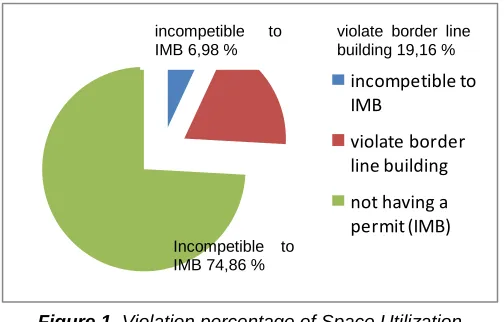
Basically control is done through the establishment of spatial use zoning regulations, licensing, provision of incentives and disincentives as well as control of sanctions. However, the implementation is often found a violation of the use of space, among others, the use of space that is not appropriate permits and utilization of space, which is not its designation as the spatial plans. Even some hints of building were built without having Building Permit. Data of space utilization control in the city of Makassar all of 2012 there were 64 buildings constructed in contravention of the image that has been approved in the permit. From 64 buildings, they are entirely built incompatibly against permissions that have been granted, and the infraction from three of these buildings related with spatial system hence it cannot be tolerated then it should be dismantled. Furthermore, space utilization control data associated with buildings constructed in violation of the line of demarcation along the year 2012, a violation of the building on the border line of 205 cases. Of the number of cases was entirely reprimanded and four buildings demolished because of the level of the offense of which cannot be tolerated. The number of buildings are constructed without being based on the Building Permit (IMB) throughout the year 2012 is much bigger, 801 cases. From these 794 buildings, they can be bleached, which means that the building owners take care of a new permit to adjust the requirements specified in the licensing rules. For the buildings already constructed and cannot be brought into line with licensing requirements, then there is no other way except dismantled, especially if the terms spatial requirements cannot be met. If it is presented in the three types of violations for the space utilization with the number of cases, it can be seen in the image below:
incompetible to IMB
violate border line building
not having a permit (IMB)
Figure 1. Violation percentage of Space Utilization
Source: primary data, 2014
Based on the data above, it indicate that among the violations that occur space utilization is mostly about the building that
does not have a permit which shows that public awareness regarding the maintenance of the IMB is still low. For buildings that are not in accordance with the permit, it has been suggested / directed to conform to those contained in the IMB. For the buildings that violate Border Line Building, generally found at the time the owner of the building doing foundation work and directed to follow in accordance with the plans of the building that has been set / required by the City / Region in this case the Department of Spatial Planning and Building. For the building without building permit is directed to take care based on IMB. Normatively each building must meet the requirements of the administrative and technical requirements in accordance with the function of the building. The administrative requirements include the requirement of building land rights status, ownership status of the building, and building permits. Construction of a building can be implemented after the technical plan the building was approved by the Regional Government in the form of permit. Having IMB is the duty of the owner of the building. Everyone who wants to establish a building must have a permit granted by the Local Government (LG) through the permit application process. IMB application must be equipped with:
a. proof of land ownership status or proof of land use agreements;
b. Data owners of the building; c. technical plan of the building; and
d. the results of the environmental impact assessment for buildings that have a significant impact on the environment.
If the owner does not meet the requirements of the construction of the house including the obligation to have a permit, the homeowners in this case may be subject to administrative sanctions be suspended until obtaining a building permit. Building owner who does not have a building permit building demolition orders penalized. In addition to administrative sanctions, the owner of the building can also be liable to a maximum fine of 10% of the value of the buildings that are being or have been built. If the building has been established but has no permit, has been confirmed in the legislation that: Buildings that have stood, but have not had a building permit at the time of enactment of this law, to obtain a building permit must obtain the certificate of acceptance functions under the provisions of this law." Thus, the obligation to complete any construction of houses with IMB applies to everyone, and no specific exceptions. Although in practical implementation of the obligations to complete construction of the building permit is regard to public awareness and enforcement of the local government. Related to the License Area as a means of controlling the use of space, it is determined by frequency of location permit issued from the government. Because not all of the activities / businesses which utilize the land use permit instrument location, which is just a land use that exceeds one hectare. While less than one hectare using instruments Utilization Permit Land Use, that is, if the land in question is agricultural land, land for plantation / fields, or land fishery / pond. Permit Area is the main requirement to be met by a company that requires land for investment purposes, not least in terms of the development of oil palm plantations. Therefore, the land can be designated in the permit location is the land according to the Spatial Plan (RTRW) which are intended for use in accordance with the capital investment plan that will be implemented by the Incompetible to
IMB 74,86 %
violate border line building 19,16 % incompetible to
137 company according to investment agreements that it has.
Location Permit granted by the consideration of the technical aspects of land tenure and land use rights include state and land tenure is concerned, the physical assessment area, land use, and land capability. Further regulations regarding the actual location permits are arranged through local regulations. However, as long as the local government has not had a license arrangements regarding location, then Minister of State Agrarian / Head of the National Land Agency No. 2 of 1993 on Procedures for Obtaining Permit Area and Land Rights in the Company Share capital investments remain a reference concerning the procedures for the acquisition of location permits. From the results of some sample respondents companies obtained information that a percentage of the total area of the business that are used by companies generally smaller than 1 (one) hectare is equal to 74.66% and the larger one (1) hectare is only a small part is the percentage of only 25, 33%. This indicates that most companies use large areas of land less than one hectare. This means that the frequency of companies that require permits location only 25.33%, while 74.66% do not need to make use of Permit Area. To know clearly the percentage of land use by the respondents can be seen in the image below:
Figure 2: Tenure Percentage of Business Land Area
Source: primary data, 2014
Although the land area of business respondents mostly less than one hectare, but certainly it has a connection with land use made by employers for the development of community activities that require land competition resulting in land use, particularly in areas that have been developed in which the relative land preparation has been very limited. In order for community activities can take place efficiently and to create coherence in the achievement of development goals, then arrangements land are made including land use permits in order to control the activities of the community. Therefore, it takes the form of public awareness of people's understanding of land use permits. To determine the respondents' opinions related to the understanding of the regulations governing land use permits, it can be seen in the table below:
Figure 3: Understanding Percentage of Licensing Regulation
Utilization of Space
Source: primary data, 2014
Figure shows that in general the perpetrators activities / businesses lack of understanding for the regulations governing the licensing of space utilization. The frequency ratio for those who less understood is 35 respondents or 46.66%, for those who understand is 27 respondents, or 36.00% and those who did not understand at all is 13 respondents, or 17.33%. According to image above, it almost half of the respondents does not understand the regulation of land use permits. This is related to the lack of socialization to the regulations governing the licensing of space utilization in the low awareness of the legal implications of the use of space, which in turn will affect the ineffective regulatory system in the control for the space. In the five research areas, Makassar, Bulukumba, Soppeng, Enrekang, and Palopo, space utilization is strictly regulated, Each space utilization permission must be obtained in accordance with the arrangements set out in the Spatial space. Licensing provisions is a reference to the competent authority for issuing permits based on the space utilization plan, structure, and spatial patterns specified in local legislation. Terms of license are a license to use space (IPR) consists of: 1) license in principle; 2) the location permit; 3) permits the use of land utilization (IPPT); 4) building permit (IMB); and 5) other license under the provisions of the legislation. Licensing the use of space at least have the hierarchy as follows: (1) Licensing allotment and land acquisition related to the determination of the location of investment and acquisition of land in the form of location permit; (2) Permit for the development of land use plans related to the development of quality space in the form of site plan approval; (3) Licensing of building associated with the development of urban design in the form of the demolition permit and licensing mechanism set out in Article 66-67 of Makassar City Regional Regulation No. 6 of 2006 on Spatial Planning of Makassar 2005-20015. The principle of the licensing application in the control of space utilization is as follows:
1. Activity that is likely cause interference is basically prohibited except with permission;
2. Each activity and development must apply for a permit from the local authorities who will check for compliance with the standards of spatial planning and legal administration.
Regarding the ownership of Land Use Permit in the respondent's business activity or can be seen in the image below:
Figure 4. Percentage of Land Use Permit in activities or
business
138 The data above indicates that the majority of entrepreneur
respondents does not have a land use permit, 54 or by 72.00%, while those who do not have a land use permit are 21 or 28.00%. The data above seems errors understanding Land Use Permit, which it does not put in the group of Building Permit Land Use Permits. Within the scope of the Land Use Permit license includes permit to build the building because the buildings in the area of business which is said not having space utilization permit is actually has a permit to use the space since it has a building permit. Permit for the use of space is a land use designation permits which must be owned by private person or entity that will carry out the activity or activities that result in changes in land use of building / work done. To conduct other than residential development, the land use permit or permit of good location should be taken care for the status of agricultural land (paddy / tegal) and non-agricultural (yards) and then take care other technical licenses to new IMB then doing the construction is allowed. The impact of space using when it is implemented without appropriate control of planning, there will be chaos, environmental disharmony, chaos, untidiness, not well-organized building, lack of aesthetics as well as other negative impacts on the environment. Other impacts will arise as well. For example, an industrial area adjacent to the settlement residents, shopping center stands in the middle of the settlement, government offices across from the mall, mall building adjacent to the mosque or school, and so on. All this may result in difficulty for structuring the utility grid, the provision of public facilities, negative impact on social conditions, striking economic gap between society, the high cost for the solution of environmental problems and other negative things. Of course, to prevent the negative things, it is necessary to control the use of space in order to implementation be in accordance with the planning of space that has been created. There is so much money, energy and thoughts that have been incurred in making the Spatial Plan City / County (RTRWK), RDTRK, RTBL, Block Plan and other documents detail plans. To control the use of space through licensing instrument in the region Maminasata, it is regulated using Indonesian Presidential Regulation No. 55 of 2011 on Spatial Planning of Urban Makassar, Maros, Sungguminasa, and Takalar (RTRKP Maminasata). Land permits in the area Maminasata include: 1. Landing permit referred to in Article 87 paragraph (2) b is
a reference for issuing permits utilization of space. 2. Any use of space must obtain permission from the
Government for space utilization, provincial governments, and / or district / city must be in accordance with local regulations on spatial planning districts / cities and their detailed plans and zoning regulations which are based on the spatial plan of Urban Mamminasata as set forth in The Presidential Regulation.
3. Any use of space must get licenses in accordance with the provisions of each sector or field that regulates the types of activities concerned the use of space in accordance with the provisions of the legislation sector or a related field.
So space use permit here serves as an instrument of control (sturen) in layout. With the permission of a request for space utilization can be granted or denied, it is highly dependent on compliance with spatial plan that has been set. In this case space use permits are only given to the utilization of space which is in accordance with the spatial plan. Licensing is also
about some obligations that must be made by the employer or person in charge of the business before the license document issued by the competent authority. By the time a permit has been issued, imposed obligations and requirements is implemented by the company, it is an instrument for controlling the observance of environmental norms.
2. Licensed as a Means Budget (Budgettering)
The implementation of regional autonomy is correlated to giving greater authority to local governments in governance. Similarly, where the licensing authority in the formulation and delivery of previously existing permissions on the central government has now shifted to local governments. Licensing utilization of space consists of Principle License, Permit Area, Utilization of Land Use Permit and Building Permit, Permit utilization of the space under the authority of district / city of publication. There are times when the district / city prefer to functions the permits of space use in terms of revenue regions rather than in terms of space utilization control. Licensing policy of spatial planning as an instrument of control is to prevent negative externalities from the utilization of space which cannot function effectively due to the tendency to make the licensing function as revenue income instruments. It is supposedly as an instrument of control and supervision; it is still regarded as an instrument of withdrawal revenue (PAD) for local government. In today's era of regional autonomy, there is a tendency licensing functions depending only on the budgetary side, which makes licensing services as a source of cash income for the region, not as a facility to be provided free of charge, as a service (public service), or to hook investment as much as possible. Current election system encourages business licensing system into a political party to mobilize funds. It is more common in mining resources permit.
Figure 5. Percentage of Purpose for Space Utilization Permit
Source: primary data, 2014
139 Spatial each region. For Makassar area based on RTRW, the
Regional Spatial such as Antang, Hertasning Baru, Tamalanrea are intended as a water catchment area but there has been emerging elite residential development, shops and facilities for investment purposes. While the types of permits utilization of space, namely, the principle permits, location permits, and permits the use of the use of land, its role as a function budgetering is not too significant. Much more to revenue from the Location Permit sector is non-tax revenues (income tax state). For example, Department of Spatial Planning and Building of Makassar which handles the issuance of building permits, for the year 2013 is targeted to be able to submit Rp 26 billion in the budget, but until November 2013 it had included Rp 36.3 billion, with details, which derived from the new building 7467 units, add 109 units of buildings, renovation of the building 186 units, 73 units of bleaching administration, and name reserve of the building 40 units. In 2014, Department of Spatial Planning and Building targeted achievement of obtaining building permit revenue of Rp 38 billion. Overall the greatest contribution to the project revenue is derived from the levy permit construction of apartments, following the deposit of the hotel project reached USD 400 million. Licensing layout can be used to achieve revenue targets. With this licensing, the Department of Spatial Planning and building control besides functions as control, it is also to fill the space utilization Regional cash. Sometimes push-pull situations occur between the two function controls of space function budgetering. This makes the assessment of performance for the Department is focused on filling the local treasury functions rather than the control function. This situation in turn will lead to chaos on city spatial planning and the Spatial Plan of Makassar which has been prepared so that the achievement of Makassar Spatial will not be optimal. Based on these results it is known that the spatial plan is sacrificed when there is a desire to carry out the actual construction which is not in accordance with the applicable land use plan. Investment interest is often seen as the basis for change/revise the layout plan. As a result of spatial planning no longer serves to direct the investment location, but otherwise be a tool that can be customized as justification for investment. So, essence of permits no longer functions as an instrument of control, but it rather acts as local revenue. Consequently permission is no longer issued in accordance with the spatial plan for exceeding the carrying capacity and environmental capacity, including land conversion from protection area into cultivated land.
3. Permits As a Means of Law Protection
License as a juridical instrument is used by the government to influence the people to want to follow the rules and procedures which have been established in order to achieve concrete goals. As an instrument, permission is spearheading controller, director of legal instruments, engineers, and designers incarnated just and prosperous society. This means that, through a permit, it can be seen how the image of a just and prosperous society can be realized. This means the requirements, contained in a permit controlling the functioning of the license itself. So Permit as one of the instruments of government functions to control the behavior of society in accordance with its intended purpose. Instruments permissions are set by the government and local governments according to their respective authorities in accordance with the provisions of the legislation. In the Spatial Planning Act set:
a. Permit of space use that is not in accordance with the regional spatial plan is canceled by the Government and local governments according to their respective authorities based on the provisions of the legislation;
b. Permit issued space utilization and / or obtained by not following the correct procedures, null and void;
c. Permit of space use obtained through the correct procedure but later proved incompatible with the regional spatial plan, was canceled by the Government and local government in accordance with its authority;
d. For losses incurred due to cancellation of a permit referred to in paragraph (4), may be recovered eligibly for licensing agencies;
e. Permit of space use which is no longer appropriate due to changes in the spatial plans can be canceled by the Government and local governments to provide adequate compensation;
f. Every government official authorized to issue permits utilization of space is prohibited from issuing licenses which is not in accordance with the spatial plan;
From discussion above, it can be argued that any permission was basically going to give legal protection for two things, first the protection of the general public of possible problems caused by activity / business which have been allowed. Second, it is the legal protection for the activity / business from the possibility of disturbance or barriers of any party, and by anyone. That is why each license being applied must be determined a set of requirements, otherwise granted permission must be accompanied by a set of guidelines in the form of rights and obligations. Licensing space use is a space utilization operational policies relating to the determination of the location, space and spatial quality in accordance with the laws and regulations, local laws and customs applicable. Licensing the use of space consists of three types of licenses that have a structure, as follows:
1.
Licensing designation and land acquisition related to the determination of the location of investment and acquisition of land in the form of location permits.2.
Licensing land development deals with the plan of space quality development in the form of Site Plan Approval.3.
Licensing of building associated with the development ofspatial planning and building in the form of building permit.
140 environment in order to avoid damage or pose a danger,
especially natural disasters that could harm the wider community.
Figure 6. Percentage of The Importance for Taking Care /
Having Land Use Permits
Source: primary data, 2014
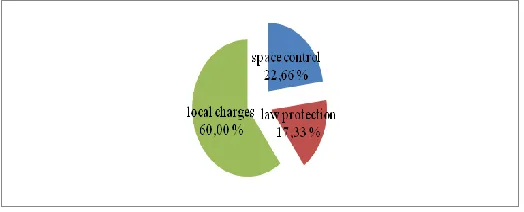
Image above shows that most respondents (39 people or 52.00%) expressed the urgency of obtaining a license due to legalize activities / business; while 30 people or by 40.00% stated the legal protection and 6 people or of 8.00% stated to obtain assistance / facility of government. Society sees legality of this effort is more important than the goal of legal protection. In fact, it must also be realized that basically land use licensing provisions intended to ensure the utilization of space in accordance with the spatial plan, standards, and quality specified minimum; avoid negative externalities; and protecting the public interest. Based on the results of a number of cases that occurred in the city of Makassar as reclamation area Losari Beach and flower promontory, the problem, a number of land owners have been given principle permission, but misused. According to Muh Sabri, Head of Government of Makassar, some companies have been given principle permission, but it cannot be used as a reference for hoarding (reclamation). New reclamation can be done if all permits derivative of license principle, have been met. Permission principle does not include permission to conduct reclamation. After the permission principle, then petitioned the location permit, permit reclamation. After all permits are issued then permit for the utilization of space is executed. It can be concluded that the function of legal protection of permission is not optimal space utilization, more public notice of the other aspects, especially the aspect of formal legality.
4.
CLOSING
The essence of permission is basically as an instrument of controlling the use of space, which controls the arrangement in achieving development in terms of emphasis on spatial planning. This permit serves as a director, social engineers, and designers in creating an orderly society space. Land Use Permit can also function as an instrument of budget (budgetter ), ie, as it means to increase revenue (PAD). This budget functions are sometimes more dominant than the other functions, but the main permit for Space Utilization is a control function ( sturen ). License is as an instrument of legal protection including two legal protections of the general public for the potential problems posed by the activities / efforts that allowed it. Second, the legal protection for the activity / business is allowed itself to the possibility of disturbance or barriers from any party, and by anyone. To optimize the use of permits for space function, then the setting of permissions that
are scattered in various laws and regulations is necessary to be combined or further simplified so as to form the systemic settings, easy to understand, do not overlap ( overlapping ) with each other, and easily applied with either.
REFERENCES
[1] Adi Febriyanto, "Towards a State of Law", http://bem-umk13.blogspot.com/2012/06/ makalah- toward state-law-yang.html . Retrieved on September 23, 2014.
[2] Andi Hamzah. 2005 Enforcement of Environmental Law . Jakarta: Graphic rays.
[3] Henry Campbell Black. 1999. Black's Law Dictionary , 6 th Edition. St. Paul Minnesota: West Publishing.
[4] Bambang Sunggono. 2004. Law and Public Policy . Jakarta: Graphic rays.
[5] Eko Budihardjo. 1995. Approach System in Spatial and Development DaerahUntuk Improve National Security . Yogyakarta: Gadjah Mada University Press, Yogyakarta.
[6] Helmi, "Building Integrated Licensing System for Environment in Indonesia." Journal of Law Dynamics. Vol. 11. No. 1. January 2011.
[7] _____, "The position of the Environmental Permit and Licensing System in Indonesia", Journal of Legal Studies , Vol. 2, No. 1, August 2011.
[8] Ilham, Friday 22 November, 2013, "As of November, the IMB Realization Spatial Agency Makassar Rp. 36.3 Billion " http: // Makassar. tribunnews.com/ 2013/11/22 / per-november-realization-imb-service-spatial-Makassar-rp-363-billion, accessed on 22 November 2013
[9] Friedmann. 1990. Theory and Philosophy of Law . Jakarta: Eagle Press.
[10]Fahrizal Afandi, Law as a Tool for Social Engineering? ", http: // fachrizalafandi. wordpress.com / 2010/08/03 / law-as-social-engineering tools / accessed on September 23, 2014.
[11]Ira Susanti, Control of Commercial Land Use Pattern Based Development And Compliance With Spatial
Plan In Bandung .
http://pl.lib.itb.ac.id/go.php?id=jbptitbpl-gdl-s1-2004-irasusanti- accessed on June 21, 2013.
[12]James A. Conser, at.al. 2011. Law Enforcement in the United States. Third Edition. United State America: Cathleen Sether
[13]Koesnadi Hardjasoemantri. 1992. Towards Ten Years of Environmental Law . Yogyakarta: Gajahmana University Press.
141 [15]Masengi, P. 1999. Public Participation in Spatial
Planning , Spatial In the Bulletin, the first edition, from August to September. National Spatial Planning Coordinating Board.
[16]Mochtar Kusumaatmadja. 2006. Concepts of Law in Development . New York: PT.Alumni.
[17]Sapru, RK, 2010. Public Policy: Art and Craft of Policy Analysis . New Delhi: PHI Learning Private Limited
[18]Soetandyo Wignyosoebroto, "Little Explanation About the Studies of Law from the Perspective of Social Sciences" . News Law and Society, No. I Year To first of November, Surabaya.1993.
[19]Susanti, Ira . " Control of the Commercial Land Use Based PolaPerkembangan and Compliance with the
Spatial Planning in Bandung .
http://pl.lib.itb.ac.id/go.php?id=jbptitbpl-gdl-s1-2004-irasusanti- accessed on June 21, 2013.
[20]Shaheed Abdul Wahab. "Utilization of IMB (building permit) for Control of Land Use in Jakarta "., http: // digilib. itb.ac.id/go.php?id=jbptitbpl-gdl-s2-2004-abdulwahab-348. accessed on June 21, 2013.
[21]Philip M. Hadjon. 2007. Legal Protection for the People; A Study About The principles, Handling by the Court of Justice in Environmental Public and Formation of Judicial Administration. New York: Civilization.
[22]Ridwan HR. 2003. Law of the State Administration . Yogyakarta: UII Press.
[23]Remigijus Ciegis et al. 2009. "The Concept of Sustainable Development and its Use for Sustainability Scenarios", Inzinerine Economics-Engineering Economics Journal.
[24]Romli Atmasasmita. 2012. Integrative Legal Theory: Reconstruction of the Theory of Law and Legal Theory Progressive Development. London: Genta Publshing.
[25]Soerjono Soekarno. 1986. Factors Affecting Law Enforcement . Jakarta: Eagle Press.
[26]Siti Sundari Rangkuti. 1991. Innovation Environmental Law: From Ius constitutum to Ius constituendum , Inauguration Speech. Surabaya: Airlangga University Press.
[27]Satjipto Rahardjo.1993. Issues Law Enforcement: A Sociological Review. New York: New Light.
[28]Salwa Sharawi Gomaa. 2002. Environmental Policy Making in Egypt . Florida: The University of Florida.