PERFORMANCE EVALUATION OF
BARKER CODES BY USING
NON-SINUSOIDAL WAVEFORMS IN RADAR
SIGNAL PROCESSING
D.BALAJI (1) J.DURGA RAO(2) P.SRIKANTH(3) CH.SRINIVASU(4)
[email protected] [email protected] [email protected]
1 Department of ECE, KL University, Guntur, AndhraPradesh, India. 2 Department of ECE, KL University, Guntur, AndhraPradesh, India. 3 Department of ECE, KL University, Guntur, AndhraPradesh, India. 4 Department of ECE, KL University, Guntur, AndhraPradesh, India.
Abstract:
In the Radar signal processing, waveform design plays major role. The target range and Doppler resolution depends on the selection of the waveform. In the waveform design, pulse compression techniques are being implemented for better resolution and accuracy measurements of range and velocity of targets. Hence radar detector requires sophisticated signal processor. Presently, there are so many radar codes are being developed. Barker codes (Bi-phase codes) are being implemented by using sinusoidal waveforms. In this paper, we developed Barker codes by using sinusoidal waveforms like Gaussian function. The performances of non-sinusoidal signals are evaluated by using Barker codes(in terms of PSLR,ISLR). By using some performance factor, these two techniques are compared and results are presented.
Keywords- Non sinusoidal waveforms, Barker codes, ISLR, PSLR, Range Resolution. 1. Introduction
In radar applications we generally utilize the reflected “known” signal to detect the existence of a reflecting target. The probability of detection is related to the SNR rather than to the exact waveform of the signal received. A specified matched filter is a linear filter whose impulse response is determined by a specific signal in a way that will result in the maximum attainable SNR at the output of the filter.
The frequency response H(ω) that will attain maximum SNR at a predetermined delay tₒ is given by equation
u (t) = Transmitted signal;
u (t- τ) = Received signal with time delay τ
Where * denotes the complex conjugate, and the variable τ denotes the delay. In general the radar signal autocorrelation function is defined as the normalized response of a matched filter method to return signal with range rate.
An ideal autocorrelation function is a single spike with no side lobes centre in the range domain. Its physical realization would yield superior target-resolution capabilities and clutter rejection capabilities for radar. Harmuth [1] and Husain [5] have demonstrated that the desired ideal autocorrelation function can be achieved by non-sinusoidal coded waveforms. It is also to attain low PSLR, low ISRL and better range resolution with non-sinusoidal coded waveforms than sinusoidal coded waveforms.
3. Waveform Design
The ideal autocorrelation functions and ambiguity functions in this paper are both sinusoidal and non-sinusoidal waveforms. The autocorrelation for the sinusoidal periodic waveform A Sin(wt) is given by the equation:
ACF= (A^2)/2cos (w*tau)
A signal that is well suited for the representation of carrier-free electromagnetic signals used in practice for impulse radar and radio communications is Gaussian pulse and it is defined by the time function,
The autocorrelation function of the Gaussian Pulse is given by :
(2)
(3)
In this paper, idealised Gaussian pulse has been considered. The disadvantage of the sinusoidal periodic signal was the presence of large subsidiary peaks in the ambiguity function. Since the peaks are caused by this sinusoidal nature, we can try to eliminate them by using a non-sinusoidal nature.
PSLR is defined as ratio of peak cross correlated side lobe to peak output of matched filter
When the filter is matched, R02 =N2
ISLR is defined as :
Range resolution is the ability to distinguish two or more targets that are very close in range. In this paper, range resolution value is attained for ideal matching conditions.
4. Barker codes
Barker codes are popular codes in radar applications. Barker codes are being implemented in existing technology. Originally, the Barker codes were designed as the sets of M binary phases yielding a peak-to-peak
(5)
(6)
5. Simulation Results:
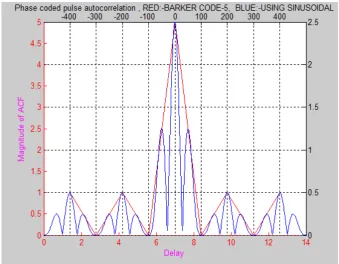
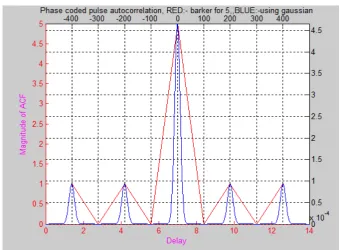
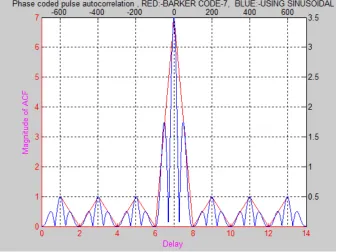
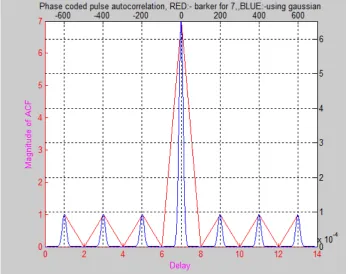
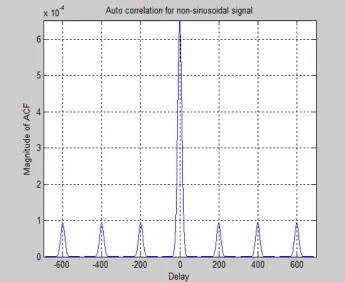
The Autocorrelation and Ambiguity plots for Barker code of lengths 5, 7 using sinusoidal and non-sinusoidal (e.g.: Gaussian) waveforms plots are simulated and results have been given from following figures. These plots will determine PSLR, ISLR and Range Resolution.
Fig 1(b) Autocorrelation plot for sinusoidal signal
Fig 1(d) Autocorrelation plot for Gaussian signal
Fig 2(b) Phase coded autocorrelation of Barker-7 for sinusoidal signal
Fig 2(d) Magnitude plot for Auto correlation for non-sinusoidal
PARAMETER SINUSOIDAL
NON-SINUSOIDAL
PSLR(dB)
-13.79 -13.79
ISLR(dB)
-7.95 -7.95
RANGE
RESOLUTION(cm)
39 25.5
Table (1) comparision of sinusoidal and non-sinusoidal for Barker code-5
PARAMETER SINUSOIDAL
NON-SINUSOIDAL
PSLR(dB)
-16.90 -16.90
ISLR(dB)
-9.12 -9.12
RANGE
RESOLUTION(cm)
39 27
Table (2) comparision of sinusoidal and non-sinusoidal for Barker code-7
6.Conclusions:
References
[1] Harmuth H.F “Synthetic Aperture Based On nonsinusoidal waves for radio and communications”.
[2] ville j.Theory and applications of the notion of the complex signal.
[3] Woodward P.M.Probability and information Theory with applications radar-Newyork Mc.Graw Hill.
[4] Hermuth H.f. “Synthetic Aperture Based Radar On Nonsinusoidal Functions”.
[5] Hussain M.G.M. “Principle of high resolution radar based on nonsinusoidal waves part-II Generalized ambiguity Function”.
[6] Levanon.N, Radar Principles Wiley,New York, 1988.
[7] J.D. Taylor, ed.,Introduction to Ultra-wideband Radar Systems.Florida:CRC Press, 1995.
[8] F.E.Nathanson, J.P.Reilly, and M.Cohen. Radar Design Principles, 2 ed., New York: MCGraw-Hill, 1991.
[9] Merrill I. Skolnik., Introduction To Radar Systems 3/E, McGraw-Hill, New York.
[10] Coxson, G. E., Cohen, M. N., and Hirschel, A.New results on minimum-PSL binary codes.Presented at the IEEE National Radar