Lincoln University Digital Thesis
Copyright
Statement
The digital copy of this thesis is protected by the Copyright Act 1994 (New Zealand).
This thesis may be consulted by you, provided you comply with the provisions of the Act
and the following conditions of use:
you will use the copy only for the purposes of research or private study
you will recognise the author's right to be identified as the author of the thesis and
due acknowledgement will be made to the author where appropriate
you will obtain the author's permission before publishing any material from the
thesis.
Real and simulated altitude training:
physiological and performance effects
A thesis
submitted in partial fulfilment
of the requirements for the Degree of
Doctor of Philosophy in Exercise Science
at
Lincoln University
by
Apiwan Manimmanakorn
Lincoln University
Abstract of a thesis submitted in partial fulfilment of the
requirements for the Degree of Doctor of Philosophy in Exercise Science.
Abstract
Real and simulated altitude training:
physiological and performance effects
by
Apiwan Manimmanakorn
The use of altitude training has long been of interest to enhance sea-level performance in
athletes. Living at altitude and training at sea-level is claimed to be the most effective
approach compared to other forms of altitude training. However, interest in intermittent
hypoxia has increased over recent decades because it is more convenient than conventional
altitude training, which involves transportation and accommodation costs. Benefits of both
real and simulated altitude training remain controversial. Additionally, not all subjects
respond to altitude in the same way, with some showing improvement in performance
(responders) while others exhibit either no change or a decrease in performance
(non-responders). The mechanism(s) behind these changes have yet to be identified. Furthermore,
the effects of simulated altitude training (using hypoxicators) on muscular strength and
endurance are yet to be fully examined. This thesis contains three experimental studies which
investigated the effects of both real and simulated altitude training on muscular performance
and physiological changes in athletes and well trained subjects.
In Study 1, responders and non-responders were investigated using a live high-train low
(LHTL) approach. The Snow Farm Lodge, above the Cadrona Valley in Wanaka (1,545 m),
was used for athletes to stay and sleep before travelling down to 300 m each day to train over
the experimental period. Based on changes in sea level 800 m swim time trials, athletes were
separated into responders (subjects who improved their swim performance after altitude
training) or non-responders (athletes whose performance decreased). A submaximal cycling
test (10-min at 250 watts for males and 200 watts for females) was performed at altitude at the
same time of day, on the first and last day of the training camp. Arterial oxygen saturation
test.Compared tonon-responders, responders had higher SpO2 (1.2 ± 1.3%, mean ± SD) and
lower heart rate, (-6.3 ± 7.8%) after 10 min of submaximal cycling. A recommendation for
coaches from this research is that they could consider identifying responders and
non-responders to altitude training by measuring SpO2 and HR changes during submaximal
exercise at altitude.
In studies 2 and 3 Simulated altitude training (intermittent hypoxic training: IHT) approach
was used and conducted mainly at Lincoln University. In Study 2, I was interested in finding
out whether altitude training (hypoxic exposure) could improve anaerobic fitness. In this
study muscle strength and muscular endurance were investigated by using low-load resistance
exercise (50% 1RM) combined with simulated altitude training in well trained male subjects.
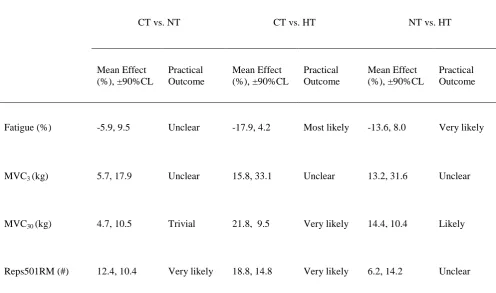
The simulated altitude or hypoxic training group clearly showed improvement in muscle
endurance (maximal voluntary contraction force which measured as an area under 30 seconds
curve; MVC30)by 14.8 ± 10.4% and fatigue (measured as the decrease in force from the
maximum to the minimum from over 30 seconds) improved by 12.7 ± 8.0% compared to a
placebo group breathing normal room air. These findings suggest that this exercise regimen is
very likely to be worthwhile for enhancing muscle endurance and reducing fatigue in well
trained males. Such training may be used by coaches as a compliment to current strength
training regimes.
In Study 3, I further investigated the mechanisms behind the apparent enhancement in
performance after intermittent hypoxic training from study 2. In addition, I also determined
the effect of local blood flow occlusion on muscular performance. To do this, low-load
resistance exercise (20% 1RM), combined with either simulated altitude or local blood flow
occlusions, was examined in female netball players. Relative to the control training group,
both exercise regimes resulted in improvement in all muscular performance variables
(maximal voluntary contraction force over 3 second; MVC3, and over 30 seconds; MVC30 and
number of repetitions to be performed at 20% 1RM; Reps201RM ) after five weeks training.
Muscle cross-sectional area also significantly increased after training with both blood
occlusion (6.6 ± 4.5%) and intermittent hypoxia (6.1 ± 5.1%) compared to training control
group (2.9 ± 2.7%). This study indicated that the hypoxic conditions of the muscles, caused
by either hypoxia or blood occlusion, may be involved in these positive performance
In conclusion, breathing air with a low partial pressure of oxygen due to decreased barometric
pressure (real altitude exposure) can result in beneficial aerobic performance changes in some
athletes. Additionally, breathing a low partial pressure of oxygen intermittently in a
normobaric environment (simulated altitude) can improve anaerobic-based performance such
as MVC over 30 seconds and number of repetitions at 50% 1RM. However, considerable
variation exists in subjects’ response to such training. Likely indicators for detecting positive
adaptation for athletes at altitude are positive changes in oxygen saturation in arterial blood
(SpO2) and heart rate during a 10 minute submaximal cycle test. In addition, the muscle
strength and endurance enhancement found in study 2 and 3 suggests intermittent hypoxia
may have a beneficial effect on anaerobic performance mechanisms perhaps through changes
in neuromuscular recruitment or metabolic changes within the muscles. This research has
found that performance (aerobic or anaerobic) improvement seen with altitude training may in
part be due to changes resulting from tissue hypoxia. It is clear however, that not all athletes
respond in the same way.
Keywords: altitude, intermittent hypoxia, responders, non-responders, muscle strength,
Acknowledgements
I would like to thank my supervisor, Associate Professor Mike Hamlin, who regularly
encouraged and supported me throughout my PhD study. You always gave me valuable
suggestions for any problems I faced during my experimental studies. You also gave very
good advice and helped me in my personal life as I am your first international student. You
had much patience and understanding with me which was made even more valuable since I
am an overseas student who uses English as a second language.
To my co-supervisor, Associate Professor Jenny Ross, your guidance and very useful
comments on my thesis writing has also been greatly appreciated. You always smiled and
gave me very warm and valued support every time I met with you. Although you have been
affected by Canterbury earthquake, you showed me how stress makes people strong. Thank
you Jenny I appreciate this.
I would like to thank the volunteers used in this research: triathlon athletes for Study 1,
Lincoln University students for Study 2 and Lincoln University netball athletes for Study 3.
Without your help this thesis would not have succeeded.
Thanks also to all the staff in the Recreation Centre of Lincoln University including Peter
Magson for your support in providing equipment, exercise machines and other facilities.
Thanks to all the MRI technicians at Canterbury Medical Imaging, Christchurch for your help
and professionalism.
Thanks also to Andrew Chapman (Airo Limited New Zealand) for the hypoxicator and his
valuable suggestions for Study 2 and Study 3.
To Mr Surasuk Satitsatit and Mr Pitak Srikitsuwan my senior Thai friends who supported and
helped me come through my troubled PhD student life. I deeply appreciated your help.
Finally, special thank with all my heart to my husband and my children for your great support
and understanding. I know you put a lot of effort into starting a new life with me in New
Zealand. Without you, I could not have passed my stressful circumstances. I look forward to
Peer-reviewed articles to be submitted and conference presentations arising
from this PhD Thesis
Chapters 2-4 of this thesis represent three separate papers that are to be submitted to
peer-reviewed journals for consideration for publication. These papers were prepared in
collaboration with my supervisors Associate Professor Mike Hamlin and Associate Professor
Jenny Ross. The percentages of my own work in these papers are noted in brackets.
Peer-reviewed articles to be submitted
Manimmanakorn A, Hamlin MJ, Ross JJ, Creasy RH. Responders and non-responders of live
high-train low (LHTL) altitude training. (Apiwan Manimmanakorn 85%, Mike Hamlin, Jenny
Ross and Robert Creasy 15%)
Manimmanakorn A, Hamlin MJ, Ross JJ. Effect of resistance training combined with hypoxia
on muscular strength and endurance. (Apiwan Manimmanakorn 90%, Mike Hamlin and
Jenny Ross 10%)
Manimmanakorn A, Hamlin MJ, Ross JJ, Taylor R. Effect of low-load resistance training
combined with vascular occlusion or hypoxia on muscle function and performance in athletes.
(Apiwan Manimmanakorn 85%, Mike Hamlin, Jenny Ross and Robert Taylor 15%)
Published peer-reviewed article
Hamlin MJ, Manimmanakorn A, Sandercock GR, Ross JJ, Creasy RH, Hellemans J (2011).
Heart rate variability in responders and non-responders to live-moderate, train-low altitude
training. World Academy of Science, Engineering and Technology, Vol. 70, page 1704-1709
Conference Presentations
Manimmanakorn, A and Hamlin MJ, Ross, JJ. Responders and non-responders of live
high-train low (LHTL) altitude high-training. The Lincoln University Postgraduate Conference,
Christchurch, New Zealand, 31 August-1 September 2009, page 17.
Manimmanakorn, A and Hamlin MJ, Ross, JJ. Responders and non-responders of live
high-train low (LHTL) altitude high-training. Proceedings of the New Zealand Conference of Sports
Science and Medicine, Rotorua, New Zealand, 12-14 November 2009, page 92.
Manimmanakorn, A and Hamlin MJ, Ross, JJ. Effect of resistance training combined with
hypoxia on muscular strength and endurance. Proceedings of the American College of Sports
Medicine Conference,World Congress on Exercise is Medicine, Baltimore, Maryland
USA,1-5 June 2010, Vol. 42, No.USA,1-5, page S331.
Manimmanakorn, A and Hamlin MJ, Ross, JJ. Effect of resistance training combined with
hypoxia on muscular strength and endurance. The Lincoln University Postgraduate
Conference, Christchurch, New Zealand, 2-3 September 2010, page 28.
Interest Group Meeting
KAATSU Training
Effect of low-load resistance training combined with vascular occlusion or hypoxia on muscle
function and performance in athletes. Orally presented (part of the results) in the American
College of Sports Medicine Conference;World Congress on Exercise is Medicine, Baltimore
Table of Contents
Abstract ... ii
Acknowledgements ... v
Peer-reviewed articles to be submitted and conference presentations arising from this PhD Thesis ... vi
Table of Contents ... viii
List of Tables ... x
List of Figures ... xi
Chapter 1 Preface ... 1
1.1 Introduction ... 1
1.2 Literature Review from Original Proposal ... 4
1.3 Originality of the Thesis... 16
1.4 Thesis Organisation ... 17
Chapter 2 Live high-Train low (LHTL) Altitude Training: Responders vs. Non-responders ... 18
2.1 Abstract ... 18
2.2 Introduction ... 19
2.3 Methods ... 20
2.4 Results ... 22
2.5 Discussion ... 24
2.6 Conclusion ... 28
2.7 Acknowledgements ... 28
2.8 References ... 29
Chapter 3 Effect of Low-Load Resistance Training Combined with Hypoxia on Muscular Strength and Endurance ... 39
3.1 Abstract ... 39
3.2 Introduction ... 40
3.3 Methods ... 41
3.4 Results ... 44
3.5 Discussion ... 45
3.6 Conclusion ... 47
3.7 Acknowledgements ... 48
3.8 References ... 49
Chapter 4 Effect of Low-Load Resistance Training Combined with Vascular Occlusion or Hypoxia on Muscle Function and Performance in Athletes ... 58
4.1 Abstract ... 58
4.2 Introduction ... 59
4.3 Methods ... 60
4.4 Results ... 64
4.5 Discussion ... 65
4.7 Acknowledgements ... 69
4.8 References ... 70
Chapter 5 General Summary ... 81
5.1 Conclusion ... 84
5.2 Limitations ... 86
5.3 Future Research ... 87
References... 88
Appendix A Ethical Approval Study 1,2,3 ... 97
Appendix B Subjective score sheets ... 102
Appendix C Participant Information Sheets, Consent Forms and Questionnaires ... 107
Appendix D Published peer-reviewed article ... 125
List of Tables
Table 2.1 Characteristics and training workloads of athletes in the two training groups... 33
Table 2.2 Mean changes in physiological measures during a 10-min submaximal cycle
test (post minus pre) and chances that the differences represent real changes ... 34
Table 2.3 Mean rates of perceived exertion at day 1(pre) and day 20 (post) in responders
and non-responders before, during and after submaximal cycle test... 35
Table 3.1 Characteristics of subjects in the three groups ... 52
Table 3.2 Muscle performance measures in the 3 groups before and after 5 weeks
training. ... 53
Table 3.3 Difference in the changes in performance variables between groups, and
likelihood that the true difference represents a substantial improvement or
impairment in performance (practical outcome) ... 54
Table 3.4 Differences in the changes between groups in arterial oxyhemoglobin and heart
rate at the end of MVC3, MVC30 and 501RM Reps testing sessions. Included is
the likelihood that the true difference represents a substantial benefit or harm
(practical outcome). ... 55
Table 4.1 Characteristics of subjects in the three groups ... 72
Table 4.2 Strength and endurance performance in the three groups pre- (before) and post-
(after) five week’s training. ... 73
Table 4.3 Mean effect of intervention between groups and chances that the true difference
represents a substantial improvement or impairment in performance (practical
outcome). ... 74
Table 4.4 Differences in the changes between groups and chances that the true differences
represent a substantial improvement or impairment in the sport-specific fitness
in all groups. ... 75
Table 4.5 Differences in the changes between groups and chances that the true differences
represent a substantial improvement in muscle cross-sectional area (cm2) in KT
List of Figures
Figure 2.1 Individual data for 800-m swimming time trial (sec) in the responders and
non-responders 1 week before (baseline) and 1 week after (post-test) altitude camp. . 36
Figure 2.2 Daily monitoring for HR, SpO2 and body weight throughout the altitude camp.
Close circles represent responders and open circles represent non-responders.
*Substantial difference from non-responders. Values are mean ± SD ... 37
Figure 2.3 Subjective fatigue, muscle soreness and Lake Louise Acute Mountain Sickness
score in both responders (close circles) and non-responders (open circles)
throughout the altitude camp. * Substantial difference from non-responders.
Values are mean ± SD ... 38
Figure 3.1 Low-load resistance training protocol and muscle performance testing ... 56
Figure 3.2 The daily arterial oxygen saturation (SpO2)and heart rate (HR) at the end of
four sets of resistance exercise training and the daily muscle soreness score in
hypoxia (closed circles) and normoxia (open circles). Values are mean ± SD.
*substantial difference between hypoxia and normoxia. ... 57
Figure 4.1 The pain score during exercise training for the 15 training days in all three
groups, * substantial difference from CT; ± 90% CL. CT, control training
(open circles); KT, Kaatsu training (closed triangles); HT, hypoxic training
(closed circles) ... 77
Figure 4.2 Typical magnetic resonance images showing transverse sections of the
mid-thigh, taken before (above) and after (below) the exercise training (control
training group) lasting for 5 weeks. ... 78
Figure 4.3 Typical magnetic resonance images showing transverse sections of the
mid-thigh, taken before (above) and after (below) the exercise training combined
with blood occlusion (Kaatsu training group) lasting for 5 weeks. ... 79
Figure 4.4 Typical magnetic resonance images showing transverse sections of the
mid-thigh, taken before (above) and after (below) the exercise training combined
Chapter 1
Preface
1.1
Introduction
Since the 1968 Olympic Games, the exercise and sport science fields have shown increased
interest in the use of altitude training to improve sea-level performances in athletes. At that
time, endurance athletes from high altitude countries like Kenya and Ethiopia showed higher
numbers of Olympic medal winners compared to sea-level countries (Wilber, 2004). These
performances encouraged sport scientists and researchers to explore the beneficial effects
from altitude training in sea-level based athletes. Many researchers over the years have tried
to answer the question of ‘whether altitude training produces positive improvements in athlete performance at sea level’. Scientists have also explored new approaches to altitude training
and simulated altitude devices, which avoid the inconvenience of real altitude sojourns.
Simulated altitude training is widely used by researchers and coaches in the sport science
area. In New Zealand, there have been few studies which have investigated either real altitude
or simulated altitude on athletes’ performance. In the present study, both real and simulated
altitude have been used to investigate what, why and how altitude affects the human body in
an attempt to gain more in depth knowledge about the use of altitude training for performance
enhancement.
The interest in both real and simulated altitude training has mainly focused on aerobic-based
performance (Levine, Stray-Gundersen, Gore, & Hopkins, 2005). There is significantly less
information on the effect of simulated altitude training on anaerobic-based performance,
particularly on muscle strength and endurance. Therefore, this thesis aims to investigate
physiological, aerobic and anaerobic-based performance changes after real and simulated
altitude training. The thesis consists of three studies; where the first study examined real
altitude conducted in Wanaka at 1,545 metres; the second and third studies were conducted in
Lincoln, New Zealand at sea level using a hypoxicator to artificially create an altitude
stimulus.
Real altitude training, living high at altitude and training at sea-level (live high-train low:
LHTL) was reported to be the most effective form of conventional altitude training (Levine &
Stray-Gundersen, 1992). However, these researchers also showed a large variability in post
Alexander, Hochstein, deLemos, & Levine, 1992). Responders are referred to as the athletes
who adapt well and increase their performance while non-responders were athletes who did
not gain any benefit and in many cases got worse from such training. Therefore the initial
study of this thesis concentrated on this question and in particular focused on live high-train
low effects (LHTL) on physiological variables that may indicate responders from
non-responders. The first study examined the physiological changes, including arterial oxygen
saturation (SpO2) and heart rate (HR) during a 10 minute submaximal cycling test, and other
physiological, subjective, and performance variables, after 20 days of LHTL in national elite
triathletes in New Zealand. Altitude exposure has been reported to influence a number of
physiological changes such as arterial oxyhemoglobin saturation and maximal oxygen
consumption which limit the ability to compete or train in elite athletes (Wilber, 2004).
Therefore I postulated that such physiological changes could be used to discern responders
from non-responders among the elite athletes. Therefore, the aim of this study was to
investigate whether physiological variables were related to the performance changes in
athletes during a 20-day LHTL period.
The second and third studies of the thesis were aimed at untangling some of questions around
the positive effects of hypoxia on anaerobic performance by using simulated altitude training.
In particular, I wanted to measure the effect of intermittent hypoxic exposure on muscle
strength and endurance performance and uncover possible mechanisms for any change. These
two studies were conducted at Lincoln University, Christchurch using simulated altitude and
local blood occlusion devices to investigate the effects of hypoxia in conjunction with
resistance exercise. At present, it is not clearly understood how the hypoxic condition that
occurs in exercised muscles induces increases in muscle strength and endurance. Furthermore,
comparisons between hypoxic breathing and blood occlusion (both of which cause muscle
hypoxia), as well as the mechanisms behind the changes, have not been investigated
extensively.
Thus, in the next two studies I investigated the effect of simulated altitude on anaerobic
muscular performance. Intermittent hypoxic exposure (IHE) is a form of simulated altitude in
which subjects passively breathe hypoxic gas intermittently with room air at rest. In
intermittent hypoxic training (IHT), however, subjects perform continuous or interval-training
sessions while breathing hypoxic gas. There are reports that IHT is more beneficial than IHE
for performance enhancement (Millet, Woorons, & Roels, 2009). Recent studies have tended
consequently there are few reports on the effects of IHT on anaerobic performance, especially
muscle strength. Some researchers have reported IHT benefits anaerobic rather than aerobic
performance ability in athletes (Hamlin & Hellemans, 2004; Hamlin, Marshall, Hellemans,
Ainslie, & Anglem, 2010). High-load resistance exercise is known to increase strength and
muscle size, but it is not yet known if low-load resistance exercise combined with intermittent
hypoxic breathing would make substantial muscular performance improvements in hypoxic
muscles. Therefore, study 2 aimed to determine muscle strength and endurance effects of IHT
with low-load (50% 1 repetition maximum) knee extension training in well trained males.
The information gained from the study 2 showed that hypoxia with low-load exercise was
successful in improving muscle strength and endurance in well-trained males. The underlying
physiological changes occurring as a result of hypoxia were further investigated in study 3. In
this study the effects of IHT and vascular occlusion on muscular physiological variables were
compared. Previous research has determined that vascular occlusion combined with low-load
resistance exercise enhances muscle strength, size and dynamic endurance of the knee
extensors muscles (Moritani, Sherman, Shibata, Matsumoto, & Shinohara, 1992; Takarada,
Sato, & Ishii, 2002). However, several studies have indicated that this exercise regimen where
blood flow is intermittently restricted by inflating a cuff around the exercising limb
(commonly known as Kaatsu training) has potential hazards, such as high blood pressure
(Takano et al., 2005) muscle and blood vessel damage (Takarada et al., 2000) and swelling of
capillaries (Menger, Pelikan, Steiner, & Messmer, 1992). In addition, it is not known whether
the strength gains witnessed after training with blood occlusion are due to the physiological
responses of ischemia (decreased blood flow) in the working muscles or whether hypoxia
(decreased muscle oxygen) is the mechanism behind the changes. If hypoxia is the
mechanism responsible for the increase in strength, then it may be possible to improve
strength without the deleterious effects from blood occlusion. This final study aimed to
compare IHT and vascular occlusion exercise training regimes on muscle strength and
endurance in female athletes and uncover any possible physiological mechanisms behind any
1.2
Literature Review from Original Proposal
Introduction
Most of the world’s population lives at sea level which has optimal atmospheric pressure and oxygen concentration for the human body’s functioning. At altitude, the air volume expands
due to the lowering of atmospheric pressure, which results in the reduction of oxygen
concentration. Research in aviation physiology has contributed significantly to the
understanding of how the human body responds and adapts to a hypoxic or low oxygen
concentration condition. In the 1880’s an Italian physiologist, Angelo Mosso, (1846-1910)
was the first to conduct experiments in the Italian Alps on the physiological effects of high
altitude on humans. In 1968, the effects of altitude became a more significant area of study for
scientists and sports coaches when the Olympic Games were awarded to Mexico City located
at an elevation of 2,300 m (7,544 ft). Many athletes that came from sea-level countries were
affected by the thin air of Mexico and struggled to gain medals. In particular, the sea-level
middle and long distance runner’s performance times were significantly slower at Mexico
City compared with their performance times at sea-level the same year. On the other hand, the
athletes from high altitude-based countries, for example, Kenya and Ethiopia, won many of
the medals available in the middle and long distance track events. Consequently, a number of
investigations were initiated to address a number questions including what was the effect of
altitude; how much high altitude can the human body endure, and for how long; does living at
altitude and training at altitude provide an advantage to performance at sea-level; and what is
the most effective form or model of altitude training.
Recent research has started to answer some of these questions but has also uncovered
additional problems. Training at real altitude is expensive and time consuming and may in
fact work to decrease rather than increase performance in some cases due to the decreased
quality of training that can be performed at altitude. Because of these disadvantages scientists
have investigated whether there is a more efficient and less expensive way to train at low
oxygen concentrations. From this research a series of new devices have been developed
recently that allows altitude training withouthaving to travel to high altitude. These devices
were originally developed to investigate the effects of the hypoxic environment on human
physiology. The Hypoxicator (Airo HTMH; High Tech Mixing Head, Airo Limited, New
Zealand). is one of the simulated altitude devices which has been widely used in both sport
Exposure to real altitude produces a drop in the partial pressure of oxygen in blood and results
in a decrement in kidney oxygenation. This reduction of oxygen concentration stimulates the
synthesis and release of erythropoietin (EPO), a hormone produced in the kidney, which
subsequently stimulates erythropoiesis in the red bone marrow, finally resulting in red blood
cell (RBC) and haemoglobin production. These haematological changes may significantly
improve aerobic performance in endurance athletes by enhancing the delivery of oxygen to
working muscles. Iron supplementation is a common strategy to increase the ability of red
blood cells to deliver oxygen to exercising muscles. Iron supplementation increases the heme
content of the haemoglobin molecule thereby allowing more oxygen to bind to and be
transported by the RBC. A limited number of studies have addressed the effects of altitude
exposure on EPO synthesis, RBC mass with and without iron supplementation.
The scientific rationale supporting the use of altitude training for anaerobic performance is
less compelling than aerobic performance. Altitude-induced increments in RBC mass and
haemoglobin are physiological adaptations which probably do not significantly affect the
anaerobic performance in athletes. One important physiological adaptation of altitude training
is an improvement in the capacity of the skeletal muscle to buffer the concentration of
hydrogen ions and increases the lactate threshold which may improve anaerobic performance.
Recent research also suggests hypoxic training may affect muscle strength. Japanese
researchers found a large (14.3%) increase in isotonic knee extension muscle strength after a
training regimen that partially occluded the blood supply thereby decreasing oxygen levels to
the exercising muscle (Takarada et al., 2002). The physiological mechanisms for this change
have not been fully explained. Currently it is not known whether the increased strength is an
adaptation to the reduced blood supply or to the subsequent hypoxic state of the muscle tissue.
Therefore, there are three main objectives of my research: firstly, to explore beneficial effects
of intermittent hypoxic exposure on muscle strength development on well trained athletes. In
this experiment I aim to find out whether the increase in strength is due to the hypoxic state of
the muscle rather than the blood occlusion. Secondly, to investigate performance change
resulting from iron supplementation with live high-train low altitude exposure on elite
athletes. Currently it is unknown what effect iron supplementation has on physiological and
performance change with live-high train-low altitude training. Lastly, I will examine the
performance and physiological effects of intermittent hypoxic exposure on muscular strength,
athletes can be improved by intermittent hypoxic training, I want to find out how this affects
the aerobic and anaerobic performance of athletes. This study will also investigate the
mechanisms behind such changes.
Background Information
The effect of high altitude on the human body has been of interest since 1878, when Paul Bert
suggested in his book that the most deleterious effects of high altitude on man are caused by
hypoxia, which is a direct result of the reduction in atmospheric pressure (Ward, Milledge, &
West, 2000). In children and adults, profound, prolonged hypoxia may cause disability and
even death. Effects of brief hypoxia for a few minutes or transient hypoxia for several hours
tolerable by human body are less clear (Serebrovskaya, 2002). The thin air layer at altitude
due to low barometric pressure causes lower partial pressure of oxygen in the lungs and
consequently in the blood (Wilber, 2004). In long term hypoxia, the deleterious effects of low
partial pressure of oxygen in the blood forces the human body to adapt and change, for
example increasing in the number of red blood cells thereby improving oxygen delivery to the
muscle and subsequently performance improvement (West et al., 1983). On the basis of the
previously described scientific rationale, the potential physiological benefits of altitude
training can be summarized as follow. The reductions in PIO2 (oxygen in air) and PAO2
(oxygen in lung) result in decrements of kidney PaO2 and it is kidney oxygenation that
stimulates the synthesis and release of Erythropoietin (EPO), which subsequently leads to an
increase in red blood cell (RBC) mass and haemoglobin concentration. These haematological
changes may improve an athlete’s VO2 by enhancing the blood’s ability to deliver oxygen to
the exercising muscles. It has been shown that these improvements in RBC mass,
haemoglobin concentration, and VO2 enhance aerobic performance (Hall & Guyton, 2010;
Wilber, 2004). Essentially, altitude training is of interest by many sport scientists and coaches
as a natural or legal strategy of blood doping.
The interest in the effects of altitude in sports was first highlighted at the 1968 Mexico
Olympics. Athletes from high altitude-based countries in particular Kenya and Ethiopia won a
relatively large proportion of medals in events from the 800 m through to the marathon
(Wilber, 2004). Such athletes continue to dominate middle and long distance running today.
For example out of the 36 medals contested at the Beijing Olympics in 2008 in the running
races from 800 m to the marathon, 21 (58%) were won by athletes born or living in high
2008.cn). Because of the known physiological response to altitude and the high number of
successful athletes that use altitude training, sport scientists and coaches continue to
experiment with altitude training for the purpose of enhancing athletic performance. However,
it remains unclear which method is best.
Since the majority of athletic competitions tend to occur at or near sea level, many scientists
have tried to find the most appropriate and beneficial type of altitude training to improve sea
level performance. A variety of strategies have been developed to reduce the availability of
oxygen at sea level to simulate what occurs at altitude. For example, nitrogen houses, altitude
tents, altitude rooms, re-breathing devices, and so on. The Hypoxicator are machines which
have been used to simulate altitude for athletes who seek performance gains. The hypoxicator
and other such devices can dilute oxygen (either via a membrane system extracting oxygen or
via a system which increases nitrogen gas to the body) which then creates a hypoxic
environment.
Traditionally altitude training is thought to improve performance via haematological changes.
Levine and Stray-Gundersen were the first to provide convincing evidence on the effects of
altitude on haematological indices when they asked a group of subjects to complete four
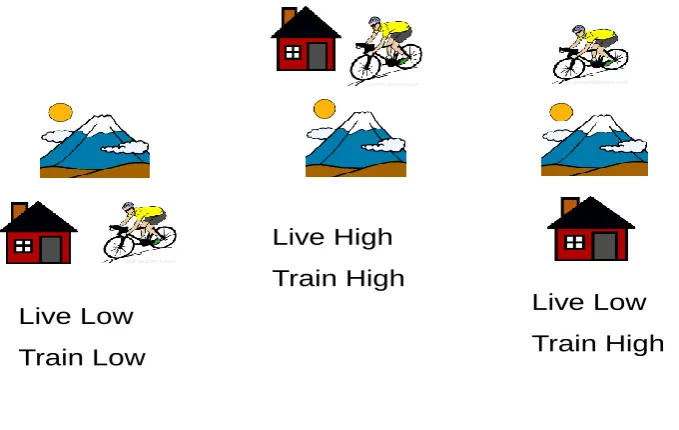
different protocols (figures 1.1 and 1.2); live-low train-low (LLTL), live-high train-high
(LHTH), live-high train-low (LHTL) and live-low train-high (LLTH); The LHTL protocol
(live at altitude and train at or near sea level) had previously been shown to be the most
effective method for improving sea level performance in athletes (Levine & Stray-Gundersen,
1992) .
• Live high-train low is the most effective form to improve aerobic based performance compared to other forms of altitude training.
Levine and Stray-Gundersen (1992)
Live Low
Train Low
Live High
Train High
Live Low
Train High
Figure 1.2 The other forms of altitude training.
The initial study on LHTL on blood parameters was conducted by Levine and
stray-Gundersen (1997) and they found a significant improvement in RBC mass (5%) and
haemoglobin (9%) (Levine & Stray-Gundersen, 1997). Stray-Gundersen (2001) has also
found erythropoietin (EPO) increased 92% in LHTL subjects (Levine & Stray-Gundersen,
2001). Other researchers using LHTL protocols have not found significant differences in any
blood parameters including EPO, RBC mass and haemoglobin concentration (Ashenden,
Gore, Dobson, & Hahn, 1999). Moreover, studies from Gore and Hopkin (2005) and Schmitt
et al. (2006) demonstrated that an improvement in exercise economy (power per unit of VO2)
is the more reasonable explanation for improvements in performance than haematological
effects (Gore & Hopkins, 2005; Mounier et al., 2006#195; Schmitt et al., 2006). Regardless,
the ability of live high-train low paradigm to elicit significant improvements in sea level
performance is dependent upon a number of critical factors, first, the degree of hypoxia;
second the duration of exposure to hypoxic conditions; third the exercise intensity; lastly
inter-individual variability in adapting to hypoxic environments (Mazzeo, 2008).
Altitude training is a well-known and used performance enhancing method in high
performance sport. One of the key issues in the final outcome of altitude training is the
problem of responders vs. non-responders. In other words, some athletes thrive on altitude
training and their performance improves while others either fail to improve or actually get
worse. It is not known why some athletes ‘respond’ to altitude and why others do not. There
training programme for individual athletes. Altitude scientists try to explore what is/are the
mechanisms behind the differences in athletes’ response to altitude. It is clear that there is
considerable inter-individual variability such that some athletes are ‘responders’
demonstrating significant increases in many key variables (e.g. erythropoietin, red cell
volume, and other physiological variables) while other individuals are ‘non-responders’
showing little or no change after acclimatization (Chapman, Stray-Gundersen, & Levine,
1998; Heinicke, Heinicke, Schmidt, & Wolfarth, 2005). Calbet et al. (2009) reported that
heamatological adjustments play an important role in individual acclimatization (Calbet &
Lundby, 2009). Therefore, the question has been raised, as to whether physiological and
heamatological adjustments play roles in responders’ acclimatization or other factors
involved. The individual differences in athletes iron levels may influence the production
processes of RBC on the amount of oxygen each RBC can carry and may be the one of key
role for altitude adaptation.
Iron supplementation with altitude training has been used for improved performance in
athletes (Nielsen & Nachtigall, 1998). Exposure to altitude without a supplemental dose of
iron, results in a marked decrease in serum ferritin (Robach, Fulla, Westerterp, & Richalet,
2004). Theoretically, iron is a requisite component of the haemoglobin molecule and serves as
the exclusive site for oxygen binding and release. Iron is necessary for red blood cell
multiplication; part of erythropoetic process (Wilber, 2004). Ferritin, the storage form of iron,
is significantly decreased after three weeks altitude exposure at 2,225 m in elite male
swimmers (Roberts & Smith, 1992). Similar results were reported in elite female speedskaters
who lived at 2,700 m for 27 days and trained between 1,400 m and 300 m (Pauls, Duijnhoven,
& Stray-Gundersen, 2002). These reports suggest that the hypoxic environment of altitude
may exacerbate the requirement for iron among well-trained athletes (Stray-Gundersen et al.,
1992). In addition, recent studies have shown that endurance performance was decreased due
to iron insufficiency in well trained non-anemic athletes (Friedmann, Weller, Mairbaurl, &
Bartsch, 2001) signifying even if athletes meet guidelines for iron levels they may be
disadvantaged if iron levels are not sufficient for their individual turnover rates. Whether
additional iron via regular intramuscular injections or oral supplementation is beneficial to
elite athletes undergoing LHTL-altitude training is not known.
It is an aim of this project to investigate the different physiological and performance
responses of athletes to moderate altitude by monitoring the athletes during an altitude camp.
concentration. Athletes that have insufficient iron levels to adapt to the extra stress of altitude
are less likely to benefit from such training.
Additional responses that may differ between athletes and may contribute to the success of
altitude training in individuals are changes in the autonomic nervous system. Heart rate
variability (HRV) is a monitoring tool used to detect changes in autonomic nervous control
that may indicate slow or impaired adaptation to altitude. HRV analysis provides a
non-invasive assessment of parasympathetic and sympathetic nervous system. A heart rate
variability analysis may be used to detect changes in autonomic nervous control that may
indicate slow or impaired adaptation to altitude. Altitude is an additional stress on the body
and athletes that must also train while undergoing altitude exposure may be unable to cope
with the increased stress, ultimately resulting in maladaptation and performance decrement.
Measuring heart rate variability may give an insight into why some athletes respond and other
do not.
To the present day, intermittent hypoxic exposure (IHE), a form of simulated altitude training
has been used extensively for the treatment of a variety of clinical disorders, including lung
disease, asthma, and hypertension and in sport (Serebrovskaya, 2002). IHT whereby subjects
breathe hypoxic air equivalent to high altitude (16-9% oxygen equal to 2,000-6,500m)
interspersed with recovery periods of normoxic air is a common method of altitude training
for athletes. This form of training has been shown to improve endurance performance and
submaximal exercise efficiency (Katayama, Matsuo, Ishida, Mori, & Miyamura, 2003). Other
forms of short hypoxic exposure include IHT (intermittent hypoxic training, where subjects
exercise while breathing the low oxygen air) short-moderate exposures (typically 2-4 hours of
hypoxia usually in a hypobaric chamber) and long intermittent exposures (where subjects may
stay in a tent or hypobaric chamber for 8-12 hours per day).
It is well known that muscular strength usually decreases during a sojourn to high altitude
probably through a combination of muscle wasting caused by water loss, increased basal
metabolic rate, decreased caloric intake and altered training intensity (Hoppeler & Vogt,
2001). Chronic exposure to high altitude leads to a reduction in muscle cross-sectional area
and decrease in size of muscle fibers in humans (Narici & Kayser, 1995). Hypoxia per se
might be responsible for this atrophy. This muscle loss occurs due to real altitude exposure
but has not been well identified by studies using IHT, in which athletes exercise under
combined resistance training with hypoxia (such as IHT) can improve muscular strength and
endurance. Intermittent hypoxia can influence cellular production of ATP and alter the
nervous control of muscle. If these systems are able to adapt to the hypoxic conditions by
improving either the generation of ATP in the cell or recruitment of muscle cells by the
nervous system it may lead to improved muscular performance including muscle strength.
Although intermittent hypoxia has been relatively effective strategy for improving endurance
performance in athletes, there is limited information about anaerobic performance after
intermittent hypoxic exposure (IHE). Preliminary data suggests that anaerobic power and
anaerobic capacity may be improved as a result of IHE (Wilber, 2004). Nummela and Rusko
(2000) claimed that elite triathletes exhibit increased power performance in both aerobic and
anaerobic tests after intermittent exposure (Nummela & Rusko, 2000). Hamlin et al. (2004)
also found that intermittent hypoxia benefited the anaerobic rather than the aerobic
performance ability in multi-sport athletes (Hamlin & Hellemans, 2004). Mizuno et al. (1990)
reported that relative to pre-altitude value, there was a 29% increase in oxygen deficit, as well
as a 6% increase in the buffering capacity in the quadriceps muscle (Mizuno et al., 1990).
Moreover, a pilot study by Wood and colleagues (2006) showed that professional team-sport
athletes exhibited enhanced performance in repeated sprint and shuttle runs following
exposure to simulated altitude (Wood, Dowson, & Hopkins, 2006). These studies imply a
positive effect of intermittent hypoxia on anaerobic muscle power. Whether similar positive
effects can be found in muscle strength after intermittent hypoxia is yet to be determined.
In order to gain increases in the size and strength of skeletal muscle it is commonly believed
that training intensity or load of at least 65% of 1 repetition maximum (1 RM) is required.
However, recent research suggests such gains may be obtainable with considerably lower
resistance in combination with blood occlusion, even in well-trained athletes with a history of
resistance training. Several studies have demonstrated that low-load resistance exercise
combined with blood occlusion effectively causes increases in muscular strength (Madarame
et al., 2008; Takarada et al., 2002; Takarada et al., 2000; Takarada, Tsuruta, & Ishii, 2004).
Low-intensity resistance training combined with vascular occlusion has also been shown to
improve strength and endurance in well-trained male rugby players with at least 5 years of
weight training experience. The researchers found a large (14.3 ± 2%) increase in isometric
knee extension strength after a training regimen that partially occluded the blood supply the
leg, thereby, decreasing oxygen levels to the exercising muscle (Takarada et al., 2002). The
known whether the increased strength is an adaptation to the reduced blood supply (blood
occlusion), or to the subsequent hypoxic state of the muscle tissue, or both. It has also been
shown that this exercise regimen markedly enhances metabolite accumulation within muscles
(Takarada et al., 2000). Whether such improvements are due to alterations in blood flow to
the muscle resulting in metabolic and/or pressure changes or due to alterations in blood flow
to the muscles resulting in blood flow reduction is not clear. In addition, apart from blood
flow reduction, hormone, growth factors, motor unit recruitment, heat stress, reactive oxygen
species (ROS) and nitric oxide (NO) have all been suggested as possible stimuli in training
with vascular occlusion (Goto et al., 2003; Kawada, 2005; Takarada et al., 2000). It is also
unclear whether improvements in strength and endurance found with such training occur in
well-trained female athletes and whether these improvements transfer to improvements in
sport specific performance.
Takarada et al. (2002) and Moritani et al. (1992) found that resistance exercise combined with
vascular occlusion improved muscle size, strength and dynamic endurance of the knee
extensor muscles (Moritani et al., 1992; Takarada et al., 2002). A similar result was found by
others who reported increased muscular strength along with enhanced motor unit firing rate,
spike amplitude, and responsiveness of muscle to calcium after blood occlusion (Moore et al.,
2004; Moritani, Stegeman, & Merletti, 2004). The mechanisms underlying such changes
remain unclear. Increased pressure around the limb (to the order of 200 mmHg: Kaatsu
technique) will eventually inhibit arterial inflow and venous outflow of blood through the
occluded site. Consequently metabolites (e.g. blood lactate) will start to build-up along with a
pooling of blood and a reduction in the oxygenation of the muscles in the occluded area. A
build-up of metabolites in the occluded area, may increase the activity of the muscle
metabo-receptors resulting in increased release of growth hormone via sympathetic activation of the
hypothalamus-pituitary system. Resistance exercise with blood occlusion has resulted in
increased circulating growth hormone which may be related to muscle hypertrophy also found
in such studies (Tanimoto, Madarame, & Ishii, 2005). In addition, ischemic strength training
with vascular occlusion has been found to decrease motor unit threshold (Houtman,
Heerschap, Zwarts, & Stegeman, 2002; Houtman & Stegeman, 2003; Sahlin, Soderlund,
Tonkonogi, & Hirakoba, 1997) and increased type II fibre recruitment (Yasuda et al., 2005).
A chronic reduction in the oxygen available may cause a shift in the muscle fibre type to
predominantly large Type II fibres thereby increasing the strength and size of the muscle. It is
also possible that during training the occluded muscle with lower oxygenation requires
The increased muscle EMG found by Takarada et al. (2000), subjects exercised at (30-50%
repetition maximum [1RM]) would suggest additional motor units were recruited (Takarada et
al., 2000). These studies would support this hypothesis. Hypoxia may also influence reactive
oxygen species that may play a role in the growth and proliferation of some cell species
leading to hypertrophy and strength increases.
Such hormonal and neural changes may result in the substantial muscle hypertrophy and
improved strength witnessed after low-intensity resistance training combined with occlusion.
However, several studies reported that low intensity exercise training and blood flow
restriction by cuff have potential negative effects such as high blood pressure (Takano et al.,
2005), muscle and blood vessels damage, thrombosis (Takarada et al., 2000), swelling of
capillary endothelial cells (Menger et al., 1992), and high levels of reactive oxygen species
(ROS) (Powers, Kavazis, & McClung, 2007). Currently it is not fully understood whether the
improved strength witnessed after such training (occluded blood flow) is due to the
physiological responses of ischemia or whether hypoxia is the mechanism behind the changes.
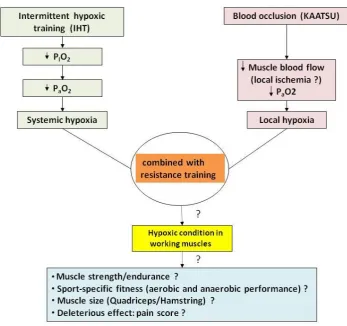
I summarized the likely mechanisms between IHT and blood occlusion in figure 1.3. If
hypoxia is the mechanism responsible for the increase in strength we may be able to improve
strength by using IHT without the deleterious effects of blood occlusion. I hypothesize that
intermittent hypoxia during low intensity strength training (20%1RM) will cause increased
stress in the muscle forcing the muscle to adapt. Such adaptation will ultimately increase
strength, but may also have an effect on other measures of performance related to strength
including muscular power and endurance. The physiological mechanisms behind these
changes are not fully understood, therefore part of this thesis will be devoted to investigating
changes such as cross-sectional area and motor unit recruitment in order to uncover possible
Figure 1.3 The likely mechanisms and effects of intermittent hypoxic training (IHT) and
Research Objectives
1. Identifying possible physiological parameters that may predict responders from
non-responders in triathlon athletes undergoing training at 20-day live-high train-low altitude
camp.
2. Determine the beneficial effect of intermittent hypoxic training combined with low-load
resistance exercise on muscle strength and endurance in well-trained subjects.
3. Investigate the muscle performance and muscle cross-sectional area changes that occur
with low-load resistance training combined with either hypoxia or blood occlusion in elite
1.3
Originality of the Thesis
- There are limited studies in which the use of real altitude using the live high-train
low approach has been used to improve sea-level performance in New Zealand
athletes. This is a pioneer study examining the effect of LHTL on physiological
variables in such athletes (study 1).
- Currently, we do not know why some athletes respond and improve and others do
not, study 1 is one of the first studies to attempt to answer this problem.
- At present there is a lack of information on the effect of simulated altitude training
on anaerobic performance. Study 2 has specifically investigated the use of
low-load resistance exercise training in conjunction with hypoxia on anaerobic
performance.
- This is the first study in New Zealand to investigate the effects of blood occlusion
using the Kaatsu technique to increase muscle strength and size (study 3). This
new technique has been used in Japan for many years but is new to Western
countries. There is no other study that has made comparisons between changes
resulting from simulated altitude (IHT) using a hypoxicator compared to blood
occlusion using the Kaatsu technique. In addition, almost all research into IHT or
Kaatsu is on male subjects. This final study is unique because it used female
1.4
Thesis Organisation
This thesis consists of five chapters. Chapter 1 contains a general introduction, a summary of
my original literature review for my PhD proposal and the originality of the thesis. Chapters
2, 3 and 4 are experimental studies written in manuscript format for publication in target
journals. Chapter 5 provides a general summary and conclusions. There are references for
each study, in Chapters 2 to 4, which are again collated at the end of the thesis in APA format.
Chapters 2, 3 and 4 comprise experimental studies 1, 2 and 3, respectively. Each chapter
consists of an individual abstract, introduction, methods, results, discussion, conclusions,
acknowledgements and references.
The appendices contain ethical approval of three studies, documents used in the thesis,
Chapter 2
Live high-Train low (LHTL) Altitude Training: Responders
vs. Non-responders
2.1
Abstract
The use of altitude training remains controversial despite its wide utilisation by athletes. This
study aimed to investigate differences between athletes that responded (improved their
performance) compared to those that did not (decreased their performance) after a 20-day
“live high-train low” (LHTL) training camp. Ten elite triathletes completed 20 days of live
high (Snow Farm, New Zealand, 1545 m), train low (Wanaka, New Zealand, 300 m) training.
The athletes underwent (i) two 800-m swimming time trials at sea-level (1 week prior to and 1
week after the altitude camp) (ii) two 10-min standardised submaximal cycling tests (250 W
for males and 200 W for females) at an altitude of 1,545 m on the first (day 1) and last day
(day 20) of the training camp. All subjects were randomly assigned to receive iron
supplementation (n=5) or placebo (n=5). Based on their 800-m swimming time trial, athletes
were divided into responders (improved performance by 3.2 2.2%, mean SD, n = 6) and
non-responders (performance decreased by 1.8 1.2%, n = 4). Compared to non-responders,
the responders had lower exercise heart rates (-6.3 7.8%, mean 90% confidence limit),
and higher oxygen saturations (1.2 1.3%) at the end of the 10-min submaximal test at the
end of the altitude camp. Non-responders were 3 times (90% confidence limit = 0.5-16.6)
more likely to suffer mild to severe symptoms of acute mountain sickness during first 5 days
of altitude compare to responders. By virtue of random allocation, 66% of responders and
25% non-responders consumed iron supplements during the camp. Our results show
considerable individual variation in performance exists in response to 20 days of LHTL
among elite triathletes undergoing similar training. Changes in SpO2 and HR during exercise
may help determine responders from non-responders.
Keywords
2.2
Introduction
The LHTL protocol (live at altitude and train at or near sea level) has been shown to be the
most effective altitude training method for improving sea level performance among athletes
(Bonetti & Hopkins, 2009; Levine & Stray-Gundersen, 1992). One of the key issues in the
final outcome of LHTL altitude training is the problem of responders vs. non-responders.
Some athletes thrive on altitude training and their performance improves, while others either
fail to improve or suffer performance decline. It is currently not known why some athletes
‘respond’ to altitude and why others do not.
Many researchers have investigated the individual variability in athletes’ response to altitude
training. Investigators have suggested that some athletes experience a better haematological
response at altitude than others (Chapman et al., 1998; Heinicke et al., 2005) which may help
reduce stress by allowing more oxygen to be transported to the working muscle. Chapman
and colleagues (1998) found that performance improvement related to increased
Erythropoietin (Epo) which increased total red cell volume and subsequently VO2max after a
28-day altitude training camp in responders (Chapman et al., 1998).Wide inter-individual
variability has been found in erythropoietic response to the altitude training which might not
identify those elite athletes who respond to altitude training (Friedmann et al., 2005). Recently
researchers have searched for genetic determinants in the individual variability of the Epo
response to altitude which may help explain why some athletes respond and some do not.
However, Jedlickova et al.’s (2003) study demonstrated little association between the
proposed genes involved in Epo regulation and Epo response to hypoxia (Jedlickova et al.,
2003). In addition, Hypoxia Inducible Factor (IHF-1) gene expression quantification after a
3-h 3-hypoxic test performed before training was unable to predict poor and good responder
athletes to the living high-training low model (Mounier et al., 2006). One study demonstrated
that individual difference in the tolerance to hypoxia may be explained by an increased Acute
Mountain Sickness (AMS) incidence (Burtscher, Szubski, & Faulhaber, 2008). In short, the
differentiation between responders and non-responders are probably based on many factors:
genetic predisposition (Wilber, Stray-Gundersen, & Levine, 2007), automatic nervous system
adaptation (Hamlin et al., 2011), hypoxia-induced ventilator drive (Ainslie, Kolb, Ide, &
Poulin, 2003) and other factors. It is clear that there is considerable individual variation in the
physiological responses of athletes using altitude training but, it is still relatively unclear how
The aim of the current project was to investigate different physiological (i.e., oxygen
saturation, heart rate and performance responses) and subjective (AMS, rate of perceived
exertion [RPE] during exercise) responses of athletes undergoing training at a 20-day altitude
camp in the hope of identifying possible physiological parameters that may predict responders
from non-responders.
2.3
Methods
Subjects
Ten elite triathletes were recruited from the New Zealand Academy of Sport development
programme. All of the subjects (6 males and 4 females) who participated in the present study
were international level athletes. The research was conducted over the summer period at
Snow Farm (1,545 m), Wanaka, New Zealand. The study was approved by the Lincoln
University Human Ethics Committee. Informed, voluntary, written consent was obtained
from each subject prior to the start of the study. All subjects were free from injury, lived at
sea level and had not been residents at altitude within the past 6 months. Subject
characteristics and baseline measures of training are presented in Table 2.1.
****Table 2.1 near here****
Study design
The elite triathletes slept and stayed at Snow Farm (1,545m) and travelled to train at Wanaka
(300 m) for approximately 2.7 ± 1.2 hour/day for 20 days during the camp. The athletes were
assigned to train aerobic based performance, swimming, biking and running which were
instructed by coaches. All subjects performed two exercise tests; swimming and submaximal
cycling pre and post training camp. During the altitude camp, five subjects were randomly
selected to receive iron supplementation 1capsule a day (controlled release iron tablets
containing dried Ferrous Sulphate BP 325 mg [equivalent to 105 mg element iron], vitamin C
500 mg as sodium ascorbate [FERROGRAD® C, Abbott Laboratories (NZ) Ltd, Naenae]),
while five subjects received a placebo (the same size capsule which contained plain flour) 1
capsule a day. Retrospectively, based on their 800-m swim time trial, athletes were divided
into responders (n = 6) who had positive results (decreased their swimming time) and
non-responders (n = 4) who had negative results (increased their swimming time).
Maximal Exercise Test
Performance was assessed by individual 800-m timed swim trials in a standard 25-m pool
near sea level. Time trials were performed at the same time each day with similar water
temperature and brands of swimming costumes. Subjects completed a standardised 10-15
min warm-up with stretching prior to the swim. Subjects were instructed to try to achieve the
best time possible during the swim, but were not provided any feedback on time or pace.
Submaximal Exercise Test
The submaximal cycling test was performed at altitude 1,545 m on each athlete’s own bicycle
set up on a stationary ergometer (Cycle Ops Fluid 2, Madison, WI, USA) at the same time of
day, on the first and last day of the altitude camp. Subjects performed the 10-min
submaximal test at 250 W (for males) or 200 W (for females) during which heart rate (S610;
Polar, Kempele, Finland), oxygen saturation (Sport-Stat, Nonin Medical, Minneapolis, MN)
and rate of perceived exertion were recorded every minute. Subjects performed a 10-minute,
self-selected warm-up before the test followed by a 5-minute self-selected warm-down.
Ongoing Monitoring
All of the subjects were monitored daily for: morning heart rate, body weight, oxygen
saturation and subjective perception of fatigue, muscle soreness, sleep, stress and training
performance before breakfast at 6.00-6.30am. The Lake Louise Acute Mountain Sickness
Score and training intensity and volume were recorded throughout the camp. All athletes had
a similar diet during experimental period. The athletes were measured
Training
Training loads were calculated via the training impulse (TRIMP) method (Banister & Calvert,
1980), which was expressed as product of stress (duration of activity) and strain (a 5-point
Likert-type scale based on exercise heart rate; easy=1, steady=2, moderately hard=3, hard=4,
very hard=5). The heart rate training zones were indentified initially from laboratory based
cycling and running lactate tests, and confirmed or adjusted by training sessions performed in
the field prior to the altitude training camp. The following training zones were established;
easy, corresponded to heart rates where lactate was ≤ resting lactate concentration, steady =
heart rate at the first lactate turn point, moderately hard = heart rate range between the first
and second lactate turn point, hard = heart rates that matched the second lactate turn point (~4
mmol.L-1) and very hard = heart rate from the second lactate turn point to maximum heart
Data analysis
All data are means and standard deviations (SD) within and between groups and subjects. We
used the baseline data as a covariate in the analysis to adjust for any differences between
groups at baseline. We used a contemporary statistical approach because small performance
changes can be beneficial for elite athletes (Hopkins, Hawley, & Burke, 1999), whereas
conventional statistics can be less sensitive to such small but worthwhile changes.
Specifically, we used magnitude-based inferences about effect sizes, and then to make
inferences about true (population) values of the effect, the uncertainty in the effect was
expressed as 90% confidence limits (CL). The probability that the true value of the effect was
practically negative, trivial, or positive accounted for the observed difference, and typical
error of measurement (Batterham & Hopkins, 2006). The natural logarithm of each measure
was analysed to reduce any effects from non-uniformity errors and then back-transformed.
For the physiological variables, the value was determined by multiplying the baseline
between-subject standard deviation by Cohen’s value of the smallest worthwhile effect of 0.2
(Cohen, 1988). The unequal variances t statistic was used to analyse differences in the mean
change between groups. The difference in the proportion of responders taking iron
supplementation and having Acute Mountain Sickness were analysed using the general linear
modelling procedure (Proc Genmod version 8.2, SAS Institute Inc., Cary, N.C.) and given as
relative risk. The smallest worthwhile change in 800-m performance was assumed to be a
reduction or increase in performance time of more than 1.0%, based on previous research into
elite athletes competitive performance (Paton & Hopkins, 2005).
2.4
Results
Based on any improvement (change) in the sea level 800-m, swim time trial, all of the
subjects were retrospectively grouped as responders and non-responders (Figure 2.1).
Responders performance improved by 3.2 ± 2.2%, mean ± SD and non-responders
performance decreased by 1.8 ± 1.2%.
*****Figure 2.1 near here*****
Physiological variables
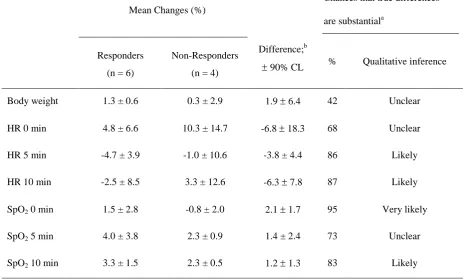
Heart rate and SpO2: Compared to non-responders, responders heart rate at the end of the 5
mean ± 90% CL, respectively). Relative to the non-responders, the responders also showed a
substantial increase in SpO2 at the start (0 minute 2.1 ± 1.7, mean ± 90% CL) and at the end
of the 10 minute submaximal cycle test (1.2 ± 1.3%). Responders SpO2 at the end of the 5th
minute of the cycle was elevated compared to non-responders but was not substantially
different (Table 2.2).
*****Table 2.2 near here*****
Iron supplementation: Interestingly, 4 of the 6 responders who improved their swimming
performance were taking iron tablets during the altitude camp while 3 of the 4 non-responders
were taking placebo. In other words, those participants that underwent iron supplementation
were 4.0 times (90% CL = 1.3-12.8) more likely to improve performance than participants
who did not take the supplement.
Subjective variables
Compared to non-responders, responders were more likely to have a lower RPE score before
(0 min) and after (end of 5 min recovery) the 10-min submaximal cycle tests (Table 2.3).
Changes to RPE score during the 10-min cycle test were unclear.
*****Table 2.3 near here*****
Continuous data collection was taken throughout the 20 days of altitude training, including,
morning SpO2, heart rates and body weight. There were substantial differences in morning
SpO2 at day 1, 2 and 3 between responders and non-responders (1.1 ± 2.0 %, 1.0 ± 1.1 % and
0.8 ± 0.8 %, mean ± 90% CL ). The morning heart rates were not substantially different
between groups. The body weights in non-responders tended to decline from day 1 to day 6
(no substantial difference from day1) of altitude camp, then changed little throughout the
camp. Compared to responders, non-responders body weights were substantially higher at day
1, 2 and 3 (5.8 ± 7.6 kg, 6.0 ± 7.5 kg, 6.0 ± 7.6, mean ± 90% CL) of camp (Figure 2.2).
*****Figure 2.2 near here*****
Subjective scores for fatigue, muscle soreness, the Lake Louise Acute Mountain Sickness
(LL-AMS) score and training performance are presented in Figure 2.3. The scores for fatigue