United Kingdom
Vol. II, Issue 4, 2014
Licensed under Creative Common Page 1
http://ijecm.co.uk/
ISSN 2348 0386
EVALUATING THE ANTECEDENTS OF ONLINE CONSUMER PURCHASING BEHAVIOR
AN EMPIRICAL STUDY BASED ON THEORY OF PLANNED BEHAVIOR
Al-Azzam, Abdel Fattah Mahmoud
Department of marketing, Zarqa University, Zarqa, Jordan
Abstract
Today, internet has been emerged as an indispensable means to develop business activities.
Whereas a small number of consumers in Jordan frequently shop on the Internet, research on
what factors affect their behavior changes has been fragmented. Therefore, this study that
proposes a framework to increase researchers’ understanding of Jordan young consumers’
attitudes toward Internet shopping and their intention to shop on the online. Moreover, this
research aims to overcome the drawback of prior studies and evaluate up to five antecedent
factors in one research model. Also, this research extends theory of planned behavior (TPB) by
including five important factors as external beliefs to online consumer behavior. The five factors
are identified by previous research, mostly in the areas of management information systems
and marketing science. This research is performed with a survey of 500 consumers who have
online shopping experiences. The collected survey data is applied to test each hypothesis
developed in the study model. The findings of data analysis confirm perceived ease of use;
perceived behavioral control, attitude, and perceived usefulness are essential antecedents in
determining online consumer behavior. However, the study found no significant relationships
between trust and online purchasing behavior
Keywords: Perceived ease of use, Perceived behavioral control, Attitude, Perceived usefulness,
Consumer behavior, Jordan.
This research is funded by Deanship scientific research and Graduate studies Zarga University,
Jordan.
INTRODUCTION
Nowadays, Internet is a part of our everyday life and it definitely changed our vision of shopping
with the progress of e-commerce. At present, E-commerce is significant and is here to stay.
Internet marketing has been become an essential part of marketing strategy. Furthermore,
Marketers and customers has been used the Internet to make decisions, choose brands and
Licensed under Creative Common Page 2 have contributed to the understanding of online consumer behavior. Most factors to online
consumer behavior have been identified and examined. Although previous researches provide
much valuable knowledge in the area, a lot of questions remain unanswered. Diverse previous
results lead to inconsistent and even controversial findings and several important antecedents
are missing. At present scholars of online consumer behavior are attempting to pursue a more
comprehensive viewpoint and build a more consolidated conceptual model to overcome the
drawbacks from prior studies. Furthermore, this study aims at developing new knowledge,
models and theories online customer behavior (Laroche, 2010). More specifically, Studying
online consumer behavior is one of the most significant research agendas in E-commerce
during the past decade. The studies of online consumer behavior has been performed in
multiple disciplines including information systems, marketing, management science, psychology
and social psychology, etc. (Chen, 2009; Hoffman & Novak 1996; Koufaris 2002; Gefen et al.
2003; Pavlou 2003, 2006; Cheung et al. 2005; Zhou et al. 2007). Currently, majority of
researches and academic literatures have been emphasizing on traditional consumer behavior
in different settings such as the product and service sector (Gao, 2008; Woodall, 2009;
Durvasula, et al., 2004), But only a few researches have focused online consumer behavior
(Lin, 2007; Flick, 2009; Osama, & Ahmed, 2013). Finally, this study is important because the
online consumer behavior is still considered a new field where flows in the system, reliability,
and manageability have become quite evident (Bapna etal., 2004; Constanza, & Lynda, 2012;
Smith, & Rupp, 2003; Newes, 2011).
LITERATURE REVIEW
A review of work in the area of consumer behavior indicates that a few studies have examined
online consumer behavior (Sinha, 2010; Osama, & Ahmed, 2013; Chen, & Huang, 2013).
Current studies have emphasized the need to modify and examine the dimensionality of the
theory of planned behavior format. So, creating a multidimensional scale for theory of planned
behavior and testing its psychometric characteristic is a great interest in recent studies (Chen,
2009). Furthermore, previous studies has demonstrated that there are numerous factors that
affect online consumer behavior, but a complete coverage of all potential factors in one
research model is almost impossible. Most research focused on a few main factors. For
instance, Koufaris (2002) explored variables which come from information systems (technology
acceptance model), marketing (Consumer Behavior), and psychology (Flow and Environmental
Psychology) in one model; Pavlou (2003) investigated the relationship between consumer
acceptance of E-commerce and trust, risk, perceived usefulness, and perceived ease of use. On the other hand, Pavlou and Fygenson (2006) found consumer’s adoption of e-commerce
with the extended theory of planned behavior (TPB) (Ajzen, 1991). Furthermore, the literature
Licensed under Creative Common Page 3
Theory of planned behavior (TPB)
The increase of marketing strategy improvement is ability to predict the consumer behavior in
the future. Thus, it is very significant for marketer to understand and impact the consumer
behavior. There are numerous theories that used to predict the purchase behavior of the
consumer in the purchasing method. In addition, as an extension of theory of reasoned action,
the Theory of Planned Behavior (TPB) clarifies the human decision making method (Azjen
1985, 1991; Azjen and Fishbein 1980). Theory of Planned Behavior assists the study in
clarifying behaviors over which individuals have incomplete voluntary control. Furthermore,
factors included in the theory contain a) perceived behavior control, b) behavior, c) attitude, d),
subjective norm, and e) intention. More specifically, Technology Acceptance Model (TAM) is
used for a prediction of the information, which is related to the technology such as online
purchasing. Additionally, Technology Acceptance Model (TAM) can describe the acceptance of information technology and an individual’s attitude among applying that technology. To describe
the information system acceptance, there are two fundamental variables which are perceived
usefulness and perceived ease of use (Davis et al., 1989). It was supported by Nasri & Charfeddine, 2012, Sinha, 2010, McKechnie et al., 2006; O’Cass and Fenech, 2003.
Online Consumer Behavior
These days, there are differences between online consumer behavior and traditional offline
consumer behaviors (Pavlou & Fygenson 2006; Mohamed et al., 2012; Chen 2009). Also, online
consumers are not only consumers but also computer users (Koufaris 2002; Chen & Huang,
2013). In addition to, information technology has significant effect on online consumer behavior.
This is the main difference between online and offline consumer behaviors. Moreover, due to
online purchasing happening in the virtual environment, online consumers miss several valuable
features or activities from the offline shopping. Furthermore, the study on online consumer
behavior is significant because it helps to understand when and how online consumer prepares
themselves for purchasing. Additionally, previous studies has demonstrated that there are
numerous factors that impact online consumer behavior, but a complete coverage of all
potential factors in one study model is almost impossible. Most researches focused on a few
main factors. For instance, Osama and Ahmed, (2013), and Muhammed, and Nasir. (2011)
found that online shopping is just simply facilitating diverse stages of traditional shopping,
specifically decision making and this implies that the only difference between online and offline
consumers is a desire for convenience and time saving. Similarly, Koufaris (2002) evaluated
factors which come from information systems (technology acceptance model),
marketing(Consumer Behavior), and psychology (Flow and Environmental Psychology) in one
E-Licensed under Creative Common Page 4 commerce and trust, risk, perceived usefulness, and perceived ease of use. In their study
model, consumer behavior was separately tested in terms of getting information behavior and
purchasing behavior, both of which were influenced by trust and Perceived behavioral control, consumer’s attitude, and technology-oriented factors including perceived usefulness, perceived
ease of use and web site features. This study demonstrates that factors are significant
antecedent factors to online consumer behavior
Factors that Affect Online Consumer Behavior
In the last decades, majority of researches of online consumer behavior have attempted to
identify main factors which play vital roles in determining online consumer behavior. Prior
researches demonstrated that there were a large numbers of factors to online consumer
behavior. These factors, not comprehensively listed, include attitude, Perceived behavioral
control, trust, perceived usefulness, and perceived ease of use (Lee et al., 2011; Flink , 2009).
Attitude
A number of studies have attempted to define attitude. Researchers have used both a positive
or negative evaluation of performing that behavior measures to define and assess attitude.
Chen (2009) defined an attitude toward a behavior as a positive or negative assessment of
performing that behavior. Applied to this studies context, an attitude toward Internet purchasing
refers to the degree to which the consumer has a favorable or unfavorable assessment or
appraisal of internet purchasing. Numerous studies in the marketing, information systems, and
psychology fields have used attitude as a factor of consumer purchase behavior, since attitude
is one of the main factors in the theory of planned behavior, and the technology acceptance
model (Sinha, 2010; Gao, 2008; ). These theories are appropriate for predicting purchase
behavior as well as actual behavior. For example, Flink (2009) indicated that attitude toward the
internet shopping was positively related to internet purchasing behavior. The positive attitude
toward the internet purchasing considerably increased intention to use the internet for shopping.
Furthermore, Nasri and Charfedding (2012) also found a positive relationship between attitudes toward online purchase behavior. Similarly, (Lee et al., 2011) defined an attitude as a person’s
positive or negative evaluations, emotional feelings, and action tendencies toward some object
or idea, and which is stable over time. More specifically, most prior studies have showed
attitude towards online shopping is an important predictor of making online purchases
(Jaturarith , 2007; Nemes, 2011). Finally, for this research, consumer attitude towards online
purchasing is defined as the extent to which a consumer makes a positive or negative
assessment about purchasing online. Hence, based on the above arguments, the following
Licensed under Creative Common Page 5
Hypothesis 1: There is a significant positive relationship between attitude and online
purchasing behavior
Perceived Behavioral Control
Ajzen and Madden (1986) extended the TRA into the Theory of Planned Behavior (TPB)
through adding a new factor "perceived behavioral control" as a determinant of both intention and behavior. Furthermore, perceived behavioral control indicates to consumers’ perceptions of
their ability to perform a given behavior. TPB allows the prediction of behaviors over which
people do not have complete volitional control. Perceived behavioral control reflects perceptions
of internal constraints (self-efficacy) as well as external constraints on behavior, like availability
of resources. It has been found that the Planned Behavioral Control (PBC) directly affects online
shopping behavior (George 2004) and has a strong relationship with actual Internet purchasing
(Khalifa & Limayem 2003, Mahammed et al.,2012). Applying Theory of Planned Behavior to
online purchase behavior.
Hypothesis 2:There is a significant positive relationship between Perceived Behavioral Control
and online purchasing behavior
Trust
Studies and literature about online consumer behavior frequently cite trust as a significant factor
in a consumer being willing to purchase online (Chen et al., 2004; Hansen, 2013; Mohamed et
al., 2012). Furthermore, there is no consensus among authors on the definition of online trust. Contanza, & Lynda (2012) defined trust as, “the willingness of a party to be vulnerable to the
actions of another party based on the expectation that the other will perform a particular action important to the trustor, irrespective of the ability to monitor or control that other party” .
Similarly, this definition is widely recognized and the most frequently cited (Osama, & Ahmed,
2013). According to Kim, & Forsythe, (2010), trust is a critical experienced factor fundamental in
initiating relationships with consumers. Thus, in marketing literature, trust is positively related to a consumer’s experience with a selling party (Keystone, 2008). Moreover, People purchase
products and services are the most based on their level of trust in this product or services, and
sellers either in the physical store or online shops. Finally, online trust is the basic and vital
element for developing a relationship with customers. More specifically, numerous researches,
between them Chang & Chen (2008), Ganguly et al (2012), Dash & Saji (2007), and Chen &
Barnes (2007), find a significant positive relationship between trust and online purchase
behavior. Hence, based on the above arguments, the following hypothesis is offered
Hypothesis 3: There is a significant positive relationship between trust and online purchasing
Licensed under Creative Common Page 6
Perceived usefulness (PU)
Davis (1989) defines Perceived usefulness as the degree to which a person believes that using
a particular system will enhance his or her job performance. Similarly, Chen, (2009) perceived
usefulness are defined as the degree to which one believes that using a system will enhance
her performance or increase productivity and influence purchasing behavior (Davis1989; Taylor
& Todd 1995). Therefore, Perceived usefulness is the most important factor influencing
purchasing behavior especially when making an adoption decision. More specifically , this study
focuses on Internet purchasing behavior, the meaning of perceived usefulness was modified
from the original to denote the extent to which an individual believes that using the online as a
shopping medium will enhance the outcome of the individual shopping experience (Cao &
Mokhtarian, 2005; Monsuwe et al., 2004; Salisbury et al., 2001; Venkatesh, 2000). Numerous
studies have suggested that usefulness influences the intent to purchase over the online directly (Ahn et al., 2004; Fenech & O’Cass, 2001; Gefen & Straub, 2000; Salisbury et al., 2001).
Hypothesis 4: There is a significant positive relationship between perceived usefulness and
online purchasing behavior
Perceived ease of use (PEOU)
There are numerous definitions and measures of perceived ease of use, but there is no
consensus on a single definition. The definition of perceived ease of use in the literature refers
to the degree to which a person believes that using a particular system would be free of effort
(Davis, 1989). According to Jaturarith (2007), Perceived ease of use is defined as the extent to
which a person believes that using a particular technology will be free of effort. Applied to the
online context, ease of use refers to consumer beliefs that purchasing over the Internet will
involve a minimal effort and that it is easy to use the Internet as a shopping medium.
Furthermore, ease of use has also been termed usability or efficiency in the online perspective,
which contains ease of navigation, ease of ordering, search function, download speed, overall
site design, and ease of Internet purchasing (Broekhuizen & Jager, 2003; Salisbury et al., 2001;
Swaminathan et al., 1999; Zeithaml, Parasuraman, & Malhotra, 2002, Monsuwe et al., 2004).
Davis indicated that ease of use alone is not adequate to predict usage behavior; therefore, it
was a causal antecedent to usefulness. prior studies have suggested that ease of use
determined attitude toward Internet purchasing by applying the technology acceptance model
(Ahn et al., 2004; Childers et al., 2001; Henderson & Divett, 2003; Pavlou, 2003). Finally,
numerous studies discussed the impact of perceived ease of use on purchase behavior in
general; some of the past studies, found a significant relationship between perceived ease of
use and purchase behavior (Sin, Nor, & Al-gagga, 2012; Tero et al., 2004: Nemes, 2011 ).
On the other hand, other studies found an insignificant relationship (Lee et al., 2011; Lin,
Licensed under Creative Common Page 7 behavior. Furthermore, previous study indicated that perceived ease of use positively affects the
online purchase behavior (Chen et al., 2004; Mon,& Kim, 2001; Cho, & Fiorito, 2008;, Lee et al.,
2011). Also, this study was aimed at examining the impact of perceived ease of use on the
purchase behavior to buy online. Perceived usefulness is hypothesized to have a direct effect
on purchase behavior when buying online.
Hypothesis 5: There is a significant positive relationship between perceived usefulness and
online purchasing behavior
CONCEPTUAL FRAMEWORK
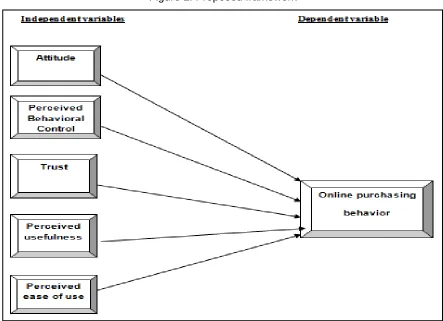
The proposed model for the study was developed to examine the online purchasing behaviors
of Jordanian consumers (See Figure 1). Online consumer behavior is influenced by numerous
factors. Figure 1 demonstrates a proposed research model of important variables from prior studies that influence a consumer’s behavior to purchase online. This proposal model builds on
the attitude (Hausman, & Siekpe, 2009). perceived behavioral control (Chen, 2009), trust (
Liang, & Huang, 1998), perceived usefulness (Hausman, & Siekpe, 2009), perceived ease of
use (Chen, 2009). Furthermore, the proposed model that incorporates the variables to be
studied is illustrated in Figure 1.
Licensed under Creative Common Page 8
METHODOLOGY
The objective of this study is to identify antecedents of online consumers’ behavior to purchase.
The method will be discussed in this chapter in the following order: population and sample, data
collection method, research instrument, data analysis, result and implication.
Population and Sample
The target population for the study is Yarmouk University of Jordan and keeping in view the
limitation of time and resources writer have decided to take the sample of 500 students.
Questionnaires were distributed by hand to respondents and enough time given to respondents
to fill the questionnaire to reduce sampling error. Furthermore, students were selected because
the student population is known for its technological expertise (Hair et., 2007; Coakes et al.,
2006). In addition, there were 500 questionnaires distributed to one university in Jordan, in
Arabic languages, located at the North. However, only 400 were completed as usable
questionnaires and were used for data analysis in this research. According to Sekaran (2003),
400 responses are considered as an acceptable number for researchers to proceed with data
analysis.
Data Collection Procedures
According to Saunders et al., (2009) there are two types of data: primary and secondary data.
Primary data indicates to collection of required data by the researcher specifically for their own
purpose and research. Secondary data indicates to the data that has been collected by other
researchers for some other purposes. According to Hair et al. (2011) “when the research objectives cannot be achieved with secondary data, primary data must be collected”. In this
study, Self-administered questionnaires were used for data collection from students of Yarmouk
University in Jordan. After identifying all the respondents, this study involved to distribute the
questionnaires. The researcher intercepted personally the respondents in the selected Yarmouk
University and it took one month to complete the collection process. The structure of the
questionnaire is clear, easy to understand, and straightforward to ensure that the students could
answer the questions with ease.
Research Instrument
A Self-administered questionnaire in English will be translated into the Arabic language, and
divide into five sections: online purchasing behavior, attitude, perceived behavioral Control,
trust, perceived usefulness, perceived ease of use, included items on demographic details of
respondents. Therefore, this study used a Likert scale to measure responses since this scale is
Licensed under Creative Common Page 9 researchers argued that using a five-point scale is just as good as any other (Churchill &
Lacobucci, 2004; Garland, 1991) for the reason that it reduces confusion to the respondents.
Data Analysis
This research used SPSS software to analysis the collected data. Descriptive statistics, Cronbach’s Alpha, Pearson’s correlation, Factor analysis, missing data, treatment of outlier,
normality, homoscedasticity, and multicollinearity and multiple regressions were the statistical
tools that were done in this research. A five part questionnaire was given to each participant.
The first part of the questionnaire included question # 1 through # 4. These items were summed
and then divided by four to determining the value for attitude. The second part of the
questionnaire included question # 5 through # 8. These items were summed and then divided
by four to determining the value for Perceived Behavioral Control. The last questions which are#
20 through # 24 are online purchasing behavior. Through descriptive statistics, any data
problems and statistical assumptions concerning the parameters used in this research were
further examined. The variables were measured with scales. The consistency of the scales was estimated through Cronbach’s alpha. To describe the relation between the variables correlation
analysis was used and to test the, attitude, perceived behavioral Control, trust, perceived
usefulness, perceived ease of use, on the online purchasing behavior regression analysis was
utilized.
RESULTS AND DISCUSSION
Profile of Respondents
In this study, the evaluated profile include, gender, age, academic qualification, household
income. Among 400 respondents, there were slightly more male (55. 5%) than females (44.5%).
In terms of age, the majority of respondents were between the ages of 18 and 25, which
represented 40.4% of the total respondents. The age of these respondents were almost evenly
distributed among the age groups of 26-35 (25.4%), 36-45 (17.8%), and 46 and above (16.4%). With respect to academic qualification, 50% had a bachelor’s degree, 30% a master’s degree,
and only 20% with PhD qualification. One-third of the respondents (25.0 %) reported to earn an
annual household income of between JD 15.000 – 25.000 and 15. 0% earned more than
JD26.000-35, and 50.0% had an annual income under JD 15.000. Only 10.0% of the
respondents had an annual income of JD 35 and above. With respect to purchase, 60.0 % of
the respondents reported that it was their first time purchase whilst 25.0% purchase for a
second time. Only 10% respondent reported that this was their third purchase, and 5.0%
Licensed under Creative Common Page 10 this study is also observed in many studies in other research works (Nems, 2011 ;Chen, 2009;
Lee, 2010).
Factor Analysis
According to Hair et al. (2006) and Tabachnick and Fidell (2001), factor analysis is often
performed when a researcher wants to understand the underlying structures or factors of his or
her studied variables. Thus, it can be a useful exploratory tool to test theories involved in one
particular research and help determine the construct adequacy of a measuring device
(Tabachnick & Fidell, 2001; pallant, 2007). Exploratory factor analyses were conducted
separately for each variable, using principal component factoring and the Oblimin rotation
method. In interpreting the factors, we used the guideline provided by Hair et al (2006) where a
loading of 0.50 or greater on one factor are considered. The appropriateness of exploratory
factor analysis was determined by examining the correlation matrix of the variables. The Kaiser-
Meyer- Olkin measure of sampling adequacy was over .760 in all investigations. The Bartlett
test of sphericity (over 959.468 in all variable) showed that the correlation matrix has significant
correlations (p = 0.000 for all variables), which indicated very good overall sampling adequacy
(Hair et al 1998).
Scale Reliabilities
The research measures were checked for dimensionality with factor analysis; results are
demonstrated in table 1. The Cranach’s Alpha scores were all greater than 0.70 and are
considered reliable (Hair et al., 2006). All the variables show a high degree of reliability.
Table: 1. Reliability Analysis of Factor of Purchase intention
Variables Number of items Cronbach’s Alpha
purchase behavior 4 .83
attitude 4 .85
perceived behavioral control 4 .75
trust 4 .77
perceived usefulness 4 .82
perceived ease of use 4 .87
Descriptive Statistics
Responses to all items of the study variables were measured on a 5-point likert scale (on a
Licensed under Creative Common Page 11 Table: 2. Means and standard deviations
Component Mean Std. Deviation
Purchase behavior 4.05 0.56
Attitude 3.7291 .75704
perceived behavioral control 3.93 0.60
Trust 3.77 0.56
perceived usefulness 3.89 0.68
perceived ease of use 4.16 0.57
Based on Table 2 above, 400 valid data were analyzed. Mean value for each variable was
calculated. According to Hair et al.(2006), the mean scores of less than 2.5 are considered low;
mean scores of 2.5 to 3.5 are considered moderate, and mean scores more than 3.5 are
considered high. As mentioned previously, Perceived ease of use is represented by four items.
As shown in Table 2, the mean score of this variable is considered very high (4.16), whereas
the other variables had a high mean score (3.7and above). For instance, the mean score of
Purchase behavior is 4.05, perceived behavioral control 3.93, perceived usefulness, 3.89,
attitude 3.7291, Trust 3.77, and perceived ease of use 4.16. Finally, this result confirms
respondents' viewpoint to Purchase behavior in the future.
Regression Analysis
Multiple regression analysis was performed for getting answers of research questions of this
study. In order to conduct multiple regression analysis, some assumptions of the relationship
between the dependent variable and the independent variables need to be met such as
normality, linearity, constant variance of the error terms and independence of the error terms
(Hair et al., 1998). Multiple regressions are used to explain the relationship between a single
dependent (criterion) variable and several independent (predictor) variables. There are a few
approaches that are used for multiple regression analysis such as standard regression,
hierarchical or sequential, and stepwise regression (Palant, 2001; 2007).
Table: 3. Results of Multiple Regressions between attitude, perceived behavioral control, trust,
perceived usefulness, perceived ease of use, and purchasing behavior
Model Dependent variable: purchasing behavior
Independent variable B Beta Sig
attitude .328 .318 .000
perceived behavioral control .358 .302 .000
trust .041 .041 .183
perceived usefulness .309 .401 .000
perceived ease of use .409 .315 .000
F statistics=826.464 R Square= .861
Licensed under Creative Common Page 12
Hypothesis Testing
Based on the theoretical model (Figure 1), multiple regressions was performed using online
purchasing behavior as the dependent variable and attitude, perceived behavioral control, trust,
perceived usefulness, and perceived ease of use as the independent variables. The result for
each hypothesis is described below. Hypotheses one, which states that attitude has positive
influence on purchasing behavior, is accepted. As shown in table 2, the significant value is less
than 0.05, therefore, there is a significant relationship between attitude and purchasing
behavior. This finding is consistent with the study conducted by (Chen, 2009; Osama, & Ahmed,
2013). Hypotheses two, which states that perceived behavioral control has positive influence on
purchasing behavior, is accepted. As shown in table 2, the significant value is less than 0.05,
hence, there is a statistically a significant relationship between perceived behavioral control and
purchasing behavior. This result is consistent with studies (Mohamed et al., 2012, Muhammed,
& Nasir, 2011). Hypotheses three, which states that trust has negative influence on purchasing
behavior to buy online, fails to be is rejected. As shown in table 2, the significant value is less
than 0.05, hence, there is a statistically a negative relationship between trust and purchasing
behavior to buy online. This result is consistent with studies (Wu et al. 2010; McCole et al.,
2010). Regarding Hypotheses 4, the data indicate that perceived usefulness is significantly
related to purchasing behavior. This result is consistent with studies (Nasri, & Charfeddine,
2012; Chen, 2009). Therefore, the results support Hypothesis 4. Finally, the findings of
Hypotheses 5, the data indicate that perceived ease of use is significantly related to purchasing
behavior. This result is consistent with studies (Nasri, & Charfeddine, 2012; Chen, 2009).
Therefore, Hypothesis 5 is support.
Correlation Analysis
Correlation analysis describes the strength and direction of the linear relationship between two
variables (Pallant, 2001) and the degree of correlation indicates the strength and importance of
a relationship between them. According to Cohen (1988), correlation values between 0.1 and
0.3 are considered small correlations; values between 0.3 and 0.49 are considered medium and
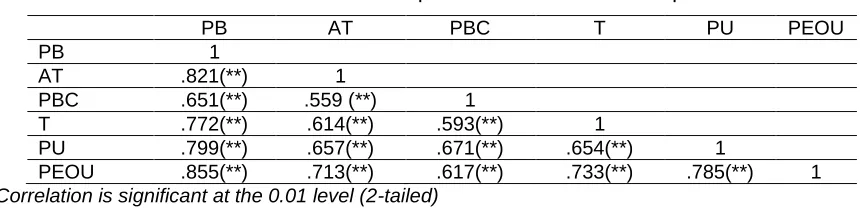
values from 0.5 to 1.0 are considered large. In this study, the correlation between these five
variables is shown in Table 4. The correlation is considered a high correlation based on Cohen
(1988), and Pallant (2007) more than .50 score is considered largely correlated between
Licensed under Creative Common Page 13 Table: 4. Pearson Correlation for Independent Variables and Dependent variable
PB AT PBC T PU PEOU
PB 1
AT .821(**) 1
PBC .651(**) .559 (**) 1
T .772(**) .614(**) .593(**) 1
PU .799(**) .657(**) .671(**) .654(**) 1
PEOU .855(**) .713(**) .617(**) .733(**) .785(**) 1 ** Correlation is significant at the 0.01 level (2-tailed)
Note. PB: purchasing behavior, AT: attitude, PBC: perceived behavior control, T: trust, PU: perceived usefulness, PEOU: perceived ease of use.
Table 4, shows a summary of the correlation analysis results where the computation of the
Pearson correlation coefficient was performed to understand the relationship among all
variables in the study. The correlation coefficients (r) given in Table 4, indicate the strength of
the relationship between the variables and the correlation coefficient for all latent variables were
found under the threshold of .90 (Hair et al., 2006). Overall correlation values of the variable as
shown in Table 4, showed correlation coefficients with values above .5, which normally indicate
high associations between variables. The relationship between perceived usefulness and
purchase intention is highly significant (r = .821). According to Cohen (1988) and Pallant (2007),
a coefficient of more than .50 means largely correlated variables. It signals also that subjective
norm influences purchase intention. Table 4, also shows that most of the variables are
statistically correlated with perceived usefulness, perceived ease of use, subjective norm, trust.
The r coefficients range from .651 to .821.
CONCLUSION
Most previous studies on online purchasing behavior has focused predominantly on developed
markets such as the USA, Europe, Canada, parts of Asia and Australia (Hansan, 2013; Chen,
2009; Zhang,2006) , but there was very little studies to be found about online consumer
behavior in the Jordanian context ( AL-Jabari, 2012). Furthermore, the objective of this research
was to conduct a thorough analysis of the literature in the area of online consumer behavior. A
studies framework was suggested to better understand existing researchers and to highlight
under-researched areas. These findings demonstrate that the literature on online consumer
behavior is rather fragmented. More specifically, this study intends to evaluate several major
antecedents that have been believed to determine online consumer purchasing behavior. The
major antecedents introduced in the research model were identified from previous research
findings. Five main antecedents, falling into two belief categories, were examined as to their
effects on online consumer behavior in the extended-TBP model. They are perceived
Licensed under Creative Common Page 14 trust (TBP beliefs). Among them, attitude, perceived behavioral control, and perceived
usefulness and perceived ease of use were found to significantly influence online consumer
purchasing behavior. The result is consistent with that reported by previous study of Chen,
(2009), who found a significant and positive relationship between attitude, perceived behavioral
control and online consumer purchasing behavior. Sinha (2010) investigated the relationship
between perceived usefulness, perceived ease of use and online shopping. Similar findings
were report by Lee etal, (2011), who demonstrated that attitude, has a positive influence online
shopping. In contrast, Constanza Bianchi, & Lynda Andrews, (2012) examined the relationship
between trust and online purchasing behavior. He found insignificant influence of online
purchasing behavior. This finding is supported in other studies (Wu et al. 2010; McCole et al.,
2010). It was expected that attitude will improved the consumer intentions, but unfortunately
Jordan consumers are much worried about trusting the web site as the most vital factor to
increase their intention for accepting online purchasing. These findings may encourage IT
sector professionals to introduce more secured internet and e-payment tools for intranet
transaction such as the digital signature which will increase consumers' trust with online
purchasing. Hence, this study found that perceived ease of use is number one factor that affect
Jordan consumer behavior followed by perceived behavioral control, attitude, perceived
usefulness for purchasing online as this is a new experience for them and very limited number
of local vendors offer online purchasing transactions. Finally, these findings provide interesting
insights into internet purchase behavior for Jordan consumers that have implications for both
domestic companies and global companies seeking geographical expansion of their
e-commerce activities. In conclusion, this study provides a valuable research model and empirical
results in the area. Meanwhile, it exposes some limitations of the research method and the
measurement instruments. Overcoming these limitations in future research will open new
research avenues for the study of online consumer behavior.
REFERENCES
Ahn, T., Ryu, S., & Han, I. (2004). The impact of the online and offline features on the user acceptance of internet shopping malls. Electronic Commerce Research and Applications, 3, 405-420.
Ajzen, I. (1985). From intentions to actions: A theory of planned behavior. In J. Kuhl, & J. Beckmann (Eds.), Action control: From cognition to behavior (pp. 11–39). New York: Springer-Verlag
Ajzen, I. (1991). The theory of planned behaviour. Organisational Behaviour and Human Decision Processes, 50, 179–211.
Ajzen, I. (2002). Behavioral interventions based on the theory o f planned behavior. Retrieved February 9, 2006, from www.unox. Unmass.edu.
Ajzen, I. and Fishbein, M. (1980), Understanding Attitudes and Predicting Social Behavior, Prentice-Hall, Englewood Cliffs, NJ
Licensed under Creative Common Page 15 AL-Jabari, M, Othman, S, & Nik-Kamaria, N, (2012), Actual Online Shopping Behavior among Jordanian Customers. American Journal of Economics June 2012, Special Issue: 125-129
Bapna, R., Goes, P, & Jin, Y. (2004). User heterogeneity and its impact on electronic Auction market design: An empirical exploration. MIS Quarterly, 28(1),21-44. Retrieved September6, 2006, from Proquest data base.
Burns, A., & Bursh, R. (2002). Marketing research: on line research applications (4th e d). New Jersey: Prentice Hall.
Cao, X., & Mokhtarian, P. L. (2005). The intended and actual adoption o f online purchasing: A brief review o f recent literature. Retrieved January 30, 2006, from www.its.ucdavis.edu/publications/2005/UCD-ITS-RR-05-07.pdf
Chang, H. H. & Chen, Y (2008). "The impact of online store environment cues on purchase intention: Trust and perceived risk as a mediator." Online Information Review 32(6): 818-841.
Chen L, Gillenson M, Sherrell D. (2004). Enticing online consumers: an extended technology acceptance perspective. Information and Management, 39(8)PP,705-19.
Chen, H, & Hung,S (2013), Exploring antecedents and consequence of online group-buying intention: An extended perspective on theory of planned behavior. International Journal of Information Management, 33,1885-198.
Chen, L.(2009). Online consumer behavior: An Empirical study based on theory of planned behavior. University of Nebraska.
Chen, Y.-H. and Barnes, S (2007). "Initial trust and online buyer behaviour." Industrial Management & Data Systems 107(1): 21-36.
Cheung, C. M. K., Chan, G. W. W., and Limayem, M. (2005) “A critical review of online consumer behavior: Empirical research”, Journal of Electronic Commerce in Organizations, 3(4), pp. 1-19.
Childers, T. L., Carr, C. C., Peck, J., & Carson, S. (2001). Hedonic and utilitarian motivations for online retail shopping behavior. Journal o f Retailing, 77, 511-535.
Cho H, & Fiorito, S. (2008). Acceptance of online customization for apparel shopping. International Journal of Retail & Distribution Management 37(5), pp389-407.
Churchill, G., & Lacobucci, D. (2004). Marketing research: methodological foundations (9th e d). Ohio: Thomson south-Western
Coakes, S. j., & Steed, L. G. (2003). SPSS Analysis Without Anguish. Sydney: Australia: John Wiley & Sons
Coakes, S., Steed, L., & Dzidic, P. (2006). SPSS version 13.0 for windows Milton: John Wiley and sons Australia.
Cohen, J. (1988). Statistical power analysis for the behavioral science (2nd ed). Mahwah. NJ: Lawrence Erlbaum Associates
Constanza Bianchi, & Lynda Andrews, (2012),"Risk, trust, and consumer online purchasing behaviour: a Chilean perspective", International Marketing Review, 29 (3) pp. 253 – 275
Dash, S. and K. Saji (2007). "The role of consumer self-efficacy and website social-presence in customers' adoption of B2C online shopping: an empirical study in the Indian context." Journal of International Consumer Marketing 20(2): 33.
Davis, F. D. (1989) “Perceived usefulness, perceived ease of use, and user acceptance of
Davis, F. D., Bagozzi, R., & Warshaw, P. R. (1989). User acceptance of computer technology. Management Science, 35(8), 982–1003.
Durvasula, S., Lysonski, S., Mehta, S.C., & Tang, B.P. (2004). Forging relationships with services: The antecedents that have an impact on behavioral outcomes in the life insurance industry. Journal of Financial Services Marketing, 8(4), 314.
Licensed under Creative Common Page 16 Flick, K (2009). Assessing consumer acceptance of online shopping: Examining factors affecting purchase intentions. North central University.
Ganguly, B (2012). "The effects of website design on purchase intention in online shopping: the mediating role of trust and the moderating role of culture." International Journal of Electronic Business 8(4): 302-330.
Gao, L.(2008). Understanding consumer purchasing behavior regarding luxury fashion related goods. Hongkong Polytechnic University
Garland, R. (1991). The mid-point on rating scale: is it desirable? Marketing Bulletin, 2, 66-70
Gefen, D., & Straub, D. (2000). The relative importance of perceived ease of use in IS adoption: A study of e-commerce adoption. Journal o f the Association fo r Information Systems, 5(1), 1-28.
Gefen, D., Karahanna, E., and Straub, D. W. (2003) “Trust and TAM in online shopping:An integrated model”, MIS Quarterly, 27(1), pp. 51-90.
George, J. F. (2004). The theory of planned behavior and Internet purchasing. Journal of Internet Research,14(3), 198-212. http://dx.doi.org/10.1108/10662240410542634
Hair, F., Bush, R., & Ortinau, D. (2003). Marketing research-within a changing information environment (2nd ed). Newyork, NY: McGraw-Hill-Irwin
Hair, J, Black, B, Anderson, R, & Tatham, R (2006). Multivariate data analysis. Upper Saddle River, NJ: Pearson Prentice Hall.
Hair, J, Celsi, M, Mone, A, Samousel, M. (2011), Essentials of Business Research Methods, M E SHARPE INC.
Hair, J, Money, A., Samouel, F., & Page, M, (2007). Research method of business. London John Wiley and Sonsltd, Chichester
Hair, J, Money, A., Samouel, F., & Page, M, (2007). Research method of business. London John Wiley and Sonsltd, Chichester.
Hair, J. Anderson, R. Tatham, R. & Black. (1998). Multivariate data analysis, New Jersey, prentice –
Hair, J., Black, B., Babin, B., Anderson, R., & Tatham, R. (2006). Multivariate data analysis: Upper saddle river, NJ: Pearson prentice hall.
Hansen, R (2013), online consumer behavior among Norwegian business students. University of Agder Hausman, A., & Siekpe, J.S. (2009). The effect of web interface features on consumer online purchase intentions. Journal of Business Research, 62(1), 5-13.
Henderson, R., & Divett, M. J. (2003). Perceived usefulness, ease of use and electronic supermarket use. International Journal o f Human-Computer Studies, 59, 383-395.
Hoffman, D. L., and Novak, T. P. (1996) “Marketing in hypermedia computer-mediated environments: Conceptual foundations”, Journal of Marketing, 60, pp. 50
information technology”, MIS Quarterly, 13(3), pp. 319-340.
Jaturarith, W (2007), Consumer adoption of the internet as a shopping medium: the case of Thailand. Alliant International University
Keystone, P (2008), Antecedents of online consumers’ intention to buy. Nova Southeastern University.
Khalifa, M., & Limayem, M. (2003). Drivers of internet shopping. Communications of the ACM, 46(12), 233-239
Kim, J, & Forsythe, S, (2010), factors affecting adoption of product virtualization technology for online consumer electronics shopping. International Journal of Retail & Distribution Management 38 (3), pp. 190-204
Koufaris, M. (2002) “Applying the technology acceptance model and flow theory to online consumer behavior”, Information Systems Research, 13(2), pp. 205-223.
Licensed under Creative Common Page 17 Lee, M, Cheung, C, Lim, K, & Sia, C(2011), Consumer’s decision to shop online: The moderating role of positive informational social influence, Information & Management 48 (5) 185–191.
Lee, Z. (2010). An investigation of antecedents and Consequences of consumers’ attitude toward an apparel website. published doctoral dissertation University of North Carolina at Greensboro
Liang, Ting P. and Huang, J.S. (1998). An empirical study on consumer acceptance of products in electronic markets: a transaction cost model. Decision Support Systems 24: 29-43
Lin, H. (2007). Predicting consumer intentions to shop online: An empirical test of competing theories. Electronic Commerce Research and Applications 6 (2007) 433–442.
Ling, K.. (2010). "The effects of shopping orientations, online trust and prior online purchase experience toward customers’ online purchase intention." International Business Research 3(3): P63.
McCole, P., Ramsey, E. and Williams, J. (2010), “Trust considerations on attitudes towards online purchasing: the moderating effect of privacy and security concerns”, Journal of Business Research, Vol. 63 pp. 1018-24.
McKechnie, S., Winklhofer, H. and Ennew, C. (2006), “Applying the technology acceptance model to the online retailing of financial services”, International Journal of Retail & Distribution Management, Vol. 34 No. 4/5, pp. 388-410
Mohammad,J, Hossein, D, Mojtaba, N, & Amir, P (2012), An analysis of factors affecting on online shopping behavior of consumers. International Journal of Marketing Studies,4(5)
Monsuwe, T. P., Dellaert, B. G. C., & Ruyter, K. (2004). What drives consumers to shop online? A literature review. International Journal o f Service Industry Management, 75(1), 102-121.
Moon, J, & Kim Y. (2001). Extending the TAM for a world-wide-web context. Information and Management ,38(4)PP217-30.
Muhammed, U, & Nasir, U (2011), Consumers’ Attitude towards Online Shopping. Hogskolan Pagotland
Nasri, W, & Charfeddine, L. (2012). Factors affecting the adoption of Internet banking in Tunisia: An integration theory of acceptance model and theory of planned behavior. Journal of High Technology Management Research 23 (3) 1–14.
Nems, L. (2011). Factors Influencing Consumer Bidding Behavior in Online Auction (Consumer-to-Consumer. published doctoral theses, Lynn University.
Newes, L. (2011). Factors information consumer bidding behavior in online Auction. Lynn University. O’Cass,A. and Fenech, T. (2003),“Web retailing adoption: exploring the nature of internet users web retailing behavior”, Journal of Retailing and Consumer Services, Vol. 10 No. 2, pp. 81-94.
Osama,E & Ahmed,R. (2013). Factors Affecting Egypt ion consumers’ intention for accepting online shopping. The Journal of American Academy of business,Cambridge, 19(1),pp 12-30
Pallant, J. (2001). SPSS survival manual: a step by step guide to data analysis using SPSS for windows: Crows vest: Allen and Unwin.
Pallant, J. (2007). SPSS survival manual: a step by step guide to data analysis using SPSS for windows: Crows vest: Allen and Unwin
Pavlou, P. A. (2003) “Consumer acceptance of electronic commerce: Integrating trust and risk with the technology acceptance model”, International Journal of Electronic Commerce, 7(3), pp. 69-103.
Pavlou, P. A. (2003). Consumer acceptance of electronic commerce: Integrating trust and risk with the Technology Acceptance Model. International Journal o f Electronic Commerce, 17(3), 101-134.
Pavlou, P. A., & Fygenson, M. (2006) “Understanding and predicting electronic commerce adoption: An extension of the theory of planned Behavior”, MIS Quarterly, 30(1), pp. 115-143.
Salisbury, D. W., Pearson, R. A., Pearson, A. W., & Miller, D. W. (2001). Perceived security and World Wide Web purchase. Industrial Management & Data Systems, 70/(14), 165-176.
Licensed under Creative Common Page 18 Sekaran, U. (2006). Research methods for business: a skill building approach New Delhi: Wiley India. Sin,S., Nor, K .,Al-gaga A. (2012). Factors Affecting Malaysian young consumers’ online purchase intention in social media websites. Procedia - Social and Behavioral Sciences 40, PP 326 – 333.
Sinha, J.(2010). Factors affecting online shopping behavior of Indian consumers. University of South Carolina.
Smith, A, & Rupp, W.(2003). Strategic online customer decision making: Leveraging the transformational power of the internet. Online information Review27(6),418-433. Retrieved September6, 2006, from Proquest data base.
Swaminathan, V., Lepkowska-White, E. & Rao, B. P. (1999). Browsers or buyers in cyberspace? An investigation of factors influencing electronic exchange. Journa o f Computer-Mediated Communication, 5(2). Retrieved December 6, 2006, from http://jcmc.indiana.edu/vol5/issue2/swaminathan.htm
Tabachnick and Fidell, (2001). Using multivariate statistics.Boston: Allyn & Bacon.
Taylor, C. S., and Todd P. A. (1995) “Understanding information technology usage: A test of competing models”, Information Systems Research, 6(3), pp. 144-176.
Tero ,P, Kari ,P, Heikki ,K, & Seppo ,P.(2004),"Consumer acceptance of online banking: an extension of the technology acceptance model", Internet Research, Vol. 14 Iss: 3 pp. 224 – 235.
Venkatesh, V. (2000) “Determinants of perceived ease of use: Integrating control, intrinsic motivation, and emotion into the technology acceptance model”, Information Systems Research, 11(4), pp. 342-365.
Woodall, J. (2009). Does loyalty drive success: A study of the behavior that influence consumer purchase decisions. Argosy University.
Wu, G., Hu, X. andWu, Y. (2010), “Effects of perceived interactivity, perceived web assurance and disposition to trust on initial online trust”, Journal of Computer Mediated Communication, 16 (1), pp. 1025-32.
Zeithaml, V. (1988). “Consumer perceptions of price, quality, and value: a means- end model and synthesis of evidence”. Journal of marketing, 52, no, 7: 2- 22.
Zeithaml, V., Parasuraman, A., & Malhotra, A. (2002). Service quality delivery through Web sites: A critical review of extent knowledge. Journal o f the Academy o f Marketing Sciences, 30, 362-375.