IJEDR1903119 International Journal of Engineering Development and Research (www.ijedr.org) 687
HRM as a key Enabler in Knowledge Creation
Process – A Study on Small & Medium Scale
Enterprises (SMEs)
1T. Sreenivas 1Professor
1Yogi Vemana University, Kadapa, AP
_____________________________________________________________________________________________________
Abstract - Knowledge Management is known as one of the most promising and advanced tools that can contribute to the creation of a sustainable competitive advantage for business today.KM implementation requires various prerequisites such as a substantial information technology platform, specialized personnel, a supportive working environment and supportive organizational structures etc. Those components are considered as KM enablers or KM success factors. In business, KM’s main function is to facilitate the new knowledge creation which, on its turn, becomes the competitive advantage of firms. The present paper focuses on the relationship between HRM practices and knowledge creation. This paper surveys the responses of managers working in SME’s specifically, drawing upon HRM theory and KM theory; we develop a conceptual model that predicts that the critical factors of HR practices, and policies would be associated to knowledge creation capabilities. Using factor analysis and multiple regression the paper concludes that Socialization supports Training & Development, Selection of Employees and Performance Appraisal. Externalization supports compensation reward system and Performance appraisal. Combination doesn’t support the HR Practices. Internalization supports compensation and reward system, training & development and performance appraisal. Therefore this paper highlights the importance of HRM as a key enabler of knowledge creation process.
keywords - HRM, Knowledge Creation Process, SME’s, Key enabler
_____________________________________________________________________________________________________
Introduction:
While knowledge in itself may be difficult to manage, all the related technologies, structures, instruments, values, and even people are susceptible to a range of management activities. In terms of the HRM function, Gloet (2006) has been suggested that one way for HRM to reinvent itself is though its contribution to effective linkages between human resources and KM within organizations. In fact, the rising of the so called “knowledge economy” has had a major impact, with a considerable shift from HRM as a bureaucratic “personnel management” operation focused on cost minimization to the development of a new HRM function where human experience is critical, so that knowledge can be generated, shared and leveraged in the learning processes of living experiences.
Scarbough & Carter(2000) highlighted that managing human resources to achieve better knowledge related outcomes means retaining personnel, building their knowledge and expertise into the organizational routines, and establishing mechanisms for the distribution of benefits arising from the utilization of that knowledge.
Even Drucker (1992) identified the role of “knowledge workers” in the new society. According to him “every organization is in competition for its most essential resources; qualified, knowledgeable people.” His view is echoed elsewhere in the literature. The importance of individual knowledge workers and the role of HRM have been developed into the current theory of “knowledge management”, and is therefore the main focus in the present study.
In today’s business environment knowledge management is considered as the main source of competitive advantage for any type of organization, especially those belonging to the service sector. The purpose of the present research was firstly to gain a better understanding of which factors are critical for the successful implementation of knowledge management.
Literature review:
Much of the KM literature has reflected a techno-centric focus which, in essence, regards knowledge as something (similar to information) that can be captured, manipulated, and leveraged through IT. This is a limited perception that needs to be completed with a more human-centric focus, Gloett(2006) that perceives knowledge as a social creation emerging at the interface between people and information, and between people and people. From this perspective, KM can be described as the way organizations create, supplement, and organize knowledge around their activities and within their cultures, and develop organizational efficiency by improving the use of employees’ talent.
Pan and Scarbrough(1999) identifies that KM can be defined as the capacity within an organization to maintain and improve organizational performance based on experience and knowledge.
Argote, McEvily and Reagans(2003) stated that effective KM occurs here within an organizational context characterized by certain characteristics that affect knowledge creation, sharing, and maintaining as desirable KM outcomes.
IJEDR1903119 International Journal of Engineering Development and Research (www.ijedr.org) 688 Alexopoulos and Monks(2004) stated that knowledge creation concerns the building of new knowledge (create and innovate) by applying knowledge to solve problems, and translate these efforts into new ways of doing that will be competitive and attractive in the marketplace. In fact, several authors Pulakos(2003) have argued that enhancing the creative and innovative performance of individuals is critical if organizations are to achieve competitive advantage.
To achieve knowledge sharing, knowledge maintaining, and knowledge creation capabilities as desirable outcomes, KM requirements are based on a set of behaviors, procedures, and stimulus. Accordingly, we next argue that a revitalization of the HRM function to respond to the demands of the “knowledge economy” and to develop linkages with KM requires major changes across three key areas: employees’ ability, employees’ motivation, and employees’ opportunity to leverage knowledge.HRM practices can impact on individual’s ability, motivation, and opportunity to share, maintain and leverage knowledge. The employees’ skills and abilities have long been conceptualized as human capital, which is shown to involve a stronger knowledge base.
Nadler, Thomson, and Van Boven (2003) highlights that these skills and abilities are innate, but also can result from training and career development chances in the organization.
Argote et al., (2003) highlighted that training provides individuals the ability to share knowledge accumulated in one task to another task. In a similar, way, experience in different work positions also affects ability, so that individuals acquire the capacity to understand knowledge in different areas while correspond transmitting what they already know. Together with it, the use of training and development programmes should help to develop the general level of self-efficacy among organizational employees; so that they feel more assure of their abilities and will be more likely to exchange knowledge with others.
Nahapiet and Ghoshal, (1998),Kang, Morris and Snell(2007) highlighted that formal training, training in team building, cross-based training, job rotation programs, etc. are very useful to increase employees’ abilities, but also to increase interactions between employees that result in a shared language and closer interpersonal ties (social capital) that positively affects knowledge flows within organizations
HRM practices can also provide people the motives and incentives to participate in KM processes. In knowledge dependent organizations, employees must be willing and motivated to share their education and experience with other employees in order to generate innovation (Nonaka and Takeuchi, 1995). Employees who are committed to their organizations are more likely to look for ways to improve conditions and will be more receptive to new ideas and information. From the HRM point of view, performance appraisal and compensation systems are considered as important components that nurture KM.
As suggest by Argote et al. (2003), the “not invented here” syndrome in organizations is an example of how rewards can affect KM outcomes. Individuals are unlikely to share knowledge if they are not rewarded for achieving knowledge outcomes, such as exchanging and utilizing internal knowledge.
Similarly Cabrera and Cabrera (2005) stated that performance appraisals that have a developmental, rather than a controlling, focus, will increase the willing to share ideas in organizational climates that are safe and non-judgmental
Kang et al. (2007) states that the biggest potential drawback of performance appraisal and compensation systems is that often lead to competition among employees. Appraisal of incentive systems based on group and firm performance and stock ownership programmes should lead to higher levels of acquaintance necessary for knowledge work.
Lee and Sukoco(2007) stated that for many organizations achieving improved performance is not only dependent on the successful deployment of tangible assets and natural resources but also on the effective management of knowledge.
Lee and Sukoco(2007) highlighted that much of the overall spending by organization on knowledge management initiatives is driven by strategic imperatives that depend on the effective management of the knowledge resource.
This SECI model employs the spiral movement of knowledge. It involves continuous interactions between the explicit and tacit knowledge. The process followed in the SECI model creates a good amount of new knowledge. Also, Jennex (2007) states that knowledge is recognized as a key economic resource and organizations should posses the right knowledge in the desired form and content under all circumstances in order to be competitive and successful.
Heaidari, M., Moghimi, S. M., & Khanifar, H. (2011) highlighted the critical success factors of KM such as ; culture, senior managers, teamwork, empowerment, performance measurement, training, involvement, information system, benchmarking, and knowledge
Makoto Matsuo, (2015) examined how human resource development (HRD) programs promote the linkage between knowledge transfer and knowledge creation in engineering departments. He highlighted three major findings, First, The Toyota technical Development Corporation effectively links knowledge transfer to knowledge creation so that new knowledge on vehicle development is created by transferred competencies. Second, the Toyota technical development corporation promotes the transfer of explicit and tacit knowledge by complementarily combining off-the-job and on-the-job training (OJT). Third, HRD programs are developed and operated in communities of practice.
Amy C Edmondons and Jean-Francois Harvey (2017) have highlighted that Cross-boundary teaming, and the role of HR within and across organizations, is an increasingly popular strategy for innovation. Knowledge diversity and knowledge creation is seen to expand the range of views and ideas that teams can draw upon to innovate.
Need for study
IJEDR1903119 International Journal of Engineering Development and Research (www.ijedr.org) 689 time to market and increased customer satisfaction. In SME’s Employees work with the KM programme because they see its benefits and realize the value its brings them on a day-day basis. Knowledge work defined at the point of need by the issues, problems or opportunities that arise.
In this connection, Human resource management can make an important contribution to knowledge management simply because knowledge is shared between people; it is not just a matter of capturing explicit knowledge through the use of information technology. Many SME’s lack usage of IT and their tools, from this point of view the role of human resource management is to ensure that the organization has the intellectual capital it needs; all components of the human resource management system have an influence on knowledge and knowledge management. Combined with the increased efficiency of the individuals, teams and working groups contribute to the creation of a sustainable competitive advantage of the business organizations.
Hypothesis of study
H0: There is no significant relationship between HRM Practices and Knowledge Creation Process.
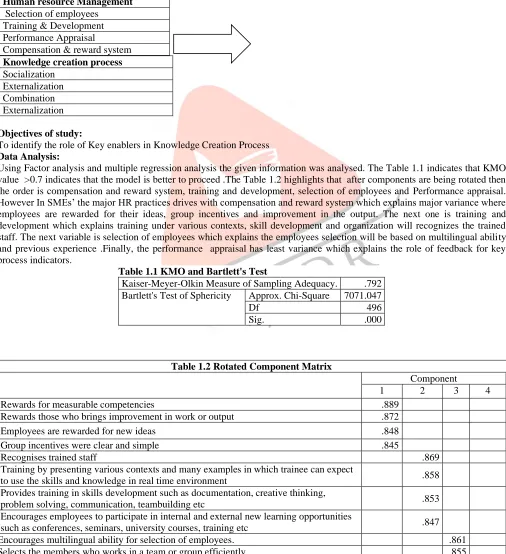
H1: There is a significant relationship between HRM Practices and Knowledge Creation Process. Research Model:
Human resource Management Selection of employees
Training & Development Performance Appraisal
Compensation & reward system Knowledge creation process Socialization
Externalization Combination Externalization Objectives of study:
To identify the role of Key enablers in Knowledge Creation Process Data Analysis:
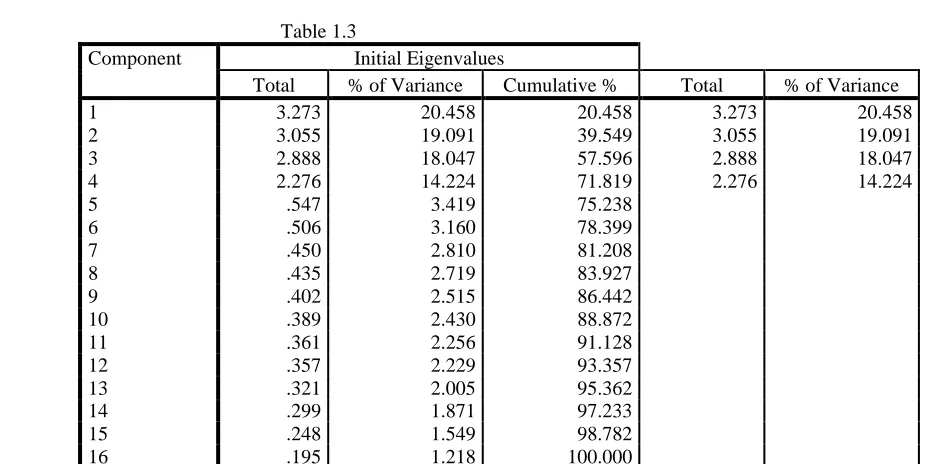
Using Factor analysis and multiple regression analysis the given information was analysed. The Table 1.1 indicates that KMO value >0.7 indicates that the model is better to proceed .The Table 1.2 highlights that after components are being rotated then the order is compensation and reward system, training and development, selection of employees and Performance appraisal. However In SMEs’ the major HR practices drives with compensation and reward system which explains major variance where employees are rewarded for their ideas, group incentives and improvement in the output. The next one is training and development which explains training under various contexts, skill development and organization will recognizes the trained staff. The next variable is selection of employees which explains the employees selection will be based on multilingual ability and previous experience .Finally, the performance appraisal has least variance which explains the role of feedback for key process indicators.
Table 1.1 KMO and Bartlett's Test
Kaiser-Meyer-Olkin Measure of Sampling Adequacy. .792 Bartlett's Test of Sphericity Approx. Chi-Square 7071.047
Df 496
Sig. .000
Table 1.2 Rotated Component Matrix
Component
1 2 3 4
Rewards for measurable competencies .889
Rewards those who brings improvement in work or output .872
Employees are rewarded for new ideas .848
Group incentives were clear and simple .845
Recognises trained staff .869
Training by presenting various contexts and many examples in which trainee can expect
to use the skills and knowledge in real time environment .858
Provides training in skills development such as documentation, creative thinking,
problem solving, communication, teambuilding etc .853
Encourages employees to participate in internal and external new learning opportunities
such as conferences, seminars, university courses, training etc .847
Encourages multilingual ability for selection of employees. .861
IJEDR1903119 International Journal of Engineering Development and Research (www.ijedr.org) 690
People who exhibit interest in learning are preferred .837
Considers related professional experience for employees .827
Provides feedback which is useful for improvement .734
Provides feedback which is used for ratings, reward and sanctions .724
Collects feedback based on personal characteristics not relevant to work .689
Collects feedback based on the key process indicators .680
Extraction Method: Principal Component Analysis. Rotation Method: Varimax with Kaiser Normalization. Table 1.3
Component Initial Eigenvalues
Total % of Variance Cumulative % Total % of Variance
1 3.273 20.458 20.458 3.273 20.458
2 3.055 19.091 39.549 3.055 19.091
3 2.888 18.047 57.596 2.888 18.047
4 2.276 14.224 71.819 2.276 14.224
5 .547 3.419 75.238
6 .506 3.160 78.399
7 .450 2.810 81.208
8 .435 2.719 83.927
9 .402 2.515 86.442
10 .389 2.430 88.872
11 .361 2.256 91.128
12 .357 2.229 93.357
13 .321 2.005 95.362
14 .299 1.871 97.233
15 .248 1.549 98.782
16 .195 1.218 100.000
The above Table 1.3 explains that Compensation & reward system will explain 20.45% of variance, training and development plays 19.09% of variance, selection of employees explains 18.04% of variance and finally the performance appraisal explains 14.22% of variance.
Table 1.4 Rotated Component Matrix:
Socialisation,Externalisation,Combination & Internalisation Model(SECI Model)
Component
1 2 3 4
Sharing experience with suppliers and customers .890
Engaging in dialogue with competitors .887
Gathers information inside to develop strategies .877
Encourages observing the work of experts and skilled people .858
Encourages documenting one’s expertise for others to use. .860
Facilitates exchange of ideas through Social media .848
Circulates suggestions and improvements through channels like brochures, circulars etc. .837 Applies the best knowledge to deliver our organizational products and services. .830
Develops plans based on published information, forecasting etc.
Cmb1 Cmb2 Cmb3 Cmb4
.833
Stresses creating manuals and documents on products and services.
Cmb1 Cmb2 Cmb3 Cmb4
.827
creating a data-base on products and service
Cmb1 Cmb2 Cmb3 Cmb4
IJEDR1903119 International Journal of Engineering Development and Research (www.ijedr.org) 691 Develops reports by gathering both
technical and financial information
Cmb1 Cmb2 Cmb3 Cmb4
.805
Cross functional teams works together for development .790
Teams experiments with improvements and the result are shared with the departments .784
Employees search and share new values and thoughts .777
Employees to understand and share management vision through group communication .745 Sampling Design and Characteristics
The analysis in this research is focused only on SMEs. Samples were constrained to the listed companies in SME sector in Guntur. Primary data was collected from SMEs by administering the questionnaire and by conducting face-to-face interviews. A questionnaire-based survey was conducted. The questionnaire was circulated personally as well as through e-mails; Interviews were conducted to discover the awareness of the Knowledge management and its existing status. During this process, it was also observed that the percentage of respondents were reluctant to express their deep seated opinions due to the inherent fear, many of them end up in giving socially acceptable answers. In view of the problem and scope of the study, a simple random sampling technique is adopted in drawing the sample. Every possible effort was made to include a cross section of the population in the sample.
Sampling Method
Simple random sampling technique was used to identify the respondents for data collection. The collected data was classified, tabulated and analyzed in a systematic manner.
Sample Size The questionnaire was administered to over 539 respondents from select Textile SMEs. Out of which 75 responses were incomplete, the number of valid questionnaires returned was 464, and the response rate was 86.08%.
The above Table 1.4 indicates that after rotation Socialization highlights employees share their experience with supplier and other members, Externalization emphasizes on documenting one’s expertise where others to use, Combination specifies creating a data base on products and Internalization highlights about shared vision .The cronbach’s alpha of reliability scale of items which is >0.7 highlight we can rely on these items.
Multiple regression Analysis :
The following table highlights about the importance of multiple regression analysis and its important factors. Table 1.5: Socialization vs. HRM Enablers
Model R R Square R Square Adjusted R Square Std.Error of the Estimate
1 0.287 0.082 0.074 0.96215768
a. Predictors: (Constant), Dependent variable : Socialization, Independent variables : HRM Enablers
Table 1.5a: Socialization vs. HRM Enablers ANOVA
Model Sum of Squares Df Mean Square F Sig.
1
Regression 38.082 4 9.520 10.284 .000b
Residual 424.918 459 .926
Total 463.000 463
. a. Predictors: (Constant), Dependent variable : Socialization, Independent variables : HRM Enablers
The Table 1.5a indicates that Socialization directly supports to the Training & Development (p<0.05), Socialization directly supports to the Selection of employees (p<0.05), Socialization directly supports to the Performance appraisal (p<0.01) where as Socialization doesn’t support to the Compensation and reward system.
Table 1.6 : Externalization vs. HRM Enablers Model Summary
Model R R Square Adjusted R
Square
Std. Error of the Estimate
1 .149a .022 .014 .99314972
Predictors: (Constant), Dependent variable : Externalization, Independent variables : HRM Enablers
Table 1.6a : Externalization vs. HRM Enablers ANOVAs
Model Sum of Squares Df Mean Square F Sig.
1
Regression 10.267 4 2.567 2.602 .035b
Residual 452.733 459 .986
Total 463.000 463
IJEDR1903119 International Journal of Engineering Development and Research (www.ijedr.org) 692 The Table 1.6b highlights the Externalization directly supports to the Compensation reward system (p<0.1), Externalization supports to the performance appraisal (p<0.1), where as Externalization doesn’t support the Training and development and Selection of employees.
Table 1.6b : Externalization vs. HRM Enablers ANOVAs
Table 1.7 : Combination vs. HRM Enablers Model Summary Model R R Square Adjusted R Square Std. Error of the Estimate
1 .126a .016 .007 .99632235
a. Predictors: (Constant),
b. Dependent variable Combination, Independent variables : HRM Enablers Table 1.7a : Combination vs. HRM Enablers ANOVAa
Model Sum of Squares Df Mean Square F Sig.
1
Regression 7.370 4 1.842 1.856 .117b
Residual 455.630 459 .993
Total 463.000 463
Dependent variables Combination, Independent variables :HRM Enablers
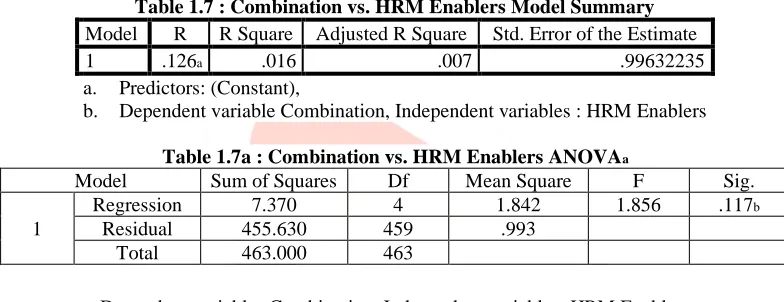
From the Table 1.7a Combination doesn’t support any HRM process, since signicance (p>0.1).Therefore majority of SME’s doesn’t possess the data base of products and services , where they are offering.
Table 1.7b : Combination vs. HRM Enablers ANOVAa
Coefficients
Model Unstandardized
Coefficients
Standardized Coefficients
T Sig. Collinearity Statistics
B Std. Error Beta Tolerance VIF
1 (Constant) -2.104E-016 .046 .000 1.000
Compensation & Reward system
.027 .046 .027 .586 .558 1.000 1.000
Training & Development .045 .046 .045 .971 .332 1.000 1.000
Selection of Employees .041 .046 .041 .885 .377 1.000 1.000
Performance Appraisal .107 .046 .107 2.314 .021 1.000 1.000
Dependent variables Combination, Independent variables :HRM Enablers
Table 1.8 : Internalization vs. HRM Enablers Model Summary
Model R R Square Adjusted R
Square
Std. Error of the Estimate
1 .284a .081 .073 .96291657
Dependent variable Internalization, Independent variables : HRM Enablers
Table 1.8a : Internalization vs. HRM Enablers ANOVAa
Model Sum of
Squares
Df Mean Square F Sig.
1 Regression 37.411 4 9.353 10.087 .000b
Residual 425.589 459 .927
Coefficients
Model Unstandardized
Coefficients
Standardized Coefficients
T Sig. Collinearity Statistics
B Std. Error Beta Tolerance VIF
1
(Constant) 2.002E-018 .046 .000 1.000
Compensation &
Reward system .077 .046 .077 1.667 .096 1.000 1.000
Training & Development .015 .046 .015 .333 .739 1.000 1.000
Selection of Employees .033 .046 .033 .716 .475 1.000 1.000
Performance Appraisal .122 .046 .122 2.647 .008 1.000 1.000
IJEDR1903119 International Journal of Engineering Development and Research (www.ijedr.org) 693
Total 463.000 463
Dependent variable Internalization, Independent variables : HRM Enablers
Table 1.8b : Internalization vs. HRM Enablers Coefficients
Model Unstandardized
Coefficients
Standardized Coefficients
T Sig. Collinearity Statistics
B Std.
Error
Beta Tolerance VIF
1
(Constant) 4.563E-017 .045 .000 1.000
Compensation & Reward
system .116 .045 .116 2.588 .010 1.000 1.000
Training & Development .215 .045 .215 4.812 .000 1.000 1.000
Selection of Employees -.007 .045 -.007 -.147 .883 1.000 1.000
Performance appraisal .145 .045 .145 3.236 .001 1.000 1.000
a. Dependent variable Internalization, Independent variables : HRM Enablers
From the above Table 1.8b Internalization directly supports the Compensation and reward system (p<0.05), Internalization directly supports the training and development (p<0.01), Internalization directly supports the performance and appraisal system (p<0.01) and Internalization doesn’t support the selection of employees.
Findings:
From the above analysis there is a link between HRM practices and Knowledge creation process. Socialization, Externalization and Internalization are partially supporting HRM practices .However in our study Combination doesn’t support the HRM practices. Therefore HRM is a key enabler for knowledge creation process. Therefore Null hypothesis is rejected and Alternate hypothesis was accepted.
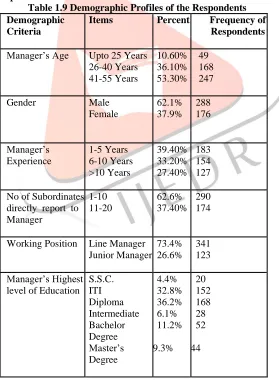
Demographic profile of the respondents:
Table 1.9 Demographic Profiles of the Respondents Demographic Items Percent Frequency of
Criteria Respondents
Manager’s Age Upto 25 Years 10.60% 49 26-40 Years 36.10% 168 41-55 Years 53.30% 247
Gender Male 62.1% 288
Female 37.9% 176
Manager’s 1-5 Years 39.40% 183 Experience 6-10 Years 33.20% 154 >10 Years 27.40% 127 No of Subordinates 1-10 62.6% 290 directly report to 11-20 37.40% 174 Manager
Working Position Line Manager 73.4% 341 Junior Manager 26.6% 123 Manager’s Highest S.S.C. 4.4% 20 level of Education ITI 32.8% 152
Diploma 36.2% 168 Intermediate 6.1% 28 Bachelor 11.2% 52 Degree
Master’s 9.3% 44 Degree
Suggestions:
IJEDR1903119 International Journal of Engineering Development and Research (www.ijedr.org) 694 motivated employees, organizations can create and leverage knowledge by providing a social context in which employees trust in one another and interact to exchange and combine ideas. Such exchange creates new knowledge by combining previously unconnected ideas or by recombining old ideas in new ways that make them more useful. There seems to be unanimous agreement that individuals will be more willing to share knowledge in an open, collaborative, and trusting culture when firms create a trusting and collaborative context that facilitates knowledge sharing and combination, they are more adept to share and create knowledge.
Accordingly, we consider that HRM practices can influence employees’ abilities, motivation and opportunity to share, maintain and create knowledge by respectively: (1) impacting on staff qualification by means of training processes and development opportunities; (2) inducing employees’ motivation with proper rewards and performance appraisal; and (3) fostering relationships that are based on trusting and collaborative behaviors.
Conclusion:
The use of HRM practices can be seen to be concerned not only with attempting to create a positive attitude towards, and a willingness to participate in, organizational KM activities, but also with making employees committed and loyal to their employer. This is fundamental because, if employees are not committed and loyal to their organizations, there is a risk of losing knowledge possessed by the employees through staff turnover. Recruitment and selection processes by employers can be utilized, as well, to support KM activities. This can be used to recruit people whose values are compatible with the existing organizational culture and whose personalities are conducive to knowledge creating sharing and recruiting people whose values are aligned with those of the organization was an important factor in the success of the companies they studied. Retaining employees who possess valuable knowledge should equally be as important an element in an organization’s KM strategy as motivating employees to participate in knowledge activities. This is because the tacit and embodied nature of much organizational knowledge means that when employees leave an organization, they take the knowledge with them. Practice communities where employees could meet and solve problems and address issues could also be established. The implementation of mentoring programs is also important. The use of coaching and mentoring through SECI model in organizations can facilitate informal sharing of knowledge. This involves the sharing of knowledge between a relatively experienced person (the mentor/coach) and someone less experienced (the mentee).
The reason for assuming a mediating effect is that HRM practices are seen as a system that is gradually developed over time and do not produce automatic results. The HRM practices that shape employees’ abilities, motivation and opportunities, in turn shape a collective capacity to share and maintain knowledge, and this results in a collective capacity to create new knowledge and ideas.
Finally HRM is a key enabler of knowledge management which helps to retain scare knowledge, expertise and skills apart from ensuring that long-term as well as committed connections with the organization’s knowledge workers.
References
Alexopoulous, A. and Monks, K. (2004), “A social perspective on the role of human resource practices in intra-organizational knowledge sharing”, Paper submitted to the 5the International Conference on HRD and Practice across Europe 2004.
Amayah, A.T. (2013), “Determinants of knowledge sharing in a public sector organization” Journal of Knowledge Management, 17(3), 454-471
Amy C Edmondson and Jean Francosis Harvey (2017), “Cross-boundary teaming for innovation : Integrating research on teams and knowledge in organizations”, HRM Review ,March 2017
Argote, L., McEvily, B. and Reagans, R. (2003), “Managing knowledge in organizations: An integrative framework and review of emerging theme”, Management Science, vol. 49, pp. 571-582.
Carter, C. & Scarbrough, H. (2001), “Towards a second generation of KM? The people management challenge, Education & Training, Vol. 43, 4/5, pp. 215-224.
Drucker, P.F. (1992), “The New Society of Organizations”, Harvard Business Review, Sept-Oct, pp. 95-104.
Gloet, M. (2006), “Knowledge management and the links to HRM”, Management Research News, vol. 29, pp. 402-413 Gold, A.H., Malhotra, A. & Segars, A.H. (2001), “Knowledge management: an organizational capabilities perspective”, Journal of Management Information Systems, 18 (1), 185-214.
Heaidari, M., Moghimi, S. M., & Khanifar, H. (2011), “The critical success factors in implementing knowledge management: Agricultural organization in Islamic Republic of Iran”, British Journal of Science, 1(2), 54-75
Hislop (2013), “Knowledge management in organizations: A critical introduction “, Oxford University press.
Lee, L.T. & Sukoco, B.M. (2007), “The effects of entrepreneurial orientation and knowledge management capability on organizational effectiveness in Taiwan: the moderating role of social capital”, International Journal of Management, 24(3), 549-73.
Makoto Matsuo(2015), “Human resource development programs for knowledge transfer and creation : the case of the Toyota Technical Development Corporation”, Journal of Knowledge Management, Vol.19 Issue:6, pp.1186-1203.
Pan, S.L. and Scarbroug, H. (1999), “Knowledge management in practice: An exploratory case study”, Technology Analysis & Strategic Management, vol. 11, pp. 359-374.
Pulakos, E.D., Dorsey, D. W. and Borman, W.C. (2003), “Hiring for knowledge-based competition”, Jossey-Bass, John Wiley & sons, Inc, USA.
Reich, R. (1991), “The wealth of nations: Preparing ourselves for 21st century capitalism”,Simon & Schuster,London.
Shalley, C.E. (1995), “Effects of coaction, expected evaluation, and goal setting on creativity and productivity”, Academy of Management Journal, vol. 38, pp. 483-503.