ISSN (Online): 2320-9364, ISSN (Print): 2320-9356 www.ijres.org Volume 7 Issue 1 Series I
ǁ
2019ǁ
PP. 07-17Quality Management System Maintenance in Brazilian SMEs
Monise Coutinho Dias
Paulo Sérgio de Arruda Ignácio Francisco Ignácio Giocondo César Ieda Kanashiro Makiya
ABSTRACT
Objective – This paper aims to characterize the Critical Success Factors (CSFs) and problems of small and medium-sized enterprises (SMEs) in São Paulo State to maintain Quality Management System (QMS).
Design/methodology/approach – Exploratory bibliographical research was done to provide a theoretical basis to this paper. A survey method questionnaire conduct this research. The questionnaire had 12 queries on the QMS maintenance difficulties. This paper nature is applied, with exploratory character and quantitative approach, using statistical concepts such as Boxplot, Cronbach’s Alpha, Descriptive Statistics and Exploratory Factor Analysis.
Results – The results allowed to identify the difficulties and the low perception of the companies about their own problems, by splitting their difficulties in two groups possible: “Information, monitoring, diagnosis, action and improvement” and “Cooperation, commitment, knowledge and feedback.”
Research Limitations and Implications – This research was developed in the most industrialized state of Brazil. Future research in this area could look for a broader sample.
Practical implications – Brazilian SMEs have the major difficulties on the maintenance of a QMS by the results. Originality/value – By evaluating the difficulties perception that Brazilian SMEs face and pointing to the main groups of problems, this paper contributes to the analysis of the QMS maintenance profile.
KEYWORDS: Quality Management System (QMS), ISO 9001, Critical Success Factors (FCS) and problems, maintenance, quality, Small and Medium-sized Enterprises (SMEs).
Article type: Research paper.
--- Date of Submission: 20-02-2019 Date of acceptance: 08-03-2019 ---
I. INTRODUCTION
This paper identifies the Critical Success Factors (CSF) and problems faced by Small and Medium-sized Enterprises (SMEs) while seeking an effective maintenance of a Quality Management System (QMS). Companies, in general, face many difficulties according to Aggelogiannopoulos et al. (2007), which can be even worse for smaller ones. We believe these difficulties are derived from critical factors and problems on the implementing and maintenance of a QMS. This paper has fundamental importance because it is capable of displaying, analyzing and characterizing those critical points of the maintenance process of a QMS on SMEs. Confirming the ability of a company to provide products that consciously match customer requirements, as well as an increase of their satisfaction through the efficiency of the system (ABNT ISO 9001:2015) the implementing of a Quality Management System (QMS) is essential. However, according to Ujihara, Cardoso & Chaves (2006) most companies seek to implement and certify these systems just because customers require them. It results in exclusive focus on certification, dismissing that the system must be incorporated into the organizational culture of the company (Asif, 2009).
As a result, many attempts to maintain a QMS fail in many companies. Some critical factor of these systems fails are described as: low levels of commitment from top management, few financial resources, lack of a strong organizational culture, over-bureaucratization on the use of the norm and poor interpretation of the requirements represent (Maekawa et al., 2013).
According to Moreira (2016) problems in QMS are derived from poor implementing, and that argument is what justify this paper. Furthermore, there are critical factors and problems for the success of the maintenance of a ISO 9000 system, which is treated more carefully by the company (Wahid & Corner, 2009). This research makes use of the surveyed factors to confirm and characterize the challenges faced by Brazilian SMEs, especially in the state of São Paulo.
1.1 Objectives
The primary objective of this paper is to study, assess and characterize, the critical success factors and problems in maintaining a QMS in Brazilian SMEs, mainly those in São Paulo State.
Secondary objectives are:
● Set the level of difficulty found in each of the critical success factors and problems of the QMS maintenance;
● Point out what are the main points of difficulty SMEs of São Paulo face on the QMS maintenance.
II. THEORETICAL FRAMEWORK
2.1. Quality Management Systems (QMSs)
Quality has huge importance for the survival of competitiveness between markets (Marino, 2006). Because of that, quality standards were created, for example: the quality assurance manuals. The first of them was the British Standards (BS) 9000 in the electronics industry, then the BS 5179 came as a guide for quality assurance, and finally the BS 5750 was published in 1979, by grouping common industrial standards (The British Assessment Bureau, 2017).
During this period, Europe stood out with a new and trustful relationship between supplier and customer, which one was based on the quality certification of suppliers. By allowing free trade between many countries of the continent, the European Single Market developed specific needs. For such needs, it was proposed that instead of receiving an approval of each customer, the company would be audited once by qualified independent auditors within standardized criteria described in a norm. The mentioned certification was the ISO 9000, accepted in all the countries of the European Economic Community (EEC) becoming a requirement to access those markets (Mariani, 2006).
The ISO 9001 version (whose latest revision is dated from 2015) proposes a general structure of other QMS standards (ABNT, 2015). Such standard will specify its requirements for a QMS, in which a company is able to demonstrate the ability to provide products that match customer requirements, as well as the regulations requirements. Additionally, it is used applicable and objective ways to increase customer satisfaction (ABNT, 2000).
2.2. Critical Success Factors (CSF) and problems
The concept of Critical Success Factors (CSF) was developed by D. Ronald Daniel in the 1960s and since then it has been addressed and discussed by multiple companies and research studies. The most important and most commonly used version of the concept was developed by John F. Rockhart at the end of the 1970s (Caralli, 2004).
To Caralli (2004), the definition of CSF consists on a set of key performance areas considered essential to achieve the company mission. According to the Business Dictionary (2017), the CSFs are a limited number of characteristics, conditions or variables that have a direct and serious impact on the effectiveness, efficiency and feasibility of an organizational activity, program or project. All activities related to the CSFs must be performed with the utmost excellence to achieve pre established objectives.
To Wahid and Corner (2009), the CSFs and problems of maintaining an ISO 9000 system, according to a case study, are: top management staff, other employees, reward system, teamwork, continuous improvement, an understanding of ISO itself, performance measurement and communication. We believe that these factors and problems need to be cautiously observed by the company in such a way that each one of them must be continuously improving.
2.3. QMS maintenance in Small and Medium-sized Enterprises (SMEs)
Small and Medium-sized Enterprises (SMEs) significantly contribute to the Brazilian Gross Domestic Product (GDP) and represent a key role in generating jobs in the country, accounting for 30% of the Brazilian GDP and employing around 15 million people (PwC, 2013).
However, how these ventures reach such margins is questionable. Implementing or taking actions for improvement in such companies is difficult, since there are a huge lack of investment, and the prioritization of actions is only for corrective ones. In addition, it is prioritized the investment in certification rather than the training of maintenance associates, which does not promote the expected improvement in quality and productivity (Correa, 2005).
According to Olander et al (2009), that happens because of the resources of SMEs in general are rare, which triggers a series of diary barriers. These barriers are what distances them from the competitive advantage. But this is not the only disadvantage faced by SMEs.
Small and medium-sized enterprises have many other disadvantages and they results in several difficulties on the implementing of a quality management system such as ISO 9001. This is pointed by Aggelogiannopoulos et al. (2007), mentioning the control of documents and records, internal audits and calibration of equipment, as bottleneck processes for the implementing of an ISO 9000 standard in these companies that often have centered on family leadership.
In addiction Vanalle; Lucato and Rodrigues (2016), confirm that maintenance is fundamental to the success of a QMS. In addition, Denton and Maatgi (2016) argue that SMEs that focus on continuous improvement, could find more easily success, since it make them able to rebuild their strategies, structures, and processes.
Given the basis provided by literature, the difficulty faced by SMEs in implementing, maintaining and investing on improvement of a QMS is noticeable. The question is in which FCS this difficulty level intensifies. The objective of our paper is to understand these issues.
III. METHODS
This paper intends to contribute to solve practical applications of real problems, therefore, its nature can be defined as applied. This paper has an exploratory objective. A bibliographic research was done and from that a questionnaire was created to obtain real qualitative and quantitative data, since the obtained results are numerical through the replies to these questionnaires. Then those answers are analyzed through descriptive statistics.
The paper began with a search for the theme: critical success factors and problems in the QMS maintenance. Then, from the literature, the questionnaire (Table A1 from Appendix 1) could be created. The questionnaire was based on the work by Wahid & Corner (2009), which points some of the problems faced by companies after they were certified.
The research was conducted based on the survey method and from the questionnaire applied to a sample of the intended population to obtain direct knowledge of reality with efficiency and economy (Prodanov; De Freitas, 2013). The first 12 questions were a profile data collection, from which was possible to identify the population.
represents that the enterprise strongly agree with the same affirmative, emphasizing the difficulty found on act as required to maintain a quality management system.
The questionnaire was sent through email to 700 small and medium-sized enterprises in Brazil. The following procedures and criteria were applied to include responding companies:
a) Be classified as small or medium-sized enterprise, according to the Table 1, from the Serviço Brasileiro de Apoio às Micro e Pequenas Empresas [Brazilian Micro and Small Business Support Service] (SEBRAE, 2017);
b) Operating in the defined research regions after the literature review is complete, with preference for the state of São Paulo;
c) Be registered as a valid or granted certificate, the certificate can be active, canceled or suspended;
d) Be registered on the field Tipo de Acreditação: Organismo de Certificação de Sistemas de Gestão da Qualidade [Accreditation: Body of Certification of Quality Management Systems];
e) Be registered with Normative standard ABNT NBR ISO 9001 2008 or 2015;
f) Be available for access on the websites of each company selected and have an up to date email contact.
Table 1: Classification of industry size by SEBRAE
Classification: Number of employees
Microenterprise Up to 19 employees
Small-sized enterprise From 20 to 99 employees
Medium-sized enterprise From 100 to 499 employees
Large enterprise More than 500 employees
Source: Adapted from SEBRAE (2017)
2.4. AnalysisProcedure
The 9.3 version of the SAS software (Statistical Analysis System) was used to obtain the results. This version of the software is licensed for use for the University of Campinas (UNICAMP). The choice for the software was done because of its ability to process large numbers of data and the possibility to develop and apply advanced statistical tools due to its versatile interface (Juiz de Fora University, 2017).
Data were extracted from the questionnaires and analyzed using a Boxplot graph. This form of visual data set representation allows the elimination of possible atypical observations, obtaining greater reliability (Bussab; Morettin, 2013). To build a Boxplot it is necessary to identify the quartiles of the sample and consequently, the superior limit (SL) and the bottom limit (BL) using Equations (1) and (2) (Montgomery; Runger, 2012).
SL = Q3 + 1,5(Q3 – Q1) (1) BL = Q1 – 1,5(Q3 – Q1) (2)
Then, the Cronbach alpha was used to ensure reliability and robustness of sample. This tool can be applied when the measuring instrument is a fixed scale of items, as is the case of the Likert scale, besides being fundamentally important to add consistency to data analysis (Tavakol; Dennick, 2011). According to Almeida et al. (2010), this index is calculated following the formula presented in Equation (3).
(3)
[ ]
α = k−1k σ2
m
σ −2
m ∑ k
n=1σ 2
n
To obtain Equation (3), σ2 should be considered as the variance of the sum of each subject response,
m
the variance of each query, and k as a correction factor. Furthermore, the value varies between 0 and 1 σ2
n α
After filtering and testing the robustness, the next step of this analysis is descriptive statistics. Measures of position and dispersion: mean, median, mode and standard deviation are ideal tools for analysis and will be key to analyze the sample behavior and for subsequent calculations (Bussab; Morettin, 2013).
Finishing the method, Exploratory Factor Analysis (EFA) was used to facilitate the interpretation of data, in addition to enabling the grouping of a set of original variables through common factors (Favero et al., 2005). There are four fundamental steps during a factorial analysis: data entry is the first; calculating the correlations between variables is the second; the initial extraction of the factors is the third; and the fourth is performing some form of rotation that allows identifying factors which have high correlation and other variables that have low correlation, what is important after the initial calculations of primary factors (Costa, 2006).
Scree plot was used to choose the number of factors used. The test consists on the construction and analysis of the sample eigenvalues versus the number of existing factors (FAVERO Et al., 2005). Using this method, it is possible to define which factors have the most relevant eigenvalues, which can ensure what factors have the biggest variances, i.e., through this test it is possible to achieve the optimal number of factors that describe the sample (Hair et al., 2006).
The rotation can be oblique or orthogonal. Orthogonal rotation is responsible for minimizing the number of variables that have high loads on each factor, requiring the no correlation between factors. Oblique rotation allows the correlation between those factors, not delimiting the interaction between the factors. (Sass; Schmitt, 2010). The Promax method was chosen for this analysis. This method uses oblique rotation, which assumes that variables have some dependence and then, groups them making the interpretation easier. For an effective calculation of an EFA, the sample size must be greater than the number of original variables, in such a way that the correlation between the variables is calculated (Hair et al., 2006).
IV. RESULTS
Out of the 700 questionnaires sent, 23 responses were received. From the received answers 69.6% of the respondents were from the industrial sector and 30.4% were from the services sector. Regarding the size of the companies: 34.8% were microenterprises, 39.1% were small-sized enterprises and 26.1% were medium-sized enterprises. This gave heterogeneity to the responses.
It is important to clarify that we opted to maintain the responses from microenterprises, considering them within the scope of SMEs. According to Cezarino and Campomar (2005), microenterprises and small-sized enterprises have great similarities such as informal and low-quality management and few resources. It should be emphasized that only one of the respondents does not have an active ISO 9001 certification.
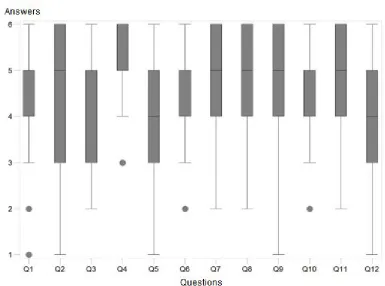
Figure 1: Boxplot of Critical Success Factors and problems Source: Elaborated by the authors.
After filtering the data through the boxplot, we performed the sample robustness analysis by calculating the Cronbach Alpha. This parameter presented a value of 0.9089, corroborating a consistent and reliable questionnaire and allowing the required validation for the research.
Then, the descriptive statistic provided the mean, standard deviation, median and the mode. This was able to present the general behavior of the sample as it is shown on Table 2. The individual analysis of the issues will be based on it, perceiving how the SMEs relate to each of the difficulties presented in the literature.
Table 2: Descriptive Statistics of the sample.
Question number Identification Mean Deviation Median Mode
13 Q1 5.0588 0.6390 5.0000 5.0000
14 Q2 5.3529 0.8360 6.0000 6.0000
15 Q3 4.7647 1.1130 5.0000 5.0000
16 Q4 5.2941 0.5703 5.0000 5.0000
17 Q5 4.5294 1.2423 5.0000 6.0000
18 Q6 4.8824 0.7579 5.0000 5.0000
19 Q7 5.2353 0.7300 5.0000 5.0000
20 Q8 5.2941 0.7487 5.0000 6.0000
21 Q9 5.1176 0.7579 5.0000 5.0000
22 Q10 4.9412 0.7252 5.0000 5.0000
23 Q11 5.3529 0.9037 6.0000 6.0000
24 Q12 4.5294 1.0357 5.0000 5.0000
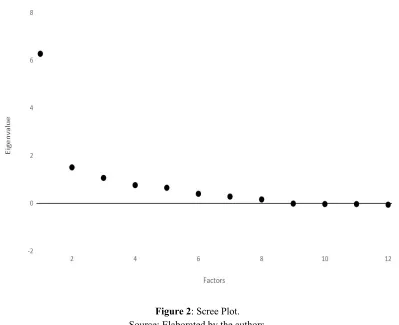
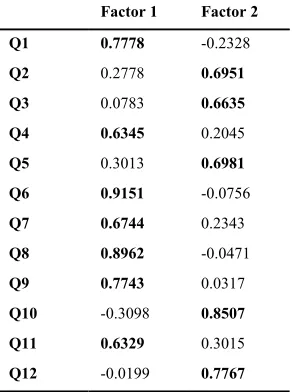
Finally, factorial analysis relates and groups the issues in two new groups of factors, defined by the distribution of a scree plot (Figure 2). The graph shows the relation level of each of the variables with the factors through their eigenvalues. The most prevalent factors of correlation between variables can be diagnosed using the graph, they are the first and the second. Within these two factors there is a greater number of questions correlated than on the others.
Figure 2: Scree Plot. Source: Elaborated by the authors.
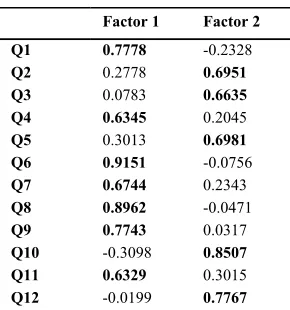
Table 3: Promax scores.
Factor 1 Factor 2
Q1 0.7778 -0.2328
Q2 0.2778 0.6951
Q3 0.0783 0.6635
Q4 0.6345 0.2045
Q5 0.3013 0.6981
Q6 0.9151 -0.0756
Q7 0.6744 0.2343
Q8 0.8962 -0.0471
Q9 0.7743 0.0317
Q10 -0.3098 0.8507
Q11 0.6329 0.3015
Q12 -0.0199 0.7767
Source: Elaborated by the authors
V. RESULT ANALYSIS
The results presented by the descriptive statistics argues that the respondents may not realize the real problems that companies deal with QMS maintenance due to all the answers that were obtained through a range between 5 and 6, which means that it is not difficult to adopt or maintain the QMS.
The scores obtained by the questionnaire do not shows that is a huge difficult to keep the QMS implemented in small and medium sized organizations of Brazil, due to the answers given by themselves were not positive to what Wahid and Corner (2009) affirms.
Through scores with median 5, the analysis proves that SMEs may not realize the greatest difficulties of finding the root causes of their problems neither ways to prevent them of recurring as the first question (Q1) affirms. SMEs also may not offer training programs to ensure the development of people within the company neither to manage documents and records as affirmed by the third and fourth questions (Q3 and Q4).
Still referring to responses with median 5, we could say that the perception of the fundamental problems may not be so strong, as affirmed by the literature such as those presented in fifth, sixth, seventh and eighth questions (Q5, Q6, Q7 and Q8). They refer, respectively, to the establishment of work groups to do audits, management reviews, the modification, simplification and improvement of the production process (and also of documents), records and work instructions, the maintainability of a system of monitoring and approval of suppliers and contractors.
Furthermore, could be realized that ninth, tenth and twelfth questions (Q9, Q10, Q12), which approaches maintaining the indexes efficient, following procedures and new or revised instructions, providing feedback on the performance of the processes, respectively, are also difficulties that may not have a high level of perception, since they are in the group of responses with median 5 scores.
Through the median 6 scores it is possible to interpret that most companies can perceive low difficulties in developing a serious and committed internal audit program that considers the complexity and size of the company (Q2). It is also interpreted that the enterprises may not found difficulties in telling the employees how important the QMS certification is (Q11).
Exploratory Factor Analysis allowed us to observe that the questions are divided into two larger blocks that have a broader consideration of them. These blocks of subjects are the factors that correlate the issues through the Promax rotation, presenting the major trends of each variable (question) of a given subject.
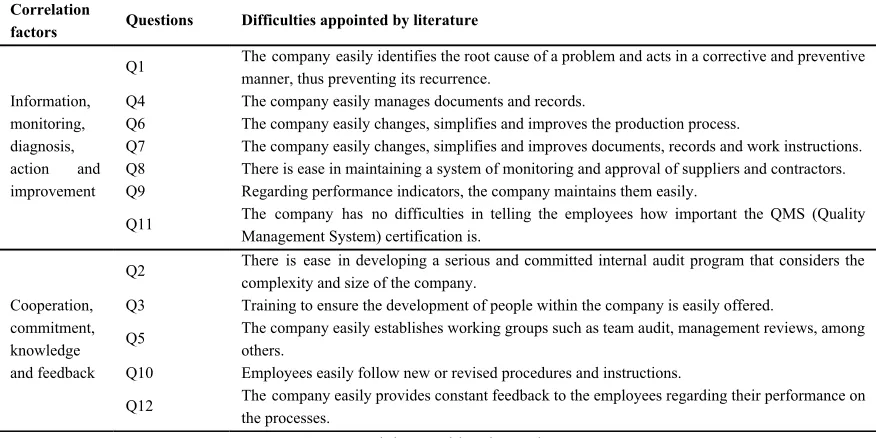
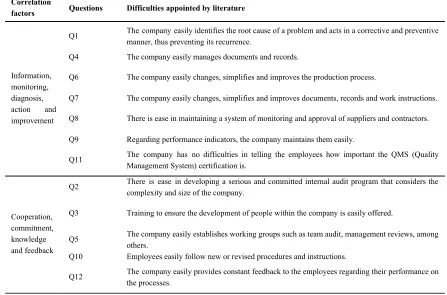
teamwork, with understanding and commitment, always valuing feedback. This grouping is presented in Table A2 from Appendix 2.
By the end of this paper, we could not be more conclusive than affirm this two groups of difficulties, since the organizations affirms that there is no critical factors or problems to maintain a quality management system as appointed by literature.
The only conclusion we can make is that these enterprises may not realize the difficulties approached on this paper or have other critical points in the attempt to maintain the system, that we could not raise.
VI. FINAL REMARKS
By using the survey method of research as basis it was possible to define which are the biggest difficulties to keep a QMS faced by SMEs in the state of São Paulo. Our paper was based on literature review in order to gather perceptions of companies to focus the research about the critical factors and problems for success.
It was possible to diagnose that the companies may perceive low or no difficulty in the QMS maintenance since their responses (statistical descriptions in Table 2) were very positive regarding the ease of maintenance. However, they were not consistent with the critical success factors and problems pointed by Wahid and Corner (2009).
Additionally, the applied questionnaire resulted in identifying two main factors of difficulty through the correlation between the points of literature (questions) and the results (answers). From an EFA the points or variables were correlated with each other and formed two thematic groups as shown on Table A2 from Appendix 2 (Table 3 shows the questions of each group). Therefore, the groups of difficulties can be defined as “Information, monitoring, diagnosis, action and improvement” consisting of seven out of the twelve questions, and “Cooperation, commitment, knowledge and feedback”, which consists of five questions.
As a way of continuing this paper, we suggest an increase in the number of respondents in such way that broader and more precise opinions could be formed regarding the difficulties in maintaining a QMS in SMEs. Furthermore, we think about the importance of covering a broader range of small and medium-sized enterprises, expanding the sample space out of the country. It is possible and interesting to gather and compare the profile of SMEs from multiple countries, as well as analyzing the global behavior of companies to identify and corroborate the maintenance difficulties of every SME in the world.
ACKNOWLEDGEMENT
The elaboration of this paper would not have been possible without the support of Conselho Nacional de Desenvolvimento Científico e Tecnológico (CNPq) [National Council for Scientific and Technological Development], Centro de Pesquisa em Engenharia de Produção (CENPRO – FCA) [Research Center in Production Engineering], Faculty of Applied Sciences (FCA), State University of Campinas (UNICAMP), and the collaboration of the respondent companies. For all of them we would like to emphasize gratitude.
We also would like to thank Research Ethics Committee (CEP) of UNICAMP, which granted the application of questionnaires under the CAAE number: 57760016.6.0000.5404, and Espaço da Escrita [Writing Space] from General Coordination of the University for the language services provided.
REFERENCES
1. Aggelogiannopoulos, D., Drosinos, E. and Athanasopoulos, P. . Implementation of a quality management system (QMS) according to the ISO 9000 family in a Greek small-sized winery: A case study. Food Control, 2007. 18(9): 1077-1085.
2. ABNT ISO 9001:2015. Sistemas de Gestão da qualidade – Requisitos.
3. Ujihara, H. M., Cardoso, A. A. and Chaves, C. A. Implantação de sistema de gestão da qualidade em empresa de pequeno porte: avaliação de resultados – XIII SIMPEP. Bauru, 2006. November from 6 to 8.
4. Asif, M., Joost de Bruijn, E., Douglas, A. and Fisscher, O. Why quality management programs fail. International Journal of Quality & Reliability Management, 2009. 26(8): 778-794.
5. Maekawa, R., Carvalho, M. and Oliveira, O. Um estudo sobre a certificação ISO 9001 no Brasil: mapeamento de motivações, benefícios e dificuldades. Gest. Prod., São Carlos, 2013, v. 20, n. 4, 763-779.
7. Wahid, R. A. and Corner, J. Critical success factors and problems in ISO 9000 maintenance. International Journal of Quality & Reliability Management, 2009, Vol. 26 Iss. 9: 881 – 893. [online] Available at: http://dx.doi.org/10.1108/02656710910995073. [20 November 2017].
8. Marino, L. H. F. C. Gestão da qualidade e gestão do conhecimento: fatores-chave para produtividade e competitividade empresarial. XIII SIMPEP – Bauru, SP, Brazil, 2006. November from 06 to 08.
9. The British Assessment Bureau, 2017. ISO 9001 History. [online] Available at:
http://www.british-assessment.co.uk/iso-9001-history/. [20 November 2017].
10. Mariani, E. J. As Normas ISO. Revista Científica Eletônica de Administração. Ano VI-Número 10, June. Periódicos Semestral,
2006. [online] Available at:
http://faef.revista.inf.br/imagens_arquivos/arquivos_destaque/W1EsmW9A6Hxjf4R_2013-4-29-15-27-14.pdf. [Accessed 20 Nov. 2017].
11. ABNT. Atualização da ABNT NBR ISO 9001:2008 para a ABNT NBR ISO 9001:2015, 2015. p. 04. 12. ABNT. Sistemas de gestão da qualidade – Fundamentos e vocabulário. Projeto NBR ISO 9000:2000, p. 01.
13. Caralli, Richard A. The Critical Success Factor Method: Establishing a Foundation for Enterprise Security Management (CMU/SEI-2004-TR-010). Software Engineering Institute, Carnegie Mellon University, 2004. [online] Available at: www.sei.cmu.edu/library/abstracts/reports/04tr010.cfm. [20 November 2017].
14. BusinessDictionary.com. What is critical success factors (CSF)? definition and meaning, 2017. [online] Available at: http://www.businessdictionary.com/definition/critical-success-factors-CSF.html [20 November 2017].
15. PwC (Pricewaterhouse Coopers). Pequenas e Médias Empresas. Private Company Services, 2013. [online] Available at: https://www.pwc.com.br/pt/publicacoes/setores-atividade/assets/pcs/private-compay-services-pcs-13-pt.pdf. [20 November 2017]. 16. Corrêa, F. D. D. Influência do nível de capacitação e treinamento do pessoal da manutenção na qualidade e produtividade de
pequenas e médias empresas. Master dissertation. Universidade Metodista de Piracicaba, 2005.
17. Olander, H., Hurmelinna-Laukkanen, P. and Mähönen, J. What's small size got to do with it? Protection of intellectual assets in SMEs. International Journal of Innovation Management, 2009. v. 13, n. 03: 349-370.
18. Vanalle, R., Lucato, W. and Rodrigues, R. The utilization of ISO 9004: case study of the maintenance area of a public transportation company. Journal of Quality in Maintenance Engineering, 2016. v. 22, n. 1: 94-110.
19. Denton, P. D. and Maatgi, M. K. "The development of a work environment framework for ISO 9000 standard success",
International Journal of Quality & Reliability Management, 2016. Vol. 33 Issue: 2: 231-245,
https://doi.org/10.1108/IJQRM-12-2013-0196.
20. Prodanov, C. C.and De Freitas, E. C. Metodologia do Trabalho Científico: Métodos e Técnicas da Pesquisa e do Trabalho
Acadêmico – 2 ed. Editora Feevale, 2013. [online] Available at:
http://www.feevale.br/Comum/midias/8807f05a-14d0-4d5b-b1ad-1538f3aef538/E-book%20Metodologia%20do%20Trabalho%20C ientifico.pdf. [20 November 2017].
21. Silva Júnior, S. D. and Costa F. J. Mensuração e Escalas de Verificação: uma Análise Comparativa das Escalas de Likert e Phrase Completion. PMKT – Revista Brasileira de Pesquisas de Marketing, Opinião e Mídia. São Paulo, 2014. V. 15: 1-16, October. 22. Collings, David P. Selecting a questionnaire response scale for student feedback surveys: a comparison of psychometric properties
and student preferences among three alternatives. Master dissertation. Murdoch University, 2006.
23. SEBRAE (Serviço Brasileiro de Apoio às Micro e Pequenas Empresas). Critérios de classificação de empresas: MEI - ME - EPP, 2017. [online] Available at: http://www.sebrae-sc.com.br/leis/default.asp?vcdtexto=4154. [Accessed 20 Nov. 2017].
24. Juiz de Fora University (UFJF). O que é SAS, 2017. [online] Available at:
http://www.ufjf.br/estatistica/eventos-e-projetos/projeto-sas/o-que-e-o-sas/. [20 November 2017].
25. Bussab, W. O. and Morettin, P. A. Estatística básica. 8. ed. São Paulo: Saraiva, 2013. 548 p. ISBN 9788502207998.
26. Montgomery, D. and Runger, G. Estatística aplicada e probabilidade para engenheiros 5a. ed. Rio de Janeiro, 2012: Grupo Gen - LTC. 521 p., il. ISBN 9788521619024.
27. Tavakol, M. and Dennick, R. Making sense of Cronbach's alpha. International Journal of Medical Education, 2011 v. 2, p. 53-55. 28. Almeida, D, Santos, M and Costa, A. Aplicação do coeficiente Alfa de Cronbach nos resultados de um questionário para avaliação
de desempenho da saúde pública. XXX ENEGEP - Maturidade e desafios da Engenharia de Produção: competitividade das empresas, condições de trabalho, meio ambiente, 2010. São Carlos – SP.
29. Favero, L.P., Belfiore, P., Silva, F.L. and Chan, B.L. Análise de dados: modelagem multivariada para tomada de decisões. Rio de Janeiro: Elsevier, 2005.
30. Costa G. G. O. Um Procedimento Inferencial para Análise Fatorial Utilizando as Técnicas Bootstrap e Jackknife: Construção de Intervalos de Confiança e Testes de Hipóteses. PhD dissertation. Rio de Janeiro: PUC, Departamento de Engenharia Elétrica, 2006. 31. Hair, J. F., Black, W. C., Babin, B. J., Anderson, R. E. and Tatham, R. L. Análise Multivariada de Dados. 6. ed. Porto Alegre:
Bookman, 2009.
32. Sass, D. A. and Schmitt, T. A. A comparative investigation of rotation criteria within exploratory factor analysis. Multivariate Behavioral Research, 2010. v. 45, n. 1: 73-103.
Appendices
Appendix 1
Table A1: Queries of the questionnaire sent, scale from 1 to 6.
Identification Questions
Q1 The company easily identifies the root cause of a problem and acts in a corrective and preventive manner, thus preventing its recurrence.
Q2 There is ease in developing a serious and committed internal audit program that considers the complexity and size of the company.
Q3 Training to ensure the development of people within the company is easily offered.
Q4 The company easily manages documents and records.
Q5 The company easily establishes working groups such as team audit, management reviews, among others. Q6 The company easily changes, simplifies and improves the production process.
Q7 The company easily changes, simplifies and improves documents, records and work instructions. Q8 There is ease in maintaining a system of monitoring and approval of suppliers and contractors. Q9 Regarding performance indicators, the company maintains them easily.
Q10 Employees easily follow new or revised procedures and instructions.
Q11 The company has no difficulties in telling the employees how important the QMS (Quality Management System) certification is.
Q12 The company easily provides constant feedback to the employees regarding their performance on the processes.
Source: Elaborated by the authors.
Appendix 2
Table A2: Related questions according to the EFA
Correlation
factors Questions Difficulties appointed by literature
Information, monitoring, diagnosis, action and improvement
Q1 The company easily identifies the root cause of a problem and acts in a corrective and preventive manner, thus preventing its recurrence.
Q4 The company easily manages documents and records.
Q6 The company easily changes, simplifies and improves the production process.
Q7 The company easily changes, simplifies and improves documents, records and work instructions. Q8 There is ease in maintaining a system of monitoring and approval of suppliers and contractors. Q9 Regarding performance indicators, the company maintains them easily.
Q11 The company has no difficulties in telling the employees how important the QMS (Quality Management System) certification is.
Cooperation, commitment, knowledge and feedback
Q2 There is ease in developing a serious and committed internal audit program that considers the complexity and size of the company.
Q3 Training to ensure the development of people within the company is easily offered.
Q5 The company easily establishes working groups such as team audit, management reviews, among others.
Q10 Employees easily follow new or revised procedures and instructions.
Q12 The company easily provides constant feedback to the employees regarding their performance on the processes.
Source: Elaborated by the authors.
Table 1: Classification of industry size by SEBRAE
Classification: Number of employees
Microenterprise Up to 19 employees
Small-sized enterprise From 20 to 99 employees
Medium-sized enterprise From 100 to 499 employees
Large enterprise More than 500 employees
Table 2: Descriptive Statistics of the sample.
Question number Identification Mean Deviation Median Mode
13 Q1 5.0588 0.6390 5.0000 5.0000
14 Q2 5.3529 0.8360 6.0000 6.0000
15 Q3 4.7647 1.1130 5.0000 5.0000
16 Q4 5.2941 0.5703 5.0000 5.0000
17 Q5 4.5294 1.2423 5.0000 6.0000
18 Q6 4.8824 0.7579 5.0000 5.0000
19 Q7 5.2353 0.7300 5.0000 5.0000
20 Q8 5.2941 0.7487 5.0000 6.0000
21 Q9 5.1176 0.7579 5.0000 5.0000
22 Q10 4.9412 0.7252 5.0000 5.0000
23 Q11 5.3529 0.9037 6.0000 6.0000
24 Q12 4.5294 1.0357 5.0000 5.0000
Source: Elaborated by the authors.
Table 3: Promax scores.
Factor 1 Factor 2 Q1 0.7778 -0.2328
Q2 0.2778 0.6951
Q3 0.0783 0.6635
Q4 0.6345 0.2045
Q5 0.3013 0.6981
Q6 0.9151 -0.0756
Q7 0.6744 0.2343
Q8 0.8962 -0.0471
Q9 0.7743 0.0317
Q10 -0.3098 0.8507
Q11 0.6329 0.3015
Q12 -0.0199 0.7767
Source: Elaborated by the authors
Table A1: Queries of the questionnaire sent, scale from 1 to 6.
Identification Questions
Q1 The company easily identifies the root cause of a problem and acts in a corrective and preventive manner, thus preventing its recurrence.
Q2 There is ease in developing a serious and committed internal audit program that considers the complexity and size of the company.
Q3 Training to ensure the development of people within the company is easily offered.
Q4 The company easily manages documents and records.
Q5 The company easily establishes working groups such as team audit, management reviews, among others. Q6 The company easily changes, simplifies and improves the production process.
Q7 The company easily changes, simplifies and improves documents, records and work instructions. Q8 There is ease in maintaining a system of monitoring and approval of suppliers and contractors. Q9 Regarding performance indicators, the company maintains them easily.
Q10 Employees easily follow new or revised procedures and instructions.
Q11 The company has no difficulties in telling the employees how important the QMS (Quality Management System) certification is.
Q12 The company easily provides constant feedback to the employees regarding their performance on the processes.
Table A2: Related questions according to the EFA
Correlation
factors Questions Difficulties appointed by literature
Information, monitoring, diagnosis, action and improvement
Q1 The company easily identifies the root cause of a problem and acts in a corrective and preventive manner, thus preventing its recurrence.
Q4 The company easily manages documents and records.
Q6 The company easily changes, simplifies and improves the production process.
Q7 The company easily changes, simplifies and improves documents, records and work instructions.
Q8 There is ease in maintaining a system of monitoring and approval of suppliers and contractors.
Q9 Regarding performance indicators, the company maintains them easily.
Q11 The company has no difficulties in telling the employees how important the QMS (Quality Management System) certification is.
Cooperation, commitment, knowledge and feedback
Q2 There is ease in developing a serious and committed internal audit program that considers the complexity and size of the company.
Q3 Training to ensure the development of people within the company is easily offered.
Q5 The company easily establishes working groups such as team audit, management reviews, among others.
Q10 Employees easily follow new or revised procedures and instructions.
Q12 The company easily provides constant feedback to the employees regarding their performance on the processes.