An Improvement of User Authentication Framework for
Cloud Computing
Jongho Mun, Jiye Kim, Dongho Won
*College of Information and Communication Engineering, Sungkyunkwan University, Korea.
* Corresponding author. Tel: +82-31-290-7107; email: [email protected] Manuscript submitted July 15, 2015; accepted December 15, 2015.
doi: 10.17706/jcp.11.6.446-454
Abstract: Cloud computing is an emerging computing paradigm in which resources of the computing infrastructure are provided as outsourcing services through the Internet. With cloud computing technique, the users are able to outsource their computing and storage tasks to the cloud servers. In cloud computing environments, the user authentication is very important issue because it provides the authorization while users access their data and cloud services. In 2014, Chen et al. improved Choudhury et al.’s scheme, and claimed that their scheme is more secure and practical remote user authentication scheme for cloud computing. However, we find that Chen et al.’s scheme is still insecure against outsider attack, server impersonation attack, smart card stolen attack and off-line password guessing attack. To overcome this drawback, we propose a robust and more secure user authentication scheme. Finally, we show that our proposed scheme is more secure and supports security properties than Chen et al.’s scheme.
Key words: Cloud computing, remote user authentication, smart card.
1.
Introduction
for cloud computing. Their scheme verifies user authenticity using two-step verification, which is based on password, smart card and out of band authentication. However, in 2014, Chen et al. [14] found that Choudhury et al.’s scheme does not provide proper authentication and cannot resist impersonation attack. They proposed an improved scheme of Choudhury et al.’s scheme for cloud computing. However, Chen et al.’s scheme is still insecure. We find that their scheme cannot withstand outsider attack, impersonation attack, smart card stolen attack and off-line password guessing attack as well. Furthermore, Chen et al.’s scheme has no wrong password detection mechanism. To overcome this drawback, we propose a robust and more secure remote user authentication scheme which is an improvement of Chen et al.’s scheme. The remainder of the paper is organized as follows. We begin by reviewing Chen et al.’s remote user authentication scheme in Section 2. In Section 3, we describe security weaknesses of Chen et al.’s scheme. Our proposed scheme is presented in Section 4. Security analysis of our proposed scheme is given in Section 5. Finally, we conclude this paper in Section 6.
2.
Review in Chen
et al
.’s Scheme
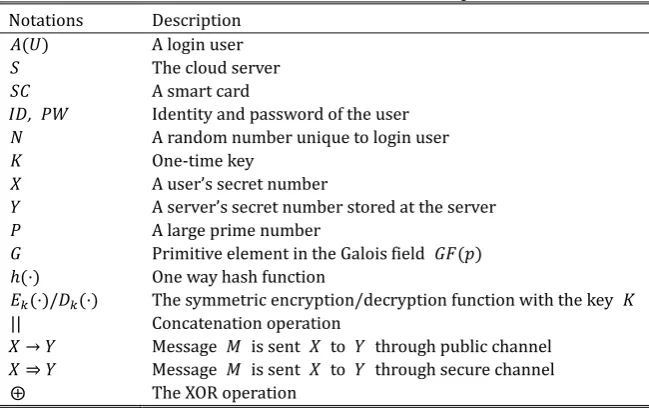
This section reviews the remote user authentication scheme proposed by Chen et al. in 2014. As previous researches, Chen et al.’s scheme consists of four phases: registration, login, authentication and password change phases which as follows. The notations used in this paper are summarized as Table 1.
Table 1. Notations Used in This Paper
Notations Description
A login user
The cloud server
A smart card
, Identity and password of the user
A random number unique to login user
One-time key
A user’s secret number
A server’s secret number stored at the server
A large prime number
Primitive element in the Galois field
One way hash function
The symmetric encryption/decryption function with the key
Concatenation operation
Y Message is sent to through public channel
Y Message is sent to through secure channel The XOR operation
2.1.
Registration Phase
The registration phase is the initial phase of the scheme. In this phase, user provides appropriate identification details to the cloud server. Then the cloud server issues a smart card to user according user’s data.
1) selects a random number x and computes
2)
3) checks whether the has existed in server. If has existed in server, rejects registration request. Otherwise, generates and computes:
channel.
5) enters into his smart card. Now, smart card contains .
6) stores and in the server.
2.2.
Login Phase
This phase is invoked when user wants to login into cloud. To start any conversation, the user must first login to a specific terminal using smart card.
1) inserts his smart card and inputs and .
2) computes where denotes ’s current timestamp. 3) .
2.3.
Authentication Phase
After receiving the login request messages , the server verifies the identity of the user. The procedure is as follows.
1) , rejects ’s login request. Otherwise, performs the following computations:
where is the current timestamp of server and is the maximum time interval for transmission delay. If equals , accepts the user ’s login request and computes, , and
). is ’s current timestamp. Then, generates a random number . 2) .
3) Upon receiving response message, computes and . Then, decrypts with and gets . A checks the timestamp. If is invalid, terminates
this session. Otherwise, computes ) and compares to the received If equal,
successfully authenticates and sends the value to server .
4) checks . If is correct, mutual authentication successes. Now both user and server can compute the session key .
2.4.
Password Change Phase
The phase is invoked when the user wants to change his/her password. 1) inserts his/her smart card into card-reader and inputs and .
2) . and executes the login and authentication phase mentioned above. If passes the verification, will send a password change request to and then submit and where is ’ n w p wo n is random number. 3) receiving password change request, checks and replaces it by . 4) .
5) n receiving response message, A checks . If it is correct, the smart card performs,
3.
Security Analysis of Chen
et al
.’s Scheme
In this section, we demonstrate the vulnerability of Chen et al.’s scheme in various communication scenarios.
3.1.
Denial-of-Service via Wrong Password Login
This is the type of attack when a legal user is denied access to services which are meant for him. Suppose inserts wrong password in login phase. Smart card has no mechanism to detect it, then sends wrong login request as login request, when checks the equivalence
. Clearly, it will not hold. As a result, will terminate the session and will face the DoS.
3.2.
Outsider Attacks
Any adversary who is the legal user and owns a smart card can obtain information and then he/she can compute . If an adversary intercepts
any user ’s login request message and server ’s response message , then
he/she can compute the encryption key by calculating . Hence, adversary
can decrypt server ’s response message and compute the session key .
3.3.
Server Impersonation Attacks
If user sends login request message to outsider adversary which impersonates as the server , then easily can compute by using . An adversary
performs following step.
1) adversary generates a random number and computes and ) where is ’s current timestamp.
2) . After receiving response message from , will decrypt
response message and check the timestamp and . However, is equal of . Therefore, an outsider adversary can impersonate the server .
3.4.
Smart Card Stolen & Off-line Password Guessing Attacks
If an adversary intercepts legitimate user ’s login request message and steals ’s smart card, he/she can obtain parameters . Then, an adversary can perform off-line password guessing attacks.
1) n adversary guesses any password .
2) n an adversary calculates and compares it with . If the result is equal to
, the adversary infers that is user ’s password. Otherwise the adversary selects another password nominee and performs the same processes, until he/she locates the valid password.
3.5.
Requirement of Verifying Table
The server must maintain the verifying table that stores each user’s and for verifying the legitimacy of the login users in Chen et al.’s proposed scheme. Therefore, the server requires extra memory space to store the verifying table. Although the one-way hash functions and encryption algorithms are applied to prevent the passwords from being disclosed, the verifying table is still vulnerable. Because any insider adversary who knows the server’s secret key easily can impersonate any user by using
and . Furthermore, if user wants to change his/her password, then server should replace
to in verifying table.
In this section, we describe more secure remote user authentication. Our improved scheme consists of four phase and works as follows.
4.1.
Registration Phase
The registration phase is operated when the user initially registers to the cloud server and is described as follows.
1) chooses his/her identity and password , then computes . 2) . sends } to the server over a secure channel.
3) pon receiving registration request message from , generates and where is a random number to unique to . Then, computes,
where is a large prime number and is a server ’s secret number stored at the server.
4) : a smart card. installs } in the smart card and sends the smart card to user via secure channel.
4.2.
Login Phase
If wishes to login cloud server , inserts his/her smart card into the card-reader and performs the following steps.
1) inputs his/her identity and password .
2) n, smart card computes and compares with stored . If it holds, smart card computes,
where is the current timestamp. Otherwise, smart card rejects login request.
3) . Smart card sends login request to through a common channel.
4.3.
Authentication Phase
After receiving the login request message from , the server verifies the identity of the user . The procedure is as follows.
1) , rejects ’s login request. Otherwise, performs the following computations:
where is the current timestamp of server and is the maximum time interval for transmission delay. If equals , accepts the user ’s login request and computes,
where is ’s current timestamp. Then, generates a random number .
2) . encrypts with , and sends the response message to user .
3) receiving response message, computes,
and decrypts with and gets . checks the timestamp. If is invalid, terminates this session. Otherwise, computes and compares to the received . If equal, successfully authenticates .
4) . computes and sends to server .
5) checks . If is correct, mutual authentication successes. Now both user and server can compute the session key .
4.4.
Password Change Phase
If wants to change his/her password, he/she inserts his/her own smart card into a card reader, then enters identity and password . After receiving identity and password , smart card performs the following steps.
1) card computes and compares with stored . If it holds, smart card accepts to enter a new password . Otherwise, smart card rejects password changing request.
2) receiving new password , smart card computes,
and updates as . Then, can use the new password to login the authentication cloud server .
5.
Security Analysis of Our Proposed Scheme
In this section, we demonstrate that our scheme can withstand several possible attacks. We also show that our scheme supports several security properties. Our proposed scheme keeps the merits of Chen et al.’s scheme
5.1.
Support User Anonymity
user anonymity.
5.2.
Resisting Impersonation Attack
In the our proposed scheme, only can compute and since
only he/she has the secrets and password and can compute and since only he/she has the secrets The authentication server authenticates by checking and the remote user authenticates by checking . Thus, our proposed scheme can resist impersonation attacks.
5.3.
Resisting Smart Card Stolen Attack
If an adversary steals ’s smart card, then can extract security parameters
} from legitimate user ’s smart card. However, this information does not help them. He/she cannot obtain any information of ’s and because these values are protected by secret parameters. An identity in (= is protected by ’s long-term secret key and the collision resistance one-way hash function , and a password in (= , (= ) is encrypted with . Therefore, the our proposed scheme can resist smart
card stolen attack.
5.4.
Resisting Replay Attacks
In the proposed authentication scheme, an adversary cannot correctly modifies and
without and , where , and .
When and an adversary tries to use the previous message to login or
to response , a failed adversary will be detected by checking the invalid timestamp and . Thus, the proposed authentication scheme is secure against the replay attack.
5.5.
Comparison of Security Properties
We compare the proposed scheme with the scheme of Choudhury et al. [13], Chen et al. [14] regarding resistance to possible attacks as depicted by Table 2. Our proposed scheme resists all those attacks to which the previous schemes are susceptible.
Table 2. Comparison of Security Properties
Security Properties Choudhury et al. Chen et al. Our scheme
User impersonation attacks No No Yes
Server impersonation attacks No No Yes
Off-line password guessing Attacks Yes No Yes
Denial-of-service attacks Yes No Yes
Smart card stolen attacks No No Yes
Modification attacks No No Yes
Replay attacks Yes Yes Yes
Support mutual authentication Yes Yes Yes
Support user anonymity Yes No Yes
Wrong password detection by SC Yes No Yes
6.
Conclusion
impersonation attacks and smart card stolen attacks and proposed an improved protocol for authentication scheme that keeps the similar properties of Chen et al.’s scheme and make it more secure. The security analysis explains that our improved scheme rectifies the vulnerabilities of Chen et al.’s scheme.
Acknowledgment
This work was supported by Institute for Information & communications Technology Promotion(IITP) grant funded by the Korea government(MSIP) (No.R0126-15-1111, The Development of Risk-based Authentication· Access Control Platform and Compliance Technique for Cloud Security)
References
[1] Armbrust, M., Fox, A., Griffith, R., Joseph, A., Katz, R., Konwinski, A., Lee, G., Patterson, D., Rabkin, A., Stoica, I., & Zaharia, M. (2010). A view of cloud computing. Communication of the ACM, 53, 50-58. [2] Smith, E., et al. (2010). The management of security in cloud computing. Proceedings ofInformation
Security for South Africa (pp. 1-7).
[3] Huang, C., Qin, Z., & Kuo, C. (2011). Multimedia storage security in cloud computing: An overview.
Proceedings ofIEEE 13th International Workshop on Multimedia Signal Processing (pp. 1-6).
[4] Lamport, L. (1981).Password authentication with insecure communication. Communication of the ACM, 24, 770-772.
[5] Gennaro, R., & Lindell, Y., (2006). A framework for password-based authenticated key exchange. ACM Transactions on Information and System Security, 9, 181-234.
[6] Yang, Y., Deng, R., & Bao, F. (2006). A practical password-based two-server authentication and key exchange system. IEEE Transactions on Dependable and Secure Computing, 3(2), 105-114.
[7] Jeun, I., Kim, M., & Won, D. (2012). Enhanced password-based user authentication using smart phone.
Advances in Grid and Pervasive Computing, 7296, 350-360.
[8] Lee, Y., & Won, D. (2013). On the use of a hash function in a 3-party password-based authenticated key exchange protocol. Grid and Pervasive Computing, 7681, 730-736.
[9] Lee, J., Ryu, S., & Yoo, K. (2002). Fingerprint-based remote user authentication scheme using smart cards. Electronics Letters, 38, 554-555.
[10]Yi, W., Kim, S., & Won, D. (2009). Smart card based AKE protocol using biometric information in pervasive computing environments. Computational Science and Its Applications, 5593, 182-190.
[11]Lee, Y. (2012). A new dynamic ID-based user authentication scheme to resist smart-card-theft-attack. Applied Mathematics and Information Sciences, 6, 355-361.
[12]Mun, J., Jin, Q., Jeon, W., & Won, D. (2013). An improvement of secure remote user authentication scheme using smart cards. Proceedings ofInternational Conference on IT Convergence and Security (pp. 1-4).
[13]Choudhury, A., Kumar, P., Sain, M., Lim, H., & Lee, H. (2011). A strong user authentication framework for cloud computing. Proceedings of 2011 IEEE Asia-Pacific Services Computing Conference (pp. 110-115).
[14]Chen, N., & Jiang, R. (2014). Security analysis and improvement of user authentication framework for cloud computing. Journal of Networks, 9, 198-203.
He is currently pursuing the Ph.D. degree in electrical and computer engineering at Sungkyunkwan University. His current research interest includes cryptography, malware, forensic, and authentication or key management protocols.
Jiye Kim was born in Seoul, Korea on December 2, 1976. She received the B.S. degree in information engineering from Sungkyunkwan University, Korea, in 1999 and the M.S. degree in computer science education from Ehwa University, Korea, in 2007. She also worked as a software engineer for mobile phone manufacturers in Korea or Japan between 1999 and 2013. She is currently pursuing the Ph.D. degree in electrical and computer engineering at Sungkyunkwan University. Her current research interest includes cryptography, authentication or key management protocols, wireless sensor networks, and mobile security.