VOL.7, ISSUE 4, 2019; 28 - 37; http://ijpda.com; ISSN: 2348-8948
Research Article
Solution Equilibrium
Study of Complexation of
Pb(II), Cd(II) and Hg(II)
With histidine and
L-glutamic acid in organic
media-water mixture
Meti Mengistu, Rajalakshmanan
Eswa-ramoorthy and Hadgu Hailekiros Belay*
Department of Applied Chemistry, Adama Science and Technology University, Adama,
Oromia, Ethiopia
Date Received: 9th July 2018; Date accepted: 21st August 2019; Date Published: 3rd September 2019
Abstract
Speciation of mixed ligand complexes of Pb(II), Cd(II) and Hg(II) with Histidine and L-glutamic acid were studied in varying amounts (0.0–50v/v) of Dimethylformamide-Water mix-ture by maintaining an ionic strength of 0.16mol dm-3 (NaNO3) at 310K. Titrations were carried out in the presence of different relative concen-trations (M: L: X=1.0:2.5:2.5, 1.0:2.5:5.0, 1.0:5.0:2.5 in the case of Pb (II) and Cd(II) and 1.0:5.0:5.0, 1.0:5.0:10.0, 1.0:10.0:5.0 in the case of Hg(II)) were
carried out with 0.4 mol dm-3 NaOH as titrant in
Dimethylformamide- water mixture. Stability constants of ternary complexes were refined with MINIQUAD75. The best-fit chemical models were selected based on statistical parameters and residual analysis. The species detected were
MLXH3, MLXH2, MLXH and ML2X for Pb(II),
MLX2H2 and ML2X for Cd(II) and MLXH3 and
MLXH2 for Hg(II). Extra stability of ternary
complexes compared to their binary complexes was believed to be due to interactions outside the coordination sphere such as the formation of
hydrogen bonds between the coordinated li-gands, charge neutralization, chelate effect and stacking interactions and hydrogen bonding. The species distribution with pH at different compo-sitions of Dimethylformamide and plausible equilibria for the formation of species were also presented. The bioavailability of the toxic metal ions is explained based on the speciation.
Keywords: Mixed ligand complexes, L-Histidine,
L-glutamic acid, stability constant and DMF
Introduction
The specificity and selectivity of enzyme– substrate reactions are achieved by manipulating the equivalent solution dielectric constants at the active site. The knowledge of the equivalent solu-tion dielectric constant can throw light on the mechanism of the reaction. Further, intra mole-cular and ligand–ligand stacking interactions in mixed ligand complexes are favored in water– organic media, which reduce solution dielectric constant. Hence, modeling studies involving ter-nary complexes have gained popularity [1, 2] in different aqua-organic mixtures with varying dielectric constants.
L-Histidine (H) is one of the strongest metal coordinating ligands among the amino acids and plays an important role in the binding of metal ions. H is an important component of active sites of biomolecules and there is a very likely hood for toxic metals to interact with H [3]. L-Glutamic acid (E) serves as a source component in the syn-thesis of glutathione, peptides and proteins. L-Glutamate is a major excitatory neurotransmitter in the mammalian central nervous system that contributes to fast synaptic neurotransmission, and to complex physiological processes like memory, learning, plasticity and neuronal cell death [4]. E is the only amino acid metabolized by the brain.
stu-dies, which can be used to understand the shift from precipitates that show poor bioavailability and low toxicity to more soluble forms with in-creased bioavailability and toxicity [7]. Hence, we have undertaken speciation studies of ternary complexes of Pb(II), Cd(II) and Hg(II) with L-histidine and L-glutamic acid in DMF–water mixtures.
MATERIALSANDMETHODS
Chemicals
DMF (Qualigens, India) was used as received. Aqueous solutions 0.05 mol dm-3 of L-Histidine and L-Glutamic acid (Kerala, India) were pre-pared in triple-distilled deionized water. Sodium nitrate (Qualigens, India) of 0.2 mol L-1 was pre-pared to maintain 0.16 moldm-3 ionic strength in the titrand. 0.1 mol dm-3 solutions of Pb (II), Cd (II) and Hg (II) nitrate (E-Merck, Germany) were prepared. To increase the solubility of ligands and to suppress the hydrolysis of metal salts, the mineral acid concentration in the above solutions was maintained at 0.05 moldm-3. Sodium hydrox-ide (Qualigens, India) of 0.4 moldm-3 was pre-pared. To assess the errors that might have crept into the determination of the concentrations, the data were subjected to analysis of variance of one-way classification (ANOVA) by using the computer program, COSWT the probable errors that may creep into the concentrations of the stock solutions of the ligands [8] was deter-mined. All the solutions were standardized by standard methods. The strengths of alkali and mineral acid were determined using the Gran plot method [9].
Apparatus
The titrimetric data were obtained using ELICO (Model Ad8000) pH meter (readability -2.00-16.00), which was calibrated with 0.05 mol L-1 potassium hydrogen phthalate in acidic region and 0.01 moldm-3 borax solution in basic region. The glass electrode was equilibrated in a well-stirred DMF-water mixture containing the inert electrolyte. All the titrations were carried out in the medium containing varying concentrations of DMF-water mixtures (0-50% v/v) by maintaining an ionic strength of 0.16 mol dm-3 with sodium nitrate at 310K. The effect of variation in asym-metry potential, liquid junction potential, activity coefficient, sodium ion error and dissolved car-bon dioxide on the response of glass electrode was accounted for in the form of correction factor [10].
ALKALIMETRIC TITRATION
Initially strong acid was titrated against alkali at regular intervals to check the complete equilibra-tion of the glass electrode. Then the calomel elec-trode was refilled with DMF-water mixture of equivalent composition as that of the titrand. In each of the titrations, the titrand consisted of ap-proximately 1 mmol mineral acid in a total vo-lume of 50 ml. Titrations with different metal to ligand ratios (M: L: X=1.0:2.5:2.5, 1.0:2.5:5.0, 1.0:5.0:2.5 in the case of Pb (II) and Cd(II) and 1.0:5.0:5.0, 1.0:5.0:10.0, 1.0:10.0:5.0 in the case of Hg(II) ) were carried with 0.4 moldm-3 sodium hydroxide.
Modeling Strategy
The computer program SCPHD [11] was used to calculate the correction factor. By using pH me-tric titration data, the ternary stability constants were calculated with the computer program MI-NIQUAD75 [12]. Which exploit the advantage of constrained least-squares method in the initial refinement and reliable convergence of Mar-quardt algorithm. During the refinement of ter-nary systems, the correction factor and stability constants of H and E and their ternary complexes with Pb (II), Cd (II) and Hg (II) in DMF-water mixtures were fixed.
RESULTS AND DISCUSSION
The alkalimetric titration curves of mixtures con-taining different mole ratios of H and E in the presence of mineral acid and inert electrolyte are given in Figures1.
SELECTION OF BEST-FIT MODEL
The qualitative evidence for the formation of mixed ligand complexes was obtained from the shift of the precipitation point of 1:1:1 mixed li-gand system compared to that of the correspond-ing 1:1 binary system. In all the systems, the pH of precipitation for the mixed ligand systems was found to be more than that for any of the binary system.
Existence of species was determined by perform-ing exhaustive modelperform-ing. The models were eva-luated assuming the simultaneous existence of different combinations of species. As the number of species increased, the models gave better sta-tistics denoting better fit. The program MINI-QUAD75 rejects all the metal complexes of the form ML2XHh or MLX2Hh. This may be because of the instability of these complexes due to the inability of the metal ions to accommodate three bulky ligands. The reasons for the existence of different species are ascribed under the head distribution diagrams.
Residual Analysis
For most of the systems the kurtosis values are around 3 hence the residuals form mesokurtic pattern. For some systems kurtosis values are more than 3 hence they form a leptokurtic pat-tern. The values of skewness between -1.13 and 1.80 in DMF-water mixtures show that the resi-duals form a part of normal distribution and hence a least squares method can be applied to the present data. The sufficiency of the model is further evident from the low crystallographic R factor values, which indicate the need for inclu-sion of additional species in the model. χ2 is a special case of γ distribution which measures the probability of residuals forming a part of stan-dard normal distribution [8].
Effect of Systematic Errors
The results of effect of errors in the concentra-tions of alkali, mineral acid, ligands, metal, cor-rection factor (log F) and volume are given in Table 2, which emphasizes that the errors in alka-li and acid affect stabialka-lity constants more than those of the ligands, metal and volume.
Stability of Ternary Complexes
The formation of mononuclear unprotonated binary and ternary complexes from a mixture of metal ion (M) and primary (L) and secondary (X) ligands can be shown as the equilibria given be-low. The change in stability of the ternary com-plexes as compared to their binary analogues was quantified [13]based on the disproportiona-tion constant (log X) given by Equadisproportiona-tion 4.5
log log log 2 log 2 2 M MX M ML M
MLX K K K
X = − − ---4.5
Which corresponds to the equilibrium
ML2 + MX2 2 MLX
Under these equilibrium conditions, one can ex-pect 50% ternary complex and 25% each of the binary complexes to be formed and the value of log X was reported[14] to be 0.6. A value greater than this account for the extra stability of MLX.
M MX M
ML M
MLX
K
K
K
K
log
log
log
log
=
−
−
∆
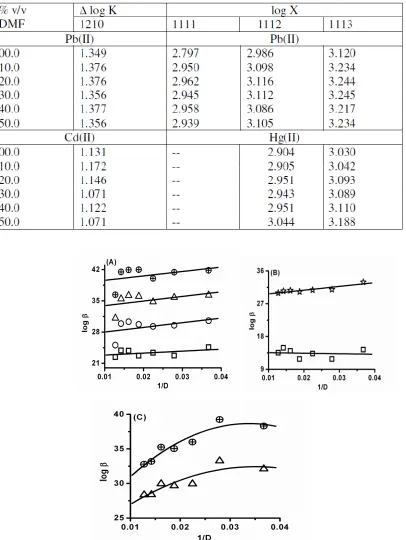
.. (4.6)The log X and Δ log K values calculated from binary and ternary complexes are included in Tables 3. These values could not be calculated for some systems due to the absence of relevant bi-nary species. In the present study, the Δ log K values range from 1.071 to 1.377 for DMF-water mixtures. The log X values range from 2.797 to 3.245 for DMF-water mixtures. Some Δ log K values and log X values are found to be more than the theoretical values, which account for the extra stability of the ternary complexes. The rea-sonfor the extra stability of these complexes may be due to interactions outside the coordination sphere such as the formation of hydrogen bonds between the coordinated ligands, charge neutra-lization, chelate effect and stacking interactions.
Effect of Co-Solvent on Mixed-ligand Equili-bria
Figure 1: Alkalimetric titration curves for His and Glu complexes in 20 %( v/v) DMF water mixture (A) Pb (II), (B) Cd (II) and (C) Hg (II). Number of mmols of the ligands: a) 0.25, 0.25 b) 0.25, 0.50 c) 0.50, 0.25
Table 2: Effect of errors in influential parameters on H-Pb(II)-E complexes stability constants in 40% v/v
DMF-water mixture.
Ingredient % of
error
log βmlxh(SD)
ML2X MLXH MLXH2 MLXH3
0 23.86(7) 30.16(6) 34.95(0) 40.61(7)
-5 Rejected 32.05(19) 39.50(22) 45.20(22)
Alkali -2 Rejected Rejected 35.68(28) 41.06(23)
+2 23.80(18) 27.64(31) 32.16(55) 37.70(33)
+5 25.09(30) 26.37(44) 31.30(66) Rejected
-5 24.62(32) 26.40(32) 31.27(29) 35.80(50)
Acid -2 23.62(19) Rejected 32.37(68) 37.90(35)
+2 Rejected 29.73(29) 35.35(37) 40.83(20)
+5 Rejected 30.80(29) 38.26(23) 43.74(23)
-5 24.12(19) 30.23(18) 35.08(26) 41.00(19)
Ligand(L) -2 23.96(17) 30.19(12) 35.05(20) 40.80(18)
+2 23.80(14) 30.15(19) 34.93(19) 40.51(17)
+5 23.7315) 30.09(15) 34.82(21) 40.30(19)
-5 23.80(10) 29.75(19) 34.14(17) 40.15(10)
Ligand(X) -2 23.87(19) 30.04(12) 34.70(8) 40.43(12)
+2 23.90(17) 30.27(13) 35.27(9) 40.80(9)
+5 24.00(11) 30.40(10) 35.60(19) 41.09(15)
-5 23.86(9) 29.20(8) 34.59(8) 40.39(19)
Metal -2 23.88(8) 30.06(7) 34.83(19) 40.59(18)
+2 23.90(7) 30.18(7) 35.89(16) 40.70(18)
+5 23.94(7) 30.29(6) 35.90(13) 40.68(9)
-5 23.87(9) 30.14(7) 35.00(22) 40.67(8)
Volume -2 23.88(9) 30.14(7) 35.00(21) 40.66(8)
+2 23.90(9) 30.14(7) 34.99(18) 40.65(8)
Table 3: ∆ log K and log X values of ternary complexes of Pb(II), Cd(II) and Hg(II)-H and E in DMF-water mixtures
Distribution Diagrams
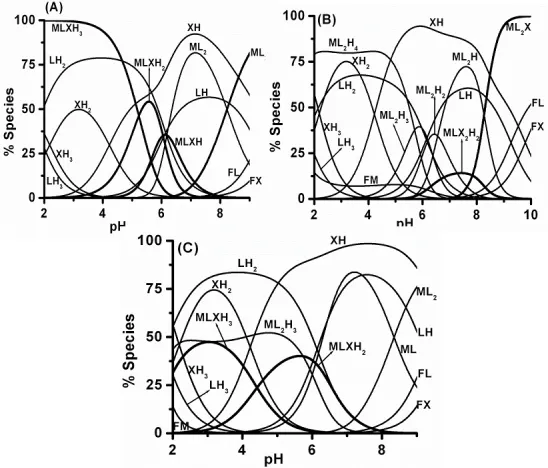
Distribution diagrams were drawn using the formation constants of the best-fit model and are discussed in this section. The species detected are MLXH3, MLXH2, MLXH and ML2X for Pb(II), MLX2H2 and ML2X for Cd(II) and MLXH3 and MLXH2 for Hg(II) in DMF-water mixtures. A perusal of the distribution diagrams (Figures. 4-5) reveals that at very low pH the concentration of mixed ligand complexes is less than those of protonated ligands. As the pH increased the concentrations of the ternary species increased. The proto-nated ternary species, MLXH3, MLXH2 and MLXH are distributed at lower pH than that of the unproto-nated ternary species, ML2X. The concentrations of binary species are less compared to those of the ternary species, due to extra stability of ternary complexes. The ternary species exist in the pH ranges 9.9, 2.0-10.0 and 2.0-9.1 for Pb(II), Cd(II) and Hg(II), respectively. The formation of the complex species can be represented by the following equilibria.
M(II) + LH3 + XH3 MLXH3 + 3H+ ---(1)
M(II) + LH3 + XH3 MLXH2 + 4H+ ---(2)
MLXH3 MLXH2 +H+ ---(3)
M(II) + LH3 + XH3 MLXH + 5H+ ---(4)
M(II) + LH2 + XH2 MLXH + 3H+ ---(5)
MLXH3 MLXH +2H+ ---(6)
M(II) + LH3 + 2XH3 MLX2H2 + 7H+ ---(7)
MX2H4 + LH3 MLX2H2 + 5H+ ---(8)
M(II) + 2LH2 + XH2 ML2X + 6H+ ---(9)
MLXH2 + LH2 ML2X + 4H+ ---(10)
MLXH + LH ML2X + 2H+ ---(11)
ML2H3 + XH2 ML2X + 5H+ ---(12)
ML2H2 + XH2 ML2X + 4H+ ---(13)
The predominant species MLXH3 of H-Pb(II)-E system is formed at low pH by the interaction of free metal (FM) ion with protonated ligands (Equi 1). MLXH2 species is formed by the reaction of FM with LH3 and XH3 or by the deprotonation of MLXH3 with increasing pH (Equi 2 and 3). MLXH is formed by the interac-tion of FM with LH3 and XH3 or LH2 and XH2 or by the deprotonation of MLXH3 (Equi 4-6). Reaction of MLXH2 with LH2 or MLXH with LH forms ML2X (Equi. 10 and 11). For H-Cd(II)-E system, ML2XH2 is formed by the interaction of FM with protonated ligands or MX2H4 with LH3 (Equi. 7 and 8). ML2X species is formed by the interaction of FM with LH2 and XH2 or reaction of ML2H3, ML2H2 and ML2H with proto-nated ligand species (Equi 12-14). In the case of H-Hg(II)-E system, MLXH3 species is formed by the inte-raction of FM with protonated species (Equi. 1). MLXH2 is formed by the interaction of FM with protonated ligands or deprotonation of MLXH3 with increasing pH (Equi 2 and 3).
Structures of Ternary Complexes
Depending upon the nature of the ligands, metal ions and based on the chemical knowledge the structures of ternary complexes were proposed as shown in Figure 6. These structures indicate that H and E act as
bidentate or tridentate ligands depending upon the pH conditions [15].At physiological pH, the tridentate
chelation of H ligand has been established for bis-metal complexes of Co(II), Ni(II), Zn(II) and Cd(II) [16].
Figure 4: Distribution diagrams of H-E complexes of (A) Pb(II), (B) Cd(II) and (C) Hg(II) in aqueous medium.
Amounts of mixed ligand complexes of Pb(II) and Cd(II) 1.0:5.0:2.5 and Hg(II)
Figure 5: Distribution diagrams of H-Hg(II)-E complexes in DMF-water mixtures; (A) 10.0%, (B) 20.0%, (C) 30.0%, (D) 40.0% and (E) 50.0%. Ratio of Hg(II), H and E is 1.0:10.0:5.0.
CONCLUSIONS
The following conclusions have been drawn from the modeling studies of the L-Histidine and L-Glutamic acid complexes of Pb(II), Cd(II) and Hg(II) in DMF-water mixture. The species de-tected were The species dede-tected are MLXH3, MLXH2, MLXH and ML2X for Pb (II), MLX2H2 and ML2X for Cd(II) and MLXH3 and MLXH2 for Hg(II) in DMF-water mixtures. The linear varia-tion of the log β values with mole fracvaria-tion of the medium indicates the dominance of electrostatic forces over non-electrostatic forces. The change in the stability of the ternary complexes as com-pared to their binary analogues shows that the ternary complexes are more stable than the bi-nary complexes due to the interactions outside the coordination sphere. The protonated ternary species, MLXH3, MLXH2 and MLXH are distri-buted at lower pH than that of the unprotonated ternary species, ML2X. The concentrations of bi-nary species are less compared to those of the ternary species, due to extra stability of ternary complexes. The ternary species exist in the pH ranges 2.0-9.9, 2.0-10.0 and 2.0-9.1 for Pb (II), Cd (II) and Hg (II), respectively. The ternary com-plexes are more amenable for metal transport because of their extra stability while the binary complexes make the metal bioavailable due to their decreased stability.
References
1. Sailaja, B.B.V., Kebede, T., Rao, G.N. and Rao, M.S.P., Proc. Nat. Acad. Sci. India, vol. 74A, p. 399–412, 2004.
2. Rao, G.N. and Sudarsan, K.G., Chem. Spec. Bioavail., vol. 18, p. 71–76, 2006. 3. Quig, David, Altern Med Rev, vol. 3, no. 4,
pp. 262-270, 1998.
4. Ozawa, S. Kamiya, H. Tsuzuki, K., Prog. Neurobiol, vol. 54, pp. 581-618, 1998. 5. A. C. P. a. P. R. Verma, Orien. J. Chem.,
vol. 20, p. 365, 2004.
6. Dodke, R. and Khan, F., J. Indian Chem. Soc., vol. 70, p. 14–18, 1993.
7. Clarkson, T.W. , Crit. Rev. Clin. Lab. Sci., vol. 34, p. 369–403., 1997.
8. R.S. Rao and G.N. Rao., Computer Appli-cations in Chemistry, Mumbai: Himalaya Publishing House, 2005.
9. Gran, G. , Anal. Chim. Acta, vol. 206, p. 111–123, 1988.
10. P. Gans, A. Sabatini and A.Vacca , J.Inorg. Chem. Acta, vol. 18, pp. 237-239 , 1976. 11. Jarup.L. , J. Br. Med. Bull., vol. 68, pp.
167-182, 2003.
12. Ercal, N. Gurer-Orhan, H. and Aykin-Burns, N., Curr., Top Med. Chem, vol. 1, p. 529, 2001.
13. Griesser, R. and Sigel, H., Inorg. Chem, vol. 13, p. 462, 1974.
14. [14]S. 2. (. 8. Kida, Bull. Chem. Soc. Jpn, vol. 29, p. 805, 1956.
15. W. Grosch, " Amino Acids, Peptides, Pro-teins," German Research Centre for Food Chemistry, 2014.