R E S E A R C H
Open Access
Electric grid reliability research
Vivian Sultan
*and Brian Hilton
* Correspondence:vivian.sultan@ icloud.com
Claremont Graduate University, Claremont, CA 91711, USA
Abstract
Background:
Energy informatics (EI) is the area of research that addresses the
application of technology to resolve complex problems in the energy domain.
Goebel et al. (BISE 6:25
–
31, 2014) provided an EI research framework to encompass
all aspects of EI research. Due to rapid EI improvements, many current research areas
have not been incorporated into this framework. Specifically, this research posits that
grid reliability is an underrepresented research area and should be incorporated into
the framework. The rapidly changing nature of energy generation, and new
developments in the electric-power network, are driving the need for grid reliability
research. The goal of this paper is to extend the EI research framework offered by
the Goebel et al. through a systematic review of current literature.
Methods:
This literature review includes current publications (2015
–
2017) in power
utility and technical reference libraries together with the earlier foundational EI papers.
Results:
The systematic literature review is based on a broad automated search of
appropriate digital sources (IEEE Xplore and the Web of Science) using relevant search
terms. The paper also details the components of grid reliability research as well as their
accompanying use cases.
Conclusion:
The expanded EI research framework presented in this literature review
should help researchers identify areas for future research endeavors. In the extended EI
research framework, service reliability is now included as a third research component
adding to the existing energy efficiency and renewable-energy supply components.
Keywords:
Energy informatics, Grid reliability, EI research framework
Background
Energy informatics (EI) research concerns the use of information and communication
technologies to address energy challenges (Watson and Boudreau
2011
) and to inform
the application of technology to resolve complex problems in the energy domain. The
U.S. Department of Energy, Office of Energy Efficiency and Renewable Energy (
2017
)
classified
challenges
within
the
electricity-grid
domain
into
two
types:
(1)
transmission-system challenges and (2) distribution-system challenges.
Transmission-system challenges include grid operations, grid reliability, grid stability, models and
codes, grid operators, and utilities. Distribution-system challenges includes voltage and
volt-ampere reactivity regulation, unintentional islanding, power quality, protection
co-ordination, distribution modeling, visibility and control, codes, and standards.
Goebel et al. (
2014
) stated that energy efficiency and renewable-energy supply are
the two principal types of research movements within the energy domain. Energy
effi-ciency research involves studying individual incentives and behavioral dynamics to
influence electricity consumers
’
usage behavior. This first type drives the evolution of
smart energy-saving systems. The second type of research, renewable-energy supply,
seeks to resolve challenges arising in the integration of such renewable sources of
en-ergy as wind and solar power into the electric grid. This, in turn drives, the
advance-ment of smart grids.
This research paper discusses an understudied research area within EI, grid reliability.
Given the rapidly changing nature of energy generation, new developments of the
elec-tric power network, the incorporation of distributed energy resources into the grid, and
circuit and equipment overloads, grid reliability research has been underwhelming.
Ac-cording to Goebel et al. (
2014
), energy efficiency and the renewable-energy supply are
the two principal types of research movements in the energy domain. In their EI
re-search framework, Goebel et al. considered grid reliability a subtopic, one of the many
segments underlying the renewable-energy-supply research theme. Specifically,
reliabil-ity was a segment under renewable-energy research. However, rapidly shifting
chal-lenges within the electric utility industry suggest that grid-reliability research should be
classified as a new and separate area of research.
Grid reliability has several definitions. The North American Electric Reliability
Cor-poration defined reliability as
“
the degree to which the performances of the elements of
the electric system result in power being delivered to consumers within accepted
stan-dards and in the amount desired
”
(Hirst and Kirby
2000
, p 7). Osborn and Kawann
(
2001
) viewed reliability as
“
the ability of the power system components to deliver
elec-tricity to all points of consumption, in the quantity and with the quality demanded by
the customer
”
(p 2). Reliability is measured by outage indices as illustrated by the
Insti-tute of Electrical and Electronics Engineers
’
Standard 1366. To facilitate a unified view
of grid reliability, a definition is proposed:
“
the ability of the electric grid to deliver
elec-tricity to customers without degradation or failure.
”
The argument is that today
’
s power
systems cannot accommodate, for instance, significant variable distributed energy
gen-eration without failure (U.S. Department of Energy
2015
).
Grid reliability aims to address challenges and remove barriers to integrating high
penetration of distributed-energy generation at the transmission and distribution levels
(U.S. Department of Energy, Office of Energy Efficiency and Renewable Energy
2017
).
The subject includes many unaddressed questions: What makes the grid reliable? Why
might reliability degrade? How do ongoing changes in grid use impose such a risk?
What can we do to improve grid reliability? The U.S. Department of Energy has
re-cently released its electric-grid reliability study, recommending prioritization of
devel-opments for grid resiliency and reliability (Profeta
2017
). Additionally, in the same
month, the U.S. Department of Energy, Office of Electricity announced an initial
invest-ment of nearly $900,000 to address power systems
’
risks and uncertainty, enabling
aca-demic research in the United States (Laezman
2017
).
The goal of this paper is to restructure the Goebel et al. (
2014
) EI research
framework through a systematic literature review to produce an updated
frame-work highlighting grid-reliability research, all of its components, and its additional
use cases.
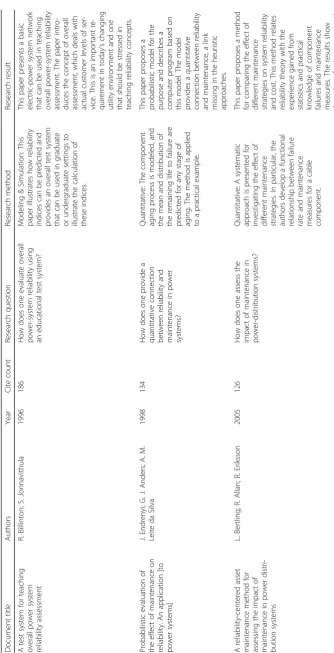
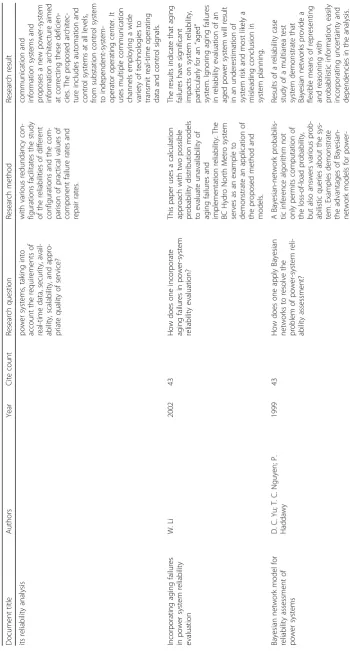
enhanced EI framework, and presents a bibliography of foundational papers. Finally,
the fifth section offers conclusions.
Research importance
Due to a rise in electricity use resulting from such new technologies as electric vehicles
and circuit and equipment overloads, a significant number of publications from
re-search organizations, governmental bodies, and utility companies have focused on
un-derstanding grid reliability, fault causes, and power outages. The National Academies of
Sciences, Engineering, and Medicine (
2017
) recently published
“
Enhancing the
Resili-ence of the Nation
’
s Electricity System
”
in response to Congress
’
s call for an
independ-ent assessmindepend-ent to
“
conduct a national-level comprehensive study on the future
resilience and reliability of the nation
’
s electric power transmission and distribution
sys-tem.
”
In addition, the National Academies of Sciences, Engineering, and Medicine
established a committee to conduct the relevant research. Throughout this report, the
committee highlighted all elements of grid reliability, resilience, and the risks of the
system-wide failure that will grow as the structure of the power industry becomes more
atomized and complex and laid out a wide range of actions to improve the U.S. power
system
’
s resilience. Analytics (including machine learning, data mining, and other
artificial-intelligence techniques) will play a very important role in response to the
pre-dicted attacks on the electric grid, failures, or other impairments due to their ability to
generate real-time recommendations (National Academies of Sciences, Engineering,
and Medicine
2017
).
In another exemplar research, Shawn Adderly (
2016
) examined U.S. Department of
Energy
’
s power outage data from 2002 to 2013 and investigated reliability trends. The
research objective was to assess the correlation between utilities
’
reliability and
grid-investment projects such as the deployment of smart-grid assets. Using the
deploy-ment of smart meters as a proxy for grid investdeploy-ments, Adderly concluded that the
increase of smart meters correlated strongly with a decrease in the frequency of
out-ages. The author acknowledged that due to the presence of confounding variables, the
reduction in power outage could not be attributed to any specific smart-grid
invest-ment project.
Several studies attempt to understand grid reliability. Steve Mitnick
’
s (
2015
) report
prepared for the Electric Markets Research Foundation, another important resource,
explains the reasons for concerns about grid reliability. The author suggests that
dis-tributed energy resources must be carefully incorporated into the grid to minimize
grid-reliability risk. Another relevant study conducted by the Lawrence Berkeley
Na-tional Lab (Eto et al.
2012
) highlighted the fact that reliability-data trends might not
improve
due
to
the
addition
of
smart-grid
technology
because
automated
outage-management systems may report service interruptions more accurately. Since
the study was based on a sample of reliability data from several utilities, the authors
did not attempt to make claims about overall U.S. power reliability.
human errors. Among hardware and technical failures, outages are experienced due to
equipment overload and short circuits, to name a few (Westar Energy
2017
; Diesel
Ser-vice and Supply
2017
; Rocky Mountain Power
2017
). These failures are often attributed
to unmet peak demand, outdated equipment, and malfunctions of backup power
sys-tems (Chayanam
2005
).
Environmental incidents, the largest portion of power outage causes, can be classified
into two distinct categories: weather and other factors. Such publications as Wisconsin
Public Service (
2017
) have highlighted the weather-related causes of power outages.
The Edison Electric Institute states that 70% of U.S. power outages are weather related
(as cited in Campbell
2012
). Kenward and Raja (
2014
) analyzed power outage data over
a 28-year period and noted that between 2003 and 2012, 80% of all outages were caused
by weather. Similarly, Campbell (
2012
) highlighted the damage to the electrical grid
caused by seasonal storms, rain, and high winds.
Besides weather, other external forces create power outages. As a byproduct of heavy
weather patterns, falling tree branches disrupt the flow of electricity (National
Acad-emies of Sciences, Engineering, and Medicine
2017
). Animals are another culprit of
power disruption. The Edison Electric Institute study also indicated that animals, such
as large birds, contacting power lines accounted for 11% of U.S. outages (as cited in
Campbell
2012
).
Human-error incidents are the last cause of power outages. Chayanam (
2005
)
in-dicated that training is essential for technicians and staff to battle outages with
proper maintenance procedures. This ensures a reduction in the frequency of power
outages. Car accidents are another major source of power outages (Wisconsin
Pub-lic Service
2017
).
In a 2013 white paper entitled
“
the Smart Grid Investment Grant Program Progress
Report,
”
the Department of Energy highlighted reliability improvements observed
through decreasing reliability indices and highlighted that such projects as automated
feeder switching were able to reduce the frequency of outages. No statistics were shown
in the report to demonstrate the correlation between reliability indices and spending.
However, the study identified the progress made by utilities as a result of receiving
fed-eral funding (U.S. Department of Energy
2013
).
Interrupted power supply is no longer a mere inconvenience. As the duration and
spatial extent of electrical outages increases, costs and inconvenience grow. Critical
social services such as medical care, police and other emergency services, and
com-munications systems rely upon electricity to function at minimally acceptable levels.
Failures can bring catastrophic outcomes; lives can be lost. We must better
under-stand the causes to be more ready to implement redundancy and resilience in the
electric grid.
Methodology
The systematic literature review offered in this paper follows the three stages in a
sys-tematic review: the Planning Stage, the Conducting Stage, and the Reporting Stage
(Kitchenham
2004
; Kitchenham and Charters
2007
).
The first step is the identification of a need for a systematic review. As described in
the previous two sections, although several studies have investigated electric-grid
reli-ability, these studies should be summarized to update the current knowledgebase.
Therefore, the urgent need for a systematic literature review providing solid
founda-tions and equipping researchers with pertinent information is clear.
The second step is the development of the review protocol. This section presents the
research questions, search strategy, inclusion/exclusion criteria, quality-assessment
cri-teria, and the data extracted from the studies.
Defining research questions is an essential step in every systematic review. By
answer-ing the followanswer-ing questions, the literature review can accomplish its aim.
1. How many research studies have examined electric-grid reliability?
2. What are the types of reliability-research questions?
3. What are the studies
’
results?
4. What research methods are used?
To conduct the systematic literature review, it was decided to do a broad automated
search, a method that includes the selection of the most appropriate digital sources
(digital libraries and indexing systems) and the determination of the search terms
(Spa-nos and Angelis
2016
). The digital libraries of IEEE Xplore and the Web of Science
were selected for the systematic review. The Web of Science database provides a wide
breadth and depth, whereas the IEEE database provides more narrowly focused and
very recent research. These searches relied on papers
’
titles to avoid receiving duplicate
or irrelevant papers as search results. The following search strings were used.
IEEE Xplore Boolean/Phrase
(((((
“
Document Title
”
:Electricity Reliability) OR
“
Document Title
”
:Electric Grid
Reli-ability) OR
“
Document Title
”
:Power System Reliability) OR
“
Document Title
”
:Electric
Circuit Reliability) OR
“
Document Title
”
:Power Outage Research)
refined by.
Content Type: Conference Publications Journals & Magazines Books & eBooks Year:
2015
–
2017
The year range is limited to those 3 years to ensure the search captures the reliability
impact of integrating distribution-energy resources into the electric grid.
Web of Science Boolean/Phrase
TITLE:(Electricity Reliability) OR TITLE:(Electric Grid Reliability) OR TITLE:(Power
System Reliability) OR TITLE:(Electric Circuit Reliability) OR TITLE:(Power Outage
Research) AND TITLE: (
“
estimate*
”
OR
“
assess*
”
)
refined by.
Timespan: 2015
–
2017. Indexes: SCI-EXPANDED, SSCI, A&HCI, CPCI-S, CPCI-SSH,
ESCI.
The inclusion/exclusion selection criteria of any systematic literature review must be
distinct and clearly stated (Spanos and Angelis
2016
). The following selection criteria
were used for the systematic review.
1. Full-article publication (not just an abstract),
2. English-language publication,
3. Year of publication sufficiently recent (since year 2015) to ensure that the
reliability impact of integrating distribution energy resources into the electric grid
has been captured, and
4. Study relevance.
The following exclusion criterion was used.
1. Duplicate publications (to avoid double counting studies)
The quality-assessment criteria are provided to ensure that all the included studies in
a systematic literature review contain an adequate level of quality. The following were
the criteria.
Availability and the description of the data,
Description of the used methodology, and
Presentation of the results.
The last task is related to the development of the review protocol and the selection
of the data features that will be extracted from the papers found by the search. The
data features for this review are as follows.
Author(s),
Year of publication,
Type of paper,
The research question(s),
Method(s) used, and
Result(s).
Results
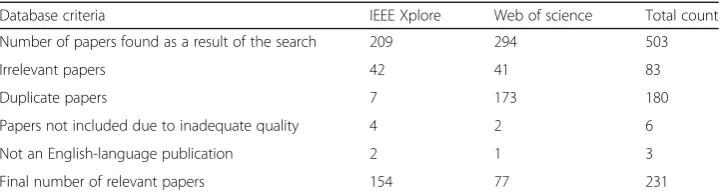
This section presents the initial results of the systematic literature review: 209 papers
from the IEEE Xplore database and 294 papers from the Web of Science core
collec-tion. Table
1
summarizes the characteristics of the documents identified and the counts
of papers by year.
The top publishing authors were M Fotuhi-Firuzabad (10 publications), C Singh (8),
LF Wang (8), YM Xing (8), and M Benidris (6).
those not-included after the quality assessment, and the final number of relevant papers
included in the systematic literature review for analysis.
Preliminary analysis of the relevant papers identified four key types of research
question:
1. How does one assess or evaluate reliability of the power grid?
2. How does one improve or enhance the reliability of the electric-power system?
3. How should one plan reliability of the smart grid?
4. What are the impacts of changes, including adding distributed-energy resources,
new regulations, and investment projects, on the reliability of the electric-power
system?
Research methods within this research domain can be classified either as analytical or
as Monte Carlo simulation. Analytical techniques represent the system by a
mathemat-ical model and evaluate the reliability indices from this model using mathematmathemat-ical
solu-tions. Monte Carlo simulation methods, on the other hand, estimate the reliability
indices by simulating the actual process and the system
’
s random behavior. Simulation
treats problems as a series of real experiments. There are advantages and disadvantages
to both methods.
Table 1
Study characteristics
IEEE Xplore Web of science
Paper type
Proceedings and conferences 152 164
IEEE conference publications 146
IET conference publications 5
VDE conference publications 1
Journals and magazines 57 132
CPSS journals and magazines 1
IEEE journals and magazines 40
IET journals and magazines 16
Total 209 296
Year
2015 66 111
2016 95 122
2017 48 61
Total 209 294
Table 2
Database search results
Database criteria IEEE Xplore Web of science Total count
Number of papers found as a result of the search 209 294 503
Irrelevant papers 42 41 83
Duplicate papers 7 173 180
Papers not included due to inadequate quality 4 2 6
Not an English-language publication 2 1 3
The foremost research methods are modeling and simulation. Simulation modeling is
the process of creating and analyzing a prototype of a physical model to predict its
per-formance in the real world. Simulation modeling is used to help researchers understand
whether, under what conditions, and in which ways a part could fail and what loads it
can withstand. Researchers have used various modeling and simulation tools to perform
the analysis, but Monte Carlo simulation is the most dominant research method.
Based on the systematic literature review, the Goebel et al. (
2014
) EI research
framework was extended. The following section illustrates the impact of this
exten-sion and highlights the addition of grid reliability research, all of its components,
and its use cases.
Energy informatics enhanced research framework
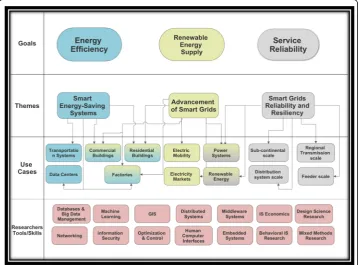
In the proposed Energy Informatics enhanced research framework (Fig.
1
), energy
effi-ciency, renewable-energy supply, and service reliability are the three types of research
streams in the energy domain. These streams reflect the topics identified in the
system-atic literature review. The restructured Goebel et al. (
2014
) framework includes service
reliability as a third research stream in addition to energy efficiency and the
renewable-energy supply to distinguish this understudied research area. The first
theme, energy efficiency, drives the evolution of smart energy-saving systems. The
sec-ond theme, renewable-energy supply, drives the advancement of smart grids. Finally,
the third additional theme, service reliability, drives smart-grid reliability and resiliency.
In the context of the service-reliability research theme, use cases (a collection of
pos-sible scenarios) were classified into four transmission scales: subcontinental, regional,
local distribution system, and feeder. Power systems and renewable energy can also be
viewed as additional use cases due to their impact on grid reliability. The rapidly
chan-ging nature of energy generation and the new developments of the electric power
net-work have fueled the rise of grid-reliability research to justify considering it a separate
research stream.
The first category of use cases, the subcontinental scale, examines large, relatively
self-contained landmasses forming a subdivision of a continent. Within this category,
multiple grids, transmission, and distribution systems may exist and be interconnected.
In the second category of use cases, regional transmission, studies examine
high-voltage transmission networks that enables power to travel long distances from
generating units to substations closer to local end-use customers where the voltage is
stepped back down and sent into the distribution system for delivery to consumers.
Given the interconnected configuration of the high-voltage grid, events in one place
can propagate across the transmission system in seconds or a few minutes, potentially
causing cascading blackouts that can affect customers hundreds of miles from the
ini-tial disturbance. Outage events on the transmission system can result in large-area
im-pacts (National Academies of Sciences, Engineering, and Medicine (
2017
).
In the third type of use cases, the electric distribution system moves power from the
energy system to the meters of electricity customers. Typically, power is delivered to
distribution substations from two or more transmission lines, where its voltage is
re-duced, and sent to customers over distribution feeders. Although distribution-system
outages are more common than those occurring on transmission facilities, their
im-pacts are smaller in scale and generally easier to repair (National Academies of
Sci-ences, Engineering, and Medicine
2017
).
The fourth category of use cases includes the feeder scale. Customers on radial
sys-tems are exposed to interruption when their feeder experiences an outage. In
metropol-itan areas, these feeders typically have switches that can be reconfigured to support
restoration from an outage or regular maintenance. When a component fails in these
systems, customers on unaffected sections of the feeder are switched manually or
auto-matically to an adjacent, functioning, circuit. However, this still exposes critical services
such as hospitals or police stations to potential outages, so these facilities are often
con-nected to a second feeder for redundancy (National Academies of Sciences,
Engineer-ing, and Medicine
2017
).
The definition of service reliability
—“
the ability of the electric grid to deliver
electri-city
to
customers
without
degradation
or
failure
”—
is
used
to
outline
the
service-reliability research theme. Recent developments such as the integration of
distributed-energy resources into the smart grid make information collection,
integra-tion, management, and analysis of vital importance. That is why EI has flourished in
the research community.
Power-system reliability research framework
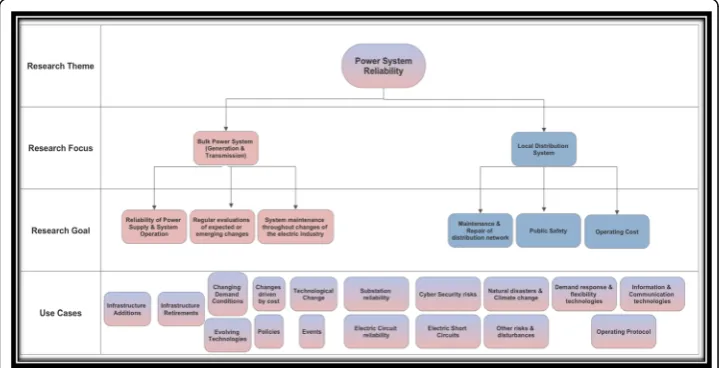
In addition to the EI enhanced research framework, Fig.
2
illustrates a framework
for power-system reliability founded on the previous literature. The focus within
the power-system-reliability research theme can be organized into one of two main
types: the bulk-power system (BPS) and the local-distribution system. The first
re-search focus, can be defined as a large interconnected electrical system made up of
generation and transmission facilities and their control systems. A BPS does not
include facilities used in the local distribution of electric energy. If a BPS is
dis-rupted, the effects are felt in more than one location. In the United States, BPS
are managed by the North American Electric Reliability Corporation (National
Academies of Sciences, Engineering, and Medicine
2017
). Reliability of power
sup-ply and system operation, regular evaluations of expected or emerging changes,
and system maintenance throughout changes in the electric industry are all
pos-sible goals within the BPS research focus.
The local-distribution system, the second research focus, provides power to
in-dividual consumer premises. Distribution networks usually consist of distribution
substations, primary distribution feeders, distribution transformers, distributors,
and service mains (National Academies of Sciences, Engineering, and Medicine
2017
). Maintenance and repair of the distribution network, public safety, and
op-erating cost are the possible goals within the local-distribution system research
focus.
The combined transmission and distribution network is known as the
“
power grid
”
or simply
“
the grid.
”
North America
’
s BPS involves four different power grids
(intercon-nections). The Eastern Interconnection serves the eastern two thirds of the continental
United States and Canada from the Great Plains to the Eastern Seaboard. The Western
Interconnection covers the western third of the continental United States, the Canadian
provinces of Alberta and British Columbia, and a portion of Baja California Norte in
Mexico. The Texas Interconnection includes most of the State of Texas. Finally, the
Canadian province of Quebec is served by the fourth North American interconnection.
The grid systems in Hawaii and Alaska are not connected to the grids in the
continen-tal states (U.S. Department of Energy, Office of Electricity
2015
).
In the context of the power-system reliability research theme, possible scenarios, or
use cases, can be classified into: infrastructure addition, infrastructure retirement,
changing demand conditions, evolving technologies, changes driven by cost, policies,
technological change, events, substation reliability, electric-circuit reliability, electric
short circuits, cybersecurity risks, natural disasters and climate change, demand
re-sponse and flexibility technologies, information and communication technologies,
oper-ating protocol, and other risks and disturbances.
Foundational papers on the subject of electric-grid reliability
One way to grasp the main core of a subject is to look at the references cited in the
current articles and highlight papers that are continually referenced. This step was
par-ticularly helpful in identifying the foundational papers.
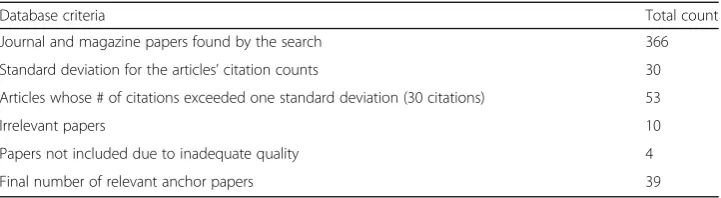
The same search string was used without an exclusion criterion (no year range
re-striction) to pull all journal and magazine publications from the database. The results
(366 extracted articles) were sorted in descending order based on the number of
cita-tions (the number of other papers
’
reference lists that included them), the standard
de-viation for each article
’
s number of citations was calculated, and the outliers (articles
whose number of citations was more one standard deviations) were identified. Based
on this analysis, 59 foundational papers were identified. After excluding the irrelevant
papers and those not meeting the quality criteria, 39 relevant papers remained
(Table
3
).
This section presents a bibliography and the analysis of foundational papers on the
subject of electric-grid reliability (Table
4
).
Table
5
summarizes the research methods identified in the foundational papers.
Though modeling and simulation are dominant research methods within the literature,
articles using analytical approaches seem to be gaining more attention considering how
often they are cited.
Bearing in mind the research themes and the methods illustrated in the
founda-tional papers, analytics has been a popular topic in research and more research is
needed in the area of reliability planning and improvement, particularly in the
energy field. Through the use of GIS, machine learning, and data-mining
techniques, analytics would help the research community plan and improve the
smart grid.
Table 3
Foundational paper statistics
Database criteria Total count
Journal and magazine papers found by the search 366
Standard deviation for the articles’citation counts 30
Articles whose # of citations exceeded one standard deviation (30 citations) 53
Irrelevant papers 10
Papers not included due to inadequate quality 4
Table
4
Foundational
papers
in
electric-power-supply
reliability
(Continued)
Do
cument
title
Authors
Year
Cite
cou
nt
Researc
h
question
Rese
arch
method
Re
search
res
ult
simul
ation
and
transien
t
en-ergy
function
for
the
trans
ient
stabi
lity
analysi
s.
propo
sed
me
thodolo
gy.
Loss
-of-l
oad
pro
bability
measu
res
ade
quacy
and
security.
They
are
also
decom
posed
to
cap-tu
re
the
contrib
utions
of
vari-ous
failure
types
cons
idere
d:
phase
fau
lts,
etc.
Powe
r
syst
em
reliability
enhan
cement
usin
g
a
thyris
tor
cont
rolled
se
ries
capac
itor
R.
Billinton;
M.
Fot
uhi-Firuzabad;
S.
O.
Faried
1999
33
What
is
the
impac
t
of
a
thyristor-contro
lled
se
ries
cap-acitor
on
powe
r-syste
m
reliability?
Mod
eling
an
d
app
lication:
The
pap
er
prese
nts
a
rel
iability
mod
el
of
a
multim
odule
thyris
tor-cont
rolled
series
cap-acitor
incorporat
ed
in
a
trans
-missi
on
system.
Thi
s
pap
er
exa
mines
the
im
pact
of
a
thyris
tor-con
trolled
se
ries
cap
acitor
on
po
wer-sy
stem
reliab
ility.
This
applica-ti
on
empl
oys
a
thy
ristor-cont
rolled
series
capacit
or
to
adj
ust
the
natural
powe
r
shar-ing
of
tw
o
different
parallel
trans
missio
n
lines
an
d,
there-fore
,
enab
le
the
maxim
um
trans
missio
n
capacit
y.
The
re-sul
ts
of
the
invest
igations
sho
w
a
signific
ant
impro
ve-me
nt
in
system
reliab
ility.
The
im
provement
is
me
asured
usi
ng
tw
o
indices:
loss
-of-load
exp
ectati
on
and
loss
-of-ene
rgy
exp
ectati
on.
Eva
luation
of
power
system
s
reliab
ility
by
an
arti
ficial
neu
ral
netwo
rk
N.
Amjady;
M.
Ehs
an
1999
32
How
does
one
eva
luate
power-system
reliability
with
an
artificial
neu
ral
net
work?
The
auth
ors
bas
e
this
method
on
the
artif
icial
neu
ral
netwo
rks
that
req
uire
sho
rt
training
times.
The
pap
er
pre
sents
a
new
me
thod
for
reliability
analysi
s
of
power
system
s,
which
can
solv
e
diff
iculties
of
the
pre
vious
reliab
ility-analysis
me
thods,
such
as
low
accu
r-acy,
complex
model
ing,
and
larg
e
com
putations.
The
pro-pose
d
artif
icial
neu
ral
netwo
rk
eva
luate
s
gen
erating-unit
an
d
trans
missio
n-system
rel
Conclusion
This paper identifies the use of analytics to predict reliability issues and plan for grid
reliability. To engender cutting-edge grid-reliability research activity, prospective
au-thors in this space could examine topics such as:
Modeling grid behavior,
Detecting outages,
Location analytics on smart-grid resiliency,
Planning secondary and tertiary backup for the smart grid,
Data management and pipeline to enable analytics,
Internet of things (IOT) and sensors for analytics, and
Recent advances in analytics and smart grids.
This systematic literature review of grid-reliability research provides a solid
founda-tion to equip researchers with the most pertinent informafounda-tion, offers an enhanced EI
research framework, and provides directions for future research in this domain.
Abbreviations
BPS:Bulk-power system; EI: Energy Informatics
Acknowledgements
The first author thanks her entire dissertation committee for their helpful advice.
Funding
This literature review is based on the first author’s doctoral dissertation earned from Claremont Graduate University. No additional funding was used for this project.
Availability of data and materials
Additional supporting data is available from the first author.
Authors’contributions
The first author completed the literature review. The second author was the chair of the first author’s dissertation committee, designed the paper structure, reviewed the findings, and proofread/edited the final paper. All authors read and approved the final manuscript.
Ethics approval and consent to participate Not applicable.
Consent for publication Not applicable.
Competing interests
The authors declare that they have no competing interests.
Publisher
’
s Note
Springer Nature remains neutral with regard to jurisdictional claims in published maps and institutional affiliations.
Table 5
Research methods
Research method Count anchor paper used the method
N Percent
Modeling & simulation 16 41
Quantitative/Analytical approach 20 51
Received: 18 February 2019 Accepted: 12 April 2019
References
Adderly S (2016) Reviewing power outage trends, electric reliability indices and smart grid funding. Thesis, University of Vermont.http://scholarworks.uvm.edu/cgi/viewcontent.cgi?article=1530&context=graddis. Accessed 15 Sept 2017 Campbell RJ (2012) Weather-related power outages and electric system resiliency. (Congressional Research Service Report,
Vol. August 28, pp. 1–15).https://fas.org/sgp/crs/misc/R42696.pdf. Accessed 15 Sept 2017
Chayanam K (2005) Analysis of telecommunications power outages. Thesis.https://etd.ohiolink.edu/rws_etd/document/get/ ohiou1125024491/inline. Accessed 15 Sept 2017
Diesel Service and Supply (2017). The many causes of power failures.http://www.dieselserviceandsupply.com/Causes_of_ Power_Failures.aspx. Accessed 11 Sept 2017
Eto JH, Lacommare, KH, Larsen P, Todd A, Fisher E (2012) An examination of temporal trends in electricity reliability based on reports from U.S. electric utilities.https://emp.lbl.gov/publications/examination-temporal-trends. Accessed 15 Sept 2017 Goebel C, Jacobsen H-A, del Razo V, Doblander C, Rivera J, Ilg J et al (2014) Energy informatics—current and future research
directions. BISE 6:25–31.https://doi.org/10.1007/s12599-013-0304-2
Hirst E, Kirby B (2000) Bulk-power basics: reliability and commerce. Consulting in Electric-Industry Restructuring, Oak Ridge http://www.consultkirby.com/files/RAPBPBasics.pdf
Kenward A, Raja U (2014) Blackout: extreme weather, climate change and power outages.https://www.eenews.net/assets/ 2014/04/14/document_ew_01.pdf. Accessed 15 Sept 2017
Kitchenham B (2004) Procedures for performing systematic reviews (NICTA Technical Report 0400011T.1). Durham University and Keele University, Durhamhttp://www.inf.ufsc.br/~aldo.vw/kitchenham.pdf. Accessed 11 Sept 2017
Kitchenham B, Charters S (2007). Guidelines for performing systematic literature reviews in software engineering (Keele University and Durham University Joint Report).https://userpages.uni-koblenz.de/~laemmel/esecourse/slides/slr.pdf Laezman R (2017) Office of Energy invests in grid reliability research. Electrical Contractor Magazine.http://www.ecmag.com/
section/systems/office-energy-invests-grid-reliability-research. Accessed 11 Sept 2017
Mitnick S (2015) Changing uses of the electric grid: reliability challenges and concerns.http://www.emrf.net/uploads/3/4/4/6/ 34469793/emrf_business_models_final_web_version.pdf. Accessed 11 Sept 2017
National Academies of Sciences, Engineering, and Medicine (2017) Enhancing the resilience of the nation’s electricity system. The National Academies Press, Washington, DC.https://doi.org/10.17226/24836
Osborn J, Kawann C (2001) Reliability of the U.S. electricity system: recent trends and current issues. Energy Analysis Department, Ernest Orlando Lawrence Berkeley National Laboratory, Berkeleyhttps://emp.lbl.gov/sites/all/files/ REPORTlbnl-47043.pdf. Accessed 11 Sept 2017
Profeta T (2017) The climate post: grid reliability study released as climate change panel disbands.http://www.huffingtonpost. com/entry/the-climate-post-grid-reliability-study-released-as_us_599ef43ae4b0a62d0987ad61. Accessed 11 Sept 2017 Rocky Mountain Power (2017) Key causes of power outages.https://www.rockymountainpower.net/ed/po/or/kcopo.html.
Accessed 11 Sept 2017
Spanos G, Angelis L (2016) The impact of information security events to the stock market: a systematic literature review. Comput Secur 58:216–229.https://doi.org/10.1016/j.cose.2015.12.006
U.S. Department of Energy (2013) Smart Grid Investment Grant Program progress report II.https://www.smartgrid.gov/files/ SGIG_progress_report_2013.pdf. Accessed 15 Sept 2017
U.S. Department of Energy (2015) Enabling modernization of the electric power system. In: Quadrennial technology review: An assessment of energy technologies and research opportunities http://energy.gov/downloads/chapter-3-enabling-modernization-electric-power-system. Accessed 11Sept 2017
U.S. Department of Energy, Office of Electricity (2015). United States electricity industry primer (DOE/OE-0017).https://www. energy.gov/sites/prod/files/2015/12/f28/united-states-electricity-industry-primer.pdf. Accessed 11 Sept 2017
U.S. Department of Energy, Office of Energy Efficiency and Renewable Energy (2017) Performance and operation.https:// energy.gov/eere/sunshot/grid-performance-and-reliability. Accessed 11 Sept 2017
Watson RT, Boudreau M-C (2011) Energy informatics. Green ePress, Athens
Westar Energy (2017). What causes power outages?https://www.westarenergy.com/outage-causes. Accessed 11 Sept 2017 Wisconsin Public Service (2017) Why power outages occur.http://www.wisconsinpublicservice.com/home/power_occur.aspx.