Vol. 06, Issue 06 (June. 2016), ||V2|| PP 54-58
Using the oxyhydrogen as an additive to increase the performance
of an internal combustion engine.
Sánchez, J. C
1; Casanova, P
2; Solís, K
11(Escuela de Ingeniería Agrícola. Universidad de Costa Rica, Apdo. postal: 3620-60. San Pedro de Montes de
Oca, San José, Costa Rica.)
2(Instituto de Investigaciones de Ingeniería (INII). Universidad de Costa Rica. Apdo. postal: 3620-60. San
Pedro de Montes de Oca, San José, Costa Rica.)
Abstract: - Reducing the pollution emission associated with oil combustion is gaining an increasing interest worldwide. Recently, Brown’s gas (HHO gas) has been introduced as an alternative clean source of energy. A system to generate HHO gas has been built and integrated with Isuzu trooper (2255 cc 4 cylinder engine). The results show that a mixture of HHO, air, and gasoline causes a reduction in the concentration of pollutant emission constituents and an enhancement in engine efficiency. The emission tests have been carried out varying the engine speed to 754 rpm, 1500 rpm, 2000 rpm and 2500 rpm and the flux of HHO by 6,639, 15,461 y 22,389 mL/s. The results show that carbon monoxide (CO), carbon dioxide (CO2) and Hydrocarbons (HC) were reduced to approximately 12,18 %, 1 %, 32,67 %, respectively, when a mixture of HHO for different HHO flows, air, and fuel was used: in other cases, CO, CO2 and HC emission increased.
Keywords: - Oxyhydrogen, Brown’s Gas, Carbon Monoxide, Carbon Dioxide, Hydrocarbons.
I.
INTRODUCTION
An emerging factor driving the increase in the cost of food is the high price of fossil fuels, which is increasingly correlated with the price of agricultural products, that due to automation and implementation of mechanical equipment in agribusiness.
Petroleum as a primary fuel source increases its value because of its scarcity and high environmental impact, with the main consequences being the accumulation of greenhouse gas in the atmosphere and rising costs of any productive activity. Internal combustion engines are largely responsible for this effect, emitting gases such as CO, HC and NO among others.
The development of alternative energy use can increase fuel economy, improve power and reduce harmful emissions from internal combustion engines. In this case thinking of water as an energy source and with the construction of a gas generator oxyhydrogen cell, which decomposes water into its constituent atoms, having hydrogen as fuel and oxygen as oxidizing, by an electrolysis process.
This research aims to study the behavior of internal combustion engines, implementing a co-feed oxyhydrogen-gasoline or oxyhydrogen-diesel, to analyze the impact of oxyhydrogen on the emission of polluting gases.
The most common gaseous pollutants from the combustion product in diesel and gasoline engines are carbon dioxide (CO2), carbon monoxide (CO), hydrocarbons, nitrogen oxides (NO), sulfur oxides (SO) among others. Several studies confirm a significant reduction of these gases by supplying oxyhydrogen in the intake system, whereby it is confirmed that not only the power and torque increasing system but also the efficiency of burning of fossil fuel increases, which is reflected in the analysis of gases emitted.
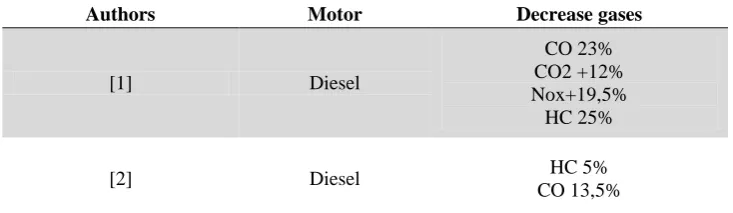
Table 1.1. Summary values obtained by different authors on polluting gases.
Authors Motor Decrease gases
[1] Diesel
CO 23% CO2 +12% Nox+19,5% HC 25%
[2] Diesel HC 5%
[3] Diesel
HC 9,5% CO 7,2% CO2 4,4% Nox +9,9%
[4] Gasoline CO 2%
HC 51%
II.
MATERIAL AND METHODS
The use of a gas analyzer can determine the amount of polluting gases emitted from a vehicle. To determine whether the oxyhydrogen has an impact on the reduction of the emitted gases, it is necessary to make several measurements varying the amount of oxyhydrogen and engine speed. For this, the engine is placed at fixed speed for a few seconds until the gas analyzer has stabilized, the measurement is recorded and the procedure is repeated for different flows and revolutions.
In order to evaluate the effect of oxyhydrogen in reducing greenhouse gases, a visit to the INA (Instituto Nacional de Aprendizaje, for its acronym in Spanish) was held. The project manager facilitated the needed equipment for testing, at the facilities located in Alajuela. The equipment used for the measurements consisted of a vehicle and a gas analyzer as described below.
The gas analyzer used was a Tecnotest model 488 Italian manufacturing, which allowed measurement of vehicle exhaust gases, both carbon monoxide (CO) and carbon dioxide (CO2) in percentage and density of hydrocarbons (HC).
For testing of gaseous pollutants the following procedure is followed:
1. Check that the exhaust system of the vehicle is in perfect condition, so there is no dilution of the exhaust gas or leaks.
2. Check the oil level in the crankcase of the vehicle is between the ranges recommended by the manufacturer.
3. Place the vehicle transmission in neutral (manual transmission).
4. Start the engine of the vehicle until it reaches normal operating temperature.
5. Turn on the measurement equipment and wait until stable as specified by the manufacturer. 6. Verify that you have completed the process of self-calibration of equipment.
7. With the motor running in "idle", performing at least three consecutive accelerations, from the position of "idle" to the position of maximum speed in order to clean the exhaust.
8. Connect the test probe at the outlet of the exhaust pipe of the vehicle (Fig.1). 9. With the engine running at the suggested speed values are taken.
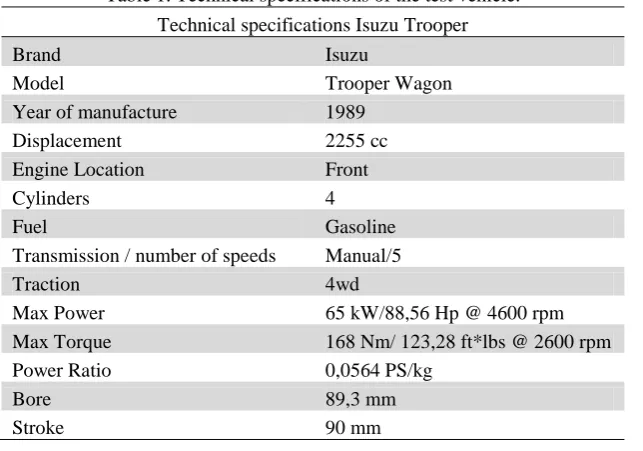
A system to generate HHO gas has been built and integrated with Isuzu trooper with a data sheet showed in Table 1.
Table 1.Technical specifications of the test vehicle.
Technical specifications Isuzu Trooper
Brand Isuzu
Model Trooper Wagon
Year of manufacture 1989
Displacement 2255 cc
Engine Location Front
Cylinders 4
Fuel Gasoline
Transmission / number of speeds Manual/5
Traction 4wd
Max Power 65 kW/88,56 Hp @ 4600 rpm
Max Torque 168 Nm/ 123,28 ft*lbs @ 2600 rpm
Power Ratio 0,0564 PS/kg
Bore 89,3 mm
The gas analyzer was installed similar to Fig 1 and Fig 2.
Figure 1. Probe connection to the exhaust pipe of the vehicle.
Tests at different speeds of engine rotation were performed, evaluating four speeds, the engine idling speed on average to 754 rpm, 1500, 2000 and 2500 rpm. For each test, measurements were made using three different oxyhydrogen flows: 6,639, 15,461 and 22,389 mL/s.
Figure 2. Gas Analyzer Tecnotest 488.
III.
RESULTS AND DISCUSSIONS
3.1 Carbon Monoxide
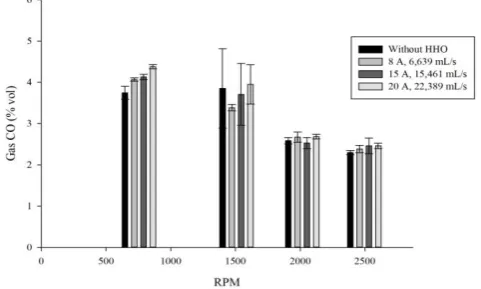
The results in Fig 3 correspond to the behavior of carbon monoxide as a function of the amount of supplied oxyhydrogen and the engine’s rotational speed. When the engine was idling an increase in CO emissions by 8,53 % for 6,639 mL/s (8 A, 1 % KOH), 10,13 % for 15,461 mL/s (15 A, 1 % KOH) and 16,8 % for 22,389 ml/s (20 A, 1 % KOH) with respect to the gas test without the use of HHO. At 1500 rpm a decrease of 12,18 % and 3,89 % for flows produced 8 and 15 A respectively, however when 22,389 mL/s were used there was an increase in emissions of 2,33 %. In the case of 2000 rpm emissions, they remained fairly constant with a decrease of 2,32 % using the flow of 15,461 mL / s and increased emissions by 3,86 % for a flow of 22,389 ml/s. With 2500 rpm there was a maximum increase at 15 and 20 A of 6,96 %.
The results obtained by [4] show a decrease in CO of only 2 %, while [1] achieved 23 % less emissions. The study conducted by [2] achieved 13,5 % results, while [3] achieved 7,2 %.
The study shows that the behavior of CO is not constant and can therefore increase as decrease gas emissions. The most significant drop was a 12,176 % registered at 1500 rpm and a flow rate of 6,639 mL/s, while the largest increase recorded was at idling using 22,389 mL/s with an increase of 16,8 %.
3.2 Carbon Dioxide
According to [1] CO2 emissions increase due to high burn obtained product of a higher catalytic action in the gas mixture. High speed HHO flame associated with high diffusion properties and oxidation reactions, due to change in the fuel temperature, make the air-fuel mixture more homogeneous and consequently resulting in increased CO2 emissions.
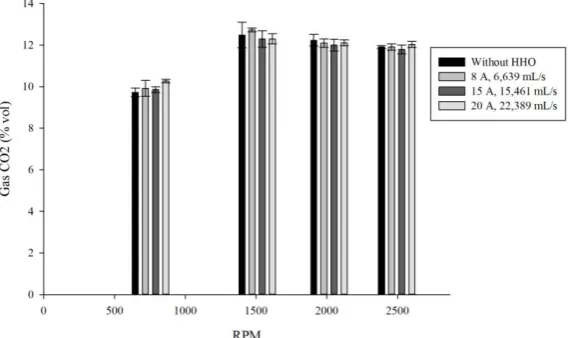
The behaviors of CO2 emissions are shown in Fig 4, where values were very stable over the tests, presenting minimal variation. At idle there was an increase in all oxyhydrogen flows supplied where the maximum value is reported with a flow of 22,389 mL/s, for a value of 10,27 % vol equivalent to an increase of 5,55 % over the test without oxyhydrogen. At 1500 rpm, values increased slightly to 8 A, reaching a difference of only 2 % and then decreasing for 15,461 and 22,389 mL/s, with percentage differences of 1,44 % and 1,52 % respectively. At speeds of 2000 rpm there was a decrease in all flows used with a difference of 1,14 %, 1,88 % and 0,98 %. For tests at 2500 rpm, the value obtained with a flow of 6,639 mL/s remained unchanged from the test without HHO. When the flow of 15,461 mL/s was provided, emissions fell by 1 % while using 22,389 mL/s an increase of 1 % occurred.
Both positive and negative results have been reported by different authors as in the case of [1] who obtained an increase of 12 % in CO2 emissions, while [3] achieved a decrease of 4,4 %.
As carbon monoxide CO2 also fluctuates positively and negatively with respect to variations of HHO used, the variations in this case are much lower with positive and negative values of approximately 1 %.
Figure 4. CO2 gas emissions as a function of RPM.
3.3 Hydrocarbons
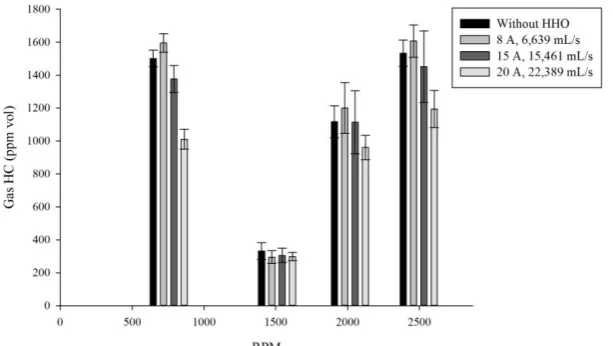
The results observed in Fig 5 correspond to the behavior of hydrocarbons as a function of the amount of supplied oxyhydrogen and engine speed. When the engine was idling there was a maximum decrease in HC emissions of 32,67 % for 22,389 mL/s, with respect to the gas test without the use of HHO. Very regular decreases were obtained at 1500 rpm with all oxyhydrogen flows supplied with a decrease of 11,312 %, 8,07 % and 10,24 % for the flows produced by 8, 15 and 20 A respectively. In the case of 2000 rpm and 2500 rpm, HC emissions decreased in its maximum value for 22,389 mL/s with a percentage difference of 14.01 % and 22,1 %, with respect to the test without oxyhydrogen, respectively. However, for tests at idle at 2000 and 2500, there was an increase of HC emissions when a flow of 6,639 mL/s was used by 7,44 % and 4,80 %.
As for the results obtained by different authors, outcomes vary from a decrease of 51 % of HC in the study conducted by [4], up to 5 % in the study by [2]. Other results like [1] with declines of 25 % and 9,5 % in the research of [3].
The hydrocarbon gases could be reduced in a higher percentage while introducing the HHO, with a reduction of up to 32,67 % when a flow of 22,389 mL/s is provided. The values presented by different authors report the HC as the gas that is most affected by the incorporation of HHO fuel mixture, which confirms the behavior of the model presented in this study.
Figure 5. HC gas emissions as a function of RPM.
IV.
CONCLUSION
The analysis of gaseous pollutants was successfully held at the premises of INA, getting results for CO, CO2 and HC. It was observed that the behavior of the gaseous pollutants studied, regarding the amount of supplied oxyhydrogen, there is both a positive and negative variation depending on the speed and flow of supplied oxyhydrogen.
For carbon monoxide the study shows that the behavior of CO is not constant and can therefore increase or decrease gas emissions, for tests at idle and 1500 rpm, the most important variations were recorded, while for 2000 rpm and 2500 rpm, values recorded remained more constant. The most significant drop was a 12,18 % registered at 1500 rpm and a flow rate of 6,639 mL/s, while the largest increase was at idle using 22,389 mL/s with an increase of 16,8 %. CO gas behavior is not predictable in the case studied; however, a considerable drop was obtained in the specific case of 1500 rpm at a flow rate of 6,639 mL/s.
Carbon dioxide remained very stable during testing, varying by only 1 % in most cases, and showing an increase in idle with a flow of 22,389 mL/s, for a value of 10,27 % vol, equivalent to a 5,55 % increase with respect to the test without HHO.
The most representative changes were made in the analysis of hydrocarbons, which achieved a drop of up to 32,67 % when 22,389 mL/s flow was provided, showing a better performance when high HHO flows are used.
REFERENCES.
[1] SR. Premkartikkumar, K. Annamalai and A.R. Pradeepkumar, Effect of addition of oxygen enriched hydrogen gas produces by electrochemical reaction in the reduction of pollutants coming out from a DI diesel engine, International Journal of ChemTech Research, 5(4), 2013, 1523-1531.
[2] A. C. Yilmaz, E. Uludamar and K. Aydin, Effect of hydroxyl (HHO) gas addition on performance and exhaust emissions in compression ignition engines, International Journal of Hydrogen Energy, 35(20),
2010, 11366-11372
[3] HK. Wang, CY. Cheng, YC. Lin and KS. Chen, Emission reductions of air pollutants from a heavy-duty diesel engine mixed with various amounts of H2/O2, Aerosol and Air Quality Research, 12, 2012, 133-140.