Intelligent Traffic Control System using
Adaptive Logic
Manish Shrivastava Shashank Singh
Assistant Professor B. Tech Student
Department of Electrical & Electronics Engineering Department of Electrical & Electronics Engineering Galgotias College of Engineering & Technology, Galgotias College of Engineering & Technology,
Greater Noida, India Greater Noida, India
Tarun Yadav Piyush Tiwari
B. Tech Student B. Tech Student
Department of Electrical & Electronics Engineering Department of Electrical & Electronics Engineering Galgotias College of Engineering & Technology, Galgotias College of Engineering & Technology,
Greater Noida, India Greater Noida, India
Sunil Karki
B. Tech Student
Department of Electrical & Electronics Engineering
Galgotias College of Engineering & Technology, Greater Noida, India
Abstract
In this new Era, the growing Vehicle population in all developing and developed country calls for a major improvement and innovation in the existing Traffic Signalling systems. The most widely used Traffic Control uses a simple time based system which works on a fixed time interval basis which is now inefficient for random and non-uniform Traffic .This Proposed system uses the congestion based dynamic timing system .This system does not require any system in vehicles so can be implemented in any Traffic system quite easily with less time and is less expensive also. This system uses Wireless sensor networks Technology to sense vehicles and a Microcontroller IC- based routing algorithm programmed for excellent Traffic management.
Keywords: IC-89s51, IR Sensor, LEDs, Counters, Traffic Enforcement Cameras
________________________________________________________________________________________________________
I. INTRODUCTION
Traffic signals are the most convenient method of controlling traffic in a busy junction. But, we can see that these signals fail to control the traffic effectively when a particular lane has got more traffic than the other lanes. This situation makes that particular lane more crowded than the other lanes. The Traffic density is increasing at an alarming rate in developing countries which call for the need of Advance intelligent Traffic signals to replace the Conventional manual and time based Traffic signal system. It is also difficult for traffic police to monitor the whole scenario round the clock. If traffic signals are smart enough to allot dynamic timing to different lanes according to the number of vehicles present in a particular lane, this problem can be solved to a large extent.The main aim of designing Intelligent traffic controllers is that the traffic controllers have the ability to adapt to the real time data from detectors(or, Sensors) to perform constant optimizations on the signal timing plan for intersections in a network in order to reduce traffic congestions, which is the main concern in traffic flows control nowadays, at traffic intersections.
The 8051 Controller receive the input from IR Sensors which will be installed at each lane .The Timing of green light for a particular lane depends on the actual number of vehicles present in that lane. It is counted by counters. The lane which has more congestion is allotted more time for the green light and vice-versa.
Along with solving the problem of traffic control especially during peak hours, this proposed system also has a provision for penalising those who try to cross the red signal. This will be achieved by installing Traffic Enforcement Cameras (or, Red light camera) which will be installed on each traffic post.
It takes high quality still pictures when triggered .The trigger will be provided by an IR sensor which sends signal to the Microcontroller when any vehicle crosses the stopping zone during a red light for that lane.
The main aim in designing and developing of the Intelligent Traffic Signal Simulator is to reduce the waiting time of each lane of the vehicles.
II. OVERVIEW OF IC-8051 BASED ITCS
The main objective is to build a hardware device that has:
1) The ability to collect the information of the busy tracks by sensors and providing the output to microcontroller. 2) The ability to take decision against the information and change the time according to the priorities.
3) Penalise those who try to break the traffic rule.
Advantages
1) Traffic signals help control the flow of vehicles, pedestrians and bicycles by giving “right-of-way” to the various movements in an orderly manner.
2) Signals that are properly located, designed and maintained can: Provide for orderly movement of traffic.
Increase capacity of the intersection.
Provide for continuous movement of traffic at a definite speed along a given route. Interrupt heavy traffic at intervals to permit other vehicles or pedestrians to cross. Effectively perform traffic management.
Overall, traffic signals help us get where we’re going safely and in a timely manner.
Study Overview-
This study has two main parts. First is study of Microcontroller and the second part is its application intelligent traffic control system. The intelligent traffic control system has further divided into two main parts, Programming and hardware. Atmel 89cxx family programmer series is used for programming. In hardware IR sensors are used for sensing the presence of the vehicles on the square in proto type.
What is a Microcontroller?
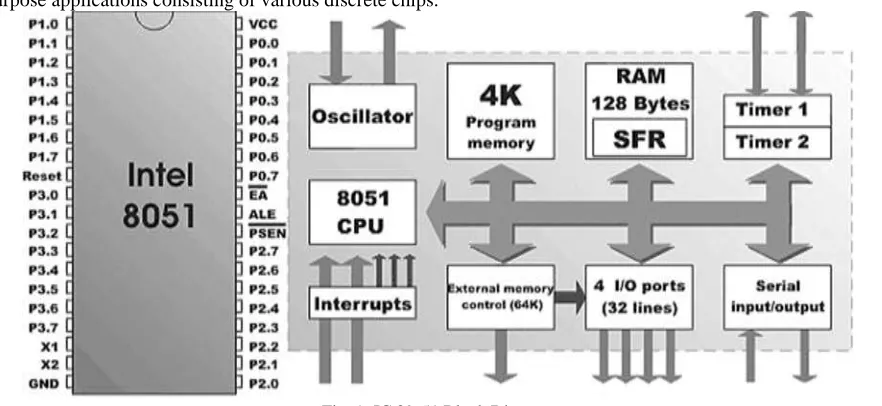
A microcontroller is a small computer (SoC) on a single integrated circuit containing a processor core, memory, and programmable input/output peripherals. Program memory in the form of Ferroelectric RAM, NOR flash or OTP ROM is also often included on chip, as well as a typically small amount of RAM.
Microcontrollers are designed for embedded applications, in contrast to the microprocessors used in personal computers or other general purpose applications consisting of various discrete chips.
Fig. 1: IC 89s51 Block Diagram
IR Sensor
An Infrared (IR) sensor is used to detect obstacles in front of it or to differentiate between colours depending on the configuration of the sensor.
Fig. 2: IR Sensor
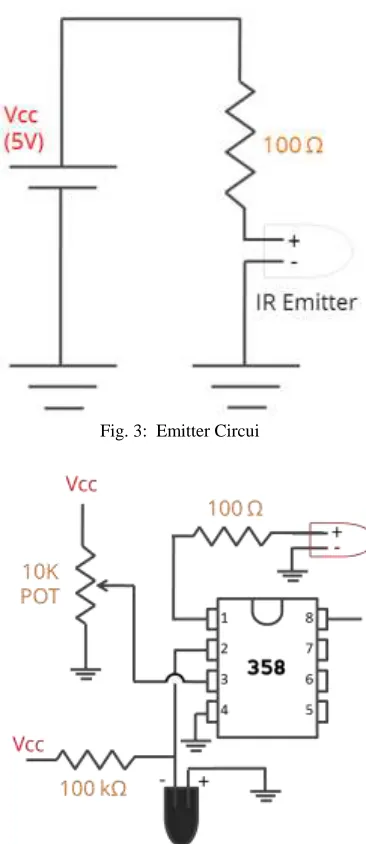
An IR sensor consists of an emitter, detector and associated circuitry. The circuit required to make an IR sensor consists of two parts; the emitter circuit and the receiver circuit.
The emitter is simply an IR LED (Light Emitting Diode) and the detector is simply an IR photodiode which is sensitive to IR light of the same wavelength as that emitted by the IR LED. When IR light falls on the photodiode, its resistance and correspondingly, its output voltage, change in proportion to the magnitude of the IR light received. This is the underlying principle of working of the IR sensor.
Circuit Diagram
Fig. 3: Emitter Circui
Light Emitting Diode(LED)
A light-emitting diode (LED) is a two-lead semiconductor light source. It is a p–n junction diode, which emits light when activated.[4]When a suitable voltage is applied to the leads, electrons are able to recombine with electron holes within the device,
releasing energy in the form of photons.
This effect is called electroluminescence, and the colour of the light (corresponding to the energy of the photon) is determined by the energy band gap of the semiconductor.
We are using LEDs of Red, Yellow and Green colours which act as traffic lights in the hardware model.
Counter
Counter is a solid state device which is used for counting the number of times an event has occurred. It works on discrete Pulses. The Counter will send the trigger pulses to PLC which will then send the output to LEDs.
Fig. 5: Traffic Enforcement Camera
A traffic enforcement camera (also red light camera, road safety camera, road rule camera, photo radar, photo enforcement, speed camera, Gatso, safety camera, bus lane camera, Safe-T-Cam, depending on use) is a camera which may be mounted beside or over a road or installed in an enforcement vehicle to detect traffic regulation violations, including speeding, vehicles going through a red traffic light, unauthorized use of a bus lane, or for recording vehicles inside a congestion charge area. It may be linked to an automated ticketing system. It will be used for taking high quality pictures of vehicles when triggered.
III. PROPOSED ALGORITHM
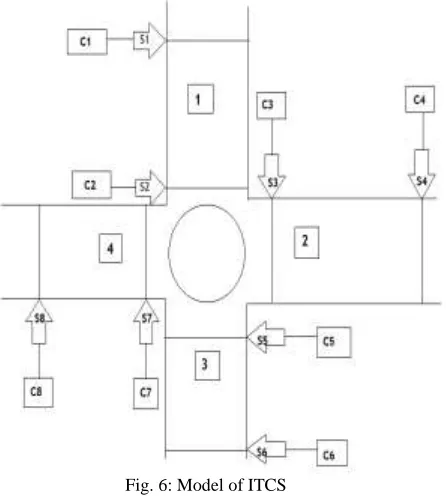
This Proposed Model is shown for a square. Let the four roads be numbered as 1,2,3,4.
Fig. 6: Model of ITCS
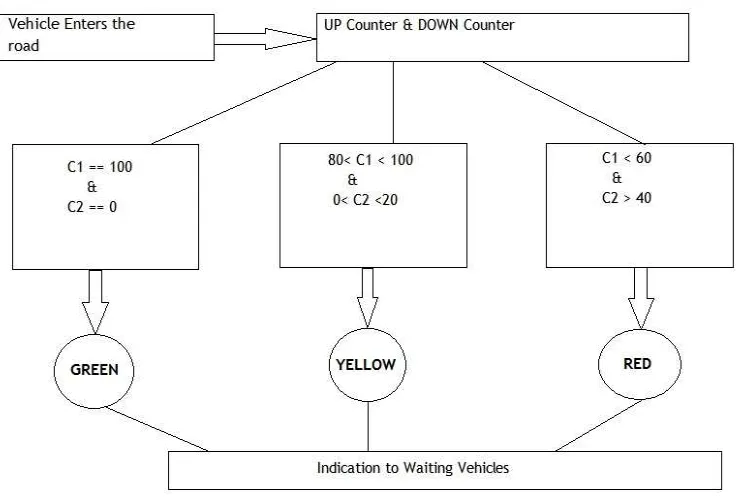
Fig. 7: Flow chart for diversion of vehicles based on traffic density
The Counter C1 does the Up Counting while the Counter C2 does the Down Counting. Both these Counters get the input from Two IR Sensors S1 and S2.These counters are connected to the Input terminals of PLC while the traffic Lights (LEDs) are connected to the output terminals of it.
If number of vehicles in Lane 1 becomes equal to 100, the traffic light becomes Green for this Lane and Red for the rest 3 lanes.If the number of vehicles are around 80, Yellow LED glows. If the number of vehicles falls to around 20, Red LED glows indicating the vehicles to stop.
Moreover the timing of the Green light varies according to the number of vehicles in a particular Lane. Number of Vehicles Timing of Green LED(in sec)
Between 100 & 120 60 Between 120 & 150 90 Greater than 150 120
The Control will move in a clockwise Direction i.e. 1, 2,3,4,1. The PLC will keep checking the counting of C1 & C2 and allot the timings of Green light as specified in the above table.
The Sensor S1 will perform an additional function of triggering the Traffic Enforcement Camera if a vehicle crosses S1 when the signal is Red for that particular lane. This camera is also connected to the output terminal of Allen Bradley Micrologix 1000 PLC.
IV. RESTRICTIONS
The proposed method faces a challenge that if more than one vehicle crosses together one beside the other, sensor senses them as a single entity and gives only one pulse to the counter .This problem can be solved if we use Image Processing in spite of IR Sensors.
Another Problem faced by this proposed system is that the Counter counts all the things which crosses the sensor like Humans, animals, etc. This problem can be solved by implementing weight sensors along with IR Sensors but this makes the system more complex.
V. CONCLUSION
REFERENCES
[1] SMART TRAFFIC CONTROL SYSTEM USING PLC and SCADA-Mohit Dev Srivastava
[2] WSN Applications: Automated Intelligent Traffic Control System Using Sensors-Rashid Hussian
[3] PLC Based Intelligent Traffic Control System Muhammad Arshad Khattak Department of Computer Science and Information Technology Sarhad University of Science and Information Technology (SUIT),Pakistan
[4] Wenjie Chen, Lifeng Chen, Zhanglong Chen, and ShiliangTu , “WITS: A Wireless Sensor Network for Intelligent Transportation System”, 2006 IEEE, IMSCCS'06
[5] A.A. M.A. A. M. HIRARI. Et al. (2006), “Design and Development of sensor based traffic light system.” American Journal of Applied Sciences 3: 1745, 1749.