C
HANGE
D
ETECTION
Ronald A. Rensink
Departments of Psychology and Computer Science, University of British Columbia, Vancouver, British Columbia, V6T 1Z4 Canada; e-mail: [email protected]
Key Words change blindness, visual attention, scene perception, eye movements,
visual memory
■ Abstract Five aspects of visual change detection are reviewed. The first concerns
the concept of change itself, in particular the ways it differs from the related notions of motion and difference. The second involves the various methodological approaches that have been developed to study change detection; it is shown that under a variety of conditions observers are often unable to see large changes directly in their field of view. Next, it is argued that this “change blindness” indicates that focused attention is needed to detect change, and that this can help map out the nature of visual attention. The fourth aspect concerns how these results affect our understanding of visual perception—for example, the implication that a sparse, dynamic representation underlies much of our visual experience. Finally, a brief discussion is presented concerning the limits to our current understanding of change detection.
CONTENTS
INTRODUCTION . . . .246
DISTINCTIONS AND DEFINITIONS . . . .247
Change vs. Motion. . . .248
Dynamic vs. Completed Change . . . .249
Change vs. Difference . . . .250
EMPIRICAL APPROACHES . . . .251
Contingency of Change . . . .251
Repetition of Change . . . .253
Content of Display . . . .254
Content of Change . . . .255
Observer Intention . . . .256
Type of Task. . . .257
Type of Response . . . .258
ATTENTION AND CHANGE DETECTION . . . .259
Involvement of Focused Attention. . . .259
Comparison vs. Construction . . . .260
Construction vs. Maintenance . . . .260
Independence of Attentional Complexes. . . .261
Contents of Attentional Complexes. . . .261
Coherence Theory . . . .262
IMPLICATIONS FOR VISUAL PERCEPTION . . . .263
Visual Buffer . . . .264
Coherent Structure . . . .264
Scene Representation . . . .265
Dependence on Task . . . .266
High-Level Knowledge . . . .267
Implicit Perception. . . .268
OPEN ISSUES . . . .269
CLOSING REMARKS . . . .272
INTRODUCTION
Change detection is the apprehension of change in the world around us. The ability
to detect change is important in much of our everyday life—for example, notic-ing a person enternotic-ing the room, copnotic-ing with traffic, or watchnotic-ing a kitten as it runs under a table. However, in spite of the pervasiveness of change detection in our lives, it has proven surprisingly difficult to study. Only recently have var-ious approaches begun to converge in terms of what it is and how it is carried out.
As used here, the term change detection pertains primarily to the visual pro-cesses involved in first noticing a change. It denotes not only detection proper (i.e., the observer reporting on the existence of the change), but also identifica-tion (reporting what the change is) and localizaidentifica-tion (reporting where it is). The perception of dynamic patterns per se (e.g., the perception of movement) is not discussed in detail here, since this involves a formidable set of issues in its own right (see e.g., Jacobs et al. 1988). Likewise, the focus is on behavioral mea-sures and their interpretation rather than investigations into underlying neural systems.
Restricted in this way, change detection might appear to be a fairly straightfor-ward process. However, empirical studies have repeatedly proven otherwise. For example, we as observers tend to believe we could immediately detect any change in front of us if it were sufficiently large (Levin et al. 2000). However, this is not so: Under a wide variety of conditions we can be amazingly blind to changes, failing to see them even when they are large, repeatedly made, and anticipated (for reviews, see Rensink 2000a, Simons & Levin 1997). This “change blindness” (Rensink et al. 1997) is a striking phenomenon, one that has often served as the flip side of change detection: Just as our ability to detect change has cast light on some perceptual mechanisms, so has our inability to detect it cast light on others.
seconds. Meanwhile, studies such as Ditchburn’s (1955) and Wallach & Lewis’s (1966) investigated displacements made during an eye movement (or saccade). All studies showed observers to be surprisingly poor at detecting changes made contingent on a temporal gap or a saccade. However, no attempt was made to incorporate the entire set of findings into a systematic framework.1
The second phase took place during the 1970s, with some work continu-ing into the 1980s. Examples here include Pollack (1972), Phillips & Scontinu-inger (1974), and Pashler (1988), who systematically investigated the limits of the detection of gap-contingent changes in arrays of simple figures. This work— along with that on visual integration—formed the basis for the proposal of a limited-capacity visual short-term memory (vSTM). Concurrent with these de-velopments, studies such as those by Mack (1970), Bridgeman et al. (1975), and McConkie & Zola (1979) showed that observers were poor at detecting saccade-contingent change under a variety of conditions. Although a consider-able body of knowledge about this phenomenon was eventually gathered (see e.g., Bridgeman et al. 1994), no integration with the work on gap-contingent changes was achieved.
The third phase began in the early 1990s and has continued to the present. Ex-amples are Simons (1996), Rensink et al. (1997), and Henderson & Hollingworth (1999a). Work here can be distinguished from previous approaches in at least one of three ways: (a) Stimuli are more realistic—e.g., images of real-world scenes or dynamic events; (b) repeated rather than single changes are used, allowing the use of time as a measure of performance; and (c) an emphasis on integrating results obtained via different kinds of manipulations—e.g., the identification of transsac-cadic memory with vSTM (Irwin 1991), which connected saccade-contingent and gap-contingent change blindness. These studies emphasize the idea that change detection is not a marginal process, but involves mechanisms central to the way we perceive our world.
DISTINCTIONS AND DEFINITIONS
As with many ideas in psychology, the concept of change initially appears un-problematic, but upon closer examination contains subtleties that may cause great confusion unless carefully handled. Indeed, the concept of change has had a par-ticularly long and tortuous history, extending back at least to the time of the pre-Socratic philosophers, when it formed the basis for a host of problems. Some
1The work on saccade-contingent change was intended to address the question of how
of these problems—such as the paradoxes of Zeno of Elea—were highly intricate, taking centuries to resolve2(see e.g., Kirk & Raven 1957); indeed, several persist to this day.
Consequently, this section focuses on some of the basic issues pertaining to the concept of change. In particular, it attempts to clarify the distinctions (and relations) between change, motion, and difference. These distinctions are examined from the perspectives of both physical description and perceptual mechanism.
Change vs. Motion
The word change generally refers to a transformation or modification of something over time. As such, this notion presumes a nonchanging substrate on which changes are imposed. More precisely, change is defined here as the transformation over time of a well-defined, enduring structure. The complexity of the structure does not matter—it can range from an undifferentiated particle to a highly articulated object. All that is required is that the structure continues to exist over the course of its transformation. Although such continuity can be defined in a variety of ways, the most appropriate appears to be spatiotemporal continuity (see e.g., Smith 1998).
Stated this way, an important distinction can be drawn between change and
motion. Motion is often taken to refer to change of position over time. However,
consider a situation such as a flowing stream. Here, the critical property is the velocity at each point in space; the complete array of these velocities forms a motion field. Referencing temporal variation to space in this way allows motion to be treated much like color or brightness, so that constructs such as borders can be defined on the basis of the motion pattern. More generally, motion can refer to the temporal variation at a point in space of any measurable quantity (see e.g., Adelson & Bergen 1991).
Thus, motion is most usefully defined as variation referenced to location, whereas change is referenced to structure.3This distinction has important conse-quences for the perceptual processes involved. For example, motion can generally
2Perhaps the most famous of these is the paradox of Achilles and the tortoise, which involves
change in position (i.e., movement). A tortoise is given a head start in a race with Achilles. It is then argued that Achilles can never overtake the tortoise, for by the time he arrives at the previous location of the tortoise, the tortoise will have moved yet further ahead. Based on apparent paradoxes such as this, some early thinkers (e.g., Parmenides of Elea) argued that change was impossible, and that the perception of change was therefore illusory (see e.g., Kirk & Raven 1957).
3This distinction can always be maintained, even when the variations are smooth and pertain
be described in terms of local derivatives—no other structure is needed.4Motion detectors can therefore be located at the initial stages of visual processing, where spatial representations have minimal complexity (see e.g., Hildreth & Koch 1987, Nakayama 1985). In contrast, change is referenced to a particular structure that must maintain spatiotemporal continuity, and so more sophisticated processes are needed.
In this view, then, the transformation of any external entity is picked up by two concurrent perceptual systems: one describing motion (variation referenced to location), and the other change (variation referenced to a structure).5Although the outputs of these systems are often correlated, they can sometimes be decoupled, e.g., by their differential response to different stimuli (Seiffert & Cavanagh 1998), or by using transformations that occur beyond the temporal window of most motion detectors, a window of approximately 50–80 ms (e.g., Woodhouse & Barlow 1982, van der Grind et al. 1986).
Dynamic vs. Completed Change
Another important distinction is that between the detection of dynamic change (i.e., seeing a change in progress) and the detection of completed change (i.e., seeing that something has changed). Loosely speaking, this distinction reflects the difference between present progressive and past perfect tense.
More precisely, the detection of dynamic change refers to the perception of the transformation itself: The change is perceived as a dynamic visual event. This suggests that the spatiotemporal continuity of the external entity may be reflected in the spatiotemporal continuity of the internal representation. Note that the entity need not be continually present, however. Mechanisms at early levels may allow its representation to be sustained over brief intervals.
In contrast, the detection of completed change refers to the perception that the structure changed at some point, such as might happen if the change took place
4In general, simple continuity is not enough: Additional conditions are generally required
to ensure that the derivatives of that particular order and type can exist (see e.g., Gelfand & Fomin 1963). However, the initial stages of visual processing usually involve only simple first- and second-order derivatives, which are calculated after smoothing by low-pass filters. As such, these quantities exist for virtually all conditions encountered when viewing the world (see e.g., Hildreth & Koch 1987, Marr 1982).
5Note that a change in the use of terms is advocated here. For example, “first-order
while the entity was briefly occluded. Phenomenologically, there is no sense of a dynamic transformation; the change is simply noted to have taken place some time in the past. The mechanisms involved here would likely compare a property of a representation in memory against a representation of a currently visible structure, with the continuity of the referents established by means other than the continuity of the visual representation itself.6
Change vs. Difference
Finally, it is also important to distinguish between change and difference. As dis-cussed above, change refers to the transformation over time of a single structure. In contrast, difference refers to a lack of similarity in the properties of two struc-tures. The issue then is to clarify how these two notions differ. To the degree that they are not the same, trying to “spot the difference” between two side-by-side images will be a rather different activity than trying to detect the change in a pair of sequentially presented images (see Gur & Hilgard 1975, Brunel & Ninio 1997, Scott-Brown et al. 2000, Shore & Klein 2000).
It is important to note that the concepts of change and difference do have several elements in common. Both are referenced to structure, with the nature of the structures being unimportant. And both rely on the idea of similarity as applied to one or more of their properties.
However, the two concepts are not the same. To begin with, change refers to a single structure, difference to two. Furthermore, change involves temporal trans-formation, the measures of similarity pertaining to the same structure at different points in time; this is especially pronounced in dynamic change. In contrast, dif-ference involves no notion of transformation, with similarity defined instead via the atemporal comparison of structures that may or may not exist simultaneously. There consequently appears to be an ordering of sorts: (a) dynamic change, with dynamic transformation and spatiotemporal continuity; (b) completed change, with inferred transformation and possibly a more abstract kind of continuity; and (c) difference, with no transformation (only comparison) and no continuity.
As in the case of motion, these distinctions have implications for the perceptual mechanisms involved. The detection of dynamic change involves spatiotemporal continuity, not only of the external entity, but likely of the internal representations as well. As such, a memory of a fairly sophisticated sort is required, one that not
6In some sense, these two types of perception are analogous to modal completion (i.e.,
only maintains continuity but also supports the perception of a dynamic transfor-mation. In contrast, all that is needed to detect difference is to extract the relevant properties from each entity and compare them at some point; memory need not enable continuity to be determined. Meanwhile, the mechanisms underlying the detection of completed change depend on the kind of continuity involved. If the external entity is somehow tracked, these mechanisms might be largely the same as those used for dynamic change. If the entity is not tracked, the mechanisms could be much the same as those used for detecting difference, along with an additional mechanism to identify the two structures as the same entity at different moments in time.
It is also important to maintain a careful distinction between structures defined as external entities and structures defined as internal representations. For example, a person may be encountered on two different occasions years apart. If the exter-nal entity is considered, there exists a set of transformations linking the current manifestation to the previous one; it is therefore the same person, who has simply changed. However, suppose the observer previously knew the person, but does not now recognize him or her. In terms of internal representations, the old and the new manifestations will be seen as different people.
These distinctions not only affect the way that words are used: They also affect the types of experiments considered relevant to a discussion of change detection. For instance, “match-to-sample” experiments (e.g., Biederman & Gerhardstein 1993) do not pertain to change detection, because the test and sample items are not necessarily perceived as corresponding to the same entity. Meanwhile, some “same vs. different” studies (e.g., Carlson-Radvansky & Irwin 1999) do pertain to change detection, because successive stimuli are perceived as the same entity.
EMPIRICAL APPROACHES
As mentioned earlier, the study of change detection has evolved over many years, proceeding through phases that have emphasized different types of stimuli and different types of tasks. All studies, however, rely on the same basic design: An observer is initially shown a stimulus (e.g., a picture or array), a change of some kind is made to this stimulus (e.g., removal or alteration of an element), and the response of the observer is then measured. The wide variety of approaches that have been developed around this design can be categorized via a relatively small number of dimensions.
Contingency of Change
change- and motion-detection systems. A few studies (e.g., Brawn & Snowden 1999, Castiello & Jeannerod 1991) attempt this via the temporal pattern of re-sponses to a sudden change. Others (e.g., Seiffert & Cavanagh 1998) look at how performance is affected by different types of stimuli. However, for the most part, change and motion have been decoupled by making the change contingent on some event.
Gap-contingent techniques, for example, make the change during a temporal
gap (or interstimulus interval) between the original and altered stimulus. A pat-terned mask is sometimes displayed during this gap, although often a simple blank field is used. Examples of this include work by Hochberg (1968), Phillips (1974), Pashler (1988), Simons (1996), and Rensink et al. (1997). Observers are generally poor at detecting change if more than a few items are present.
Saccade-contingent approaches make the change during a saccade of the
eyes (see e.g., Sperling & Speelman 1965, Bridgeman et al. 1979, McConkie & Zola 1979, Carlson-Radvansky & Irwin 1995, Grimes 1996, and Henderson & Hollingworth 1999a). In all cases, observers are generally poor at detecting change. Indeed, this is true for position change if even only one item is present, provided it has no global frame of reference.
Shift-contingent techniques make the change during a sudden shift of the entire
display; this is like the saccade-contingent technique, but with a simulated saccade [see e.g., Sperling & Speelman (1968) in Sperling (1990), Blackmore et al. 1995]. A considerable amount of change blindness is found both when the eye does and does not move in response to the shift.
Blink-contingent procedures make a change during an eyeblink. An example
of this is the work of O’Regan et al. (2000). Again, observers are generally poor at detecting such changes. [This effect was known to movie editors long ago, who would use a sharp noise to induce the blink (see Dmytryk 1984, p. 31)]. Interest-ingly, change blindness can occur even if the observer is fixating the item being changed.
Splat-contingent techniques make the change simultaneous with the appearance
of brief distractors, or splats (e.g., Rensink et al. 2000b). The change blindness induced by this technique is less severe than that of others; nevertheless, it still oc-curs (O’Regan et al. 1999, Rensink et al. 2000b). This shows that change blindness can be induced even when the change itself is completely undisturbed.
Occlusion-contingent change occurs while the changing item is briefly
oc-cluded. Examples can be found in the work of Simons & Levin (1998), Vaughan & Yantis (1999), Scholl et al. (1999), and Rich & Gillam (2000). In all cases, changes are much more difficult to detect than when the changing item is not occluded.
Cut-contingent methods involve items in movies, the change being made during
Gradual change, meanwhile, has the transition between original and modified
display made slowly, i.e., over the course of several seconds (see e.g., Simons et al. 2000). (Note that the transition must still be fast enough that it can be easily seen once noticed.) Observers have great difficulty detecting this kind of change, even though no disruptions of any kind appear in the display.
Repetition of Change
Studies can also be characterized by the number of times the change is made; this is roughly analogous to the duration of a static presentation in a conventional detection experiment. As for visual experiments generally, brief and extended pre-sentations are complementary approaches, with the weaknesses of the one largely compensated for by the strengths of the other.
In the one-shot approach the change is made just once during each trial (Figure 1a). Performance is primarily measured by accuracy, although response time is sometimes measured as well [(see e.g., Hochberg 1968, Avons & Phillips 1980, Blackmore et al. 1995, Levin & Simons 1997) Wright et al. 2000]. This technique minimizes the involvement of eye movements and long-term memory.
It can also distinguish between particular transformations (e.g., blue to yellow, present to absent), which would not be easily separated otherwise.
The repeated-change approach, in contrast, has the change made repeatedly un-til detected, or unun-til the trial ends. Performance is primarily measured via response time, although accuracy is sometimes measured as well (see e.g., Rensink et al. 1997, Hollingworth & Henderson 2000, Aginsky & Tarr 2000, Wallis & B¨ulthoff 2000). In the case of gap-contingent change, the constantly repeating gaps gen-erate a visible flicker (Figure 1b); this technique is therefore known as the flicker
paradigm (Rensink et al. 1997). Because this technique allows sufficient time to
process the input, the finding of change blindness here rules out the possibility that it stems from a failure to consolidate the information in memory (Rensink et al. 2000b).
Content of Display
Another dimension is the content of the displays used. As for visual stimuli gen-erally, this can range from simple static figures on computer monitors to dynamic events in the world itself. The level of realism used reflects a particular choice of trade-offs: Simpler displays afford more control and usually allow results to be more easily analyzed, whereas more realistic displays involve factors more difficult to compensate for, but more applicable to tasks in everyday life.
Simple figures form the simplest type of display; these are typically dots, lines, or
letters arranged in circular, linear, or rectangular arrays. If configural effects can be neutralized, such stimuli are well suited for investigating individual mechanisms, because the effects of other processes (e.g., scene organization) are minimal (see e.g., Phillips 1974, Luck & Vogel 1997, Rensink 2000b, Scott-Brown et al. 2000). In all cases, a considerable amount of change blindness occurs whenever more than a few items are present.
Drawings of objects and scenes range from line-based sketches to full-color
computer renderings; these are placed into simple arrays or form complete scenes. Such displays are a step towards greater realism, but without the full complexity of real-world stimuli (see e.g., Simons 1996, Henderson & Hollingworth 1999a, Scholl 2000, Williams & Simons 2000). In general, a high degree of change blind-ness can be induced, although not always as dramatic as that obtained with more realistic stimuli (Hollingworth & Henderson 2000).
Images of objects and scenes provide even more realism. These are photographs
of real-world objects, which—as in the case of drawings—are either placed into simple arrays or form complete scenes. Such stimuli have the advantage of avoiding an artificial parsing of objects into parts; in the case of complete scenes, they also avoid an artificial parsing of the scene (see e.g., Blackmore et al. 1995, Grimes 1996, Rensink et al. 1997, Zelinsky 1997, Ro et al. 2001). In all situations, a high degree of change blindness can be induced.
Dynamic displays such as movies also provide a greater degree of realism
observers generally have great difficulty detecting change, especially in objects irrelevant to the main events in the presentation. Changes to moving objects appear to be detected more easily than changes to stationary objects (Gysen et al. 2000).
Real-life interactions provide the highest level of realism. An example of this
is work by Simons & Levin (1998), in which an experimenter requested directions from an unwitting observer, with an occlusion-contingent switch of experimenters occurring during the interaction. As in the case of other techniques, observers are poor at noticing the change. Wang & Simons (1999) provide another example, with observers detecting changes in the layout of a set of real-world objects. Changes were more difficult to detect if this set was rotated during a temporal gap; interestingly, performance was better if the observer was rotated instead, indicating possible involvement of the vestibular system.
Content of Change
Most studies to date have been careful to ensure that changes made to a display do not introduce a radical change in its overall appearance. For example, a change to a real-world image will be such that both the original and modified images are of the same kind of scene. Care is also taken that no anomalies are caused by the alteration (e.g., an automobile floating in the air), for otherwise, performance could be influenced by the anomaly, and not the change per se.
Even with such constraints, however, changes can be made in many ways. It is difficult to compare different types of changes with each other: Performance depends on the magnitude of the change (Carlson-Radvansky & Irwin 1999, Smilek et al. 2000, Williams & Simons 2000), and there is no simple way to equate the visibility of different kinds of changes. However, a great deal can be learned by examining how change detection is affected by manipulations within each change type.
Of the various types of change, perhaps the simplest is that in the existence of an item, i.e., addition or deletion.7Examples can be found in Rensink et al. (1997), Henderson & Hollingworth (1999a), Aginsky & Tarr (2000), and Mondy & Coltheart (2000). Provided that the changed item is unique, some deletions appear to be detected more easily than additions. However, this asymmetry may be eliminated—or even reversed—depending on how the initial and modified images are to be used subsequently, suggesting that detection of existence change may be based on a feature-matching process (Agostinelli et al. 1986, Mondy & Coltheart 2000).
7This simplicity is only in terms of the pattern of light on the retina or the image on a visual
Changes can also be made to various properties of an item; these are usu-ally simple features such as orientation, size, shape, or color (e.g., Palmer 1988, Grimes 1996, Simons 1996, Scott-Brown & Orbach 1998). Three variants are commonly used: (a) change to an item with a property unique in the display, (b) change to an item with a nonunique value, and (c) a switch in properties among two or more items. Detection is best for changes to a unique property, and worst for switches (Saiki 1999, Rich & Gillam 2000, Wheeler & Treisman 2001). Performance can differ for different properties (Aginsky & Tarr 2000, Rensink 2000b).
Property changes can also be more complex—e.g., disjunction, where one of two possible properties can change. This is as easy as detecting a single property change, indicating that both properties are concurrently encoded (Luck & Vogel 1997, Wheeler & Treisman 2001). Another variant is conjunction, where all items change one of two properties, with the target changing in both. Such changes are extremely difficult to detect, as is the absence of change among changing items (Rensink 1999a, 2001).
Another type of change is that of the semantic identity of an item—by rearrang-ing its parts, for instance, or by substitutrearrang-ing an entirely different item altogether. Examples of this can be found in work by Levin & Simons (1997), Zelinsky (1997), Archambault et al. (1999), and Williams & Simons (2000). If the change is such that the overall appearance of the item is maintained (e.g., same overall size or shape), detection of the change is usually quite poor. Provided that visual similarity can be taken into account, such an approach may provide a powerful way to map out the various categories used in visual perception. Related to this is the issue of how the type of change connects to the item being changed—e.g., detecting the displacement of a car along its direction of travel (i.e., back and forth), versus a similar displacement sideways.
Finally, changes can also be made to the spatial arrangement (or layout) of the items in the display. Care must be taken to keep the number of items—and their properties—constant to avoid confounding factors. (For instance, removing an item would result in a change in layout, but would also result in a change in existence.) Examples are French (1953), Pollack (1972), Irwin (1991), Wang & Simons (1999), and Jiang et al. (2000). Change blindness is generally found for layout changes involving more than a few items. In some cases, layout change appears to be easier to detect than feature change (e.g., Simons 1996), whereas in others it is more difficult (e.g., Mondy & Coltheart 2000). This divergence may be due to different encoding strategies: In some situations, a group of items might be seen as a single item, with layout change then corresponding to a change in the configuration of its parts.
Observer Intention
the mechanisms used (see Simons & Mitroff 2001). This is especially important for investigation into the mechanisms involved in everyday vision, which are not usually devoted to the detection of an anticipated change.
At one end of this spectrum is the intentional approach. Here, the observer fully expects a change and devotes all available resources to detecting it; as such, this is a good way to examine perceptual capacities. Examples can be found in work by Pollack (1972), Pashler (1988), Jiang et al. (2000), and Wright et al. (2000). Change blindness is generally found under these conditions, even though all resources have been allocated to the task.
A less-extreme variant is the divided-attention approach, in which some other task is primary—e.g., memorization of an image for a subsequent memory task (e.g., Grimes 1996, McConkie & Currie 1996). Meanwhile, observers are told that changes may “occasionally” occur, and to report any changes that they notice. Change blindness is again found, although detection still occurs for changes to certain items, such as saccade targets (McConkie & Currie 1996).
At the other end of this spectrum is the incidental approach (e.g., Levin & Simons 1997, Rich & Gillam 2000). Here, there is no mention at all of a pos-sible change—observers are typically given some other task as their primary responsibility and are questioned only afterwards about whether they noticed a change. The degree of blindness encountered is generally much higher than that found using intentional approaches. However, some ability to detect change remains.
Type of Task
Tasks can also be classified according to which aspect of the change is involved. As for perception generally, detection is not necessarily identical to localization or identification (see e.g., Henderson 1992, Pashler & Badgio 1987). Comparing performance for different types of task may therefore cast light on the various mechanisms at play.
Detection is perhaps the most widely used type of task; here, the observer
simply responds to the presence of a change in the display (e.g., Phillips 1974, Verfaillie et al. 1994, McConkie & Currie 1996, Luck & Vogel 1997, Austen & Enns 2000, Scott-Brown et al. 2000). A high degree of change blindness is generally found.
Localization requires that the observer respond to the location of the change.
Examples can be found in the work of Fernandez-Duque & Thornton (2000), Scott-Brown & Orbach (1998), and Smilek et al. (2000). In most cases, observers are relatively poor at determining the location of the change.
Identification is potentially more complex, requiring the observer to respond
et al. 1999, Mondy & Coltheart 2000). Results indicate that identification is more difficult than detection of change.
Type of Response
An important aspect of any psychophysical experiment is the set of mechanisms generating the observer’s response. These are determined both by the instructions to the observer (i.e., what aspect of their experience they are told to respond to) and by the choice of system to regard as “responding.” Different mechanisms may tap into different perceptual systems; consequently, a great deal may be learned from the various types of response to a change.
Explicit responses are triggered by the conscious visual experience of the
ob-server; these most closely match the intuitive idea of “seeing” a change (e.g., French 1953, Simons 1996, Rensink et al. 1997, Jiang et al. 2000). Two variants exist: “yes/no,” in which the observer must answer either “yes” or “no” (or more generally, select from a fixed set of alternatives), and “go/no-go,” in which the observer only responds “yes” if the change is seen (or if one particular type or location of change is seen). The go/no-go response has the advantage of guaran-teeing that the observer truly did experience the change, although the response bias differs from that of yes/no responses (Wilken et al. 1999). A high degree of change blindness is still found in all cases.
Semi-explicit responses are similar, though triggered by a “feeling” that a change
is occurring—no visual experience is involved. This trigger is therefore explicit in some ways (i.e., an awareness that a change is occurring) but not others (i.e., what the change looks like). An example of this can be found in the work of Rensink (1998, 2000a). Although detection of change via this mindsight is not immediate, it can precede the visual experience of change by several seconds in approximately one third of observers.
Implicit responses, in contrast, are measured by the extent to which a change
not consciously perceived can influence a consciously initiated decision—e.g., how the occurrence of an unseen change affects forced-choice guessing about its possible location. Examples of this can be found in Fernandez-Duque & Thornton (2000), Thornton & Fernandez-Duque (2000), and Williams & Simons (2000). Although implicit detection of change is generally poor, it is above chance levels, suggesting that the underlying mechanisms may provide some information about the location and nature of the item changed.
Visuomotor responses are based on the reaction of a visually guided motor
ATTENTION AND CHANGE DETECTION
As the previous section shows, a striking blindness to change can be induced under a wide variety of conditions. The sheer range of these conditions—together with the strength and robustness of the effect itself—indicates that the mechanisms involved are central to the way we perceive the world around us. But what might these mechanisms be?
Most results to date can be explained by the thesis that focused attention is needed to see change (Rensink et al. 1997). A change in the world is always accompanied by a motion signal in the input; under normal circumstances, this signal will be unique—or at least larger than the background noise—and thus attract attention to its location (see e.g., Klein et al. 1992). This in turn will enable the change to be seen. However, if this signal is too weak (e.g., is made too slowly or is swamped by transients associated with a saccade, flicker, or splat), it will not draw attention, and change blindness will result.
If this view is correct, the possibility arises of reversing things: Instead of using focused attention to help clarify what change blindness is, change blindness could be used to help clarify what focused attention is. Much has been learned of attention using approaches such as visual search on static displays and priming (see e.g., Pashler 1998). However, the high degree of change blindness found under many conditions might be harnessed to provide results with a high signal-to-noise ratio, which could allow the mechanisms of focused attention to be explored in great detail.
Involvement of Focused Attention
Given the thesis that change detection is mediated by “attention,” it is important to specify exactly what is meant by this term, because several different meanings can be ascribed to it (see e.g., Allport 1992). In particular, it is important to determine whether the detection of change is mediated by the focused attention believed to bind together features in the perception of static displays (e.g., Treisman & Gormican 1988).
Thornton 2000). Again, this supports the view that the relevant quantity is the focused attention involved in the perception of static displays.
Comparison vs. Construction
If attention is needed for change detection, how does it operate? At least two possi-bilities exist. First, attention could construct a limited number of relatively complex structures (e.g., the object files of Kahneman et al. 1992 or the coherence fields of Rensink 2000c), with these complexes8then being the basis for change detection. Alternatively, attention may simply enable a limited amount of comparison on an effectively unlimited amount of information (Scott-Brown et al. 2000).
Several results argue against this latter possibility. First, it cannot explain the failure to combine the detailed contents of successive fixations (Irwin 1991) or why visual search for a changing item should be difficult (Rensink 2000b): If the detailed contents of successive fixations or displays could be accumulated, a dis-tinctive pattern formed from these should be easy to detect. Second, when both the initial and changed displays are presented for increasingly long durations, a limit is reached in the number of items that can be seen to change orientation at any one time (Rensink 2000b). This would not occur if storage were unlimited, because all stored items would eventually be compared, even by a limited-capacity mech-anism. Finally, the comparison of items already in (short-term) memory requires about 20 ms/item (Rensink 1999a); if limits on comparison dominated change detection, search for change would also proceed at this rate. However, search typ-ically proceeds at about 100 ms/item (Rensink 2000b), showing that additional operations are involved. Relatively little of change blindness therefore appears to be due to a bottleneck in the comparison process. Rather, detection of change apparently involves the construction of a limited number of structures.
Construction vs. Maintenance
If attention forms complexes capable of supporting change detection, an impor-tant issue is then how these are stored in visual short-term memory (vSTM). A commonly held view is that focused attention and vSTM are largely separate, with attention constructing complexes and vSTM maintaining them. However, results on change detection are beginning to alter this picture.
For example, the absence of change is extremely difficult to detect—only one item can be compared at each alternation (Rensink 1999a, 2000a). If several items could be placed into vSTM, this difficulty should not exist, for each item could be examined in turn against the input. Conjunctions of changes are also extremely difficult to detect, also being limited to one per alternation (Rensink 2000a, 2001);
8The term complex is used here to denote the representational structure formed by attention
again, this should not happen if several complexes could be held in vSTM and compared (one at a time, if need be) against the input. Finally, detection of change to a conjunction of features is improved when all items are removed except the test item, again indicating that items are not held in vSTM in bound form (Wheeler & Treisman 2001).
These results show that focused attention and vSTM overlap much more than previously believed, a conclusion also arrived at from other areas of study (see e.g., Cowan 1988). Indeed, the two may simply be different aspects of the same process, with items held in a coherent complex as long as they are attended, but falling apart when attention is withdrawn (Wolfe 1999, Rensink 2000c).
Independence of Attentional Complexes
Several studies (e.g., Luck & Vogel 1997, Rensink 2000b) show that several items can be held by attention at any one time. How are the corresponding complexes related to each other? One possibility is that each is completely independent of the others (Pylyshyn & Storm 1988). Alternatively, a higher-level structure may constrain what can be done with them (Yantis 1992; Rensink 2000a, 2001).
Results from change-detection studies support the latter view. In particular, it appears that although attention can hold on to 4–5 items at a time, there is some pooling of their properties into a single collection point, or nexus (Rensink 1999a, 2000c). The number of items attended therefore will depend on the nature of the task. Detecting the presence of change, for example, can be done by attending to several items at a time: All that is needed is a change in the pooled signal. In contrast, determining the absence of a change involves detecting the presence of a nonchanging signal in a signal collected from several changing items; to do this reliably, items must be attended one at a time (see Rensink 2000a, 2001). Note that this constraint would not exist if complexes were independent entities; in such a case, each complex could simply be tested in turn.
Other studies also indicate that complexes are not independent. For example, a high degree of change blindness exists for switches of colors in tracked items (Saiki 1999, Scholl et al. 1999) and for conjunctions of features in stationary items, even when only three items are in the display (Wheeler & Treisman 2001). In both situations, the relevant items are almost certainly attended; if the corresponding complexes were independent, detection should be near perfect. The poor perfor-mance actually found indicates a migration of features among the attended items, something much more consistent with a pooled signal. Furthermore, perceiving the identity of a change (e.g., bigger vs. smaller) is more accurate when attention is given to one item than to four, again indicating a pooling of attentional resources (Palmer 1990).
Contents of Attentional Complexes
handful of features represented. Results from change-detection studies have rein-forced this conclusion. For example, observers in an incidental change-detection task can miss relatively large changes in an item even when it is attended, suggest-ing that the correspondsuggest-ing complex may be far from a complete representation of the object (Levin & Simons 1997).9
Thus, attention may not be concerned with the construction of general-purpose representations, but rather, with the construction of more specialized representa-tions suitable for the task at hand. It appears that at least four properties—e.g., orientation, color, size, and presence of a gap—can be simultaneously represented in a complex (Luck & Vogel 1997), presumably via concurrent systems (Wheeler & Treisman 2001). Furthermore, items can be described not only in terms of their properties, but also their parts and the structural relations between these parts (Carlson-Radvansky & Irwin 1995). Such relations appear to be encoded via a concurrent set of spatial representations, the simplest of these describing the spa-tial configuration (or layout) of the attended items (Jiang et al. 2000).
Observers are generally good at selecting the properties to be entered into a com-plex while screening out others. For example, the detection of orientation change is almost entirely unaffected by irrelevant variations in contrast sign (Rensink 2000b). Selection is possible for structural relations as well. For instance, observers can focus on a particular level (local or global) of a compound item, although this appears to be limited to one level at a time (Austen & Enns 2000).
Coherence Theory
The characteristics described above provide a necessary set of constraints on any model of visual attention. One model consistent with all these characteristics is
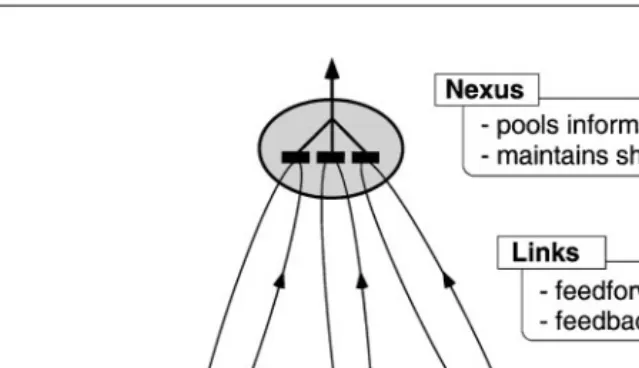
coherence theory (Rensink 2000c). This proposal (Figure 2) has three parts:
1. Prior to focused attention is a stage of early processing, i.e., processing that is low-level, rapid, and carried out in parallel across the visual field. The resul-tant structures (proto-objects) can be quite sophisticated, describing several aspects of scene structure. However, they have limited spatial coherence. They also have limited temporal coherence: They are volatile, and so are simply replaced by any new stimuli at their location.
2. Focused attention acts as a hand that “grasps” several proto-objects from this constantly regenerating flux. While held, they are part of a coherence field representing an individuated object. This field is formed via feedback be-tween low-level proto-objects and a mid-level nexus. The coherence formed
9Care must be taken in distinguishing between an object defined as a structure in the external
Figure 2 Coherence theory (Rensink 2000c). In the absence of focused attention, low-level structures (proto-objects) are volatile, and thus are simply replaced by the representations of new stimuli at their location. Attention acts by establishing feedback links between a selected set of proto-objects that provides visual properties and a mid-level nexus that stabilizes them; the interacting set of proto-objects, links, and nexus is a coherence field. This interaction allows attended proto-object properties to be held in coherent form, both in time and in space. When the feedback loop is broken, coherence dissolves, with the previously attended proto-objects reverting to a volatile state.
this way allows the object to maintain continuity across brief interruptions; as such, it is perceived as being transformed when new stimuli arrive at its location.
3. To release attention, the feedback loop is broken. The field then loses its coherence, with the object representation dissolving back into its constituent set of volatile proto-objects.
Note that in contrast to previous models of attended complexes (e.g., the object files of Kahneman et al. 1992), coherence theory posits that these structures (the coherence fields) collapse as soon as attention is withdrawn. Furthermore, these complexes are not independent, but are parts of a more integrated structure that loosely corresponds to a concrete instance (or token) of an articulated object.
IMPLICATIONS FOR VISUAL PERCEPTION
the adoption of this thesis has a number of important implications for various aspects of visual perception. For example, if only a small number of objects have a coherent representation at any one time, why do we experience all the objects in our surroundings as existing simultaneously? If we can implicitly perceive change in the absence of attention, how might this be carried out, and how might it contribute to our visual experience? In general, then, work on change detection is forcing a reconsideration of what it means to see and what might be the mechanisms involved.
Visual Buffer
Among the first casualties of the thesis that attention is needed to see change was the hypothesis of a visual buffer, a spatiotopic memory store believed to accumu-late the contents of successive fixations (e.g., Feldman 1985). This was thought to provide a detailed representation of the incoming light that was independent of eye movements; among other things, it was taken as the basis for the richly detailed experience we have of our surroundings. However, the widespread exis-tence of change blindness suggests that no such buffer exists (see Comparison vs. Construction, above), a conclusion consistent with complementary work on the visual integration of information (e.g., Irwin 1996, Henderson 1997). More gen-erally, it appears that the detailed contents of successive presentations—including successive fixations—can never be added, compared, or otherwise combined in their entirety, thereby ruling out any large-scale accumulation of information.
It should be pointed out, however, that there still exists a detailed retinotopic representation of the incoming light at any moment in time. Indeed, it is exactly this that constitutes the output of early vision (see e.g., Rensink 2000c). However, according to coherence theory, this representation does not endure: Unattended proto-objects are quickly replaced whenever the eye (or the visual stimulus) moves and rapidly decay when the eye closes (or the stimulus disappears).
The memory trace of the decaying proto-objects may correspond to the informa-tional persistence (or iconic memory) found using partial-report techniques (e.g., Sperling 1960). Although such memory persists for only about 300 ms, it may nevertheless enable a change in a proto-object to be represented without attention. According to coherence theory, such an unattended change will not be consciously perceived, but it could have other effects. For example, it could be salient, drawing attention to its location sooner than otherwise would have been the case (Rensink et al. 2000a, Smilek et al. 2000). As such, informational persistence may play a larger role in visual perception than previously believed (see Haber 1983). One interesting possibility is that it enables the dynamic transformation that is experi-enced in dynamic change.
Coherent Structure
This limit is similar to that obtained from work on saccade-contingent change, and indicates that transsaccadic memory may be largely—if not entirely—identical to vSTM (Irwin 1991). If vSTM and visual attention are also much the same, there may then exist only one system concerned with the formation and maintenance of coherent visual structure. According to coherence theory (Rensink 2000c), this system would be primarily concerned with the perception of objects.
A key issue in determining the viability of this view is the fate of an attentional complex once attention has been withdrawn. Results suggest that the binding of features into coherent complexes does fall apart in the absence of attention (see Construction vs. Maintenance, above), supporting the idea that vSTM and visual attention are largely the same, and thus supporting the proposal of a single system for the formation and maintenance of coherent structure.
Scene Representation
The results of various studies of change detection (and related phenomena such as visual integration) appear to converge on two main points concerning visual representation: (a) If it is detailed, it cannot be coherent to any great extent, and (b) if it is coherent, it cannot be highly detailed. Thus, no visual representations are both coherent and detailed.
To reconcile this with the coherent, detailed scene we believe we experience, consider what needs to be represented for a task. There is usually little need for a detailed representation of all the objects present; instead, all that is really needed is a representation of only those objects—and those particular properties—involved in the task at hand. If attention can form a coherent representation of any aspect of any object whenever requested, the result will be a virtual representation of the scene that will appear to higher levels as if real, i.e., as if all objects simultaneously have detailed, coherent representations (Rensink 2000c).10In this view, the notion of a static, all-purpose representation is replaced by that of a dynamic representation highly sensitive to the demands of the task and the expectations of the observer.
It is not yet known whether such a system is actually implemented in the human perceptual system. However, one possibility that is consistent with what is known of human vision is the triadic architecture (Rensink 2000c) shown in Figure 3. This is composed of three largely independent systems:
1. Early processing. A low-level system that continually generates highly de-tailed, volatile structures. (This could be, for example, the proto-objects posited by coherence theory.)
10Note that this applies only to the visual experience of coherent structure—the structure
Figure 3 Triadic architecture (Rensink 2000c). Here, visual processing is split into three largely independent systems: (a) an early system concerned with the rapid for-mation of sophisticated—but volatile—proto-objects; (b) an attentional system con-cerned with the formation of coherent objects; and (c) a nonattentional setting system that guides attention. According to coherence theory, attention is needed for the visual experience of change, and thus unattended structures do not support such experience. The contribution of unattended structures to the visual experience of static stimuli is indeterminate.
2. Object system. A limited-capacity attentional system that stabilizes these and forms them into a coherent object representation. (This could be, for example, the coherence field posited by coherence theory.)
3. Setting system. A limited-capacity nonattentional system that helps guide attention. This may be based on the meaning (or gist) of the scene and the arrangement (or layout) of items in it. These attributes are based on properties obtained via early vision, largely without the involvement of attention.
Here, the constantly regenerating set of proto-objects provides a rapid estimate of the visible properties of the scene. These then form the basis of a rapid determina-tion of scene gist. This—together with possibly longer-lasting layout informadetermina-tion— then allows the observer to verify whether the initial impression was correct and to gather additional detail and construct coherent representations whenever required. Note that such a process of sparse construction and verification is believed to un-derlie much of the conscious perception of scenes (Henderson 1992, Henderson & Hollingworth 1999b).
Dependence on Task
such that the limited amount of information stabilized is used as effectively as possible. An important part of this is to allocate attention in a way suitable for the task at hand.
Evidence of this kind of management appeared in a study that examined search for change in an array of figures (Rensink 1999b). When observers searched for an orientation change, speed was strongly influenced by the shape of the items. However, when the same figures were used in a search for a contrast polarity change, no such influence was found. Apparently, some geometric information did not enter into the representations formed when only nongeometric (i.e., color) information needed to be compared.
Similar effects appeared in a study comparing incidental and intentional de-tection of changes made during movie cuts (Levin & Simons 1997). Intentional detection was found to be much more accurate than incidental detection, indicat-ing that the only properties put into coherent form (or at least compared) were the minimal ones sufficient for the immediate needs of the observer.
High-Level Knowledge
Another important aspect of attentional management involves the high-level knowl-edge of the observer. Such knowlknowl-edge often takes the form of a “chunk,” a structure in long-term memory containing a cluster of properties that can be attended and held in vSTM in much the same way as a simple element (e.g., Miller 1956). The contents of a chunk can affect what is attended, and thus what is perceived. Evidence of this was found by Archambault et al. (1999), who had observers learn a set of objects either at a general level of categorization (e.g., “a mug”), or at a specific level (e.g., “the mug owned by Bill”). Detection of change was better for objects learned at a specific level, suggesting that more detailed representations had been formed.
High-level knowledge can also have a more direct influence via the selection of the content of attentional complexes. For example, Simons & Levin (1998) inves-tigated detection of changes to people asking for directions. Observers were more likely to notice the change when the experimenter was considered a member of their social group, suggesting a high-level influence on the amount of information contained in the corresponding complexes.
Another aspect is the control of attention by various objects in a scene. Known objects may be rapidly identified via the setting system, and so preferentially draw (or at least hold) attention. For example, changes to real-world scenes are noticed most quickly for “central interests,” i.e., objects or regions mentioned most often in brief verbal descriptions of the scene (Rensink et al. 1997). Although central interests may be preferentially attended in part because of the salience of their features (Shore & Klein 2000), semantic considerations are also involved (Hollingworth & Henderson 2000, Ro et al. 2001).
changes in scenes of American football games. Comparing the performance of experts and nonexperts, it was found that experts could spot changes in meaning more quickly and could attentionally scan meaningful scenes more efficiently.
Implicit Perception
The thesis that attention is needed to see change is somewhat ambiguous regard-ing the implicit detection of change that may occur in the absence of conscious awareness (see Type of Response, above). If “see” denotes any use of light to affect behavior (see Rensink 2000a), this thesis makes the strong claim that no detec-tion of change can occur without attendetec-tion; if attendetec-tion is sufficient for conscious experience, this would then rule out the possibility of implicit change detection [a result in accord with some views on implicit perception (e.g., Dulany 1997)]. On the other hand, if “see” is restricted to conscious visual experience, then the the-sis says nothing about how the implicit perception of change may be carried out.
Owing to various methodological difficulties, relatively little is known about this type of perception generally (see e.g., Milner & Goodale 1995, Merikle & Reingold 1992). Several studies have examined the response of the visuomotor system to various types of change. Results show that even if the observer does not consciously experience a change, the visuomotor system may still respond to it (e.g., Bridgeman et al. 1975, Goodale et al. 1986, Hayhoe et al. 1998). This has provided much of the support for the proposal that vision is composed of two largely independent streams: an on-line stream concerned with immediate visuomotor action and a slower off-line stream concerned with object recognition (Milner & Goodale 1995). However, the particular mechanisms underlying visuo-motor change detection (including any possible involvement of attention) remain unknown.
Another approach is the forced-choice guessing of unseen changes. For exam-ple, observers may be able to guess the location of a change more often than chance, even if they have no awareness that it occurred (Fernandez-Duque & Thornton 2000). Note that the key issue here is not whether detection is “really” implicit, but whether performance accompanied by conscious awareness differs from perfor-mance unaccompanied by awareness (Merikle & Reingold 1992). Some evidence (Thornton & Fernandez-Duque 2000) suggests that this is the case, but there is some disagreement on this point (Mitroff & Simons 2000). If implicit detection of change does exist, the neural substrate might be the on-line stream believed to support visuomotor action; alternatively, it might be the setting system of the triadic architecture (Rensink 2000c), a nonattentional system not concerned with conscious perception per se.
latent form not available to conscious perception. An interesting possibility is that this may be the information supporting implicit detection, with the reappearance of the target somehow triggering its transfer to a more explicit system.
OPEN ISSUES
As the previous sections have shown, much has been learned about the nature of change detection, both what it is and what mechanisms may be involved. This in turn has cast considerable light on how the visual system operates. However, many issues concerning the nature of change detection remain open. Some of these involve the properties of the particular mechanisms used—e.g., the capacity of attention/vSTM, the types of units used, etc. (see e.g., Rensink 2000b). However, others are more fundamental and require resolution before change detection itself can be said to be well understood. These latter issues include:
1. How does identification of change differ from detection of change? Several studies have shown that identifying a change is more difficult than detect-ing it (see Type of Task, above). This may be in part because identification is simply a less sensitive process, requiring a higher signal-to-noise ratio. However, different mechanisms appear to be involved (Wilken et al. 1999). If so, it is not clear which ability—if either—should be considered as “basic”; for example, detection may occur via simple comparison, whereas identi-fication may occur via mechanisms underlying the perception of dynamic events. More generally, different mechanisms may be used for various as-pects of change perception, including not only detection and identification, but other tasks as well (e.g., localization).
2. How does implicit detection of change differ from explicit detection of
change? Given the possibility that observers may be able to implicitly detect
a change without any awareness of it (see Implicit Perception, above), an important issue is to determine whether this form of perception exists out-side of visuomotor responses. If so, a key concern would be the mechanisms involved—not just in the details of their operation, but also how they relate to each other (i.e., whether there exist several separate systems) and how they relate to the mechanisms underlying the explicit detection of change.
3. Does explicit detection of change involve only a subset of attended
infor-mation? Although attention may be needed to explicitly experience change,
dimensions being attended, with only a subset of these being compared in any given task.
It is important to resolve this issue, for otherwise characteristics of the comparison mechanism could be ascribed to visual attention, or vice versa. For example, the relatively poor detection of incidental change (e.g., Levin & Simons 1997) cannot be used as conclusive evidence that fewer properties are being attended. It could simply be that fewer properties are being compared. However, careful analysis can often provide information about the attentional structures involved, even if the details of the comparison process are unknown (e.g., Rensink 2000a, 2001).
4. How might detection of dynamic change differ from detection of completed
change? At a conceptual level, there is a considerable difference between
these two types of detection, suggesting that separate mechanisms may be involved (see Dynamic vs. Completed Change, above). However, whether this division really exists in the human visual system remains unknown. Interestingly, a phenomenological dissociation appears to exist in the de-tection of gap-contingent change, with dede-tection of dynamic change (see-ing the dynamic transformation) found for interstimulus intervals of about 300 ms or less, and detection of completed change (seeing that something has changed) for longer intervals (e.g., Phillips 1974, Rensink et al. 2000a; see also Bridgeman et al. 1975). To establish this difference firmly would require behavioral correlates (see Merikle & Reingold 1992). A possible candidate in this regard might be the finding of two separate mechanisms for the detection of displacement: one for intervals less than 200 ms, the other for intervals greater than 500 ms (Palmer 1986).
If the two types of detection are separate, the continued application of attention would likely be needed only for the detection of dynamic change; the detection of completed change might simply then be carried out via a referral to remembered information, with attention perhaps needed only for the comparison operation. This latter possibility may explain the finding that a change can sometimes be explicitly detected when the eye returns to a previously fixated item (Henderson & Hollingworth 1999a); if it can be ascertained that attention is not continually applied to such items, this would indicate that the relevant quantity is indeed remembered information. However, note that such information would not be a complete description of the scene; rather, it would still be a relatively sparse representation, such as the schematic map proposed by Hochberg (1968) for the guidance of eye movements, or the setting system proposed by Rensink (2000c) for the guidance of attention.
possibility that detection of dynamic change is simply a form of motion perception. However, 300 ms is also a duration typical of informational persistence, suggesting that detection of dynamic change may be based on this instead. An interesting possibility in this regard is that changes may be picked up at the level of informational persistence, with these changes becoming explicitly detected only when attention is applied to the relevant structures (see Visual Buffer, above).
One way to settle this issue might be to examine how change detection is affected by a sudden displacement of the stimulus: Performance would de-cline for a motion-based mechanism, whereas it might remain unaffected for a mechanism referenced to stimulus structure. Evidence for the indifference of dynamic change detection to displacement has been found (Rensink et al. 2000a), providing preliminary support for the existence of separate systems.
6. How might detection of completed change differ from detection of difference? If a distinct system exists for the detection of completed change, it might not need to have items continually attended. Instead, a currently visible item would simply be compared with a structure in memory. As such, detection of completed change may differ from perception of difference only in the use of an additional process to establish that the structures being compared refer to the same external entity (see Change vs. Difference, above). However, the detection of completed change can occur after interstimulus intervals of only 300 ms, something difficult to reconcile with the long-term memories that can be involved in the perception of difference. Preliminary work (e.g., Shore & Klein 2000) suggests behavioral differences between the two forms of detection. It may be that several systems are at play, each involving a different time scale, and perhaps different ways of making comparisons.
7. What are the limits to which change-detection mechanisms can access visual
representations? Although change blindness can arise from a failure to
main-tain relevant information, it can also arise from a failure to access the relevant representations (see e.g., Simons 2000). For example, the explicit detection of saccade-contingent change is greatly improved when a brief blank fol-lows the landing of the eye (Deubel et al. 1996), showing the existence of preserved information normally inaccessible to the mechanisms underlying the conscious detection of change. Again, such information is unlikely to be a complete and detailed description of the visible scene, being instead a sparser description containing information about particular aspects of it.
CLOSING REMARKS
Resolving the many issues centered around change detection will not be easy. However, as the discussion above has indicated, ways exist to investigate the various problems involved. If history is any guide, these investigations will likely lead to effects again at odds with our intuitions. These will then lead to further revisions in our understanding of what change detection is and how it is carried out. And this in turn will improve our ability to explore other aspects of visual perception. Thus, it appears that the concept of change, a concept that caused so many difficulties for so many years, is well on its way to becoming the basis for important new insights into the way we experience the world around us.
ACKNOWLEDGMENTS
I would like to thank Dan Simons and Ian Thornton for their comments on an earlier draft of this paper.
Visit the Annual Reviews home page at www.AnnualReviews.org
LITERATURE CITED
Adelson EH, Bergen JR. 1991. The plenoptic function and the elements of early vision. In
Computational Models of Visual Processing,
ed. M Landy, JA Movshon, pp. 3–20. Cam-bridge, MA: MIT Press
Aginsky V, Tarr MJ. 2000. How are different properties of a scene encoded in visual mem-ory? Vis. Cogn. 7:147–62
Agostinelli G, Sherman SJ, Fazio RH, Hearst ES. 1986. Detecting and identifying change: additions versus deletions. J. Exp. Psychol.:
Hum. Percept. Perform. 12:445–54
Allport A. 1992. Attention and control: Have we been asking the wrong questions? A crit-ical review of twenty-five years. In
Atten-tion and Performance XIV, ed. DE Meyer, S
Kornblum, pp. 183–218. Cambridge, MA: MIT Press
Archambault A, O’Donnell C, Schyns PG. 1999. Blind to object changes: when learn-ing the same object at different levels of cat-egorization modifies its perception. Psychol.
Sci. 10:249–55
Arijon D. 1976. Grammar of the Film
Lan-guage. Los Angeles: Silman-James
Austen E, Enns JT. 2000. Change detection: paying attention to detail. Psyche 6(11). http://psyche.cs.monash.edu.au/v6/psyche-6-11-austen.html
Avons SE, Phillips WA. 1980. Visualization and memorization as a function of display time and poststimulus processing time. J.
Exp. Psychol.: Hum. Learn. Mem. 6:407–
20
Ballard DH, Hayhoe MM, Pelz JB. 1995.
Memory representations in natural tasks. J.
Cogn. Neurosci. 7:66–80
Batchelor GK. 1967. An Introduction to Fluid
Dynamics. Cambridge: Cambridge Univ.
Press
Biederman I, Gerhardstein PC. 1993. Recog-nizing depth-rotated objects: evidence and conditions for three-dimensional viewpoint invariance. J. Exp. Psychol.: Hum. Percept.
Perform. 19:1162–82