Application of Information System in Educational
Institutions in Dindigul District
K.BOOPATHI
Assistant Professor
Department of Computer Science
GTN Arts College, Dindigul, Tamilnadu, India.
Abstract : The developing mindfulness in India that learning in a completely digitalized, arranged and information based society will be radically not the same as the present realizing, which depends on the necessities generally modern social orders. The across the board dispersion of Information and Communication Technologies (ICT) together with other financial and statistic changes not just offers ascend to new open doors for adapting yet in addition raises the requirement for procuring new abilities and capabilities that are fundamental for work, instruction and preparing, self-improvement and interest in the general public. The target of this paper is (I) to recognize the structure and activity of data framework in Educational Institutions (ii) study the clients contribution and demeanor towards data framework (iii) distinguish the issues experienced while utilizing the data framework and show the clients' discernment on the utilization of IS. (iv) look at the variables affecting the selection of data framework (IS) at the organization divisions of Educational Institutions in Dindigul (v) propose reasonable measures for the powerful working of data framework in Educational Institutions.
IndexTerms - Information and Communication Technologies (ICT).
I.INTRODUCTION
The use of data correspondence advances (ICTs) in the creation and scattering of data are the two significant improvements of the data age that profoundly affects training instructional method and library administrations. There is extensive increment in the distributing yield of insightful assets which are promptly open by means of worldwide electronic systems. This has come about in the new, quicker and progressively compelling methods for data access and conveyance. Data would now be able to be passed legitimately to the client through the internet with no go-between. The second significant advancement is the postindustrial accentuation on data because of the most evaluated crude material for financial improvement. This has driven the business visionaries to connect work execution with aptitudes improvement in the colleges. Data and the capacity to change over it into information has become the absolute most significant factor and capacity expected to advance in the social setting of the 21st century. The world has subsequently moved from the period of industrialization to post-industrialization, therefore moving accentuation from controlling material products to controlling information.
The advancement in Information Technology has made progressive changes in every one of the fields of information. Libraries being the stores of information are no exemption to this improvement. Individuals look for data for their exploration, instruction, reference and direction from the libraries. The media of correspondence is creating and the arrangement of data conveyance and trade is additionally experiencing fast change. Individuals require the most exceptional data from the libraries. Thus, the mechanical improvements must be received in the libraries to satisfy the requirements of the clients. The creation of web, the World Wide Web (WWW) has nearly brought the world extremely closer and shorter. The ongoing advancements or an innovation made in any piece of the world is accessible to the client very quickly. This has expanded the duties of the library to give modern and the most recent data to the clients. Presently the advancements of digital books, e-diaries have changed the library from data stackers or purchasers to the proprietors of electronic assets.
The Information Communication Technology (ICT) and the software engineering have acquired transformative changes data items, data looking for conduct of the clients, and the general data association. The adjustments during the time spent data age are because of the assembly of assortment of innovation, for example Hypertext, Multimedia, Virtual reality, and so forth. ICT has carried new structures and new components to sort out and to make data productively and in a split second accessible to the clients. Data being a vital apparatus, the job and duty of the experts are at the push of progress from its customary to moral unbending nature. Data is our item, our money, our medium. All the more extensively, training includes data's disclosure, age, preparing, association, stockpiling, transmission, and sharing. It is unimaginable for us to think of a scholastic control that doesn't utilize data innovation as an essential medium, and in numerous cases it is the mechanism of decision and need. Employees in different divisions can be heard honestly by portraying the nature of the IT condition as an indispensable component in their development and accomplishment in both educating and research. Other than talks and showings, the customary and still critical devices for data transmission are books, periodicals, and original copies, yet the extent of contemporary library and reference materials accessible in advanced arrangement proceeds with its fast development.
department after department, the computer-based processing of information is what employees do, all day, every day. If that is obviously true in
The Registrar’s Office (class registration, course scheduling, room allocations, grades and transcripts, student advising) and the Business Office (accounts payable and receivable, the general ledger, and payroll).
The case in Admissions (recruiting, advertising, receiving and processing applications), Alumni and Donor Relations (staying in touch, maintaining alumni records, soliciting and processing gifts), Finance, Human Resources, Public Relations, Institutional Research.
The day-to-day coordination of all those activities by the institutions’ senior management. Even in Safety/Security and Physical Facilities information tools are the key to efficiency and success.
Auxiliary Services (dining, catering, bookstore, and other product delivery services) use computers for planning, ordering, purchasing, organizing, record keeping, and the processing of point-of-sale transactions. For every day effective work we need IT.
II. INFORMATIONANDCOMMUNICATIONTECHNOLOGY(ICT)
Technology is the systematic knowledge of a device and its application is essential for industrial process. Further, ICT is the field of engineering by involving computer-based hardware and software systems, communication systems, to enable the acquisition, representation, storage, transmission, and use of information. The second edition of the Cambridge Encyclopedia (1990) says that information technology is “a term commonly used to cover the range of technologies relevant to the transfer of information in particular to computers, digital electronics, and telecommunications.” Closely related to the definition is offered by McGraw-Hill Dictionary of scientific and technical terms which says “information technology is the collection of technologies that deal specifically with processing, storing and communication of information, including all types of computer and communication systems as well as reprographic methodologies.”
In order to assess the potential role of information and communication technologies for development, a proper understanding is required of what ICTs actually are “ICT’s are basically information-handling tools—a varied set of goods, applications and services that are used to produce, store, process, distribute and exchange information. They include the ‘old’ ICT of radio, television and telephone, and the ‘new’ ICT of computers, satellite, wireless technology, and the Internet. With appropriate content and applications, these tools are now able to work together, and combine to form a ‘networked world’ - a massive infrastructure of Interconnected telephone services, standardized computing hardware, the Internet, radio and television -which reaches into every corner of the globe.”
THE IMPORTANCE OF ICT’S
ICTs presents a revolutionary approach for addressing developmental questions and it is due to their unequalled capacity to provide access to information instantaneously from any location in the world at a relatively low cost. This has brought down the global geographic boundaries very faster. The resulting new interconnected digital world heralds the fluid and seamless flow of information, capital, ideas, people and products. The advances are made in convergence technologies, whereby the mode of information available is no longer restricted to text. But it includes real-time audio and video data streaming which has many implications for applying in all the fields of human knowledge as well as in social, economic and political life. In fact, many governments, the private sector and civil society members have begun to recognize the immense potential offered by ICTs in overcoming structural and historical weaknesses. They argue that ICTs offer the developing world the opportunity to ‘leapfrog’ the several stages of development by the use of ‘frontier’ technologies that are more practical, environmentally sound and less expensive than undergoing the traditional stages and cycles of progress to the information society.
COMPONENTS OF ICT
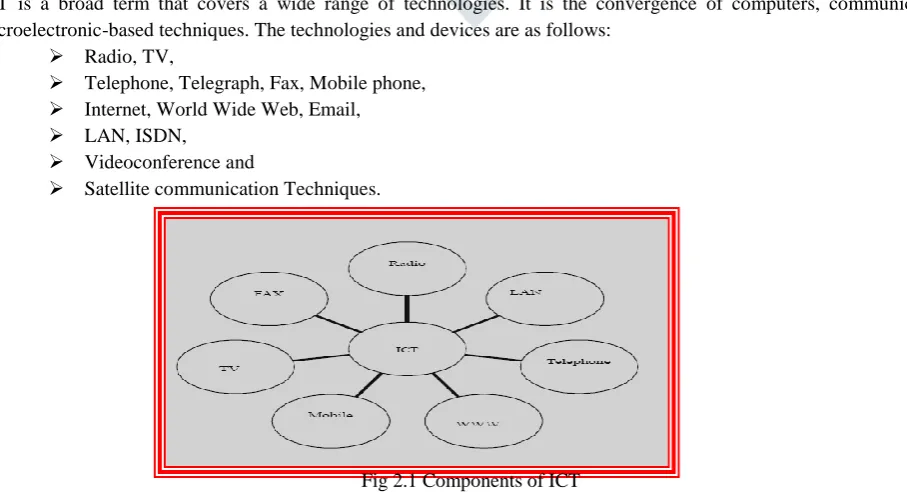
ICT is a broad term that covers a wide range of technologies. It is the convergence of computers, communication and microelectronic-based techniques. The technologies and devices are as follows:
Radio, TV,
Telephone, Telegraph, Fax, Mobile phone,
Internet, World Wide Web, Email,
LAN, ISDN,
Videoconference and
Satellite communication Techniques.
ICT is broadly divided into two components namely: ICT production and ICT consumption. And ICT production is the creation of hardware and software components of ICT, provision of ICT infrastructure, ICT consultants and trainers, web designers, internet service providers (ISPs) and data service providers (DSPs), while ICT consumption is the use of ICT amenities in applications like e-learning, e-medical, e-commerce, e-government and etc,. From the foregoing, it is seen that the various definition of ICT is actually referring to ICT production which also have their foundation in engineering technology especially in electronic and communication engineering, and since most of the ICT devices are software driven, it also indicates that computer science also plays a vital role in ICT production.
III.RELATED WORKS
Chinwe M.T. Nwezeh (2010) analyzed the impact of internet resources and the evaluation of their usefulness on teaching, learning and research in Nigerian universities with particular emphasis on Obafemi Awolowo University (OAU), Ile-Ife, Osun State, Nigeria. The paper is based on a descriptive survey by using questionnaires for data collection. The respondents constitute students (750) and academic staff (115) from OAU. Descriptive statistics (frequency counts and percentages) were used to analyze the data. The results from the paper reveal that a majority of the surveyed academic staff and the students found the internet to be very useful. Internet resources mostly used by both the groups were e-mail and the World Wide Web (WWW). Search interfaces were used for looking for research information. It was discovered that the users were not given adequate user education to enable them make use of the available internet resources. That the internet is widely used is not a surprise, but the paper points to the fact that more conscious efforts must be made in the introduction of user education and information literacy programmes, as well as in staff training on information and communication technology resources in the library.
IV.IMPLEMENTATION
The reason for examine is to find the responses to inquiries through the use of explicit methodology. Research configuration is the fundamental structure, which gives rules to the exploration procedure. It is a guide or outline as per which the exploration is to be led. "An exploration configuration is the game plan of conditions for assortment and examination of information in a way that expects to join significance to the exploration reason with economy in method". Research configuration is required on the grounds that it encourages the going great of different research tasks.
SAMPLING PLAN
In Dindigul District 19 Arts and Science College and 2 Universities were chosen for inspecting. The specialist has disseminated surveys among the chose instructive establishments on irregular testing and according to the necessity of the goals of the present investigation. The topped off survey has been gathered from the respondents for the information examination and understanding. Complete number of 2700 surveys were given, out of these 2601 ( 96.33%) poll were gathered and deficient 9 survey were dismissed. For specialist helpful 216 respondents were chosen for examination reason. (1: 12 Ratio reason for the strategy for Lottery Method). It is obvious that 63.9 % of the respondents are Male (138) and 36.1 % of the respondents are Female (78).
STATISTICAL TOOL
After the completion of the data collection, the filled in questionnaires were edited properly to make them for coding. After coding, the data were fed into computer and database was created. From the database, the required tables were prepared for further analysis by using SPSS Ver 15.0.The analysis part employed suitable statistical techniques to the data collected and tabulated. Keeping in mind, the nature of the present study, the following statistical tools are used:
1. Simple percentage score 2. ANOVA test
3. Chi-square test
4. Co-efficient of Correlation 5. Graphs.
Explanations to some of the statistical techniques applied to the data of the present study are presented here. The t-test assesses whether the means of two groups are statistically different from each other.
PERIOD OF THE STUDY
The period of coverage of the present study spans between 2010 and 2011. Data collection was started during the month of March 2010 and completed in the month of September 2011.
FINDINGS
Gender wise Classification of Period of Usage
Out of 216 respondents, 63 male respondents are using the Information Systemsfor 2 to 4 years. 60 respondents are using the Information Systemsfor 4 to 6 years. Among these 24 respondents are male and the remaining 36 respondents are female.
Gender wise Classification of Frequency of Usage
respondents are using once in two weeks and the remaining 12(5.6%) of the female respondents are using once in a week.
Gender wise Classification of Time to Access
It is construed from the table 4.9 that, out of 216 respondents, 80 (37.04%) of the respondents are getting to around evening time just, among these 21.76 percent of the respondents are male and 15.28 percent of the respondents are female. 66 (30.56%) of the respondents are getting to just at night. Among these 18.06 percent of the respondents are female and 12.50 percent of the respondents are male. 49 (22.69 %) of the respondents are getting to at late night. Among these 22.22 percent of the respondents are male and 0.46 percent of the respondents are female. 14(6.48%) of the respondents are getting to toward the evening. Out of these 5.09 percent of the respondents are male and the staying 1.39 percent of the respondents are female. 7(3.24%) of the respondents are getting to in the first part of the day. Out of these 2.31 percent of the respondents are male and the staying 0.93 percent of the respondents are female.It is presumed that greatest number of the respondents are working around evening time and at night.
Gender wise Classification of Time Spending
96 (44%) of the respondents are spending the time for Information Systemsonly one hour per day. Out of these 96 respondents, 78 respondents are female and 18 respondents are male. 72 (33.3 %) of the male respondents are spending the time for Information Systemstwo hours per day.36(16.7%) of the male respondents are spending the time for Information Systemsthree hours per day.12(5.6%) of the male respondents are spending the time for Information Systemsabove three hours per day.
Gender wise Classification of Purpose of Usage
81 (37.5%) of the respondents are using the Information Systems for studying purpose. 66 (30.6%) of the respondents are using Information Systems for improving the teaching ability, 27 (12.5%) of the respondents are using the Information Systems for exchanging of various ideas to gather new information. 24(11.1%) of the respondents are using the Information Systems for the completion of their research work. 12 (5.6%) of the respondents are using the Information Systems for publishing journals, articles and books. 6 (2.8%) of the respondents are using the Information Systems for other purpose.
Correlation Result
Age wise Analysis of Accessing E-resources at Libraries
From the Table 4.12, the correlation analysis reveals that the co-efficient of correlation is Insignificant and therefore there is a significant relationship between accessing Information Systems in the libraries and no accessing Information Systems in the libraries.
Age wise Analysis of Accessing E-resources at Open Access Centre
Table 4.13, the correlation analysis reveals that the co-efficient of correlation is Insignificant and therefore there is a significant relationship between accessing Information Systems in the centre and not accessing Information Systems in the centre.
Age wise Analysis of Accessing E-resources at Home
The Table 4.14, the correlation analysis reveals that the co-efficient of correlation is Insignificant and therefore there is a significant relationship between accessing Information Systems at home and not accessing Information Systems at home.
Age wise Analysis of Accessing E-resources at Working Place
From the Table 4.15, the correlation analysis reveals that the co-efficient of correlation is Insignificant and therefore there is a significant relationship between accessing Information Systems in the working places and not accessing Information Systems in the working places.
Age wise Analysis of Accessing E-resources at Other Places
Table 4.16, the correlation analysis reveals that the co-efficient of correlation is Insignificant and therefore there is a significant relationship between accessing Information Systems in the other places and not accessing Information Systems in other places.
ANOVA Test
Spending Time for Website Usage
It is evident that the average satisfaction of each group is found to be statistically not significant as the calculated value 15.080 is greater than the table value 3.8451. Thus the hypothesis framed is rejected.
Spending Time for E-journals Usage
the average satisfaction of each group is found to be statistically not significant as the calculated value 1.219 is less than the table value 3.8451. Thus the hypothesis framed is accepted.
Spending Time for E-books Usage
Spending Time for Entertainment Purpose
the average satisfaction of each group is found to be statistically not significant as the calculated value 1.594 is less than the table value 3.8451. Thus the hypothesis framed is accepted.
Spending Time for CD-Rom database
the average satisfaction of each group is found to be statistically not significant as the calculated value 2.104 is less than table value 3.8451. Thus the hypothesis framed is accepted.
Spending Time for OPAC
the average satisfaction of each group is found to be statistically not significant as the calculated value 0.156 is less than the table value 3.8451. Thus the hypothesis framed is accepted.
Spending Time for Other Purpose
it divulges that the average satisfaction of each group is found to be statistically not significant as the calculated value 0.007 is less than the table value 3.8451. Thus the hypothesis framed is accepted.
Ranking for Website
Gender wise rank for the users of the Website. Out of 216 respondents, 141 respondents have been given first rank for using the website. Among these 141 respondents 95 respondents are male and 46 respondents are female. Ranking for E-journals
Gender wise rank for the users of e-Journals. Out of 216 respondents, 79 respondents have been given third rank for using the e-journal. Among these 79 respondents, 46 respondents are male and 33 respondents are female.
Ranking for E-books
Gender wise rank for the users of e-Books. Out of 216 respondents, No respondents have been given First rank and Sixth rank for using e-books,
Ranking for Entertainment
Gender wise rank for the users of Entertainment purpose. Out of 216 respondents, 36 respondents have been given First rank for using e-journals. Among theses 36 respondents, 11 respondents are male and 25 respondents are female.
Ranking for CD-Rom
, Gender wise rank for the users of CD-ROM, out of 216 respondents, No respondents have been given First rank for using CD-ROM.
Ranking for OPAC
Gender wise rank for the users of OPAC. Out of 216 respondents, No respondents have been given First and Third rank for using OPAC.
QUALIFICATION WISE ANALYSIS OF LEVEL OF SATISFACTION CHI-SQUARE TEST
Generally Easy to Access
the calculated chi-square value is greater than the table value (5% level) and the result is not significant. Hence the hypothesis “qualification and the level of satisfaction in utilizing Information Systems gets very easy are associated”, from this analysis it is identified that there is a close relationship between qualification and the level of satisfaction in utilizing the Information Systems.
Faster Completion of Task
the calculated chi-square value is greater than the table value (5% level) and the result is not significant. Hence the hypothesis “qualification and the level of satisfaction in utilizing the Information Systems gets faster completion of task are associated” does not hold well. From this analysis, it is identified that there is a close relationship between qualification and the level of satisfaction in utilizing the Information Systems.
Provides Adequate Information
the calculated chi-square value is lesser than the table value (5% level) and the result is significant a. Hence the hypothesis “qualification and the level of satisfaction in utilizing the Information Systems provides adequate information are not associated” holds good. From this analysis, it is identified that there is a close relationship between qualification and the level of satisfaction in utilizing the Information Systems.
Finding Relevant Document
the calculated chi-square value is greater than the table value (5% level) and the result is Insignificant. Hence the hypothesis “qualification and the level of satisfaction in utilizing the Information Systems for finding relevant documents are not associated” does not hold good. From this analysis, it is identified that there is a close relationship between qualification and the level of satisfaction in utilizing the Information Systems.
Need Adequate Training for Use
More Variation for Year to Year
that the calculated chi-square value is lesser than the table value (5% level) and the result is Significant. Hence the hypothesis “qualification and the level of satisfaction in utilizing the Information Systems more variation for year to year are associated” does hold good. From this analysis, it is identified that there is a close relationship between qualification and the level of satisfaction in utilizing the Information Systems.
Easy to Resolve Technical Problem
the calculated chi-square value is greater than the table value (5% level) and the result is Insignificant. Hence the hypothesis “qualification and the level of satisfaction in utilizing the Information Systems easy to resolve technical problems are not associated” does not hold good. From this analysis, it is identified that there is a close relationship between qualification and the level of satisfaction in utilizing the Information Systems.
Very Difficult due to the Lack of Computer Knowledge
The calculated chi-square value is greater than the table value (5% level) and the result is Insignificant.. Hence the hypothesis “qualification and the level of satisfaction in utilizing the Information Systems towards the difficulty to operate without computer knowledge are not associated” does not hold good. From this analysis, it is identified that there is a close relationship between qualification and the level of satisfaction in utilizing the Information Systems.
Very Helpful to Exchange of Journals and Articles
The calculated chi-square value is greater than the table value (5% level) and the result is Insignificant. Hence the hypothesis “qualification and the level of satisfaction in utilizing Information Systems very helpful to exchange of journals and articles are not associated” does not hold well. From this analysis, it is identified that there is a close relationship between qualification and the level of satisfaction in utilizing the Information Systems.
Displays more Scientific Information
The calculated chi-square value is greater than the table value (5% level) and the result is Insignificant. Hence the hypothesis “qualification and the level of satisfaction in utilizing the Information Systems displays more scientific information are not associated” does not hold good. From this analysis, it is identified that there is a close relationship between qualification and the level of satisfaction in utilizing in Information Systems.
Ability to Access at Any Place
The calculated chi-square value is greater than the table value (5% level) and the result is Insignificant. Hence the hypothesis “qualification and the level of satisfaction in utilizing the Information Systems and the ability to access at any place are not associated” does not hold good. From this analysis, it is identified that there is a close relationship between qualification and the level of satisfaction in utilizing the Information Systems.
Using this Facility Gets Very Tired
The calculated chi-square value is lesser than the table value (5% level) and the result is Significant. Hence the hypothesis “qualification and the level of satisfaction in utilizing Information Systems gets very tired are associated” does hold well. From this analysis, it is identified that there is a close relationship between qualification and the level of satisfaction in utilizing the Information Systems.
Helpful to My Experimental and Assignment
The calculated chi-square value is greater than the table value (5% level) and the result is Insignificant. Hence the hypothesis “qualification and the level of satisfaction in utilizing the Information Systems very helpful to experimental and assignments are not associated” does not hold well. From this analysis, it is identified that there is a close relationship between qualification and the level of satisfaction in utilizing the Information Systems.
Helpful to Data Organisation and Archive Papers
The calculated chi-square value is lesser than the table value (5% level) and the result is Significant. Hence the hypothesis “qualification and the level of satisfaction in utilizing the Information Systems which is very helpful to data organization and archive papers are associated” does hold well. From this analysis, it is identified that there is a close relationship between qualification and the level of satisfaction in utilizing the Information Systems.
Easy to Find Earlier Date Journals
The calculated chi-square value is lesser than the table value (5% level) and the result is Significant. Hence the hypothesis “qualification and the level of satisfaction in utilizing the Information Systems very helpful to find earlier date journals are associated” does hold well. From this analysis, it is identified that there is a close relationship between qualification and the level of satisfaction in utilizing the Information Systems.
Inspired to Joint Research and Team work
The calculated chi-square value is greater than the table value (5% level) and the result is Insignificant. Hence the hypothesis “qualification and the level of satisfaction in utilizing the Information Systems inspire to joint research and team works are not associated” does not hold good. From this analysis, it is identified that there is a close relationship between qualification and the level of satisfaction in utilizing the Information Systems.
Helpful to Further Publication
GENDER AND LEVEL OF OPINION FOR IMPLEMENTATION OF INFORMATION SYSTEMS
Implementation Helps to Save Space
Implementation Helps to Save Time
Implementation to Save Money
Implementation Helps to Access Any Time
Implementation Helps Easy to Use
Implementation Helps to Provide Modern Information
Implementation Helps to Maintain Quality Library
Implementation Helps to Expert Lecture
Implementation Helps to Interact with the Experts
Implementation Helps to Wider Reach
Implementation Helps to Data Preservation
Implementation Helps to Stimulating Research V. SUGGESTIONS AND RECOMMENDATIONS
Government ought to give satisfactory framework offices and persuade the client network for research.More sorted out preparing programs are expected to acquaint the e-resources.Few distributers permit free e-diaries. For example, Directory open access diary is a free site which covers full content, quality controlled logical and academic diaries in all subjects and languages.The speed of web should be expanded fast access to the accessible resources.Qualified web information ought to be required for the users.Librarians should show more drive steps in partaking on-line consortium for satisfaction of data need of the clients and improving the online assortment of the library.The Libraries at advanced education get presentation in Information Systems. The University Grant Commission data library organize is in the bleeding edge of robotization of scholastic libraries in Indian Universities and schools. Programming of University Libraries has been brought and effectively running in numerous schools of different states in India. Consequently, library entrance with suitable instruments is basic.
VI. CONCLUSION
All in all, it very well may be said that in perspective on validity, the web and Information Systems have exponentially changed the manner in which the individuals convey, cooperate, gain, share information, search, research and partake in creation and re-utilization of substance and incited to get the progressive changes practically every one of the circles of exercises of present day instruction and learning framework and advanced extensively a community oriented structure over the ground and mainstays of a scope of new mechanical apparatuses and procedures. On the utilization of web and Information Systems detailed that every one of the clients use web as a wellspring of data and the basic issues they generally experience are whimsical power supply, low web transmission capacities and lacking full-content diaries need sufficient strides for broad utilization of Information Systems. The name of data and correspondence innovation (ICT) joined to new abilities and administrations offered by second era internet (www).
REFERENCES
[1]Amandeep Kaur / Indian Journal of Computer Science and Engineering (IJCSE) ISSN : 0976-5166 Vol. 2 No. 3 Jun-Jul 2011 475
[2] Bruce, B. C. (1997). Searching for digital libraries in education: Why computers cannot tell the story. Library Trends, 45(4), 746-770.
[3] Cawkell ( Tony) . Electronic books. ASLIB proceedings. 51 (2), 54058. February 1999.
[4] Chao Peng, Hong Shen, ''New Algorithms For Fault-Tolerant QoS Routing",submitted to the International Conference on Dependable Systems and Networks(DSN-2006).
[5] Franks, J. (1993). What is an electronic journal? In Gopher wiretap. spies.com /Library/Articles/Publishing:
[6] Janus, R. J. 1997. From paper and ink to CD-ROM: Digitizing the World Book image. Library Trends, 45(4), 602-622. [7] Kist, J. (1989). Electronic Publishing. In M. Eraut (Ed.), International Encyclopedia of Educational Technology (pp.
600-608). New York: Pergamon
[8] McGraw-Hill. (2002). Information Technology. In McGraw-Hill Encyclopedia of Science and Technology, (Vol.9 pp.169) New York, McGraw-Hill Book Company.
[9] Muzammil Tahira, Information Needs and Seeking Behavior of Science & Technology Teachers of the University of the Punjab, Unpublished Master’s thesis, University of the Punjab, Lahore.
[10] Obenaur, G. The Internet: an Electronic treasure. ASLIB Proceedings, Vol.46(4), 1994
[11] Ramashinsh M. and singh Prachi. E-learning tools and technology. DRTC Conference on ICT for digital learning environment. 11-15 January 2006, DRTC, Bangalore.
[12] S. Chen and K. Nahrstedt, “An Overview of Quality of Service Routing for Next-Generation High-Speed Networks: Problems and Solutions,”.
[13] Sorj, Bernarodo, Braxil@digitaldivide-Confronting Inequality in Information Society, UNESCO, 2003
[14] Xun Su, Gustavo de Veciana “Predictive routing to enhance QoS for stream-based flows sharing excess bandwidth” [15] URL: http: //www. accesseric.org: 81