Protocols in MANETs: A Comparative Analysis
DSR and AODV
1
Sumanpreet Kaur,
2Rahul Malhotra
1COE & M, Neighbourhood Campus, Punjabi University, Rampura Phul, Punjab, India 2Dept. of ECE, Bhai Maha Singh College of Engineering and Technology, Muktsar, Punjab, India
Abstract
Mobile Adhoc networks are complex distributed systems comprising of wireless mobile nodes which are self organizing and can move freely into different network topologies. A mobile adhoc network is a collection of nodes that is connected through a wireless medium forming rapidly changing topologies. In past years, different type of routing protocols for Mobile Ad hoc Networks have been developed for devices with higher computing features. This paper compares the performance of the adhoc on-demand distance vector routing protocol with dynamic source routing protocol for Mobile Ad hoc Networks. This paper focuses on adhoc ondemand distance vector routing protocol and dynamic source routing protocols for packets received and packets lost with variation in number of nodes.
Keywords
AODV, DSR, Packet Received, Packets Lost, Routing Protocols, MANETs
I. Introduction
The changing era of technology in this century has changed the way of living, thinking and executing our ideas during the different phases of our life cycle. The engineering sector has contributed to this modern way of living, with quality infrastructure like buildings, transportation, communication facilities and many more. But at the same time this development poses a challenge in the likes of implementation, market size, pros and cons of technological innovations on the human life. Telecommunication industry is the one which is changing the human lifestyle in many ways and helped the whole world look like a global village where we can easily interact with each other through different mediums of communication. In this thesis work, the role of wireless infrastructure in making the world a global village is being explored. The challenges of implementation, security, routing techniques etc have been discussed.
II. Wireless Communication Technology
Wireless communication technology is emerging as the most
effective tool in the field of communication and networking
technologies. This is due to the increasing demand for different types of communication mediums viz. mobile telephony, wireless internetworking, intranet and many types of satellite televisions and radar communication techniques. But at the same time, when we are in the era of technological change, it needs, an individual to be careful in using the tremendously changing technology and needs to have a closer look on the ever changing demands of the technology. Hence, for the purpose a standard for various wireless communication technologies needs to be developed to overcome the problems of incompatibility of older versions with the newer ones. To overcome this issue a standard family of next generation wireless devices is introduced by International Telecommunication Union (ITU). The proposed new standards use higher frequencies to increase capacity of the networks as well as address the issues of incompatibilities as many generations
of networks were developed and deployed over the last decade. Wireless networking techniques provide a cableless network infrastructure to connect various wide area networks, metropolitan area networks and local area networks.
III. Ad-Hoc Networks
A mobile ad-hoc network is a collection of mobile nodes forming an ad-hoc network without the assistance of any centralized structures. These networks introduced a new art of network establishment and can be well suited for an environment where either the infrastructure is lost or where deploy an infrastructure is not very cost effective.
There are quite a number of uses for mobile ad-hoc networks. For example, the military can track an enemy tank as it moves through the geographic area covered by the network. Your local community can use an ad-hoc network to detect your car moving though an intersection, checking the speed and direction of the car.
In an environmental network, you can find out the temperature,
atmospheric pressure, amount of sunlight, and the relative humidity at a number of locations.
A. Ad-Hoc Routing Protocols
In wireless adhoc networks, the way by which the packets are routed to and between different computing devices and the standard set of rules designed for the purpose is known as An Ad hoc routing protocol.
Routing is one of the core issues in mobile ad-hoc network. An effective routing mechanism will be helpful to extend the successful deployment of mobile ad-hoc networks. Current routing protocols provide routing solutions up to a certain level, but are lacking the ability to handle other related issues. In ad hoc networks, the network nodes have no prior knowledge of network topology to be used, they are required to discover the same. The basic fundamental is that a new node, optionally, announces its presence and listens to broadcast announcements from the neighbor nodes. The node learns about new nearby nodes and ways to connect with them, and may declare that it can also reach these nodes. As time passes, each node comes to know about all other nodes and more than one way to reach them.
B. Ad-hoc On-Demand Distance Vector (AODV) Routing Ad hoc On-Demand Distance Vector (AODV) Routing is a routing protocol for mobile ad hoc networks (MANETs) and other wireless ad-hoc networks. It is jointly developed in Nokia Research Center, University of California, Santa Barbara and University of Cincinnati by C. Perkins, E. Belding-Royer and S. Das. It is a reactive routing protocol, meaning that it establishes a route to a destination only on demand. In contrast, the most common
routing protocols of the Internet are proactive, meaning they find
routing paths independently of the usage of the paths. AODV is, as the name indicates, a distancevector routing protocol.
AODV avoids the counting-toinfinity problem of other
and multicast routing.
In AODV, the network is silent until a connection is needed. At that point the network node that needs a connection broadcasts a request for connection. Other AODV nodes forward this message, and record the node that they heard it from, creating an explosion of temporary routes back to the needy node. When a node receives such a message and already has a route to the desired node, it sends a message backwards through a temporary route to the requesting node. The needy node then begins using the route that has the least number of hops through other nodes. Unused entries in the routing tables are recycled after a time. When a link fails, a routing error is passed back to a transmitting node, and the process repeats.
Much of the complexity of the protocol is to lower the number of messages to conserve the capacity of the network. For example, each request for a route has a sequence number. Nodes use this sequence number so that they do not repeat route requests that they have already passed on. Another such feature is that the route requests have a "time to live" number that limits how many times they can be retransmitted. Another such feature is that if a route request fails, another route request may not be sent until twice as much time has passed as the timeout of the previous route request.
Fig. 1: Routing in AODV
The advantage of AODV is that it creates no extra traffic for
communication along existing links. Also, distance vector routing is simple, and doesn't require much memory or calculation. However AODV requires more time to establish a connection, and the initial communication to establish a route is heavier than some other approaches.
The AODV Routing protocol uses an on-demand approach for
finding routes, that is, a route is established only when it is
required by a source node for transmitting data packets. It employs destination sequence numbers to identify the most recent path. The major difference between AODV and Dynamic Source Routing (DSR) stems out from the fact that DSR uses source routing in which a data packet carries the complete path to be traversed. However, in AODV, the source node and the intermediate nodes
store the next-hop information corresponding to each flow for data
packet transmission. In an on-demand routing protocol, the source
node floods the RouteRequest packet in the network when a route
is not available for the desired destination. It may obtain multiple routes to different destinations from a single RouteRequest. The major difference between AODV and other on-demand routing protocols is that it uses a destination sequence number to determine an up-to-date path to the destination. A node updates its path information only if the DestSeqNum of the current packet received is greater than the last DestSeqNum stored at the node.
A Route Request carries the source identifier, the destination
identifier , the source sequence number, the destination
sequence number, the broadcast identifier, and the time to live field. DestSeqNum indicates the freshness of the route that is
accepted by the source. When an intermediate node receives a RouteRequest, it either forwards it or prepares a RouteReply if it has a valid route to the destination. The validity of a route at the intermediate node is determined by comparing the sequence number at the intermediate node with the destination sequence number in the RouteRequest packet. If a RouteRequest is received multiple times, which is indicated by the BcastID-SrcID pair, the duplicate copies are discarded. All intermediate nodes having valid routes to the destination, or the destination node itself, are allowed to send RouteReply packets to the source. Every intermediate node, while forwarding a RouteRequest, enters the previous node address and its BcastID. A timer is used to delete this entry in case a RouteReply is not received before the timer expires. This helps in storing an active path at the intermediate node as AODV does not employ source routing of data packets. When a node receives a RouteReply packet, information about the previous node from which the packet was received is also stored in order to forward the data packet to this next node as the next hop toward the destination.
C. Advantages and Disadvantages
The main advantage of this protocol is that routes are established
on demand and destination sequence numbers are used to find the
latest route to the destination. The connection setup delay is lower. One of the disadvantages of this protocol is that intermediate nodes can lead to inconsistent Rahul Malhotra et al routes if the source sequence number is very old and the intermediate nodes have a higher but not the latest destination sequence number, thereby having stale entries. Also multiple RouteReply packets in response to a single RouteRequest packet can lead to heavy control overhead. Another disadvantage of AODV is that the periodic beaconing leads to unnecessary bandwidth consumption.
D. Dynamic Source Routing
Dynamic Source Routing (DSR) is a used in wireless mesh networks for the routing of the packets from source to destination. It is an On-Demand routing protocol like Adhoc On-Demand Distance Vector (AODV) routing protocol. In this technique of routing the route is formed on-demand only when it is required by the transmitting computer. The dynamic source routing technique uses source routing method rather than focusing on the traditional approach of routing table for each intermediate node.
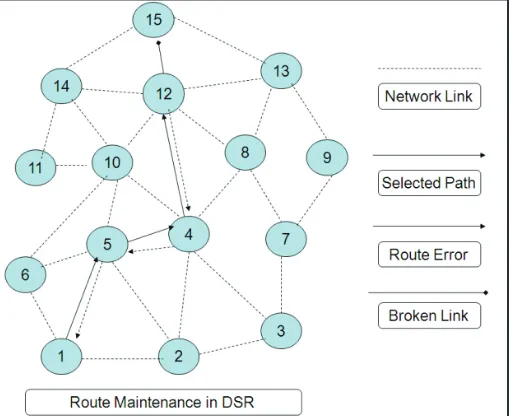
Fig. 3: Route Maintenance in DSR
It is required to accumulate the addresses of all the source and destination nodes for the discovery of route. The information so collected for a particular route discovey, is stored in the cache memory of the nodes used for processing. The routing of the packets is done with the help of learned paths. The packets routed have the addresses of each device through which the packets will reach the destination for achieving the source routing. The major problem arises when we have large addresses for the intermediate or destination devices, as in the case of IPv6. To overcome the problem, dynamic source routing technique uses the concept of
flow id that helps in forwarding the packets on hop-by-hop basis.
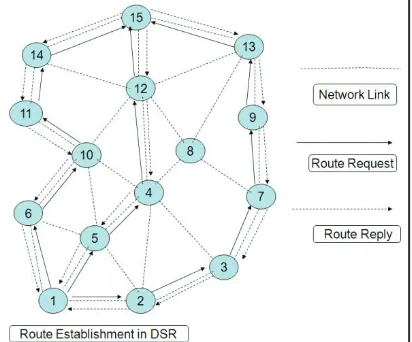
Here, it can be said that the dynamic source routing protocol is based on source routing technique, in which, continuous updation of the routing information is done by mobile nodes. Dynamic Source Routing technique has two major constitutents viz. Route Discovery and Route Maintenance. Route Reply is initiated when the Routed packet/information reaches the assigned destination node. Route reply can be received only if the destination nodes have a route to source node. In case, if destination node contains the route of the source node in its cache, it will be directly routed through that route. If the destination node do not have the route of the source node in its cache, the reverse route will be followed depending on the route record, which is stored in route reply message header, but to reply with the help of route record, the nodes must be symmetric. The route maintenance is activated and route error packets are generated at the nodes in case of fatal transmission error. The hop due to which error is generated, is removed from the route cache of the node and all the routes containing the particular hop in the node cache are abridged at
that point. Route discovery phase is again initiated to find the
most viable route.
Dynamic source routing protocol (DSR) is an on-demand protocol designed to restrict the bandwidth consumed by control packets in ad hoc wireless networks by eliminating the periodic table-update messages required in the tabledriven approach. The major difference between this and the other on-demand routing protocols is that it is beacon-less and hence does not require periodic hello packet (beacon) transmissions, which are used by a node to inform its neighbors of its presence. The basic approach of this protocol (and all other on-demand routing protocols) during the
route construction phase is to establish a route by flooding Route
Request packets in the network. The destination node, on receiving
a Route Request packet, responds by sending a Route Reply packet back to the source, which carries the route traversed by the Route Request packet received.
Consider a source node that does not have a route to the destination. When it has data packets to be sent to that destination, it initiates
a RouteRequest packet. This RouteRequest is flooded throughout
the network. Each node, upon receiving a RouteRequest packet, rebroadcasts the packet to its neighbors if it has not forwarded it already, provided that the node is not the destination node and that the packet’s time to live (TTL) counter has not been exceeded. Each RouteRequest carries a sequence number generated by the source node and the path it has traversed. A node, upon receiving a RouteRequest packet, checks the sequence number on the packet before forwarding it. The packet is forwarded only if it is not a duplicate RouteRequest. The sequence number on the packet is used to prevent loop formations and to avoid multiple transmissions of the same RouteRequest by an intermediate node that receives it through multiple paths. Thus, all nodes except the destination forward a RouteRequest packet during the route construction
phase. A destination node, after receiving the first RouteRequest
packet, replies to the source node through the reverse path the RouteRequest packet had traversed. Nodes can also learn about the neighboring routes traversed by data packets if operated in the promiscuous mode (the mode of operation in which a node can receive the packets that are neither broadcast nor addressed to itself). This route cache is also used during the route construction phase. If an intermediate node receiving a RouteRequest has a route to the destination node in its route cache, then it replies to the source node by sending a RouteReply with the entire route information from the source node to the destination node.
E. Advantages and Disadvantages
This protocol uses a reactive approach which eliminates the need
to periodically flood the network with table update messages
which are required in a table-driven approach. In a reactive (on-demand) approach such as this, a route is established only when it
is required and hence the need to find routes to all other nodes in
the network as required by the table-driven approach is eliminated. The intermediate nodes also utilize the route cache information
efficiently to reduce the control overhead. The disadvantage of
this protocol is that the route maintenance mechanism does not locally repair a broken link. Stale route cache information could also result in inconsistencies during the route reconstruction phase. The connection setup delay is higher than in table-driven protocols. Even though the protocol performs well in static and low-mobility environments, the performance degrades rapidly with increasing mobility. Also, considerable routing overhead is involved due to the sourcerouting mechanism employed in DSR. This routing overhead is directly proportional to the path length.
IV. Simulation
Simulation is a process of designing a model of real system, with this model user can understand the behavior and reactions of real working situations, during particular events. It is the application of computational models, to study and predict physical events or the behavior of engineered systems. Computer simulation is an
indispensable tool for resolving large amount of scientific and
technological problems.
A. Network Simulator (NS2)
provides substantial support for simulation of routing, multicast protocols and IP protocols, such as UDP, TCP, RTP and SRM over wired and wireless local and satellite networks. It has many advantages that make it a useful tool, such as support for multiple
protocols and the capability of graphically detailing network traffic.
NS2 also supports several algorithms in routing and queuing. LAN routing and broadcasts are part of routing algorithms.
Queuing algorithms include fair queuing, deficit round-robin
and FIFO. It was originally designed for wired networks and further extended for wireless networks, including wireless local area networks, mobile ad hoc networks, and sensor networks. The architecture is based on object-oriented programming methodology. The simulator uses C++ and object tool command language.
V. Problem Statement and Results
Ad hoc Demand Distance vector (AODV) is a routing protocol for mobile adhoc networks and other wireless networks developed in Nokia Research Center of University of California. It is On-demand and Distance Vector routing protocol. The routes are established by Ad hoc Demand Distance vector (AODV) only on demand.
Dynamic Source Routing protocol is used for wireless mesh networks, which establishes a route on demand with the initiation of mobile node request. The objective of this thesis is to investigate the performance of two routing protocols viz. Ad-hoc Demand Distance vector (AODV) and Dynamic Source Routing (DSR) in terms of throughput, that is, data transferred over the period of time in kilobits per seconds (kbps) and data received, which is obtained from the ratio of number of data packets sent over the number of data packets received. Open Source Network Simulator NS-2, which is available for free download, is used to compare the different models. Mobility models have been designed for the comparison of protocols.
Ad hoc Demand Distance vector (AODV) and Dynamic Source Routing (DSR) protocols have been taken with the following parameters, by increasing simulation in steps of 5 seconds. 20 Number of nodes have been simulated for 10 seconds, 15 seconds, 20 seconds, 25 seconds and 30 seconds with a pause time of 5 ms having geographical area 1000 x 1000 m within a transmission range of 250 m. Packet size were considered to be 256 bytes and 512 bytes respectively for the above simulation times. An antenna of omnidirectional type was used for the simulations.
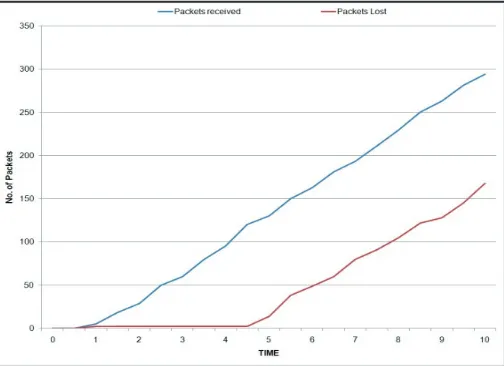
Fig. 3 shows the graph of Adhoc on demand distance vector routing protocol, at the time of initiation, the nodes are not mocile, thus packet received and packet lost does not take place. As soon as the connections are established between the nodes, the number of packets received increases. It has been observed that there is no packet loss at the time of inception, which shows that all packets which are transmitted are received at the receiver end. It is investigated that the packet loss increases in substantial amount as the simulation time increases. The graph shows the packet received ratio with respect to packet packet loss for different simulation time varying from 10 seconds to 30 seconds with a ratio of 5 seconds.
Fig. 3: Model 1 for implementation of AODV for 10 Seconds Simulation Time
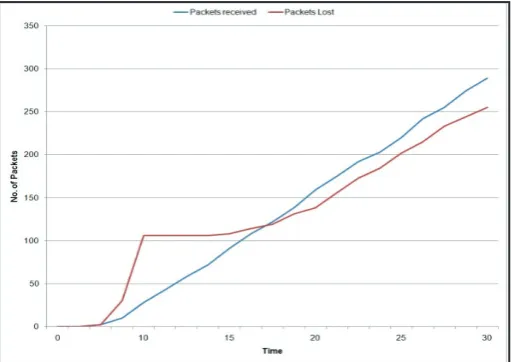
Fig. 4 shows the graph of dynamic source routing protocol, it has been observed that similar to Adhoc on demand distance vector routing protocol, there is no packet loss at the time of initialization. When the connection is established between the nodes, the packet loss increases very much, which gives the indication of dropping the packets at the nodes. With a substantial increase in the simulation time with a ratio of 5 seconds. Number of packets lost decreases and the packet received increases, which shows the generated packets are being received remarkably by the nodes.
Fig. 4: Model 1 for Implementation of DSR for 10 Seconds Simulation Time
Fig. 6: Model 10 for Implementation of DSR for 30 Seconds Simulation Time
The above simulation results shows that the behavior of Adhoc on demand distance vector and dynamic source routing protocols shows the packet received and packet loss for different simulation timings, it is concluded that in Adhoc on demand distance vector, initially there is no packet loss, but in dynamic source routing, the packet loss at initiation is very high.
VI. Conclusion
Adhoc networking is receiving attraction among researchers from last few years, as the different types of wireless and mobile networking systems are now capable being used in almost every industry with the explosion of technology. A number of routing
protocols specifically in the field of ad hoc networking have been
proposed by many researchers, but in this thesis work Ad hoc On-Demand Distance Vector (AODV) Routing has been compared with Dynamic Source Routing protocol (DSR). The simulation results show that the behavior of Adhoc on demand distance vector and dynamic source routing protocols shows the packet received and packet loss for different simulation timings, it is concluded that in Adhoc on demand distance vector, initially there is no packet loss, but in dynamic source routing, the packet loss at initiation is very high.
References
[1] Wells. I, Xianhui et.al,“A selective-abstraction modeling approach for simplifying computer network studies”, ultra Modern Telecommunications workshop 2009, pp. 1-4, 2009.
[2] T.H. Meng,"Minimum energy mobile wireless networks”, IEEE J.Select.Areas Comm., Vol. 17, pp. 1333-1344, 1999.
[3] D.B.Johnson, D.A Maltz,"Dynamic source routing in ad hoc wireless networks”, In Mobile computing, pp. 1369-1379, 2003.
[4] Michael D.colagrasso,“Classification Approach to Broadcasting in a Mobile Ad Hoc Network”, IEEE International Conference (2003), pp. 546-551.
[5] Lihong Wang,“Simulation modelling Contention-collision cancellation access mode in a multi-star LAN”, Control and Decision Conference, 2006.
[6] Subbalakshmi, Koduvayur,"Congestion and packet loss”, Technical Symposia 2006.
[7] Hongzhi, Qin Wang,"Simulation and Evaluation for SS Network on Chip architecture using OPNET”, ICSICT 06 8th International conference 23-26 oct 2006.
[8] Haesun Byun, Meejeong Lee,"Network Architecture and Protocols for BGP/MPLS Based Mobile VPN”, Vol. 5200, 2008.
[9] Hammoodi, I.S.; Stewart, B.G.; Kocian, A.; McMeekin, S.G.,“A Comprehensive Performance Study of OPNET Modeler for ZigBee Wireless Sensor Networks", 3rd IEEE Conference 2009, pp. 357-362.
[10] S. Pierre, G. Legault,“A genetic algorithm for designing distributed computer network topologies”, IEEE transaction on system, man and cybernetics, April 1998, Vol. 28, Issue 2, pp 249- 258.
[11] Yu-Chee Tseng, Chih-shu Hsu, Ten-Yueng Hsieh, “Power saving protocols for IEEE 802.11 based multi hop adhoc networks”, computer networks magazine, October 2003, Vol. 43, Issue 3, pp. 317-337.
[12] C.S. Raghavendra, M. Gerla, A. Avizienis,“Reliable loop topologies for large local computer networks”, IEEE transactions on computers, January 1985, Vol. c-34, Issue 1, pp. 46-55
[13] Min-Seak Kang, Jaeshin Jang,“Performance evaluation of IEEE 802.16d ARQ algorithm with NS2 simulator”, Communications magazine, August 2006, pp. 1-5
[14] D. Mahrenholz, S.Ivanov,“Real time network emulation with NS2”, Eight IEEE International symposiums on distributes simulation and real time applications, October 2004, pp. 29-36
[15] S. Kurkowski, T. Camp, N. Mushell, M. Colagrasso, “Visualization and analysis tool for NS2 wireless simulations: iNSpect”, 13 IEEE International symposium on modeling, analysis and simulation of computer and telecommunications systems, September 2005, pp. 503-506
[16] Li- ming, Li- dong Zhu, Shi-qiwa,“Design on the simulation platform for mobility management in LEO satellite network based on OPNET”, Future generation communication and networking, 2007, Vol. 1, pp. 198-202
[17] M. Foras, J. Mohorko,“Estimating the parameters of measured
self similar traffic modeling in OPNET”, Systems, signals
and image processing, June 2007, pp. 78-81
[18] N. Golmie, R.E Vandyck, A. soltanian,“Interference of Bluetooth and IEEE 802.11 simulation, modeling and performance evaluation”, International; Workshop on modeling analysis and simulation of wireless and mobile systems, 2001, pp 11-18
[19] R. Pries, D. Staehle, D. Marsico, “Performance evaluation of piggyback requests in IEEE 802.16”, IEEE 66th vehicular technology conference, September 2007, pp 1892-1896. [20] D. Stevanaic , N. Vlajc, “Performance of IEEE 802.15.4 in
wireless sensor networks with a mobile sink implementing various mobility strategies”, 33 IEEE conference on local computer networks, October 2008, pp 680-688
[21] Guangwei Bai, C. Williamson, “Simulation evaluation of wireless web performance in an IEEE 802.11b classroom area network”, 28 Annual IEEE international conferences on local computer networks, October 2003, pp 663-672 [22] Huazhu Zhu, Ming Li, I. Chlamtac, B. Prabhakaran, “A survey
of quality of service in IEEE 802.11 networks”, IEEE wireless communications, August 2004, vol. 11, issue 4, pp 6-14 [22] S. Garg, M. Kapper, “An experimental study of throughput
conference on wireless communication and networking, march 2003, vol.3, pp 1748-1753
[23] F. Cali, M.conti, E. Gregori, “IEEE 802.11 protocol: design and performance evaluation of an adaptive backoff mechanism”, IEEE journal on selected areas in communications, September 2000, vol. 18, issue 9, pp 1774-1786
[24] R. Bruno, M. Canti, E. Gregori, “Mesh networks: commodity multihop adhoc networks”, IEEE communications magazine, March 2005, vol. 43, issue 3, pp 123-131
[25] Matthias Grossglauser, David N.C. Tse, “Mobility increases the capacity of adhoc wireless networks”, IEEE/ACM transactions on networking, 2002, vol. 10, issue 4, pp 477-486
[26] C.S. Raghavendra, M. Gerla, A. Avizienis, “Reliable loop topologies for large local computer networks”, IEEE transactions on computers, January 1985, vol.c-34, issue 1, pp 46-55
[27] Chee-Yee Chang, S.P. Kumar, Booz Allen Hamilton, “Sensor networks: evolution, opportunities and challenges”, Proceedings of the IEEE, August 2003, vol. 91, issue 8, pp 1247-1256
[28] A. Adya, P. Bahl, J. Padhye, A. Wolwan, Lidong Zhou, “A
multiradio unification protocol for IEEE 802.11 wireless networks”, Proceedings of first international conference on
broadband networks, October 2004, pp 344-354
[29] P. Gupta, P.R. Kumar, “The capacity of wireless networks”, IEEE transaction on information theory, Vol. 46, Issue 2, pp. 388-404.
[30] Mohd Nazri Ismail, Abdullah Mohd Zin,“Emulation network analyzer development for campus environment and comparison between OPNET Application and Hardware
Network Analyzer”, European Journal of Scientific Research,
Vol. 24, No. 2, pp. 270-291, 2008.