Abstract — The communication link between a satellite and the Earth Station (ES) is exposed to a lot of impairments such as noise, rain and atmospheric attenuations. It is also prone to loss such as those resulting from antenna misalignment and polarization. It is therefore crucial to design for all possible attenuation scenarios before the satellite is deployed. This paper presents the rudiments of a satellite link design in a tutorial form with numerical examples.
Index Term— Satellite communications, Link analysis, Link design, EIRP, SNR, CNR.
I. INTRODUCTION
The satellite link is essentially a radio relay link, much like the terrestrial microwave radio relay link with the singular advantage of not requiring as many re-transmitters as are required in the terrestrial link. Transmission of signals over a
satellite communication link requires Line-of-Sight (LoS)
communication, but since theoretically three equidistant satellites in the geosynchronous orbit can effectively cover over 90 percent of the earth surface, the need for multiple
retransmissions is removed. Satellite communication
specialists, radio and broadcast engineers are in the business of determining the factors required for optimal link availability and quality of performance. These factors can be
divided into two broad categories; the conduit factors and the
content factors. The conduit factors include such factors as:
earth-space and space-earth path (a.k.a. uplink and downlink) effect on signal propagation, quality of earth station equipments, and the impact of the propagation medium in the
frequency band of interest, et cetera. The content factors deal
mainly with the type of message transmitted and the devices involved in its transformation from one form to another for suitability for transmission over a microwave medium. These include, but are not limited to: satellite functionality, nature and peculiarities of the precise nature of information, data protocol, timing, and the telecommunications interface standards that apply to the service. It is for these reasons that a proper engineering methodology is required to guarantee timely deployment and effective and efficient exploitation of satellite communication applications and devices. These in turn must guarantee delivery of objectives for quality, reliability and availability. The remaining part of this tutorial paper presents the various component parts necessary for designing a robust satellite link with appreciable availability and required signal/noise ratios.
Aderemi A. Atayero, Matthews K. Luka and Adeyemi A. Alatishe are with the Department of Electrical & Information Engineering, Covenant University, PMB1023 Ota, Nigeria. (phone: +234.807.886.6304; e-mail:
II. BASIC LINK ANALYSIS
Link analysis basically relates the transmit power and the receive power and shows in detail how the difference between these two is accounted for. To this end the fundamental elements of the communications satellite Radio Frequency (RF) or free space link are employed. Basic transmission parameters, such as antenna gain, beam width, free-space path loss, and the basic link power equation are exploited. The concept of system noise and how it is quantified on the RF link is then developed, and parameters such as noise power, noise temperature, noise figure, and figure of merit are defined. The carrier-to-noise ratio and related parameters used to define communications link design and performance are developed based on the basic link and system noise parameters introduced earlier.
The flux density and link equation can be used to calculate the power received by an earth station from a satellite transmitter with output power Pt watts and driving a lossless
antenna with gain Gt, the flux density in the direction of the
antenna bore sight at a distance R meters is given by:
PtGt
4R2 [W/m
2] (1)
PtGtis called the Effective Isotropic Radiated Power or EIRP
because an isotropic radiator with an equivalent power equal
to PtGt would produce the same flux density in all directions.
1
Example A:
A satellite downlink at 12 GHz operates with a transmit power of 20 W and an antenna gain of 45 dB. Calculate the EIRP in dBW.
Solution: EIRP = 10log20 +45 =58 dBW 2
For an ideal receiving antenna with an aperture area of A m2
would collect a power of Pr watts given by
PrAPtGtA
4R2 [Watts]
(2)
The product PtGt is called is called Effective Isotropic
Radiated Power (EIRP) since an isotropic radiator with an
equivalent power equal to PtGt would produce the same flux
density in all directions. The received ideal antenna gain is
given by:
Gr4A 2 A
Gr2
4 (3)
Thus
Pr PtGtGr
4R/
2 (4)1 – Denotes the beginning of an example. 2 – Denotes the end of an example
Satellite Link Design:
A Tutorial
110904-3232 IJECS-IJENS © August 2011 IJENS Equation (4) is known as the link equation and it is essential in
the calculation of power received in any radio link. The term
(4R/)2 is known as the Path Loss (Lp). It accounts for the
dispersion of energy as an electromagnetic wave travels from a transmitting source in three-dimensional space. A measure
of the attenuation suffered by a signal on the Earth-Space
path. For a real antenna, however, the physical aperture area
Ar, the effective aperture area Ae, and the aperture efficiency
A are related by the equation (5).
AeAAr (5)
For a real antenna equations (2) and (4) become (6) and (7):
PrPtGtAAr
4R2 PtGtAe
4R2 [Watts] (6)
Gr4AAr 2
4Ae
2 A D
2
QAD2
(7)
The link equation expressed in equation (4) may be read as presented in equation (8).
Power receivedEIRPReceive antenna gain
Path loss [Watts] (8) Using decibel notations, equation (8) can be simplified to:
PrEIRPGrLp [dBW] (9)
where
EIRP10 log
PtGt
[dBW] Gr10 log 4
Ae/2
[dB]Lp20 log 4
R/
[dB]
III. SIGNAL ATTENUATION
The path loss component of equation (9) is the algebraic sum of various loss components such as: losses in the atmosphere due to attenuation by air, water vapor and rain, losses at the antenna at each side of the link and possible reduction in antenna gain due to antenna misalignment (due to poor
operation of the AOC3 satellite subsystem). This needs to be
incorporated into the link equation to ensure that the system margin allowed is adequate. Thus, equation (9) can be rewritten as (10):
PrEIRPGr
ltalralatmlrainlpollpt...
(10) wherelta–Attenuation due to transmit antenna, lra–Attenuation due to
receive antenna, latm–Atmospheric attenuation, lrain–
Attenuation due to precipitation, lpol–Attanuation due to
polarization, lpt–Antenna pointing misalignment related
attenuation
Example B:
A satellite at a distance of 39,000 km from the EIE departmental building radiates a power of 20 W from an antenna with a gain of 22 dB in the direction of a VSAT at the
EIE building with an effective aperture area of 10 m2.
Find:
a.The flux density at the departmental building
b.The power received by the VSAT antenna
3 AOC – Attitude and Orbit Control subsystem
c.If the satellite operates at a frequency of 11 GHz and
the Earth Station (ES) antenna has a gain of 52.3 dB. Determine the received power.
Solution
Data and conversion:
Satellite antenna gain = 22 dB = 1022/10 = 158.5 W;
Satellite signal wavelength
c
f 3108
111090.0273 m
where c – speed of light;
Earth station to satellite distance, R=39,000 km = 3.9x10⁷ m
a) Substituting the given values into (1), we have:
20158.5
4
3.9107
21.661013W/m2
Using the decibel notation:
10 log(PtGt)(20 logR10 log( 4))
10 log( 20158.5)(20 log 3.910710 log 12.57)
35.01151.8210.99 127.8 dBW/m2
Note that
10 log(1.661013) 127.8 dBW/m2
b) The power received with an effective collecting antenna of
10 m2 aperture is:
PrAe1.66101310 1.661012W
In decibels:
Pr
A 127.810 117.8 dBWNote that
117.8 dBW 1011.78W1.661012W
c) Working in decibels using equation (9) we have:
LP20 log( 4R/)
20 log( 43.9107/ 0.0273)
205.08 dB
PrEIRPGrLp 35.0152.3205.08 117.77 dBW.
IV. SOURCES OF INTERFERENCE
With many telecommunication services using radio
transmission, interference between services is inevitable and can arise in a number of ways. The Satellite Users Interference
Reduction Group (SUIRG) categorizes satellite
communication interference into five main groups, these are:
1. User error (Human error and equipment failure)
2. Crossbow Leakage
3. Adjacent satellites
4. Terrestrial services
5. Deliberate interference
performance is determined by the ratio of wanted to interfering powers. In this case the wanted carrier to the interfering carrier power or C/I ratio [2]. The single most important factor controlling interference is the radiation pattern of the earth station antenna.
A.Downlink and Uplink Interference Ratios
Consider two satellites, SC as the wanted satellite and SI as the
interfering satellite. The carrier power received at an earth station is given by equation (11):
C
EIRPC GR FC Lac (11)
[*] – denotes values are in decibels.
where EIRPC – Equivalent Isotropic Radiated Power from
satellite SC; GR – Bore-sight (on-axis) receiving antenna gain;
FC – footprint contour of the satellite transmit antenna and Lac
– free space loss. An equation similar to equation (11) may be used for the interfering carrier power, albeit with the
introduction of an additional term: [PD], which incorporates
the polarization discrimination. Also the receiving antenna
gain at the earth station is determined by the off-axis angle ,
giving:
I
EIRPI
GR
FI Lac [PD] (12)Assuming that the free-space loss is the same for both the carrier and interference signals, then from equations (11) and (12) we have that:
C
I EIRPCEIRPI GR GR [PD]
C/I
D EIRP GR GR [PD]
(13)
The subscript D is used to denote Downlink.
Example C:
The desired carrier [EIRP] from a satellite is 36 dBW, and the on-axis ground station receiving antenna gain is 43 dB, while the off-axis gain is 25 dB towards an interfering satellite. The interfering satellite radiates an [EIRP] of 31 dBW. The polarization discrimination is assumed to be 4 dB. Find the downlink Carrier to Interference ratio.
Solution:
For the Space-Earth path (Downlink), using equation (13) we
have that the C/I ratio will be:
C/I
D36314325427 dB
For the Earth-Space path (Uplink), the C/I ratio will be given
by equation (14):
C/I
U Power GS GS [PU] (14)
where
[Power] – Difference in dB between wanted and interference
transmit powers; [GS] – Satellite receive antenna gain for
wanted earth station; [GS()] – Satellite receive antenna gain
for interfering earth station; [PU] – Uplink polarization discrimination.
Assuming that the interference sources are statistically independent, the interference powers may be added to give the total interference ratio of the satellite link.
I/C
UDI/CUI/CD (15)
Example D:
Given that [C/I]U = 26 dB and [C/I]D = 24 dB, determine the
overall Carrier-to-Interference ratio of the given link [C/I]UD.
Solution:
1. Do unit conversion from dB 2. Determine inverse ratio [I/C] values 3. Use equation (15)
4. Determine inverse ratio [C/I] value 5. Do unit conversion back to dB
C/I
U26 dB102.6398.11 C/I
D24 dB102.4251.19
I/C
U1/ 398.110.00251 I/C
D1 / 251.190.00398 from (15)I/C
UD2.511033.981030.00649 henceC/I
UD 10 log 0.00649
21.88 dB
B.Carrier To Noise Ratio (C/N)
One of the objectives of any satellite communication system is to meet a minimum carrier to noise (C/N) ratio for a specified percentage of time. The C/N ratio is function of the system noise temperature, which is very important in understanding the topic of carrier to noise ratio.
V. SYSTEM NOISE
A.Noise temperature
Noise temperature provides a way of determining how much thermal noise active and passive devices generate in the receiving system. The most important source of noise in receiver is thermal noise in the pre-amplification stage. The noise power is given by the Nyquist equation as (16):
PnkTpBn (16)
Where Pn – delivered to load with matched impedance to
source noise; k – Boltzman constant = 1.39 x 10⁻²³ J/K =
-228.6 dBW/K/Hz; Tp – Noise temperature of source in Kelvin;
Bn – Noise bandwidth in which the temperature is measured in
Hz.
110904-3232 IJECS-IJENS © August 2011 IJENS for all radio frequencies up to 300 GHz. A low noise amplifier
is usually desired. An ideal noiseless amplifier has a noise
temperature of 0 K. Gallium Arsenide field effect transistors
(GaAsFET) are normally used as amplifiers in satellite communication systems because they can be used to achieve
noise temperatures of 30 K to 200 K without physical cooling.
GaAsFET can be built to operate at room temperature with a
noise temperature of 30 K at 4 GHz and 100 K at 11 GHz;
other conventional amplifiers give higher values.
A simplified ES receiver is presented in Fig. 1. Since the RF amplifier in a satellite communication receiver must generate as little noise as possible, it is called a low noise amplifier (LNA). The mixer and local oscillator form a frequency conversion stage that down-converts the radio frequency signal to a fixed intermediate frequency (IF), where the signal can be amplified and filtered accurately. BPF is the band pass filter, used for selecting the operational frequency band of the ES. The receiver shown in Fig. 1 employs a single
stage down frequency conversion.
Many earth station receivers use the double super-heterodyne configuration shown in Fig. 2, which has two stages of frequency conversion. The front end of the receiver is usually mounted behind the antenna feed and converts the incoming RF signals to a first IF in the range 900 MHz to 1400 MHz. This allows the receiver to accept all the signals from a satellite in a 500 MHz bandwidth at C or Ku band for
example. The noise is further reduced in IF low noise block converter (LNB). The second IF amplifier has a bandwidth matched to the spectrum of the transponder signal.
The noise temperature of a source located at the input of a noiseless double conversion receiver shown in Fig. 2 is given by equation (17):
TS TinTrf Tm
Grf
Tif
GmGrf
[K] (17)
where Gm, Gif, Grf – Mixer, IF and RF amplifier gains
respectively; Tm, Tif, Trf – their equivalent noise temperatures.
Example E:
Suppose we have a 4 GHz receiver with the following gains
and noise temperatures: Grf = 23 dB, Tin = 25 K, Tm = 500 K,
Tif =1000 K and Trf = 50 K. a) Calculate the system noise
temperature assuming that the mixer has a gain Gm = 0 dB. b)
Determine the system noise temperature when the mixer has a 10 dB loss. c) How can the noise temperature of the receiver be minimized when the mixer has a loss of 10 dB?
Solution
a) The system noise temperature is given by equation (17), after unit conversion from dB.
23 dB102.3199.53 0 dB1001
TS2550500 200
1000
1200 82.5 K
b) If the mixer had a loss (as is usually the case), the effect of
IF amplifier would be greater. Gm =–10 dB = 0.1, then TS
becomes:
TS2550500
200 1000
0.1200 127.5 K
c) Lower system temperatures are obtained by using a higher gain LNAs. Suppose we increase the LNA gain in this
example to Grf = 50 dB (= 105), then Ts becomes:
TS75500 105
1000
0.1105750.0050.175.105 K
B.Noise Figure
Noise figure (NF) is frequently used to specify the noise
generated within a device. The operational noise figure of a device can be gotten from equation (18).
NF SNRin
SNRout (18)
where SNRin, SNRout – is the Signal-to-Noise ratio at the input
and the output of the device respectively.
Since the noise temperature is more useful in satellite communications, it is best to convert noise figure to noise
temperature Tnusing the relationship in equation (19).
Tn T0
NF1
T0 SNRinSNRout1
(19)
Where T0 – reference noise temperature = 290 K
Fig. 1. Simplified earth station receiver [2].
The value of NF is usually given in dB in the literature and must be converted before using it in equation (19). The
relationship between Tn and NF for some typical values is
given in Table I.
TABLE I
RELATIONSHIP BETWEEN TNAND NF.
Tn ,
K 0 20 40 60 80 100 150 200 290 400 600
NF , dB 0 0 .2 9 0 .5 6 0 .8 2 1 .0 6 1 .2 9 1 .8 1 2 .2 8 3
.0 3.8 4.9
NF 1 1 .0 6 9 1 .1 3 8 1 .2 0 8 1 .2 7 6 1 .7 1 8 1 .5 1 7 1 .6 9 0 1 .9 9 5 2 .3 9 9 3 .0 9 0 Example F:
Given a noise figure of 0.82 dB find the corresponding noise temperature.
Solution
NF = 0.82 dB = 100.082 = 1.208
from equation (19) we have that
Tn T0
NF1
290 1.208
1
2900.20860.32 K
C.Figure of merit (G/T)
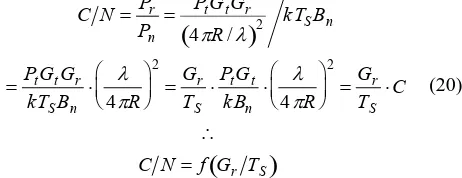
From equation (4) we have the power of the carrier signal at
the receive antenna as Pr. And from equation (16) we have the
noise power given by the Nyquist equation. Since the C/N ratio is the ratio of signal power to noise power, we have that:
C N Pr
Pn
PtGtGr
4R/
2 kTSBn PtGtGr
kTSBn
4R
2
Gr
TS PtGt
kBn
4R
2
Gr
TS C
C N f G
r TS
(20)
Where C is constant for a given operational mode of the
satellite, thus C/N G/T. The ratio Gr/Ts (or simply G/T) is
known as the Figure of Merit. It indicates the quality of a
receiving satellite earth system and has a unit [dB/K].
Example G:
An earth station has a diameter of 30 m, and an overall efficiency of 69%. It is used to receive a signal of 4150 MHz. At this frequency, the system noise temperature is 79 K when the antenna points at the satellite at an elevation angle of 28˚. a) What is the earth station G/T under these conditions? b) If heavy rain causes the sky temperature to increase so that the system noise temperature increases to 88 K what is the change in G/T value?
Solution
a) From equation(7) we have that
Gr 4A
2
D 2
at 4.15106Hz; c f 0.0723 m
Gr0.69 30
0.0723 2 1,172,856.9
60.69 dB
b)
For Ts79 K
10log79
18.98 dBK GT 60.6918.9841,71 dB/KIf Ts increases to 88 K in heavy rain, then Ts88 K
10log88
19.44 dBKGT
/60.6919.4441,25 dB/K
Change in G/T value
G/T
GT
G T
/41.7141.250.46 dB/K
VI. SYSTEM AVAILABILITY
The availability of a satellite communication system is the ratio of the actual period of correct operation of the system to the required period of correct operation [3]. This availability depends not only on the reliability of the constituents of the system, but also on the probability of a successful launch, the replacement time and the number of operational and back-up satellites (in orbit and on the ground). Availability of the earth stations depends not only on their reliability but also on their maintainability. For the satellite, availability depends only on reliability since maintenance is not envisaged with current techniques. Availability A is defined as given in equation (21).
A ROT - DT
ROT (21)
Where ROT and DT – Required Operational Time and Down Time respectively.
ROT is the period of time for which the system is required to be in active operational regime, while DT is the cumulative amount of time the system is out of order within the required
operational time. To provide a given system availability A for
a given required time L, it is necessary to determine the
number of satellites to be launched during the required time L.
This number will affect the cost of the service. The required
number of satellites N and the availability A of the system will
be evaluated for two typical cases for which Tr is the time
required to replace a satellite in orbit and P is the probability
of a successful launch.
A. No backup Satellite in Orbit
For this case, the number of satellites to be launched is given by equation (22).
110904-3232 IJECS-IJENS © August 2011 IJENS
Where L – ROT [years]; P – Probability of success of each
launch; T – mean time to failure (MTTF); U – Maximum
lifespan of satellite.
If it is assumed that satellites close to their end of maximum
lifetime U are replaced soon enough so that, even in the case
of a launch failure, another launch can be attempted in time, the mean unavailability (breakdown) rate is:
B
t
rP
T
(23)Where tr – time required for each replacement and the availability A = 1- B of the system is thus:
A
1
t
rP
T
(24)B. Back–up Satellite in Orbit
By assuming, pessimistically but wisely, that a back-up satellite has a failure rate of l and a maximum lifetime U equal to that of an active satellite, it becomes necessary to launch twice as many satellites during L years as in the previous case reflected in equation (22):
N
2
L
P
T
1
e
U T
(25)Taking account of the fact that tr/T is a small value, the
availability of the system expressed in equation (22) becomes:
VII. LINK BUDGET
The link budget determines the antenna size to deploy, power requirements, link availability, bit error rate, as well as the overall customer satisfaction with the satellite service. A link budget is a tabular method for evaluating the power received and the noise ratio in a radio link [2]. It simplifies C/N ratio calculations
The link budget must be calculated for an individual transponder, and must be recalculated for each of the individual links. Table II below shows a typical link budget for a C band downlink connection using a global beam GEO satellite and a 9m earth station antenna. Link budgets are usually calculated for a worst-case scenario, the one in which the link will have the lowest C/N ratio or lowest tolerable availability.
TABLE II
C–BAND GEOSATELLITE LINK BUDGET IN CLEAR AIR
C – band satellite parameters
Transponder saturated output power 20 W Antenna gain on axis 20 dB Transponder bandwidth 36 MHz Downlink frequency band 3.7 – 4.2 GHz Signal FM – TV analogue signal
FM – TV signal bandwidth 30 MHz Minimum permitted overall C/N in receiver 9.5 dB Receiving C – band earth station
Downlink frequency 4 GHz Antenna gain on axis at 4GHz 49.7 dB Receiver IF bandwidth 27 MHz Receiving system noise temperature 75 K Downlink power budget
Pt – satellite transponder output power, 20 W 13 dB Bo – transponder output backoff -2dB Gt – satellite antenna gain, on axis 20 dB Gr – earth station antenna gain 49.7 dB LP – free space path loss at 4GHz -196.5 dB Lant = edge of beam loss for satellite antenna -3 dB La = clear air atmospheric -0.2 dB Lm = other losses -0.5dB Pr = received power at earth station -119.5 dBW
Downlink noise power budget in clear air
k = Boltzmann’s constant -228.6 dBW/K/Hz TS = system noise temperature, 75 K 18.8 dBK Bn = noise bandwidth 27 MHz 74.3 dBHz
N = receiver noise power -135.5 dBW
C/N ratio in receiver in clear air
C/N =Pr – N = -119.5 – (-135.5) 16.0 dB
VIII. SATELLITE LINK DESIGN METHODOLOGY
The design methodology for a one-way satellite
communication link can be summarized into the following steps. The return link follows the same procedure.
Methodology
Step 1.Frequency band determination.
Step 2.Satellite communication parameters determination.
Make informed guesses for unknown values.
Step 3.Earth station parameter determination; both uplink and
downlink.
Step 4.Establish uplink budget and a transponder noise power
budget to find (C/N)up in the transponder
Step 5.Determine transponder output power from its gain or
output backoff.
Step 6.Establish a downlink power and noise budget for the
receiving earth station
Step 7.Calculate (C/N)down and (C/N)0 for a station at the
outermost contour of the satellite footprint.
Step 8.Calculate SNR/BER in the baseband channel.
Step 9.Determine the link margin.
Step 10. Do a comparative analysis of the result vis-à-vis the
specification requirements.
Step 11. Tweak system parameters to obtain acceptable
(C/N)0 /SNR/BER values.
Step 12. Propagation condition determination.
Step 14. Redesign system by changing some parameters if the link margins are inadequate.
Step 15. Are gotten parameters reasonable? Is design
financially feasible?
Step 16. If YES on both counts in step 15, then satellite link
design is successful – Stop.
Step 17. If NO on either (or both) counts in step 15, then
satellite link design is unsuccessful – Go to step 1.
IX. CONCLUSION
A number of factors have to be taken into consideration in the design of a robust satellite link. We have presented the most salient of these factors and examined how they are interrelated vis-à-vis satellite link design for the provision of optimal service availability. The transmitted and received power of the link between the satellite and earth stations must be accounted for, losses due to the link and communication equipments
must be taken into consideration et cetera. The link ratios,
which include carrier–to–noise and Bit error rate are good indicators of the feasibility of the system design. The system availability is another factor of high interest, and must therefore be taken into account. Frequency re – use enhances the capacity of the satellite, which makes it a vital element for optimizing the link. A sample link budget was outlined to illustrate the process. We have summarized in the satellite link design methodology the most salient points necessary for achieving a robust satellite link design with desired characteristics.
REFERENCES
[1] Dennis Roddy, “ Satellite Communications”, 3rd edition, McGraw Hill, USA, 2001, ISBN: 0-07-120240-4
[2] Timothy Pratt et al., “Satellite Communications “Copyright©2003, ISBN: 9814-12-684-5
[3] Gerard Maral and Michel Bousquet, “ Satellite Communication Systems”, 5th edition, John Wiley, UK, 2002
[4] International Telecommunications Union, “Handbook on satellite communications”, 3rd edition, April, 2002, ISBN: 978-0-471-22189-0. [5] J. A. Pecar, “The New McGraw-Hill Telecom Factbbok”, McGraw-Hill,
![Fig. 1. Simplified earth station receiver [2].](https://thumb-us.123doks.com/thumbv2/123dok_us/1385332.1649363/4.612.56.272.437.590/fig-simplified-earth-station-receiver.webp)