e-ISSN: 2278-7461, p-ISSN: 2319-6491
Volume 6, Issue 9 [September. 2017] PP: 16-34
Evaluation of Urban Decisions in the Context of Urban Regime
Theory: The Case of Konya Courthouse Project
*
Sinan Levend
1, Rahmi Erdem
21
Dr. Department of City and Regional Planning, Selçuk University, Konya, Turkey, 2Assoc. Prof. Dr. Department of City and Regional Planning, Selçuk University, Konya, Turkey
Corresponding Author:Sinan Levend
Abstract:
Planning as an urban policy is a power that organizes the allocation of resources and shapes ownership because it involves decisions that affect future. This power legitimizes urban decisions. In urban decision-making processes, regimes created by actors who have this power regulate the planning process, and urban decisions are shaped by power relations between actors (deals/negotiations). In light of this observation, the main hypothesis of this study is that planning is an instrument to legitimize urban decisions agreed upon by powerful groups. In order to test the hypothesis, the decision concerning the location of Konya Courthouse Project (KCP) was evaluated in the context of urban regime theory. The aim of the study is to examine the effects of power relations formed between actors who have a role in the making of urban and planning decisions on the decisions actually made. Thus, the study also aims to generate clues on how to create a democratic urban decision making process. To this end, social network analysis was used to examine the decision making process of the KCP, which was produced with a fragmentary planning approach and played an important role in shaping of the urban space of Konya. Characteristics of the management coalition that formed in the decision making process of KCP was evaluated using the urban regime theory, which is an urban politics approach. It was found that the decision making process was managed by a management coalition that brought together actors with different resources/powers. When the case is analyzed in the context of urban regime theory, it becomes clear that the management coalition consisting of local political actors constitutes the urban regime.Keywords
: Urban Policy, Urban Regime Theory, Decision-Making Process, Power Relations, Social Network Analysis, Konya (Turkey)--- --- Date of Submission: 25-08-2017 Date of acceptance: 13-09-2017 --- ---
I.
INTRODUCTION
Planning is a decision making process with which urban policies for the future are determined. Actors who wish to use the power of legitimization in planning, are aiming to give direction to urban policies. For this reason, during the urban decision making process, relation networks comprising the conflict of interests and reconciliation of actors are built and resolved [4]. This situation shows that planning has a border of freedom that is dependent on the intention, priority and policies of actors [25]. Power relations that are established among actors give direction to plan decisions.
In the urban decision making process, one of the fundamental urban politics structure resolution approaches for analyzing power relations among actors is urban regime theory. Urban regime theory focuses on regimes having power regulations being formed by actors from different public groups, aiming to reach certain goals in the urban environment [13,34,36,37,2]. Urban regime theory provides a frame as relating with effectiveness of conditions in order for management coalitions to be established by formal and informal actors that shape urban policies and to maintain them.
Besides, urban regime theory also provides a comprehensive view point with respect to the subject of power. The theory is interested in the power generation process instead of the type of class or public group having it. In this way the theory provides opportunity for analyzing the complex causal relations underlying the formation of management coalitions that form during urban policies making process.
As a result of above stated evaluations, it has been decided to use the theoretical frame of urban regime theory which is one of urban politics structure analysis approaches, with regards to the resolution of process relating with the decision for choosing the place for Konya Courthouse Project (KCP).
In social structure, individuals live in a network structure being formed of relations network. Therefore, the phenomenon in social structure are tried to be explained by using network concept. Actors that take part in urban decision making process, make collaboration with formal and informal relation network. In this line, social network analysis has been used in the resolution of relations among actors within urban decision making process.
Within the scope of study, first of all theoretical information is given about urban regime theory. Afterwards, in line with in-depth interviews that are made, decision making process of KCP has been defined. Relations among the actors taking part in the process, were resolved with social network analysis method. Finally, in line with the data obtained, it has been evaluated whether management coalition forming during the decision making process of KCP can be defined as regime or not, with respect to urban regime theory.
II.
URBAN
REGIME
THEORY
Planning Urban regimes are defined as management coalitions that have continuity in taking administrative decisions for making and implementing policies in line with a specific goal and which have formed on an informal coordination ground as a result of formal and informal relations among different social groups [33,6,7,24,23,17]. Therefore, regime management has the capability of coordinating actions and activating resources by establishing political alliances and by maintaining these alliances.
In this line, urban regime theory focuses on management regimes forming with the formal and informal relations among public managers who have legitimization for producing policies and business sector having control power over capital sources. In this way, it defines fragmentation of authority and the dependency between sources of market economy that produce capital and capacities of democratic institutions for producing policies [6,32,24,8,23,29].
Theory focuses on the formation process of management coalitions, quality of relations among actors forming the coalition, the type of sources owned by the actors forming the coalition, and the expectations of actors at the finalization of process. In the analysis of urban politics structures, especially the assertion to present a system at the point of analyzing the community power, has made regime theory become one of the most widely used approaches [13,12,24,8,5,36,23]. The theory is interested in the making process of power instead of the type of class or community group having it. In this way urban regime theory provides the opportunity to analyze the complex casual relations underlying the management coalitions forming during decision making process of urban policies.
2.1. Power Emphasis of Urban Regime Theory
According to regime theory, power forms as the social groups having the skills to solve problems and/or owning certain resources act in a common way [1]. As power is not distributed equally among individuals and groups in the complex world, control over resources has a complex structure. Therefore, it is not possible for a group to have an extensive control over resources. Regime theory defends that in urban policy production process, there are at least four forms of power concept in urban politics structure analysis. First one of these is systemic power. Actors who can reach certain resources in socioeconomic structure due to their positions, own systemic power. For example as business sector owns certain resources, this creates a privileged position in the policy production process relating with investment decision for business sector [31,36,11,27].
The second form of power is command power. In this meaning, power comprises the active mobility of resources (information, finance, reputation, experience) in order for power to have hegemony over other interests. For this reason emphasis is on the capacity of an actor for attaining power and on the resistance capacities of others [29,30,36,11,27].
The third form of power is coalition power. Hegemony and control of coalition power in urban politics structure is limited. The foundation of coalition power is formed as actors who don’t request to be dominant but which are autonomous on the basis of marketing, come together and join their powers. In this way, actors form coalition power by joining their powers in order to reach to the targets they desire [29,30,36,11,27].
solve problems. In this way, by establishing regime to realize common actions, management capacity is increased [29,30,5,36,11]. In order to understand policy production process in a complex urban system, it is needed to go beyond the approach that sees power as the capability of realizing something which another actor can not demonstrate. In this respect, importance of theories of community power theoreticians with regards to the definition and measurement of power/power relations which enable the decision making in urban systems is quite significant. Urban regime theory focuses on management coalitions established by actors from different segments of community having power, in line with a certain goal and it presents a comprehensive frame as relating to how the notion of power shapes urban spaces.
2.2. Formation of Urban Regimes
Regimes are established as a result of collaborative relations based on agreements, incentives and opportunities which are not clearly written within the frame of a common approach as relating with the types of management models (tasks and strategies) shall be formed among the actors within urban policy production process [6]. As regimes strive to activate their capacities, they are required to have certain goals [24]. In the formation of urban regime, expectation of local politicians to be elected (again) is an important factor. Local politicians are motivated with this expectation and they establish coalition powers to realize their expectations. Besides, local politicians need finance for their campaigns and these influence the formation of regimes in a significant way [8].
Another key participant in the formation of regimes with management coalitions is the business world. This originates form the hegemony of business world on capital. Apart from local managers and actors from business world, in line with the changing goals, in urban regimes different actors (district community, environmentalists etc.) can also take part [24].
Regime theory asserts that regimes that are formed in line with certain interests provide advantages/incentives to the actors. This depends on actors’ managing their strategic positions and their control over the resources within long term coalitions. In order for regimes to be maintained, they are needed to be successful or to convince people that the targets are being reached. Once a regime is established, it becomes a powerful actor of urban policy production process. In order to realize their objectives, opponents need to act in accordance with the existing regime or they should establish a powerful counter regime [30].
2.3. Features of Urban Regimes
In order to qualify a political coalition as a regime, it should have certain features. In this line, by using the definitions made in literature as relating with urban regimes, features of urban regimes are specified. In accordance, for a political coalition to be evaluated as an urban regime, it should possess below features [18]: Urban regimes are established on an informal coordination ground having a formal and informal relation
network that is partially stable as having continuity for taking decisions in making and implementing policies.
Regimes are established with relation networks that are based on collaboration, common goals, mutual interests and resources.
Generally the basic actors are managers who are assigned as being elected and the elite people in the private sector. However, in line with changing goals, different actors can take part in the coalition.
In order to activate capacities, regimes should have certain goals. Generally the common goal is to provide the economic development of the city but depending on the actors forming the regime, this goal can show variations. As the relations established in regimes are based on informal ground, these goals are agreements which are not explicitly written.
Since the actors forming the regime can not reach to the desired goals alone, they establish collaborations. For this reason, partners forming the regimes are dependent on one another at the point of reaching their goals and the actors activate resources which complete each other.
Regimes have the tendency to survive even though political agenda, people and leaders can change or in case of political successes achieved.
Number of these features being defined as relating with urban regimes could be increased but while certain features can be present in one city, they may not be present in another one. Because in cities having different political and economic context, accessibility to corporate sources and distribution of these resources are also different. For this reason, features of urban regimes show variations from one city to another (from country to country).
III.
METHOD
3.1. Choosing the SampleKonya has been an important settlement place through the history due to its geographical location and its being situated on important roads. Findings from the excavation works that are realized at the city center show that the history of settlement goes back to years around B.C.2000. These data show that Konya is one of the oldest settlement places in Central Anatolia [35]. Konya has become the capital of state during Seljuk period and it has become an important trade city and it has become the biggest city of Anatolia. The city maintained its administrative, political and commercial importance during the Ottoman period.
In the preliminary plans prepared as relating with the city after the Republic, it is observed that the macro form of the city has been maintained. Master development plan of year 1966, has enabled for the current macro form of city to be established. This plan foresees for the settlement to be developed in the direction of east and northeast and for the first class soils in the south and southeast regions to be preserved. Accordingly, the city has developed in the directions of west, north-west and north [22,28,38].
In 1987 as it was announced that Konya has become a metropolitan, it had a management structure being composed of Konya Metropolitan Municipality (KMM) comprising of district municipalities of Selcuklu, Karatay and Meram and the municipalities of these districts. However, since district municipality governments of Selcuklu, Karatay and Meram were only focused on their areas of responsibilities, this caused for actions to take place as being independent from the macro scale plan decisions providing directions for the city. It is seen that plan decisions that are produced in macro scale as relating with the city are shaped in accordance with competitive power of district government in lower scale [19].
Besides, economic crisis which was lived through in 2000s, has influenced construction investments in the city. As the influences of crisis were reduced (or as the crisis was over), a rapid structuring process began to take place in the city. During this process, in general instead of an integral planning approach, production of point projects were influential. Coalitions formed by municipality government and capital owners have been influential in shaping the urban space.
Urban regimes are observed more in the decision making process of projects that are formed with partial (point) approach instead of macro scale decisions as relating with the whole city. In this line, with the aim to test the hypothesis of the study, as a case study Konya Courthouse Project (KCP), which is planned with a partial approach as being contrary to the macro scale plan decisions of city and as having an important impact on spatial development of Konya, has been chosen.
3.2. Data Collection Technique
In the study, it is aimed to evaluate the process with respect to regime theory context, by analyzing the relations among actors having roles in the decision making process relating with the city. Accordingly, as analysis technique, social network analysis has been used. As the fundamental data collection method, semi-structured in-depth interview technique has been used. In this way, in addition to the questions which were previously developed, subjects requiring to be explained within the flow of interviews and to be handled in detail, were also mentioned.
Names of actors being interviewed have been determined as per the information obtained from institutions and the information given by the people being interviewed. In-depth interviews were conducted with people (deputy, council members, bureaucrats, investors etc.) who have played roles in the production process of plan amendment of KCP or with people having information about this process. In this line, as relating with decision making process of KCP, in-depth interviews were held with 50 people between January, 2014 and August 2014.
For in-depth interviews, an interview guide being composed of two parts has been prepared. In the first section of interview guide, questions aiming to analyze the decision making process of KCP are present. In the second section of the guide, questions were asked to the interviewers about the actors taking role in the process, about the people with whom actors had dense relations, and about the effectiveness levels of actors within the process. In order to determine the importance of actors during the process, it is asked each interviewer to rank the actors by giving a score between 0 and 10. By taking the average of scores given by the interviewers, the effectiveness of each actor in the decision making process is determined.
3.3. Method of Analysis
In community structure, for defining the relations among individuals, social scientists use the concept of network [9]. Network is the network of connections or relations of individuals forming the community, organizations or coalitions. In social system, this network is composed of actors, relations of actors with one another and the economic, social and political structure arising as a result of these relations [26,14,3].
Social network analysis is a method which sees the social structure as a network being composed of actors ( ties/units) and relation groups connecting the actors with each other and which enables for the resolution of relations between individuals and institutions and for the resolution of network structure forming with these relations [3,9].
Network analysis provides a consistent frame in defining the relations forming during urban policy production process. Researchers working on urban regimes, state that life is composed of social network relations. Network approach makes emphasis on collaboration attempts of different interest and organizations as similar to the regime theory. Actors have the opportunity to influence and direct the urban decisions with the collaboration networks they establish. In this process the informal partnerships and networks that form are as important as formal structures [20]. Being able to analyze these informal coalitions which become more apparent in nowadays [10], enables for understanding the power relations forming during urban policy production process. For this reason, within the scope of work, in order to analyze the relations between actors, social network analysis has been used.
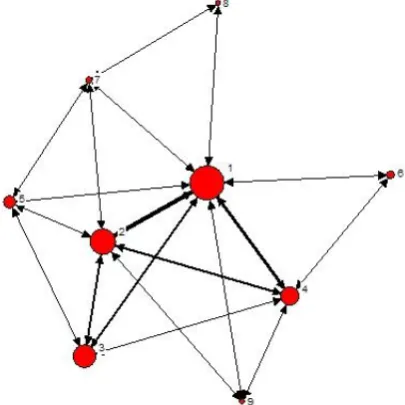
Social network analysis is an analysis method that enables to define the relations between actors and to explain their content. Network maps are visual materials on which relations among the actors are defined in a schematic way. In these maps, actors are symbolized with points and relations among actors is symbolized with lines. Besides, on the network map, direction of relations among actors is shown with an arrow and the density of relations is shown as bold [26]. In order for an actor to be within a relation network, he should establish at least one connection within the network. Importance of actors within the network is defined with the size of point symbolizing the actor. Boldness of lines on network map, show the density of relations among actors (Figure 1). Furthermore, by using different colors for lines between actors, the relation types are also defined.
Figure 1. Network Map Sample (actors, relationships, power of relationships and direction of relationships)
Network maps relating with decision making process of KCP have been established. Besides betweenness centrality is also realized. In this way, relations among actors within plan decision making process have been resolved.
IV.
EVALUATION
OF
DECISION
MAKING
PROCESS
OF
KONYA
COURTHOUSE
PROJECT
contradictory to the macro scale plan decisions of the city. In this part of the study, first of all decision making process of KCP has been analyzed in line with in-depth interviews being realized. Later on, relations of actors taking role in the process have been revealed with social network analysis. Finally, decision of KCP for choosing a location has been evaluated within the frame of urban regime theory.
4.1. Decision Making Process of Konya Courthouse Project
Decision making process of KCP as relating with the choice of location, has started in 2003 as the Ministry of Justice took the decision to renew the Courthouse. In that period, while Central Government and Karatay District Municipality (KDM)1 were connected to AK Party, Konya Metropolitan Municipality (KMM) was connected to Saadet Party. Since the deputies elected from Karatay district area and KDM government requested for the project to be situated in Karatay, they kept the decision of Ministry of Justice secret without revealing it to KMM government. In the interviews made, the deputies of that time stated below particulars as relating with that process:
At that period, president of KMM was from Saadet Party. Since both the Ministry of Justice and we were opponents to the mayor of that period, we kept the process as hidden from him. We held a meeting as the deputies in Ankara with the Bar President (Interviewee 42).
We as being three deputies are from Karatay and we put our efforts to enable KCP to be established in Karatay. I insisted because I am born in Karatay and I wished to gain a project to the region. Karatay had remained far behind and it needed to develop. In Karatay there are no hospitals and there is no other public investment (Interviewee 44).
The deputies with Karatay origin began to manage the process for allocating the land owned by Ministry of Forestry in the district of Karatay to the Ministry of Justice. While the process was continuing, local elections took place in 2004. In these elections, AK Party won the presidency of KMM. In this way, central government, KMM and KDM all became part of the same political party.
After the elections of 2004, decision regarding the selection of location for the Courthouse began to be discussed at local government level. KMM has become one of the important actors in the process. After the elections, all the district municipalities made applications requesting for the Courthouse to be established in their own districts. KMM Councils explained the situation as stated below:
Within the process, without considering the principles of urbanization and the public interests, all three district municipalities began to compete in order for Courthouse to be built within their own borders(Interviewee 16;18;20;23).
Different actors had different attitudes as relating with the location choice of KCP, showing different justifications. However, during the process two coalitions were established. First coalition2 is Karatay Coalition being composed of the deputies, KDM, and civil society institutions (Chamber of Architects, Konya Bar etc.). Second coalition3 is the Metropolitan Coalition being composes of KMM bureaucrats, Selcuklu District Municipality, council members, and Chief public prosecutor.
Karatay Coalition wishes for KCP to be built on the land owned by the Ministry of Forestry in the southeast region of the city within the district of Karatay. After the area was determined for the project, the deputies began to work both for the area to be transferred to the Ministry of Justice and for the surrounding public areas to be transferred to KDM. The deputy explained this process as stated below:
Elections would be held in 2007 and it was required for the project to be completed before this date. The area considered for KCP was a land having a size of 84855 m2 as being allocated to the Ministry of Forestry. We went to the Ministry of Finance for 4-5 times in year 2004 for the allocation of area and we obtained allotment of the land. We enabled for the transfer of all public lands around KCP to be made to the Municipality of Karatay. Afterwards, I allocated the areas that were reserved for public institutions to the Ministries one by one. Municipality prepared these documents and I followed them from Ankara. In order to expand their ownership, KDM allocated these areas for usages such as Housing, Courthouse, University, Shopping Centers, Regional Hospital, and green areas (Interviewee 44).
In this period, bureaucrats who were working in the Municipality of Karatay, have prepared reports explaining why the Courthouse should be established in Karatay. These reports were submitted to the Ministry of Justice during the visits made to Ankara. Explanations of KDM bureaucrats relating with the studies are as stated below:
At that period, there were negative facilities such as prison and garbage collection facility within the borders of Karatay. Besides, structuring had rural features. Therefore, struggle was given to have KCP in Karatay. In order to support for KCP to be established at its current location, we prepared a technical report
1KDM, is a sub-government division being connected to KMM.
2
This coalition will be referred to as Karatay Coalition in the following sections. 3
where we explained the reasons. In the report we emphasized that it would be convenient for established a sub-region in Karatay in order to avoid the single centered development of Konya. The biggest criticism about this area was that it was not suitable with respect to geological aspects but we defended that it was also convenient with regards to the ground. We expressed that in order for such a sub-center to be established, big public usages were needed to be brought here. Furthermore, in the report we made comparisons to show that other alternatives emphasized by KMM could not be realized (we made triple comparisons). We stated that it was considered to establish hospital and university areas at this location and that having KCP be established here, would support this process. As per the alternation of plan being made, changes were made on the plan relating with hospital, park, and Courthouse (Interviewee 24; 26).
Karatay Municipality council members stated that they were not the real decision makers, that they did not take part in the decision making process, and that they only used votes to legitimate the process:
The deputies have managed the process in a secret way. As Karatay Mayor was elected, he also became part of the process. When the process came to a certain stage, the subject was explained to the members of council. Some of our colleagues who were council members, stated that they did not agree with the president with respect to the selection of place. But as we were members of the same party, we made decision unanimously (Interviewee 30; 34).
The deputies and Karatay Mayor also got support from certain civil society institutions in order to legitimize the selection of place and to get public support. Chamber of Architects also gave support for the Courthouse to be established in Karatay. Chairman of Chamber of Architects has told about the support they gave for the process in an interview held as mentioned below:
As the management of Chamber of Architects, we gave our support for the Courthouse to be established in the district of Karatay. This project was required in order for Karatay region to develop. Even the deputy who wanted the Courthouse to be established in Karatay, was astonished with my idea. Later on, Chamber of Architects also created a public opinion that they are supporting us. First, it was us (Chamber of Architects) who issued a press statement (Interviewee 41).
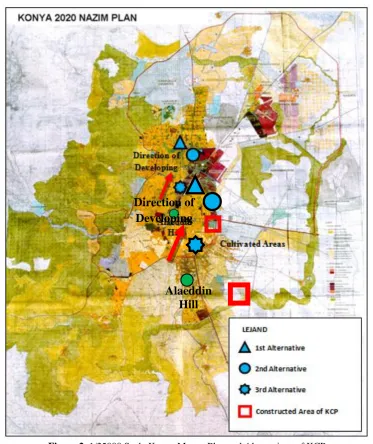
On the other hand, Metropolitan Coalition was giving struggle for KCP to be established at some other location. In the discussions they held, Metropolitan Coalition specified three alternative areas for KCP. As a result of the discussions held for these three alternatives, it was decided that the third alternative (old industrial zone) was the most appropriate area. (Figure 2) KMM bureaucrats have requested for KCP to be established on this area in order for the transformation of old industry being situated on the development axis of the city to be accelerated. They stated that they acted commonly with Chief Public Prosecutor in accordance.
First environmental arrangement plan of KMM was made in 1984. As the main decision area of this plan was comprised of the efficient agricultural lands in the south-southeastern direction of the city, the areas in the north and northeastern directions were planned as development areas. By maintaining the traditional center of the city and by eliminating the industrial areas in the north part of this center, it was aimed to establish the modern center. Housing areas with low density were planned for the south, southeast, and southwest areas of the city (Interviewee 2; 3; 4).
By considering macro scale plan decisions, infrastructure situation, public transport and similar particulars, an area with a size of nearly 65000 m2 was determined at the old industrial zone for KCP. This area was a suitable area both with respect to public transportation and the transformation of old industrial area. Besides, this area was planned as development area in macro scale plans (Interviewee 2; 3; 4).
As a result of the attempts of KMM and the Office of Chief Public Prosecutor, agreement was reached with the authorized officials and deputies undersecretary at the relevant department of Ministry of Justice as regards to the selection of place at the old industrial zone for KCP. Within the frame of this agreement, architectural project drafts were prepared. KMM bureaucrats have explained this process as stated below:
Figure 2. 1/25000 Scale Konya Master Plan and Alternatives of KCP
In the discussions held with KDM council members taking part in Karatay Coalition, council members stated that they went to the capital city in order to be influential in the process:
As being KDM council members, we were not authorized to state something regarding the decision for KCP. The decision was already taken. Mayor gave a speech at Karatay council and he stated that Courthouse would add value to the district. As being the council members, we only took part in the process in the council regarding land allocation and zone amendment. During that period, we went to Ankara for 8-10 times. We first met with deputies undersecretary who was dealing with technical works and then, we also had discussion with the Ministry of Justice (Interviewee 9; 10; 12).
A local channel tried to create public opinion by means of television as stated below:
At the programs we had on our channel, we emphasized that it was required for the Courthouse to be established in Karatay. Besides, the deputies also made explanations about why KCP should be established in Karatay (Interviewee 1).
During the process relating with the selection of place for KCP, the deputies with Karatay origin were influential in the formation of provincial organization of AK Party at that period. For this reason, while Karatay AK Party district organization gave support for KCP to be established in Karatay, other district organizations remained silent during the process. AK party member from Karatay district explained the situation as stated below:
As being the district organization of Karatay, we were thinking that we had to struggle for the Courthouse project to be built in Karatay. For this reason, we went to the capital city for 8-10 times. We met
Direction of
Developing
with the Ministry of Justice. We expressed to the Minister that even though Karatay was an essential part of Konya, it remained idle and that there were no investments there. Each district manager worked to make KCP be established in their own district. We worked with devotion and finally, we gained the project to Karatay. At that period, center of Karatay was powerful in the government (Interviewee 49).
During the period of 6 months as relating with the selection of location for the Courthouse project, some tensions were also lived through in politics regarding the city of Konya. At that period the tensions between KMM and KDM were also reflected on the documents. Selcuklu County Municipality has stated that they were disturbed as it was requested to build KCP in the district of Karatay, in various platforms.
The breaking point of the struggle lived through in the politics of Konya regarding selection of location for KCP, has been a request petition which was prepared by AK Party deputies with Karatay origin and by the district organization of AK Party and which was signed by 14 AK Party deputies elected from Konya and submitted to the Ministry of Justice. The said petition was as stated below with its general terms:
“The parcel in the district of Karatay situated on plot no. 2311 and parcel no.11 as having a size of 84855 m2 has been allocated to the Ministry of Justice as per the petition dated of Governorship of Konya being dated 15.07.2004 in order for KCP to be built there. However, till now the progress expected as relating with the project could not be achieved. We request for your assistance and instructions in order for KCP, which is vitally important for Konya and which is among the important projects of our Ministry, to be brought to life at the soonest time.”
The deputy who made the said petition be prepared, explained the process as stated below:
I enabled for the petition, which was signed by 14 AK Party deputies elected from Konya requesting for KCP to be built on the area we have specified in KCP, to be prepared. We prepared the petition. I got appointment from the Ministry of Ministry and I presented this petition to him. This petition resolved the issue. Later on, Minister of Justice came to Konya. We showed the area to the Minister. Minister requested for the process to be accelerated. For that reason, we adapted the project that was prepared previously by KMM to the area (Interviewee 44).
Minister of Justice adopted the idea of building KCP in Karatay but he requested for the decision to be taken by the politicians of Konya. After a while, as Metropolitan Coalition and Karatay Coalition which were formed in the politics of Konya could not reach to an agreement on a common decision, Minister of Justice expressed his being disturbed to the metropolitan government. General lines of the conversation that the Minister of Justice had with metropolitan government are as stated below:
…The process took a long time. Take your decision. There are also other cities where investment should be made. If you don’t hurry, resources can be allocated to some other places… (Interviewee 2; 3).
After these statements of the minister, decision making process has been completed as KMM also accepted for the Courthouse project to be established in Karatay. In accordance, as per the decision of Konya Metropolitan Municipality Council (KMMC) being dated 14.01.2005 with no.13, plan alteration has been accepted. After the alteration of plan, construction of KCP has begun in 2005 and it was completed in 2007 (Figure 3) [15].
At the end of the process, for KCP the area that was determined by Karatay Coalition as being more powerful at the level of central government, has been chosen. As per the laws in Turkey, decisions relating with the city are taken by the municipality council. However, it is seen that sometimes the laws can not go beyond being written texts. Opinions of some deputies as relating with this situation are given below, as being stated during in-depth interviews held within the scope of work:
We were always part of the work. As being the deputies, we took part both in the studies carried out at the Ministry and during the process when the final decision was taken. This is a political deal. As being a political actor, we also took part in the process and we enabled for the process to be accelerated (Interviewee 42; 44).
Opinions of some KMM council members with regards to the effectiveness of the deputies during the decision production process are as given below (Interviewee 11; 12; 15; 16; 18):
These works are carried out in this way. Those having political power take the decision and the council members approve it;
Regarding big projects, Mayor, party (provincial organization) and the deputies take the decisions and council members complete the procedure part. Council members can not object to the decision being taken later on or else they would be left aside. If you object, they will not elect you as council member in the following period. Decision was brought to the council. It was not discussed and it was voted and approved;
This is the political structure of Turkey. Leaders can make whatever they wish be approved. For this reason they choose people who will act as complying with them. No party would leave these to chances. Municipality councils are composed of people who don’t criticize.
Another problem which was expressed in the interviews made was that institutions being authorized to make plans were not working in coordination due to their different priorities. Selcuklu, in the city of Konya being composed of the districts of Karatay and Meram, it is not always possible to talk about an integrated plan approach. Meshur and Ayten (2001) have asserted that after Konya became a metropolitan, district municipalities did not start to deem their areas of responsibilities as part of a whole [22]. Therefore, the efforts of district municipalities to attract investments for their own responsibility areas, have caused for developments to arise as noncomplying with the upper scale plan.
The interviewers have used below statements as relating with this problem during the in-depth interviews made with regards to the decision production process of KCP (Interviewee 8; 9; 11; 23):
There is differentiation based on districts in Konya. A district municipality council member in KMMC, has to defend his own district regarding a subject relating with his district even if there may be problems relating with the matter.
As KMM council members come from the districts, they have to provide/protect political balances. In the process of selecting a location for KCP, the notion of being from Karatay district came to the forefront;
To enable for an investment considered for the city, to be realized in our district, we act in a common manner with district mayor and other council members both at the district municipality council and at the metropolitan municipality council. Because we are responsible for those who voted and elected us. If we don’t act in this way, we would get reactions;
3 District municipalities in Konya center are striving to attract investments to their district as being independent from the metropolitan and for this reason they can not come together under the umbrella of metropolitan.
In cities with the scale of Konya, the most important problem in the decision production process is the presence of central districts. Everyone is dealing with micro-nationalism in their own district. One of the important reasons causing the public investments coming from the center to be shifted to inappropriate places is the implementation of central districts. Districts have president, council members, district party organization, and deputies who are selected from the district. All of these are actors.
In the end, Karatay Coalition being composed of Karatay District Municipality and some deputies has enabled for selection of place relating with KCP to be made within the district of Karatay. As an outcome of this decision, density increases were observed in this region and the pressure on agricultural lands began to increase. This situation has damaged 1/25000 scale Konya Master Plan which integrated policies in macro scale are being determined for Konya.
4.2. Social Network Analysis of Production Process of Plan Decision for Konya Courthouse Project
interviews through UCINET program, network plans and analysis relating with network structure for the plan decision making process were obtained.
In the discussions held, in order to obtain data relating with network analysis, it was requested from interviewers to make two different scoring. First of all it was requested from interviewers to grade the effectiveness of actors in the process by giving a score between 0 and 10.
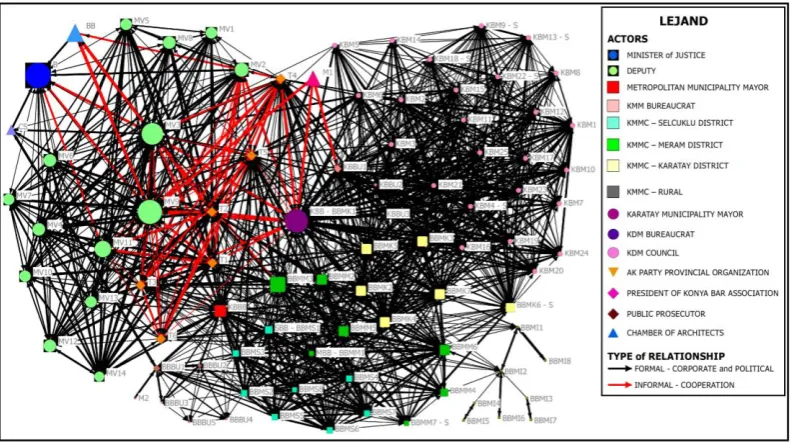
Afterwards it was requested from the people being interviewed to score the relation levels with other actors by giving a grade between 0 and 10. By using the numeric data obtained from in-depth interview, network map relating with the process has been produced. (Figure 4)
As the network map relating with decision making process of KCP is investigated, it is understood that the most effective actors in decision making process were the Ministry of Justice, deputies and district mayor. It is also seen from the network map that the relations among these actors were generally informal relations.
When the network structure forming during the plan decision making process of KCP is analyzed, it is seen that relation density4 was 0.226. While a network density value which is close to 1 means that the relations among the actors in that network are strong, it is clear that the network density of decision making process of KCP is low. This value shows that all the actors in the process don’t have strong relations with each other. This situation shows that all the actors in the network did not have dense relations with each other (Figure 4).
During the in-depth interviews held in order to define the decision making process of KCP, council members of KDM have stated that they were generally not effective in the process and that they only paid visits to the Ministry of Justice in order to gain the project to their own district and that they voted to legalize the process. Some members of KDM council explained the process as stated below:
As being the council members of KDM, we did not have right to influence the decision relating with KCP with our words as the decision was already taken when it came in front of us. Mayor gave a speech at Karatay council and he expressed that KCP’s being established in Karatay would add value to this district location. We, as being the council members, we only took part in the process by using our votes with regards to land allocation and zone amendments (Interviewee 28; 30; 31; 32; 34).
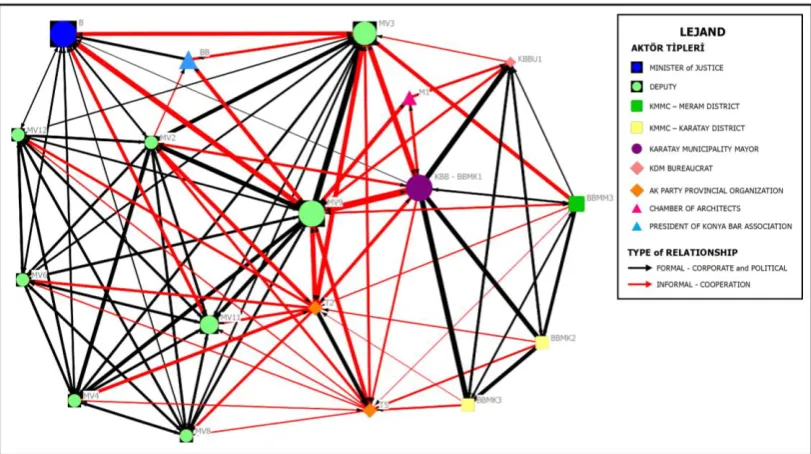
Reflections of these explanations made by council members of KDM can also be seen on the network map of the process. (Figure 4). For this reason, in order to make the network map relating with the process to become more understandable, in figure 5 district council members have been removed from the network map.
Figure 4. Social Network Map5 forming during the plan decision making process of KCP
As Figure 5 is investigated, it is clearly seen that KDM government, the deputies and the Minister of Justice of that period were the most effective actors in the process. In the Turkish planning system, the laws have given the authorization to take upper scale planning decisions at the metropolitan level as involving the overall cities, to metropolitan municipality councils. However, as the relation network among the actors for the period when planning decision of KCP was produced has been investigated, it is seen that district municipality
4
Density of contact numbers of each actor in a network is defined 5
government was more effective in the process. Most important reason explaining why district municipality government was effective in the process was the informal alliances they had with district party organization and the deputies. Other relations seen in the network map are formal relations as they are generally bureaucratic and hierarchical relations. (Figure 5).
Figure 5. Social Network Map forming during the plan decision making process of KCP (Karatay District Municipality Councilors are removed)
As KDM council members were removed from the network map prepared as relating with KCP, the density of the new network being formed was 0.279. This value reveals that the actors in the network structure did not have powerful relations with all the actors. During the process of plan decision production as relating with KCP, relations of council members being elected from the same district, with each other at the metropolitan municipality councils were denser than their relations with the other district council members.
A small number of actors managing the decision production process of KCP had strong relations among themselves. As KDM was very effective in this process, this situation has caused for the effectiveness of actors giving support for KCP to be established in the Selcuklu District to get reduced. As the network map is investigated, it is seen that effectiveness of council members being elected for KMMC from Selcuklu district and the effectiveness of KMM bureaucrats in the process was limited. Similarly, it is seen that the effectiveness of council members coming to KMMC from first tier municipalities, could not go beyond being present in the council and using their votes.
As the plan decision production process of KCP and the network structure relating with this process are investigated, another point that needs to be emphasized is the situation of planners, architects and other occupational people working as bureaucrats in the institutions. It is also clearly seen from the social network map that the effectiveness of mentioned people in the decision production process was shaped in accordance with the power of alliances in which they took part. (Figure 5). When in-depth interviews held as relating with the process and the network analysis are evaluated, it is apparent that the bureaucrats working within the body of KMM could not be effective in the process. For this reason, it is understood that the efforts shown to carry out the plan decision relating with KCP in accordance with the existing planning tendencies, were insufficient. On the other hand, it is seen that the bureaucrats working at KDM were more effective due to the works they carried out to make KCP be established in Karatay.
As per the data obtained from in-depth interviews held as relating with plan decision production process of KCP, network structure of relations of actors whose effectiveness score in decision production process was 5 or more, has been as shown in Figure 6. As the network structure is investigated, it is clearly seen that plan decision production process of KCP was managed by the alliance formed with the deputies, AK Party district organization members and KDM government. Density of network structure formed with actors having effectiveness score which is 5 or above during decision production process is 0.526. This value shows that density of relations among actors managing the decision production process relating with KCP was more than the density of relations among all the actors.
composed of the deputies, AK Party district organization and KDM government. When network structure of Karatay Coalition and the in-depth interviews held as relating with the process are evaluated together, it is seen that Karatay Coalition managing the decision production process aimed to convince the Minister of Justice. From Figure 6 it is understood that some deputies enabled for the communication among Karatay Coalition and the Minister of Justice to be realized. These deputies are actors qualified as a bridge in the social network terminology and they have an important role in the government of process. It is understood that the most effective deputies serving as a bridge in decision production process were those deputies who identified themselves as being from Karatay during the in-depth interviews held.
Another particular that needs to be emphasized as network map is investigated is the situation of Konya Metropolitan Municipality (KMM) president during the decision production process of KCP. In Turkey legal regulations give broad tasks and authorizations to metropolitan mayors. However, KMM president is not seen as an actor in Figure 6. Because the effectiveness score of the president is below 5 during the process. Reason for KMM President’s not being a powerful actor in the process is due to the management of Karatay Coalition regarding the process.
Another important indicator with regards to social network analysis is the concept of centrality. Actors who are at a central location within network structure cause for connections to be established among different actors and thus, they are more advantageous than other actors in reaching to information and sources. According to betweenness centrality measures of network structure of decision production process for KCP (Table 1), the highest value is 803.119 and it belongs to KMM president. This value shows that KMM president was communicating with many actors during decision production process. From the in-depth interviews held it is understood that effectiveness of KMM president in the process was limited (effectiveness score was below 5).
This situation arises from the fact that KMM president has connections with other actors due to his status in daily life. Similarly, there are actors whose effectiveness score average was less than 5 for the decision production process but whose betweenness centrality value was high. These actors have connections with other actors during the flow of daily life. For this reason, in the decision production process of KCP, betweenness centrality values of actors, having effectiveness score averages of 5 or more, have been analyzed.
Figure 6. Social Network Map forming during the plan decision making process of KCP (Actors was effectiveness score 5 or more)
Table 1. Betweenness centrality values of network structure of decision production process of Konya Courthouse Project (as excluding KDM council members)
Actor Code Betweenness Centrality Values6
MV2 89.173
MV3 141.96
MV9 142.55
KBBB 803.119
BBBU1 187.154
SBB – BBMS1 296.739
BBMM4 70.865
BBMM6 109.503
BBMK7 56.253
BBMI1 118.571
BBMI2 368.328
KBB-BBMK1 542.916
T1 50.039
T2 50.039
T3 51.718
T4 145.382
T5 62.85
As a result as the network structure of decision production process of KCP is investigated, it is understood that the process was managed by Karatay Coalition being formed of informal relations of certain deputies, AK Party provincial organization and KDM government instead of KMMC which had legal authorization to plan the process.
4.3. Evaluation of Plan Decision of Konya Courthouse Project within the Frame of Urban Regime Theory As the relations among actors having role in the plan decision production process of KCP are investigated, it is understood that the process was managed with a coalition formed on an informal ground by the actors at central government and local government levels. In this section of the study, it was discussed whether the said management coalition could be defined as an urban regime or not. This discussion is held within the frame of definitions made in the literature section of study conducted regarding the features of urban regimes.
Since urban regimes are alliances that are formed with formal or informal relation network with the aim to create policies relating with the city, relations among actors are usually long term relations. During the in-depth interviews held as relating with KCP, it was emphasized that some of the deputies in Konya were effective in the political environment of that period. Furthermore, during the interviews it was stated that the said actors were effective in determining the president candidates for the local government institutions of the city and in determining the party provincial organization of the city. From these statement it is understood that relations among the actors have started long before KCP and that the alliance being formed from these relations had an important role in shaping the local government structure of the city. It can be seen from the social network maps relating with the process (Figure 4, 5 & 6) that the actors forming Karatay Coalition managed the process. During the in-depth interviews that were held, it has been observed that some connections among the actors have resolved and that some of them still continued. In the light of these data, it is possible to mention that there was a stable relation network among the actors managing the process.
According to urban regime theory, fundamental actors of regimes were generally public managers having legitimacy to produce policies and investors from business sector having control power over capital sources. These actors establish management coalitions by joining their powers with the aim to reach a certain objective. During the decision production process of KCP, the management coalition that was established with the deputies and KDM government aimed to make the Courthouse to be established in the district of Karatay. Management coalition acting in line with this purpose, tried to convince the Minister of Justice, holding the authority for the financing of project, to establish the project in the district of Karatay. As a result of lobby activities carried out by the management coalition during the process, Ministry of Justice accepted for KCP to be established in the district of Karatay. There wasn’t any investors from business sector in the management coalition that was formed during the decision production process relating with KCP. However as management coalition convinced the Minister of Justice, holding the authorization for financing the project, it is seen that
there was also the capital dimension in the process as being emphasized by the regime theory. Besides, when it is considered that KDM established cooperatives and built housings just like an actor in the sector and that the deputies and municipality congress members worked as contractors, it is possible to mention that groups controlling the capital were also present during decision production process. When it is considered that the main target in establishing the alliance during the decision production process of KCP was to develop the district of Karatay, it is seen that the process has not been completed and that it still continues in our time.
From the analysis made above, it is understood that the common goal of the actors forming Karatay Coalition managing the decision production process was to develop the district of Karatay. Since the relations formed within the scope of coalition was established on an informal ground, objectives of the coalition are generally not written.
A feature that is related with the regimes is that actors having different sources and capacities have the tendency to establish alliances to complete each other. As the structure of coalition structure forming during the plan decision production process of KCP is investigated, it is seen that actors have the qualities that complete one another. When the process is investigated it is seen that while the deputies had the opportunity to reach to the Ministry of Justice, KDM had the capacity to have legitimacy in local ground. These two groups were being supported by the provincial organization representing the corporate power of AK Party at the provincial center and by the occupational chambers. The power of Karatay Coalition that was formed with the alliance of actors having qualities which completed each other, had an important role in the decision making process for the selection of location for KCP.
As a conclusion, as the plan decision production process of KCP is investigated, since Karatay Coalition that was formed with the alliance of the deputies and KDM government possessed majority of features relating with regimes, it is considered as an urban regime. This urban regime has been established as actors having different sources/powers came together to enable for Konya Courthouse Project to be built within the boundaries of Karatay District Municipality.
V.
CONCLUSION
Although in Turkish planning system the authorities deciding on zoning plans in the cities are the municipality councils, with the impact of different dynamics, during the implementation most of the time different actors are being effective in the planning process. Since these actors have different expectations, a decision production process that does not comply with the existing planning tendencies and which does not provide protection for public interests and which disregards the structural dimension becomes dominant. In this way, planning turns into one of the intervention tools which urban regimes use to reach their targets instead of being a tool for regular urban development.
Within the scope of work, power relations giving direction to the decision for selection of location relating with KCP, has been investigated within the frame of regime theory being one of the urban political structural approaches by using social network analysis. In this way, findings were reached as aiming to determine the impact of urban regimes that are a management coalitions established with formal and informal relations of actors having different sources, on the plan decisions.
The analysis conducted revealed that the decision production process relating with KCP was managed by Karatay Coalition as being a management coalition established on informal relations ground. As the features of Karatay Coalition are evaluated within the frame of urban regime theory, the coalition has been defined as urban regime.
Karatay Coalition aimed for the development of the district by enabling for the location of Courthouse to be selected within Karatay. It was aimed for the municipality to build housings and to attain higher tax revenues. Furthermore during the in-depth interviews held, it was seen that the deputies and municipality council members managing the decision production process of KCP, were also dealing with construction works. As a result of these discussions it was seen that actors being part of the urban regime were motivated with the financial benefits that would be attained with the attainment of the space.
The interviews held for testing the hypothesis of above study have revealed that in the urban decision production processes, regimes formed by actors wishing to use the legitimating power of planning, manage the planning process in line with the expectations of actors and that decisions about the city were taken as a result of power relations (agreements/bargaining) among the actors. This situation has made planning become the legitimization tool of certain power groups for their decisions relating with the city.
In a community, during the production process of plan decision if all communal groups can organize and defend their rights in a negotiation environment with horizontal network relations, then it is possible to mention that there is a democratic planning process. Therefore, subjects regarding with decisions should be taken to resolve the problems relating with the city, should be produced with the participation of all segments in the community. During the production process of urban decisions, all participants will be able to transmit their accumulations. In this way plan decisions can become truly legitimated. For this reason, a decision production process model where the citizens are included in the production process of decisions relating with the city is designed. As a conclusion, success of the plan is dependent on the intentions, strategies and attitudes of actors and local dynamics and dynamics which are above local ground, in addition to the capabilities of the planner. Having the ground for participating in decision production mechanism aiming to make cities livable and having an approach that sees cities with respect to their usage value and not as income sources, is the preliminary condition for establishing cities both with respect to social and physical aspects. For this reason, management of decision production process relating with the city is important. In order to improve the impact of planning on the production of healthy urban spaces, it is required to establish the frame relating with decision production process based on negotiations with regards to a planning regulation that will be enriched with scientific, technical, artistic and aesthetic aspects.
ACKNOWLEDGEMENT
Data given in this paper is a part of doctorate thesis prepared by Sinan Levend titled “An Examination of Power Relations That Give Direction to Making of Urban Planning Decisions".
VI.
ABBREVIATIONS
KCP: Konya Courthouse ProjectKDM: Karatay District Municipality KMM: Konya Metropolitan Municipality
KMMC: Konya Metropolitan Municipality Council
A
PPENDIX:
A
CTORSL
ISTInterviewee No Codes Description of Codes B Minister of Justice
Interviewee 1 BB President of Konya Bar Association Interviewee 2 BBBU1 KMM Bureaucrat 1
Interviewee 3 BBBU2 KMM Bureaucrat 2 Interviewee 4 BBBU3 KMM Bureaucrat 3 Interviewee 5 BBBU4 KMM Bureaucrat 4 Interviewee 6 BBBU5 KMM Bureaucrat 5 Interviewee 7 BBMI1 KMMC – Rural 1 Interviewee 8 BBMI2 KMMC – Rural 2 BBMI3 KMMC – Rural 3 BBMI4 KMMC – Rural 4 BBMI5 KMMC – Rural 5 BBMI6 KMMC – Rural 6 BBMI7 KMMC – Rural 7 BBMI8 KMMC – Rural 8
Interviewee 21 BBMS6 KMMC – Selcuklu District 6 Interviewee 22 BBMS7 KMMC – Selcuklu District 7 Interviewee 23 BBMS8 KMMC – Selcuklu District 8
CS Public Prosecutor
KBB – BBMK1 Karatay Municipality Mayor – KMMC Karatay District 1 KBBB Konya Metropolitan Municipality Mayor
Interviewee 24 KBBU1 KDM Bureaucrat 1 Interviewee 25 KBBU2 KDM Bureaucrat 2 Interviewee 26 KBBU3 KDM Bureaucrat 3 Interviewee 27 KBM1 KDM Council 1 Interviewee 28 KBM2 KDM Council 2 Interviewee 29 KBM3 KDM Council 3 KBM4 - S KDM Council 4 Interviewee 30 KBM5 KDM Council 5 Interviewee 31 KBM6 KDM Council 6 KBM7 KDM Council 7 KBM8 KDM Council 8 Interviewee 32 KBM9 - S KDM Council 9
KBM10 KDM Council 10 KBM11 KDM Council 11 Interviewee 33 KBM12 KDM Council 12 Interviewee 34 KBM13 - S KDM Council 13 Interviewee 35 KBM14 KDM Council 14 KBM15 KDM Council 15 KBM16 KDM Council 16 Interviewee 36 KBM17 KDM Council 17 Interviewee 37 KBM18 - S KDM Council 18 KBM19 KDM Council 19 KBM20 KDM Council 20 Interviewee 38 KBM21 KDM Council 21 Interviewee 39 KBM22 - S KDM Council 22
KBM23 KDM Council 23 KBM24 KDM Council 24 KBM25 KDM Council 25
Interviewee 40 M2 Chamber of Architects, Konya Branch Interviewee 41 M3 Architect (Designer of Project)
MBB – BBMM1 Meram Municipality Mayor – KMMC Meram District 1
MV1 Deputy 1
Interviewee 42 MV2 Deputy 2
MV3 Deputy 3
Interviewee 43 MV4 Deputy 4
MV5 Deputy 5
MV6 Deputy 6
MV7 Deputy 7
MV8 Deputy 8
Interviewee 44 MV9 Deputy 9
MV10 Deputy 10 MV11 Deputy 11 MV12 Deputy 12 MV13 Deputy 13 Interviewee 45 MV14 Deputy 14
Interviewee 46 SBB – BBMS1 Selcuklu Municipality Mayor – KMMC Selcuklu District1 Interviewee 47 T1 AK Party Provincial Organization 1
REFERENCES
[1] Baèlija, I. (2011). Urban Management in a European Context. Urbani izziv, 137-146.
[2] Bayraktar, U. (2013). Yerel Yönetimler. F. Güneş içinde, Kent Sosyolojisi (s. 116-143). Eskişehir: [3] Borgatti, S. P., Everett, M. G., & Johnson, J. C. (2013). Analyzing Social Networks. London - California:
SAGE Publications Ltd.
[4] Cullingworth, B., & Caves, R. W. (2009). Planning in the USA Policies, Issues and Processes. Routledge: New York.
[5] Davies, J. S. (2002). Urban Regime Theory: A Normative-Empirical Critique. Journal of Urban Affairs, 1-17.
[6] DiGaetano, A., & Klemanski, J. (1993). Urban Regimes in Comparative Perspective: The Politics of Urban Development in Britain. Urban Affairs Review, 29-59.
[7] DiGaetano, A., & Klemanski, J. S. (1999). Power and City Governance. Minneapolis: The University of Minnesota Press.
[8] Dowding, K. (2001). Explaining Urban Regimes. International Journal of Urban and Regional Research, 7-19.
[9] Gürsakal, N. (2009). Sosyal Ağ Analizi. Bursa: Dora.
[10] Harding, A. (1998). Elite Theory and Growth Machine. D. Judge, G. Stoker, & H. Wolman içinde, Theories of Urban Politics (s. 35-53). London-California-New Delhi: SAGE Publications.
[11] Harding, A. (2012). The History of Community Power. J. S. Davies, & D. L. Imbroscio içinde, Theories of Urban Politics (s. 29-39). Los Angeles - London - New Delhi: SAGE Publications Ltd.
[12] Imbroscio, D. L. (1998). Reformulating Urban Regime Theory: The Division of Labour Between State and Market Reconsidered. Journal of Urban Affairs, 233-248.
[13] Judge, D., Stoker, G., & Wolman, H. (1998). Urban Politics and Theory: An Introduction. D. Judge, G. Stoker, & H. Wolman içinde, Theories of Urban Politics (s. 1-2). London-California-New Delhi: SAGE Publications.
[14] Karakayacı, Ö. (2011). Sanayi Kümelerinin Başarısında Sosyal Sermayenin Rolü: Ankara ve Konya Makine İmalat Sanayi Örneği. İstanbul: Yıldız Teknik Üniversitesi Fen Bilimleri Enstitüsü.
[15] Konya Adliyesi. (2012, 09 04). Konya Adliyesi. 06 10, 2014 date Konya Adliyesi: http://www.konya.adalet.gov.tr/adliyemiz.html
[16] Konya BİM. (2013, 01 01). Konya Bölge İdare Mahkemesi. 06 10, 2014 tarihinde Konya Bölge İdare Mahkemesi: http://www.konyabim.adalet.gov.tr/ adresinden alındı
[17] Krinsky, J. (2007). The Urban Politics of Workfare: New York City's Welfare Reforms and the Dimensions of Welfare Policy Making. Urban Affairs Review, 42(6), 771-798.
[18] Levend, S. (2015). Kente İlişkin Plan Kararlarının Üretilmesine Yön Veren Güç İlişkilerinin İrdelenmesi. Konya: Selçuk Üniversitesi Fen Bilimleri Enstitüsü.
[19] Levend, S., & Erdem, R. (2014). District Policy being ahead of the Urban in Integrated Planning of Metropolitan Municipalities in Turkey, the Example of Konya. Regional Development and Globalization: Best Practices, 54th Europen Congress of ERSA (s. 1-15). St. Petersburg: ERSA.
[20] Lowndes, V. (2012). New Institutionalism and Urban Politics. J. S. Davies, & D. L. Imbroscio içinde, Theories of Urban Politics (s. 91-105). Los Angeles-London-New Delhi: SAGE Publications Ltd. [21] Meşhur, M. Ç. (2008). Planlama Geleneği Olan Kentten Planlama Tartışmasını Unutan Kente...
Planlama, 33-39.
[22] Meşhur, M. Ç., & Ayten, T. (2011). Konya'da Yerel Siyasetin Kent Algısı Üzerine Bir İnceleme. Diyarbakır, (s. 2). Diyarbakır.
[23] Mossberger, K. (2012). Urban Regime Analysis. J. S. Davies, & D. L. Imbroscio içinde, Theories of Urban Politics (s. 40-54). Los Angeles - London - New Delhi: SAGE Publications Ltd.
[24] Mossberger, K., & Stoker, G. (2001). The Evolution of Urban Regime Theory: The Challenge of Conceptualization. Urban Affairs Review, 36(6), 810-835.
[25] Özgen, L. (2006). Küreselleşmiş Dünyada Planlama, Devlet ve Hükümet Üzerine: Türkiye Örneği. Altıncı Türkiye Şehircilik Kongresi: Planlama, Siyaset, Siyasallar (s. 161-176). İzmir: TMMOB Şehir Plancıları Odası.
[26] Öztaş, N., & Acar, M. (2004). Ağbağ Analizine Giriş: Kavramlar ve Yöntemler. M. Acar, & H. Özgür içinde, Çağdaş Kamu Yönetimi II (s. 289-317). Ankara: Nobel.
[27] Penpecioğlu, M. (2012). The Political Construction of Urban Development Projects: The Case of Izmir. Ankara: METU.
[28] Sağ, N. S. (2011). Dönüşüme Bağlı Kentsel Gelişmenin Yönetilmesinde Bir Araç Olarak Akıllı Büyüme; Konya Kenti Örneği. Konya: Selçuk Üniversitesi.
![Figure 3. Konya Courthouse Project [16]](https://thumb-us.123doks.com/thumbv2/123dok_us/1365801.1646115/9.595.84.515.518.738/figure-konya-courthouse-project.webp)