E-COMMERCE: MEANING, BENEFITS AND GROWTH IN INDIA
NISHA TELANGA
ASSISTANT PROFESSOR IN COMMERCE CMK NATIONAL PG GIRLS COLLEGE, SIRSA
Abstract:-
The E-Commerce market is thriving and poised for robust growth in Asia.E-commerce involves an online transaction. Electronic commerce is a term for any type of business, or commercial transaction that involves the transfer of information across an electronic network, primarily the Internet. EC has expanded rapidly over the past decade and is predicted to continue at this rate, or even accelerate because it allows consumers to exchange goods and services with no barriers of time or distance and it is often faster, cheaper and more convenient than the traditional methods of commerce. Electronic commerce as part of the information technology revolution became widely used in the world trade in general and Indian economy in particular.
This paper is outcome of a review of various research studiescarried out on Impact of E-commerce on Indian Commerce.The purpose the study is to explore and bring about the benefits of e-commerce in Indian context. E-commerce has seen unprecedented growth in India in the last decade.
Though the e-commerce is benefiting the business and society at large there are some challenges and limitations also the main being that of financial security, trust, delivery and human less transaction.
Key words: E-commerce, India, internet, globe,impact,benefits,online. Introduction:-
E-commerce has so many advantages in our life because it makes convenient in daily life of the people. E-commerce stands for electronic commerce and pertains to trading in goods and services through the electronic medium, i.e. the Internet or phone. It can be basically defined as the production, promotion, selling and distribution of products and services in an online environment. As with e-commerce, e-business also has a number of different definitions and is used in a number of different contexts. E-commerce evolved in various means of relationship within the business processes. It can be in the form of electronic advertising, electronic payment system, electronic marketing, electronic customer support service and electronic order and delivery.
wide range of suppliers and trading partners, areas that typically add significant overheads to the cost of products and services
The objectives of this article are to present a snapshot of the evolution of e-commerce business indicating the chronological order, category of e commerce business, description of organizations involved in e-businesses in India, key characteristics of the firms engaged in e-commerce application, to examine the growth of e-commerce in both physical and financial terms, to evaluate the benefits obtained from e-business and to develop a framework for effective dissemination of e-commerce in India.
Distinct categories of e-commerce:-
Four distinct categories of electronic commerce can be identified as follows:
• Business-to-business (B2B):
Business-to-business (B2B) is commerce transactions between businesses, such as between a manufacturer and a wholesaler, or between a wholesaler and a retailer. Pricing is based on quantity of order and is often negotiable.B2B transactions are largely between industrial manufacturers, partners, and retailers or between companies. Business-to-Business refers to the full spectrum of e-commerce that can occur between two organizations. Among other activities, B2B ecommerce includes purchasing and procurement, supplier management, inventory management, channel management, sales activities, payment management, and service and support.
• Business-to-Consumer (B2C):
Business or transactions conducted directly between a company and consumers who are the end-users of its products or services. B2C transactions take place directly between business establishments and consumers. Although business-to-business transactions play an important part in e-commerce market, a share of e-commerce revenues in developing countries like India is generated from business to consumer transactions.Business-to-Consumer e-commerce refers to exchanges between businesses and consumers. Similar transactions that occur in to businesse-commerce also take place in the business-to-consumer context. No doubt, the total value of the B2B transactions is muchlarger than that of the B2C transactions, because typically B2B transactions are of much greater value thanB2C transactions.
• Consumer-to-Consumer (C2C):
Customer to Customer (C2C) markets are innovative ways to allow customers to interact with each other. While traditional markets require business to customer relationships, in which a customer goes to the business in order to purchase a product or service. In customer to customer markets the business facilitates an environment where customers can sell these goods and or services to each other.C2C sites don't form a very high portion of web-based commerce. Most visible examples are the auction sites. Basically, if someone has something to sell, then he gets it listed at an auction sites and others can bidfor it. Consumer-to-Consumer exchanges involve transactions between and among consumers. Theseexchanges may or may not include third-party involvement as in the case of the auction-exchange eBay.
• Consumer-to-Business (C2B):
demand collection model, enables buyers to name or demand their own price, which is often binding, for a specific good or service. The website collects the demand bids then offers the bids to participating sellers. Consumers can band together to form and present themselves as a buyer group to businesses in aconsumer-to-business relationship.
Benefits of e-commerce:-
The benefits of e-commerce include it’s the speed of access, a wider selection of goods and services, accessibility, and international reach. E-commerce can have good effects on society which are enables more individuals to work at home, and to do less traveling for shopping, resulting in less traffic on the roads, and lower air pollution, allows some merchandise to be sold at lower prices benefiting the poor ones, enables people in Third World countries and rural areas to enjoy products and services which otherwise are not available to them, facilitates delivery of public services at a reduced cost, increases effectiveness, and/or improves quality. Today, in every aspect of our day to day life internet has become undivided part of our life.
One of the ecommerce benefits is that it has a lower startup cost. Physical retail stores have to pay up to thousands of dollars to rent one of their store locations. Another advantage is that online stores are always open for business. Moreover it’s easy to scale the business quickly. You can increase your ad budget when ads are performing well without having to worry too much about keeping up with the demand, especially if you dropship. It’s easy to create retargeting ads to retarget customers in your area when running an online business making it one of the most profitable ecommerce benefits.
Another one of the ecommerce benefits is that getting your customers to become impulse buyers is possible. If you have an attractive product photography, one with vibrant color or human emotion, you can create ads that drive impulse buys. Ecommerce benefits like being able to easily display best-sellers makes it easier to show off products to customers. While you can design a brick and mortar store to sway people to buy certain products, it’s easier for a customer to find the best-sellers in an online store. Next on the list of ecommerce benefits is that a new brand can sell to customers around the world easily. E-commerce: growth and prospects in India:-
E-commerce in India is still in budding stage but it offers extensive opportunity in developing countries likeIndia. India’s ecommerce industry is on the growth curve and experiencing a surge in growth.Increasing internet and mobile penetration, growing acceptability of online payments and favorable demographics has provided the e-commerce sector in India the unique opportunity to companies connect with their customers. There would be over a five to seven fold increase in revenue generated through e-commerce as compared to last year with all branded apparel, accessories, jewellery, gifts, footwear are available at a cheaper rates and delivered at the doorstep. Many sites are now selling a diverse range of products and services from flowers, greeting cards, and movietickets to groceries, electronic gadgets, and computers. With stock exchanges coming online the time fortrue e-commerce in India has finally arrived.
currentlyhindered down by slow transmission speeds, frequentdisconnects, cost of Wireless connection and wirelesscommunication standards over which data is transmitted.High-speed-bandwidth Internet connection is not available tomost citizens of the nation at an affordable rate. In India,mostly people are not aware about the English language or not so good in English language. So that for the transaction over internet through electronic devices, language becomes one of the major factors to purchases, hire and sell a particularproduct or services. Multiple issues of trust in e-commercetechnology and lack of widely accepted standards, lack ofpayment gateways, privacy of personal and business dataconnected over the Internet not assured security andconfidentiality of data not in place to deploy ubiquitous ITInfrastructure and its maintenance.However, many Indian Bankshave put the Internet banking facilities. The speed post and courier system has also improved tremendouslyin recent years. Modern computer technology like secured socket layer helps to protect againstpayment fraud, and to share information with suppliers and business partners. With further improvement inpayment and delivery system it is expected that India will soon become a major player in the e-commercemarket.While many companies, organizations, and communities in India are beginning to take advantage of the potential of e-commerce, critical challenges remain to be overcome before e-commerce would become an asset for common people.
Conclusion:-
E-commerce has undeniably become an important part of our society. The World Wide Web is and will have a large part in our daily lives. It is therefore critical that small businesses have their own to keep in competition with the larger websites. With the explosion of internet connectivity through mobile devices like Smartphone and tablets, millions of consumers are making decisions online and in this way enterprises can build the brand digitally and enhance productivity but government policies must ensure the cost effective methods/solutions.Advantages of e-commerce are cost savings, increased efficiency, and customization. In order to understand electronic commerce it is important to identify the different terms that are used, and to assess their origin and usage. These include information overload, reliability and security issues, and cost of access, social divisions and difficulties in policing the Internet. Successful e-commerce involves understanding the limitations and minimizing the negative impact. Ecommerce in India is destined to grow both in revenue and geographic reach. The challenge of establishing consumer trust in e-commerce poses problems and issues that need further research.
References:-
Day, “A model of monitoring Web site effectiveness”, Internet Research: Electronic Networking Applications and Policy, vol. 7, no. 2, (1997), pp. 109-115. AlkaRaghunath, 2013. “Problem and Prospects of Ecommerce“, International
Journal of Research andDevelopment- A Management Review (IJRDMR) ISSN(Print): 2319–5479, Volume-2, Issue – 1, 2013 68
Kulkarni, Product Manager: http://yourstory.in/2013 /01/indian-e-commerce-what-does-the-future-look-like/.
Bansal, Rashmi, Growth of the Electronic Commerce in China and India: A Comparative Study
J. Jansen and T. Mullen, “Sponsored search: An overview of the concept, history, and technology”, International Journal of Electronic Business, vol. 6, no. 2,
(2008), pp. 114-131.
Crisil Research. Crisil Opinion, e-tails eats into retail, 2014. Retrieved from
http://www.crisil.com/pdf/research/CRISIL-Research-Article-Online-Retail-Feb14.pdf.
Drew, Stephen. "Strategic uses of e-commerce by SMEs in the east of England." European Management Journal 21.1 (2003): 79-88.
Durlabhji, S. and Fusilier, M. R. (2002). Ferment in Business Education: E-Commerce Master's Programs, Journal of Education for Business, 77(3), pp. 169-176.
Ernest A. Capozzoli, Thomas K. Pritchett, E Commerce: A Conceptual framework, Journal of Asia-Pacific Business
E-Commerce Companies in India (n.d), http://comp aniesinindia.net/top-10-ecommerce-companies-in-india.html as viewed on 10.02.16Electronic Commerce (n.d),
F. J. M. Gonzalez and T. M. B. Palacios, “Quantitative evaluation of commercial websites: an empirical study of Spanish firms”, International Journal of Information Management, geocart.com:http://www/geocart.com/online-business-success.asp, vol. 24, no. 4, (2004), pp. 313-328.
Gibbs, Jennifer, Kenneth L. Kraemer, and Jason Dedrick. "Environment and policy factors shaping global e-commerce diffusion: A cross-country comparison." The information society 19.1 (2003): 5-18.
Gunasekaran, A., et al. "E-commerce and its impact on operations management." International journal of production economics 75.1 (2002): 185-197
I Prospect, Information on http://www.iprospect.com/search-engine-marketing-university/, (2008).
Jain, S., & Kapoor, B. (2012). Ecommerce in India-Boom and the Real Challenges, VSRD International Journal ofBusiness& Management, 2(2), pp. 47-53.
Kalakota, R. and Whinston, A.B. (1996). Frontiers of the Electronic Commerce, Addison Wesley Longman Publishing, Redwood City, CA, USA
MK, Euro Info Correspondence Centre (Belgrade, Serbia), “E-commerce-Factor of Economic Growth.”
P. Malhotra and B. Singh, “Determinants of internet banking adoption by banks in India”, Internet Research, vol. 17, no. 3, (2007), pp. 323-339.
R. R. Ruckman, http://www.imgrind.com/10-advantages-of-internet-marketing/10 Advantages Of Internet Marketing, (2012) January 19.
R. Sen, S. Bandyopadhyay, J. D. Hess and J. Jaisingh, “Pricing paid placements on search engine”, Journal of Electronic Commerce Research, vol. 9, no. 1, (2008), pp. 33-50.
Sarbapriya Ray 2011.” Emerging Trend of E-Commerce in
India: Some Crucial Issues, Prospects and Challenges‖,Computer Engineering and Intelligent Systems ISSN 2222-1719 (Paper) ISSN 2222-2863 Vol 2, No.5, 2011 Sharma Shweta, Mittal, Sugandha, ―Prospects of E-Commerce in India‖.
T. Lamoureux, ―IS goes shopping on the web‖, Computerworld, vol. 31, no. 46, (1997), pp. 106.
Times of india: http://timesofindia.indiatimes.com/tech/tech-news/internet/50- sales-of-e-commerce-sites-like-Indiatimes-Shopping-Myntra-Jabong-from-tier-II-III-cities/articleshow/18460504.cms, (2013)
COINCIDENCE AND FIXED POINT THEOREMS IN TOPOLOGICAL SPACES
Savita Sharma
Abstract
The existence of fixed point theory for continuous mappings on Hausdorff
topological spaces and regular compact space are proved. Our results are different from
known, or are generalizations, extensions and improvements of the corresponding results
due to Ciric, Jungck, Liu and Liu et al. Further, the Edelstein result for contractive
mappings is extended to Hausdorff (not necessarily completely regular) topological spaces
and generalized in many aspects. Examples and Theorems is presented to show that our
results are genuine generalizations of the Edelstein result.
Keywords: Fixed point, Hausdorff topological spaces, Pseudo-compact space
Introduction
The purpose of this paper is to provide sufficient conditions for the existence and uniqueness of a fixed point and existence theorems of coincidence point of continuous mapping on Hausdorff topological spaces.
The fixed point theory is a combination of analysis, topology and geometry. The theory of existence of fixed points of maps has been depicted as very important tools in the study of non-linear phenomena. The fixed point theory is much extended when a topological space (X, ℑ ) is a metric space or a linear topological space. On the other side, if (X, ℑ) possess a topological structure only, in such types of spaces the fixed point theory
is very rigid. The results for Hausdorff topological spaces are different from known, or are generalization and improvement of the Edelstein [3] result for contractive mappings.
The material of this paper has been derived from the paper of Ciric [2] in which he improved and extended the result due to Jungck [4], Liu [5] and Liu et al. [6].
In 2014, Shah, Hussain and Ciric [7] generalized, extended and improved the results given
fixed point. But Shah, Hussain and Ciric [7] extended the results and proved that unique fixed point exists on compact topological space.
The material of my paper has been extended from the paper of Ciric and research paper of Shah, Hussain and Ciric.
Thetheorem (12) is generalization and improvement of the results due to Ciric [2], Edelstein [3], Jungck [4] and Liu et al. [6].
Notation 1 : = {F} where F : X × X [0, ) is continuous, symmetric and such that
F(x, y) = 0 if and only if x = y.
Theorem 1 : Let (X, ℑ) be a completely regular topological space, K be a non-empty
pseudo-compact subset of X and T : K K be a continuous self mapping on X. Suppose that for some F , a mapping T satisfies the following condition:
F(Tn(x), Tn(y)) < max {F(x, y), min{F(x, T(x)), F(y, T(y))}}
+ min {F(x, T(y)), F(y, T(x))} (1.1)
for all x y; x, y K, where n = n(x, y) is a positive integer and is an arbitrary positive
real number. Then T has at least one fixed point.
Proof : As F and T are continuous functions, this implies that the function F(x, T(x)) is continuous on K. Since K is a pseudo-compact subset of X, there exists a point, say w K such that
F(w, T(w)) = inf {F(x, T(x)): x K}. (1.2)
Now, to prove that T(w) = w. Let us consider, to the contrary, that w T(w). Then from
(1.1),
F(Tn(w), Tn(T(w))) < max {F(w, T(w)), min{F(w, T(w)), F(T(w), T(T(w)))}} + min{F(w, T(T(w))), 0}
= max{F(w, T(w)), min{F(w, T(w)), F(T(w), T(T(w)))}}. Thus, since F(Tn(w), Tn(T(w))) = F(Tn(w), T(Tn(w))) and, by (1.2),
min{F(w, T(w)), F(T(w), T(T(w)))}} = F(w, T(w)), we obtained
F(Tn(w), T(Tn(w))) < F(w, T(w)),
a contradiction by (1.2). Hence, our assumption w T(w) is wrong. So, w is the fixed point
Theorem 2 : Let (X, ℑ) be a completely regular topological space, K be a non-empty
pseudo-compact subset of X and T : K K be a continuous self mapping on X. Suppose that for some f , a mapping T satisfies the following condition :
F(Tn(x), Tn(y)) < max{F(x, y), [min{F(x, T(x), F(y, T(y))}
+ min{F(x, T(y)), F(y, T(x))} ]} (1.3)
for all x y; x, y K, where n = n(x, y) is a positive integer. Then T has a unique fixed
point.
Proof : It is clear that (1.3) implies (1.1). Hence, by theorem 1, there exist some w K
such that T(w) = w. Consider that, there is v K such that T(v) = v and v w. Then by
(1.3),
F(v, w) = F(Tn(v), Tn(w))
< max{F(v, w), [min{F(v, T(v)), F(w, T(w))} + min {F(v, w), F(w, v)}]} = F(v, w),
a contradiction. Thus, T has a unique fixed point.
Theorem 3: Let (X, d) be a metric space and T be a self mapping of X such that d(T(x), T(y)) < d(x, y) for all x y; x, y X.
If there exists a point x X whose sequence of iterates {Tn(x)} contains a convergent
subsequence
Tni(x)
, then =
i
lim Tni(x) X is a unique fixed point of T.
Theorem 4: Let (X, ℑ) be a Hausdorff topological space and T : X X be a continuous self mapping and for some F,
F(T(x), T(y)) < max{F(x, y), F(x, T(x)), F(y, T(y))}
+ min{F(x, T(y)), F(y, T(x))}, (1.4)
for all x y; x, y X, where 0. If there exists a point x X whose sequence of iterates
{Tn(x)} contains a convergent subsequence
Tni(x)
, then =
i
lim Tni(x)X is a fixed
point of T. If T satisfies (1.4) with = 0, then T has a unique fixed point.
Proof: Suppose that x0 X is such that a subsequence
Tni(x)
is convergent. Letxn=Tn(x0), n1. We may consider that xn+1 xn for all n. For this, if we suppose on the
contrary, that
0 0
0 1 n n
n T(x ) x
x for some n0, then xn xn0 for each nn0. Thus xn0 =T(
0 n
x )==T() and hence the proof.
ni+1 = ni + pi,
where pi = ni+1 – ni 1. Then for pi> 1, by (2.1.4),
xni1,T xni1
F
xnipi,T
xnipi
F
T
xnipi1,T
T
xnipi1
F
<
i i i i i i i i i i i
i p n p n p n p n p n p
n T x F x T x F x T x
x
F , , , , ,
max 1 1 1 1
+min
1,
,
,
1
i i i i i i i
i p n p n p n p
n T x F x T x
x F
= max
i i i i i i i i i i i
i p n p n p n p n p n p
n T x F x T x F x T x
x
F 1, 1 , 1, 1 , ,
= max
i i i i i i i
i p 1 n p 1 n p n p n ,T x ,Fx ,T x
x
F .
Thus, since
i i i i i i i
i p n p n p n p
n ,Tx Fx ,Tx
x
F is impossible,
hence,
n p
n p
n p 1
n p 1
i i i i i i i
i ,Tx Fx ,Tx
x
F . (1.5)
Continuing the process, we obtain
xni pi,Txni pi
F
xni pi 1,T
xni pi 1
F
xni pi 2,Txni pi 2
F
...
xni 1,T xni 1
F
i ni
2 n ,T x
x T F
.
Hence, if pi> 1, then
i1 i
i ni
2 n 1
n
n ,Tx FTx ,T x
x
F .
Clearly, if pi = 1, then xni1 = xni 1 = T
xni and therefore
xni T xni
F
T
xni T xni
F , , 2
1
1
.
So, for all pi 1,
xni T xni
F
T
xni T xni
F 2
, ,
1
1
. (1.6)
As T is continuous and
i n
x as i , we obtain that T
xni T(),T
xni1 T() and
ni 2x
T T2() as i . Hence, taking the limit in (1.6) as i , we obtain
F(, T()) F(T(), T2()).
(1.7) Now we prove that T() = . Assume, to the contrary, that T() . Then by (1.4),
< max{F(, T()), (max{F(, T()), F(T(), T2())}
+ min{F(, T2()), F(T(), T())})}
= max{F(, T()), max{F(, T()), F(T(), T2())}}
= max{F(, T()), F(T(), T2())}.
Thus, since F(T(), T2()) < F(T(), T2()) is impossible, we get
F(T(), T2()) < F(, T()),
which is a contradiction by (1.7). Hence, our assumption is wrong. Thus, T() = .
Next, to prove that if T satisfies (1.4) with = 0, then T has a unique fixed point.
For uniqueness, let us suppose that x and y are two different fixed points of T with = 0.
Then, T(x) = x and T(y) = y. By (1.4), we obtain
F(T(x), T(y)) < max {F(x, y), F(x, T(x)), F(y, T(y))} = max{F(x, y), F(x, x), F(y, y)}
= F(x, y) = F(T(x), T(y)),
which is a contradiction. Hence, our supposition is wrong. Therefore, T has a unique fixed point with = 0.
This completes the proof.
Theorem 5: Let (X, ℑ) be a Hausdorff topological space and T : X X be a continuous self mapping and for some F ,
F(T(x), T(y)) < max {F(x, y), [max{F(x, T(x)), F(y, T(y))}
+min{F(x, T(y)), F(y, T(x))}]}. (1.8)
If there exists a point x X whose sequence of iterates {Tn(x)} contains a convergent
subsequence
Tni(x)
, then = ni i Tlim (x) X is a unique fixed point of T.
Proof: The proof is similar to the proof of theorems 1 and 2.
Theorem 6: Let (X, ℑ) be a completely regular topological space, K be a nonempty pseudo-compact subset of X and T, S, G and H be continuous self mappings on K such that T and S are surjective on K, T commutes with G and H, and S commutes with G and H. If, for some F , mappings T, S, G and H satisfy the following conditions :
F(T(x), S(y)) > inf{F(t, P(t)), F(Q(t), P(t)), F(Q(t), P(Q(t))), F(Q(x), Q(y)): t {x, y}, P {T, S} and Q {G, H}}, (1.9) for any x, y K with T(x) S(y), then at least one of the following assertions holds:
(1) T has a fixed point in K; (2) S has a fixed point in K;
(3) T and G have a coincidence point in K; (4) T and H have a coincidence point in K; (5) S and G have a coincidence point in K; (6) S and H have a coincidence point in K.
Proof: As K is a pseudo-compact and F, T, S, G and H are continuous functions, it obtains
that the functions F(x, P(x)) and F(Q(x), P(x)) with P {T, S} and Q {G, H}, are continuous on K, and that there exist a, b, p, q, r and s K such that
F(a, T(a)) = inf {F(x, T(x)) : x K}; F(b, S(b)) = inf {F(x, S(x)) : x K};
F(G(p), T(p)) = inf{F(G(x), T(x)) : x K}; F(H(q), T(q)) = inf{F(H(x), T(x)) : x K}; F(G(r), S(r)) = inf{F(G(x), S(x)) : x K}; F(H(s), S(s)) = inf{F(H(x), S(x)) : x K}.
Consider the following cases: Case 1 : Let
F(a, T(a)) = min{F(a, T(a)), F(b, S(b)), F(G(p), T(p)),
F(H(q), T(q)), F(G(r), S(r)), F(H(s), S(s))}. (1.10)
As S(K) = K, there exist some w K such that S(w) = a. Consider that T(S(w)) S(w), that is, T(a) a.
As S commutes with G and H, from (1.9), we obtain
F(T(S(w)), S(w)) > inf{F(t, P(t)), F(Q(t), P(t)), F(Q(t), PQ(t)), F(Q(S(w)), Q(w)} : t {S(w), w}, P {T, S} and Q {G, H}}
F(H(q), T(q)), F(G(r), S(r), F(H(s), S(s))}. Thus, from (1.10), we obtain
F(a, T(a)) > F(a, T(a)), which is a contradiction. Hence, T(a) = a, that is, a is the fixed point of T.
Case 2 : Consider that
F(G(r), S(r)) = min{F(a, T(a)), F(b, S(b)), F(G(p), T(p)),
F(H(q), T(q)), F(G(r), S(r)), F(H(s), S(s))}. (1.11) As T(K) = K, there exist some z K such that T(z) = r.
Consider that S(T(z)) G(T(z)), that is, S(r) G(r).
By (1.9), we obtain
F(S(T(z)), T(G(z))) > inf {F(t, P(t)), F(Q(t), P(t)), F(Q(t), P(Q(t))), F(Q(T(z)), Q(G(z))): t {T(z), G(z)}, P {T, S} and Q {G, H}}
min{F(a, T(a)), F(b, S(b)), F(G(p), T(p)), F(H(q), T(q)),
F(G(r), S(r)), F(H(s), S(s))}.
Thus, since F(S(T(z)), T(G(z))) = F(S(T(z)), G(T(z))) = F(S(r), G(r)), from (1.11), we obtain
F(G(r), S(r)) > F(G(r), S(r)), which is a contradiction.
Hence, G(r) = S(r) which means that r is the coincidence point of S and G. Hence, proved assertions (1) and (5).
Case 3: Considering the remaining cases
F(b, S(b)) = min{F(a, T(a)), F(b, S(b)), F(G(p), T(p)), F(H(q), T(q)), F(G(r), S(r)), F(H(s), S(s))}, F(G(p), T(p)) = min{F(a, T(a)), F(b, S(b)), F(G(p), T(p)),
F(H(q), T(q)), F(G(r), S(r)), F(H(s), S(s))}, F(H(q), T(q)) = min{F(a, T(a)), F(b, S(b)), F(G(p), T(p)),
F(H(q), T(q)), F(G(r), S(r)), F(H(s), S(s))}, or
F(H(s), S(s)) = min{F(a, T(a)), F(b, S(b)), F(G(p), T(p), F(H(q), T(q)), F(G(r), S(r)), F(H(s), S(s))}
Lemma 1. Let X be a compact topological space and f : X R is a function lsca. Then
there exists x0 X such that f(x0) = inf{f(x) : x X}.
Proof : Suppose that f is lower semi-continuous from above on X. There exists a net
(xt) X such that f
xt' f(xt) if t´ t and f(xt) infxX f(x). Since X is compact, withoutloss of generality, we may suppose that xt x0. By the lower semi-continuity from above
of f(x), we obtain f(x0) limt f(xt) and therefore
f(x0) = infxX f(x).
Lemma 2 : Let X be a topological space and f : X × X X be a continuous function. If g : X R is a lsca function, then the composition function F=gof : X×XR is also lsca.
Proof: Let (x0, y0) X × X and consider a net {(x, y)} in X × X converging to
(x0, y0) such that, for 21,
x 1,y 1
F
2 2,y
x
F
Put z= f
x,y
and z = f(x0, y0). Then, as f is continuous and g is lsca,
x ,y
f x ,y
X flim 0 0 and
f(x ,y )
limg
f(x ,y )
limg(z ) g) z (
g 0 0
where g
z g z for 2 1.2
1
Hence, f(x0, y0) limf
x,y
and therefore F is lsca.Remark: Let X be a topological space. Let f : X X be a continuous function and F : X ×
X R be a lsca function. Then g: X R defined by g(x) = F(x, f(x)) is also lsca. In fact,
let
x be a net in X converging to a point x X.As f is continuous, so limf(x)f(x)
Let us consider that g(x ) g(x )
2
1
for 2 1; then, since F is lsca, we obtain
g(x) = F(x, f(x)) limF
x,f(x)
= limg(x1)
and therefore g is lsca.
Theorem 7: Let X be a topological space, K be a nonempty compact subset of X and f : K K be a continuous function. If F Փ and
F(fx, fy) < max{F(x, y), min {F(x, fx), F(y, fy)}}
for all x, y K with x y and an arbitrary positive real number, then f has at least one
fixed point.
Proof : Consider : K (–,) which is defined by (x) = F(x, fx)) for x K.
Since f is continuous and F is lsca, therefore, from Remark, it obtains that the function is also lsca on K. By Lemma (1), there exists a point, say, w K such that
(w) = F(w, f(w)) = inf {(x) : x K}. (1.13)
Now, to show that f(w) = w.
Let us consider, to the contrary, that w f(w).
Then by (1.12),
F(f(w), f(f(w))) < max{F(w, f(w)), min{F(w, f(w)), F(f(w), f(f(w)))}} + min{|F(w, f(f(w)))|, 0}
= max{F(w, f(w)), min{F(w, f(w)), F(f(w), f(f(w)))}}. From (1.13),
min{F(w, f(w)), F(f(w), f(f(w)))}} = F(w, f(w)). Therefore, we obtain
F(f(w), f(f(w))) < F(w, f(w)), which is a contradiction to (1.13).
Hence, f(w) = w, that is, w is a fixed point of f.
Corollary 1: Let X be a compact topological space, K be a closed subset of X and f: K K be a continuous function. If F Փand
F(fx, fy) < max{F(x, y), min{F(x, fx), F(y, fy)}}+ min{|F(x, fy)|, F(fx, y)}
for all x, y K with x y and is an arbitrary positive real number, then f has at least one
fixed point.
Corollary 2: Let X be a topological space, K be a non-empty compact subset of X and f: K K be a continuous function. If F Փ is symmetric and
F(fx, fy) < max{F(x, y), min{F(x, fx), F(y, fy)}}+ min{|F(x, fy)|, F(fx, y)}
for all x, y K with x y and is an arbitrary positive real number, then f has at least one
fixed point.
Corollary 3: Let (X, d) be a metric space, K be a nonempty compact subset of X and f: K K be a continuous function. If F Փ and
for all x, y K with x y and is an arbitrary positive real number, then f has at least one
fixed point.
Theorem 8: Let X be a topological space, K be a nonempty compact subset of X and f: K K be a continuous mapping. Suppose that for F Փ, the mapping f satisfies the
following condition :
F(f(x), f(y)) < max{F(x, y), [min{F(x, f(y)), F(y, f(y))}
+ min{F(x, f(y)), F(f(x), y)}]} (1.14) for all x, y K with x y. Then f has a unique fixed point.
Proof: Since (1.12) is implied by (1.14), thus, by theorem (7), there exists some w K
such that f(w) = w.
Next, to prove the uniqueness of fixed point, show that, for v, w K such that
f(v) = v and f(w) = w then v = w. Let us consider that there is v K such that
f(v) = v, f(w)=w and v w.
Then by (1.14),
f(v, w) = F(f(v), f(w))
<max{F(v, w), [min{F(v, f(v)), F(w, f(w))} +min{F(v, f(w)), F(f(v), w)}]} = max{F(v, w), [min{F(v, v), F(w, w)}
+min{F(v, w), F(v, w)}]} = F(v, w),
which is a contradiction. Thus v = w and hence, f has a unique fixed point.
Theorem 9: Let X be a topological space, K be a compact subset of X and f : KK be a continuous function. If F Փand
F(fnx, fny) < max {F(x, y), min{F(x, fnx), F(y, fny)}} + min{|F(x, fn
y)|, F(fnx, y)} (1.15)
for all x, y K with x y; n = n(x, y) N and is an arbitrary positive real number, then f
has atleast one periodic point.
Proof : Let : K (–, ), defined by (x) = F(x, fn(x)), x K.
(w) = F(w, fn(w)) = inf{(x) : x K}.
(1.16)
To prove theorem, show that fn(w) = w. Let us consider, to the contrary, that w fn
(w).
Then by (1.15),
F(fn(w), fn(fn(w))) < max{F(w, fn(w)), min{F(w, fn(w)), F(fn(w), fn(fn(w)))}} +min{|F(w, fn
(fn(w)))|, 0}
= max{F(w, fn(w)), min{F(w, fn(w)), F(fn(w), fn(f(w)))}} +.0
= max {F(w, fn(w)), min{F(w, fn(w)), F(fn(w), fn(fn(w)))}}. Since from (1.16),
min{F(w, fn(w)), F(fn(w), fn(fn(w)))}} = F(w, fn(w)), we obtain
F(fn(w), fn(fn(w))) < F(w, fn(w)),
which is a contradiction to (1.16).
Hence, fn(w) = w for some n N and thus w is a periodic point of f.
Theorem 10: Let X be a topological space, f: X X be a continuous function. Let for F Փ, the mapping f satisfying the contractive condition :
F(fx, fy) < max{F(x, y), min{F(x, fx), F(y, fy)}} +min{|F(x, fy)|, F(fx, y)}
for all x, y X with x y and is an arbitrary positive real number. If, for x0 X and for
some K X
K = f(K) {x0} K is relatively compact, then f has a fixed point.
Proof : Let x1 = f(x0) and consider the sequence {xn} in X as follows:
xn+1 = f(xn), for n 1.
Suppose A = {xn : n 1}, then
A = {xn+1 : n 1} {x1}
= f(A) {x1}
and so, by hypothesis, A is relatively compact. Let : A R, defined by
As f is continuous and F is lsca, so, from Remark, is lsca and thus, by Lemma (1), has a minimum, say, at a A . Hence by theorem (7), a is a fixed point of f.
Result: Let X be a Hausdorff topological space and f : X X be a continuous self mapping and such that for some F ,
F(f(x), f(y)) < max{F(x, y), F(x, f(x)), F(y, f(y))}
+ min{F(x, f(y)), F(y, f(x))}, (1.17)
for all x, y X with x y and 0. If there exists a point x X whose sequence of
iterates {fn(x)} contains a convergent subsequence
fni(x)
, then = limfni(x) Xi
is a fixed point of f. If f satisfies (1.17) with = 0, then f has the unique fixed point.
The following theorem is modification of the Result.
Theorem 11: Let X be a topological space, f : X X be a continuous mapping and for
some continuous
F : X × X R (with F(x, y) = 0 when x = y),
F(f(x), f(y)) < max{F(x, y), [max{F(x, f(x)), F(x, f(y))}
+ min{F|x, f(y))|, F(f(x), y)}]}, (1.18)
for all x, y X with x y and 0. If there exists a point x0 X whose sequence of
iterates {fn(x0)} contains a convergent subsequence
f (x0)
ni , then a =
X ) x ( f
lim 0
n i
i
is a
fixed point of f. If = 0, then f has a unique fixed point.
Proof : Suppose x0X and consider the sequence {xn} in X such that xn= fn(x0), for n 1.
Suppose
fni(x0)
be a subsequence of {xn} such that f (x0)
ni a X, as i . We may
assume that xn+1 xnfor each n.
Indeed, if we suppose, to the contrary, that
0 0 0
0 0 n n
1 n 1
n f x f x x
x for some n0, then
xn == xn0 for all n n0 and thus
x a f(a)f x
0
0 n
n and hence the proof.
For i 1, set
pi = ni+1 – ni 1, that is, ni+1 = ni + pi.
Case 1 : Let pi> 1. Then by (2.1.18), we obtain
xni1,f xni1
F
xni pi,f
xni pi
=
n p 1
n p 1
i i i
i ,f f x
x f
F
< max
F
xn p 1,f
xn p 1
,i i i
i
max Fxnipi1,f xnipi1 ,Fxnipi,f xnipi
Fxni pi 1,f xni pi 1 ,Ff xni pi 1,xni pi
min
Fxni pi 1,f xni pi 1 ,Fxni pi 1,f xni pi 1 ,Fxni pi,f xni pi
max
Fxni pi 1,f xni pi 1 ,Fxni pi,f xni pi
max
Fxni pi 1,f xni pi 1 ,Fxni 1,f xni 1
max
.
Thus, since
n
n
n p
n p
n 1
n 1
i i i i i i 1 i 1
i ,f x Fx ,f x Fx ,f x
x
F is false, we obtain
x ,f x
F
x ,f
x
F
x ,f
x
,F n n n p n p n p 1 n p 1
i i i i i i i i 1 i 1
i where pi> 1. (1.19)
Continuing the above process, we obtain
xni1,f xni1
F
xni pi,f
xni pi
F
<
n p 1
n p 1
i i i
i ,f x
x
F
....
<
n 1
n 1
i i ,f x
x
F
=
i
i n
2 n ,f x
x f
F .
Hence, if pi> 1, then
i1 i1
i ni
2 n n
n ,f x Ff x ,f x
x
F .
Case 2 : Suppose pi = 1. Then
x f
f
x
f x and f x x i i i i 1i 0 n
n 0 1 n 1 n
n
Therefore
i1 i1
i ni
2 n n
n ,f x Ff x ,f x
x
F .
Thus, for each pi 1, we obtain
i1 i1
i ni
2 n n
n ,f x Ff x ,f x
x
F . (1.20)
Since f is continuous and
i n
x a as i, it obtains that f
xni f(a) and
i n 2
x
f f2(a)
as i .
F(a, f(a)) =
i
lim F
x ,f
x
,1 i 1
i n
n . and
F(f(a), f2(a)) =
i
lim
i
i n
2 n ,f x
x f
F .
Combined with (1.20), these two equations imply that F(a, f(a)) F(f(a), f2
(a)). (1.21)
Now, to prove f(a) = a.
Assume, to the contrary, that f(a) a.
Then by (1.18),
F(f(a), f2(a)) = F(f(a), f(f(a)))
< max{F(a, f(a)), [max{F(a, f(a)), F(f(a), f2(a))} +min{|F(a, f2
(a))|, F(f(a), f(a))}]}
= max{F(a, f(a)), max{F(a, f(a)), F(f(a), f2(a))}} = F(f(a), f2(a)),
which is a contradiction.
Hence, f(a) = a and thus f has a fixed point.
Further, we show that if = 0, then f has a unique fixed point.
Assume, to the contrary, that f has not a unique fixed point, that is, there is b X such that f(b) = b and b a for = 0.
Then by (1.18),
F(a, b) = F(f(a), f(b))
< max{F(a, b), [max{F(a, f(a)), F(b, f(b))}]} = max{F(a, b), [max{F(a, a), F(b, b)}]} = max{F(a, b), max{0, 0}}
= F(a, b), which is a contradiction.
Hence a = b and thus, f has a unique fixed point for = 0.
Theorem 12: Let X be a topological space, f : X X be a continuous mapping and for some F Փ, we have
F(f(x), f(y)) < max{F(x, y), [max{F(x, f(x)), F(y, f(y))}
for all x, y X with x y. If there exists a point x0 X whose sequence of iterates {fn(x0)}
contains a convergent subsequence
fni
x0
, then a =
i
lim
0 nx
f i X is a unique fixed
point of f.
Proof : Since (1.18) is implied by (1.22), so by Theorem (11), there exists some a
Ksuch that f(a)=a. Assume, to the contrary, that there exists bK such that f(b) = b and a b.
Then by (1.22), we obtain F(a, b) = F(f(a), f(b))
< max{F(a, b), [max{F(a, f(a)), F(b, f(b))} + min{|F(a, f(b))|, F(f(a), b)}]}
= max{F(a, b), [max{F(a, a), F(b, b)} + min{|F(a, b)|, F(a, b)}]} = max{F(a, b), [0 + F(a, b)]} as |F(a, b)| F(a, b)
= F(a, b),
which is a contradiction. Thus a = b and hence, f has a unique fixed point.
Theorem 13: Let X be a topological space, K be a nonempty compact subset of X and T,
S, G, H : K K be continuous self mappings on K such that T, S are surjective on K, T
commutes with {G, H} and S commutes with {G, H}. If for F Փ, the four mappings T,
S, G and H satisfy the following condition :
F(S(x), T(y)) > inf{F(t, P(t)), F(Q(t), P(t)), F(Q(t), P(Q(t))), F(Q(x), Q(y)) : t {x, y}, P {T, S} and Q {G, H}} (1.23) for any x, y K with T(x) S(y), then at least one of the following assertions hold:
(1) T has a fixed point in K; (2) S has a fixed point in K;
(3) T and G have a coincidence point in K; (4) T and H have a coincidence point in K; (5) S and G have a coincidence point in K; (6) S and H have a coincidence point in K.
Proof : Since K is a compact and F, T, S, G and H are continuous functions, it follows from Remark, it obtained that the functions x F(x, P(x)) and x F(Q(x), P(x)) with P
F(a, T(a)) = inf{F(x, T(x)) : x K}; F(b, S(b)) = inf{F(x, S(x)) : x K}; F(G(p), T(p) = inf{F(G(x), T(x)) : x K}; F(H(q), T(q) = inf{F(H(x), T(x)) : x K}; F(G(r), S(r) = inf{F(G(x), S(x)) : x K}; F(H(s), S(s) = inf{F(H(x), S(x)) : x K}.
To prove the results, require to consider the following cases: Case (1) : Suppose that
F(a, T(a)) = min{F(a, T(a)), F(b, S(b)), F(G(p), T(p)),
F(H(q), T(q)), F(G(r), S(r)), F(H(s), S(s))}. (1.24)
As S(K) = K, there exists some w K such that S(w) = a. Assume that T(S(w)) S(w), that is, T(a) a.
Since S commutes with G and H, by (1.23), we obtain
F(S(w), T(S(w))) > inf {F(t, P(t), F(Q(t), P(t)), F(Q(t), PQ(t), F(Q(S(w)), Q(w)) : t {S(w), w}, P {T, S} and Q {G, H}}
= min
inf
F(t,P(t))
, inf
F(Q(t),P(t))
} w ), w ( S { t } w ), w ( S {
t
= inf
F(Q(t),PQ(t))
, inf
F(S(Q(w),Q(w))
} w ), w ( S { t } w ), w ( S {
t
: P
T,S and Q
G,H
min{F(a, T(a)), F(b, S(b)), F(G(p), T(p)),
F(H(q), T(q), F(G(r), S(r)), F(H(s), S(s))}. As
F(t, P(t)) = F(t, T(t)), or F(t, P(t)) = F(t, S(t)),
then, inf
F(t,P(t))
inf
F(t,P(t))
min
F(a,T(a)),F(b,S(b))
K t } w ), w ( S {
t
Similarly, since
F(Q(t), P(t)) = F(G(t), T(t)), or F(Q(t), P(t)) = F(G(t), S(t)), or F(Q(t), P(t)) = F(H(t), T(t)), or F(Q(t), P(t)) = F(H(t), S(t)), implies that,
Q(t),P(t)
min
F(G(p),T(p)),F(G(r),S(r)),F(H(q),T(q)),F(H(s),S(s))
F inf } w ), w ( S {Further,
F(Q(t), PQ(t)) = F(Q(t), TQ(t)) or F(Q(t), PQ(t)) = F(Q(t), SQ(t)), then, we obtain
)), a ( T , a ( F )) x ( T , x ( F inf )) t ( TQ ), t ( Q ( F inf K x } w ), w ( S { t ; K ) t ( H , K ) t (
G
)) b ( S , b ( F )) x ( S , x ( F inf )) t ( SQ ), t ( Q ( F inf K x } w ), w ( S { t ; K ) t ( H , K ) t (
G .
Also, since
F(Q(S(w), Q(w)) = F(S(Q(w)), Q(w)) = F(S(G(w)), G(w)), or
F(Q(S(w)), Q(w)) = F(S(G(w)), H(w)), or F(Q(S(w)), Q(w)) = F(S(H(w)), G(w)), ... then, we obtain
)) b ( S , b ( F ) x ), x ( S ( F inf )) w ( Q ), w ( S ( Q ( F inf K x K ) w ( H , K ) w (
G .
Therefore, we get
F(S(w), T(S(w))) > inf{F(t), P(t)), F(Q(t), P(t)), F(Q(t), PQ(t), F(Q(S(w)), Q(w)) min{F(a, T(a)), F(b, S(b)), F(G(p), T(p)),
F(H(q), T(q)), F(G(r), S(r)), F(H(s), S(s))}.
Thus, from (1.24), we obtain
F(S(w), T(S(w))) = F(a, T(a))
> min{F(a, T(a)), F(b, S(b)), F(G(p), T(p)), F(H(q), T(q)), F(G(r), S(r)), F(H(s), S(s))} = F(a, T(a)),
which is a contradiction.
Hence T(a) = a, that is, a is the fixed point of T. Case (2) : Assume that
F(G(r), S(r)) = min{F(a, T(a)), F(b, S(b)), F(G(p), T(p)),
F(H(q), T(q)), F(G(r), S(r)), F(H(s), S(s))}. (1.25) Since T(K) = K, there exists some z K such that T(z) = r.
Assume that S(T(z)) G(T(z)), that is, S(r) G(r).
By (1.23), we obtain
F(T(G(z), S(T(z))) > inf{F(t, P(t)), F(Q(t), P(t)),
F(Q(t), PQ(t))), F(Q(T(z)), Q(G(z)))
F(H(q), T(q)), F(G(r), S(r)), F(H(s), S(s))}. Thus, since F(T(G(z)), S(T(z))) = F(G(T(z)), S(T(z))) = F(G(r), S(r)), from (1.25), we obtain
F(G(r), S(r)) > F(G(r), S(r)), which is a contradiction.
Hence, G(r) = S(r) which means that r is the coincidence of S and G. Thus, Assertion (1) and (5) are proved.
Next, we discuss about the remaining cases :
F(b, S(b)) = min{F(a, T(a)), F(b, S(b)), F(G(p), T(p)), F(H(q), T(q)), F(G(r), S(r)), F(H(s), S(s))}. F(G(p), T(p)) = min{F(a, T(a)), F(b, S(b)), F(G(p), T(p)),
F(H(q), T(q)), F(G(r), S(r)), F(H(s), S(s))}. F(H(q), T(q)) = min{F(a, T(a)), F(b, S(b)), F(G(p), T(p)),
F(H(q), T(q)), F(G(r), S(r)), F(H(s), S(s))}. or
F(H(s), S(s)) = min{F(a, T(a)), F(b, S(b)), F(G(p), T(p)). F(H(q), T(q), F(G(r), S(r)), F(H(s), S(s))}.
and proceeding on lines as in the proof of Assertion (1) or Assertion (5), Assertions (2), (3), (4) and (6) also hold.
Corollary 4: Let X be a topological space, K be a non empty compact subset of X and T,
S, G, H : K K be continuous self mapping on K such that S, T are surjective on K and
commutes with G, H. If, for F Փ, the four mappings T, S, G and H satisfy the following
condition :
F(S(x), T(y)) > Sup{F(t, P(t)), F(Q(t), P(t)), F(Q(t), P(Q(t))), F(Q(x), Q(y)) : t {x, y}, P {T, S} and Q {G, H}}
for any x, y K with T(x) S(y), then at least one of the following assertions hold:
(1) T has a fixed point in K; (2) S has a fixed point in K;
References
1. Ciric, Lj. B.: Coincidence and fixed points for maps on topological spaces,
Topological and its Applications, 154(2007), 3100-3106.
2. Ciric, Lj. B.: Fixed point theorems in topological spaces, Fund. Math., LXXXVII
(1975), 1-5.
3. Edelstein, M.: On fixed and periodic points under contractive mappings, J. London
Math. Soc., 37(1962), 74-79.
4. Jungck, G.F.: Common fixed point theorems for compatible self maps of
Hausdorff topological spaces, Fixed Point Theory and Appl., 2005(2005), 355-363.
5. Liu, Z., Gao, H., Kang, S. M. and Kim, Y.S.: Coincidence and fixed point theorems in compact Hausdorff spaces, Inter. J. Math. Sci., 6(2005), 845-853.
6. Liu, Z.: Some fixed point theorems in compact Hausdorff spaces, Indian J. Math., 36(3)(1994), 235-239.
7. Shah, M.H., Hussain, N. and Ciric, Lj. B.: Existence of fixed points of mapping on
NEW COMPATIBILITY POLICY FOR E-COMMERCE BASED WEB SERVICES SECURITY
Gazal & Sanjay Kalkal
Department of Engineering, Kalinga University, Raipur
Abstract
Now security is a growing in concern and for most organizations supporting business-to business interactions. In security policy files the web services providers and consumers document their primary and alternative security policy requirements and capabilities these are defined by WS-Policy, WS-Security Policy and WS-Security syntax. For the exchanges of secure message to the satisfaction of all parties, the security requirements of both web services need to be satisfied. This paper explains how security policies can be created. An analysis of the policy intersection algorithm highlights its drawbacks for finding mutually compatible policies. An important aspect not yet considered is the interrelated effect that security policy assertion choices have on each other. A proposal is made on how the assertions of two security policies should be considered, in order to create a secure, mutually agreed-upon security policy that will satisfy the requirements of both parties. Keywords- WS-Policy; WS-Security Policy; Policy Intersection, Security Policy Assertions, Policy Compatibility.
Introduction
E-commerce supported by web services technologies has been on the rise. Businesses experience is the benefits that web services technology provides as they extend their business processes beyond the physical boundaries of their enterprise. Security requirements of B2B web services are becoming increasing important. In Internet of services (IoS), services need to interact continuously, across domains and even international borders.
Web service providers specify their security requirements and capabilities in machine-readable security policies that web services consumers have to conform to. If they cannot conform, they need to search for other web services providers. In these modern days, web services providers need to be more flexible and accommodate a variety of security requirements.
The compatibility between the security policies of web services consumers and providers is determined by policy intersection. Policy intersection suffers from a number of limitations as semantic meaning of policy assertions is not considered.
In this paper an analysis of security policy intersection has given .Currently, WS-Policy and related WS-Security Policy specifications determine policy compatibility by using policy intersection. The main contribution of this paper is to give an overview of the limitations of policy intersection, and to highlight additional considerations that should be taken into account when mutually compatible policies are defined.
Section II begins the paper by reviewing web services and their corresponding security specifications using an example to highlight important aspects. Section III analyses the intersection of two security policies. Section IV gives a high level model of aspect to consider and section V concludes the paper.
Backgound
Web services security is implemented is a unique way. The WS-Policy specification defines an XML Schema that defines the main structure of a security policy. Web services and security specifications namely WS-Security, WS-Policy and WS Security Policy are briefly discussed next.
A. Web Services
Via the use of explicitly defined interfaces, web services are exposed to consumers documented in Web Services Definition Language (WSDL) files. The WSDL syntax cannot be used to specify non-functional characteristics for web services such as quality-of-service or security. To specify such nonfunctional requirements, additional policies are needed. For security, there are many policy specifications that can additionally be used such as WS-Policy, WSPL and WS-Agreement. To better understand the security requirements of web service interactions, consider the following example: Web Supply is a web service provider supporting the sale of digital media such as music Compact Discs (CDs) to retail stores. Web Supply provides services that allow online customers of web services consumers to search a selection of music on CD’s, order and pay for the ordered CD’s. As confidential information is exposed such as client information and credit card numbers, SOAP messages need to be well protected. As a consumer, New Hits Music is a retail CD store that has recently discovered Web Supply as provider of services. New Hits Music requires the integration of the services of Web Supply into their application environment. New Hits Music is a new company and have not yet managed to support a comprehensive number of security mechanisms. When credit card numbers are exchanged, they have to be protected by security mechanisms such as encryption algorithms that both parties can successfully apply to a part of the SOAP message. In order to be able to specify security mechanisms, WS-Security is discussed next.
B. WS-Security
Before reaching the destination the web service message passes through untrusted medium, point-to-point security mechanisms such as HTTPS are not sufficient. WS-Security provides end-to-end security for web services by extending SOAP to include security mechanisms, such as Kerberos, XML signature and XML encryption. WS-Security specifies three main mechanisms:
Security tokens for authentication,
Encryption of SOAP messages for confidentiality,
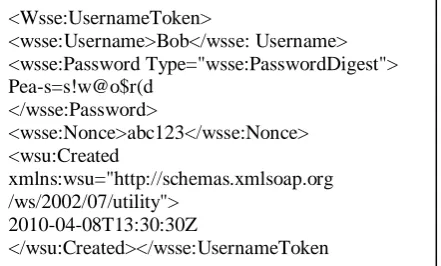
WS-Security uses a variety of signature formats, encryption algorithms and authentication tokens. To imbed security into a SOAP message, a security header is added to it as shown in Figure -1 The <wsse:UsernameToken> tag contains all information needed to send a secure message with a username, password and timestamp. The username tag, <wsse:Username> requires a plain text username; ―Bob‖ and the <wsse:Password
Figure-1: WS-Security Header with Username Token
Type="wsse:PasswordDigest>" tag is the password digest. Because a password digest is required, a nonce is used inside the <wsse:Nonce> tags. A timestamp is inserted between the <wsu:Created> tags to give the SOAP message additional protection.
WS-Security only specifies platform-independent security mechanisms. In order to allow a consumer to understand how to format a security header, and to explicitly state all other security requirements and capabilities, a security policy needs to be defined.
C. WS-Policy
WS-Policy is a framework for defining XML based policies and has been standardized in 2007. Policies consist of policy assertions that represent domain-specific capabilities, constraints or requirements, specified by for example, WS-Security and WS-Security Policy. Policy assertions are grouped together to form a policy expression. Each policy has a subject such as a web service port, operation or message to which the policy can be bound.
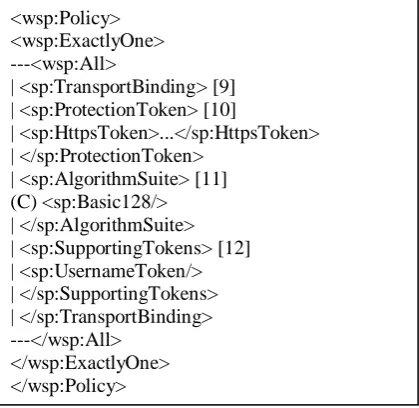
Figure 2 is an example of a policy defined in WS-Policy. The policy uses three operators to control assertions namely:
<wsp:Policy>,<wsp:All>,and<wsp:ExactlyOne>
. Namespaces wsu, sp and wsp represent the WS Services Utility, WS-Security and WS-SecurityPolicy
namespaces respectively. <wsp:Policy> is a container for nested policy assertions. Each <wsp:Policy> has a unique ID value by use of the wsu:id attribute. The <wsp:All> operator requires that all child assertions contained within it are satisfied.
<Wsse:UsernameToken>
<wsse:Username>Bob</wsse: Username> <wsse:Password Type="wsse:PasswordDigest"> Pea-s=s!w@o$r(d
</wsse:Password>
<wsse:Nonce>abc123</wsse:Nonce> <wsu:Created
xmlns:wsu="http://schemas.xmlsoap.org /ws/2002/07/utility">
2010-04-08T13:30:30Z
Figure-2: Web Supply Security Policy
As Figure 2 contains one <wsp:All> tag, all the child assertions have to be satisfied. The policy has two nested assertions. The first assertion, surrounded by a <wsp:ExactlyOne> tag, has two nested assertions relating to the use security tokens. The second assertion is compulsory and requires the use of time stamps. The policy thus states with the <wsp:ExactlyOne> operator that either a Username Token or a X509Token must be used. A timestamp is always needed. The definition of policy alternatives is discussed next.
Policy Alternatives
WS-Policy allows the use of policy alternatives. Policy alternatives are the building blocks of combined security policies. By being able to specify alternatives in a policy, security policies become less static in nature as web services consumers are given a choice between security requirements of web services providers. With more, equally secure, sets of security requirements and capabilities, a web services provider will thus be able to interact with more diverse web services consumers.
Before policy alternatives can be compared with each other, the policy has to be in normal form to clarify the content of all alternatives. Normal form of policies is a standardized format where only one <wsp:ExactlyOne> operator is used. <wsp:All> tags are used to represent policy alternatives, which are nested in the
<wsp:ExactlyOne> tag. Figure 2 is converted into normal form, and shown in Figure 3. Each <wsp:All> tag contains a set of nested assertions There are two alternatives, the one requires the use of a Username Token and timestamp, and the other requires the use of a X.509 Certificate Token and timestamp.
Figure-3: Part of Web Supply’s Security Policy in Normal Form.
<wsp:Policy> <wsp:ExactlyOne> <wsp:All>
<sp:X509Token>...</sp:X509Token> <sp:IncludeTimestamp/>
</wsp:All> <wsp:All>
<sp:UsernameToken>...</sp:UsernameToken> <sp:IncludeTimestamp/>
</wsp:All>
</wsp:ExactlyOne> </wsp:Policy>
<wsp:Policy wsu:Id="WebSupplyPolicy"> <wsp:All>
<wsp:ExactlyOne>
<sp:UsernameToken>...</sp:UsernameToken> <sp:X509Token>...</sp:X509Token>
</wsp:ExactlyOne> <sp:IncludeTimestamp/> </wsp:All>
WS-Policy provides the structure and rules of policy processing. If developers were to be given a free hand when designing security policies, much confusion will arise. To ensure that standard, usable security policies are defined, WS Security Policy is used.
D. WS-Security Policy
The WS-Security Policy defines a set of policy assertions that are used to define individual security requirements or constraints of a web service. It reuses the operator set defined in WS-Policy to create security policies that contain policy alternatives with nested security assertions. The range and structure of security aspects over which compatibility between the service consumer and provider must be reached is defined by these security specifications. ISO 7498-2 defines 5 main categories of security services namely authentication, access control, confidentiality, integrity and non-repudiation. The main focus of WS Security Policy is on authentication, confidentiality and integrity. Mechanisms for non-repudiation are not explicit, but can be applied with integrity and binding mechanisms. Access control is either left to the web services provider to implement, or can be defined with SAML or Kerberos Tokens. WS Security Policy incorporates WS-Security to define policies that can use weaker security mechanisms such as the transport security provided by HTTP, or much stronger security mechanisms such as a custom combination of XML signature and encryption. Administrators need to carefully evaluate chosen mechanisms and their combinations in order to determine the strength of security that is supported by a security policy. There are five main policy assertion types:
Token assertions specify security tokens such as X509 certificates that provide public/private keys when a SOAP message is signed and encrypted.
Security binding assertions define the way in which SOAP message exchanges are secured, such as the use of HTTPS transport protection when the Transport binding assertion is selected.
Protection assertions specify which message parts are protected and how they are protected for selective signing and encryption of SOAP message parts.
Supporting token assertions specify security tokens used to provide additional claims about a message sender such as security tokens used in authentication. Protocol assertions are used to specify predefined security requirements for SOAP
message security and trust related options that SOAP message senders and receivers must both support. For example, the Wss10 assertion requires that the sender and receiver are able to process external URI references. The Token assertions and Security binding assertion are now further examined as they provide the foundation for a security policy. The Token Assertion is used to specify the types of tokens used for SOAP message protection such as Username Tokens, X509 Tokens, SAML Tokens and HTTPS Tokens. The second part of algorithm gives supported authentication tokens. If stronger authentication tokens are used, better identification and trust in the other party is possible.