Comparison of Hydrogen and Gaseous Fuel
with other Conventional Fuels on the basis of
Safety and Toxicity
Sumit sharma
Department of Mechanical Engineering
Kautilya Institute of Technology and Engineering, Jaipur, Rajasthan, India
Palak Jindal
Department of Mechanical Engineering
Kautilya Institute of Technology and Engineering, Jaipur, Rajasthan, India
Kapil Kumar Khandelwal
Department of Mechanical EngineeringVivekananda Institute of Technology, Jaipur, Rajasthan, India
Abstract- Nowadays Non-Conventional motor fuels are receiving increased attention and use. This paper shows the study of the safety of three alternative gaseous fuels plus gasoline and the advantages and disadvantages of each. The gaseous fuels are hydrogen, methane (natural gas), and propane. Qualitatively, the overall risks of the four fuels should be close. Gasoline is the most toxic. For small leaks, hydrogen has the highest ignition probability and the gaseous fuels have the highest risk of a burning jet or cloud.
Keywords – Non-conventional fuels, combustion, safety, toxicity
I. INTRODUCTION
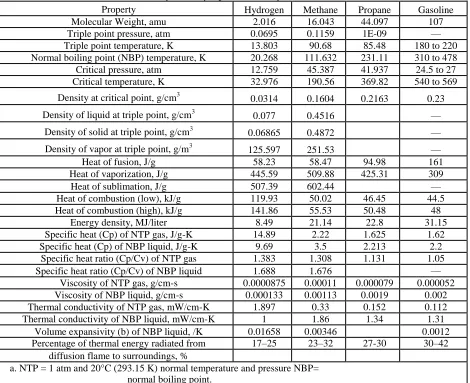
With the increase in use of the non-conventional motor vehicle fuels in place of gasoline, the issue of safety of these fuels should also be notified. Each potential replacement for gasoline holds some safety advantages and disadvantages. This paper gives a comparison of several of the leading gaseous fuels, herein called gases, and gasoline. The gaseous fuels of interest are hydrogen, propane (liquefied petroleum gas [LPG]), and methane (natural gas). Hydrogen may be cryogenic liquid (LH2) or compressed (CH2). Natural gas may be compressed (CNG) or liquid (LNG). There have been several published research work performing general comparisons, and these will be drawn upon in this work. This discussion focuses on the physical and chemical hazards associated with fuel handling for the four subject fuels. Table I gives some general data on the fuels under consideration.
II. PHYSICAL HAZARDS
There are several physical hazards inherent with each type of motor fuel. The physical hazards with fuels are addressed here as follows:
A. Acoustic Energy
B Electrical Energy
Electrical energy as discussed here dwells on electrostatic charge. Three scenarios should be considered: when vehicles travel, when they are refueled, and when persons refueling have an electrostatic charge. When motor vehicles travel they can acquire an electrostatic charge. This charge dissipates quickly (seconds or less) through the resistance of tires and concrete surfaces. When fuel is dispensed into an automobile, if the refueling nozzle is in metal-to-metal contact with the fill opening (that is, electrically bonded to the car) then no special provisions are needed for the electrostatic charge generated by flowing hydrocarbon fuel. The third issue is electrostatic charge on persons performing refueling. The safety issue is that electrostatic discharges in the fractional milli Joule (mJ) energy range are adequate to ignite gasoline vapor and fuel gases. In his case history of process plant disasters, Kletz discusses an event where a man drove to a gasoline station to refuel. The attendant handed the man the car’s gas cap to hold while the attendant fueled the car. While holding the gas cap, the man removed his pullover sweater. The man was wearing non-conducting footwear (i.e., rubber-soled shoes), so the electrostatic charge generated by removing the sweater did not dissipate to the ground. The spark provided sufficient energy to ignite the gasoline vapors in the air near the port and a fire started at the refueling nozzle. The fire was quickly extinguished. Note that this fire could not have propagated into the fill nozzle because the gasoline vapor mixture is much too rich in the fill port. Electrostatic charge buildup is an important factor in motor fuel safety for both gasoline vapors and gaseous fuels. Proper grounding and bonding is necessary to prevent fuel combustion during handling operations.
Table I. Properties of Hydrogen, Methane, Propane, and Gasoline
Property Hydrogen Methane Propane Gasoline
Molecular Weight, amu 2.016 16.043 44.097 107
Triple point pressure, atm 0.0695 0.1159 1E-09 —
Triple point temperature, K 13.803 90.68 85.48 180 to 220
Normal boiling point (NBP) temperature, K 20.268 111.632 231.11 310 to 478
Critical pressure, atm 12.759 45.387 41.937 24.5 to 27
Critical temperature, K 32.976 190.56 369.82 540 to 569
Density at critical point, g/cm3 0.0314 0.1604 0.2163 0.23
Density of liquid at triple point, g/cm3 0.077 0.4516 —
Density of solid at triple point, g/cm3 0.06865 0.4872 —
Density of vapor at triple point, g/m3 125.597 251.53 —
Heat of fusion, J/g 58.23 58.47 94.98 161
Heat of vaporization, J/g 445.59 509.88 425.31 309
Heat of sublimation, J/g 507.39 602.44 —
Heat of combustion (low), kJ/g 119.93 50.02 46.45 44.5
Heat of combustion (high), kJ/g 141.86 55.53 50.48 48
Energy density, MJ/liter 8.49 21.14 22.8 31.15
Specific heat (Cp) of NTP gas, J/g-K 14.89 2.22 1.625 1.62
Specific heat (Cp) of NBP liquid, J/g-K 9.69 3.5 2.213 2.2
Specific heat ratio (Cp/Cv) of NTP gas 1.383 1.308 1.131 1.05
Specific heat ratio (Cp/Cv) of NBP liquid 1.688 1.676 —
Viscosity of NTP gas, g/cm-s 0.0000875 0.00011 0.000079 0.000052
Viscosity of NBP liquid, g/cm-s 0.000133 0.00113 0.0019 0.002
Thermal conductivity of NTP gas, mW/cm-K 1.897 0.33 0.152 0.112
Thermal conductivity of NBP liquid, mW/cm-K 1 1.86 1.34 1.31
Volume expansivity (b) of NBP liquid, /K 0.01658 0.00346 0.0012
Percentage of thermal energy radiated from 17–25 23–32 27-30 30–42
diffusion flame to surroundings, %
a. NTP = 1 atm and 20°C (293.15 K) normal temperature and pressure NBP= normal boiling point.
Thermal energy refers to the thermodynamic state of the fuels under scrutiny. Hydrogen may be used at cryogenic temperature (20 K) or at ambient temperature, depending on the means used to store fuel on the vehicle. Methane may also be used at cryogenic temperature (111 K) or at ambient temperature, and propane is usually pressure liquefied gas at several atmospheres pressure and ambient temperature (300 K). Gasoline is typically used at ambient temperature as well. The inherent thermal energy of cryogenic liquids or cold gases poses hazards to people. Contact or immersion on bare skin can freeze body parts.A typical person’s skin temperature is 35°C (95°F). Cooling skin by exposing it to liquid, cold gas, or cold metal parts that reduce the skin’s temperature to below -3°C (27°F) causes the formation of ice crystals in the body’s skin cells.Even escaping propane gas jets can be very cold and have cooled skin sufficiently to produce burns.
D. Pressure Energy
Pressure energy discussed here refers to the storage pressure of the fuel onboard the vehicle or at the refueling station. Hydrogen might be stored at low pressure as a cryogenic liquid (i.e., ~ 0.3 MPa) or at very high pressure as a compressed gas (up to ~ 60 MPa). Methane is expected to have similar properties, ~ 0.2 MPa as a cryogenic liquid or up to ~ 40 MPa as a compressed gas. Propane at 300 K liquefies at ~ 4 MPa, so the operating pressure would be slightly above that threshold. Gasoline is stored a very low pressure of ~0.1 MPa. For this form of energy, gasoline is the most benign of the fuels considered.
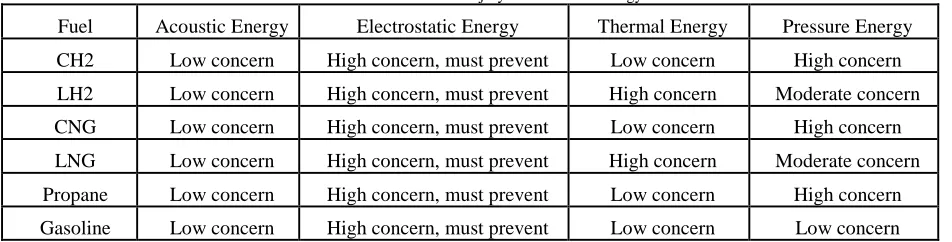
Thus, there are engineered safety features of positive connection fittings on the gas lines and quick shutoff valves to limit gas flow. A further consideration is the stored pressure energy in the station and vehicle tanks. If any part of the pressure boundary fails, such as a fitting or instrument, it could be propelled outward at high velocity because of the high pressures. Using formulas from Baum for an arbitrarily selected 50-gram piece propelled from the hydrogen, methane, or propane pressurized gas systems gives values of well over 79 J for hydrogen and methane, and -10 J for propane.10 A fragment is generally considered to produce a critical injury or lethal hazard if its kinetic energy is 79 J or greater, although fragments with 40 to 60 J can also cause serious wounds.11 With a person standing between the pump unit and vehicle tank, the likelihood of being struck by a failed part expelled under pressure is reasonably high. Therefore, pressure part failures are important for high-pressure gas storage of gaseous motor fuels. The stored energy in pressurized gas systems must be respected; even 13 MPa gas cylinders weighing 62 kg have sufficient thrust to launch themselves upward at velocities of tens of m/s when the gas valve has been sheared from the cylinder body. Table II gives a comparison of the results from these potential hazards. In general, engineering controls have been designed and installed on traditional and alternate fuel vehicle refueling stations, particularly natural gas refueling stations, to manage the hazards.
Table II. Potential for Fuel-related Injury from Several Energy Sources
Fuel Acoustic Energy Electrostatic Energy Thermal Energy Pressure Energy
CH2 Low concern High concern, must prevent Low concern High concern
LH2 Low concern High concern, must prevent High concern Moderate concern
CNG Low concern High concern, must prevent Low concern High concern
LNG Low concern High concern, must prevent High concern Moderate concern
Propane Low concern High concern, must prevent Low concern High concern
Gasoline Low concern High concern, must prevent Low concern Low concern
III. CHEMICAL HAZARDS
There are two areas of chemical safety concern when considering refueling with motor vehicle fuels. The first is the chemical toxicity of the fuel, and the second is combustibility. Both of these issues are important to workers in all arts of the chemical processes industry as well as consumers.
A. Toxicity
IARC points out that gasoline is a complex mixture of hydrocarbons, including 2–3% benzene, and benzene is positively carcinogenic to humans. There have been a number of research studies of station personnel and customer exposures to gasoline during refueling station operations. As shown in the studies, public exposure to gasoline during refueling is typically small for two reasons: the exposure time is generally brief in any given month (gasoline flows at 10 ppm at refueling stations so typical automobiles only require a few minutes per refueling session and people do not always stand near the self-service refueling nozzle), and some states require vapor recovery systems to capture vapors emanating from the vehicle tank fill port.
B Combustion
Combustion can occur in many forms. Table IV gives some combustion properties of the four fuels under consideration. For combustible gases, there is either a premixed flame or a diffusion flame. A pre-mixed flame burns with the gas disbursed into the air and can burn in a flash fire/fireball, deflagration, or detonation. In a diffusion flame, air is drawn to the base of a stationary flame and diffuses into the combustion flame front. A flame jet is a diffusion flame. A deflagration of gas dispersed in air is a rapid combustion event, where the combustion wave front moves at subsonic (~ m/s, but still rapid) speed through the gas-air mixture. Deflagrations are explosions because there is overpressure, heat release, and generation of debris missiles.
Hydrogen flames are typically non-luminous to the naked eye unless some carbon-based fuel is also combusting with the hydrogen (e.g., paint, rubber hose, or electrical insulation). To avoid walking into a hydrogen flame, a fire protection good practice at suspected fire locations is to hold out a broom and toss dirt ahead of the broom to probe the area. When the broom bristles and any combustibles in the dirt reach the edge of the hydrogen fire they will incandesce, immediately depicting the edge of the fire Of course, isolating any break locations is prudent from a safety as well as economic perspective. There have been a few hydrogen powered vehicles, but the operating experience data are insufficient to draw any conclusions about hydrogen vehicle reliability or safety.
Table IV. Combustion Properties of Hydrogen, Methane, Propane, and Gasoline
Property Hydrogen Methane Propane Gasoline
Quenching gap in NTP air, mm 0.64 2.03 1.78 2.0
Limits of flammability in air, volume % 4–75 5–15 2.1–9.5 1.4–7.6
Limits of detonation in air, volume % 18.3–59 6.3–13.5 3.4–7 1.5–3.3
ignition, mJ
Autoignition temperature, K 858 813 740 501–744
Flame temperature in air, K 2,318 2,148 2,243 2,470
Some initial estimates of hydrogen and other fuel ignition probabilities given a spill from road tankers (generally carrying up to 8,000-gal inventories) are given in Table VThese values tend to be large because they are only estimates. Operating experiences will provide data to refine these estimates.
Table V. Conditional Probabilities of Gas or Vapor Ignition Given a Spill
Fuel Small Spill Large Spill
Immediate ignition upon spill initiation
Gasoline 0.15 0.5
Hydrogen 0.5 0.9
Methane 0.25 0.9
Propane 0.25 0.75
Delayed ignition after spill initiation
Gasoline 0.04 0.05
Hydrogen 0.45 0.09
Methane 0.50 0.09
Propane 0.68 0.23
IV. CONCLUSIONS
discussed because gasoline is stored as a low-pressure, ambient-temperature liquid and uses a low flow rate that is easily dispensed. All four fuels have a concern for electrostatic charge production and safe dissipation of electrostatic energy. Regarding toxicity of fuels, gasoline is the highest toxicity fuel of the four because the benzene constituent of gasoline is a known carcinogen and bulk gasoline is labeled as a possible carcinogen. Gasoline intrusion into the environment is a continual source of concern. The three gaseous fuels considered here are essentially nontoxic except that they displace air and could lead to asphyxia, which is not credible in open air refueling situations. The gaseous fuels pose much less hazard to the environment than gasoline. All four fuels discussed here would pose a potential asphyxiation hazard if they leaked into an unventilated passenger compartment of an automobile or into an enclosed space, such as a garage.
REFERENCES
[1] G. MELESE and R. KATZ, Thermal and Flow Design of Helium-Cooled Reactors, American Nuclear Society, La Grange Park, Illinois (1984).
[2] AMERICAN PETROLEUM INSTITUTE, Protection Against Ignitions Arising Out of Static, Lightning, and Stray Currents, sixth edition, API RP 2003, Section 4.6.9, American Petroleum Institute, Washington, DC, September (1998).
[3] T. A. KLETZ, What Went Wrong? Case Histories of Process Plant Disasters, Chapter 15, Gulf Publishing Company, Houston, Texas (1988).
[4] M. A. GREEN, “Hydrogen Safety Issues Compared to Safety Issues with Methane and Propane,” Advances in Cryogenic Engineering: Transactions of the Cryogenic Engineering Conference (CEC), Anchorage, Alaska, 22–26 September, 51, 319, American Institute of Physics (2006).
[5] F. J. EDESKUTY and W. F. STEWART, Safety in the Handling of Cryogenic Fluids, Chapter 2, Plenum Publishing Corporation, New York, New York (1996).
[6] T. C.WRIGHT, J. B. KIM, L. J. CURRIE, A. R. KAY, and T. S. BURGE, “Leakage of Liquefied Petroleum Gas during Motor Vehicle Refueling – A New Cause of Cold Injury,” Burns, 32, 1, 132 (2006).
[7] P. M. MURUGKAR, N. W. JONES, K. SHOKROLLAHI, T. S. POTOKAR, P. J. DREW, and W. A. DICKSON, “Hand Burns Sustained Whilst Refueling Car with LPG,” Burns, 32, 4, 515 (2006).
[8] R. L. BRAUER, Safety and Health for Engineers, second edition, p. 367, Wiley-Interscience Publishers, New York, New York (2005). [9] SOCIETY OF AUTOMOTIVE ENGINEERS, Liquefied Natural Gas Vehicle Metering and Dispensing Systems, Standard J2645, Society
of Automotive Engineers, Warrendale, Pennsylvania (2003).
[10] 49. U.S. DEPARTMENT OF TRANSPORTATION, Transportation of Natural and Other Gas by Pipeline: Minimum Federal Safety Standards, Odorization of Gas, U.S. Department of Transportation, Washington, DC 49 CFR 192.625 (2007).
[11] S. CHAMBERLAIN and M. MODARRES, “Compressed Natural Gas Bus Safety: A Quantitative Risk Assessment,” Risk Anal., 25, 2, 377 (2005).
[12] K. PARK, M. S. MANNAN, Y.-D. JO, J.-Y. KIM, N. KEREN, and Y. WANG, “Incident Analysis of Bucheon LPG Filling Station Pool Fire and BLEVE,” J. Hazard. Mater., 137, 1, 62 (2006).
[13] NFPA, Fires in or at Service Stations and Motor Vehicle Repair and Paint Shops, Special Data Information Package, National Fire Protection Association, Quincy, Massachusetts (2002).
[14] DOE, Preparation Guide for U.S. Department of Energy Nonreactor Nuclear Facility Documented Safety Analyses, DOE-STD-3009-94, Change Notice No. 3, U.S. Department of Energy, Washington, DC, March (2006).