Kowsalya et al. World Journal of Engineering Research and Technology
COMPARATIVE ANALYSIS OF DATA MINING CLASSIFICATION
ALGORITHM FOR STUDENTS SOFT SKILLS
1
A. Komathi, MCA., M.Phil., Ph.D., 2*R. Kowsalya
1
Head and Assistant Professor, Department of Computer Science and Information
Technology, Nadar Saraswathi College of Arts and Science, Theni.
2
Research Scholar, Department of Computer Science and Information Technology, Nadar
Saraswathi College of Arts and Science, Theni.
Article Received on 18/02/2017 Article Revised on 11/03/2017 Article Accepted on 31/03/2017
ABSTRACT
Data mining refers to the finding of relevant and useful information
from databases. Data mining is also called Knowledge Discovery in
Database (KDD), pattern Analysis, Data Archiology, and Business
Intelligences. Data mining techniques are mostly used in educational
environments. Educational data mining is an emerging field exploring
data in education context by applying different data mining tools and
techniques. The ability to predict the students writing skills is very
important in educational environments. In this paper focused on comparison of four
classification algorithms such as J48, Random Tree, LAD Tree, and ADTree. These
algorithms are compared based on Correctly Classified Instances, Incorrectly Classified
Instances, Recall, F-Measures, and Precision.
KEYWORDS: Data Mining, Decision Tree, Classification, J48, Random Tree, LAD tree, ADTree.
1. INTRODUCTION
Data mining is the non-trivial process of identifying valid, novel, potentially useful and
ultimately understandable patterns in the collected data set. EDM exploits statistical, machine
learning and data mining algorithm over different types of educational data. Writing has at all
World Journal of Engineering Research and Technology
WJERT
www.wjert.org
SJIF Impact Factor: 4.326*Corresponding Author R. Kowsalya
2
Research Scholar,
Department of Computer
Science and Information
Technology, Nadar
Saraswathi College of Arts
times and in all ages been a greater source of knowledge. Today, the ability of writing is
highly valued and very important for social and economic advancement. Writing is typically
an individual activity, although on occasion a person will write out benefit for other writers or
readers. There are seven different attributes are used to find the students writing skills such as
college type, qualification, Residence, motivation, language and improvements of writing and
hobbies.
The student writing skills data are classified and compared with J48, Random Tree, LAD
Tree, and ADTree. Comparison is mainly based on common attributes like Correctly
Classified Instances, Incorrectly Classified Instances, Recall, F-Measures and Precision.
2. METHODOLOGY 2.1 Data Collection
The sample data are collected from theni district college students. We have collected 200
sample data from students.Collected data are entered on excel sheet and initial preprocessing
is done manually by filling the missing values by standard data and various inconsistence has
been removed.
2.2 Preprocessing
Data Preprocessing begins with a collected dataset. Data preprocessing means filling in
Missing Values, Smoothing Noisy Data, Identifying or Removing Outliers and Resolve
Inconsistencies.
2.3 Classification
Classification is a form of data analysis that extracts models describing important data
classes. Many classification methods have been proposed by researchers in machine learning,
patterns recognition, and statistics. Classification is a two-step procedure, consisting of a
learning step and a classification step. Classification consists of many kinds of algorithms
such as, Byes, Functions, lazy, Meta, Rules and Trees.
3. CLASSIFICATION METHODS 3.1. Decision Tree
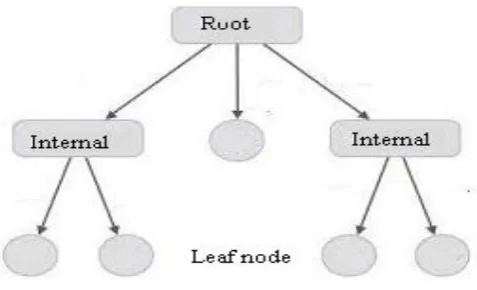
Decision tree is a flow chart-like tree structure, where each internal node (main node) denotes
(terminal node) holds a class label. A decision tree is a classification scheme which generates
a tree and set of rules, representing the model of different classes, from a given data set.
Main advantages of decision tree:
Decision tree has the ability to generate understandable rules. They are able to handle both numerical and categorical attributes.
They provide a clear indication of which field is most important for prediction or
classification.
Figure 3.1.1: Basic structure of Decision Tree.
Decision tree techniques contain many algorithms such as BFTree, Decision Stump, FT, and
j48graft, LAD Tree, LMT, NBTree, REPTree, CART, ID3, C4.5, Simple Cart, Random
Forest, Random Tree, AD Tree and User Classifier.This paper is fully based on j48 and
Random Tree, LAD Tree, and ADTree Algorithms.
3.2 Precision
It is the determination of exactness. It is the ratio of the predicted positive cases that were
correct to the total number of predicted positive cases.
Per=|{relevant document}∩{retrieval document}|
| {retrival document}|
3.3 Recall
Recall is the determination of completeness. It is the proportion of positive cases that were
correctly recognized to the total number of positive cases. It is also known as sensitivity or
true positive rate (TPR).
3.4 F-Measure
A measure that combines precision and recall is the harmonic mean of precision and recall.
3.5 J48
Decision tree J48 is the implementation of algorithm ID3 developed by weka project
team.J48 is an open source java implementation program.J48 is extension of ID3 algorithm.
The additional functions of J48 are accounting for missing values, decision tree pruning,
continuous attribute value ranges, derivation of rules, etc.
3.6 Random tree
A random tree is a collection of tree predictors that is called forest. It can deal with both
classification and regression problems.
The classification works as follows: the random trees Classifier takes the input feature vector,
classifies it with every tree in the forest, and outputs the class label that received the majority
of votes. In case of a regression, the classifier response is the average of the responses over
all the trees in the forest. The entire tree is trained with the same parameters but on different
training sets.
3.7 ADTree
An (ADTree) Alternating Decision Tree is a machine learning method for classification. It
generalizes decision trees. An alternating decision tree consists of decision nodes and
prediction nodes. Decision nodes specify a predicate condition and prediction nodes contain a
single number.ADTrees always have prediction nodes as both root and leaves. An instance is
classified by an ADTree by following all paths for which all decision nodes are true and
summing any prediction nodes that are traversed.
3.8 LAD Tree
An (LAD) Logical Analysis of Data tree builds a classifier for binary target variable based on
learning a logical expression that can distinguish between positive and negative samples in a
data set. The basic assumption of LAD model is that a binary point covered by some positive
patterns, but not covered by any negative pattern is positive, and similarly, a binary point
covered by some negative patterns, but not covered by positive pattern is negative. The
patterns and the selection of a subset of them that satisfies the above assumption such that
each pattern in the model satisfies certain requriments in items of prevalence and
homogeneity.
4. EXPERIMENTAL RESULT
Writing skills attributes are age, year, college type, qualification, Residence, motivation,
language and improvements of writing hobbies. Attribute selection method used to select
some attributes.
Thus the sample figures are used for students writing skills attributes. Such attributes are
Qualification, Location Wise and Residence Wise.
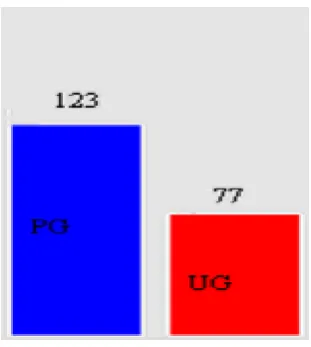
Fig 4.1: (a) Qualification Wise classification.
In the qualification chart compare two attributes such as UG and PG. Finally PG students are
improving good writing skills than UG students.
In the Location chart compare two attributes such as VILLAGE and TOWN. Finally TOWN
area students are improving better writing skills than VILLEGE area students.
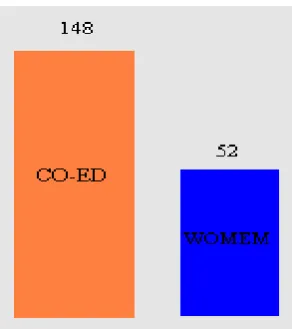
Fig 4.3: (c) College Type Wise classification.
In the College Type chart compare two attributes such as ED and WOMEN. Finally
CO-ED college students are improving writing skills than WOMEN college students.
5. RESULT AND DISCUSSION
Compare the classification algorithms (J48, Random Tree, LAD Tree, and ADTree) based on
Correctly Classified Instances (CCI), Incorrectly Classified Instances (ICCI),
Precision,F-Measure and Recall.
Thus the result, When evaluate the four algorithm J48, Random Tree, LAD Tree, and
ADTree. J48 provides a superior result in correctly classified instances, Precision, Recall and
F-Measure than other algorithms.
Tab 5.1: Location Wise Comparisons in J48, RT, ADTree, and LAD Tree.
Thus the result, When evaluate the four algorithm J48, Random Tree, LAD Tree, and
ADTree. J48 provides a greater result in correctly classified instances, Precision, Recall and
F-Measure than other algorithms.
Thus the result, When evaluate the four algorithm J48, Random Tree, LAD Tree, and
ADTree. J48 provides a grander result in correctly classified instances, Precision, Recall and
F-Measure than other algorithms.
6. CONCLUSION
From the consequence, the highest Precision, Recall and F-Measure values obtained for the
J48. It can be seen J48 achieve increased classification performance and yield results that are
exact. These sceneries also cover the missing values problem in the datasets and thus besides
accuracy. It also overcomes the overfiting problem generated due to missing values in the
datasets. For the classification troubles, if one has to a classifier among the tree based
classifier set, we suggest to use J48 with confidence for variety of classification problem.
7. REFFERENCES
1. Jiawei Han, micheline kamber and jian pei,”Data Mining: Concepts and Techniques”,
Third Edition, Elsevier, Microsoft Reasearch, 2012.
2. Leo Breiman,”Random Forset”, Machine Learning, 45(1): 5-32, 200.
3. H. Written and E. Frank, Data Mining: Pratical machine learning tools and
techniques, Morgan Kaufmann, 2005.
4. Arun K Pujari, Data Mining Techniques Universities Press (India) Private Limited.
5. Margaret H.Dunham, S. Sridhar-Data /mining /introductory and advanced
topics-pearson Education.
6. “A survey on predicting student performance” a.dinesh kumar, (ijcsit) international
journal of computer science and information technologies, 2014; 5(5): 6147-6149.
7. "Importance of data mining in higher education system" bhise r.b,thorat s.s,supekar
a.k.,iosr journal of humanities and social science(iosr-jhss), jan-feb 2013; 2(2).
8. “Mining students’ academic performance” azwa abdul aziz, nur hafieza ismail,
fadhilah ahmad, journal of theoretical and applied information technology, 31july